Sweat Patch Drug Test: How It Detects THC and What the Studies Found
A sweat patch is a week-long collector, not a snapshot. Here is what controlled studies found about THC in sweat, including in people who had stopped, where contamination arguments stand, what appeals courts have said, and what it means if you use CBD.
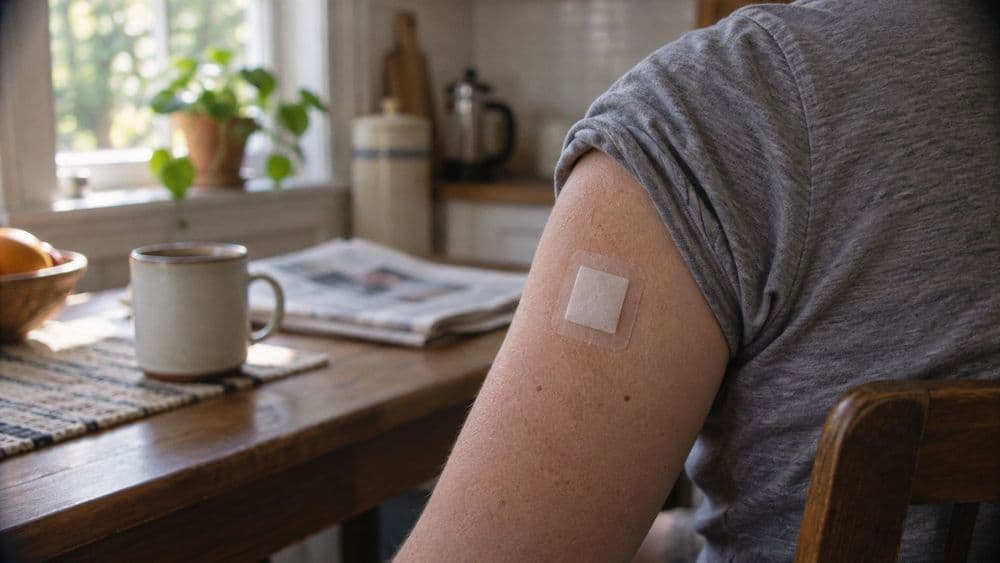
A sweat patch drug test is a week-long collector, not a snapshot. A pad on your upper arm, back or chest soaks up sweat for about seven days, then a lab looks for THC itself, not the metabolite a urine test targets. The result reflects the whole wear period plus some use from shortly before the patch went on. In a NIDA study, every patch worn by daily cannabis users in their first week off cannabis read above the proposed cutoff.
If you have been told to wear one for probation, pretrial release, a treatment program or a family-court plan, or you are looking at a positive patch result, you probably want three things: what the device actually measures, whether it can be wrong, and what it means if you use CBD. Almost every page that ranks for this question is written by a company that sells or runs the patch. This one reports what the controlled studies, the federal appeals courts and the federal record actually say, with the numbers and the limits. If you came here from our guide to what a 10-panel urine test screens for, think of this as the sweat chapter. Federal status and court decisions are as of November 2, 2026. This is not legal advice; your program's written rules and the court decide.
How a sweat patch drug test works
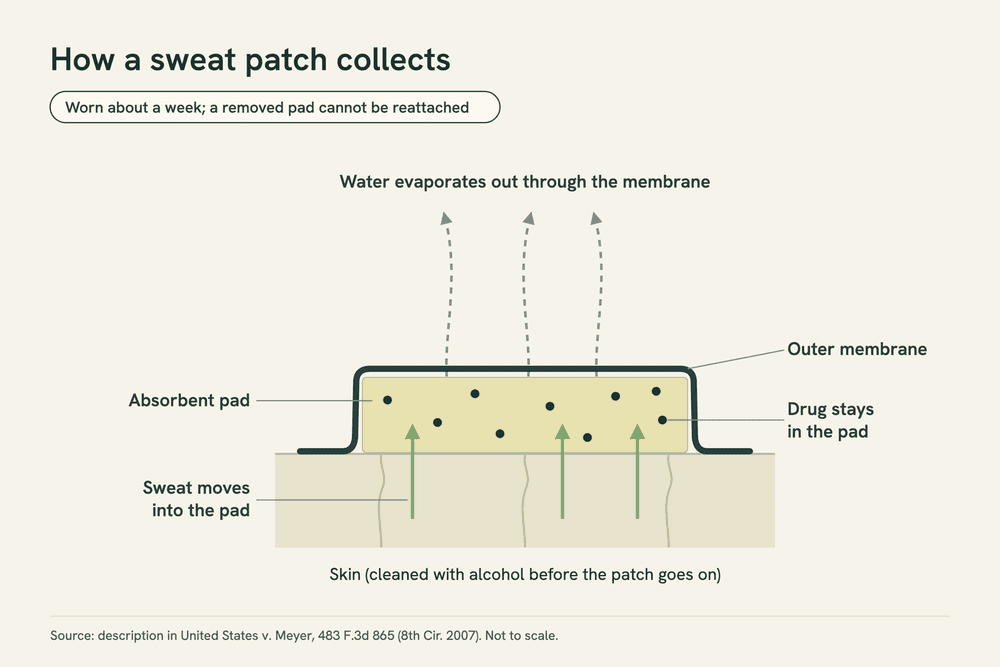
The best plain description of the device sits in a federal court opinion. In United States v. Meyer, a 2007 Eighth Circuit decision, the court, quoting two district courts, described the patch as "composed of an absorbent pad and an outer membrane." The skin is cleaned with alcohol, the patch is applied, and "the absorbent pad collects the wearer's sweat, over a period of a week or more." The water in that sweat "eventually evaporates through the non-occlusive membrane, and any drugs remain in the absorbent pad." Over the wear period, whatever drug reaches your sweat builds up in the pad.
That makes a patch a running total rather than a moment in time. When HHS proposed sweat for federal workplace testing in 2004, its proposal in the Federal Register said a patch "detects drug use that occurred shortly before the patch is applied and while the device remains applied to the skin," and called it "a cumulative measure." The same document noted a key chemical difference from urine: "Unlike urine, primarily the parent drug is found in sweat." For cannabis, that parent drug is THC.
- How long you wear it: the 2004 HHS proposal would have required at least 3 and no more than 7 days. The manufacturer recommends one week, as reported in a 2008 NIDA study.
- The current distributor markets 7 to 10 days, and up to 14 for some people. Your program, not the wearer, sets the actual schedule.
- Where it goes: the HHS proposal limited placement to the upper arm or back. In the NIDA research studies, patches were worn on the chest or abdomen.
- Why removal shows: as the Eighth Circuit quoted a district court in Meyer, "If the absorbent patch is removed from the skin, it cannot be reattached."
- HHS wrote in 2004 that attempts to remove or tamper with the patch "are usually visible to personnel trained to remove them."
- A patch that comes off is not the same as a result: in Meyer, one patch came dislodged and the district court declined to treat it as a drug test, even though it tested positive.
- At the lab: the 2004 proposal set an initial screen at 4 ng per patch and a confirmation for THC itself at 1 ng per patch. Those cutoffs were never adopted for federal programs, but the research measures against them.
The lab side is sensitive. The confirmation method developed at the National Institute on Drug Abuse, described in a 2004 *Clinical Chemistry* validation paper by Saito and colleagues, detected as little as 0.2 ng of THC in an entire patch and measured it reliably from 0.4 ng. A nanogram is a billionth of a gram. Twenty-one other compounds tested did not interfere with the THC measurement, and the authors reported that the method met the requirements of the proposed federal sweat guidelines. That was a method paper using patches spiked with THC in the lab, not a test of how accurately patches perform on people in the field.
What the studies found for THC in sweat
Sweat results are reported as nanograms of THC per patch (ng/patch), the total amount the pad collected, not a concentration. The most useful study for anyone who stopped using before a patch went on is a 2008 NIDA study by Huestis and colleagues in *Forensic Science International*. Eleven daily cannabis users lived under continuously monitored abstinence and wore week-long PharmChek patches on the chest or abdomen. Every patch from the first week was above the 1 ng/patch cutoff HHS had proposed, with a mean of 3.85 ng (standard error 0.86). In the second week, 8 of 11 had negative patches. One person kept producing THC-positive patches for four weeks of verified abstinence, and by week four, one of the five people still being tested was positive. The same study had a second arm on swallowed THC, summarized in the ledger below.
| Study | People | Use or dose | Limit or cutoff | Finding | Limit of the study |
|---|---|---|---|---|---|
| Huestis et al., 2008, abstinence arm | 11 daily cannabis users, supervised abstinence | Stopped smoking; patches worn 7 days at a time | 1 ng/patch (proposed); lab quantified from 0.4 ng | All week-1 patches above 1 ng; 8 of 11 negative in week 2; 1 positive through week 4 | Daily users only; 5 people left by week 4; 2000s study |
| Huestis et al., 2008, oral arm | 7 volunteers, double-blind | Placebo, hemp oils at 0.39, 0.47 and 14.8 mg THC/day, or dronabinol 7.5 mg/day, 5 days each | Lab quantified from 0.4 ng | No patch had THC above 0.4 ng | 7 people; swallowed only; hemp oils of that era; CBD not measured |
| Gambelunghe et al., 2016 | 12 forensic and monitoring patients, all urine- and hair-positive | Not controlled | Lab quantified from 0.4 ng | THC in every patch (0.4 to 2.0 ng); CBN in 6; CBD in 3; THC metabolite in none | Small Italian sample; no use or dose data |
| Saito et al., 2004 | None (lab method) | Patches spiked with THC | Detects 0.2 ng; quantifies 0.4 ng | 21 other compounds did not interfere | Method validation, not field accuracy |
| Ameline et al., 2020 | 1 man, 59 | One 22 mg CBD capsule | Picogram method (different from the others) | CBD built up on the patch over 7 days, to 96 pg | One person, one dose; abstract reports no THC result |
Two things in that ledger matter more than any single number. First, the patch finds THC, not the metabolite. In a 2016 *Therapeutic Drug Monitoring* study by Gambelunghe and colleagues, 12 people were tested with urine, hair and a sweat patch at the same time. THC was in every patch, at 0.4 to 2.0 ng, but THC-COOH, the metabolite your body makes from THC and the one urine tests look for, "was never detected in patches." The Huestis team wrote that the metabolite's concentration in sweat is "lower than the detection limit of most common confirmation methods." Second, real-world amounts are tiny. Those 12 patches ranged from 0.4 ng, the lab's measuring floor, to 2.0 ng, a range that straddles the 1 ng confirmation cutoff HHS once proposed. That is why the cutoff a program uses matters so much.
Can a sweat patch be contaminated?
Yes, under some conditions, and the research on this is older and stronger than vendor pages admit, though none of it is about THC. In a 2001 Naval Research Laboratory study by Kidwell and Smith, cocaine, methamphetamine and heroin dissolved in a basic (alkaline) solution on the outside of a patch passed through its membrane in lab tests, showing up at the earliest collection time, about 30 seconds. The same team found that drug on the skin was not fully removed by six days of normal hygiene, and patches applied to that skin later came back positive. THC was not tested. A follow-up, a 2003 Navy study that tested urine daily for four weeks alongside patches and skin swabs in 10 cocaine-study participants, concluded that a positive patch "may represent current use, prior use, contamination, or a combination." In three people with no sign of cocaine use, false positives occurred at a 7% rate.
“Appropriate care should be taken in the interpretation of positive results from a sweat patch test until more research is conducted.”
There is a single case in the literature that shows the conflict people worry about. In a 2001 case report by Levisky and colleagues, a former cocaine and methamphetamine user under court-ordered testing for about six months had 13 patches applied: five were positive for cocaine or methamphetamine, while every urine sample was negative. The authors read that as false-positive patches. In Meyer, the government's expert gave the other reading: urine and patch cutoffs differ, and urine detects cocaine for "only about two days," so a week-long patch can catch use that a urine test misses. Whether that pattern means a false patch or a missed urine depends on whom you ask. HHS itself wrote in its 2004 proposal that "sweat patch contamination issues continue to be a concern."
Here is why the question is sharper for THC than for cocaine. In Meyer, the expert explained that labs "will not report a sweat patch as testing positive for cocaine unless a metabolite of cocaine is found, which indicates that the wearer's body has broken down cocaine." For THC, the research offers no equivalent check: the 2004 HHS confirmation target was THC itself, and in the studies above the metabolite was not found in patches. THC is also the molecule in cannabis smoke. Put together, that leaves an open question rather than an answer: in a PubMed search on November 2, 2026, we found no published study testing whether secondhand smoke or THC on the skin can turn a sweat patch positive. A 2016 systematic review of 21 passive-exposure studies by Berthet and colleagues found positive tests in every specimen type it covered only after "extremely high passive exposure," and advised people who must show abstinence to avoid "heavily smoky and unventilated environments." It did not include a sweat-patch study. For what is known in urine and other specimens, see our look at failing a test from secondhand smoke. For skin products, how THC topicals are absorbed is covered separately; we found no sweat-patch data on them.
What federal appeals courts have said
Meyer is the leading opinion, written by retired Supreme Court Justice Sandra Day O'Connor sitting by designation on the Eighth Circuit. Meyer returned eight consecutive patches positive for cocaine and a cocaine metabolite, while his urine samples from March to June 2006 were all negative, and he argued he picked up cocaine from repossessed cars he hauled for work. The court wrote: "Today, we join the other courts that have previously determined that sweat patch results are a generally reliable method of determining whether an offender has violated a condition of his or her probation." It also left a door open: "There may well be certain instances where offenders offer compelling reasons to believe that positive test results from sweat patches are erroneous. District courts should make such determinations on a case-by-case basis." The opinion notes the patch is authorized by the Administrative Office of the United States Courts. Meyer's revocation was affirmed, and the court noted it would have stood anyway on a separate, unrelated travel violation. The same opinion describes a contrary example: in Snyder, a 2002 New York district court case, the judge found a patch unreliable "in this specific instance" because the wearer lived in a house where cocaine was smoked and sweated heavily at work. As the Eighth Circuit quoted it, Snyder held that the patch "cannot be relied upon in situations where it is shown that the possibility of exterior contamination exists due to exposure to a basic solution containing drugs."
Later Eighth Circuit decisions applied that rule. In United States v. Hall (2019), weekly patches tested positive for methamphetamine in decreasing concentrations, and a toxicologist testified about telling new use apart from carryover. In United States v. Bonaparte (2023), six positive patches sat beside 11 negative urinalyses, and the district court observed that "there could be simply a different cutoff." Here is every appeals decision we read, with the drug and the outcome:
- United States v. Meyer, 8th Cir. 2007: cocaine; contamination from repossessed cars rejected; revocation affirmed.
- United States v. Andersen, 8th Cir. 2017 (unpublished): cocaine; contamination from a partner's sweat not "compelling enough"; revocation affirmed, 7 months.
- United States v. Hall, 8th Cir. 2019 (unpublished): methamphetamine; carryover versus new use argued; revocation affirmed, 1 year.
- United States v. Bonaparte, 8th Cir. 2023 (unpublished): cocaine; positive patches against negative urines; revocation affirmed.
- United States v. Carrion, 5th Cir. 2012 (unpublished, not precedent): cocaine; patch used after concern about diluted urine; revocation affirmed.
In the federal appeals decisions we read, courts treat the patch as generally reliable and leave room for a "compelling" contrary explanation, case by case. Every one involved cocaine or methamphetamine, and in every one the revocation stood. We found no appellate opinion on a THC-only patch. Family courts weigh evidence differently from criminal courts; how cannabis use plays out in child custody cases is covered in its own guide. None of this is legal advice.
Where you will meet a sweat patch, and where you won't
Researchers describe sweat patches as used in treatment, criminal justice and employment settings, and HHS wrote in 2004 that the patch "is best used for return to duty and follow-up testing." In the court opinions and vendor materials we read, that means probation and supervised release, treatment programs and child-welfare cases. Programs sometimes switch to a patch when urine results are in doubt: in United States v. Carrion, a probation officer moved to the patch "after becoming concerned that Carrion was intentionally diluting his urine." If a dilute urine result is what started that conversation, our guide to a negative-dilute result explains what it does and does not mean.
Federal workplace testing is a different story. HHS proposed allowing "head hair, oral fluid (saliva), sweat (patch), or urine" in 2004, then, in its 2008 final guidelines, set alternative specimens aside because "significant issues have been raised by Federal agencies during the review process which require further examination." As of November 2, 2026, the current HHS Mandatory Guidelines for urine and their oral-fluid counterpart cover urine and oral fluid, and both say "Only specimen types authorized by Mandatory Guidelines ... may be collected." Sweat does not appear in either document, or in the October 29, 2026 revisions HHS has proposed (see our explainer on the HHS drug-testing proposal). Private employers outside federal programs follow state law and their own policies, which this page does not cover. For the wider legal picture, start at our hub on whether CBD is legal.
What about the FDA? Sweat patches are cleared, not approved. FDA's 510(k) database lists clearance K936135, decided June 10, 1996, for a "Sudormed sweat patch specimen container for collection of marijuana in perspiration," and the Eighth Circuit wrote in Meyer that "the Food and Drug Administration cleared the PharmChem sweat patch technology back in 1990." Cleared means FDA found a device substantially equivalent to one already on the market. It is not an accuracy rating. FDA's October 2026 final order on drug-test 510(k)s does not mention sweat, and FDA says it does not decide which specimens federal programs use; our breakdown of the FDA drug-test order covers what that order did change.

If you use CBD
The research and the 2004 HHS proposal both target THC, not CBD. Still, CBD can reach sweat. In a 2020 *Journal of Analytical Toxicology* case study, a French forensic team gave one 59-year-old man a single 22 mg CBD capsule bought at a US grocery store, and CBD built up on his week-long sweat patch, reaching 96 picograms (0.096 ng). One person, one dose, and the paper's abstract says nothing about THC, so it tells you CBD can reach sweat, not how a CBD user's patch will read. In the Gambelunghe study, 3 of the 12 patients' patches also held CBD, alongside THC.
The real question for a CBD user is trace THC, and we found no sweat-patch study on it. The closest data point is the oral arm of the 2008 NIDA study: seven volunteers swallowed hemp oil or dronabinol delivering up to 14.8 mg of THC a day for five days, and none of their patches had measurable THC. That is one small study of one route, using hemp oils from the 2000s, and it does not predict any product today. How trace THC shows up in urine, and why full-spectrum and broad-spectrum products differ, is the subject of our full CBD drug test guide. For how long CBD itself lingers in the body, see how long CBD stays in your system.
Sweat vs urine, saliva, blood, breath and hair
Each specimen sees a different slice of time and looks for a different molecule. The table keeps the time column qualitative on purpose: windows depend heavily on how often someone uses, and each sibling guide gives its own numbers with sources.
| Specimen | What the lab looks for | Time it reflects | Federal workplace status |
|---|---|---|---|
| Urine | THC metabolite (THC-COOH) | Days, longer with frequent use | Authorized (HHS urine guidelines, 2023) |
| Saliva (oral fluid) | THC in the mouth | Hours, sometimes about a day | Authorized (HHS oral-fluid guidelines); no lab certified yet |
| Blood | THC and metabolites | Hours for occasional use, longer for daily use | Not a workplace specimen |
| Breath | THC | Roughly hours, in research devices | Research stage |
| Hair | THC or its metabolite in the hair shaft | Months | Proposed in 2020, not final |
| Sweat patch | THC itself (metabolite not found in the studies above) | The wear period, plus use shortly before it | Not authorized; proposed 2004, dropped 2008 |
For the detail behind each row: urine is covered in the 10-panel drug test explained, saliva in our mouth swab drug test guide, blood in how long THC stays in your blood, and breath in where weed breathalyzers stand. The practical difference with sweat is coverage. A urine or saliva test samples one moment; a patch collects continuously for its whole wear period, which is why a positive patch can reflect use on any day while it was on, or shortly before.
Vendor claims vs the evidence
Sellers' pages make a handful of claims again and again. The PharmChek page of SCRAM Systems, the distributor, advertises it as "FDA-Cleared and Court Tested" with "Tamper and Removal Evidence." Here is how those claims, and two others from the first page of search results, line up with the record.
| What the seller says | What the record shows |
|---|---|
| "FDA-Cleared and Court Tested" (SCRAM Systems) | True as far as it goes: FDA lists a 1996 sweat-patch clearance, and the Eighth Circuit calls patches generally reliable. But cleared is not an accuracy rating, and every appeals case we found involved cocaine or methamphetamine, not THC. |
| "Tamper and Removal Evidence" (SCRAM Systems) | Supported: HHS wrote in 2004 that tampering is usually visible to trained staff, and a court described a removed pad as one that cannot be reattached. |
| "Distinct advantages over urine, saliva, or hair testing" (pharmchek.com) | Continuous coverage is real. But HHS found the evidence insufficient for federal workplace use in 2008, and sweat is still not in the federal guidelines. |
| Contamination is one limitation among many (BlueHive glossary) | Bigger than a footnote: membrane penetration and skin carryover in lab work, a 7% false-positive rate in one small cocaine study, and HHS calling it a continuing concern. For THC, we found no contamination study at all. |
What is still unknown
Every sweat-patch study on this page is small, and most are more than a decade old. Even the newer work shows how much people differ: a 2021 *Phytotherapy Research* study of 13 volunteers sampled sweat patches alongside blood, saliva and urine after medical cannabis preparations and stressed high variability between individuals. These are the gaps that matter most if you are wearing a patch:
- How well a patch detects new cannabis use. The NIDA authors wrote plainly that "the sensitivity of sweat patches to detect new drug use following cannabis smoking is not known."
- Whether secondhand smoke, or THC on the skin from smoke, handling cannabis or a topical, can turn a patch positive. We found no sweat-patch study.
- Whether THC can pass through the patch membrane from outside, as cocaine, methamphetamine and heroin did in lab tests. We found no study that tested it.
- How occasional users compare with daily users. The abstinence data come from 11 daily users.
- How courts would treat a THC-only patch. We found no federal appeals opinion on one.
- What a typical CBD user's patch shows over a full week. The only CBD-specific data come from one person and one dose.
Sweat patch drug test FAQ
A patch captures THC for as long as it is worn, usually about a week, plus some use from shortly before it was applied. There is no single detection window. In a NIDA study of 11 daily users who stopped under supervision, all first-week patches were above the 1 ng/patch proposed cutoff, 8 of 11 were negative by week two, and one person stayed positive for four weeks.
For cocaine, methamphetamine and heroin, lab studies showed drug on the outside of the patch could pass through the membrane and that drug on the skin could survive days of washing, and one small cocaine study found a 7% false-positive rate. HHS called contamination a continuing concern in 2004. We found no study that tested it for THC. Courts treat patches as generally reliable but allow a compelling contrary explanation, case by case.
CBD can reach sweat: one man who took a single 22 mg CBD capsule had CBD build up on his patch, and 3 of 12 forensic patients in an Italian study had CBD on their patches. But the tests target THC. The open question for CBD users is trace THC in a product, and we found no sweat-patch study that measured it. No product can guarantee a drug-test result.
No. It is FDA cleared, which is different. FDA's database lists a 1996 clearance for a Sudormed sweat patch to collect marijuana in perspiration, and the Eighth Circuit wrote that FDA cleared PharmChem's patch technology in 1990. Clearance means FDA found the device substantially equivalent to one already on the market. It is not a rating of accuracy.
The two tests look for different molecules, use different cutoffs and cover different stretches of time: a patch collects all week, while a urine test samples one moment. Courts in Meyer and Bonaparte accepted that explanation and upheld the patch results. The authors of one 2001 case report read a similar pattern as false-positive patches. If this happens to you, raise it with your lawyer or program.
Not in federally regulated HHS workplace programs: as of November 2, 2026, those cover urine and oral fluid only, and sweat is not an authorized specimen. Private employers outside federal programs follow state law and their own written policies, which vary and are not covered here.
If your bigger worry is how CBD, trace THC and drug tests interact across specimen types, the next step is our guide to CBD and drug tests. For how a standard workplace urine panel is screened, confirmed and reviewed, read what a 10-panel test actually checks.
Writing about hemp, wellness and the small rituals that keep us balanced.