How Long Does THC Stay in Your Blood? What NIDA Measured
In people who rarely use cannabis, blood THC is usually gone within hours. In daily users kept off cannabis on a NIDA research unit, some still tested positive a month later. Here is what was measured, in whom, and why the number is not a high.
How long does THC stay in your blood? It depends on two things most online answers blur together: which molecule the lab is measuring, and how often you use cannabis. In people who rarely use it, THC in blood usually falls below what a lab can measure within hours. In heavy daily users kept off cannabis on a locked research unit at the National Institute on Drug Abuse (NIDA), some still had measurable THC a month later. No study can tell you your own number, but the measured ranges are clear enough to be useful.
This guide reports what controlled studies measured, in whom, and with what limits. It is written for adults 21 and older. It does not cover ways to speed up clearance or beat a test: none of the studies below tested any, and we do not publish them. It also does not tell you when you are safe to drive, because, as you will see, a blood number cannot answer that question.
What a THC blood test measures
A THC blood test is not one number. When a lab analyzes blood for cannabis, it can report up to three molecules, and each one leaves at a different speed. THC (delta-9-tetrahydrocannabinol) is the parent compound that causes the high. Your body converts some of it into 11-OH-THC, an active metabolite (our guide to 11-hydroxy-THC covers what it does), and then, as a NIDA review of human cannabinoid pharmacokinetics lays out, oxidizes that into THC-COOH, which is inactive. The question "how long does THC stay in your blood" has a different answer for each of the three, so the first thing to know about any result is which one was measured.
| Molecule | What it is | After one use (people who rarely use cannabis) | Daily users, stopped under supervision | Names on a lab report |
|---|---|---|---|---|
| THC | The parent molecule; causes the high | Peaks about 10 minutes after smoking or vaping; below the lab limit within 4 hours (17 adults). After a brownie: last positive between 0 and 22 hours (18 adults) | Half of 30 men had their last positive blood sample about 22 days in; 2 of 5 still positive at day 30. In a separate group of 25, 9 never had measurable THC all week | THC, delta-9-THC |
| 11-OH-THC | Active metabolite formed from THC | After smoking, about a tenth of the THC level in plasma; after swallowing, about the same level as THC (NIDA review) | Below 1 ng/mL within 24 hours in all 30 men; median last detection in plasma about 1 day, with one man to day 15 | 11-OH-THC, 11-hydroxy-THC |
| THC-COOH | Inactive metabolite; the usual target of urine tests | About 3 to 7 days in plasma after one joint (6 people, 1990s study); up to about 4 days after a brownie in one person | Present in all 25 people at day 7 in one group; still present in 4 of 5 men at day 30 in the other | THC-COOH, THCCOOH, carboxy-THC |
Two more details explain why the numbers you find online rarely agree. First, labs test either whole blood or plasma (the liquid part, with the cells spun out), and plasma reads higher. In a NIDA study of 10 daily users given THC by mouth, whole blood held about 63% of the plasma THC level, so a "plasma" result and a "blood" result are not on the same scale. Second, every method has a limit of quantification, the lowest amount it can measure reliably. The NIDA studies below could measure THC down to 0.25 ng/mL. A lab with a higher floor will report the same sample as negative sooner. One more unit note: µg/L and ng/mL are the same thing, so papers that use either are directly comparable.
If you rarely use cannabis: hours, not days
For someone who uses cannabis now and then, blood THC is a short story. In a Johns Hopkins trial of 17 adults who rarely used cannabis, blood THC peaked 10 minutes after smoking or vaping and fell below what the lab could measure within 4 hours, while some effects lasted longer than that. Our article on how long a weed high lasts puts that blood curve next to the effect clocks.
Older NIDA work shows the same shape, with a longer tail after a stronger joint. In the original single-joint study described in that NIDA review (6 people), smoked THC peaked in plasma around 9 minutes in, before the last puff, and was at or below 5 ng/mL within 2 hours. It then stayed above the lab's detection limit of 0.5 ng/mL for 3 to 12 hours after a weaker joint and 6 to 27 hours after a stronger one. The inactive THC-COOH lasted far longer, roughly 3 to 7 days.
Edibles reverse the usual intuition. In a Johns Hopkins study of 18 adults who had not used cannabis for months, THC from a lab-made brownie showed up in blood about an hour later, at lower levels than smoking produces, and was gone within 22 hours in everyone. Two people at the lowest strength never had detectable blood THC at all. The inactive metabolite lasted longer, up to about four days in one person. So when edibles seem to "stay in your system" longer, it is the metabolite doing that, not THC itself. (Why they also start slowly is covered in why edibles take so long to kick in.)
How often you use matters even for a single session. In a NIDA study that gave one joint to frequent and occasional smokers, blood THC above 5 ng/mL was gone in about an hour for the 11 occasional smokers, but lasted a median 3.5 hours, and in one case past 30 hours, for frequent smokers. Put together, the single-use evidence looks like this:
- Smoked or vaped, occasional user: THC peaks within about 10 minutes and typically drops below lab limits within hours.
- Eaten, occasional user: a slower, lower peak, with parent THC gone within 22 hours in the brownie study.
- Frequent user, one session: blood starts from a higher baseline and stays above any given cutoff longer.
- Any route: the inactive THC-COOH outlasts THC by days.
How long does THC stay in your blood if you use every day?
The most direct measurements of how long THC lingers in a daily user's blood come from people who lived on a secure research unit at NIDA, where staff could confirm nobody used cannabis and blood was drawn every day. Two groups of heavy users went through it. It is easy to read the papers as three separate studies, but two of them measured the same men, once in whole blood and once in plasma.
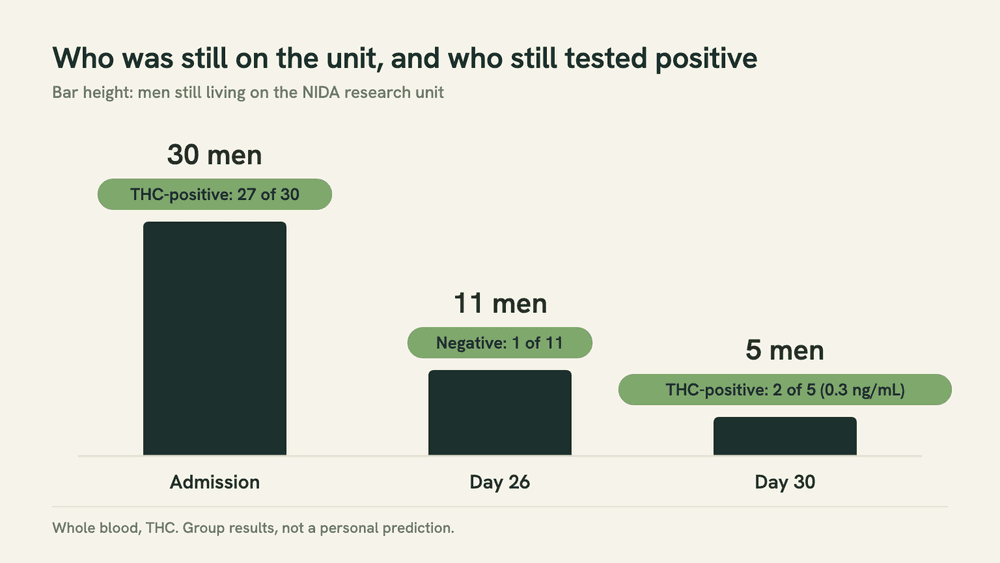
The first group was 30 men who smoked a median of 9 joints a day and had used cannabis for a median of 10 years. They stayed up to 33 days, and fewer remained as the weeks went on. The whole-blood results for those 30 men show that 27 of them had THC in their blood when they arrived, at a median of 1.4 ng/mL. Half had their last THC-positive sample about 22 days after they stopped. Of the 11 men still on the unit at day 26, only 1 was negative. Of the 5 still there at day 30, 2 still had THC in their blood, at 0.3 ng/mL, just above what the lab could measure. The active metabolite 11-OH-THC fell below 1 ng/mL within a day in everyone, while the inactive THC-COOH was still there in 4 of the 5 men at day 30.
Plasma results from the same 30 men (28 had plasma data) tell the same story on a higher scale. Two days in, 16 of the 28 still had at least 2 ng/mL of THC in their plasma, and one man stayed at or above 2 ng/mL for 18 consecutive days. A week in, THC was still measurable in 87.5% of them; at day 30, in 3 of the 5 still there. The study ended before half the men had cleared THC, so it could not compute a median detection time at all.
The second group is a reminder not to overread any of this. A separate NIDA study of 25 frequent long-term users, 12 men and 13 women, followed whole blood for 7 days. Even among these heavy users, 9 of 25 never had measurable THC in their blood during the week. Six were still positive on day 7, three of them at or above 1 ng/mL, and all 25 still had THC-COOH. The five people who tested positive on every single day were all women. The authors flagged that as a question for future studies, not a rule.
An independent look reaches the same place. A 2020 University of British Columbia systematic review found only six independent studies of this question, and five of them found some frequent users above 2 ng/mL after six days without cannabis. Its authors concluded that blood THC above 2 ng/mL, and possibly even above 5 ng/mL, does not necessarily mean recent use in a frequent user. If the idea of THC being "stored in fat" is what brought you here, our guide to taking a tolerance break answers that question in its FAQ.
Why the window varies from person to person
Within those groups, some people cleared THC in days and others took weeks. The studies point to a handful of variables, and they rule out one popular explanation.
- Years of use. In the plasma data, the longer someone had used cannabis, the higher their THC stayed through the first two weeks (correlations of 0.68 on admission, 0.60 at day 7 and 0.57 at day 14).
- How much you use. Men who reported smoking more tended to stay positive longer in whole blood, but the link was weak. In the plasma analysis, reported joints per day did not predict levels, but everyone in it smoked heavily.
- Route. Eaten THC reaches the blood later and at lower levels, while its metabolite lingers longer than the parent drug.
- Which molecule and which sample. A THC-COOH result generally stays positive longer than a THC result, and plasma reads higher than whole blood.
- The lab's cutoff. A method that measures down to 0.25 ng/mL will call someone positive for longer than one with a 1 or 2 ng/mL floor.
- Body mass index: not a predictor. BMI did not predict time to last positive in either NIDA group. Body fat itself was not measured, so the studies cannot settle the fat question directly.
- Sex: an open question. All five people positive on every day of the 7-day study were women. With five people, that is a hypothesis, not a finding.
“Body mass index did not correlate with time until the last THC-positive specimen.”
Variability is also why half-life figures online disagree. The often-quoted "4.1 days" is real, but the NIDA review traces it to a 1988 study that used labeled THC and a detection limit of 0.02 ng/mL, more than 10 times lower than the NIDA ward studies above. Studies with less sensitive methods had estimated 24 to 36 hours. Both figures are correct for their methods, and neither converts into a personal clearance date.
When blood is actually the specimen
Most people asking this question are worried about a test, so it helps to know that blood is the less common choice. According to the MedlinePlus overview of drug testing, drug tests are usually done on urine; blood is used less often, mainly in criminal or motor vehicle accident investigations and in emergency care when an overdose is suspected. Many state per se driving laws are written as a THC number in blood, and our guide to CBD, THC and driving laws covers how those laws work. The rules differ by state, as our overview of where hemp and CBD stand legally explains.
Workplace programs mostly use urine. Under the federal DOT testing rule, labs test DOT specimens for marijuana metabolites and may not test them for any other drugs beyond the federal panel. DOT added oral fluid as an option in 2023, but HHS's September 30, 2026 list of certified labs still showed no lab certified for oral-fluid testing, so DOT tests remain urine. One federal program does draw blood: after qualifying railroad accidents, FRA's post-accident testing rule requires both blood and urine. For the urine side, our 10-panel drug test guide covers panels and cutoffs, and our mouth swab drug test explainer covers saliva.
| Specimen | What it mostly detects | Where you are likely to meet it | Our full guide |
|---|---|---|---|
| Blood | Parent THC for recent use; metabolites for longer | DUI and per se investigations, FRA rail post-accident tests, emergency toxicology, research | This page; CBD and driving |
| Urine | THC-COOH, the inactive metabolite | Most workplace tests and all current DOT tests | 10-panel drug test |
| Oral fluid | Parent THC, partly from residue in the mouth | Some employers and roadside programs; DOT-authorized but no certified lab yet | Mouth swab drug test |
| Breath | Experimental | No validated legal or consumer standard | Weed breathalyzer |
Routine blood work is a different thing. A complete blood count measures red cells, white cells, platelets and hemoglobin. A comprehensive metabolic panel measures 14 substances, including glucose, sodium, potassium, calcium, proteins and liver and kidney markers. None of those is a cannabis test. THC is only measured if a drug test is ordered, such as a toxicology screen, which is often done in emergencies when poisoning or overdose is suspected, using blood or urine. If you want to know what a sample was tested for, ask the clinic what was ordered. Donating blood or plasma is a separate question, covered in whether you can donate plasma if you smoke weed.
A blood number is not a high meter, or a clock
It is tempting to treat a THC result as a reading of how high someone is. The research says otherwise. A 2022 meta-regression of 28 publications and 822 driving-related outcomes found that the link between blood THC and performance was only very weak, found no significant relationship at all in regular users, and concluded that blood and oral-fluid THC are relatively poor indicators of impairment. In a small simulator study of 14 infrequent users who vaporized cannabis, 57% still showed impairment at 3.5 hours despite a median blood THC of just 1.0 ng/mL. Breath tests that promise to solve this are still experimental; our weed breathalyzer explainer covers where they stand.
The NIDA daily users show the other side of the same problem. In the same men, plasma levels lined up with one driving-type task (tracking error) only at the start. After the first day or two, levels and performance went their separate ways. That does not mean they were unimpaired: as a group, they still did worse than non-users three weeks in. The authors concluded that detectable THC in a daily user's plasma is not a reliable sign of recent use.
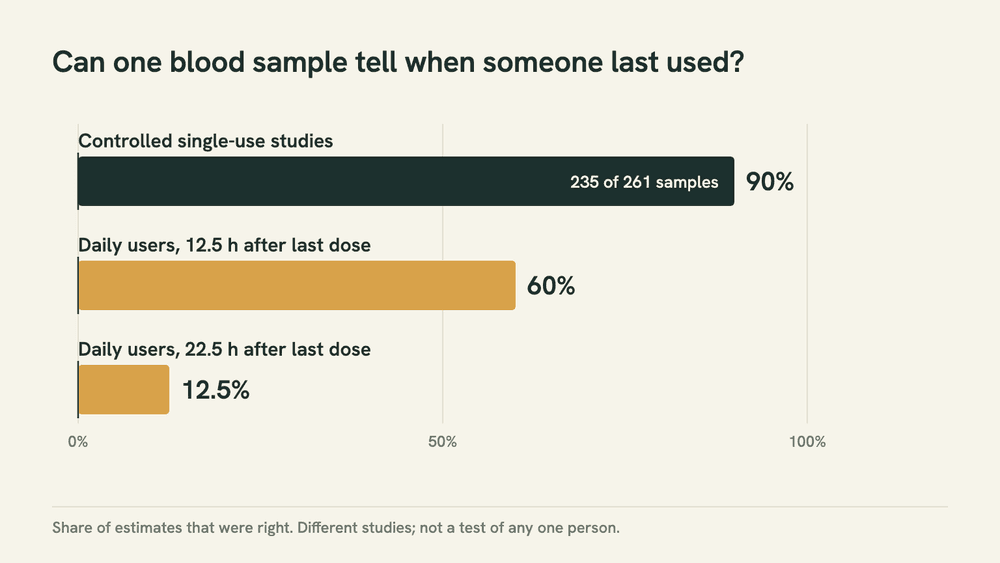
Nor is a blood result a reliable clock. Forensic formulas can estimate when someone last used from a single blood sample, and in controlled single-use studies they were right about 9 times in 10. In daily users, the NIDA study of 10 men mentioned above tested those formulas and found them right only 60% of the time 12.5 hours after the last dose, and 12.5% of the time at 22.5 hours.
If you use CBD or hemp products
CBD is a different molecule from THC, and a THC blood test does not look for it. But full-spectrum hemp products can contain trace THC, and CBD-rich flower is still cannabis. In a Swiss trial of vaporized CBD-rich cannabis with under 1% THC, blood THC fell below 1.5 ng/mL after 1.5 hours but was still detected in some participants up to 5 hours. That was inhaled flower, not an oil or tincture, so it says nothing about any particular product. No product can guarantee a drug-test result. Our guides on CBD and drug tests and how long CBD stays in your system cover the details.
What these studies cannot tell you
- Your own number. Every figure here is a group result or a range, and none predicts when one person will test negative.
- Much about the late days. The month-long results rest on very few people: 11 men at day 26, 5 at day 30 and 1 at day 33.
- Much about women or other populations. The 30-man group was all male (women were excluded for a brain-imaging part of the study), and both NIDA groups were mostly African American (26 of 30, and 84% of 25).
- Exact prior use. How much and how recently participants used before admission was self-reported.
- Today's cannabis. The original single-joint study used 1990s cannabis of 1.75% and 3.55% THC, and none of these studies tested high-potency concentrates.
- Exact levels in the 2009 group. Some of its samples were stored frozen for up to 5 years, which could only have lowered the measured levels.
- How to speed clearance. Nothing in these studies tested ways to speed it up, and we do not cover them.
Frequently asked questions
Not unless a drug test is ordered. A complete blood count measures blood cells and hemoglobin, and a comprehensive metabolic panel measures 14 substances such as glucose, electrolytes, proteins and liver and kidney markers. None of those is a cannabis test. If you are unsure what your sample was tested for, ask the clinic what was ordered.
Only if a toxicology screen or drug test is ordered. Those are often run on blood or urine in emergencies when poisoning or overdose is suspected, and what they include depends on what the clinician orders. Telling your care team what you have taken helps them treat you.
For someone who rarely uses cannabis, usually hours. In a 17-person Johns Hopkins trial, blood THC fell below the lab limit within 4 hours; in an older NIDA study of 6 people, it stayed detectable for 3 to 27 hours depending on strength. Frequent users stay above a given level longer even after one joint, and the inactive metabolite lasts days. None of this predicts your own result.
The parent THC does not. In a study of 18 infrequent users who ate cannabis brownies, blood THC was lower than after smoking and was gone within 22 hours in everyone. The inactive THC-COOH lasted longer, up to about 4 days in one person, so a test for the metabolite can stay positive after THC itself is gone.
They look for different things. Blood tests mainly target parent THC, which in occasional users is gone within hours but in heavy daily users can persist for weeks. Urine tests target THC-COOH, the longer-lasting inactive metabolite. Which one stays positive longer depends on the person and the lab's cutoff, not only the specimen.
Not reliably. A 2022 meta-regression of 28 publications found blood THC was a relatively poor indicator of impairment, with no significant relationship in regular users. Formulas that estimate time of last use were right about 9 times in 10 in single-use studies, but in daily users only 12.5% of the time 22.5 hours after the last dose.
US blood centers do not test donations for THC; being visibly under the influence is what gets you deferred. Our guide to donating plasma if you smoke weed covers the details.
If you are facing a workplace test, the specimen will most likely be urine rather than blood, and the target will be the long-lasting metabolite rather than THC itself. Our complete guide to the 10-panel drug test explains what it screens for and the cutoffs labs use.
Writing about hemp, wellness and the small rituals that keep us balanced.