Gabapentin and Weed: A Sedation Interaction, Not a Liver One
Gabapentin and weed don't compete in the liver; they stack in the brain. What the label and the FDA's 2019 breathing warning say, why gabapentin can feel like weed, what the withdrawal trials found, and what to ask your prescriber.

If you are searching "gabapentin and weed", you are probably already taking gabapentin, prescribed or not, and wondering whether cannabis on top is a problem. Here is the short version. Gabapentin and THC do not fight over your liver, so cannabis is not expected to push your gabapentin blood levels up. They meet in your brain instead, where sleepiness, dizziness and impairment can add up. The documented danger zone is gabapentin with opioids, alcohol or other sedatives, or with lung disease or older age. Below is what the label, the FDA and the human studies show, and where each one stops.
This page is about THC and cannabis (smoked, vaped or eaten) with gabapentin, the medicine sold as Neurontin and in generic form, with a short note on its close relative pregabalin (Lyrica). It is general information for adults, not medical advice, and it does not tell you whether or how to combine them. That decision belongs to the person who prescribes your gabapentin. If your question is about CBD rather than THC, the CBD-specific guide is linked in the next section.
Why gabapentin and weed don't compete in the liver
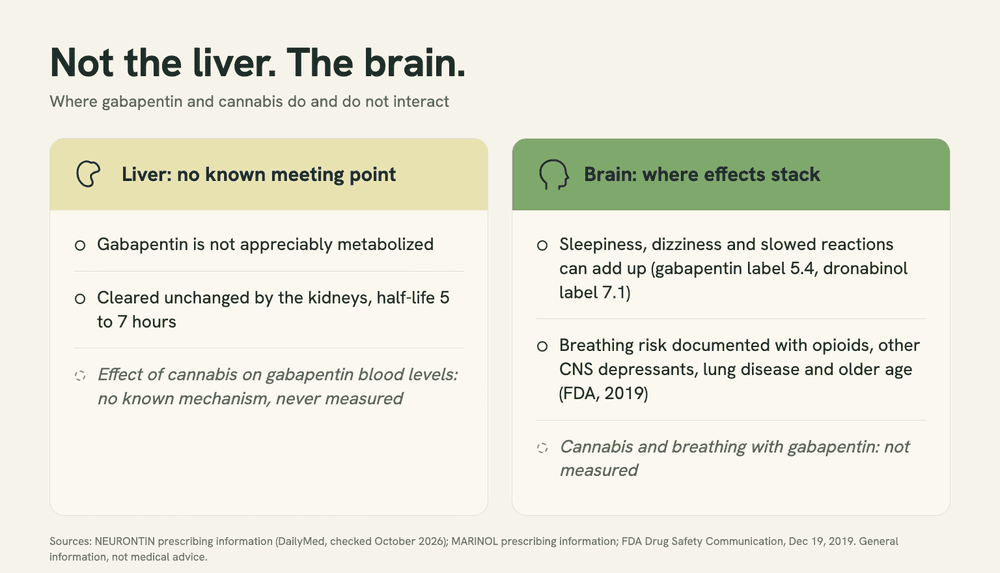
Most articles about cannabis and medicines talk about liver enzymes, the CYP450 family that breaks many drugs down. CBD and THC can slow some of those enzymes, which can raise the blood level of a medicine that depends on them. That story does not fit gabapentin. The current NEURONTIN prescribing information says gabapentin is "eliminated from the systemic circulation by renal excretion as unchanged drug" and is "not appreciably metabolized in humans." In plain terms, your kidneys clear it in the same form you swallowed it, with a half-life of 5 to 7 hours. With no liver step to block, there is no known mechanism for cannabis to push gabapentin levels up or down, and no study has measured it either.
Two cautions keep that from turning into reassurance. First, the label never mentions cannabis. In the version on DailyMed that we checked in October 2026, the words cannabis and marijuana appear zero times. That means the FDA reviewed no data on the pair, not that the pair is fine. Second, "no liver interaction" is not the same as "safe together." The interaction that matters happens after both drugs reach your brain, which is what the rest of this page is about. Our CBD and gabapentin guide does the full, section-by-section reading of the label for the CBD side of the question.
Where the real interaction is: sedation that adds up
Gabapentin and THC act on the brain in different ways, but they share effects: sleepiness, dizziness, slower thinking and unsteadiness. When two drugs produce the same effect, the effects can add up. Gabapentin's own label says so in its warning on central nervous system (CNS) depression, meaning a slowing of the brain and spinal cord:
“Patients should be carefully observed for signs of central nervous system (CNS) depression, such as somnolence and sedation, when NEURONTIN is used with other drugs with sedative properties because of potential synergy.”
To see how much sedation gabapentin brings on its own, look at its clinical trials. The numbers below compare gabapentin alone with placebo, before anything else is added. They are a baseline, not a measurement of the combination.
The cannabis side carries the same warning. The FDA label for dronabinol (Marinol), a prescription form of THC, says "additive CNS effects (e.g., dizziness, confusion, sedation, somnolence) may occur" when it is taken with other drugs that act on the central nervous system, such as CNS depressants. Dronabinol is a capsule, not street cannabis, and its label does not name gabapentin, but the principle is the one the gabapentin label states. Cannabis is not officially classed as a depressant (police drug-recognition programs give it a category of its own, as our explainer on whether weed is a depressant covers), yet sleepiness and slowed reactions are among its most common effects. Put two drugs with that effect together and you should expect more of it.
What the FDA's 2019 breathing warning says, and what it doesn't
On December 19, 2019, the FDA issued a Drug Safety Communication on gabapentin and pregabalin after reports of serious breathing problems. Its core sentence: "serious breathing difficulties may occur in patients using gabapentin ... or pregabalin ... who have respiratory risk factors." The agency named those risk factors directly:
- Opioid pain medicines, such as oxycodone, hydrocodone or morphine
- Other drugs that depress the central nervous system
- Conditions that reduce lung function, such as chronic obstructive pulmonary disease (COPD)
- Older age: "The elderly are also at higher risk"
Cannabis is not on that list. We checked: the page does not mention it once. The gabapentin label's own breathing section (5.8) says the same thing in its own words, warning of serious, life-threatening or fatal respiratory depression "when coadministered with CNS depressants, including opioids, or in the setting of underlying respiratory impairment."
So does cannabis add to the breathing risk? Honestly, nobody knows, because it has never been measured with gabapentin. The closest evidence is a 2023 crossover study in 18 healthy volunteers who inhaled high-THC cannabis (21.8% THC) after taking oxycodone or a placebo. Oxycodone cut their breathing response by about 30%. THC did not change breathing control on top of that, but a second inhalation "slightly increased sedation." That study used young, healthy adults, an opioid rather than gabapentin, and one breathing measure, so it is not reassurance for anyone on gabapentin. What it does show is the pattern this page keeps returning to: the added sedation is documented, while the breathing question is open. Treat it as open.
When the combination gets riskier
The situations below are where the label, the FDA and the overdose data concentrate their warnings. Cannabis is not the main actor in any of them, but if you are in one, it is one more sedating input on top.
Opioids. This is the pairing the label singles out: its breathing section tells prescribers to watch for slowed breathing and sedation when gabapentin is combined with another CNS depressant, "particularly an opioid", and its interactions section names morphine, hydrocodone, oxycodone and buprenorphine. The two are also often prescribed together: in a claims study of commercially insured US adults, 60.8% of people who filled gabapentin also filled an opioid, against 16.5% of those who did not. The overdose data follow the same line. A CDC-led analysis of overdose deaths in 23 states and Washington, DC, published in MMWR, covering 2019 and 2020, found gabapentin in about 1 in 10 deaths that had toxicology results, and an opioid was involved in 85% to 90% of those deaths (the range set by a 2024 correction to the report). Finding gabapentin in a death is not proof it caused it, and the report does not mention cannabis at all. Our CBD and oxycodone guide and the kratom and weed article cover the opioid side in more depth.
Alcohol and other sedatives. The gabapentin Medication Guide, the leaflet written for patients, says: "Do not drink alcohol or take other medicines that make you sleepy or dizzy while taking NEURONTIN without first talking with your healthcare provider." Cannabis is not named in that sentence, but it can make you sleepy and dizzy, which is exactly the category the sentence describes. The FDA's 2019 warning names benzodiazepines, the anti-anxiety class that includes alprazolam and diazepam, as one example of another CNS depressant. Sleep aids, sedating antihistamines and some muscle relaxants are other everyday medicines that make people sleepy. Weed plus alcohol has its own literature; our crossfaded guide covers what happens when you stack those two, before gabapentin is even part of the picture.
Edibles. Swallowed THC is slow and hard to judge. In a controlled dosing study of edible THC, effects took 30 to 60 minutes to be felt, peaked around 1.5 to 3 hours and were still fading at 8 hours. That delay makes it easy to take more before the first dose lands, and the peak can arrive long after you have decided how sedated you feel. Why edibles take so long to kick in explains the biology.
Your own body. Older age and reduced lung function are named risk factors in the FDA warning, whatever else you take. And because the kidneys are how gabapentin leaves your body, its label says the dose must be adjusted when kidney function is reduced. No study has looked at cannabis in that situation, so any kidney condition belongs on the list you give your prescriber.
Does gabapentin feel like weed?
Search forums and you will find people saying gabapentin feels a bit like being high. There is lab data behind that. In a 2016 University of Kentucky drug-discrimination study, eight regular cannabis users (four women and four men, aged 18 to 31) were first trained to tell a 30 mg oral THC capsule from placebo. They were then given gabapentin, THC and combinations of the two. Both single doses of gabapentin "substituted for" THC, meaning participants identified them as THC-like, and gabapentin produced "subjective and performance-impairing effects that overlapped with those of Δ9-THC." On its own, gabapentin raised ratings of feeling sedated and worsened scores on attention and learning tasks. Taken with THC, it "generally produced larger effects on cannabinoid-sensitive outcomes relative to Δ9-THC alone."
Keep the limits in view: eight people, single doses given without the gradual build-up used in real prescribing, and oral THC capsules rather than smoked cannabis. The researchers were exploring gabapentin as a possible withdrawal treatment, not testing the combination's safety. Still, the study matters here for two reasons. It explains why the question "does gabapentin feel like weed" exists at all. And it is the only controlled human study we found that gave gabapentin and THC together, and it points toward bigger combined effects, not smaller ones.
The overlap is in how it feels, not in how it works. The gabapentin label states that it "does not exhibit affinity for benzodiazepine, opioid (mu, delta or kappa), or cannabinoid 1 receptor sites", so it does not act on CB1, the receptor THC uses. (An FDA scientist who wrote an editorial on the Kentucky study called the result unexpected for exactly that reason.) The label also says gabapentin is not a federally controlled substance, but that misuse and abuse have been reported since approval, and that most of the people involved "had a history of polysubstance abuse." Its abuse potential "has not been evaluated in human studies." Its relative pregabalin is treated differently on paper: the LYRICA label describes it as "a Schedule V controlled substance."
Gabapentin for weed withdrawal: what the trials actually found
Some clinics and sellers say gabapentin can help with cannabis withdrawal. The evidence behind that line is thinner than it sounds. It starts with a 2012 pilot trial at the Scripps Research Institute: 50 treatment-seeking adults with cannabis dependence were randomly assigned to gabapentin (1,200 mg a day in the trial design) or placebo for 12 weeks, with weekly counseling for everyone. The gabapentin group used less cannabis, measured both by urine tests and by self-report, and scored lower on a cannabis withdrawal checklist. But only 36% of participants finished the 12 weeks, people stayed in the study for an average of 6.4 weeks, and 9 of the 50 were lost right after being randomized. The authors wrote that their results, from a "relatively small number of subjects", "require replication in an adequately powered trial."
That larger trial was done, and none of the top search results we reviewed mention it. The same team ran a 150-person version registered as NCT00974376, with 75 people on gabapentin and 75 on placebo, all with counseling, for 12 weeks. It finished on May 19, 2016, and its results were posted to ClinicalTrials.gov on June 6, 2017. On the main outcome, the share of urine screens that came back negative for cannabis, the gabapentin group averaged 11.22% and the placebo group 8.00%. No statistical test was posted, so the record cannot tell you whether that gap is meaningful, and a PubMed search we ran on October 8, 2026 found no peer-reviewed paper from the trial. It is neither a proven success nor a proven failure. It is an unfinished story.
| Study | Who and how many | What it found | The catch |
|---|---|---|---|
| Mason 2012 pilot (Scripps) | 50 adults with cannabis dependence, 12 weeks, gabapentin vs placebo | Less cannabis use and lower withdrawal scores on gabapentin | Only 36% finished; the authors called for a larger trial |
| NCT00974376 follow-up (same team) | 150 adults, 75 per group, 12 weeks, completed 2016 | Negative urine screens: 11.22% on gabapentin vs 8.00% on placebo | No statistical test posted; no journal paper found as of October 2026 |
| Prisciandaro 2022 pilot | 22 adults with bipolar disorder plus cannabis use disorder, 1 week per condition | Changes in brain chemistry and cue responses on MRI | Brain-imaging endpoints in one specific group; clinical outcomes exploratory |
| Cochrane review, 2019 | 21 trials, 1,755 participants, all medicines tested | Evidence on gabapentin "insufficient" to estimate whether it works | Superseded by the 2025 update |
| Cochrane review, 2025 | 37 trials, 3,201 participants, all medicines tested | No approved medicine; every option tested still "experimental" | More side-effect dropouts in the anticonvulsant group (very low certainty) |
The independent reviews land in the same place. A 2019 Cochrane systematic review found "no pharmacotherapies approved for treatment of cannabis use disorders" and judged the evidence on gabapentin insufficient to estimate its effect. The 2025 update of that review, covering 37 trials and 3,201 participants, still found no approved medicine, said the medicines tested "should still be considered experimental", and found that people on the anticonvulsant and mood-stabilizer group of drugs were more likely to leave a trial because of side effects. That finding is very low-certainty, and the abstract does not break gabapentin out by name. The only other published trial of gabapentin in cannabis use disorder that our PubMed search (October 8, 2026) turned up is a 22-person brain-imaging pilot in people with both bipolar disorder and cannabis use disorder, and its findings cannot be stretched beyond that group.
The bottom line: gabapentin is not FDA-approved for cannabis withdrawal or cannabis use disorder, and the evidence is too thin to show that it works for either. If cutting back is your goal, that is a conversation with a prescriber who knows your full history, not a reason to start or adjust gabapentin on your own. For what withdrawal usually feels like and how long it lasts, see our tolerance break guide.

The mouse study behind the pain claims
If you have read that THC and gabapentin "work better together" for nerve pain, the study behind that line on the clinic pages we reviewed is a 2019 University of Sydney study in mice. Mice with a constricted, injured nerve were given injections of THC, gabapentin or both. The combination reduced pain-like sensitivity at lower doses than expected: the dose needed for half the maximum effect was about 1.7 times lower than a simple additive model predicted. The half that rarely gets quoted is that the same combination "produced all the side-effects observed for THC, including motor incoordination, catalepsy and sedation." Catalepsy is a frozen, rigid state. This was in mice, with single injections, and it is not evidence that combining the two treats pain in people. If you live with nerve pain, the options belong in a conversation with your prescriber.
What changes and what doesn't: the side-by-side
| Question | What the evidence says | Source |
|---|---|---|
| Does cannabis change gabapentin blood levels? | No known mechanism: gabapentin is cleared unchanged by the kidneys and not appreciably metabolized. Never measured with cannabis. | NEURONTIN label, sections 7.2 and 12.3 |
| Does sleepiness add up? | Expect it to. Both labels warn of additive sedation, and the pair generally produced larger effects than THC alone in an 8-person lab study. | NEURONTIN 5.4; MARINOL 7.1; Lile 2016 |
| Does breathing slow? | Documented risk with opioids, other CNS depressants, lung disease and older age. Cannabis's part in it has not been measured. | FDA 2019 safety communication; NEURONTIN 5.8 |
| Is driving affected? | Assume yes. Each drug can impair driving on its own; the pair has not been tested. | NEURONTIN 5.3; FDA driving guidance |
| What about edibles? | Delayed onset (30-60 minutes, peak 1.5-3 hours) makes the combined effect harder to judge. | Vandrey 2017 |
| Can I skip or stop gabapentin to use cannabis? | No. The label says not to stop it abruptly. Any change is your prescriber's call. | NEURONTIN 5.6 and 9.3 |
| What about pregabalin (Lyrica)? | Same logic: about 90% recovered unchanged in urine, negligible metabolism, covered by the same FDA warning, and Schedule V. | LYRICA label; FDA 2019 safety communication |
Driving, work and the next morning
Driving is where added impairment becomes a risk to other people. The gabapentin label says patients "should not drive until they have gained sufficient experience to assess whether NEURONTIN impairs their ability to drive", and it notes that how long driving impairment lasts after starting therapy is unknown. The FDA's consumer page on medicines and driving adds that "taking products containing cannabis or cannabis-derived compounds, including CBD, could make driving dangerous." Neither source has data on the two together, which means nobody can tell you when the combination is safe to drive on. Assume you are impaired, and do not drive, operate machinery or do safety-sensitive work after combining them. Edibles stretch the window further, since their effects were still fading 8 hours after a dose in the controlled study above. Our guide to cannabinoids and driving covers impairment testing and the law.
What to tell your prescriber or pharmacist
The FDA's instruction to patients in its 2019 warning is simple: "Always inform your health care professional about all the drugs you are taking, including prescription and over-the-counter medicines and other substances such as alcohol." Cannabis is one of those other substances, whether or not it is legal where you live. You are not asking permission so much as giving your prescriber the information they need to judge your total sedation load. Bring this checklist:
- 1That you use cannabis, how you use it (smoked, vaped or edible) and roughly how often.
- 2Every opioid you take or might be given, including short courses after surgery or dental work.
- 3Alcohol, benzodiazepines, sleep aids, sedating antihistamines and muscle relaxants.
- 4Any lung condition, such as COPD, and any kidney condition.
- 5Whether you drive or do safety-sensitive work.
- 6Whether you have noticed more sleepiness, dizziness or unsteadiness since starting gabapentin.
- 7If you want to cut back on cannabis, say so, and ask about options rather than adjusting any medicine yourself.
- 8Whether the people you live with know the emergency signs listed at the top of this page.

What is still unknown
A lot. As of October 2026, we found no study that measured gabapentin blood levels with cannabis, and none that measured breathing with the two together. The best human data on how the pair feels comes from eight people in one lab, given single doses. The largest gabapentin trial in cannabis users, 150 people, has posted numbers but no statistical test and no journal paper. No study has looked at the combination in the groups the FDA flags as higher risk, older adults and people with reduced lung function, or in people with kidney problems. Until any of that changes, the honest position is the one the labels already take: sedating drugs add up, and the decision belongs with someone who knows your full medication list.
Gabapentin and weed: questions people ask
No label or study says the combination is safe, and the label does not address cannabis at all. The gabapentin label warns about sedation when it is used with other sedating drugs, and the FDA asks patients to tell their health care professional about every substance they use. The real question for your prescriber is your total sedation load, especially if opioids, alcohol or benzodiazepines are also involved.
No study has measured it. Gabapentin is cleared unchanged by the kidneys and is not appreciably metabolized, so the liver-enzyme mechanism behind most cannabis drug interactions does not apply. That is not the same as being safe together: the interaction that matters is added sedation and impairment in the brain.
In a 2016 lab study, eight regular cannabis users trained to recognize oral THC identified gabapentin as THC-like, and the two together generally produced bigger effects than THC alone. Gabapentin does not act on the CB1 receptor that THC uses, so the overlap is in how it feels, not how it works. Its label notes that misuse has been reported, mostly in people using several substances.
It has not been shown to. A 50-person pilot in 2012 reported less use and lower withdrawal scores, but only 36% finished. A 150-person follow-up posted 11.22% vs 8.00% negative urine screens with no statistical test, and we found no journal paper from it. A 2025 Cochrane review calls every medicine tested for cannabis use disorder experimental. Gabapentin is not FDA-approved for this, so ask a prescriber.
Edibles raise the same sedation question, plus a timing problem. In a controlled study, edible THC took 30 to 60 minutes to be felt and peaked around 1.5 to 3 hours, which makes it easy to take more before the first dose lands. No source gives a safe gap between gabapentin and an edible, and we will not invent one. Talk to your prescriber first.
Pregabalin follows the same logic. Its label says about 90% of a dose is recovered unchanged in urine with negligible metabolism, so a liver interaction is not expected. But it is covered by the same 2019 FDA breathing warning, and it is a Schedule V controlled substance. The same prescriber conversation applies.
No. Do not skip, stop or change gabapentin without your prescriber. The label says it should not be stopped abruptly because of the possibility of more frequent seizures, and withdrawal symptoms such as anxiety, insomnia and confusion can start, usually within 48 hours. Tell your prescriber about your cannabis use instead.
Gabapentin is one of many medicines people take alongside cannabis products. For the wider picture, including which medicines do run through the liver enzymes cannabinoids affect, read our guide to CBD and medications. And if the situation in front of you is someone who simply took too much THC, our greening out guide explains what usually happens and when it becomes an emergency.
Writing about hemp, wellness and the small rituals that keep us balanced.