CBD and Gabapentin: Different Organs, One Shared Side Effect
Gabapentin leaves the body through the kidneys as unchanged drug. CBD is cleared by the liver. The enzyme story behind most CBD interactions has no place to happen here, which is not the same thing as safe. What both labels do share is a warning about sedation.

Almost every question about CBD and gabapentin turns out to be a liver question asked about a kidney drug. If you take gabapentin and you are wondering about adding a CBD product, that is the shape of what you are asking. Most CBD interaction stories run through liver enzymes: CBD slows one down, and another medicine backs up behind it. Gabapentin never enters that story. Its own FDA label says the drug is eliminated from the systemic circulation by renal excretion as unchanged drug, and that it is not appreciably metabolized in humans. Two medicines, two organs. What the two do share is written into both labels in almost the same words, and it is not metabolism: each one warns about sedation when it is combined with other things that slow the central nervous system. That is the real question on this page, and it is the one worth taking to whoever prescribed the gabapentin.
The pages you found before this one disagree with each other, and it is worth knowing why. Two of the top results are stores asking which is better for nerve pain. An automatically generated summary of this exact search claims that combining the two may mitigate seizure frequency and intensity. An interaction database returns a one-word verdict. Three of the page-one results are patent PDFs, which is what a search result looks like when nobody has written the page. So we did the boring thing instead: we opened both drugs' FDA prescribing information, located the sections that describe how each one is cleared and what each one warns about, and counted the published research on the pair with dated searches you can re-run in a browser. Everything below is sourced to one of those documents. If you want the general framework for CBD and prescriptions first, that lives in our guide to CBD and other medications, and if you are new to the compound itself, start with what cannabidiol actually is.
Why CBD and gabapentin do not meet in the liver
Almost every CBD interaction page you will read, including several of ours, is built on the same machinery: a family of liver enzymes called cytochrome P450 processes a long list of medicines, cannabidiol slows some of those enzymes down, and a drug that depends on one of them can build up. It is a real mechanism and it explains most of the caution around CBD and prescriptions. It also does not apply to this pair, and gabapentin's label is unusually blunt about why. Section 12.3 of gabapentin's prescribing information on DailyMed states that gabapentin is eliminated from the systemic circulation by renal excretion as unchanged drug, and that gabapentin is not appreciably metabolized in humans. The molecule goes in, does its work, and leaves through the kidneys in the same form it arrived.
The consequence shows up a few lines later in the same section, in twelve words that are effectively this whole article: because gabapentin is not metabolized, no study was performed in patients with hepatic impairment. Regulators did not skip the liver study by accident. There was nothing to study. And where a cytochrome enzyme does turn up in that label, in section 12.3's in vitro work, gabapentin is the drug being tested rather than the drug at risk: against a panel that included CYP1A2, 2C9, 2C19, 2D6, 2E1 and 3A4, the label reports 14% to 30% inhibition of CYP2A6 only at 171 micrograms per milliliter, roughly 15 times the peak concentration reached at 3600 mg a day, and no inhibition of any of the other isoforms. That is an experiment in human liver microsomes, not in people, and it runs in the opposite direction from the one consumer pages assume.
You can see the same fact from the other side by looking at what gabapentin's dosing is built around. Its label carries a dosage table indexed to creatinine clearance, which is a measure of kidney function, and we are deliberately not reproducing that table here because it is written for prescribers. What it tells you as a reader is which organ the drug's arithmetic runs on. The label reports a half-life of 5 to 7 hours in people with normal kidney function. In 60 subjects with creatinine clearance ranging from 13 to 114 mL/min, mean half-life ran from roughly 6.5 hours at the top of that range to about 52 hours below 30 mL/min, with apparent clearance falling from about 190 to about 20 mL/min. In 11 anuric subjects the apparent half-life was about 132 hours off dialysis and 3.8 hours during it. Kidney function moves this drug enormously. Liver function, on the label's own account, has nothing to move.
| The question | Gabapentin, per its label | Cannabidiol, per the FDA-approved label |
|---|---|---|
| How is it cleared? | Renal excretion as unchanged drug | Metabolized in the liver and the gut, primarily the liver, by CYP2C19 and CYP3A4 and by UGT1A7, UGT1A9 and UGT2B7 |
| Is it metabolized? | Not appreciably metabolized in humans | Yes, and the same label documents interactions in which it raises exposure to other medicines |
| Where does it leave? | The urine | The feces, with minor renal clearance |
| Half-life | 5 to 7 hours with normal kidney function | 56 to 61 hours after twice-daily dosing for 7 days in healthy subjects |
| Plasma protein binding | Less than 3% | Greater than 94% |
| Which organ does the label adjust for? | The kidney: dosing is indexed to creatinine clearance, and no hepatic-impairment study was performed | The liver: there are hepatic-impairment sections in both the dosing and the specific-populations chapters, and no renal-impairment section exists at all |
| Does the label name the other drug? | No. Cannabidiol, cannabis and marijuana appear nowhere in it | No. Gabapentin appears nowhere in it |
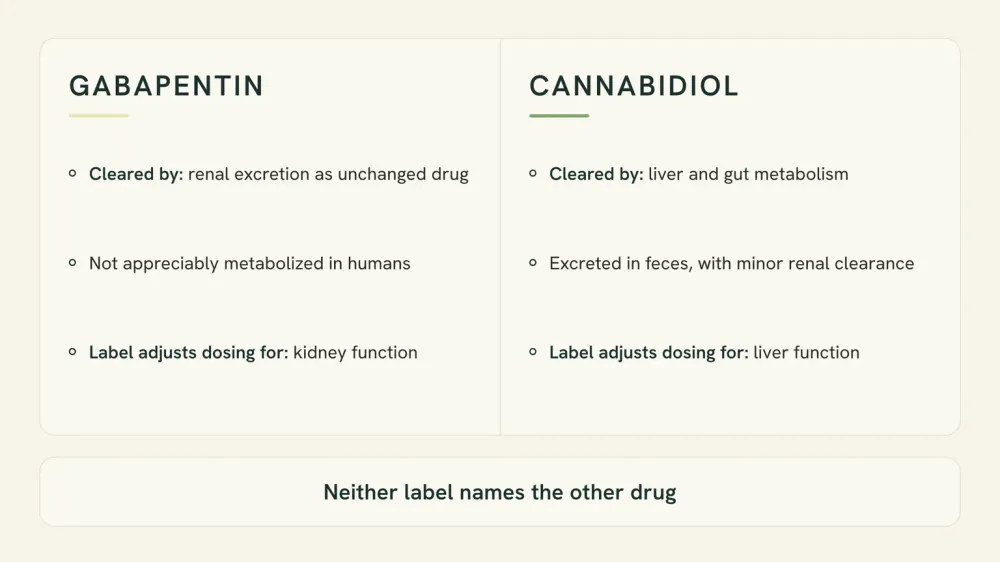
Look at that second-to-last row again, because it is the cleanest fact on this page. The two documents are mirror images. Gabapentin's label adjusts its dosing for kidney function and explicitly declines to study the liver. The approved cannabidiol label adjusts its dosing for liver function and contains no renal-impairment section whatsoever. Each medicine's regulatory paperwork worries about exactly one organ, and they are not the same organ. That is why the honest headline answer here is not the one the stores print by reflex. If your actual question is what CBD does to the liver, that belongs on the page on CBD and liver enzymes, which is a real question with real numbers behind it. It is just not the question gabapentin raises.
What each label says about the other: nothing
We read both documents looking for the other drug, and neither one is there. The words cannabidiol, cannabis and marijuana do not appear anywhere in gabapentin's prescribing information, which runs to hundreds of kilobytes of structured text. The word gabapentin does not appear anywhere in the label for the FDA-approved cannabidiol medicine. One sentence has to travel with that finding, and it cuts in both directions: a label is silent about a combination when nobody has submitted data on it, so silence is a fact about the paperwork rather than a fact about biology. It is not permission and it is not a warning. It is an absence, and the correct response to an absence is to name it rather than to fill it.
It is worth seeing what gabapentin's drug interactions chapter does contain, because it is short and it is instructive. Section 7 has four subsections: opioids, other antiepileptic drugs, an antacid, and a urine protein test. That is the whole list. The antiepileptic subsection says in plain words that gabapentin is not appreciably metabolized nor does it interfere with the metabolism of commonly coadministered antiepileptic drugs. The interactions the label does document are about absorption and about the nervous system, not about enzymes: an aluminium and magnesium antacid reduced gabapentin bioavailability by about 20%, naproxen increased gabapentin absorption by 12% to 15%, and in a study of 12 subjects, 60 mg of controlled-release morphine raised gabapentin exposure by 44%. Those are what a real, measured gabapentin interaction looks like, and none of them involves a liver enzyme. For the contrast, our page on CBD alongside sertraline covers a pair where the enzyme story genuinely does apply, and you can see how differently the evidence reads.
The one thing CBD and gabapentin actually share: sedation
Here is where the two documents finally converge, and they do it without ever mentioning each other. Section 5.4 of gabapentin's label is a warning about combining it with other sedating substances, written as a general category rather than a list of named drugs. It is the load-bearing sentence for this whole question, so read it in the label's own words rather than in ours.
“Patients should be carefully observed for signs of central nervous system (CNS) depression, such as somnolence and sedation, when NEURONTIN is used with other drugs with sedative properties because of potential synergy.”
Now the other document, speaking only for its own drug. Section 7.4 of the prescribing information for the FDA-approved cannabidiol oral solution says that concomitant use with other CNS depressants, including alcohol, may increase the risk of sedation and somnolence. That is the entire section. Notice the symmetry: gabapentin's label warns about the category cannabidiol belongs to, cannabidiol's label warns about the category gabapentin belongs to, and neither one names the other. Notice also the verbs. The gabapentin sentence says patients should be carefully observed and raises the possibility of synergy. The cannabidiol sentence says may increase the risk. Neither document quantifies anything, because neither of them is describing a study of this pair.
The federal regulator says the same thing in consumer language. The FDA's consumer update on cannabis-derived products states that use of CBD with alcohol or other drugs that slow brain activity, such as those used to treat anxiety, panic, stress or sleep disorders, increases the risk of sedation and drowsiness, which can lead to injuries. That is a statement about a category with no dose, no magnitude and no population attached, which is exactly how much the agency knows. We work through the same reasoning on the CBD and alcohol page, and the conclusion is the same one: a plausible additive mechanism tells you a direction, never a size.
| Trial programme | Reaction | On the drug | On placebo |
|---|---|---|---|
| Gabapentin, add-on epilepsy trials, patients over 12 (543 on drug, 378 on placebo) | Somnolence | 19% | 9% |
| Gabapentin, add-on epilepsy trials, patients over 12 (543 on drug, 378 on placebo) | Dizziness | 17% | 7% |
| Gabapentin, add-on epilepsy trials, patients over 12 (543 on drug, 378 on placebo) | Ataxia | 13% | 6% |
| Gabapentin, postherpetic neuralgia trials (336 on drug, 227 on placebo) | Dizziness | 28% | 8% |
| Gabapentin, postherpetic neuralgia trials (336 on drug, 227 on placebo) | Somnolence | 21% | 5% |
| Prescription cannabidiol oral solution, severe childhood epilepsy trials | Somnolence and sedation, including lethargy | 32% | 11% |
Two details in that table deserve a sentence each. Gabapentin's label notes that somnolence and ataxia appeared to have a positive dose-response relationship in its trials, meaning more drug, more of both. And the closest thing anyone has to a measurement of cannabidiol's sedation stacking with another central nervous system drug comes from clobazam, where the same composite ran at 46% in patients also taking clobazam against 16% in those who were not. That figure needs its caveat in the same breath: clobazam is a benzodiazepine, and the cannabidiol label separately documents a metabolic interaction with it, reporting that coadministration raised exposure to clobazam's active metabolite by approximately 3-fold in healthy subjects. So part of that 46% is a drug level going up, which is not what happens with gabapentin. It is an illustration of how additive sedation can look, not a number that transfers to this pair.
The practical consequence of all of this is driving, and again both labels get there on their own. Gabapentin's section 5.3 tells patients not to drive until they have gained sufficient experience to assess whether the drug impairs their ability to drive, notes that driving performance studies conducted with a prodrug of gabapentin indicate that gabapentin may cause significant driving impairment, and says outright that the duration of driving impairment after starting therapy is unknown. The cannabidiol label says nearly the same thing in section 5.2: advise patients not to drive or operate machinery until they have gained sufficient experience with it. Two documents, written years apart by different companies about different molecules, arriving at the same sentence. Adding a second sedating product resets that judgement instead of confirming it. For what drowsiness from CBD looks like on its own and what people do about it, see the full list of CBD's reported side effects.

What the research on CBD and gabapentin actually is: dogs, cats and mice
Before anyone tells you how big this interaction is, somebody has to have measured it, so we counted. On August 11, 2026 we searched PubMed, the National Library of Medicine's index of biomedical literature. The query cannabidiol AND gabapentin returned 49 records. Narrowing it to cannabidiol AND gabapentin AND (interaction OR pharmacokinetic), with wildcards on the last two terms, returned 14. Restricting the pair to randomized controlled trials returned 0. A title-and-abstract version using CBD and Neurontin as alternatives returned 51. Widening to records tagged as human research returned 33. Every one of those searches takes under a minute in a browser, and we would rather you re-ran them than took our word for it.
Then we opened all 14 of the interaction subset individually, because a count is not a finding. Here is what they are. One is a randomized trial in 48 dogs after knee surgery, in which every dog received gabapentin as part of standard pain control and the cannabinoid extract was the thing being tested. One is a study of 80 cats using infrared thermography, in which cannabidiol, gabapentin and a pheromone were each used as separate probes rather than combined. One is a case report about a single dog. One is a study of oral cannabidiol in dogs with osteoarthritis. One is a rat experiment pairing cannabidiol with tramadol, in which gabapentin appears only in the introduction as an approved comparator. One is the mouse study discussed below. Two are narrative reviews. Five are prescribing-guidance comparison tables in which both molecules appear in the same chart and neither was administered to anyone. One is a study guide on cannabis use disorder. Not one of the 14 gave a human being cannabidiol and gabapentin and measured either drug in blood.
The one record in that subset that measured drug concentrations at all, in any species, is a 2019 mouse study in Neuropharmacology by Socala and colleagues, and the species matters more than the result. Working in electrically induced seizure models, the authors report that cannabidiol increased the activity of topiramate, oxcarbazepine, pregabalin, tiagabine and gabapentin, with gabapentin tested in the 6 Hz model. On mechanism they are careful in a way that summaries of them are not: the increased activity could be, at least in part, related to pharmacokinetic interactions with cannabidiol, because there were changes in serum or brain concentrations or both, and their closing line states that further pharmacokinetic studies are required to evaluate the type of interactions. Mice, acute dosing, research-grade compounds, electrically induced seizures. That is the entire measured basis, in that whole literature, for the idea that cannabidiol moves gabapentin around.
This matters because of what happens to that mouse result on its way to a search results page. When a 2021 narrative review in Seizure surveyed cannabidiol alongside other antiseizure medicines, it listed a potential for pharmacokinetic interactions with a long list of drugs including gabapentin and pregabalin, and noted that an animal study found brain concentrations of antiseizure medicines may be altered while serum concentrations stay the same. Potential for is the review's own verb, its gabapentin entry rests on the animal work, and the whole review is about prescription cannabidiol inside epilepsy care. By the time that reaches an automatically generated summary of this search, it has become the claim that combining the two may mitigate seizure frequency and intensity. It has not been shown to do that in a person. There is no human evidence that adding a CBD product to gabapentin does anything to seizures, and if you are on gabapentin for seizure control, that is a sentence to take to a neurologist rather than a reason to experiment.
Where the real risk sits: opioids, older kidneys and a very common prescription
Gabapentin is not a niche drug, and the company it usually keeps is the reason this page ends where it does. A claims analysis of commercially insured US adults covering 2009 through 2016 found that the prevalence of gabapentin prescribing nearly doubled over those years, and that 2.7% of beneficiaries filled at least one gabapentin prescription in 2016. The striking number is the overlap: 60.8% of people prescribed gabapentin also filled an opioid prescription, against 16.5% of those not on gabapentin. They were also more likely to be women (62.5% against 52.3%) and more likely to be aged 55 to 64 (41.7% against 21.2%). Read the limits with the numbers: this is claims data ending in 2016, in commercially insured adults aged 18 to 64 only, so it excludes Medicare and understates older adults, and it describes associations rather than causes.
That opioid overlap is exactly the population a federal warning already covers. In December 2019 the agency issued a drug safety communication about gabapentin and pregabalin, warning that serious breathing difficulties may occur in patients using these medicines who have respiratory risk factors, and naming opioid pain medicines and other drugs that depress the central nervous system, conditions such as chronic obstructive pulmonary disease, and older age. CBD is not named anywhere on that page, and we are not going to put it there. What that communication does establish is that the category matters and that the agency's own advice is to always inform your health care professional about all the drugs you are taking, including prescription and over-the-counter medicines and other substances such as alcohol. Gabapentin's own label carries the same concern in section 5.8, citing case reports, human studies and animal studies associating gabapentin with serious, life-threatening or fatal respiratory depression when coadministered with CNS depressants, including opioids. Age compounds it mechanically: the label reports apparent oral clearance falling from about 225 mL/min in people under 30 to about 125 mL/min in people over 70, which it attributes largely to the decline in renal function. If that is your situation, how age changes the CBD conversation is the companion page.
It is a real question for real people, not a hypothetical. In a national probability survey of US adults published in Frontiers in Public Health, fielded in late 2023 among 1,008 adults who had ever used CBD, 32.0% said they had used CBD as a substitute or an adjunct for at least one medication, with 24.2% using it alongside a medication and 11.0% in place of one. Gabapentin was named by 1.4% of ever users, one of only six medications named by at least 1% of the sample. Ibuprofen topped that same table at 4.8%, which is why the same survey turns up on our page about taking CBD with ibuprofen. That is self-reported, cross-sectional, with no product or dose verified and nothing measured about outcomes. It does not tell you whether the combination is wise. It tells you that a lot of people are already doing it quietly, which is the argument for saying it out loud at an appointment.
What to do before you combine CBD and gabapentin
None of the steps below involves changing an amount, adding a gap or moving anything in time, and that is deliberate. Nothing in the 14 records we resolved on August 11, 2026 measured an interval between CBD and gabapentin in either direction, so any page that prints one invented it. Amounts belong on our page on CBD amounts and not on an interaction page. The one figure worth writing down is the milligrams per serving printed on the product, and how to read a certificate of analysis shows where the batch report confirms it. What follows is the part that is actually supported by the documents: turning a private decision into a two-minute conversation with somebody who can see your whole list.
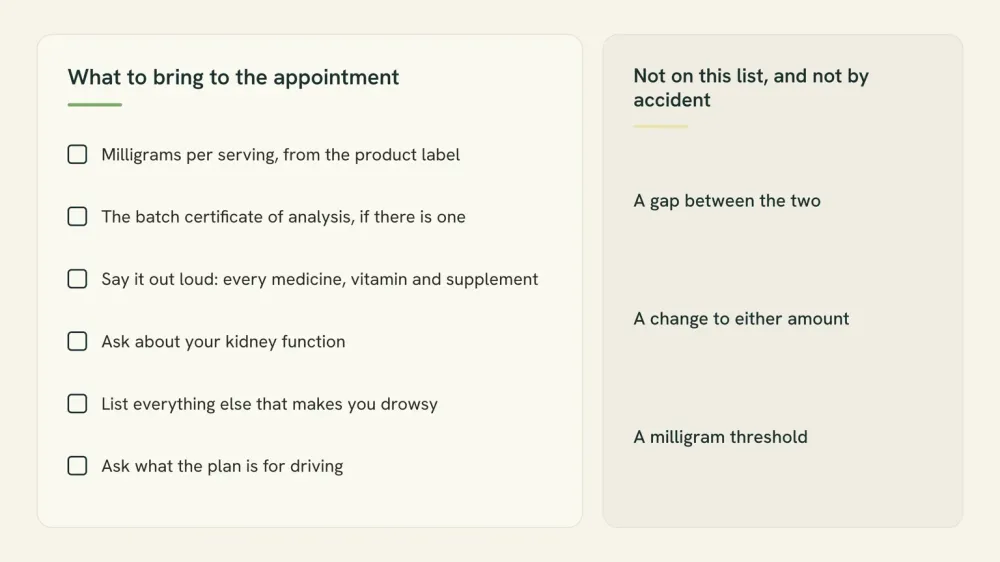
- 1Write down what is actually in the product. A label states a bottle total and a concentration per milliliter, and those are different numbers. The one a pharmacist can work with is milligrams per serving. Bring the batch certificate too.
- 2Say it out loud at the appointment: I am taking, or considering, a CBD product. That is not our idea. Gabapentin's Medication Guide tells patients to name every medicine they take, prescription and over-the-counter, plus vitamins and supplements.
- 3Ask about your kidney function specifically. Gabapentin's dosing is built around creatinine clearance and that number is probably already in your chart. It is the variable that moves this drug, and worth knowing before you add anything.
- 4List everything else that slows you down: opioids, sleep aids, muscle relaxants, sedating antihistamines, anxiety medicines, alcohol. The label's warning names drugs with sedative properties as a category, so the total matters more than any one item.
- 5Ask what the plan is for driving and machinery. Both labels tell patients not to drive until they know how the medicine affects them, and gabapentin's adds that the duration of that impairment is unknown. Renegotiate driving first, not last.
- 6Do not change either amount on your own, in either direction, and do not try to space them apart. There is no studied gap to aim for, and the sedation question is not solved by timing anyway.
- 7Agree in advance what you would do if the warning signs above appear, and who you would call. Write that number somewhere you will find it before you need it.
Should you use CBD instead of gabapentin? Why the label answers that better than we can
We are not going to compare the two, in either direction. Half of the pages competing for this search are titled as a contest between a prescription medicine and a supplement, and that framing is wrong before the evidence even comes up, because the two are not the same kind of thing and are not held to the same standard of proof. Gabapentin has exactly two approved indications: management of postherpetic neuralgia in adults, and adjunctive therapy for partial onset seizures in adults and children aged 3 and older. Everything else it is prescribed for is off-label, which is legal, common, and the reason two readers of this paragraph can be on the same drug for completely different reasons. That alone makes a general swap answer impossible: nobody writing a web page knows which of those reasons is yours.
There is also a specific fact about this drug that a substitution page owes you, and it comes from the label rather than from us. Section 5.6 states that antiepileptic drugs should not be abruptly discontinued because of the possibility of increasing seizure frequency, and that when the drug is being discontinued the dose should be tapered over at least a one-week period. Section 9.3 adds that withdrawal symptoms have been reported usually within 48 hours of stopping, with reported reactions including seizures, depression, agitation, confusion, disorientation, anxiety and insomnia. Read those as what they are: instructions written for a prescriber, and the reason the honest answer to can I swap is a phone call rather than an article. One more thing worth knowing while you make that call: section 9.1 of the label states plainly that gabapentin is not a controlled substance, while section 9.2 records that misuse and abuse have been reported after marketing, mostly in people with a history of polysubstance abuse, and that the abuse potential of gabapentin has not been evaluated in human studies.
If your prescription is pregabalin (Lyrica) rather than gabapentin, the clearance half of this article carries over almost unchanged. Pregabalin's own label states that it is predominantly excreted unchanged in the urine, undergoes negligible metabolism in humans, and does not bind to plasma proteins, so its pharmacokinetics are unlikely to be affected by other agents through metabolic interactions. About 90% of a dose is recovered in the urine as unchanged pregabalin, half-life is about 6.3 hours with normal kidney function, and the word cytochrome does not appear in the document at all. The FDA's 2019 breathing communication covers both drugs together. There is one real difference: pregabalin's label says it is a Schedule V controlled substance, where gabapentin's says it is not a controlled substance. The sedation question, and the answer to it, are identical for both.
What is still unknown, stated plainly
Here is the complete list of what this page cannot tell you. Nobody has given a person cannabidiol and gabapentin together and measured either drug in blood, so the mechanistic expectation that they do not compete metabolically has never been confirmed by a measurement. Nobody has measured how much sedation the two produce together, in anyone, which means there is no way to say whether the combination feels like a little more drowsiness or a lot. Nobody has studied the pair in people with reduced kidney function, which is the population in whom gabapentin behaves most differently and, given the age data above, a substantial share of the people asking this question. The cannabidiol figures on this page come from a prescription oral solution dosed by milligram per kilogram in children and adults with severe epilepsy, usually alongside other seizure medicines, which is not what is in a hemp tincture. And the one study that measured anything about this pair was performed in mice, and its own authors asked for the follow-up work that has not appeared.
Absence of a study is not evidence of no effect, and it is not evidence of an effect either. It means the question has not been asked in the one way that would answer it, and the useful response to that is to name the gap rather than fill it with a number. What goes in place of the number is a person who can see your whole medication list, your kidney function and your age. If your question is really about how long CBD stays around, we keep that arithmetic on its own page, how long CBD stays in your system, rather than mixing two very different half-lives on this one.
Questions people actually ask about CBD and gabapentin
That is a question for the prescriber or pharmacist who manages your gabapentin, and gabapentin's own Medication Guide asks you to bring it to them: tell your healthcare provider about all the medicines you take, including prescription and over-the-counter medicines, vitamins and herbal supplements. What can be said from the documents is that gabapentin leaves the body unchanged through the kidneys, so the liver-enzyme competition behind most CBD interaction warnings does not have a place to happen. What cannot be said is that the pair has been tested in people, because it has not, and the shared sedation question stays open regardless.
No measurement in a human being has been published: a dated PubMed search run on August 11, 2026 returned none, and the searches are printed in this article so you can re-run them. In mice, a 2019 study in electrically induced seizure models reported that cannabidiol increased the anticonvulsant activity of gabapentin, and the authors wrote that this could be related in part to pharmacokinetic interactions because serum or brain concentrations changed. Their own closing line calls for further pharmacokinetic studies to work out what type of interaction it is. Mice, acute dosing, research-grade compounds. Neither drug's label names the other anywhere.
The documented overlap is sedation. Gabapentin's label says patients should be carefully observed for signs of central nervous system depression, such as somnolence and sedation, when it is used with other drugs with sedative properties, because of potential synergy. The label for the FDA-approved cannabidiol medicine says concomitant use with other CNS depressants, including alcohol, may increase the risk of sedation and somnolence. Each document is speaking about its own drug and about a category. How much the two add up to in one person has never been measured.
No article should answer that, including this one. Gabapentin's label states that antiepileptic drugs should not be abruptly discontinued because of the possibility of increasing seizure frequency, and that the dose should be tapered over at least a one-week period when the drug is being discontinued. It also lists withdrawal reactions reported usually within 48 hours of stopping. Those are instructions written for a prescriber, which is exactly why the honest answer here is a conversation with yours rather than a plan from a web page.
Both labels tell you the same thing in nearly the same words, and neither one is speaking about the combination. Gabapentin's says patients should not drive until they have gained sufficient experience to assess whether it impairs their ability to drive, notes that driving studies with a prodrug of gabapentin indicate it may cause significant driving impairment, and states that the duration of driving impairment after starting therapy is unknown. The cannabidiol label tells patients not to drive or operate machinery until they have gained sufficient experience with it. Adding a second sedating product resets that judgement rather than confirming it.
Pharmacokinetically, yes. Its label says pregabalin is predominantly excreted unchanged in the urine, undergoes negligible metabolism in humans and does not bind to plasma proteins, that about 90% of a dose is recovered in urine as unchanged drug, and the word cytochrome does not appear in the document at all. The FDA's 2019 safety communication about serious breathing problems covers gabapentin and pregabalin together and names other CNS depressants and older age among the risk factors. One difference worth knowing: pregabalin's label says it is a Schedule V controlled substance, while gabapentin's says it is not a controlled substance.
Writing about hemp, wellness and the small rituals that keep us balanced.