CBD and Zoloft (Sertraline): What Is Actually Documented
Search PubMed for cannabidiol and sertraline and you get 14 records, no trial, and one case report describing a single patient. Here is everything that has actually been measured about CBD and Zoloft, what both drug labels say, and the one step the evidence supports.

If you take Zoloft, the generic name on the bottle is sertraline, and almost every search for CBD and Zoloft is really one question: is it safe to add a CBD product to it? Here is the honest answer. On August 11, 2026, a PubMed search for cannabidiol and sertraline returned 14 records, and not one of them gave a person both and then measured either drug in blood. What exists is one published case report describing a single patient, one chart review in which two people used a CBD oil, and one laboratory experiment that tested cannabidiol against sertraline metabolism directly and found almost nothing. That is the whole record. Your job is not to calculate a risk out of it. It is to put both products in front of the person who prescribed one of them.
The short version has three parts and they are all true at the same time. A mechanism exists on paper: the FDA-approved cannabidiol label calls cannabidiol a moderate inhibitor of a liver enzyme called CYP2C19, and the guideline prescribers use calls CYP2C19 sertraline's major metabolic pathway. The size of that mechanism in this specific pair has never been measured in a person. And the enzyme most consumer pages name for this question is not the right one. If you want the general framework first, our guide to CBD and other medications covers the drug categories and the enzymes involved, and if you are new to the compound itself, start with what cannabidiol actually is. This page stays on one drug.
What is actually documented about CBD and Zoloft
Before anyone can tell you how big this interaction is, somebody has to have measured it. So we counted. On August 11, 2026 we ran the query cannabidiol AND sertraline against PubMed, the National Library of Medicine's index of biomedical literature. It returned 14 records. The same 14 came back from a title-and-abstract version of the query using CBD and Zoloft as alternatives. Restricting it to randomized controlled trials returned 0. Both searches take under a minute in a browser, and we would rather you re-ran them than took our word for it.
We resolved all 14 individually rather than reporting a number, because what they are is the actual state of the evidence and it is not nothing. Two are clinical records: one case report and one retrospective chart review, both discussed below. Three are rodent studies, two in mice and one in rats, of behavior in stress models, which are animal experiments and do not establish anything about what happens in a person. One is a laboratory paper with a small human arm. Five are reviews or prescribing guidance, including two editions of a drugs-for-anxiety-disorders review and a geriatric prescribing algorithm. One is a commentary on adolescent cannabis use, one is a bibliography of trials in the pipeline, and one is a method paper for detecting drugs in oral fluid. Zero of the 14 gave a person cannabidiol and sertraline together and measured the concentration of either drug.
One sentence has to travel with that count, and it cuts both ways: absence of a study is not evidence of no effect, and it is not evidence of an effect either. It means the question has not been asked in the one way that would answer it. Any page that hands you a milligram threshold or a number of hours to wait is filling that gap with something it invented. One threshold in particular circulates widely: the claim that CBD above 20 mg a day meaningfully raises interaction risk with an SSRI. We could not find a source attached to it anywhere, it appears in neither drug's label, and we are not going to replace it with a number of our own.
The one case report, and everything it is not
One published case describes this exact pair, and it describes a single patient. A 2022 case report in Innovations in Pharmacy follows a 78-year-old man seen by an outpatient pharmacotherapy consult service after his neurologist raised concern about persistent cognitive decline. He had taken sertraline 50 mg once daily for 20 years, described as well controlled, with no notable adverse reactions and no serum electrolyte abnormalities. In March 2021 he started a daily over-the-counter CBD supplement for chronic pain. Over the following year his serum sodium fell into the hyponatremic range and he developed short-term memory loss and attention deficits. A brain MRI showed no significant change and no other clinical cause was found. In January 2022 the serum sodium of this one patient reached an all-time low of 120 mmol/L, sertraline was stopped, and by March 2022 sodium had climbed back to 132, with cognition improving as it recovered. Pharmacogenomic testing classified him as a CYP2C19 intermediate metabolizer, meaning he was born with reduced activity of that enzyme.
Now read the second document before you read that as a CBD effect. Hyponatremia, which means low blood sodium, is on sertraline's own label. Section 5.8 of the ZOLOFT prescribing information on DailyMed states that hyponatremia may occur as a result of treatment with SNRIs and SSRIs including ZOLOFT, that cases with serum sodium lower than 110 mmol/L have been reported, and that the signs and symptoms include headache, difficulty concentrating, memory impairment, confusion, weakness and unsteadiness, which may lead to falls. It names elderly patients, patients taking diuretics and volume-depleted patients as possibly at greater risk. We re-read both labels on August 11, 2026 to be sure of the asymmetry: hyponatremia has its own numbered warning in sertraline's label, section 5.8, and the word does not appear anywhere in the FDA-approved cannabidiol label. What a label does and does not name is a fact about two documents rather than about biology, but it tells you which molecule carries this history.
“In many cases, this hyponatremia appears to be the result of the syndrome of inappropriate antidiuretic hormone secretion (SIADH).”
So the honest reading of the case is a plausible amplification of a documented effect of the antidepressant in a 78-year-old man, not a new effect discovered for CBD, and the authors' own words are possible, proposed and possibly contributed. Several limits belong in the same breath as the finding, and most of them are the authors' own. It is one patient at one clinic with no control and no comparison. His medication list at the consult also included omeprazole, itself an inhibitor of the same CYP2C19 enzyme, and the report does not say when it was started. No drug levels were ever measured, so the rise in sertraline exposure is inferred rather than observed. The CBD product was an unverified over-the-counter supplement and the authors raise possible THC contamination as a potential external factor. They write that hyponatremia is not considered a dose-dependent adverse reaction, and that a CYP2C19 genotype does not always translate to the corresponding phenotype. And the drug that was stopped when sodium recovered was the sertraline. Age is doing real work in this story, which is why we treat it as its own variable in how age changes the CBD conversation.
Does CBD interact with sertraline? Start with the right enzyme
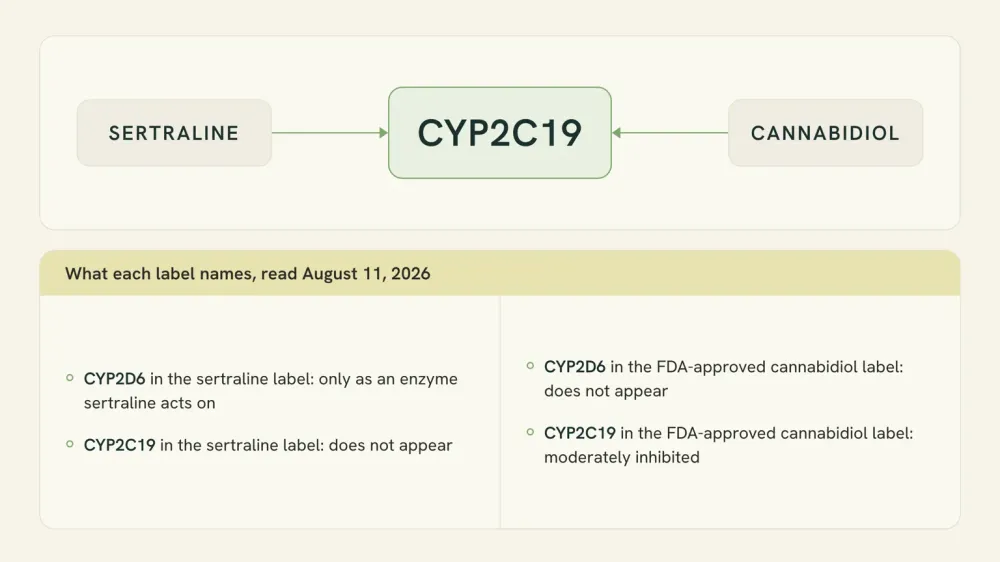
A claim circulating on consumer pages says that SSRIs rely on CYP2D6 and CYP3A4, and that CBD inhibits both. It is wrong on both halves, and the way to see that is to read the two labels rather than more pages. Sertraline's label does name CYP2D6 and CYP3A4, and every mention of either runs in the other direction. Section 7.1 lists CYP2D6 substrates among the clinically significant interactions, meaning other drugs whose clearance sertraline can slow, and section 7.2 files drugs metabolized by CYP3A4 under those with no clinically important interaction. Both enzymes appear as things sertraline acts on, never as the route that clears sertraline. Section 12.3 says the principal initial pathway of metabolism for sertraline is N-demethylation, and it names no cytochrome enzyme at all as the route that clears the drug. The strings CYP2C19, CYP2B6 and CYP2C9 appear zero times in it, and so do cannabidiol, cannabis and marijuana. We ran that check on the brand label and on two independent generic labels on August 11, 2026 and got the same result each time. In the FDA-approved cannabidiol label, CYP2D6 appears zero times. So the enzyme the internet names for the drug is absent from the drug's label, and the enzyme it names for CBD is absent from CBD's.
A label being silent is not the same as an enzyme being irrelevant, and this is where the real answer lives: not in the label, but in the pharmacogenomics guideline prescribers use. The 2023 Clinical Pharmacogenetics Implementation Consortium guideline for the SSRI antidepressants states that sertraline is metabolized by CYP2D6, CYP2C19, CYP2B6 and other CYP enzymes, with pharmacokinetic studies suggesting that CYP2C19 is the major metabolic pathway, and that studies have found little to no effect of CYP2D6 genetic variation on sertraline exposure and dose. That is the opposite of what the consumer pages say. The same guideline lists drug-drug interactions among the things to weigh alongside genotype. It is written for prescribers and its dosing text is not reader advice, which is one more reason the useful move here is a conversation rather than a calculation.
Now the other side of the pair. Section 7.2 of the EPIDIOLEX prescribing information, the label for the only FDA-approved cannabidiol medicine, says that cannabidiol is a moderate inhibitor of CYP2C19 and that concomitant use increases plasma concentrations of CYP2C19 substrates and may increase the risk of adverse reactions. Section 12.3 adds that cannabidiol is itself metabolized in the liver and gut by CYP2C19 and CYP3A4 plus three UGT isoforms. Both molecules therefore use CYP2C19, which means traffic could run in either direction. That is a real mechanism and it is where every genuine interaction story begins. It is also only the beginning: a shared enzyme tells you a mechanism exists, never how large it is. If your question is about the liver itself rather than about this pair, that belongs on our page about whether CBD is bad for your liver.
A blocked enzyme is a mechanism, not an effect size
The way to size a mechanism is to look at what happens when the enzyme is removed altogether. In a 2001 pharmacokinetic study in Clinical Pharmacology and Therapeutics, 12 healthy volunteers, 6 with normal CYP2C19 function and 6 with none of it, each took a single 100 mg oral dose of sertraline. Exposure in the poor metabolizers was 983.6 against 697.6 in the study's units of micrograms times hours per liter, about 41% higher, and terminal half-life was 35.5 hours against 23.5, about 51% longer. Deleting that enzyme entirely, genetically and permanently, in people, moved sertraline exposure by roughly 40%. That is the ceiling the mechanism is working under, and the study is small: 6 people per group, a single dose, one ancestry group, healthy volunteers, and it says nothing about whether a 40% rise causes any symptom at all. The enzymology underneath it is in-vitro work in human liver microsomes, which found that CYP2C19 catalyzes the high-affinity N-demethylation of sertraline with CYP2C9 as a low-affinity component, and that an antibody against that enzyme family did not abolish the reaction in the microsomes from any of the livers tested. Even in a dish, other enzymes carry part of the load.
Now put a second number beside the first. Sertraline's own label, section 12.3, reports a study in which cimetidine, a well-known enzyme blocker, was given at 800 mg daily for 8 days and raised sertraline exposure by 50%, its peak concentration by 24% and its half-life by 26%. Section 7.2 of the same label files cimetidine under drugs having no clinically important interactions with ZOLOFT and states that no dosage adjustment is necessary. A measured 50% rise in exposure from a known blocker was judged by the regulator not to require any change. That is a judgment about one specific drug pair rather than a general permission slip, and it is still the most honest frame available for the sentence CBD blocks an enzyme.
Run the logic the other way and the same lesson repeats. The largest human CYP2C19 signal anywhere in the FDA-approved cannabidiol label is a roughly 3-fold rise in the Cmax and AUC of N-desmethylclobazam, the active metabolite of the anti-seizure drug clobazam, in healthy subjects taking gram-scale daily doses of a pharmaceutical cannabidiol oral solution, with no effect on clobazam itself. That shows the mechanism can be large at pharmaceutical dosing, in a different drug, in a different population, and it is not a measurement of sertraline or of anything sold as a supplement. In the same section, when strong enzyme blockers were pointed at cannabidiol, the antifungal itraconazole increased cannabidiol exposure by less than 10%, and the antifungal fluconazole, a strong CYP2C19 inhibitor, by 22% and 24% for exposure and peak concentration, which the label describes as still not clinically meaningful. In-vitro inhibition is a mechanism; the numbers above are what effect sizes look like. We work the same argument through a different pair on the CBD and alcohol page.
| What was perturbed | What was measured | Result | What it is not |
|---|---|---|---|
| CYP2C19 absent by genotype (6 poor against 6 normal metabolizers) | Sertraline exposure and half-life after a single 100 mg dose | Exposure about 41% higher; half-life 35.5 against 23.5 hours | Not a drug interaction, and not a symptom. n = 6 per group, healthy volunteers, 2001 |
| Cimetidine 800 mg daily for 8 days | Sertraline exposure, peak concentration and half-life | Exposure +50%, peak +24%, half-life +26% | Not a concern: the label files it under no clinically important interactions and no dosage change |
| Gram-scale daily dosing of a pharmaceutical cannabidiol oral solution | Clobazam and its CYP2C19-substrate active metabolite, in healthy subjects | Metabolite peak and exposure up about 3-fold; clobazam itself unchanged | Not sertraline, not a consumer product, and not this population |
| Fluconazole, a strong CYP2C19 inhibitor, against cannabidiol | Cannabidiol exposure and peak concentration | +22% and +24% | Not clinically meaningful, in the label's own words |
| Cannabidiol added to sertraline | Nothing, in any person, in any published study | No measurement exists | Not evidence of safety, and not evidence of harm |
CBD and antidepressants: the one experiment that put them in the same dish
On August 11, 2026, the PubMed query combining cannabis or cannabidiol with sertraline and the drug interactions subject heading returned exactly one record, and it is the only place we could find cannabidiol tested against sertraline metabolism directly. A 2021 paper in the Journal of Clinical Psychopharmacology tested cannabidiol against the CYP450-mediated metabolism of four antidepressants in vitro: fluoxetine, sertraline, citalopram and mirtazapine. In that laboratory system, and not in people, the authors report that cannabidiol minimally affected the metabolism of sertraline, fluoxetine and mirtazapine, while it significantly inhibited the CYP3A4 and CYP2C19-mediated metabolism of citalopram and its stereoisomer escitalopram at physiologically relevant concentrations. The same paper carried a small human arm: 6 patients with anxiety disorders on stable citalopram or escitalopram who received ascending adjunctive cannabidiol over 12 weeks inside a clinical trial. Their citalopram plasma concentrations rose significantly, and the authors state that it was uncertain whether this also increased SSRI-mediated adverse events.
Two things follow, and neither is the headline you would expect from the search results. The first is that which antidepressant is in the bottle changes the question. That prescriber guideline exists in the first place because these medicines do not all clear the same way: it issues separate CYP2D6 and CYP2C19 recommendations drug by drug. The two that moved in this experiment, citalopram (Celexa) and escitalopram (Lexapro), were inhibited through CYP3A4 and CYP2C19, and CYP2C19 is precisely the enzyme the cannabidiol label flags. Sertraline, fluoxetine (Prozac) and mirtazapine were minimally affected in the same dish. Paroxetine (Paxil) was not in that experiment at all, which is worth saying plainly: nothing on this page speaks to it, or to any SSRI other than the four that were tested. The second thing is a caution against reading that as reassurance. An in-vitro result is a dish and not a person, the human arm was 6 patients, open label, on a different SSRI, at supervised trial dosing. It narrows what can honestly be said about this pair; it does not answer the question for your body.
What people actually reported when they combined them
The second clinical record is a retrospective chart review, and it is the source of the alarming symptom lists you may have read attached to this pair. A 2024 retrospective chart review in Frontiers in Pharmacology evaluated 1,586 adverse-event reports, found 256 with a causal relationship to psychotropic drugs, identified 52 involving a cannabinoid preparation, and judged 20 of those high probability. Of the 20 patients (13 women, 7 men, mean age 53.7), 70% of cases involved antidepressants, and sertraline was the single most common drug at 7 of 20 cases, or 35%.
Here is the part that disappears when this paper gets summarized. The authors write that the majority of adverse events were associated with the use of medical marijuana at approximately 18% to 22% THC and 1% CBD, in 18 patients or 90% of the cases, and that two adverse events were related to the use of a 10% CBD oil. The ataxia, hallucinations, tachycardia and coma that circulate online as the sertraline-and-CBD cases belong to the high-THC group, not to the CBD-oil group. Read from the paper's own table, the two CBD-oil cases are these.
- A 68-year-old woman on sertraline 100 mg a day, using a 10% CBD oil for osteoarthritis pain, also taking lornoxicam, oxycodone and topical diclofenac. Reported event: diarrhea, vomiting and fever.
- A 47-year-old woman on sertraline 100 mg a day, using a 10% CBD oil for endometriosis pain, also taking a combined contraceptive, ketoprofen and tramadol. Reported event: severe fatigue that prevents daily activities.
That is two people. Both were on other opioid or serotonergic medicines, oxycodone in one case and tramadol in the other. No CBD dose was recorded, no product was verified, no drug concentrations were measured, causality was graded by the authors, and the dataset has no denominator of exposure, so no rate can be computed from it in either direction. The same paper also reports that there were no side effects associated with concomitant use of antidepressants and the approved cannabinoid medicines, which is an absence in one dataset rather than evidence of safety. Digestive upset is among the reactions most commonly reported with CBD, which is why we keep a whole page on why CBD causes diarrhea for some people and the full list of CBD's reported side effects. If you are already taking sertraline, drowsiness and stomach upset are the two overlaps worth watching, and neither of them is the one the label treats as urgent.
Signs that mean stop reading and call someone

Can CBD replace Zoloft? The question, answered directly
Two of the pages competing for this search ask, in their titles, whether CBD can replace Zoloft, so the question deserves a straight answer rather than a dodge. Start with the fact that it is a common question. In a nationally representative survey of US adults published in Frontiers in Public Health, fielded from October 25 to November 3, 2023, 1,523 people qualified and 1,008 of them had ever used CBD. Among those ever-users, and it is their number rather than the whole sample's, 32.0% said they had used CBD as a substitute or adjunct for at least one medication, with adjunct use at 24.2% more common than substitute use at 11.0%. Anxiety medications were named by 1.1% of ever-users, and both Zoloft and sertraline appear by name in the survey's list of medications people mentioned. So roughly one in nine people who have ever used CBD say they used it to replace a medicine. That is self-reported and cross-sectional, with no product verified, no dose recorded and no outcome measured, which means it establishes that your question is normal and nothing more than that.
Then there is what the seller pages leave out. Sertraline is a prescription medicine with a regulated indication, a boxed warning about suicidal thoughts and behaviors in pediatric and young adult patients, and a discontinuation profile documented on its own label. Section 5.5 lists what has been reported after stopping serotonergic antidepressants, particularly after abrupt discontinuation: nausea, sweating, dysphoric mood, irritability, agitation, dizziness, sensory disturbances such as electric-shock sensations, tremor, anxiety, confusion, headache, lethargy, emotional lability, insomnia, hypomania, tinnitus and seizures. The label recommends a gradual reduction in dosage rather than abrupt cessation whenever possible. We quote that as the reason to involve the prescriber and for no other purpose: the schedule is theirs to write, not ours, and not a web page's. The same reasoning applies to every prescription somebody is tempted to swap out, which is the argument we make in more detail about CBD alongside blood pressure medication.
And then, plainly: this is not a decision a supplement page is allowed to influence, and we are not going to tell you whether CBD does or does not do what your antidepressant does, in either direction. What we will do is correct one thing that is currently being published. Some retail pages claim that CBD can relieve antidepressant discontinuation symptoms. No study we located supports that, it appears in neither drug's label, and of everything currently ranking for this question it is the sentence most likely to hurt somebody. If you arrived here because of how you have been feeling rather than because of a pharmacology question, the state of the evidence around CBD and stress describes what has and has not been shown, with its limits, and it still ends in the same place this page does.
What to do before you take both
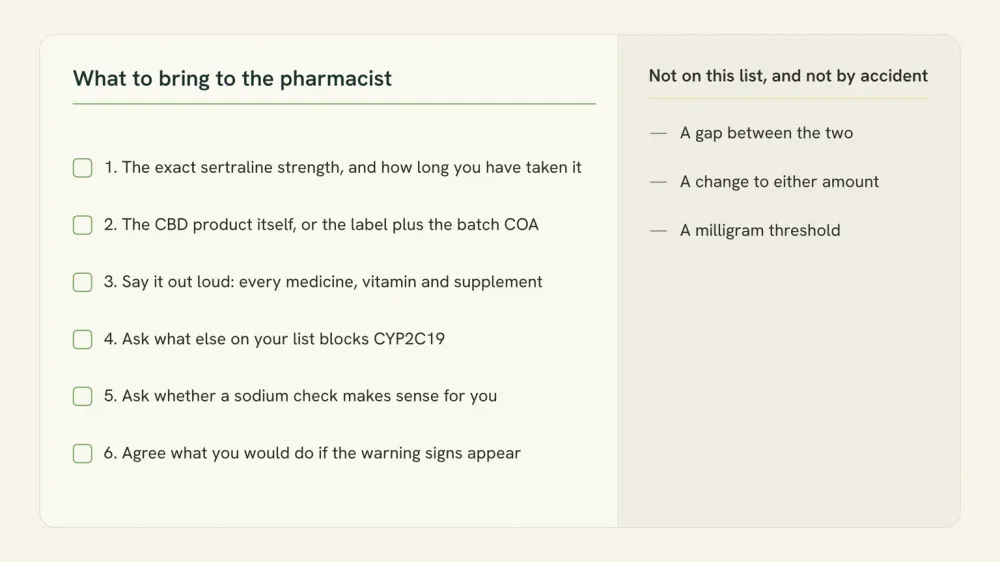
None of the steps below involves changing an amount, adding a gap between the two products, or delaying anything, because nothing in the 14 records described above measured an interval between CBD and sertraline, and this page will not invent one. Every step is disclosure or observation. Step 2 is the one people skip: CBD is not a dose. A tincture label states a total amount in the bottle and a concentration per milliliter, and those are two different numbers, which is why the word CBD alone gives a pharmacist nothing to work with. If you have never read a batch certificate, our guide to reading a certificate of analysis shows exactly which lines matter.
- 1Write down the exact sertraline strength you take, how long you have taken it, and whether anything about it has changed in the past year.
- 2Bring the CBD product itself, or a photo of the whole label plus the batch certificate of analysis. The concentration and the cannabinoid content are what the prescriber needs to see.
- 3Tell the prescriber or the pharmacist that you already use it, or that you are considering it. The instruction is NIMH's own: tell a health care provider about all other medications, vitamins and supplements you are already taking.
- 4Ask specifically whether anything else on your list also blocks CYP2C19. In the one published case of this pair, a second medicine that inhibits the same enzyme was on the patient's list.
- 5Ask whether checking your sodium makes sense for you, particularly if you are older, take a diuretic, or have ever had a low sodium result recorded.
- 6Agree in advance what you would do if the warning signs on the label appear, and who you would call. Write that number somewhere you will find it before you need it.
Step 3 is not our invention. The National Institute of Mental Health's page on mental health medications says to tell a health care provider about all other medications, vitamins and supplements you are already taking, and that people should not stop taking a prescribed medication, even if they are feeling better, without the help of a health care provider. The FDA, for its part, says in its consumer update on cannabis-derived products that CBD can affect how other drugs you are taking work, potentially causing serious side effects, and that it is concerned about the potential safety of taking other medicines with CBD when not being monitored by a healthcare provider. Both sentences point at the same person: the one who can see your entire list. More of the agency's position is collected in our summary of the FDA's position on CBD.
What nobody knows, stated plainly
Here is the complete list of what this page cannot tell you. Nobody has measured what cannabidiol does to sertraline concentrations in a human being. Nobody has established a dose-response, because no amount of either has been varied against the other under measurement. The clinical record is one patient and two chart entries, every one of them confounded by other medicines, and not one of them with a drug level attached. The single direct test of sertraline was performed in vitro, so its reassuring result carries exactly the weight of a laboratory system and no more. The two largest numbers on this page, the roughly 3-fold metabolite rise and the roughly 40% exposure change, come from a pharmaceutical product given to patients with severe epilepsy and from a genetic experiment in healthy volunteers, and neither one is a measurement of what is sold as a supplement. And consumer CBD products vary in what they actually contain, which means the exposure in the one published case is unknown twice over.
Absence of a study is not evidence of no effect, and it is not evidence of an effect either. It is a gap, and the right response to a gap on a page like this one is to name it rather than fill it with a number. What goes in place of the number is a person who can see your whole medication list, your age, your kidney function and your sodium history. That is the entire argument of this article, and it will survive whatever study gets published next.
No study has measured the pair in people, so no page can answer that for you, including this one. What is documented is a single case report, an adverse effect that sertraline's own label already carries, and a liver enzyme both molecules use. The step that is actually supported by the evidence is disclosure: tell the prescriber or the pharmacist that you take both, and bring the CBD product with you so they can see the concentration.
There is a mechanism and there is no measured effect size, and both of those are true at once. The FDA-approved cannabidiol label calls cannabidiol a moderate inhibitor of CYP2C19, and the 2023 prescriber guideline calls CYP2C19 sertraline's major metabolic pathway, so the pathway for an interaction exists. But in the one experiment we located on August 11, 2026 that tested cannabidiol against sertraline metabolism directly, sertraline was minimally affected, in vitro. Nobody has run the study in a person that would settle it.
No interval has been studied for this pair: nothing in the 14 PubMed records we resolved on August 11, 2026 measured one, and this page will not invent one. It is also worth knowing why spacing would not do what people imagine: sertraline's label reports a terminal half-life of about 26 hours and steady state after about a week of daily dosing, so the drug is in your system continuously. Moving one product a few hours away from the other does not create a gap between them.
That number circulates on consumer pages with no source attached to it. It does not appear in sertraline's label, it does not appear in the FDA-approved cannabidiol label, and we could not locate a study behind it. We are also not substituting a threshold of our own, because there is no measurement to base one on. A number with nothing underneath it is not safer than no number; it is less safe, because it sounds like it was checked.
That is a prescriber's decision and not a blog's, and we are not going to compare the two in either direction. What is documented is that stopping or reducing an SSRI without that prescriber has its own risks: sertraline's label lists discontinuation symptoms including dizziness, sensory disturbances, irritability, insomnia and seizures, particularly after abrupt discontinuation, and recommends a gradual reduction in dosage whenever possible. There is also no evidence that CBD eases those symptoms, despite what some retail pages say.
Serotonin syndrome is real and sertraline's label names the drug classes that raise the risk: other serotonergic drugs including triptans, tricyclic antidepressants, opioids, lithium, tryptophan, buspirone, amphetamines and St. John's wort, plus MAOIs. No cannabinoid appears on that list, and no case of serotonin syndrome from this pair appeared anywhere in the 14 records we resolved on August 11, 2026. The risk in that warning comes from the drugs the label actually names.
Sertraline's label carries hyponatremia as its own numbered warning, section 5.8, and the word does not appear anywhere in the FDA-approved cannabidiol label; we re-read both documents on August 11, 2026. On the same date, the PubMed query cannabidiol AND hyponatremia returned exactly one record, which is the case report described above. In that case the authors propose that cannabidiol raised sertraline exposure rather than acting on sodium itself, and they are careful to say propose. Low sodium is a documented effect of the antidepressant.
On the one direct comparison we could locate on August 11, 2026, it is citalopram and escitalopram rather than sertraline. In that 2021 experiment, cannabidiol significantly inhibited their metabolism in vitro through CYP3A4 and CYP2C19, and citalopram plasma concentrations rose in the 6 patients in its small human arm, while sertraline, fluoxetine and mirtazapine were minimally affected in the same in-vitro system. It is a small, mostly laboratory dataset, and it is a reason to name your specific drug when you ask, not a ranking to act on.
Writing about hemp, wellness and the small rituals that keep us balanced.