Zoloft and Weed: What's Documented About Sertraline and THC
Can you use weed on Zoloft? We read sertraline's FDA label, the enzyme studies, a 2024 chart review and three case reports, and lay out what is documented, what is only repeated, and when to get help.

If you take sertraline (Zoloft) and use cannabis, you have probably read three things about Zoloft and weed: the pair has a "moderate interaction", THC blocks the enzyme that clears sertraline, and the combination can cause serotonin syndrome. Each claim traces back to a short list of documents. We read them: the FDA label, the enzyme studies, a 2024 chart review and three case reports. Here is what each one actually says.
The short answer: sertraline's prescribing information never mentions cannabis, no study we found has measured sertraline levels in people who use THC, and the best-documented problem is stacking: more drowsiness, dizziness and slowed thinking on top of a medicine that can cause those by itself. Several pages ranking for this question cite studies that do not say what those pages claim, so we quote the sources directly. This page covers THC-containing cannabis, is written for adults 21 and over, and does not replace your prescriber. CBD is a separate question, covered in our review of CBD and Zoloft; our CBD vs THC comparison explains why the two are not interchangeable.
What a moderate interaction rating actually means
The interaction checker at the top of search results for this pair rates cannabis and Zoloft "moderate". The reason it gives is additive central nervous system depression: more drowsiness, dizziness and confusion, and more impaired judgment, thinking and coordination than either one alone. A checker rating is a classification built from drug class and mechanism, not a measured result, and our explainer on what interaction-checker classifications mean walks through the difference. The same concern appears in the FDA-approved prescribing information for oral THC (dronabinol, sold as Marinol), revised January 2023: "Additive CNS effects (e.g., dizziness, confusion, sedation, somnolence) may occur" with other drugs that act on the central nervous system. That label does not mention sertraline or SSRIs.
What sertraline's label says, and what it never mentions
On September 16, 2026, we read the full ZOLOFT prescribing information on DailyMed (label revised August 2023, version published July 24, 2025) and searched its text for the terms below. We searched THC as a whole word, because those letters also sit inside "healthcare".
| Term searched | Times it appears | What that tells you |
|---|---|---|
| Cannabis, cannabinoid or marijuana | 0 | No cannabis warning and no cannabis study on the label |
| THC, tetrahydrocannabinol or dronabinol | 0 | THC is not named anywhere, including the drug interaction section |
| CYP2C19 | 0 | The enzyme most pages blame is not named on the label |
| CYP3A4 | 4 | Discussed, with human data (see the enzyme section) |
| CYP2D6 | 13 | The enzyme the label discusses most |
| Serotonin syndrome | 20 | A major warning, with its own list of drugs |
The serotonin syndrome warning (section 5.2) says the risk rises with "other serotonergic drugs (including triptans, tricyclic antidepressants, fentanyl, lithium, tramadol, meperidine, methadone, tryptophan, buspirone, amphetamines, and St. John's Wort)". Cannabis is not on that list. That tells you what has been established, not that the combination is proven safe. The patient Medication Guide adds a line that matters for anyone who also uses THC: "ZOLOFT can cause sleepiness or may affect your ability to make decisions, think clearly, or react quickly. You should not drive, operate heavy machinery, or do other dangerous activities until you know how ZOLOFT affects you."
The enzyme claim, checked in both directions
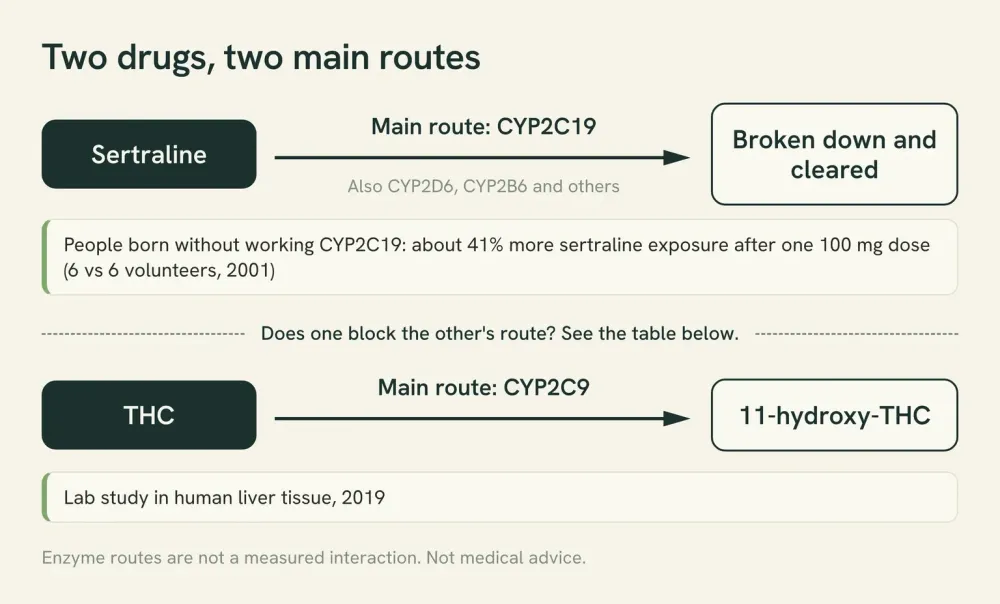
Most pages on this topic tell a two-way story: THC blocks the enzyme that clears sertraline, so sertraline builds up, and sertraline blocks the enzymes that clear THC, so the high gets stronger. Start with the routes. The 2023 CPIC pharmacogenomics guideline for antidepressants says sertraline is broken down by several liver enzymes, "with pharmacokinetic studies suggesting that CYP2C19 is the major metabolic pathway." In a small 2001 study (PMID 11452243), 6 volunteers born without working CYP2C19 had about 41% more sertraline exposure after one 100 mg dose than 6 with normal enzyme activity, a rough guide to how much fully blocking that enzyme could matter. THC takes a different road: laboratory work in human liver tissue found CYP2C9 does most of the work of turning THC into 11-hydroxy-THC, as our guide to 11-hydroxy-THC explains.
| Claim you will read | What was actually tested | Result |
|---|---|---|
| THC blocks CYP2C19 and raises sertraline | 2020 model built from human liver tissue; THC swallowed (20 to 160 mg) or inhaled (25 to 100 mg) | Predicted exposure of a CYP2C19 drug: 1.0 to 1.1 times, essentially unchanged |
| THC blocks CYP2C19 and raises sertraline | 2023 crossover study: 18 healthy adults, one brownie with 20 mg THC and no CBD | No inhibition of any of the 5 enzymes tested, including CYP2C19 |
| THC or CBD raises sertraline about 33% | 2021 review's computer simulation of an adolescent, with a 25% cut in clearance assumed as an input | The output of an assumption, not a measurement |
| Sertraline blocks CYP3A4 and raises THC | Three human studies of sertraline with other CYP3A4 drugs, summarized on the label | "Not likely to be of clinical significance"; never tested with THC |
| Sertraline blocks CYP2C9 and raises THC | Volunteer study: sertraline 200 mg/day for 13 days, then tolbutamide | 16% lower tolbutamide clearance, no dose change advised; never tested with THC |
The THC-raises-sertraline direction is the one repeated most, and it is the weakest. A 2020 modelling study built from pooled human liver microsomes predicted that THC, swallowed or inhaled, would leave drugs cleared by CYP2C19 essentially unchanged at every dose it modelled. The same model did predict effects on drugs cleared by CYP2C9 and CYP3A, so it was not built to find nothing, and the authors say the predictions need a clinical study to confirm them. A 2023 randomized crossover study points the same way: 18 healthy adults ate a brownie with 20 mg of THC and no CBD, then took a cocktail of probe drugs, one for each major liver enzyme. In the authors' words, "the Δ9-THC brownie did not inhibit any of the CYPs." That included the CYP2C19 probe. It was one oral dose in healthy volunteers, with probe drugs rather than sertraline and no daily or heavy use, so it narrows the question rather than closing it.
The other direction runs into sertraline's own label. After three human studies with CYP3A4 drugs, it concludes that "ZOLOFT's extent of inhibition of CYP3A4 activity is not likely to be of clinical significance." The label never names CYP2C9. The closest measurement is a 16% drop in the clearance of tolbutamide, a drug that the FDA-approved label for Epidiolex describes as a moderately sensitive CYP2C9 substrate, after 13 days at the top sertraline dose. Sertraline's label says tolbutamide needs no dose adjustment. As for the 33% figure, it comes from a 2021 review in the Journal of Personalized Medicine that simulated an adolescent on 150 mg/day and applied one assumed 25% cut in clearance to "THC or low-dose CBD" together. The same review states: "THC, taken orally or inhaled, was not predicted to induce drug interactions with CYP2C19 or CYP2D6."
Five people on sertraline and high-THC cannabis: the chart review, row by row
The case records cited most often come from a 2024 retrospective chart review in Frontiers in Pharmacology by Chrobak and colleagues, working with adverse-event reports at a Polish pharmacovigilance center. From 1,586 reports received in 2023, they found 256 causally linked to psychiatric medicines, 52 involving a cannabinoid, and 20 they judged high-probability interactions. Eighteen of the 20 involved medical marijuana with about 18% to 22% THC and 1% CBD, all 20 patients used cannabis for pain, and sertraline appeared in 7. Five of those seven involved high-THC cannabis and are listed below. The two involving a 10% CBD oil are covered on our CBD and Zoloft page.
| Patient | Cannabis (THC / CBD) | Used for | Sertraline | Other medicines | Outcome as recorded |
|---|---|---|---|---|---|
| Man, 41 | 22% / 1% | Cancer pain | 100 mg/day | Oxycodone, metamizole, ketoprofen, zoledronic acid | Ataxia, initial hyperactivity, then coma; intensive care |
| Woman, 71 | 20% / 1% | Cancer pain | 100 mg/day | Oxycodone with naloxone, pregabalin, metamizole, dexketoprofen, dapagliflozin | Auditory and visual hallucinations, anxiety, agitation, heart rate 160 bpm |
| Woman, 61 | 20% / 1% | Cancer pain | 150 mg/day | Oxycodone, gabapentin, paracetamol, metamizole | Ventricular tachycardia, panic attacks, disorientation |
| Man, 54 | 19% / under 1% | Cancer pain | 100 mg/day | Morphine, ketoprofen, pregabalin, lactulose | Disorientation, headache, dizziness, blurry vision |
| Woman, 38 | 18% / 1% or less | Endometriosis pain | 150 mg/day | Goserelin, ketoprofen, metamizole | Severe vomiting requiring hospitalization, dry mouth, dry eyes |
Read the rows before the headline. Four of the five people had cancer pain and were also taking an opioid, and three were also on pregabalin or gabapentin, which can cause drowsiness and dizziness on their own. Two were hospitalized, according to the table. Nobody's blood was tested for sertraline or THC, and with no count of people who used both without trouble, no rate can be calculated. The paper never uses the words serotonin syndrome. Ataxia, coma, hallucination, tachycardia and blurred vision also appear on sertraline's own label as infrequent reactions (under 2%) with no cannabis involved, so a chart review cannot prove which substance caused what. The authors proposed an enzyme explanation but did not measure it. What the cases do show is that seriously ill people on several sedating medicines had serious reactions after adding high-THC cannabis, and the reviewers judged the combination a high-probability cause.
Serotonin syndrome and weed: what the three case reports say
Serotonin syndrome is a potentially dangerous reaction to too much serotonin activity, and sertraline's label says it can happen with sertraline alone or with other serotonergic drugs. To find where the cannabis version of the claim comes from, we searched PubMed on September 16, 2026. Queries pairing serotonin syndrome or serotonin toxicity with cannabis, marijuana, THC or dabbing returned 18 records, and among them we found three published case reports linking serotonin-syndrome-like episodes to cannabis. A separate search for cannabis and sertraline returned 28 records, none of them a study that measured sertraline or THC levels in people using both.
The first report, published in 2020, describes a 17-year-old taking sertraline 50 mg daily who reached an emergency department about 30 minutes after using a THC concentrate ("dabbing"), with rigid legs, sustained clonus (rhythmic jerking) at both feet, dilated pupils and a pulse of 124. She had also taken a few cyclobenzaprine tablets earlier. Doctors considered serotonin syndrome and admitted her to pediatric intensive care; she went home the next day and returned the following night with a similar picture after dabbing again. The authors wrote that "the cases did not show all of the hallmarks of a true serotonin syndrome" and that high-potency marijuana abuse "was the final diagnosis." The second patient in that paper, a 16-year-old, was not reported to be taking an SSRI.
A 2022 case report describes a 15-year-old taking sertraline and aripiprazole who arrived lethargic, with a tremor, overactive reflexes, twitching of the tongue, dilated pupils and a heart rate of 107. She was first treated as a possible overdose and serotonin syndrome. The authors concluded it was cannabis intoxication: she later said she had used a THC dab pen for three days in a row, and she was restarted on her antidepressant before discharge.
The third report, a 2024 letter, is not about sertraline. A 20-year-old man with bipolar disorder taking fluoxetine, another SSRI, plus lithium had three emergency visits in three weeks with "features consistent with serotonin syndrome, based on the Hunter Serotonin Toxicity Criteria". The first followed an overdose of fluoxetine and lithium; the other two came within hours of THC oil or a THC vape. The authors point to that cannabis use and acknowledge "unquantified THC levels." Lithium is itself on sertraline's serotonergic-drug list.
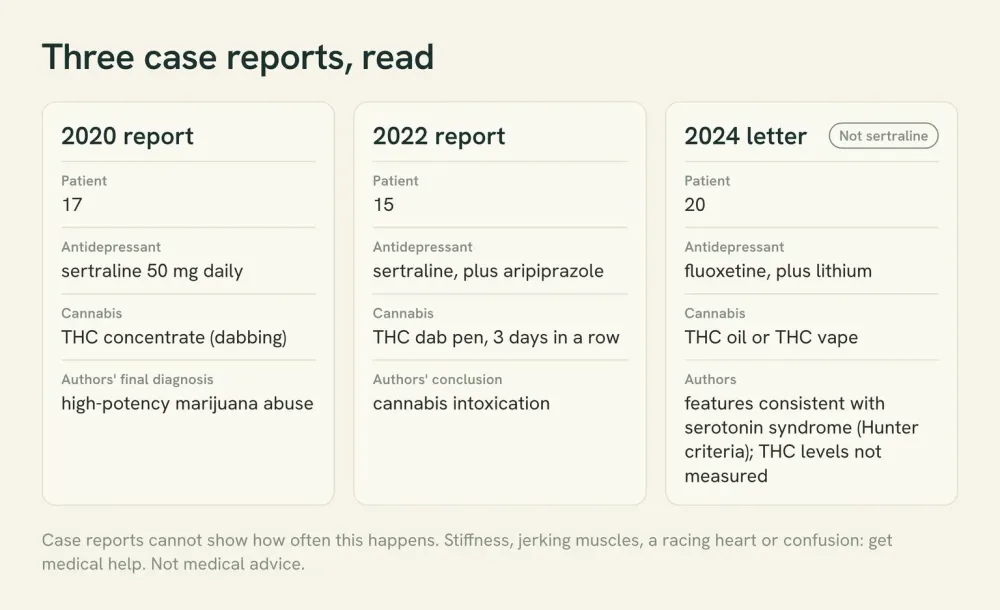
What this adds up to: the idea that THC itself pushes serotonin signaling comes from animal research, as these reports note. Both sertraline cases were teenagers using high-potency concentrates. Three case reports cannot rule the risk in or out, or say how often it happens. They do show that stiffness, jerking muscles, a racing heart and confusion after cannabis on an SSRI land people in the emergency department, which is the right place to be.
Can weed make Zoloft work less well?
No study we found has tested whether cannabis changes how well sertraline works. What exists is observational research on cannabis use and treatment outcomes in mood and anxiety disorders. A 2018 systematic review in the Journal of Clinical Psychiatry covered 12 prospective studies with 11,959 people, only 2 of them on depressive disorders. In 11, recent cannabis use was associated with worse symptoms over time, and in 10 with less improvement from treatment such as medication or psychotherapy; the authors say the results should be interpreted with caution, "considering the observational designs across studies". A 2024 systematic review of 78 studies found cannabis use associated with poorer treatment outcomes in 90.9% of the major depressive disorder studies it reviewed on that question, and called for research that accounts for the type, amount and frequency of use.
Association is not proof, and direction is the problem. In a 2017 study that followed 307 psychiatry outpatients with depression for six months, marijuana use was associated with worse depression and anxiety scores, and higher depression scores also predicted more marijuana use later. Both directions showed up in the same study, which is why this kind of data cannot tell you what cannabis does to your sertraline. Not every study points the same way: in a 2007 analysis of 232 primary care patients in an anxiety and panic care trial (Bricker and colleagues, PMID 17096386), monthly cannabis users improved on depression as much as less frequent users under the trial's combined care, but did worse under usual care. None of these studies isolated sertraline.
Overlapping effects: why it is hard to tell which one did it
| Effect | On sertraline's label | On the oral THC label | Why it matters with both |
|---|---|---|---|
| Drowsiness | 11% vs 6% on placebo | 3% to 10% | Sedation stacks; driving is the obvious risk |
| Dizziness | 12% vs 8% on placebo | 3% to 10% | Unsteadiness and falls |
| Agitation, anxiety, paranoia | Agitation 8% vs 5% on placebo | Paranoid reaction 3% to 10%; anxiety or nervousness over 1% | Can feel like the medicine failing or like a reaction |
| Fast heart rate | Tachycardia, under 2% | Tachycardia over 1%, and named in the hemodynamic warning | Also a sign of serotonin syndrome |
| Confusion, hallucinations, poor coordination | Confusional state, hallucination, ataxia, each under 2% | Confusion, hallucination, ataxia, each over 1% | All appear in the chart-review cases |
| Mood swings | Mania or hypomania in 0.4% of patients in trials | Reported to exacerbate mania, depression or schizophrenia | Mention any history of bipolar disorder |
When two substances can cause the same symptom, neither you nor a doctor can easily tell which one caused it. The practical risk is stacking: sertraline's Medication Guide already says not to drive until you know how it affects you, and THC adds impairment of its own. Our write-up of a controlled THC and CBD heart-rate trial shows THC raising heart rate, and our guide to greening out covers what taking more THC than you meant looks like. Swallowed THC also lasts: the oral THC label gives a peak effect at 2 to 4 hours and psychoactive effects lasting 4 to 6 hours, a long window for sedation from both substances to overlap. The Medication Guide also says "Do not drink alcohol while you take ZOLOFT." Our review of mixing alcohol and THC shows how impairment adds up when a third substance joins.

Signs that mean stop and get help now
Serotonin syndrome, cannabis toxicity and a bad reaction to either substance can look alike. MedlinePlus's serotonin syndrome entry notes that "Serotonin syndrome is usually not diagnosed until other causes of the symptoms have been checked for", including intoxication, and warns: "Untreated, serotonin syndrome can be deadly." You don't need to know which one it is. If you take sertraline and have used cannabis, get medical help right away for any of these signs, drawn from sertraline's label and MedlinePlus:
- Agitation, confusion or hallucinations
- A racing heart, swings in blood pressure, heavy sweating, flushing or a high temperature
- Muscle twitching or jerking, stiff muscles, overactive reflexes or a tremor
- Loss of coordination
- A seizure
- Nausea, vomiting or diarrhea, especially vomiting that won't stop
- Being very hard to wake
The Poison Help line is run by America's Poison Centers and connects you to your local poison center. Outside the US, use your local emergency and poison-center numbers.
Don't stop sertraline to make room for cannabis
Some people think about skipping or stopping an antidepressant so they can use cannabis. Sertraline's label explains, in section 5.5, why that is a decision to make with your prescriber:
“Adverse reactions after discontinuation of serotonergic antidepressants, particularly after abrupt discontinuation, include: nausea, sweating, dysphoric mood, irritability, agitation, dizziness, sensory disturbances (e.g., paresthesia, such as electric shock sensations), tremor, anxiety, confusion, headache, lethargy, emotional lability, insomnia, hypomania, tinnitus, and seizures. A gradual reduction in dosage rather than abrupt cessation is recommended whenever possible.”
If you are thinking about stopping or changing sertraline for any reason, including to use cannabis, talk to your prescriber first. Nothing on this page suggests that cannabis treats depression or anxiety, or that it can replace a prescribed medicine.
What to tell your prescriber, and what nobody knows yet
The chart review's authors end with a request to clinicians: "The use of cannabinoids by the patient should be documented in their medical records to facilitate the monitoring of any adverse events related to these substances." You can make that easy. Bring these points to your next appointment:
- What you use (flower, vape, concentrate, edible or a CBD product) and roughly how often
- Whether it is high-THC, CBD-dominant or mixed, because the enzyme answer differs
- Any drowsiness, dizziness, racing heart, anxiety, panic or unusual thoughts since starting either one
- Every other medicine and supplement, especially opioids, gabapentin or pregabalin, lithium, triptans, tramadol and St. John's Wort
- How much alcohol you drink
- Any change in your mood, including thoughts of harming yourself
What nobody knows yet, as of our September 2026 searches: no study we found has measured sertraline levels in people using THC, tested daily or heavy cannabis use with sertraline, or compared edibles, smoking and vaping in people on sertraline, and case reports cannot tell you how often problems happen. Other SSRIs, such as escitalopram (Lexapro) and fluoxetine (Prozac), have their own labels and were not reviewed here. If your mood is part of the picture, the 988 Suicide & Crisis Lifeline answers calls and texts at 988.
A disclosure: Planntz sells items that contain THC, including a full-spectrum tablet with delta-9 THC and full-spectrum CBD oils with trace THC. Nothing on this page is a recommendation to use them, or any cannabis product, alongside sertraline.
Questions people ask about Zoloft and weed
Sertraline's label does not address cannabis. The evidence is five chart-review cases, three case reports and a few enzyme studies, and the clearest known issue is stacked drowsiness, dizziness and slowed thinking. Whether it is reasonable for you depends on your dose, other medicines, mental health history and what you use, so ask your prescriber, and never skip sertraline to make room for it.
A PubMed search on September 16, 2026 found three case reports linking serotonin-syndrome-like episodes to cannabis. The two involving sertraline were teenagers using THC concentrates, and in both the authors concluded it was cannabis toxicity or intoxication rather than serotonin syndrome. The third, on fluoxetine and lithium, met formal criteria. None of that rules the risk in or out. Stiffness, muscle jerks, a racing heart, fever or confusion need medical help right away.
No study has tested sertraline specifically. Observational reviews link cannabis use with less improvement from treatment for depression and anxiety, but they cannot show cause, and in one study worse depression also predicted more cannabis use. If you feel your treatment is not working, tell your prescriber rather than changing anything yourself.
Nobody has measured it. A 2020 model predicted no meaningful THC effect on CYP2C19, sertraline's main clearance route, and in a 2023 study a single 20 mg THC brownie did not inhibit it in 18 healthy adults. That does not cover daily or heavy use, and CBD-rich cannabis is different: a CBD plus THC brownie roughly tripled exposure to the CYP2C19 probe drug.
No study has compared routes in people taking sertraline. Swallowing THC changes the mix of THC and its 11-hydroxy metabolite in the blood, and the oral THC (dronabinol) label describes a peak effect at 2 to 4 hours and psychoactive effects lasting 4 to 6 hours. A long-lasting effect gives drowsiness from both substances more time to overlap.
Yes. The authors of the 2024 chart review concluded that cannabinoid use should be documented in medical records so adverse events can be monitored. Tell your prescriber what you use, whether it is high-THC or CBD-rich, how often, what other medicines and supplements you take, and any change in mood, sleep, heart rate or anxiety.
If you take other prescriptions, or use CBD as well, our guide to CBD and medications explains how enzymes, drug labels and the strength of interaction evidence fit together, and how to build a medication record before you talk to a pharmacist.
Writing about hemp, wellness and the small rituals that keep us balanced.