Can You Smoke Mullein? What the Evidence Actually Covers
Dried mullein will burn, and it won't get you high. The 'lung herb' reputation rests on 19th-century claims and a European tea monograph for sore throat that covers the flower, not the leaf people smoke. Here's what smoke adds and what changes in a joint.
Can you smoke mullein? Dried mullein leaf will burn, so yes, in the narrow sense. It won't get you high: it contains no cannabinoid and no known intoxicant. And the evidence behind its "lung herb" reputation is about tea, not smoke. Europe's medicines regulator recognizes only mullein flower tea, for the sore throat that comes with a dry cough or a cold, based on long use rather than clinical trials. Burning any leaf makes carbon monoxide and fine particles.
Mullein turns up on wellness feeds as a "lung herb" you can brew or smoke, and most of the pages that rank for this question repeat that reputation without checking it. We read the regulator's file instead. What it shows is narrower, and more useful, than the trend: the official recognition mullein has is for a flower tea, for sore throat, on the basis of long use, and it doesn't cover the leaf people actually smoke. Below is what mullein is, why it won't get you high, what the "lung herb" idea really rests on, what smoke adds no matter which plant is burning, what changes when mullein goes into a joint, why the leaf's source matters, and who should skip inhaling it altogether. This page explains the evidence; it is not a guide to smoking anything.
What mullein is, and the part people smoke
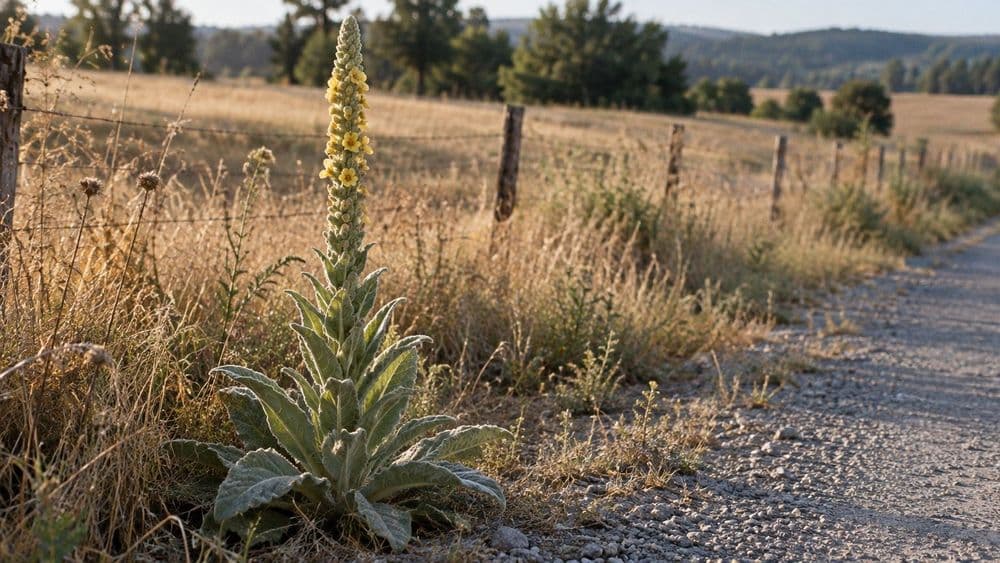
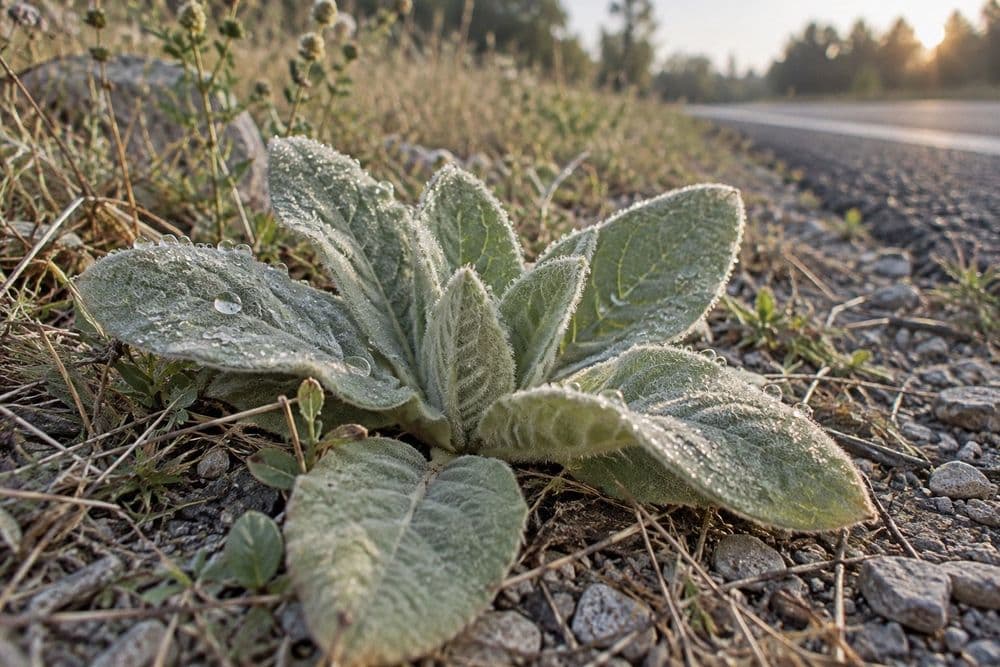
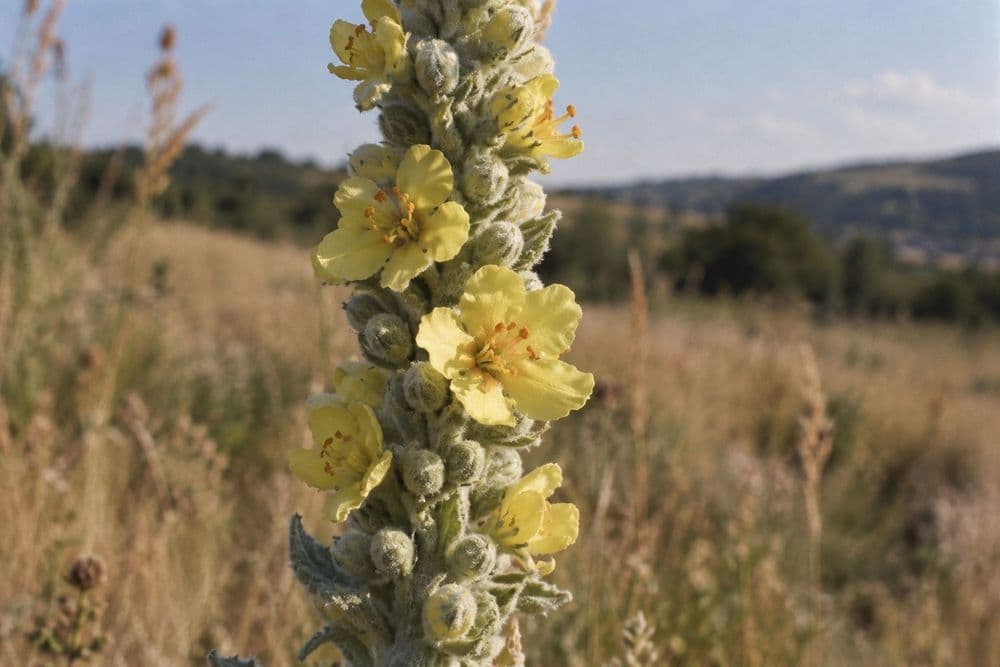
Mullein is Verbascum thapsus, a member of the figwort family (Scrophulariaceae). It's a biennial. In its first year it grows a low rosette of thick, gray-green leaves densely covered in fine, soft hairs. In its second year it sends up a single stalk packed with small yellow flowers, which an 1898 American pharmacy reference, King's American Dispensatory, put at 3 to 5 feet tall. The plant came from Europe and is now naturalized across much of the US, which is why you see it along roadsides, rail lines and vacant lots.
The part people dry, crumble and smoke is that woolly leaf. Keep that in mind, because it turns out to matter: most of the official record on mullein is about the flowers. Botanically, mullein has nothing to do with cannabis, which belongs to a different family, Cannabaceae. In that respect it's like catnip, another garden herb people try to smoke: a common plant that gets compared with weed without sharing any of its chemistry.
Does smoking mullein get you high?
No. Chemists who have taken mullein apart find iridoid glycosides such as aucubin and catalpol, triterpene saponins, flavonoids, mucilage (a gel-forming plant fiber) and a compound called verbascoside, as summarized in a 2022 review of the genus in Phytotherapy Research and in the European regulator's assessment of the plant. None of those is a cannabinoid, and none is a known intoxicant. The biological activities that review lists come from experimental lab and animal studies, not from people.
We also checked the literature directly. A November 2026 PubMed search for mullein or Verbascum together with cannabinoid, cannabis or marijuana returned a single paper, and it was not about anything in mullein (it comes up again below, for a different reason). A second search, pairing mullein with terms such as psychoactive, intoxicating, euphoria and sedative, returned 4 papers, and none reported intoxication in people. Some plants outside cannabis really do make cannabinoid-like compounds, and our guide to which plants besides cannabis contain cannabinoids covers them. Mullein is not one of them. Any calm people describe after smoking it is more plausibly the ritual of smoking or the cannabis it's mixed with; no study has measured it.
"Mullein for lungs": what the evidence actually covers
The most detailed regulatory record on mullein comes from the European Medicines Agency (EMA), through its Committee on Herbal Medicinal Products (HMPC). Its final EU herbal monograph on mullein flower, adopted in March 2018, lists one indication, word for word: "Traditional herbal medicinal product used to relieve symptoms of sore throat associated with dry cough and cold." Read that carefully. It is a sore-throat indication, not a lung one, and the word "traditional" is doing real work.
In the EMA's public summary of its mullein flower assessment, the committee explains that "although there is insufficient evidence from clinical trials, the effectiveness of these herbal medicines is plausible and there is evidence that they have been used safely in this way for at least 30 years (including at least 15 years within the EU)." "Plausible" is the EMA's word, and it rests on that track record, not on trials. The summary adds that "The HMPC noted the lack of clinical studies with mullein flower medicines." The committee's full assessment report is blunter still:
“There are no clinical data available.”
The same report lists "No data found" under clinical studies and says that "No constituent with known therapeutic activity or active marker can be recognized by the HMPC." In other words, the committee could not point to an ingredient that does the work. The file isn't stale, either. In a 2024 addendum to the assessment, the committee searched the literature again, found 20 newer references from 2017 to 2024, and wrote that "None of these references were found relevant for the monograph." The committee's decision box reads "No revision needed". Its check of the EudraVigilance and VigiBase adverse-event databases found no new safety issues. Mullein flower teas have a long market history in Europe too: the assessment report notes a Belgian tea with mullein leaves and flowers since 1964 and 10 German combination products since 1978.
Two details in that file matter most for anyone thinking about smoking mullein. First, it covers the flower, not the leaf. The public summary says: "The HMPC conclusions only cover dried mullein flowers and preparations that are obtained by drying and comminuting (reducing into tiny pieces) the flowers." The monograph does name Verbascum thapsus alongside related European species, so the US plant is included; it's the plant part that doesn't match. Second, it covers one route: a tea you drink. The monograph's form is "herbal tea for oral use", and it describes 1.5 to 2 grams of dried flower steeped in 150 mL of boiling water, three to four times a day, for a daily total of 4.5 to 8 grams. That describes licensed EU products; it isn't a recommendation. Nowhere in the monograph is there a smoked, vaped or inhaled form. Even for the tea, it limits use to adults and adolescents over 12, and the summary says symptoms that worsen or last longer than a week call for a doctor.
Tea vs smoke: what the record covers
Here is every way people use mullein, set against what a regulator or a study has actually looked at.
| Form | Plant part | What the record covers | What has been measured | What it means for you |
|---|---|---|---|---|
| Tea, drunk | Dried flowers | EU traditional-use monograph (2018): sore throat with a dry cough or cold, ages 12 and up | No clinical trials; the EMA lists no clinical data | A long safe-use history as a tea, not proof that it works |
| Smoked leaf | Leaf | Nothing we found. No regulator or trial covers it | No published measurement of mullein smoke. Herbal cigarettes in general give off carbon monoxide, tar and fine particles | You inhale smoke for an effect no study has shown |
| Vaped leaf | Leaf | Nothing | 0 PubMed papers on mullein and vaping (November 2026) | Unknown. Heating leaf you inhale is not the same as drinking a tea |
| Mixed into a joint | Leaf, plus cannabis | Nothing for mullein | One herbal cigarette (mugwort, not mullein): no nicotine, but still carbon monoxide and tar | Removes nicotine, not smoke. The high and the drug-test result come from the cannabis |
| Ear drops or skin cream | Mixed herbal products | A few small randomized trials of multi-herb ear drops and a wound cream | None of them involved inhalation | Not relevant to smoking |
The pattern is plain once it's laid out. Every bit of regulatory recognition we found is for the flower, taken by mouth. Everything people actually do with the leaf (smoking it, vaping it, rolling it into a joint) sits in the rows with no data. If you're wondering whether a vaporizer changes the picture, our comparison of dry-herb vaporizers and smoking explains what heating plant material without burning it does and doesn't change. None of that research involved mullein.
Can you smoke mullein safely? Herbal smoke is still smoke
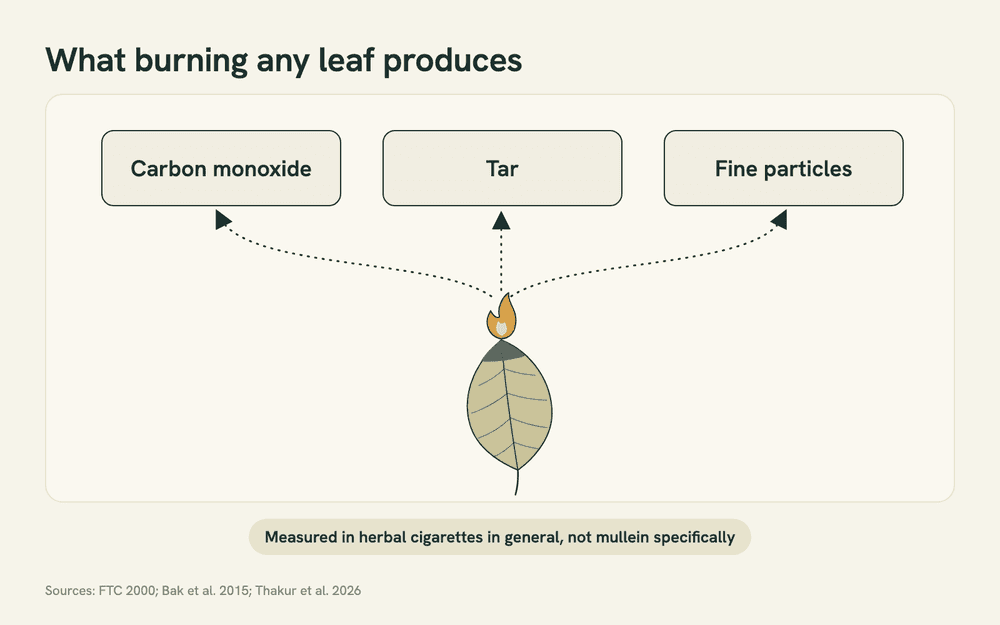
Burning a leaf makes smoke, whatever the leaf is. US regulators put it bluntly a quarter-century ago. In 2000 the Federal Trade Commission settled with two cigarette companies over herbal cigarettes, including the herbal cigarette maker Alternative Cigarettes, Inc., and made them print on packs and ads: "Herbal cigarettes are dangerous to your health. They produce tar and carbon monoxide." Our guide to herbal smoking blends and what's in them covers that case and the rest of the category in depth. We found no published measurement of mullein smoke itself in a November 2026 PubMed search, so the numbers below are for herbal cigarettes in general.
Each of those lab studies has a caveat worth knowing. When Korean researchers machine-smoked one herbal cigarette, a mugwort blend rather than mullein, it had no detectable nicotine but gave off about twice the carbon monoxide of a comparable tobacco cigarette, and its smoke condensate was mutagenic in lab tests. That is one product, smoked by a machine, with no people involved. A 2026 lab study of herbal versus tobacco cigarette emissions found that the herbal products released about 20% more of the smallest particles, and particles that were more chemically reactive in an oxidative-potential test; its abstract doesn't name the herbs, so mullein may or may not have been among them.
The researchers who study these plants as crops say the same thing. A 2024 systematic review of tobacco-replacement crops lists mullein among the six crops it found most often named as tobacco alternatives, and its authors concluded about herbal cigarettes: "under no circumstances should they be regarded as safer than regular tobacco." Smoke also irritates your airway on the way in, which our explainer on why smoke makes you cough walks through, and our piece on smoking weed out of a hookah looks at the carbon monoxide that comes from burning plant material.
Mullein in a joint: what changes and what doesn't
Mullein is also marketed as a tobacco-free filler for joints. Mixing tobacco into cannabis is far more common in some places than others. In a 2014 Global Drug Survey analysis of 33,687 cannabis smokers, 77.2% to 90.9% of past-year smokers in Europe used tobacco routes, depending on the region, compared with 4.4% to 16.0% in the Americas. That habit is where herbs marketed as tobacco-free filler come in. Here is what swapping tobacco for mullein does and doesn't do.
- It removes nicotine. Tobacco is the nicotine source in a spliff. Mullein has none, and the herbal cigarette in the Bak study had no detectable nicotine.
- It doesn't remove smoke. You're still burning leaf, plus the cannabis, so carbon monoxide, tar and fine particles stay.
- It doesn't change the high. Any effect comes from the cannabis; mullein adds no cannabinoid.
- It doesn't change a drug test. A THC screen finds what the cannabis put there. Mullein neither adds to it nor hides it.
- It isn't a measured health upgrade. We found no study comparing mullein joints with tobacco joints or plain ones.
Paper, tobacco leaf or herbal filler, the burning is the constant. Our comparison of blunts and joints explains what a tobacco-leaf wrap adds, and the same logic applies here: changing what's in the mix changes some of the chemistry, but it's still smoke.
Where the leaf came from matters
There's one more reason an anonymous "mullein blend" isn't automatically harmless, and it comes from FDA's own forensic lab. Synthetic cannabinoids, the drugs sold as K2 or Spice, are lab-made chemicals. NIDA's overview of synthetic cannabinoids explains that they are added to dried, shredded plant material so they can be smoked, and that using them "can be life-threatening." When chemists at FDA's Forensic Chemistry Center built a test to measure synthetic cannabinoids in plant products, mullein leaf was one of the three leaves they validated it on, alongside marshmallow leaf and damiana. The method recovered an average of 92% of 32 synthetic cannabinoids from mullein leaf, and the real case products the lab analyzed held anywhere from 0.2 to more than 100 mg per gram. That is a method paper, not a survey of how often mullein is laced. The practical lesson is simpler: a sprayed leaf looks like any other.
Our breakdown of how K2 differs from natural cannabis covers synthetic cannabinoids in detail, and our guide to the signs that weed may be laced explains why looks and smell are unreliable. The checklist below applies to any smokable herb product.
Red flags on a smokable herb product
- It produces a high. Nothing known to be in mullein should.
- There's no ingredient list, no maker's name or no lab report.
- It's sold as incense or potpourri, labeled "not for human consumption", or marketed as a "legal high".
- Hemp or CBD flower is in the mix. Then it contains cannabinoids, including traces of THC.
- It has an odd chemical smell. A normal smell proves nothing, though.
- Chest pain, a racing heartbeat, confusion, severe agitation or a seizure after smoking: call 911. For poisoning questions, Poison Help is 1-800-222-1222.
Who shouldn't inhale it at all
Some people have more reason than most to skip inhaling any smoke, mullein included. If you have asthma, COPD or another lung or heart condition, talk to a clinician before inhaling any smoke or vapor; an herbal reputation is not a reason to make an exception. If you're pregnant or breastfeeding, note that the EU monograph doesn't recommend even the tea: "Safety during pregnancy and lactation has not been established. In the absence of sufficient data, the use during pregnancy and lactation is not recommended." It also records that "Adequate tests on reproductive toxicity, genotoxicity and carcinogenicity have not been performed." If you're under 21, no smoked or vaped product of any kind is for you. The EU doesn't even set a tea use for children under 12, because it "has not been established due to lack of adequate data."
Is mullein legal, and will it show up on a drug test?
Federally, mullein is not a controlled substance. In November 2026 we searched the federal schedules in 21 CFR 1308.11 to 1308.15, including the Schedule I list at 21 CFR 1308.11, and found no entry for mullein or Verbascum. It also isn't among the 13 plants on Louisiana's list of prohibited smokable plants. We didn't check every state, so look up your own state's rules. This is a factual check of federal law, not legal advice.
FDA does mention mullein in one place. Its food-additive rules at 21 CFR 172.510 list mullein flowers as a natural flavoring, "in alcoholic beverages only." That's a food-additive listing for the flowers. It says nothing about the leaf, and nothing about whether smoking any part of the plant is safe.
As for drug tests: mullein itself has no THC, so it can't create the THC metabolite a urine test looks for. What's mixed with it can. A blend that contains hemp, or a joint that contains cannabis, tests as what it contains. Our explainer on the 10-panel drug test covers what standard panels actually screen for.
What the evidence does not show
- No study in PubMed has had people inhale mullein smoke or vapor (search run November 2026).
- The same searches turned up no clinical trial of mullein for any lung condition.
- We found no published measurement of what's in mullein smoke. The smoke figures above come from other herbal cigarettes.
- The EU monograph covers the flower as a tea, and the EMA says it has no clinical data even for that.
- The few randomized trials of mullein in people tested multi-herb ear drops and a wound cream. None had anyone breathe it in.
- The FDA lab's method shows mullein leaf can carry synthetic cannabinoids. It doesn't show how often products are laced.
Frequently asked questions
Any smoke irritates your airway, and burning a leaf produces carbon monoxide, tar and fine particles. In 2000 the FTC made two companies selling herbal cigarettes warn that their products "produce tar and carbon monoxide." A November 2026 PubMed search found no study in which people inhaled mullein smoke, so there's no measurement specific to mullein, and no evidence that smoking it helps your lungs. If you have a lung or heart condition, talk to a clinician before inhaling anything.
No. Its known compounds are iridoids, saponins, flavonoids, mucilage and verbascoside. None is a cannabinoid and none is a known intoxicant, and a November 2026 PubMed search found no report of mullein intoxicating anyone. If a product sold as mullein gets you high, something else is in it.
The EU record covers mullein flower tea, drunk, for the sore throat that comes with a dry cough or a cold, on the basis of traditional use, and the EMA says there are no clinical data even for that. It covers no smoked, vaped or inhaled form, and it doesn't cover the leaf, which is the part people smoke. Drinking a tea and inhaling combustion products are simply different exposures.
A November 2026 PubMed search for mullein with vape, vaping, vaporizer or e-cigarette returned 0 papers, so there's no published data on what mullein vapor contains. A dry-herb vaporizer heats plant material rather than burning it, but you're still inhaling what comes off heated leaf, and none of the vaporizer research involved mullein. This page isn't a guide to vaping anything.
Tea bags may hold flowers, leaves, other herbs or a blend, plus the bag itself, and they're made to be steeped, not burned. Nothing about the bag changes the picture above: burning it makes smoke, and our November 2026 PubMed search found no published measurement of mullein smoke.
Mullein isn't on any federal controlled-substance schedule (checked November 2026), and FDA lists mullein flowers as a natural flavoring in alcoholic beverages only. It isn't on Louisiana's 13-plant smokable ban list either. State rules vary, so check yours. This is a statement about the law as written, not legal advice.
Mullein itself has no THC, so it can't create the THC metabolite a urine test looks for. What's mixed with it can: a blend that contains hemp, or a joint that contains cannabis, tests as what it contains.
No smoked or vaped product is for anyone under 21. Even the EU's mullein flower tea isn't set for children under 12, because the regulator found too little data to establish that use.
Mullein is one of several herbs sold for smoking, and most share the same story: a folk reputation, little or no data on the smoke, and the same combustion chemistry as any other leaf. For the rest of the herbs you'll find on the shelf, see our guide to what's in herbal smoking blends.
Writing about hemp, wellness and the small rituals that keep us balanced.