Can You Smoke Wild Lettuce? What We Know About the High
Wild lettuce will burn, but no controlled human study shows it gets you high. Here is what is in its bitter latex, what the poisoning reports and mouse studies found, where the name 'opium lettuce' comes from, and how it compares with weed.
Can you smoke wild lettuce? Dried wild lettuce will burn, and in the 1970s "wild lettuce" was being sold to smoke as an "opium substitute". Does it get you high? No controlled human study has shown that. The detailed human records in the medical literature are poisoning reports from people who ate the plant or injected an extract, and the sedation behind its reputation was measured in mice. The compounds identified in wild lettuce are bitter lactones, not cannabinoids and not opiate alkaloids.
Wild lettuce (Lactuca virosa) turns up in herbal smoking blends and on supplement shelves, often under the name "opium lettuce". The pages that rank for it are mostly first-person trip reports and supplement monographs that list traditional uses. Neither tells you what the evidence actually is. So we went to the records: the two human case reports that describe what happened to real people, the two mouse studies behind the sedation story, the 1799 pamphlet that gave the plant its nickname, and the 1976 medical review that caught it being sold as a smokable "legal high". Below is what is in the plant, what those records show and don't show, how it compares with cannabis, and what the law and drug tests have to say about it.
What wild lettuce is, and what lactucarium is
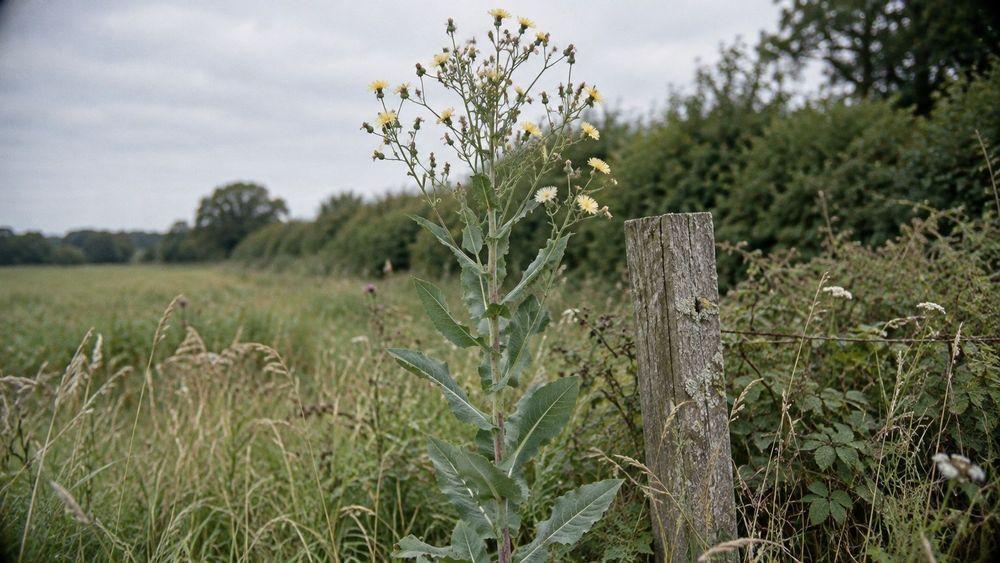
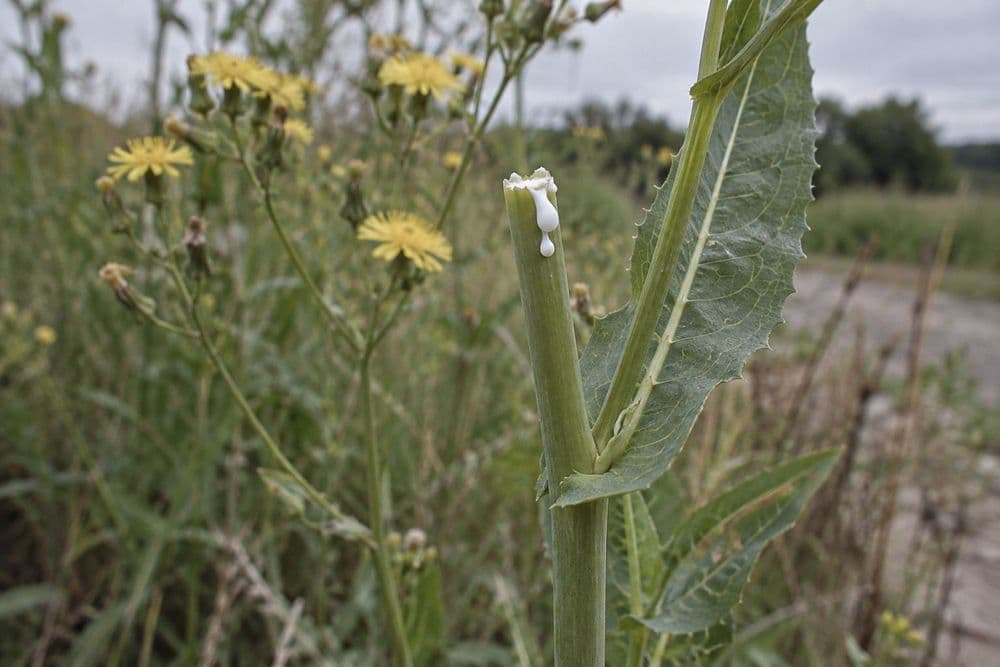
Wild lettuce is Lactuca virosa, a tall biennial weed that can reach about 6 feet. Its Latin name roughly means "milky" and "poisonous": as the authors of a 2009 case series in BMJ Case Reports put it in their background section, "lactuca means 'milky extract' and virosa means 'toxic'". Cut a stem or a leaf and the plant bleeds a bitter white latex. When that juice dries, it hardens, turns brown and is known as lactucarium. Lactucarium is the substance behind the plant's old reputation, and it is what 19th-century pharmacies actually stocked.
So what is in the latex? A 2000 study in the Journal of Biological Chemistry profiled the latex of garden lettuce and several other Lactuca species and found it dominated by bitter compounds called sesquiterpene lactones, chiefly lactucin, deoxylactucin and lactucopicrin, much of it bound to oxalate or sulfate groups. The authors reported "significant qualitative and quantitative variation" between lettuce varieties and between species, and suggested the lactones help explain lettuce's bitter taste. A 2020 study of five Turkish lettuce species in Molecules measured lactucin as the main component of their latex. Notice what is missing from those lists. The compounds chemists have actually identified in wild lettuce's latex are sesquiterpene lactones, not opiate alkaloids such as morphine and not cannabinoids such as THC.
Botanically, wild lettuce sits in the daisy family, Asteraceae, next to garden lettuce (Lactuca sativa) and chicory, which makes the same kind of bitter lactones. Cannabis is in a different family, Cannabaceae, which it shares with hops; our piece on whether hops and weed are related walks through that family tree. The lettuce in your salad is a cousin of wild lettuce, not the same plant, and nothing in this article suggests a salad does anything to you.
Does wild lettuce get you high? The evidence, rung by rung
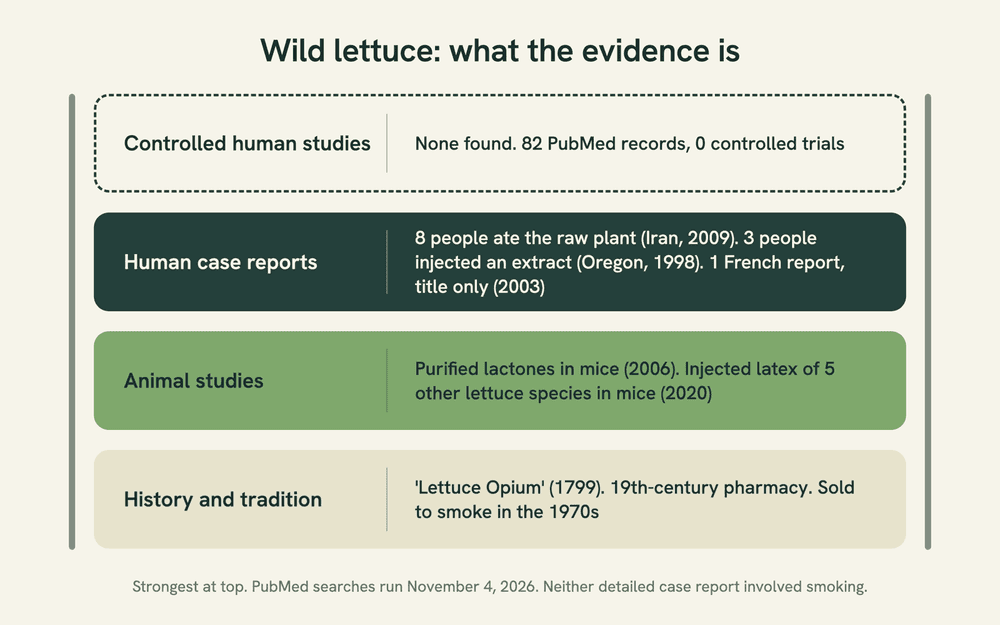
The honest way to answer is to sort what exists by how much it can tell you. Controlled studies in people sit at the top; reputation and tradition sit at the bottom. Here is the ladder for wild lettuce as of November 2026, from strongest to weakest.
- 1Controlled human studies: none found. A PubMed search on November 4, 2026 returned 82 records for wild lettuce or lactucarium, and none is a controlled human trial.
- 2Human case reports: eight people in Iran who ate the raw plant (2009), three people in Oregon who injected a homemade extract (1998), and a 2003 French report titled "Abuse of Lactuca virosa".
- 3Animal studies: purified lettuce lactones dulled pain responses and reduced activity in mice (2006); latex from three of five other lettuce species sedated mice after injection (2020).
- 4History and tradition: a 1799 "Lettuce Opium" pamphlet, 19th-century pharmacy use of lactucarium, and a 1970s market that sold wild lettuce to smoke.
The top rung is empty
We ran the searches ourselves on November 4, 2026. A PubMed search for wild lettuce or lactucarium together with smoking or inhalation returns exactly one record, and it is a history essay about a 13th-century Arabic surgeon's anesthetic sponges, which listed wild lettuce next to opium, mandrake and cannabis. Adding "randomized" or "placebo" to the plant search returns 4 records, and none is a trial of wild lettuce: two are lettuce genetics papers, one is a plant-identification method, and one is a sleep-medicine committee review of nonprescription products. Restricting the search to records tagged as clinical trials returns 0, for the plant and for lactucin or lactucopicrin. A search is not proof that no study exists anywhere, but PubMed is the main index of biomedical research, and on this question it is empty.
What the human records actually describe
The most detailed human record is that 2009 report from northern Iran. Eight people aged 12 to 38, members of a climbing group, ate a large amount of raw wild lettuce in May. Their signs included a decreased level of consciousness, agitation, dry mucous membranes, dilated pupils, blurred vision, urinary retention and unsteady walking. Two of them had hallucinations along with signs of an overactive "fight or flight" response, and two others had agitation, heavy sweating, flushing and euphoria. The authors read the overall pattern as "suggesting an anticholinergic mechanism", the kind of poisoning picture produced by substances that block acetylcholine, one of the nervous system's chemical messengers. All eight recovered and were discharged after 48 hours; one spent 48 hours in intensive care for prolonged loss of consciousness. They ate the plant. Nobody in the report smoked it.
The second record is stranger. In a 1998 Oregon Poison Center report titled "The case of the salad shooters", three young people injected a homemade wild lettuce extract into a vein, and one of them also injected a valerian extract. All three "rapidly became ill" with fever, chills, abdominal, flank and back pain, neck stiffness and headache, along with a raised white blood cell count and mild liver test abnormalities, and they recovered over 3 days. Injecting a crude homemade extract is dangerous in its own right, which makes it hard to say how much of the illness came from the plant's chemistry, and the case says nothing about smoking. The authors also noted that the opiate effect claimed online did not show up. The third report, published in La Presse Médicale in 2003, is titled simply "Abuse of Lactuca virosa". It has no abstract in PubMed, so we can't tell you what it describes, and we won't guess.
What the mouse studies show
The sedation story rests on animals. In a 2006 mouse study in the Journal of Ethnopharmacology, researchers gave mice purified lactucin, lactucopicrin and a closely related lactone at doses scaled to body weight. In a hot-plate test, a standard way of measuring pain responses in rodents, the compounds produced an effect the authors described as similar to ibuprofen's, and lactucopicrin was the most potent. Lactucin and lactucopicrin also made the mice less active, which researchers read as sedation. The 2020 Turkish study injected latex from five lettuce species into the abdomens of mice, six animals per group, with the sedative lorazepam as a comparison. Three species sedated the animals and two did nothing at all. Wild lettuce itself was not one of the five. Taken together, these are mouse data on purified compounds and injected latex. They say nothing about what smoking a dried leaf does to a person, and they show that "lettuce latex" is not one consistent substance.
Where "opium lettuce" comes from
The nickname is far older than any of these studies. In his 1911 history of the vegetable drugs of the U.S. Pharmacopoeia, the pharmacist and historian John Uri Lloyd explains that dried lettuce juice "is known as Lactucarium, an extract known also under the name Lettuce Opium." The name traces to a Dr. Coxe of Philadelphia, who suggested collecting lettuce juice "after the manner employed in the making of opium" and published his experiments in 1799 under the title "Lettuce Opium." Lloyd adds that the substance entered medicine "through usual empirical channels", meaning trial and reputation rather than chemistry. In other words, the name describes how the juice was gathered and sold, by analogy with opium poppies. It was never a lab finding about what the juice contains.
Through the 19th century, lactucarium was an ordinary pharmacy item, and medical journals were still printing notes on lactucarium syrup and paste in 1889. According to a 2005 history of its use in 19th-century medicine, lactucarium was considered an intoxicant, was used as a sedative and an analgesic, and its action was judged "weaker than that of opium". Researchers of the period also tried to isolate the substance responsible for its effects, and "the component responsible ... was not identified." That is a record of what people believed and did at the time, not evidence that it worked, and none of it suggests that wild lettuce can stand in for any medicine.
The smoking revival came much later. In 1976 the UCLA pharmacologist R. K. Siegel catalogued the herbal cigarettes, teas and capsules of the day in a JAMA review of herbal "legal highs", products he described as "promoted as legal hallucinogens, euphoriants, and marihuana substitutes". Wild lettuce was on his list, to "smoke as opium substitute", with only a "mild narcotic-analgesic" effect reported. Two details matter. Those reported effects came from users and marketing, not from measurements. And the table's botanical column names Lactuca sativa, garden lettuce, not Lactuca virosa, a reminder that what was sold as "wild lettuce" was not always wild lettuce.
“Various literature and internet sources claim that wild lettuce has opiate properties not demonstrated in this case.”
So where does that leave the opium question? The compounds identified in the latex are sesquiterpene lactones. On November 4, 2026, a PubMed search pairing lactucin, lactucopicrin or lactucarium with opioid, opiate, morphine, naloxone or cannabinoid returned 0 records, and a second search pairing wild lettuce or lactucarium with cannabinoid, CB1 or opioid receptors also returned 0. A broader search turned up one near miss: a 2022 computer-modeling study that docked 19 compounds from garden lettuce against the kappa opioid receptor, and its best-scoring molecules were two forms of vitamin E and a plant sterol. A simulation predicts fit; it does not test activity, and it was not about wild lettuce. We found no laboratory or human study showing that any wild lettuce compound acts on opioid or cannabinoid receptors. "Opium lettuce" is a name about how the juice was collected and marketed, not evidence of an opiate inside.
Can you smoke wild lettuce? What burning it adds
Physically, yes. Dried wild lettuce burns like any other dried leaf, and online trip reports describe people smoking it, with experiences that range from mild relaxation to nothing but a harsh smoke and a sore throat. Those are anecdotes, unblinded and unverified, and they are not a reason to try it. What the science can add here is short. The only PubMed record that mentions wild lettuce together with smoking or inhalation is the medieval history essay above, so no published study has measured what is in wild lettuce smoke or what happens to its lactones when they burn. Any claim you read about how gentle or harsh it is on your lungs is guesswork.
What is known is that smoke from burning plant material is still smoke. In 2000 the Federal Trade Commission settled with two cigarette companies and made them print a warning on herbal cigarette packs and ads, and the Federal Register notice of one of those settlements spells it out: "Herbal cigarettes are dangerous to your health. They produce tar and carbon monoxide." Wild lettuce smoke is no exception. Our guide to what is actually in herbal smoking blends covers that FTC case and the blend category in depth, and our explainer on why smoke makes you cough covers the airway side. If you've seen mullein listed in the same blends, the evidence on smoking mullein gets its own look. This page is not a guide to smoking anything, and we are not recommending it.
Wild lettuce vs weed
Here is how the two plants line up on the questions behind a "wild lettuce vs weed" search.
| Question | Wild lettuce (Lactuca virosa) | Cannabis (Cannabis sativa) |
|---|---|---|
| Plant family | Asteraceae, the daisy family, with garden lettuce and chicory | Cannabaceae, shared with hops |
| Signature compounds | Sesquiterpene lactones: lactucin, deoxylactucin, lactucopicrin | THC, CBD and other cannabinoids, plus terpenes |
| Known receptor target | None established. No lab or human study we found links its compounds to cannabinoid or opioid receptors (PubMed, November 2026) | THC binds the CB1 cannabinoid receptor, first cloned in 1990 |
| Human evidence | Case reports of poisoning after eating (8 people) or injecting (3 people); no controlled trials | Many controlled human studies of THC and CBD |
| Federal status | Not on any federal controlled-substance schedule (21 CFR part 1308, November 2026) | Marijuana remains a controlled substance under federal law; hemp, defined by a 0.3% THC limit, is excluded |
| Marijuana drug test | Makes no THC, so there is nothing for the test to find | The test targets THC-COOH, a breakdown product of THC |
So, is wild lettuce like weed? Only in the sense that both are plants people have smoked. THC produces its high mainly by acting on CB1, the receptor described in a 1990 Nature paper that cloned it, and our explainer on what cannabinoids are and how they work covers that system. Nothing in wild lettuce has been shown to act there. The comparison people often reach for is sedation, since wild lettuce's old reputation is as a sedative, but cannabis effects vary by person and dose, which is why the question of whether weed counts as a depressant has a longer answer than you might expect. Wild lettuce joins catnip on the list of plants compared with cannabis in which no cannabinoid has been identified. Our look at whether catnip gets you high runs the same test on a different plant, and for the opposite case, see the plants that really do make cannabinoid-like compounds.
Is wild lettuce safe? Red flags to know
Wild lettuce is often sold as a gentle herb, but the only detailed human record is a poisoning, and the injection cases made three people acutely ill. Case reports can't tell you how often problems happen, only what they looked like when they did. In the 2009 Iranian series the picture was anticholinergic: dilated pupils, dry mouth, flushing, trouble urinating, agitation, confusion, hallucinations and, in one case, prolonged loss of consciousness. Supplement monographs also flag a possible interaction with sedating drugs, so as a general rule, don't combine any sedating herb with alcohol or sedative medicines without asking a pharmacist first. And if you're looking at wild lettuce because of pain or sleep trouble, that is a conversation for a clinician: no human trial supports it for either.
Is wild lettuce legal, and does it show up on a drug test?
Federally, wild lettuce is not a controlled substance. On November 4, 2026 we searched the full text of 21 CFR part 1308, the regulation that lists scheduled drugs, including the Schedule I list at 21 CFR 1308.11, for lettuce, Lactuca and lactucarium, and found no entry. We also checked Louisiana, which keeps two of the strictest plant lists we know of. Louisiana's list of 13 prohibited plants, which covers smokable and consumable forms and names blue lotus, damiana and kratom, does not include wild lettuce, and neither does its older list of 40 hallucinogenic plants. Our guide to whether blue lotus is legal walks through that law. This is a dated factual check, not legal advice, and not a statement about every state or city. Unscheduled also does not mean approved or safe, and nothing here makes wild lettuce a substitute for anything.
As for drug tests, a marijuana screen does not look for "weed" in general. Under the federal workplace drug-testing guidelines, the cannabis target is a breakdown product of THC, delta-9-THC-9-carboxylic acid. Wild lettuce makes no THC, so there is nothing in it for that test to find, and standard panels don't look for its lactones; our guide to the 10-panel drug test lists what they do look for. Forensic scientists have noticed the plant, though. A 2020 forensic review put Lactuca virosa on its list of 14 "new psychoactive substances of natural origin" and noted that a comprehensive method for detecting these plant compounds in body fluids "is still lacking". None of that makes wild lettuce a way around a test. Labs and programs vary, so questions about a specific test belong with the lab or the program running it.
What the evidence does not show
- No controlled human trial of wild lettuce, by any route, appears in PubMed as of November 4, 2026.
- No published study has measured what is in wild lettuce smoke or what happens to its lactones when they burn.
- No lab or human study we found shows any wild lettuce compound acting on opioid or cannabinoid receptors; the one modeling study we found was of garden lettuce.
- The sedation and pain-response data come from mice given purified compounds or injected latex, and the 2020 study did not test wild lettuce itself.
- The two detailed human reports involve eating the raw plant or injecting an extract, not smoking, and case reports cannot say how common problems are.
- The 2003 French report has no abstract we could read, and the 1976 JAMA table names garden lettuce, so even the plant's identity is fuzzy in parts of the record.
Frequently asked questions
No controlled study shows that it does. Online reports range from mild relaxation to nothing but a harsh smoke. The euphoria in the most detailed medical report we could read was part of a poisoning: eight people in northern Iran who ate a large amount of the raw plant in 2009 and also had dilated pupils, agitation and urinary retention. All recovered, one after two days in intensive care.
The compounds chemists have identified in wild lettuce's latex are bitter sesquiterpene lactones, mainly lactucin and lactucopicrin, not opiate alkaloids. As of November 2026 we found no laboratory or human study showing that any of them acts on opioid receptors, and a 1998 poison-center report noted that the opiate properties claimed online were "not demonstrated". The name "opium lettuce" comes from how the juice was collected in 1799, by analogy with opium.
Lactucarium is wild lettuce's milky latex, dried until it hardens and turns brown. It was a stocked pharmacy item in the 19th century, also sold as "lettuce opium", and it was considered weaker than opium. Researchers of the period tried and failed to identify the component responsible for its effects.
No. Garden lettuce is Lactuca sativa and wild lettuce is Lactuca virosa. They are cousins in the daisy family, and garden lettuce latex contains the same family of bitter lactones in amounts that vary by variety. Nothing in the research suggests that eating salad has any sedating or intoxicating effect.
Federally, it is not a controlled substance: it does not appear in the schedules in 21 CFR part 1308 (checked November 4, 2026). It also isn't on either of Louisiana's plant lists, the strictest state lists we checked. That is not legal advice, and not a statement about every state or locality.
A standard marijuana screen looks for a breakdown product of THC. Wild lettuce makes no THC, so there is nothing in it for that test to find, and standard panels don't test for its compounds. Test types vary, so questions about a specific test are best put to the lab or program running it.
Not chemically. Wild lettuce is in the daisy family and makes sesquiterpene lactones. Cannabis is in the Cannabaceae family and makes cannabinoids such as THC, which acts on the CB1 receptor. No wild lettuce compound has been shown to act on cannabinoid receptors, and there are no controlled human studies of wild lettuce at all.
Wild lettuce usually reaches people as one ingredient in a smokable mix, alongside mullein, damiana and other dried herbs. For what those mixes contain, why "tobacco-free" does not mean smoke-free, and what their labels leave out, read our full guide to herbal smoking blends and what their labels can't tell you.
Writing about hemp, wellness and the small rituals that keep us balanced.