Is Blue Lotus Legal? Federal, State and Military Rules
Blue lotus is not on any federal drug schedule, but that is not the whole answer. Here is the Louisiana statute most sites misquote, the military ban, what lab tests found in products sold as blue lotus, and what it means for a drug test.
Is blue lotus legal? In most of the US, yes, in the narrow sense federal drug law cares about: as of November 2026, blue lotus is not on any federal controlled-substance schedule. That is where the simple answer ends. Louisiana makes it a crime to sell or possess blue lotus in forms meant to be eaten, drunk, smoked or vaped. Service members are barred from it everywhere. And not being scheduled is not the same as FDA approval, or as anyone checking what is in the package.
This page reads the law layer by layer, the way it actually reaches you: federal drug law, the FDA, your state, the military and your employer. It quotes the Louisiana statute that most pages mention without reading, and it gets the section right (it is RS 40:989.2, from 2010, not the 2005 law you will often see named). Then it covers the questions that follow: can you smoke blue lotus, how does it compare with weed, what have lab tests found inside products sold under its name, and can it show up on a drug test. Everything here is dated November 2026 and is general information, not legal advice. For the wider picture of how plant-derived products are regulated, our guide to whether CBD is legal covers hemp and marijuana law.
What blue lotus is, and what it isn't
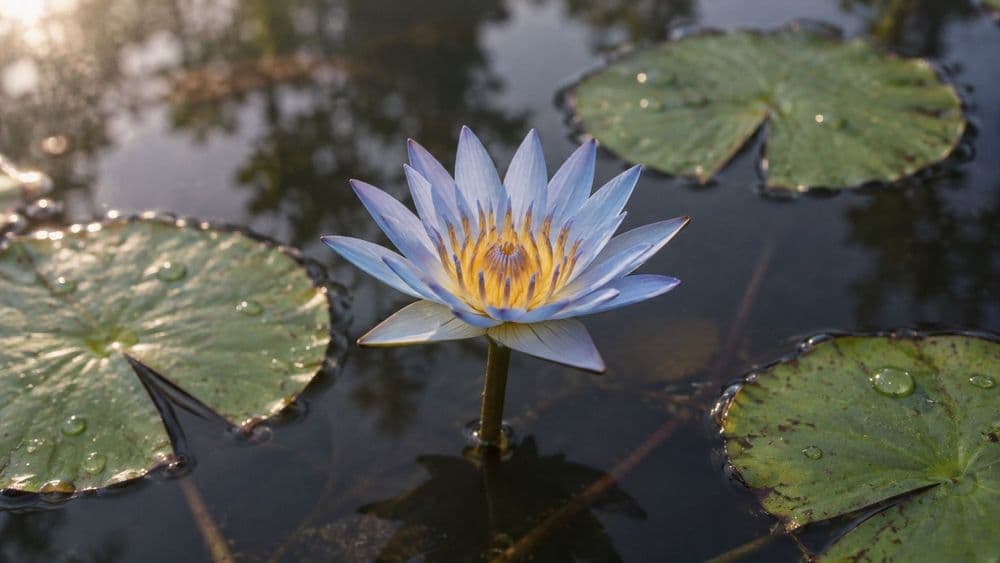
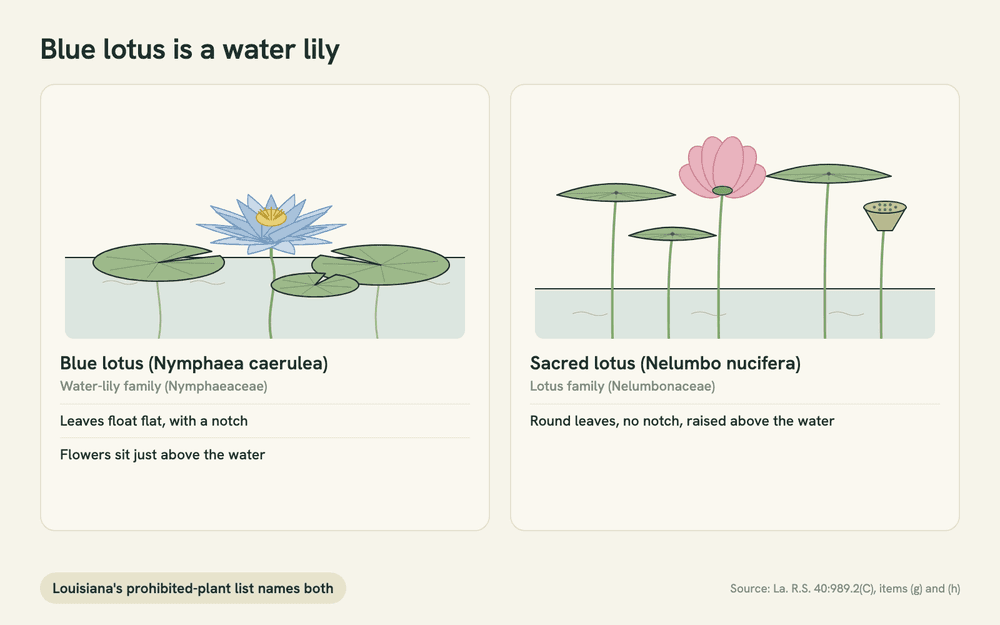
Blue lotus is the Egyptian blue water lily, Nymphaea caerulea, a member of the water-lily family, Nymphaeaceae. It grows in still water, with pale blue, star-shaped flowers held just above floating leaves. Its reputation is old. The flower appears throughout ancient Egyptian art, and a 1981 review in the Journal of Ethnopharmacology read that imagery as evidence of ritual use. That is an interpretation of art, not a measurement of anything. Today the plant is sold as dried flowers, tea, resin, oils and vape liquids. The two compounds most often linked to it are apomorphine and nuciferine, both members of a chemical class called aporphine alkaloids. Apomorphine is better known as a prescription drug for Parkinson's disease, and nuciferine has been studied mainly in the lab and in animals. How either behaves in a person who uses blue lotus has not been studied.
Despite the name, blue lotus is not a true lotus. The sacred lotus, Nelumbo nucifera, belongs to a different plant family, Nelumbonaceae. The difference matters for identifying the plant, but do not read it as a legal distinction. Louisiana's list of prohibited plants names both: blue lotus as item (h) and sacred lotus, separately, as item (g).
Is blue lotus legal in the US? The answer by layer
Most answers online collapse five different questions into one. Whether blue lotus is "legal" depends on who is asking: the DEA, the FDA, your state, your commanding officer or your employer. Each has its own rulebook, and a yes from one says nothing about the others. Here is each layer as it stood in November 2026, with the record it rests on.
| Layer | Status, November 2026 | Primary record |
|---|---|---|
| Federal drug law (DEA) | Not a controlled substance. Blue lotus and nuciferine appear on no federal schedule; the schedules name apomorphine only to exclude it. | 21 CFR Part 1308, eCFR text as of November 1, 2026 |
| FDA | Not approved for human consumption. We found no FDA rule, warning letter or import alert that names blue lotus. | America's Poison Centers; our search of FDA records, November 2026 |
| Louisiana | A crime to make, sell or possess it in forms for the mouth or nose, for smoking, or for burning and inhaling. Growing it for decoration is exempt. | La. R.S. 40:989.2 (Acts 2010, No. 565; amended through 2025) |
| Other states | We found no other state statute that names it. This was not a 50-state survey, so check your own state's code. | Our search, November 2026 |
| Military | Prohibited for all service members, in any form, overseas and stateside. | DoD Prohibited Dietary Supplement Ingredients List (DoDI 6130.06) |
| Employers | Standard panels don't test for it, but employers set their own policies, and spiked products can contain drugs a test can detect. | HHS federal workplace drug-testing guidelines (90 FR 4662, 2025) |
| Outside the US | Rules differ by country. Check local law before you travel with it. | Local law |
Federal law: not scheduled, and what that doesn't mean
The federal controlled-substance schedules live in 21 CFR Part 1308. In November 2026 we searched the full text of that part, as published in the eCFR on November 1, 2026, for Nymphaea, lotus, nuciferine and aporphine, and found no entry for any of them. One related name does appear, and it cuts the other way: the Schedule II list at 21 CFR 1308.12 controls opium and opiates "excluding apomorphine". So apomorphine is named in federal drug law only to be carved out. The Defense Department's supplement-safety program reached the same conclusion in its 2024 note on blue lotus: "Blue lotus is not currently listed as a controlled substance, according to the Drug Enforcement Administration (DEA), so it can be sold legally in most states."
Not scheduled is a narrow fact. America's Poison Centers notes that blue lotus "is not approved by the US Food and Drug Administration (FDA) for human consumption." We also searched FDA's records in November 2026 and found no rule, warning letter or import alert that names blue lotus, and Nymphaea does not appear anywhere in Title 21 of the federal regulations. That silence is not approval. It means no federal standard defines what a product sold as blue lotus should contain. In practice, "not a controlled substance" does not mean any of the following:
- That the FDA has approved it. It is not approved for human consumption.
- That the label is accurate. Lab tests of products sold as blue lotus have found the expected compounds missing, synthetic fragrance in every oil tested, and synthetic cannabinoids in seized vape cases (details below).
- That it is legal in every state. Louisiana restricts it by statute.
- That you can use it in uniform. The Defense Department prohibits it for service members.
- That it is safe. The human record is a handful of emergency cases, and no controlled study has tested its effects in people.
Louisiana: what RS 40:989.2 actually says
Louisiana is the state everyone mentions, usually with no section number. The law is Louisiana Revised Statutes 40:989.2, the state's "prohibited plant products" statute. It was enacted by Acts 2010, No. 565, and amended in 2015, 2018 and 2025 (most recently by Acts 2025, No. 41). We read the text as posted on the legislature's site and captured by the Internet Archive on September 9, 2026, after the 2026 session's laws took effect. It makes it a crime to produce, manufacture or distribute, or to possess with intent to do so, material containing a prohibited plant when any one of three things is true:
“(a) It is intended to be placed in the oral or nasal cavity. (b) It is prepared in such a manner as to be suitable for smoking in a pipe or cigarette, or other device. (c) It is to be burned and inhaled or exhaled in any manner or in any form.”
In plain English, the law covers blue lotus meant to go in your mouth or nose, to be smoked, or to be burned and inhaled. Tea, edibles, snuff, smokable flower and vapes all fit. Notice what is missing: the phrase "intended for human consumption", which many sites attach to this law, belongs to a different statute, RS 40:989.1. Under 989.2 the test is the form and purpose of the product. The list of prohibited plants runs to 13 entries, including kratom, Salvia divinorum, damiana, mugwort and lion's tail, and it reaches "any combination of any of the parts, leaves, stems, stalks, seeds, materials, compounds, salts, derivatives, mixtures, preparations, or any resin extracted from any part of" a listed plant.
| Question | What RS 40:989.2 says |
|---|---|
| Which plants? | 13 listed plants, including Nymphaea caerulea (blue lotus, item h) and Nelumbo nucifera (sacred lotus, item g), plus any part, extract or preparation of them. |
| Which forms? | Material meant for the mouth or nose, prepared for smoking, or meant to be burned and inhaled. |
| Making or selling | Up to 5 years in prison, with or without hard labor, and a fine of up to $10,000. |
| Possession | Up to 6 months in jail, a fine of up to $500, or both. |
| Growing it in a pond | Exempt when strictly for aesthetic, landscaping or decorative purposes. |
| Other exemptions | Certain FDA-recognized over-the-counter homeopathic forms, and some products labeled and made as federal dietary supplements. |
| On the books since | 2010 (Act 565); most recently amended in 2025 (Act 41). |
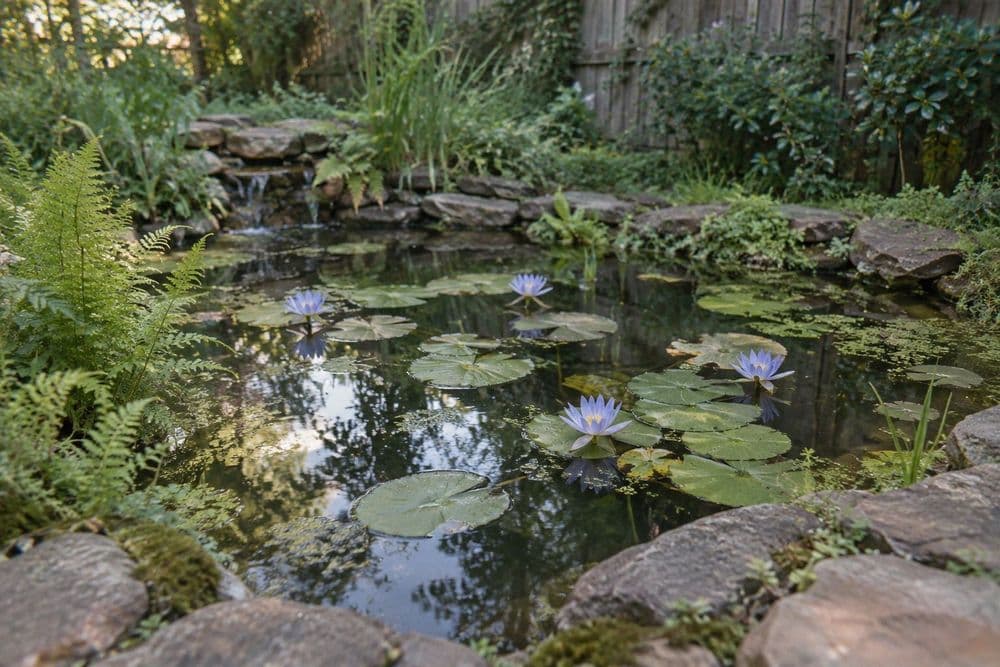
Two exemptions deserve a closer look. The decorative one is broad: the law "shall not apply to the possession, planting, cultivation, growing, or harvesting of a prohibited plant strictly for aesthetic, landscaping, or decorative purposes." A water lily in a garden pond is not the target. The dietary-supplement exemption is the one no top search result mentions. It covers "any dosage form which is labeled as a dietary supplement and is manufactured in compliance with" sections 402(g)(2), 415 and 761 of the federal Food, Drug, and Cosmetic Act, the provisions on supplement manufacturing practices, facility registration and serious adverse-event reporting. Whether any particular blue lotus capsule or tincture qualifies turns on its label and how it was made. That is a question for a Louisiana attorney, not for a product page, and not for us.
How to check the law where you live
Louisiana is the only state statute naming blue lotus that we found in November 2026. That was not an exhaustive 50-state survey, and plant laws change, which is why the steps below matter more than any list. Vendor pages are not a reliable shortcut: the ones we read cite the Louisiana law under two different sections and three different years.
- 1Search your state's code for the plant's names: Nymphaea caerulea, Nymphaea, blue lotus and Egyptian lotus. Louisiana's law uses both the Latin and the common names.
- 2Then search for the category terms states use for plant bans, such as "prohibited plant" and "hallucinogenic plant". A plant can sit on a list you would never find by its common name.
- 3Check city and county ordinances. Local rules can be stricter than state law.
- 4Look at the form, not just the plant. In Louisiana the law turns on whether a product is for the mouth or nose, for smoking or for inhaling; a pond plant is treated differently from a vape.
- 5If you serve in the military, the answer is already no. Check the DoD Prohibited Dietary Supplement Ingredients List for anything else you take.
- 6If you are drug-tested at work, read your employer's written policy. It can prohibit substances that no law does.
- 7Write down the date you checked. A seller's "legal in all 50 states" line is marketing, not a legal opinion, and if the stakes are real, ask a lawyer licensed in your state.
Blue lotus in the military
For service members there is no gray area. The Defense Department places blue lotus on its Prohibited Dietary Supplement Ingredients List, maintained under DoD Instruction 6130.06 and last updated September 3, 2026. The list page states that "Service Members are prohibited from using any substance identified in this database as ingredients in dietary supplements," and the OPSS note on blue lotus says plainly that it "is prohibited for use by Service Members." A civilian store selling it legally does not change that.
Commands have repeated the warning. An 86th Airlift Wing Q&A from Ramstein Air Base, published November 12, 2024, says blue lotus is "prohibited for use by all U.S. service members overseas and stateside" and that use "is in violation of the UCMJ and can lead to administrative and/or criminal sanctions." In a 2023 Army Times report, Defense Health Agency spokesperson Peter Graves summed up the gap between civilian and military rules: "While these products are indeed mostly legal, service members are not supposed to be using them." The same mechanism, a DoD list that overrides civilian legality, is why hemp products are a problem in uniform too, as our guide to CBD in the military explains.
Can you smoke blue lotus?
Dried flowers burn, and blue lotus is sold as smokable flower, resin and vape liquid. Legally, smoking and vaping are exactly the forms Louisiana's law targets through its second and third prongs, and for service members they are prohibited like every other form. The more useful question is what is known about inhaling it, and the honest answer is very little. A PubMed search we ran on November 4, 2026 for Nymphaea caerulea, Nymphaea coerulea or "blue lotus" returned 18 records. None was a controlled study of what smoking or vaping it does to people.
The human record is a set of emergency cases. A case series in Military Medicine from Carl R. Darnall Army Medical Center at Fort Hood, Texas, described five active-duty patients who came to the emergency department with altered mental status after using blue lotus products, four after vaping and one after making an infused beverage. They had sedation and perceptual disturbances and were managed with supportive care. A case series this small cannot say how common that is, and the products were not lab-tested, so it cannot say whether blue lotus or something added to it caused the symptoms.
Lab work on the vape products themselves shows why that second caveat matters. A 2020 analysis of 18 herbal vaping products bought from one online seller, covering eight herbs including blue lotus, found them "advertised as 'legal in the USA'", yet psychoactive compounds turned up in only two of the eight e-liquids, three of the five resins and three of the four powders. Those counts cover all eight herbs, not blue lotus alone. This page is not a guide to smoking anything, and we are not recommending it. Our overview of herbal smoking blends covers what burning any plant puts in your lungs, and our look at whether you can smoke catnip applies the same scrutiny to another plant rumored to get you high.
What's actually in the bag
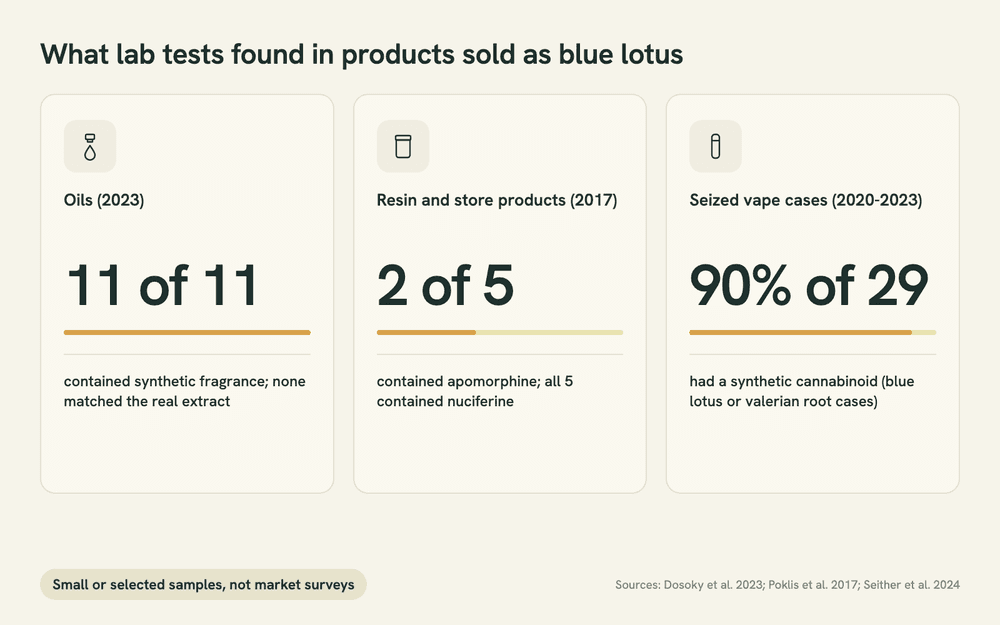
Oils. A 2023 study in Molecules bought 11 "blue lotus" oils on Amazon and Etsy: essential oils, absolutes and one glycerin tincture. "All of the tested samples contained synthetic fragrance components," and none resembled authentic blue lotus extract in aroma or composition. Even the authentic industrial extracts the team analyzed contained no apomorphine and only traces of nuciferine, 10 to 72 parts per billion. Keep the scope in mind: the study covered oils only, not tea, flower or vapes, its safety conclusion is about fragrance use on the skin, and the authors work for an essential-oil company.
Resin and store products. When Virginia toxicologists tested a confiscated blue lotus resin and four store-bought products in 2017, all five contained nuciferine but only two contained apomorphine. The resin held about 4,300 ng/g of nuciferine and no apomorphine at all. Five samples is a small set, but it shows that the two compounds people associate with blue lotus are not reliably there.
Vapes in criminal cases. Military forensic chemists reviewed seized-drug and toxicology cases from May 2020 to December 2023. Of 29 seized-drug cases that mentioned "blue lotus" or "valerian root", 90% had at least one item containing a synthetic cannabinoid; the compounds they name include 5F-MDMB-PICA, ADB-BUTINACA and MDMB-4en-PINACA. They also found 65 toxicology cases with synthetic cannabinoids where the case history mentioned blue lotus. These were cases that reached a crime lab, mostly vape products, with blue lotus and valerian pooled together. They are not a random sample of what is on store shelves, and they do not mean 90% of blue lotus products are spiked.
Synthetic cannabinoids are the compounds behind K2 and Spice. NIDA describes them as lab-made substances chemically similar to compounds in the cannabis plant that "often produce very different effects," and says use of illicit synthetic cannabinoids "is associated with severe health problems and can be life-threatening." Our comparison of K2 and natural cannabis covers the record in detail, and our guide to spotting laced weed explains why looks and smell won't reveal an additive.
Blue lotus vs weed
| Question | Blue lotus (Nymphaea caerulea) | Cannabis (Cannabis sativa) |
|---|---|---|
| Plant family | Nymphaeaceae, the water-lily family | Cannabaceae, shared with hops |
| Main compounds | Apomorphine and nuciferine (aporphine alkaloids), in amounts that vary widely between products | THC, CBD and other cannabinoids, plus terpenes |
| What they act on | In lab and animal studies, nuciferine acts on dopamine and serotonin receptors, not cannabinoid receptors | CB1 and CB2 cannabinoid receptors |
| Human evidence | One five-patient emergency case series; no controlled studies | A large clinical literature on THC and CBD |
| Federal status | Not a controlled substance | Controlled; two narrow categories moved to Schedule III in April 2026 |
| Standard drug panel | Not a target, but spiked products can contain detectable synthetic cannabinoids | THC metabolite (THC-COOH) is a standard target |
Nuciferine's receptor profile comes from lab and rodent research, where it acted on serotonin and dopamine receptors in a pattern the authors called similar but not identical to some approved antipsychotic drugs. That is preclinical work, and it says nothing about what a cup of tea or a vape does to a person. The main point of the table is simpler: blue lotus contains no cannabinoids, so it is not "natural weed" or a stand-in for it. Our guide to plants that actually contain cannabinoids covers the ones that do. On the federal side, marijuana remains a controlled substance, with two narrow categories, FDA-approved products and marijuana covered by a state medical license, moved to Schedule III by a DEA final rule in April 2026. Blue lotus is also not the only botanical on Louisiana's list that gets compared with cannabis: kratom (Mitragyna speciosa) is on it too, and our piece on kratom and weed covers that plant.
Will blue lotus show up on a drug test?
The military sources above seem to disagree. Army Times reported in 2023 that "the substance does not show up on urinalysis tests." The Ramstein Q&A warned that blue lotus "is commonly laced with substances that are detectable in a urinalysis test." Both can be true, and the forensic record shows why.
Blue lotus itself is not what standard tests look for. Under the federal workplace drug-testing guidelines, the marijuana target is a THC metabolite, THC-COOH, with a 50 ng/mL screening cutoff and a 15 ng/mL confirmation cutoff, and nothing on the authorized panel targets Nymphaea, apomorphine or nuciferine. The Fort Hood authors also note that some of the newer psychoactive substances sold for e-cigarettes are "not detectable by standard urine drug screens." Our explainer on the 10-panel drug test lists what standard panels do cover.
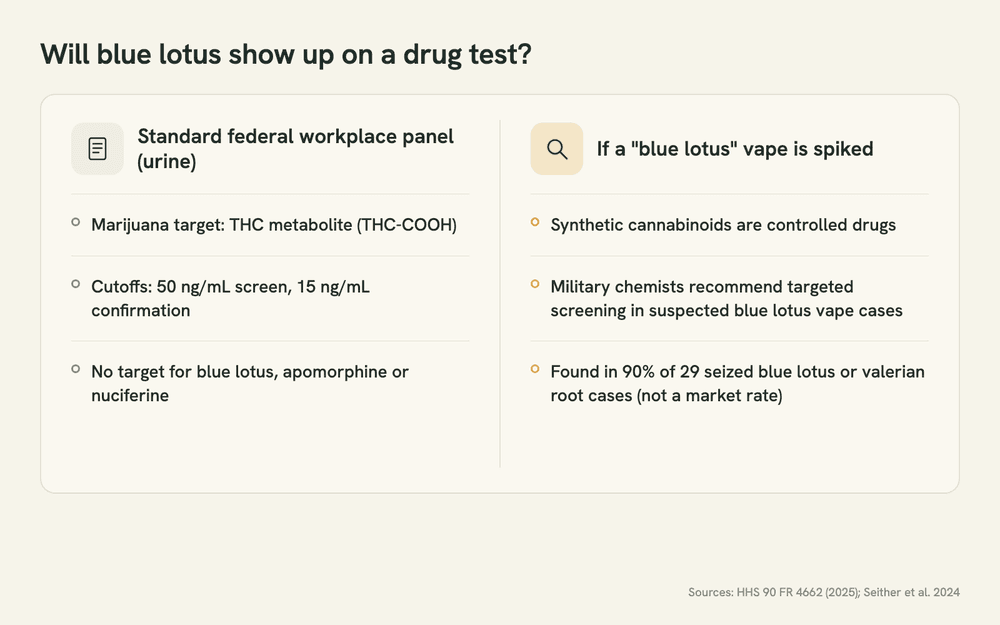
The risk is what else is in the product. If a "blue lotus" vape has been spiked with a synthetic cannabinoid, that compound is a controlled substance, and testing designed for it can detect it. That is what the military forensic team recommended: synthetic cannabinoid screening "for all cases where there is suspected use of vaping products suggested to contain 'blue lotus'." So a clean result on a standard panel tells you nothing about what you inhaled, and a targeted test can come back positive for a drug you did not know you took. At work, your employer's written policy, not federal law, decides what is prohibited, as our guide to whether you can be fired for failing a drug test explains.
Red flags: when to get help
America's Poison Centers says high doses can cause dizziness, drowsiness, confusion, agitation, nausea or a fast heartbeat, and the Fort Hood patients arrived sedated with perceptual disturbances. Because products sold as blue lotus can contain something else entirely, treat a strong or unexpected reaction as a possible poisoning. The signs below are general emergency guidance, not a list of known blue lotus effects. Get help if you or someone with you has any of these after using a blue lotus product:
- Confusion, extreme drowsiness or trouble staying awake
- Seeing or hearing things that are not there, or severe agitation
- A racing or pounding heartbeat, chest pain or trouble breathing
- A seizure, collapse or not responding: call 911
- For any other question about an exposure in the US, call Poison Help at 1-800-222-1222.
What the evidence doesn't show
- No controlled human study has tested blue lotus in any form, as of November 2026.
- The human safety record is one five-patient case series without product testing, plus forensic cases selected because something went wrong.
- No study we found has measured how much apomorphine or nuciferine a person absorbs from tea, smoke or vapor.
- We found no reliable estimate of how many products on the market are mislabeled or spiked. The 90% figure applies to 29 seized cases, not to store shelves.
- Our state check found only Louisiana. It was not a 50-state survey, and laws can change after November 2026.
Frequently asked questions
Federally, it is not a controlled substance: as of November 2026 it appears on no federal drug schedule. That does not make it FDA-approved, and it is not approved for human consumption. Louisiana restricts it by statute, the military prohibits it for service members, and employers can set their own rules. This is general information, not legal advice.
Not in any form meant for the mouth or nose, for smoking, or for burning and inhaling. Louisiana's RS 40:989.2, on the books since 2010, makes it a crime to make, sell or possess it in those forms. The maximum penalties are up to five years in prison and a $10,000 fine for making or distributing it, and up to six months in jail, a $500 fine, or both for possession. There are narrow exemptions, including one for some products labeled and made as federal dietary supplements; whether a given product qualifies is a question for a Louisiana attorney.
The statute exempts the possession, planting, growing and harvesting of a listed plant "strictly for aesthetic, landscaping, or decorative purposes." A blue water lily grown in a garden pond for its looks falls under that exemption. Turning it into tea or a smokable is a different matter.
No. Blue lotus is on the DoD Prohibited Dietary Supplement Ingredients List, and service members may not use it in any form, overseas or stateside. An Air Force base Q&A put it bluntly: use is a violation of the UCMJ and can lead to administrative or criminal sanctions.
Standard panels don't test for blue lotus or its alkaloids; the federal workplace panel's marijuana target is a THC metabolite. The real risk is adulteration. Military crime-lab chemists found synthetic cannabinoids in 90% of 29 seized cases that mentioned blue lotus or valerian root, and synthetic cannabinoids are controlled substances that targeted tests can detect. Those were cases that reached a crime lab, not a sample of store shelves.
No. Blue lotus is a water lily, Nymphaea caerulea, in the family Nymphaeaceae. The sacred lotus, Nelumbo nucifera, belongs to a different family, Nelumbonaceae. Louisiana's prohibited-plant list names both as separate entries.
No. Poison control experts note that it is not approved by the FDA for human consumption, and in November 2026 we found no FDA rule, warning letter or import alert that names it. Not being scheduled, and not being named in any FDA record we found, is not the same as being approved or tested.
Blue lotus is a clear example of a plant that can be legal at one layer and prohibited at another. For the same layered view applied to hemp and marijuana, start with our federal and state guide to CBD law, and for how a plant compound moves toward the federal schedules, see our report on the DEA's proposed 7-OH threshold.
Writing about hemp, wellness and the small rituals that keep us balanced.