Herbal Smoking Blends: What's in Them and What They Aren't
An herbal smoking blend is dried non-tobacco leaf, such as mullein, damiana or mint. It has no nicotine and, unless it contains hemp, no cannabinoids. It still makes smoke. Here's what's in the bag, what the measurements show and what the label can't tell you.
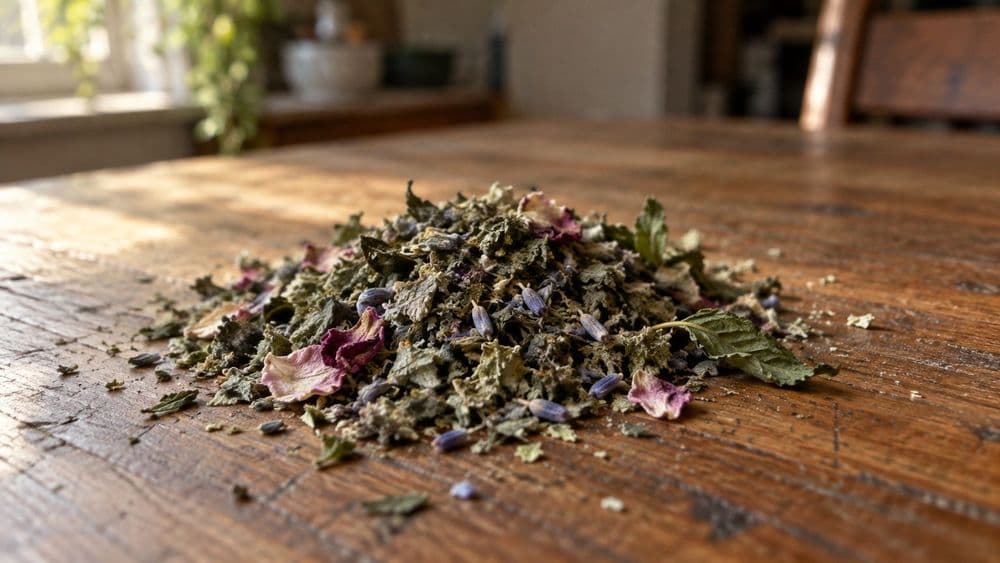
An herbal smoking blend is a bag of dried, non-tobacco leaves, usually mullein, damiana, mint, raspberry leaf or similar herbs, sold to be rolled or packed like tobacco. A truly tobacco-free blend has no nicotine, and unless it contains hemp, none of its herbs is a source of THC, CBD or any other cannabinoid. What it does not escape is combustion. In 2000 the Federal Trade Commission made two herbal cigarette makers print a blunt sentence on their packs and ads: "Herbal cigarettes are dangerous to your health. They produce tar and carbon monoxide."
You will find these blends on the same shelf as rolling papers and wraps, usually sold on the promise of being "tobacco-free". This guide covers what is usually in the bag and what each herb is (and is not), the 2000 FTC record and the lab measurements made since, what an ingredient label cannot tell you, and what changes when an herbal blend replaces tobacco in a joint. It is not a recipe or a buying guide, and we are not recommending that you smoke anything. This page is part of our series on plants that get compared with cannabis, which began with whether you can smoke catnip.
What is an herbal smoking blend?
An herbal smoking blend is loose, dried plant material made from herbs other than tobacco and cannabis, cut to a texture that rolls or packs like tobacco. The same kind of mix sold pre-rolled, often with a filter, is usually called an herbal cigarette. A 2023 review in the Canadian journal Paediatrics & Child Health lists the ingredients that turn up most often: rose petals, raspberry leaves, chamomile, mullein, lavender, blue lotus, peppermint and mugwort. The review is titled "The tobacco-free fallacy". These products are seen as safer, the authors write, but "research suggests that they emit significant levels of toxicants and carcinogens". They also note that in Canada herbal smoking products sit outside tobacco law, with no federal youth-sales or labeling rules.
Sellers pitch blends for three jobs. The first is replacing cigarettes, and many sellers go further and pitch them as a way to quit. When researchers reviewed 51 herbal and hemp cigarette listings on Amazon, 78.4% made quit-smoking claims, which the authors describe as unauthorized. If quitting tobacco is your goal, Smokefree.gov, run by the National Cancer Institute, lists free, tested options. The second job is a tobacco-free filler for joints, which we come back to below. The third is "ritual" or "relaxation" smoking built around herbs with a folk reputation. All three pitches rest on what the bag leaves out (tobacco, nicotine) rather than on what burning the leaf actually produces.
What's in the bag: common blend herbs compared
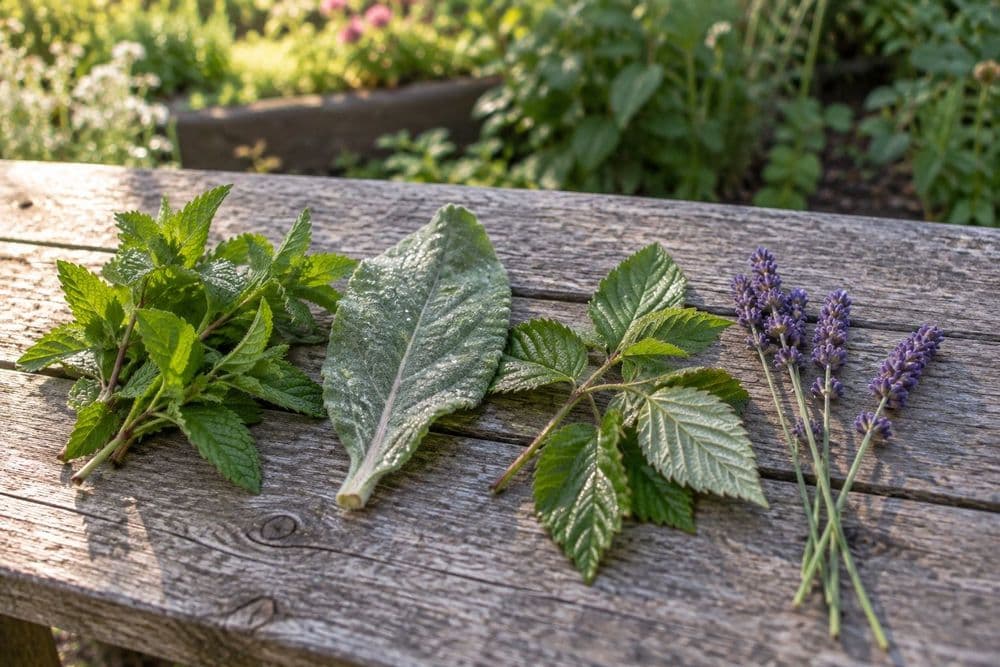
These are the herbs you are most likely to see on a blend's ingredient list, with what each one is and what the evidence covers. Real formulas can be short. Herbal Gold, the brand at the center of the 2000 FTC case below, was labeled "100% nicotine free" and listed marshmallow, passion flower and ginseng, according to the brand table in a 2022 review of herbal cigarette composition in ACS Omega. Formulas change over time, so the bag in front of you is the only list that counts.
| Herb | Plant family | THC, CBD or other cannabinoid? | What we know |
|---|---|---|---|
| Mullein (Verbascum thapsus) | Scrophulariaceae (figwort family) | No | Common base leaf. We found no study of people smoking it (PubMed, November 2026). FDA chemists used it as a test leaf for synthetic-cannabinoid spray. |
| Damiana (Turnera diffusa) | Passifloraceae | No | Shrub from Mexico and Central America. Tested effects almost all in cells or animals; no study of smoking it found. Louisiana bans smokable forms. |
| Peppermint, spearmint (Mentha) | Lamiaceae (mint family) | No | Listed among common herbal-product ingredients in a 2023 review. Mint-family leaves were frequent filler in Spice-type products tested in Japan. |
| Raspberry leaf (Rubus idaeus) | Rosaceae (rose family) | No | Listed among common herbal-product ingredients in a 2023 review. |
| Marshmallow leaf (Althaea officinalis) | Malvaceae (mallow family) | No | In Herbal Gold's listed formula. Also an FDA test leaf for synthetic-cannabinoid spray. |
| Lavender (Lavandula) | Lamiaceae (mint family) | No | Listed among common herbal-product ingredients in a 2023 review. |
| Mugwort (Artemisia vulgaris) | Asteraceae (daisy family) | No | Artemisia was the base of the Korean herbal cigarette measured in a 2015 smoke study. Louisiana bans smokable forms. |
| Passionflower (Passiflora incarnata) | Passifloraceae | No | Traditionally used as a sedative; studied by mouth, per NCCIH. We found no study of it as a cannabis substitute. In Herbal Gold's listed formula. |
| Wild dagga, lion's tail (Leonotis leonurus) | Lamiaceae (mint family) | No | Smoked traditionally in South Africa. Its smoke compounds have been tested in zebrafish larvae, not people. Louisiana bans smokable forms. |
| Blue lotus (Nymphaea caerulea) | Nymphaeaceae (water lily family) | No | Contains the alkaloids apomorphine and nuciferine. Prohibited for US service members. Louisiana bans smokable forms. |
| Catnip (Nepeta cataria) | Lamiaceae (mint family) | No | No controlled human study shows it gets people high. Covered in our catnip guide. |
| Hemp (Cannabis sativa) | Cannabaceae | Yes: CBD, trace THC | A different product class. Hemp blends can carry THC, which matters for drug tests. |
Notice the pattern in the third column. Cannabinoids, strictly defined, are the terpenophenolic compounds of the cannabis plant, which is how a 2010 review in the British Journal of Pharmacology defines them, and our primer on what cannabinoids are and how they work explains why that definition matters. None of the common blend herbs makes THC, CBD or their relatives. Hemp is the one plant on this shelf that does, so a "hemp smoking blend" belongs to a different product class, with CBD and trace THC. For the short list of other plants with real cannabinoid-like chemistry, see our guide to plants that contain cannabinoids.
Do herbal smoking blends get you high?
Not the way cannabis does. THC produces its high mainly by acting on the CB1 receptor, and none of the common blend herbs contains THC or any other cannabinoid to do that. Several blend herbs do carry a reputation, though, so here is what the record shows for each one.
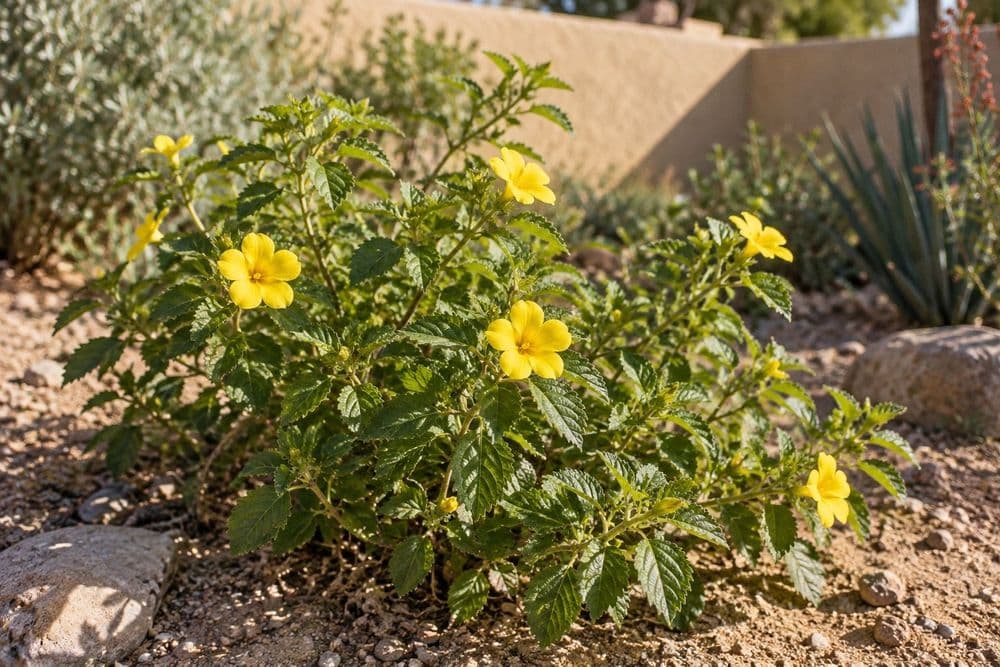
Damiana (Turnera diffusa) is the herb most often sold for its effect. It is a shrub from Mexico and Central America with a long folk reputation as an aphrodisiac. Reputation is not evidence. A 2014 review of damiana's chemistry and pharmacology found that most of its tested activities had been investigated "only in chemical, cell based, or animal assays", and the human studies it found used multi-ingredient products, so damiana's own contribution can't be separated out. On November 3, 2026, we searched PubMed for damiana or Turnera together with cannabinoids. The search returned 8 papers, and none reported a cannabinoid in the plant; half of them were about synthetic cannabinoids sprayed onto herbs like it. A second search, for damiana with smoking or inhalation, returned 4 papers, none of them a study of people smoking it.
The other herbs with a reputation have even less behind them. NCCIH notes that passionflower has traditionally been used as a sedative, that the research it summarizes is on passionflower taken by mouth, and that it "hasn't been studied extensively". Wild dagga, also sold as lion's tail (Leonotis leonurus), is a mint-family plant smoked traditionally in South Africa. A 2024 study of the compounds in its smoke tested them in zebrafish larvae, which tells us nothing yet about people. Blue lotus contains two alkaloids, apomorphine and nuciferine, and the Department of Defense prohibits it for service members. Its legal status is a topic of its own.
So where do stories of an "herbal high" come from? Usually from products that were not just herbs. When Japanese scientists DNA-tested 62 Spice-type "herbal" products from the illegal market, most of the plants they identified were different from the ones named on the labels. Damiana and mint-family leaves such as lemon balm, mint and thyme turned up often. Some products held undeclared cannabis, Salvia divinorum or kratom, and the plants served mainly as a carrier for synthetic cannabinoids. The authors noted that "no reliable psychoactive effects have been reported for most of the identified plants". Those were illegal products in Japan, not ordinary US shop blends, and they do not show that ordinary blends are mislabeled at that rate. They do show where a strong effect from an "herbal" smoke usually comes from.
Herbal cigarettes: what the FTC made two makers print
The clearest official statement on herbal smoke comes from a 2000 Federal Trade Commission case. The FTC alleged that Alternative Cigarettes, Inc. had advertised its Herbal Gold and Magic herbal cigarettes as not carrying the health risks of smoking tobacco. In the FTC's analysis of the settlement, published in the Federal Register on May 5, 2000, the agency wrote that "this claim is false, as Herbal Gold and Magic cigarette smoke, like the smoke from tobacco cigarettes, contains numerous carcinogens and toxins, including tar and carbon monoxide." The company settled without admitting the allegations, and the order spelled out what its ads and packs would have to say:
“Herbal cigarettes are dangerous to your health. They produce tar and carbon monoxide.”
That disclosure applied to the company's herbal smoking products marketed as "no tobacco", "tobacco-free" or "herbal", in the same type size and style as the Surgeon General's warning, unless the company had evidence that a product carried no material health risk. The order also barred it from claiming that any herbal smoke was low-risk without "competent and reliable scientific evidence". A parallel order against Santa Fe Natural Tobacco Company, a case mainly about its "no additives" tobacco cigarettes, carried the same herbal disclosure for the tobacco-free herbal cigarettes it also sold. Why did the warning have to come from a settlement at all? Because, as the FTC's April 27, 2000 press release noted, herbal cigarettes contain no tobacco and so were "not statutorily required to bear a Surgeon General's warning".
Two caveats keep this accurate. First, these orders bound two companies, not the industry. The final Alternative Cigarettes order (Docket C-3956, issued June 14, 2000) was written to run for 20 years, to June 14, 2020, and longer only if a later federal court complaint over a violation was filed. Neither order was ever an industry-wide rule. Second, the gap the FTC pointed to is still in the statute. Federal law defines a tobacco product as one "made or derived from tobacco, or containing nicotine from any source" (21 U.S.C. 321(rr)), so a blend with neither sits largely outside FDA's tobacco rules. That is not the same as being tested or approved for smoking. This is a reading of the statute's text, not legal advice.
Tobacco-free is not smoke-free: what the measurements show
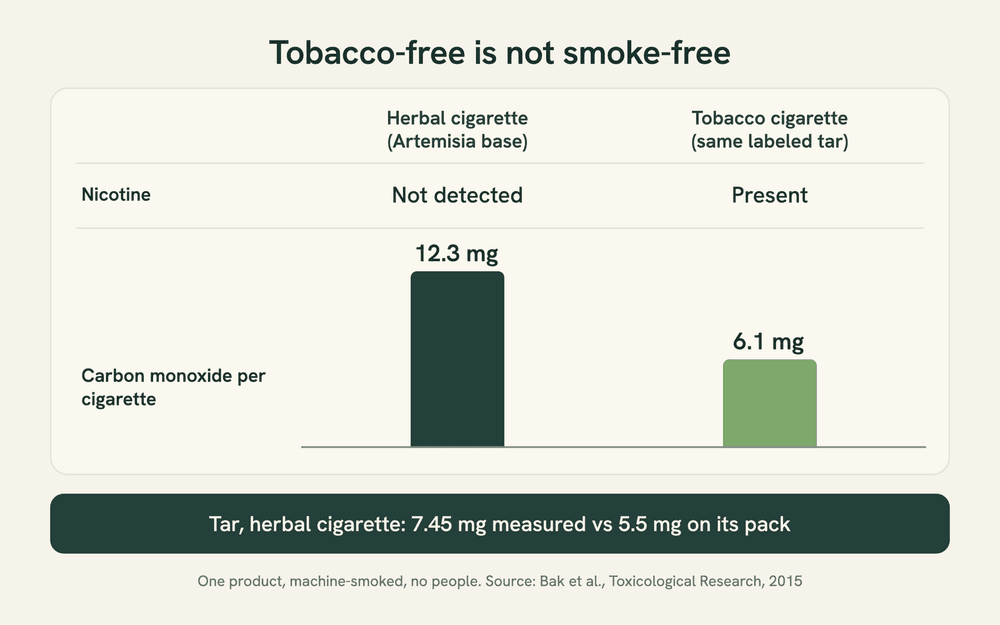
The best-documented single test is a 2015 study in Toxicological Research. Korean researchers machine-smoked an herbal cigarette built on Artemisia (mugwort) and compared it with a tobacco cigarette carrying the same 5.5 mg tar label, using a standard ISO smoking-machine setup and three replicate runs. The herbal cigarette had no detectable nicotine or tobacco-specific nitrosamines, which is what you would expect with no tobacco in it. Everything else looked like smoke. It delivered 12.30 mg of carbon monoxide per cigarette against 6.07 mg for the tobacco cigarette, 7.45 mg of tar against the 5.5 mg its own pack claimed, and somewhat more benzo(a)pyrene, a well-known combustion carcinogen (2.77 vs 2.29 ng per cigarette). Hydroquinone, resorcinol and catechol were higher too, and the smoke condensate was mutagenic in a standard bacterial test, which the authors attribute to "combustion products".
A 2026 emissions study in the Journal of Hazardous Materials reached the same place with different tools. It measured about 20% more particles under 500 nanometers from herbal cigarettes than from tobacco cigarettes, and the herbal particles showed higher oxidative potential in a test-tube assay (24 vs 18 pmol/µg-min). The authors concluded that the herbal cigarettes' emissions "matched or even exceeded" those of tobacco cigarettes. They measured smoke, not health effects, and trace metals showed no consistent trend.
One more finding belongs here because it changes what "herbal" even means. In China, "herbal" cigarettes were tobacco cigarettes with added herbs. A 2009 study of 278 smokers in one Chinese city, 135 of them herbal-cigarette smokers, found no significant difference from regular smokers in cotinine (a nicotine marker), NNAL (a marker of a tobacco carcinogen) or PAH metabolites, measured in 98 of the participants, and smokers reported smoking more after switching. That is a different product from a US tobacco-free blend, but it shows the word "herbal" on a pack is not proof that there is no tobacco inside.
The Korean test and the 2026 study measured smoke, not people, and neither followed anyone over time (the full list of limits is at the end of this guide). What the measurements do settle is narrower and still useful: removing tobacco removes nicotine. It does not remove tar, carbon monoxide or fine particles.
Can you smoke damiana, and is it legal?
Physically, yes: damiana's dried leaf burns like other herbs, and it is one of the most common ingredients in commercial blends. Whether there is any reason to is a different question: as covered earlier, no study has tested smoking it, and burning it makes smoke like any other leaf. Damiana also has a second identity that matters if you read labels: it is one of the leaves that synthetic cannabinoids get sprayed on, which the label section below explains.
Damiana is also one of the few blend herbs named in a criminal statute. Louisiana Revised Statutes 40:989.2, first enacted in 2010, makes it a crime to produce, manufacture, distribute or possess material containing any of 13 listed "prohibited plants" when it is meant for the mouth or nose, "prepared in such a manner as to be suitable for smoking in a pipe or cigarette", or meant to be burned and inhaled. The list includes damiana, blue lotus, lion's tail (wild dagga) and mugwort, along with kratom. Growing these plants for decoration or landscaping is exempt, as are FDA-recognized homeopathic forms and certain products labeled as dietary supplements. Louisiana is the clearest example we found; we did not survey other states.
Herbal blends in a joint: what changes and what doesn't
For many cannabis smokers the real question is not herbal cigarettes but the filler. Mixing tobacco into cannabis is common in much of the world. In a 2014 global survey of 33,687 people who had smoked cannabis in the past year, 65.6% used at least one tobacco-based route. It was the norm in Europe (77.2% to 90.9% across countries), less common in Australasia (20.7% to 51.6%) and uncommon in the Americas (4.4% to 16.0%). The survey was an online, self-selected sample, but it describes the habit many herbal blends are sold to replace. Swapping tobacco for an herbal filler changes one thing and leaves the rest in place.
| Question | Cannabis + tobacco (spliff) | Cannabis + herbal filler | Cannabis only |
|---|---|---|---|
| Contains nicotine? | Yes | No, if the blend is truly tobacco-free | No |
| Burns plant matter into smoke? | Yes | Yes | Yes |
| THC for a marijuana test to find? | Yes | Yes, from the cannabis | Yes |
| Does the filler add a cannabinoid? | No | No, unless the filler is hemp | No filler |
| Federal tobacco product? | The tobacco is | Not if the blend has no tobacco or nicotine | No |
In short, an herbal filler takes nicotine out of the joint. It does not take combustion out, because the cannabis and the herbs both burn, and cannabis smoke carries its own toxicants, as our look at whether a hookah filters weed smoke details. Why smoke of any kind makes you cough is covered in our explainer on coughing after a hit. The wrap matters too: a traditional blunt wrap is made from tobacco leaf, the core difference in our blunt vs joint comparison, and papers have their own makeup, laid out in what rolling papers are made of.
On a drug test, the herbal filler changes nothing. Under the federal workplace drug-testing guidelines, a marijuana test targets a breakdown product of THC, delta-9-THC-9-carboxylic acid. An herb with no THC adds nothing for the test to find, and it does not hide the THC from cannabis smoked alongside it. A hemp-based blend is different, because hemp can carry THC. Labs and test types vary, and our guide to the 10-panel drug test explains what standard panels look for.
What the label can't tell you
An ingredient list tells you what the maker says went into the bag. It cannot tell you what was sprayed onto the leaf. That is not hypothetical. When FDA's forensic chemists built a method to measure synthetic cannabinoids on plant material, they validated it on marshmallow, damiana and mullein leaf, three staples of ordinary blends, with average recoveries of 94%, 95% and 92% across 32 synthetic cannabinoids. In products from actual cases, the amounts they measured ranged from 0.2 to more than 100 mg per gram. A sprayed leaf looks like an unsprayed one. NIDA describes synthetic cannabinoids as lab-made chemicals that can be life-threatening, and our comparison of K2 and natural cannabis covers that record in detail. Our guide to spotting laced weed explains why looks and smell are unreliable. Use the checklist below as a first filter on any herbal smoking product.
- Sold as incense or potpourri, or labeled "not for human consumption", while packaged and priced like a smoking product.
- Promises a buzz, a "legal high" or an effect like cannabis.
- No full ingredient list naming each plant.
- An "herbal" cigarette with no clear statement that it contains no tobacco or nicotine, especially from markets where herbal cigarettes have included tobacco.
- Claims that it helps you quit, protects your lungs or is safer than tobacco. In the Amazon study, 45.1% of listings claimed lower risk or exposure, and only 35.3% showed a health warning on the pack.
- A hemp-based blend sold without a lab report showing its THC content.
What the evidence does not show
- The research we reviewed includes no long-term health study of people who smoke plain, tobacco-free herbal blends.
- The carbon monoxide and tar figures come from one Korean product in a smoking machine, with no people involved.
- We read the 2026 particle study as an abstract. It measured smoke and a test-tube assay, not health effects, and it does not say how many brands it tested.
- No study we found has tested smoking damiana, and as of November 2026 we found no human trial of damiana on its own.
- The Japanese label-mismatch findings come from illegal Spice-type products and do not show that ordinary US blends are mislabeled at that rate.
- The FTC orders covered two companies and were written to run for 20 years. They are history, not a current industry rule.
Frequently asked questions
There is no evidence that they are, and the record points the other way. In 2000 the FTC made two herbal cigarette makers print "Herbal cigarettes are dangerous to your health. They produce tar and carbon monoxide." When Korean researchers machine-smoked one herbal cigarette in 2015, it delivered 12.3 mg of carbon monoxide, about twice the 6.1 mg from a tobacco cigarette with the same labeled tar. That was one product in a machine, and there are no long-term studies of people, but nothing in the evidence supports calling herbal smoke safe.
A truly tobacco-free herbal cigarette shouldn't: the Korean product tested in 2015 had no detectable nicotine. But "herbal" has not always meant tobacco-free. In China, "herbal" cigarettes were tobacco with added herbs, and their smokers had the same nicotine markers as regular smokers. Check the ingredient list for tobacco or nicotine rather than trusting the word "herbal".
The common blend herbs contain no THC or other cannabinoid, so they do not produce a cannabis-type high. Damiana, passionflower and wild dagga have folk reputations, but we found no human study showing an effect from smoking any of them. If an "herbal" product hits hard, treat that as a red flag: plant material sprayed with synthetic cannabinoids looks the same as plain herbs.
Plain herbal blends are generally sold legally in the US, and a blend with no tobacco or nicotine falls outside the federal definition of a tobacco product. There are exceptions. Louisiana makes it a crime to sell or possess smokable preparations of damiana, blue lotus, lion's tail (wild dagga), mugwort and several other plants (text checked as amended through 2025), and the Department of Defense prohibits blue lotus for service members. We did not survey every state, and this is a factual summary, not legal advice.
A standard marijuana test looks for a breakdown product of THC. Herbs with no THC add nothing for it to find, and they do not hide THC from cannabis smoked in the same joint. A hemp-based blend is different: hemp can carry THC, so a hemp blend is not THC-free. Test types and labs vary.
Be skeptical of any product that says so. A 2024 study of 51 Amazon listings found that 78.4% made quit-smoking claims, which the authors describe as unauthorized, and the 2000 FTC order barred one maker from health-risk claims about herbal smoke without competent and reliable scientific evidence. Smoking a blend still means inhaling smoke. If you want to quit tobacco, Smokefree.gov, run by the National Cancer Institute, lists free, tested options, and 1-800-QUIT-NOW connects to free quitline support.
No. Neither contains a cannabinoid, and we found no research showing either one acts like cannabis. The passionflower research NCCIH summarizes is on the herb taken by mouth, and the compounds in wild dagga smoke have been tested in zebrafish larvae, not people.
Herbal blends belong to a family of plants that get compared with cannabis but contain no cannabinoid at all, a series we opened with our look at smoking catnip and why it won't get you high. If the part of this page that stays with you is the spray you can't see, read next: how K2 differs from natural cannabis, and why it is a different drug.
Writing about hemp, wellness and the small rituals that keep us balanced.