Why Is It Called Marijuana? The Word's Origin and the Law
Marijuana came into English from Mexican Spanish, but its deeper origin is unknown and the popular María Juana story is unsupported. Here is each theory graded, why federal law spells it with an h, and why some states now say cannabis.

Why is it called marijuana? Nobody knows for sure. English borrowed the word from Mexican Spanish, where its oldest known printed use, from 1846, spells it "mariguana", and where it came from before that is still a puzzle. The most popular story, that it blends the names María and Juana, is the least supported. What is documented is how the word traveled: into US newspapers, into a 1937 federal law spelled "marihuana", and, in the 2020s, out of some state codes in favor of "cannabis".
This page grades each origin theory against the evidence behind it, explains why federal law spells the word with an "h", lays out the disagreement over whether the word is racist with every position attributed to its source, and ends with a dated table of which word you will meet on which document. It is a language and history page, so there is nothing here about using cannabis. For the botanical and legal line between the plant's two legal categories, see our guide to the difference between hemp and marijuana.
Why is it called marijuana? Where the word comes from
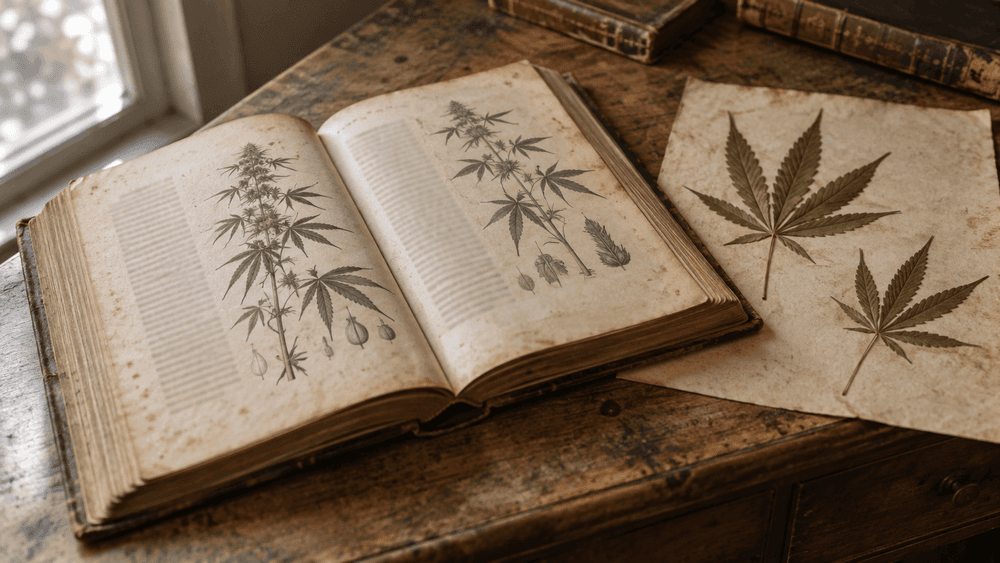
The dictionaries we read agree on the last step. Merriam-Webster says English borrowed the word from Mexican Spanish mariguana or marihuana, and adds that the etymology of the Spanish word "remains elusive despite much hypothesizing." The oldest printed use anyone has found sits in the Farmacopea mexicana, published in Mexico in 1846. There, "mariguana" is a cross-reference that sends the reader to "Rosa María", defined as cáñamo del pais, which translates as "country hemp", with the note: leaves, narcotic.
Even the first person on record to guess at the origin was unsure. In 1853, Leonardo Oliva, a pharmacology professor in Guadalajara, wrote in his Lecciones de farmacología that the name was "perhaps formed from the word Mari, meaning Maria, and the word Huana, meaning Rosa", and admitted he did not know which language the second half came from. One more fact narrows the field: cannabis is not native to Mexico. Etymonline points out that because the plant was not native there, "a native source for the word seems unlikely." If you are curious where the plant itself comes from, our guide to landrace strains and the regions they grew up in covers that side of the story.
Five origin theories, graded against the evidence
Most pages list the theories side by side as if they were equally strong. They are not. The table below grades each one against the best source we could read. Two sources do most of the work: Merriam-Webster's etymology note, which leans on historian Isaac Campos's 2012 book Home Grown, and a 2009 survey of Nahuatl loanwords in English by linguist Jason Haugen, which quotes the Oxford English Dictionary's 2008 draft entry. Researchers have also proposed other routes, including a Chinese phrase for hemp seed and an Angolan word for cannabis carried across the Atlantic by the slave trade, argued in Chris Duvall's 2019 book The African Roots of Marijuana. We have not read those works, and none has become the accepted answer, so we grade them only as proposed.
| Theory | Who proposes or reports it | What the evidence says | Status |
|---|---|---|---|
| Borrowed from Mexican Spanish mariguana or marihuana | Merriam-Webster, Etymonline, the OED (as quoted by Haugen) | Printed in Mexico from 1846; English uses follow from the 1870s on | Supported |
| A contraction of María plus Juana | Popular retelling; the OED notes it as a folk etymology | Spanish print shows only mariguana and marihuana for 60 to 70 years; the j-spelling appears in English first | Unsupported as the origin; may have shaped the English spelling |
| Nahuatl mallihuan, meaning 'prisoner' | Suggested in the OED draft entry | Haugen calls it 'a case of accidental homophony': the plant's link to prison came later than the word | Improbable |
| Mari (María) plus Huana (Rosa) | Leonardo Oliva, 1853 | One writer's guess; he said he did not know the second half's language | Speculative |
| Chinese or Angolan (Kimbundu) routes | Other researchers, including Chris Duvall (2019) | Not read for this article | Proposed, not settled |
Marijuana or marihuana: why the "h" and the "j"?
The spelling is where the María Juana story falls apart. Merriam-Webster points out that "the form marijuana is not recorded in Spanish before its use in English in the early twentieth century." In the first 60 to 70 years the word appeared in Spanish print, the only spellings were mariguana and marihuana. A story that starts with "Juana" needs a "j", and the early Spanish record does not have one. The "h" spelling is the older Spanish form, and it is the one the first federal law adopted.
“Forms in -j- appear to be an English innovation ... Influence of a folk etymology from the Spanish personal name María-Juana or its familiar form Mari-Juana has frequently been suggested; if so this would appear to have occurred within English.”
So the María Juana link may be real in one narrow sense: English speakers may have respelled a Spanish word to look like a familiar name. It is not where the word came from. The dictionaries also disagree on when the word arrived in English, because they count different spellings. Merriam-Webster points to Bancroft's Native Races (1874-75), which "contains probably the first incidence of mariguana in English." The OED, as quoted by Haugen, dates the English noun to 1894. Etymonline dates "mariguan" to 1894 and the j-spelling "marijuana" to 1918. Read together, those dates trace a Spanish loanword settling into its English spelling over about four decades.
How "marihuana" got into US law
Historian Isaac Campos traces the word into American English alongside Mexican beliefs about the drug. As a 2025 review of his work in the journal Addiction summarizes it, those ideas "began to spread to the United States in the 1890s through the press and other published sources, along with the word 'marijuana'." The same review, by Wayne Hall and Sarah Yeates, notes that El Paso banned marijuana use in 1915 and that Mexico prohibited it nationally on March 15, 1920, 17 years before the United States passed its federal tax law. When Congress debated that law in 1937, the head of the Federal Bureau of Narcotics, Harry Anslinger, told the House Ways and Means Committee, according to the hearing transcript reproduced by the Schaffer Library: "Marihuana is the Mexican term for cannabis indica." Congress passed the Marihuana Tax Act on August 2, 1937, and the "h" spelling has been in federal law ever since. The full story of that hearing and the law's motives lives on our page about when and why weed was made illegal.
The Controlled Substances Act of 1970 carried the spelling forward, listing "(10) Marihuana." in Schedule I, and the printed statute at 21 U.S.C. 812 still reads that way. (That printed list is the 1970 schedule; current scheduling lives in DEA's regulations, covered below.) Then, in 2022, Congress did something few people noticed. It did not swap the spelling; it added one. The Medical Marijuana and Cannabidiol Research Expansion Act, in a section titled "Updating Term", rewrote the federal definition so that it reads "the terms 'marihuana' and 'marijuana' mean all parts of the plant Cannabis sativa L.", with hemp excluded, as the current text of 21 U.S.C. 802 shows. Since December 2, 2022, both spellings name exactly the same thing in federal law.
Is "marijuana" a racist word? What the record shows
This is the question people argue about most, and it is a debate over history and register that no single source settles. Here is what each side points to, attributed to the source that says it. On one side, the OED, as quoted by Haugen, says the word's use "increased greatly in the United States in the 1930s in the context of the debate over the use of the drug, the term being preferred as a more exotic alternative to the familiar words hemp and cannabis." Haugen himself wrote in 2009 that the word's use "was promoted to 'exoticize' it (and its users)" and that this "is not in doubt." Washington's legislature wrote a finding into law in 2022, that the term "has discriminatory origins" (more on that below).
On the other side, Campos, the historian whose research underpins Merriam-Webster's note, argues that avoiding the word erases the influence Mexican immigrants had on US culture, as WBEZ reported in a 2019 explainer on what to call legal cannabis. In that interview, WBEZ wrote, he said the term became popular because of Mexican influence on US culture, not because of a conspiracy to demonize Mexican immigrants. Neither side disputes the documented route: the word reached English from Mexican Spanish, with a printed history in Mexico going back to 1846. A related but separate question is whether racism drove the early laws themselves. A 2024 National Academies report, quoted by Hall and Yeates, says recent detailed histories "raise questions regarding the prominently hypothesized role of explicit racism in early legislative enactments," while stating that "it is undeniable that racism played a role in the unequal enforcement and implementation of prohibition once it became enacted."
Why some states and agencies switched to "cannabis"
Washington made the clearest switch. Its 2022 law, Second Substitute House Bill 1210, is headed, in capital letters, "Replacing 'marijuana' with 'cannabis'" and gives its reasoning in section 1: "The legislature finds that the use of the term 'marijuana' in the United States has discriminatory origins and should be replaced with the more scientifically accurate term 'cannabis.'" The same section stresses that the act "is technical in nature and no substantive legal changes are intended or implied." It passed the House 83-13 and the Senate 41-8, was approved on March 11, 2022, and most of it took effect June 9, 2022, with a few sections staggered as late as July 1, 2030. What was legal did not change; only the word did.
The same year, federal law moved the other way: as described above, Congress added "marijuana" next to "marihuana" in December 2022 rather than switching to "cannabis". Other states split the difference in their agency names. New York's 2021 legalization law is the Marihuana Regulation and Taxation Act, yet the office it created is the Office of Cannabis Management: old spelling for the law, new word for the agency. Massachusetts named its regulator the Cannabis Control Commission, but the commission's own mission statement speaks of "medical and adult-use marijuana." California's regulator is the Department of Cannabis Control. The pattern is less a clean switch than a drift: newer agency names lean toward "cannabis", while statutes keep whatever word they were written with.
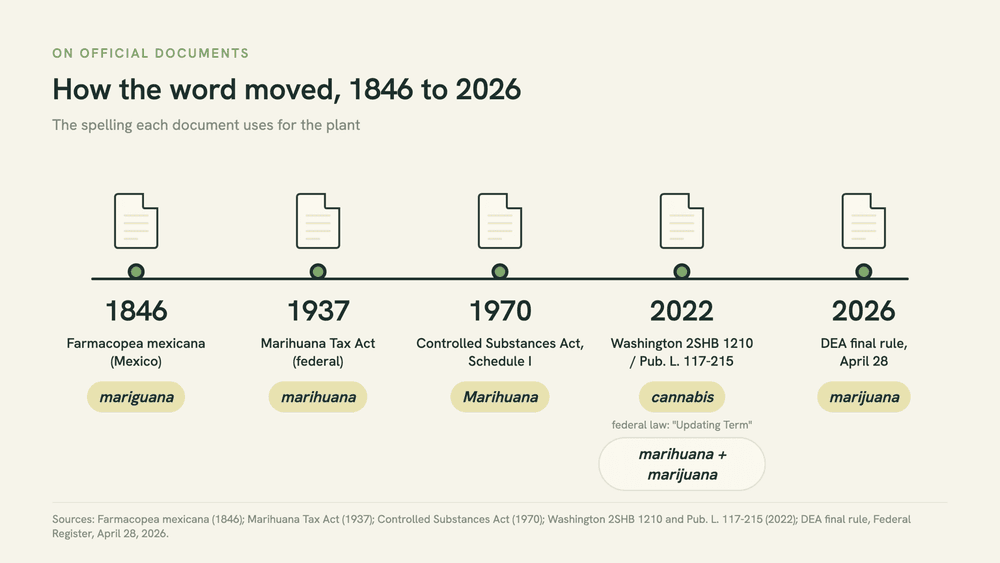
Which word you'll see on which document (as of October 25, 2026)
If you read official documents, you will meet every spelling, sometimes inside the same rulebook. DEA's April 28, 2026 final rule uses "marijuana" 215 times and "marihuana" zero times by our count, and writes its new Schedule III entry as "Marijuana, as defined in 21 U.S.C. 802(16), in a U.S. Food and Drug Administration approved product or subject to a state medical marijuana license." Yet the Schedule I list in 21 CFR 1308.11, which the rule's amendments did not touch, still prints "Marihuana 7360". One rulebook, two spellings.
On status, not just vocabulary: marijuana remains a controlled substance under federal law. Since April 28, 2026, marijuana under a state medical license or in an FDA-approved drug is Schedule III, and other marijuana stays in Schedule I. Our explainer on the medical marijuana Schedule III ruling covers what that changed. Other agencies use their own vocabulary. FDA's main cannabis regulation page puts the word in quotation marks, saying parts of the plant have been controlled since 1970 "under the drug class 'Marihuana' (commonly referred to as 'marijuana')", while its title says "Cannabis". USDA's hemp program page is titled "Hemp Production" and, on the day we checked, did not use the words marijuana or cannabis at all.
| Document | Word it uses | Exact wording |
|---|---|---|
| Federal definition, 21 U.S.C. 802(16) | Both spellings | "the terms 'marihuana' and 'marijuana' mean" (since Dec. 2, 2022) |
| Printed 1970 schedule, 21 U.S.C. 812 | Marihuana | "(10) Marihuana." |
| DEA Schedule I list, 21 CFR 1308.11(d)(23) | Marihuana | "Marihuana 7360" |
| DEA final rule, April 28, 2026 (91 FR 22714) | Marijuana | 215 uses of "marijuana", 0 of "marihuana"; new Schedule III entry reads "Marijuana" |
| FDA cannabis regulation page | Cannabis in the title; Marihuana for the drug class | "the drug class 'Marihuana' (commonly referred to as 'marijuana')" |
| USDA AMS program page | Hemp | Titled "Hemp Production" |
| Washington state code (RCW) | Cannabis | "marijuana" replaced throughout; most sections effective June 9, 2022 |
| New York | Marihuana (law), Cannabis (agency) | Marihuana Regulation and Taxation Act; Office of Cannabis Management |
| Massachusetts | Cannabis (agency), marijuana (mission) | Cannabis Control Commission; "medical and adult-use marijuana" |
| California | Cannabis | Department of Cannabis Control |
| CBD product labels, including Planntz's | Hemp | The federal hemp category, defined by THC concentration |
Cannabis, hemp, marijuana, weed, pot, ganja: a glossary
| Word | Where it comes from | First English use | Register |
|---|---|---|---|
| Cannabis | Modern Latin genus name (1728), from Greek kannabis, a Scythian or Thracian word; also the root of 'canvas' | 1798, as 'common hemp'; intoxicant sense from 1848 (Etymonline) | Botanical; now also legal in some states |
| Hemp | Old English hænep, probably an early Germanic borrowing of the same word that became Greek kannabis | Old English; slang sense 'marijuana' from the 1940s (Etymonline) | Agricultural; a federal legal category |
| Marijuana / marihuana | Mexican Spanish mariguana, marihuana; deeper origin unknown | 1874 (Merriam-Webster), 1894 (OED), j-spelling 1918 (Etymonline) | Federal legal term; everyday |
| Weed | English weed, which meant tobacco by about 1600 | Marijuana sense from the 1920s (Etymonline) | Slang |
| Pot | Probably clipped from Mexican Spanish potiguaya, 'marijuana leaves'; disputed | 1938 (Etymonline) | Slang |
| Ganja | Hindi ganjha | 1800, for a strong cannabis preparation (Etymonline) | Slang |
Two rows deserve a note. Hemp and cannabis are probably the same ancient word, borrowed twice: once into Germanic, once into Greek. And in US law, hemp is not just an older synonym. Under the 2018 Farm Bill definition, hemp is Cannabis sativa L. with a delta-9 THC concentration of not more than 0.3% on a dry weight basis, and Congress rewrote that test in November 2025 to count total THC; under timing set by a September 2026 law, the total-THC standard is scheduled to take effect on December 11, 2026. That legal line is why CBD products, Planntz's included, are labeled hemp: the word on the bottle names a legal category defined by THC concentration, not a softer name for marijuana. Our plain-English comparison of hemp and marijuana explains how the test works. For the plant parts behind these words, see our walkthrough of cannabis plant anatomy, and for newer slang, our pages on what a roach is and what 710 means.
How to choose a word: a quick checklist
The right word depends less on meaning than on what you are reading and who you are talking to. Use the checklist below as a quick decoder. If the word you care about is the one on a CBD label, our guide to what CBD is and how it differs from THC covers the basics behind it.
- Reading a federal statute or DEA document? Expect "marihuana" in older text and "marijuana" in newer text. Since December 2022 they mean the same thing.
- Reading Washington law, a state license or a regulator's website? Expect "cannabis", even where the state's founding statute used another word.
- Buying a CBD product? Look for "hemp" and a certificate of analysis (COA) that shows THC below the legal limit.
- Writing for a general audience? As of 2019, the AP Stylebook said to use marijuana on first reference generally, with pot and cannabis also acceptable. Check the current edition before you rely on it.
- Talking about the plant scientifically? Use Cannabis sativa L., the name federal law itself uses in its definitions.
- Talking with someone who has a preference? Use their word. Both terms are accurate; the difference is register, not meaning.
What we still don't know
Here are the honest limits, so you can weigh this page properly. No one has a documented etymology for the Spanish word; every theory beyond "Mexican Spanish" is a hypothesis. The dictionaries disagree on English first-use dates because they count different spellings. We read the OED's entry only as quoted in Haugen's 2009 paper, not the current paywalled entry, and we did not read the books behind the Chinese and Angolan proposals, so we grade them only as proposed. Campos's views reach us through a 2025 review and a 2019 news interview rather than his book directly. The debate over whether the word is racist rests on history and on how words land with different people, and serious sources disagree. Finally, our word counts for the DEA rule and the USDA page are our own measurements on the dates given; agency pages change.

Nobody knows for certain. Etymonline records "weed" meaning tobacco by about 1600 and marijuana by the 1920s. Campos told WBEZ in 2019 that the slang could be a shortened form of "locoweed", and the 2025 Addiction review notes that datura, like marijuana, was known as "locoweed". WBEZ also reported, citing linguist Jason Riggle, that a 1913 California bill referred to the drug as locoweed. Treat these as leads, not a settled answer.
Etymonline dates "pot" in this sense to 1938 and says it is probably a shortened form of the Mexican Spanish potiguaya, "marijuana leaves." Linguist Jason Riggle was blunter: "Basically the answer is we have no idea, so I want to call pot a mystery," he told WBEZ in 2019. The 1938 date is the firmer fact; the origin is still open.
Botanically, cannabis is the genus, and marijuana is one name for the plant and its drug forms. Legally they differ: federal law defines marijuana as parts of Cannabis sativa L. but expressly excludes hemp. So all marijuana is cannabis, but not all cannabis is marijuana. Our guide to whether CBD is legal, linked at the end of this page, explains what that means for CBD products.
Both are correct. Marihuana is the older Spanish spelling and the one written into the 1937 and 1970 federal laws; marijuana is the spelling English made common. Since December 2, 2022, the federal definition reads "the terms 'marihuana' and 'marijuana' mean" the same thing. DEA's Schedule I list still prints "Marihuana", while its April 2026 rule uses only "marijuana".
Yes, Mexican Spanish. Its oldest known printed use is from Mexico in 1846, spelled "mariguana", and "marihuana" is the other early Spanish spelling. The version with a "j" seems to have developed in English, according to the OED as quoted by linguist Jason Haugen.
Because hemp is the federal legal category for cannabis with very low THC: under the 2018 definition, no more than 0.3% delta-9 THC on a dry weight basis, a test Congress has rewritten to count total THC, scheduled to take effect on December 11, 2026. Products made from hemp use that word for legal accuracy, not as a euphemism.
It depends on the document. The statute uses both spellings; DEA's 2026 rule says "marijuana"; FDA's page says "Marihuana" (commonly referred to as "marijuana") and uses "cannabis" in its title; USDA uses "hemp" for its program. On status: marijuana remains a controlled substance under federal law, with marijuana under a state medical license or in an FDA-approved drug in Schedule III since April 28, 2026, and other marijuana in Schedule I.
Words move faster than laws, and this one has crossed a border, changed its spelling and picked up a century of politics along the way. If your real question is what the legal line between these words means for a product you might buy today, the next stop is our overview of CBD's legal status in the US.
Writing about hemp, wellness and the small rituals that keep us balanced.