What Is a Roach in Weed? Two Meanings and the Real Evidence
A roach is the stub end of a joint in the US and the card mouthpiece in the UK. Here is where a joint's THC goes, what a 1991 UCLA study set out to test, why the end feels harsh, and what a crutch does not do.
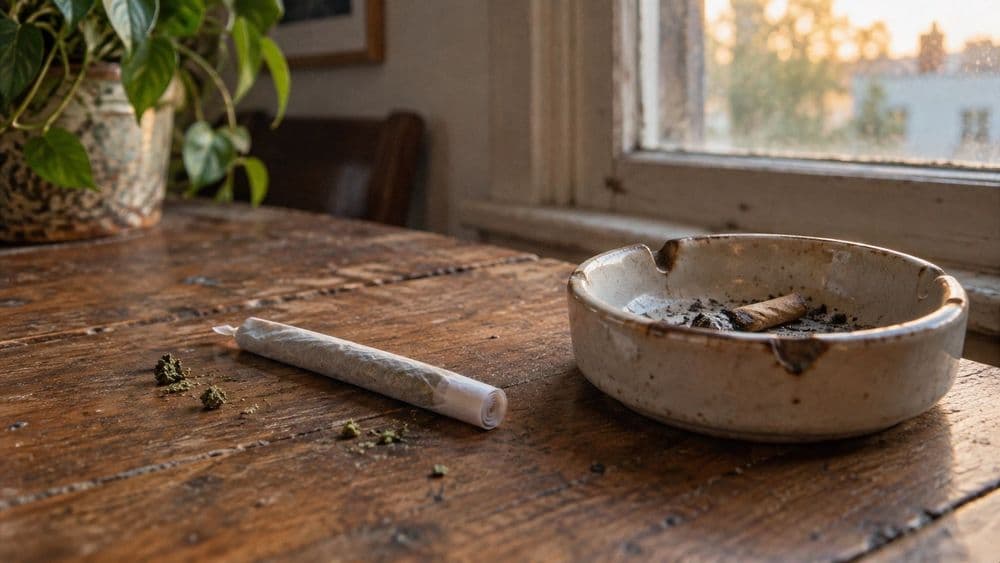
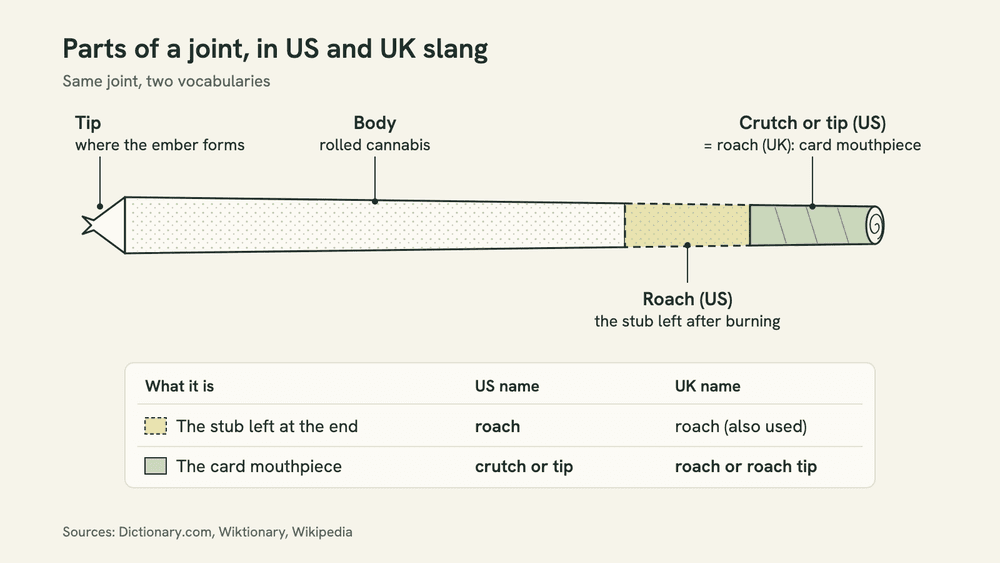
What is a roach in weed? In the US, a roach is the short stub left at the end of a joint once it has burned down too far to hold. In the UK and much of the Commonwealth, the same word usually means the rolled strip of card at the mouth end, which Americans call a crutch or tip. Older lab estimates put about a tenth of a joint's THC in that stub. It is not a stronger product, and the one controlled study we found that was built to compare the two halves of a joint does not have freely readable results.
Most pages that rank for this question are dictionary entries, and the few that go further repeat the same folk claims: the end is the strongest part, it is harsher because resin collects there, a crutch filters the smoke. None of them cites a measurement. Below you get both meanings of the word side by side, where it probably came from, what happens to THC inside a burning joint (with the numbers researchers have actually reported), what a 1991 UCLA study set out to test, and what the tar and lung data say. If you are still sorting out the basic rolled formats, our guide to blunts vs joints covers wraps, spliffs and pre-rolls. This page is about the last inch or so of any of them.
What is a roach in weed?
In American slang, a roach is the butt of a joint: the last bit left once it has burned too short to hold comfortably between your fingers. Dictionary.com's entry for roach, which draws on the Random House and Collins dictionaries, defines it plainly as "the butt of a marijuana cigarette", and Collins gives the same meaning in British English. Some people use the word loosely for a whole joint, but the stub is the standard sense, and it is the one you will hear most often if you are smoking weed for the first time around people who use the slang.
British usage adds a twist. According to Wiktionary's entry for roach, in UK slang a roach is "the filter of a rolled cigarette or joint, made from card or paper (often of the cigarette paper packet itself)". Wikipedia's article on the roach in smoking describes the same object in Europe, the UK and most Commonwealth countries: a bit of rolled thin cardboard at one end that serves as a mouthpiece, known in North America as a crutch, a tip or a filter. So in Britain and much of the Commonwealth, "roach" usually means the rolled strip of card at the mouth end, which Americans call a crutch or tip. Collins still lists the butt meaning for British English as well, so context decides. If a British friend asks you to "put a roach in", they want a mouthpiece, not a stub.
| Term | Usual US meaning | Usual UK and Commonwealth meaning | What it physically is |
|---|---|---|---|
| Roach | The burned-down stub at the end of a joint | The rolled card mouthpiece at the end of a joint (the stub meaning is also used) | US: leftover cannabis, ash and paper. UK: a small roll of thin card |
| Crutch | The rolled card mouthpiece | Usually called a roach or roach tip | A strip of card rolled into a tube or folded into a zigzag |
| Tip | Same as a crutch; also sold pre-made | Roach tip | Card or paper |
| Filter | Loose name for a crutch or tip | Loose name for a roach | Card or paper; no study we found shows it filters joint smoke |
| Roach clip | A clip for holding a stub too short for your fingers | Same | A metal clip, clamp or tweezers |
The crutch exists for practical reasons. A small roll of card at the mouth end keeps the joint's shape, keeps loose plant bits (the fine, crumbly material our page on shake weed describes) out of your mouth, and gives you something to hold that is not burning. What it is not, as far as any study we found shows, is a filter for the smoke. We come back to that in the myths section below.
Why is it called a roach?
Nobody knows for certain. Most dictionaries treat it as a shortening of "cockroach", because a small, brown, burned-down stub looks a bit like one. Wiktionary describes the marijuana sense as coming from the "similarity of appearance of the butt" and says it has been attested since the 1930s; Dictionary.com dates this sense to 1940-45. Taken together, the word was in print by the late 1930s to early 1940s, the same era in which the federal government first moved against cannabis, a story our history of when weed was made illegal tells in full.
You will often read that the slang comes from "La Cucaracha", the Mexican folk song about a cockroach. Wikipedia mentions that theory, but sources it to a single 2016 article from a cannabis lifestyle site. It is a popular story, not an established origin. Wikipedia also cites two early print uses: a 1938 New Yorker piece titled "Tea for a Viper", and a 1943 Time article that described the habit this way:
“When he has smoked a reefer down to a half-inch butt, he carefully conserves it in an empty match box... known... in English, as a 'roach'.”
That line also explains a question people still ask: why did people save roaches? The quote points to thrift, in an era when cannabis was already under federal restriction. It is a description of 1940s slang, not a recommendation, and the rest of this page explains why the stub is not the prize that folklore makes it.
What happens to the THC in a burning joint?
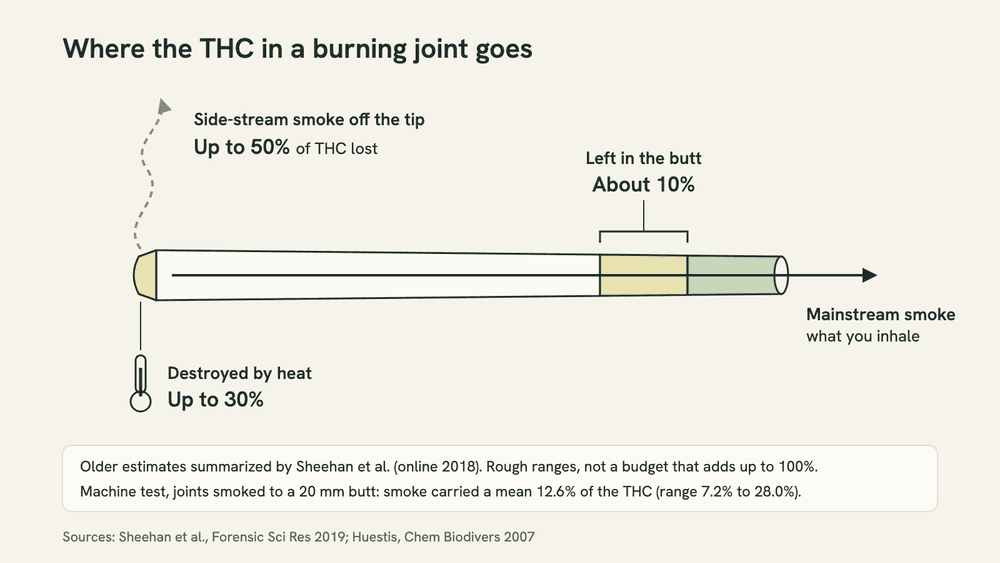
A lit joint is a small, uneven chemistry experiment. The ember at the tip burns hot. When you draw on the joint, smoke is pulled back through the unburnt cannabis behind the ember before it reaches your mouth, and between puffs the tip keeps smoldering, sending smoke into the room instead of into you. A 2007 pharmacology review of how cannabinoids move through the body lists three places THC goes missing when you smoke: destroyed by heat (pyrolysis), lost in the side-stream smoke drifting off the tip, and left in the unsmoked butt. It estimates that the share of smoked THC that actually reaches the bloodstream is roughly 8% to 24%, and notes that the figure depends strongly on how experienced the smoker is.
Those three figures are older estimates summarized in a 2018 New Zealand forensic study of how much THC joints deliver, which cites earlier work for them rather than measuring them itself. Treat them as rough ranges, not a budget that adds up to 100%. The same study did measure something useful. The researchers machine-smoked joints made from 12 seized cannabis samples, ranging from 1.0% to 13.4% THC, with about 650 mg of plant material each and no filter, and stopped each one at a butt as close as possible to 20 mm (about 0.8 inch). On average, the smoke carried about 13% of the THC in the cannabis (mean 12.6%, median 10.8%), anywhere from 7.2% to 28.0% depending on the sample. The smoke also carried 14.6 to 66.3 mg of tar-equivalent particulate matter per gram smoked.
Machines are not people, and the result swings with how a joint is smoked: an older 1972 experiment cited in the same paper recovered between 34% and 62% under different conditions. A 1971 paper in the journal Science that machine-smoked cigarettes spiked with THC and CBD found only 21% to 23% of the starting amount in the smoke. The point that holds across these studies is that a large share of the THC in a joint never reaches the smoker, and the butt holds a modest slice of it, not most of it.
Is the roach stronger than the rest of the joint?
This is the question the dictionaries skip, and it is the one a real study was built to answer. In 1991, UCLA researchers published a controlled comparison of the first and second halves of a marijuana cigarette in Pharmacology Biochemistry and Behavior. Their starting point, in their own words: "Previous in vitro studies suggest that, with successive puffs from a marijuana cigarette, delta-9-THC becomes concentrated in the remaining uncombusted portion of the cigarette." They added that this fits the common practice of smoking marijuana cigarettes down to a shorter butt than tobacco cigarettes. "In vitro" here means lab bench tests, not people.
To test it, ten habitual users each came in for four sessions and smoked a standard research cigarette (83 mm long, 800 to 900 mg, 1.24% THC) under fixed conditions: 1.5 liters inhaled per puff, a 14-second breath-hold and a puff every 30 seconds. Only the part being smoked changed:
| Session | What was smoked | What was measured |
|---|---|---|
| Day 1 | The whole cigarette: 60 mm smoked, leaving a 23 mm butt | Tar delivered, carbon monoxide in the blood (COHb), blood THC, heart rate, and how high people felt at 20 minutes |
| Day 2 | The first 30 mm only | Same measures |
| Day 3 | The second 30 mm, after the first half had been pre-smoked by syringe | Same measures |
| Day 4 | The second 30 mm, after the first half had been cut off unsmoked | Same measures |
What can you conclude without those numbers? A few things are documented. Older estimates put about a tenth of a joint's THC in the butt, which is real but modest. The stub is also small, so whatever has collected there is spread over only a few puffs. And people smoke the end differently: a 2023 review of human lab smoking studies notes that in a 1988 UCLA experiment, puff volume was significantly lower on the second half of the cigarette, whether it was a 1.24% THC cigarette or a placebo, while puff number, puff duration and breath-holding time did not change. Smaller puffs are a behavior, not proof that the end is harsher, but they mean the stub is not smoked the way the first half is.
How you inhale matters too. In a companion UCLA study from the same year, with the same 1.24% THC cigarettes, holding smoke in for 14 to 16 seconds instead of 4 to 5 seconds significantly raised how much tar stayed in the lungs, along with blood carbon monoxide, blood THC and heart rate. Taking bigger puffs (about 70 mL instead of 45 mL) made no significant difference for the same amount smoked.
The fair summary: the roach is not a meaningfully stronger product. Some THC does sit in the stub, but not much of it, and the one study we found that was designed to measure the difference has results we could not read, because they sit behind a paywall. The human studies in this section also used low-potency 1.24% THC research cigarettes of the 1980s and 1990s, and the butt estimate is older still, so none of it tells you what the end of a modern joint made from much stronger flower delivers.
Is the roach harsher, or worse for your lungs?
Any joint delivers a lot of smoke per puff, and the way cannabis is usually smoked adds to it. In a 1988 study in the New England Journal of Medicine of 15 men who smoked both, a marijuana cigarette delivered about three times the tar of a tobacco cigarette, a third more of that tar stayed in the airways, and the rise in blood carbon monoxide was nearly five times greater. The difference came largely from how the cigarettes were smoked (bigger puffs, deeper inhalation and a breath-hold four times longer), and it was only slightly influenced by THC content. Those were 1.24% THC cigarettes of the era.
The butt end is part of that picture. A 2007 New Zealand lung study of 339 adults points out that "cannabis is usually smoked without a filter and to a shorter butt length, and the smoke is a higher temperature" than tobacco, and estimated that for airflow obstruction, one joint had a similar effect to 2.5 to 5 tobacco cigarettes. That comparison applies to airflow obstruction only, not to cancer or overall harm, and the study was cross-sectional with self-reported use. Over the long run, a 2018 systematic review of 22 studies found smoking cannabis consistently linked to cough, phlegm and wheeze, and other research shows those symptoms tend to ease after quitting. Our page on why weed makes you cough covers that reflex in detail.
So why does the last part of a joint so often feel harsher? No study we found has measured harshness by position along a joint, so treat these as plausible explanations, not findings:
- Less cooling distance. Near the end, smoke travels through only a short column of plant material before it reaches your mouth, so it may arrive hotter.
- Residue in the stub. Whatever has built up in the unburnt part during earlier puffs, including condensed smoke compounds, is the last thing to burn.
- Paper and card near the ember. As the ember approaches the crutch, a larger share of what burns is paper rather than plant material.
If harshness is what you notice, the honest takeaway is not a trick for smoking the end more smoothly. It is that combustion itself is the issue. Heating flower below the point where it burns is the main alternative people consider, and our comparison of a dry herb vaporizer vs smoking lays out what is and is not known about tar and carbon monoxide from each.
Roach myths, checked
| Claim | Verdict | What the evidence says |
|---|---|---|
| The roach is the strongest part of the joint | Unproven | Older estimates put about 10% of a joint's THC in the butt. The one controlled comparison we found has no freely readable results. |
| Roach resin is concentrated THC, so it's better | Misleading | The sticky buildup in a stub is condensed smoke residue mixed with whatever cannabinoids collected there. No study shows it is a better or safer dose. |
| A crutch filters out the bad stuff | No evidence | We found no study showing that a card crutch or tip removes tar or other toxicants. Lab studies treat joints as unfiltered. |
| The end of a joint is harsher | Plausible, unmeasured | A shorter cooling path and built-up residue are reasonable explanations, but we found no study measuring harshness by position. |
| Old studies tell you what a modern roach delivers | No | The UCLA studies used 1.24% THC research cigarettes. Modern flower is often far stronger, and no modern study traces THC to the butt. |
The word resin causes most of the confusion. In the living plant, resin is made in trichomes, the tiny glands on cannabis flowers that our guide to trichomes explains. Collected and pressed on purpose, that resin becomes hash, a separate product covered in our page on what hash is and how it is made. The dark, sticky film inside a burned-down stub is something else: residue left by smoke that has already passed through, not a concentrate of fresh resin glands.
Roach clips, crutches and sharing
The roach clip is old enough that federal law defines it. Under 21 U.S.C. 863, the federal drug paraphernalia statute, roach clips are "objects used to hold burning material, such as a marihuana cigarette, that has become too small or too short to be held in the hand." The statute makes it a federal offense to sell paraphernalia, ship it across state lines, or import or export it, and it exempts people authorized by local, state or federal law to make, possess or distribute such items. Whether simply owning one matters legally depends on your state. A crutch, by contrast, is just a bit of rolled card: it holds the joint, keeps loose plant bits out of your mouth and gives you a cool end to hold. Treat it as a holder, not a filter.
Sharing is the other practical issue. Public-health researchers at UCLA, in a 2023 survey of cannabis users during the COVID-19 pandemic, note that earlier studies have shown sharing paraphernalia for cannabis, tobacco and crack cocaine to be a risk factor for respiratory viral and bacterial infections. The reason is simple: passing a joint around means passing saliva around, and by the time it is down to the roach, its mouth end has been on every pair of lips in the circle. Among respondents who inhaled cannabis for non-medical reasons, the share who did not share at all roughly doubled during the pandemic, from 12.4% to 24.9%. Separately, an outbreak investigation in Queensland, Australia looked at a tuberculosis cluster and a shared bong; the link it found for sharing the pipe was not statistically conclusive, and shared joints have not been studied the same way.
If you or someone in your home smokes, a few practical points apply to the stub specifically:
- Put it out completely in a nonflammable ashtray. A stub that looks dead can keep smoldering, so never drop one into a trash can, a plant pot or bedding.
- Do not hold a stub that is too short for your fingers. Let it go out instead of risking a burned fingertip or lip.
- Do not share a mouthpiece when you or anyone in the group is sick.
- Keep stubs, ashtrays and anything with cannabis residue out of reach of children and pets, who can swallow them.
- Empty ashtrays and air out the room. Old stubs hold onto the smell long after the session is over.
Roaches, the law and drug tests
A roach is still cannabis. Whatever rules apply to marijuana where you live apply to the leftover end of a joint too, and state laws on possession and paraphernalia differ, so treat this as general information as of October 2026, not legal advice. The lingering odor of old stubs belongs to the same picture, and our guide on clearing weed smell from a room covers what actually works. On testing, nothing about the stub changes the basic rule: THC from any part of a joint can show up on a drug test, and a roach is not a lower-THC form of cannabis.
What the evidence does not tell us
- What the 1991 half-versus-half study found. Its results are paywalled and the free abstract stops before them.
- Where THC ends up in a modern joint. The controlled human studies here used 1.24% THC research cigarettes; we found no modern study tracing THC to the butt of high-potency flower.
- Whether the end is really harsher. It is widely reported and plausible, but we found no measurement of harshness, tar or temperature by position along a joint.
- Whether a crutch or tip filters anything. Our PubMed search found no study testing card tips on joints.
- How often shared joints spread infections. Sharing is a recognized risk in general, but shared joints have not been studied directly.
Absence of evidence in our searches is not proof of no effect. It is a reason to be skeptical of confident claims in either direction, including the ones you will find near the top of search results.
Frequently asked questions
In the US, a roach is the stub left at the end of a joint once it has burned too short to hold comfortably. Dictionaries define it as the butt of a marijuana cigarette. In the UK and much of the Commonwealth, roach usually means something else: the rolled strip of card at the mouth end of a joint, which Americans call a crutch or tip.
A roach is still smoke, and the evidence on smoke applies. In a 1988 study using 1.24% THC cigarettes, a marijuana cigarette delivered about three times the tar of a tobacco cigarette, and long-term cannabis smoking is consistently linked to cough, phlegm and wheeze. Cannabis is usually smoked unfiltered and down to a short butt, with hotter smoke than tobacco, and a passed-around stub also carries other people's saliva. No study we found shows a roach is uniquely dangerous, and none shows it is safe.
Not in any way that has been shown to matter. Older estimates put about 10% of a joint's THC in the butt. A 1991 UCLA study was designed to compare the first and second halves of a joint, but its results are behind a paywall and the free abstract stops before them. People also take smaller puffs on the second half, and the UCLA studies used low-potency 1.24% THC cigarettes, far weaker than much of today's flower.
Nobody has measured it directly. Plausible reasons are that smoke near the end passes through only a short column of plant material and arrives hotter, that residue built up during earlier puffs burns last, and that more paper and card burn as the ember nears the crutch. Treat these as explanations, not findings.
A roach clip is a small clip or clamp for holding a stub that is too short for your fingers. US federal law defines roach clips as objects used to hold burning material, such as a marijuana cigarette, that has become too small or too short to be held in the hand, and lists them as drug paraphernalia. Whether owning one matters legally depends on your state.
No. A crutch, or tip, is a rolled strip of card at the mouth end of a joint (the UK calls it a roach). It holds the joint's shape, keeps loose plant bits out of your mouth and gives you a cool end to hold. We found no study showing that a card tip removes tar or other smoke toxicants, so treat it as a holder, not a filter.
Most dictionaries treat it as a shortening of cockroach, because a small, brown, burned-down stub looks like one, and record the word in print by the late 1930s to early 1940s. The popular story tying it to the Mexican song La Cucaracha is a theory, not an established origin.
In British slang, a roach usually means the mouthpiece of a rolled cigarette or joint, made from a strip of card or paper, often torn from the rolling-paper packet. Americans call the same thing a crutch or tip. It is sometimes called a filter, but no study we found shows it filters smoke. British dictionaries also record the stub meaning, so context decides.
If the harshness at the end of a joint is what sent you looking, the bigger question is burning itself. Our side-by-side look at vaporizing dry herb versus smoking it is the natural next read.
Writing about hemp, wellness and the small rituals that keep us balanced.