How to Get Rid of Weed Smell, and How Long It Lasts
Weed smell lingers because it is two things: a sulfur compound your nose detects at trace levels, and smoke residue that settles on fabric and surfaces. Here is what each cleaning step removes, how long the smell lasts, and why residue matters in a home with kids.

How do you get rid of weed smell? Open the windows, then clean what the smoke touched. The smell is really two things: a sulfur compound your nose picks up at trace levels, and smoke particles that settle on fabric, hair and surfaces. Fresh air clears the first. Washing and wiping clear the second. Fragrance covers both and removes neither.
Here is the short version, in the order that matters. Air the space out with cross-ventilation. Wash what is washable: clothes, bedding, throws, cushion covers, curtains. Wipe hard surfaces, windowsills and tables included. If you use an air cleaner, know what it does: a HEPA filter catches smoke particles, while the odor itself is a gas that needs a substantial activated-carbon filter. Skip sprays as a fix and skip ozone generators entirely. And the step that beats every other one is making less smoke indoors in the first place. This guide is about household air and laundry for adults where cannabis is legal: what each method actually removes, how long the smell tends to last, and why the residue matters more in a home with children.
Why weed smell is so hard to get rid of
Weed smell is stubborn for two separate reasons, and most advice deals with only one of them. The first is chemistry. The skunk note comes mainly from a sulfur compound, 3-methyl-2-butene-1-thiol, identified in a 2021 ACS Omega analysis of 13 cannabis cultivars. Terpenes, the compounds behind citrus, pine and pepper notes, are the best-known aroma molecules in cannabis, and they are a different class of molecule from cannabinoids such as THC, but the authors found little evidence that they produce the skunky note. Your nose is extraordinarily sensitive to that sulfur compound. In a 2012 study of Spanish red wine, people detected the same molecule at about half a nanogram to one nanogram per liter, roughly parts per trillion. That threshold was measured in wine, not air, but it explains why a room can still smell after most of the visible smoke is gone. The full chemistry is in our explainer on why weed smells like skunk.
The second reason is physical. Burning plant material makes smoke, a cloud of fine particles and gases. The particles drift through the house and settle on whatever is there: couch fabric, curtains, carpet, clothes, hair, tables and walls. That settled film is why a jacket or a sofa can smell long after the air in the room has cleared, and why spraying it only adds a second smell on top. The clearest measurement of this comes from tobacco. In a 2020 study in a non-smoking movie theater in Germany, chemists watched tobacco-smoke compounds rise in the air when certain moviegoers arrived, given off by their clothes and bodies. We found no equivalent study for cannabis, but it is the reason washing your clothes does more than spraying them.
“The most effective ways to improve your indoor air are to reduce or remove the sources of pollutants and to ventilate with clean outdoor air.”
That line from EPA's guidance on air cleaners and filters in the home maps neatly onto weed smell. Removing the source means smoking less indoors, or not at all, and cleaning off the residue that is already there. Ventilating means swapping stale indoor air for outdoor air. EPA adds that filtration "can be an effective supplement" and that air cleaners "cannot remove all pollutants." A filter helps. It does not replace the other two.
How long does weed smell last?
We found no study that timed the smell itself, but researchers have timed the smoke, and the smoke is what carries the residue. In 60 controlled tests in one 43-cubic-meter room, a joint released fine particles (PM2.5, particles 2.5 microns across or smaller) at 7.8 milligrams per minute, 3.5 times the rate of a Marlboro cigarette at 2.2. The same research group then moved to a real house. In a detached two-story, four-bedroom home, one joint smoked in the living room raised fine particles in all nine monitored rooms over the next five hours, to an average of about 4.4 times the level a cigarette produced. Opening three windows about 5 inches (12.7 cm) cut that by two-thirds, which still left more particles in the air than a cigarette with the windows shut.
Smoke also takes longer to clear than most people expect. In a UC Berkeley study of eight real bong sessions in one living room with the doors closed, fine particles averaged about 1,300 micrograms per cubic meter during smoking, 100 to 1,000 times background in six of the eight sessions. Ninety minutes after smoking stopped, levels were still about half the peak. In the one session tracked overnight, the air still held about 50 micrograms per cubic meter 12 hours later, more than ten times its normal level. The limits are real: one home, eight sessions and, as the authors note, smoking that was not directly observed.
Surfaces hold on longer than air. In a Colorado study of a university research room with ventilation strong enough to replace the air in under two minutes, a month of dry-herb vaporizer sessions still left measurable THC on six of 15 hard surfaces, from 348 to 4,882 nanograms per square meter, highest on the windowsill, which staff did not clean. The tables, which staff wiped at the start of each month, were below the quantification limit in the first sampling round. THC, like the other cannabinoids the plant makes, has no smell of its own, so these numbers mark residue rather than odor. Residue does not last forever, either: in lab tests on glass and cotton, THC films reacted with ordinary indoor ozone and broke down fairly fast, at a rate that depended on film thickness, ozone level and the surface. That is chemistry, not a health finding, and it says nothing about the sulfur compounds you actually smell.
On clothes, hair and in a car
Here the honest answer is that we found no measurement. A PubMed search in October 2026 turned up no study that timed cannabis odor on fabric, hair or car upholstery, so any page that promises "24 hours" or "three days" is not citing one. What the research does show is which variables move the answer:
- Smoke, vapor or edibles. Burning makes the most particles, vapor makes fewer, and edibles make none in use (details below).
- How much was smoked and for how long. More smoke means more residue to settle on everything in the space.
- The size of the space and its airflow. A closed bedroom or a car cabin concentrates the same smoke into far less air than an open living room.
- Ventilation during and after. In the house study, three cracked windows cut particle levels by two-thirds, but did not bring them back to normal.
- The material. Fabric cannot be wiped, so it holds what settles on it until it is washed. Smooth hard surfaces clean up in seconds.
- Whether anything was cleaned. Washing and wiping remove residue. Time alone only lets some of it fade.
What each method actually removes
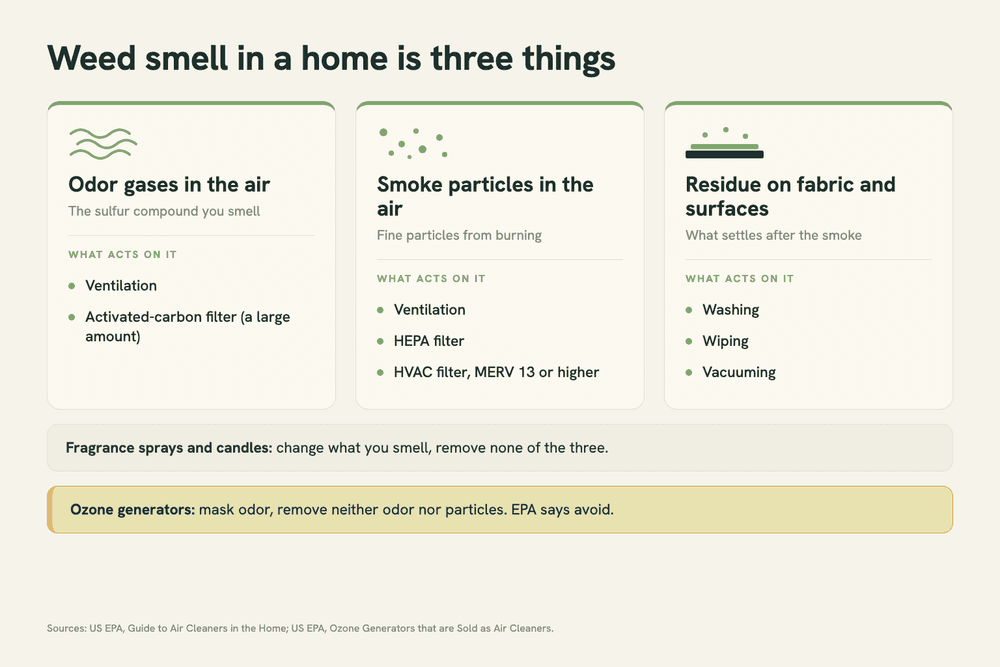
Every method on the usual list works on one of three targets: odor gases in the air, smoke particles in the air, or residue that has already settled. EPA's guide to air cleaners in the home is blunt about the first two: most filters are designed to catch either particles or gases, not both. A HEPA filter handles smoke particles. The smell is a gas, which needs an activated-carbon filter or another filter made for gases, and EPA says carbon can be effective "provided that there is a large amount of material." There is also no widely used rating that tells you how well any unit removes gases. The CADR number on the box covers particles only.
| Method | What it acts on | What it does not do | Basis |
|---|---|---|---|
| Open windows, fan pointing out | Gases and particles in the air, by dilution | Does not touch residue on fabric or surfaces | Three cracked windows cut particles 67% (house study) |
| Bathroom or kitchen exhaust fan | Air in that room, vented outside | Works mainly in the room it serves | Mechanism: air exchange |
| HEPA air cleaner | Smoke particles | Does not remove odor gases | EPA: most filters target particles or gases |
| Activated-carbon filter | Odor gases and other VOCs | Small amounts fall short; no standard gas rating | EPA: effective with a large amount of carbon |
| HVAC filter, MERV 13 or higher | Particles in recirculated air | Not a gas filter; a clogged filter works poorly | EPA: at least MERV 13 if your system allows |
| Washing fabrics | Residue in clothes, bedding, curtains | Nothing in the air | Mechanism: physical removal |
| Wiping hard surfaces | Residue on tables, sills, walls | Nothing in the air | THC found on room surfaces after vapor use |
| Baking soda, vinegar, charcoal sachets | Unclear; no cannabis-odor test found | Sachets hold far less carbon than EPA describes | No cannabis study found |
| Sprays, candles, essential oils | What you perceive | Remove nothing; add their own VOCs | EPA lists air fresheners as VOC sources |
| Ozone generator | Masks odor | Removes neither odor nor particles; can damage lungs | EPA: avoid in occupied rooms |
Two notes on the table. Baking soda and vinegar are fine cleaning tools, and the scrubbing, wiping and washing you do with them physically removes residue. What we could not find is any study showing that either one neutralizes cannabis odor on its own, so treat the bowl-of-vinegar trick as untested. And if your home has central air, the furnace or HVAC filter matters: EPA suggests a filter rated at least MERV 13, or as high as your system will accommodate, and notes that a dirty, overloaded filter won't work well. Swapping a filter that is due is one of the cheapest steps on this list.
How to get rid of weed smell: a room, your clothes and a car
- 1Stop adding to it. If you smoke at home, move it outside and away from open doors and windows. That one change shrinks every step that follows.
- 2Cross-ventilate for hours, not minutes. Open windows on two sides of the room or home and set a box fan in one window facing out, so it pulls stale air through. In the bong study, levels were still half the peak 90 minutes later.
- 3Wash what can be washed: clothes, bedding, pillowcases, throws, cushion covers and curtains. Use the warmest water the care label allows and dry fully. The goal is to remove residue, not to perfume it.
- 4Wipe hard surfaces with a damp cloth and an ordinary household cleaner: tables, counters, windowsills, doorknobs, light switches and remotes. In the Colorado study, the uncleaned windowsill carried the most THC.
- 5Vacuum what you cannot wash: carpet, rugs, upholstery and mattresses. If the smell persists, shampoo or steam-clean the carpet and upholstery.
- 6Run an air cleaner if you have one: HEPA for lingering particles, and a unit with a substantial activated-carbon filter for the smell. Replace the HVAC filter if it is due.
- 7For a car, open every door and let it air out, wipe the dashboard, console, wheel and door panels, vacuum and clean the seats and floor mats, and replace the cabin air filter if it is due.
Plan on the air taking hours to clear, longer in a closed room, and the fabrics smelling until they are washed. If a room still smells a day later, the likeliest source is something soft that has not been cleaned yet: a couch cushion, a rug, a curtain, a jacket on a hook. Go back to steps 3 and 5 before you reach for another product.
What doesn't work, and one thing to avoid
Fragrance is the most common fix and the least effective one. Sprays, plug-ins, candles, incense and essential oils change what you smell, not what is in the fabric. They also add to the air: EPA's page on volatile organic compounds lists air fresheners among household sources of VOCs and notes that VOC levels are consistently higher indoors than outdoors, up to ten times higher. Small charcoal pouches are a milder version of the same gap. Activated carbon does trap gases, but EPA's condition, a large amount of material, is the whole point, and a sachet near a vent is far short of it. EPA also says research has not yet shown that home units using plasma, photocatalytic oxidation or similar technologies remove gases. Then there is the one kind of device that does active harm. EPA's guidance on ozone generators sold as air cleaners says experiments suggest body odor may be masked by the smell of ozone but is not removed by it, and that ozone does not remove particles.
Smoke vs vape vs edibles: which leaves the most behind
The easiest cleaning is the cleaning you never have to do. In the 60 controlled tests in that 43-cubic-meter room, the joint was the heaviest emitter of fine particles by a wide margin, and every other method was measured against it.
| Method | Fine particles vs a joint | What it leaves behind |
|---|---|---|
| Joint | 100% (3.5x a cigarette) | The most smoke of the methods tested; residue on fabric and surfaces |
| Bong | About 67% | Smoke residue; in one closed living room, still half the peak 90 minutes after |
| Glass pipe | About 54% | Smoke residue |
| Cartridge vape pen | About 44% | Less particle mass than a joint, not zero |
| Dry-herb vaporizer | Not tested in this study | No combustion, but THC was measured on room surfaces after a month of use |
| Edibles | None in use | No smoke or vapor; the product and home cooking can still smell |
Read those numbers with their caveats. They come from one room, one experienced smoker and one type of vape pen (a cartridge of cannabis oil, not a dry-herb device), and particle mass is a stand-in for smoke, not a measure of smell. Still, the direction is consistent. A dry-herb vaporizer heats flower without burning it, so it skips combustion smoke, but the vapor still carries the flower's aroma and, as the Colorado surface study showed, it is not residue-free. Our comparison of dry-herb vaporizers and smoking covers the devices in full, and our explainer on what in smoke makes you cough covers the irritant side. Eating cannabis makes no smoke and no vapor, so there is nothing to settle on the couch. The smell that remains is the product in its container, and the kitchen if you cook with flower; our guide to whether weed goes bad covers storage and the musty smell of old flower.
Thirdhand residue: why surfaces matter with kids at home
Researchers call the residue that stays after the smoke clears thirdhand smoke. A 2022 University of Toronto review defined it as "the contamination that persists indoors following the cessation of a smoking event" and modeled how it reaches people, across tobacco, e-cigarettes and cannabis. The most volatile parts are breathed in, highly water-soluble parts can be absorbed through skin, and the stickiest, least volatile parts are predicted to be swallowed through hand-to-mouth and object-to-mouth contact. That last route is the one to think about for anyone who spends time at floor level: crawling babies, toddlers, and pets too. It was a model, not a measurement of people.
The cannabis evidence is thinner than the tobacco evidence. A 2017 systematic review of 15 studies found that what passive bystanders absorb depends on the amount of smoke, the ventilation, the air volume, and the number of joints and smokers, and it found no study at all on thirdhand cannabis smoke or on the health effects of long-term exposure. The lab chemistry points the other way on one detail: the glass-and-cotton ozone study expected THC residue to matter less in thirdhand cannabis smoke than nicotine does in tobacco residue, because THC evaporates so slowly. Neither finding says thirdhand cannabis residue is harmful or harmless. The question is still open.
Research since then has started to measure real homes. In a San Diego study that put particle monitors in family homes, all with a cigarette smoker and a child under 14, households that reported indoor cannabis smoking averaged about 60% more airborne particles than smoke-free ones (3,131 versus 1,968 particles per 0.01 cubic foot over seven days). The link to children's health problems in that study was not statistically significant (odds ratio 1.83, 95% CI 0.89 to 3.80), and the authors called for more research. A 2025 analysis of 275 young children from similar San Diego homes found that those living where an adult smoked cannabis indoors had five times the odds of cannabinoids showing up in their urine; about 27% of all the children had detectable levels. That measures exposure, not harm, but it is the clearest reason to keep smoke out of shared rooms.
What helps? Mostly the same things that help with smell. In a 2026 pilot study, 14 caregivers who smoked indoors were given a home air-quality monitor for three weeks. Eleven of the 13 analyzed checked it daily, and the number of days a week a child was home during smoking fell from about 4.5 to 2.8, though particle readings showed no consistent trend. It was tiny and uncontrolled, so treat it as a promising idea, not proof. Air exchange matters too: controlled studies of secondhand cannabis smoke found that ventilation was the variable that changed everything for the people sitting nearby. None of this makes indoor smoke, or the residue it leaves, safe. Cleaning reduces what is there. It does not bring it to zero, which is why EPA puts removing the source first.
Removing the smell doesn't change the rules
One thing no cleaning step can do is change what is allowed. Even where cannabis is legal for adults 21 and over, a lease, a no-smoking clause, a condo or HOA rule and a hotel policy are generally written about smoking itself, not about whether anyone can smell it afterward. If you rent, our guide to whether you can be evicted for smoking weed covers how leases and federal housing rules treat it. How the law treats the odor itself is a separate question, covered in our explainer on whether the smell of weed is probable cause. This page is about air quality and housekeeping, nothing more.
What we still don't know
- How long cannabis odor lasts on clothes, hair, upholstery or in a car. No study we could find has timed it.
- Whether baking soda, vinegar, coffee grounds or charcoal sachets reduce cannabis odor at all. We found no test of any of them on it.
- How well any home air cleaner removes cannabis odor gases specifically. There is no standard gas-removal rating to compare units.
- Whether thirdhand cannabis residue affects the health of children or pets. Studies so far measure particles and exposure, not harm, and we found none on pets.
- How dry-herb vapor compares with smoke in a real home. The surface study used one research room, and the particle studies tested smoke and cartridge pens.
Common questions about weed smell
Wash them rather than spraying them. The smell sits in residue in the fibers, so a normal wash in the warmest water the care label allows, followed by a full dry, does far more than a fabric freshener, which only adds a scent on top. If you cannot wash something right away, hang it outside in moving air. With tobacco, chemists have measured residue coming off smokers' clothes into a non-smoking room. We found no such study for cannabis, and none that timed how long the smell lasts on fabric.
Longer than most people think. In a study of bong sessions in a closed living room, fine particles were still about half their peak 90 minutes after smoking stopped and more than ten times background 12 hours later. In a house study, one joint raised particle levels in all nine rooms over five hours. After the air clears, fabrics and surfaces keep smelling until they are cleaned. Room size, ventilation and how much was smoked all change the answer.
Partly, depending on the filter. A HEPA filter catches smoke particles, but the smell is a gas, and EPA says gases need an activated-carbon filter with a large amount of carbon. There is no standard rating for gas removal, so a claim on the box is hard to check. Avoid any unit that produces ozone on purpose. A purifier supplements ventilation and cleaning; it does not replace them.
Fabric and air fresheners change what you smell. They do not remove the residue in a couch or curtains, so the odor is still there underneath. EPA also lists air fresheners among household sources of volatile organic compounds, so you are adding to the air rather than cleaning it. Washing, wiping and fresh air are what actually remove the source.
Generally less, but not none. In controlled tests, a cartridge vape pen released about 44% of the fine particles a joint did. A dry-herb vaporizer skips combustion, but the vapor still carries the flower's aroma, and a Colorado study found THC on room surfaces after a month of vaporizer use. Less smoke means less to clean, not nothing to clean.
Not while you eat them. Edibles make no smoke and no vapor, so nothing settles on furniture or fabric. The smell comes from the product itself in its packaging and, if you cook with flower at home, from the kitchen while it cooks.
Treat it as a cleaning job. Open all the doors and air the car out, wipe the hard surfaces, vacuum and clean the seats, carpet and floor mats, and replace the cabin air filter if it is due. A car cabin is a small, closed space, so the same smoke is far more concentrated there than in a room, and fabric seats hold residue until they are cleaned. Cleaning does not change any law about cannabis in vehicles, which is a separate legal question.
Soap and water for hands, a normal shampoo for hair. It matters most around small children: if you have smoked and are about to hold a baby, wash your hands and change your top first, because residue on skin and clothes can end up on the things young children touch and put in their mouths.
If you want to understand the smell itself, the chemistry makes a good next read. Why weed smells like skunk, and why it isn't the terpenes explains the sulfur compound behind it, why the smell fades as flower ages, and why a strong smell tells you nothing about potency.
Writing about hemp, wellness and the small rituals that keep us balanced.