Does Weed Lower Cortisol? Why Studies Say Both Yes and No
Does weed lower cortisol or raise it? A single dose of THC raised cortisol in lab studies, while daily users show a smaller cortisol reaction to stress. Here is what each human study measured, and why neither means less stress.
Does weed lower cortisol, the hormone your body releases under stress? Search the question and you get both answers, sometimes on the same page. The human studies explain why: they measured different things, on different time scales, in different people. Here is what each one found, with the dose, the route and who was tested, and what the results do and do not mean for stress.
The short answer. In controlled lab studies, a single intravenous dose of THC raised blood cortisol, more at higher doses. People who use cannabis often show a different pattern: a smaller cortisol reaction to a stressor, or none, and a flatter cortisol curve across the day. That second finding is where the "lowers cortisol" answer comes from. But a blunted cortisol response is a measured change in your stress system, not proof of feeling less stressed, and in teenagers a low cortisol pattern looks more like a predictor of early cannabis use than a result of it. Neither result is a reason to use cannabis for stress.
What cortisol is and how researchers measure it
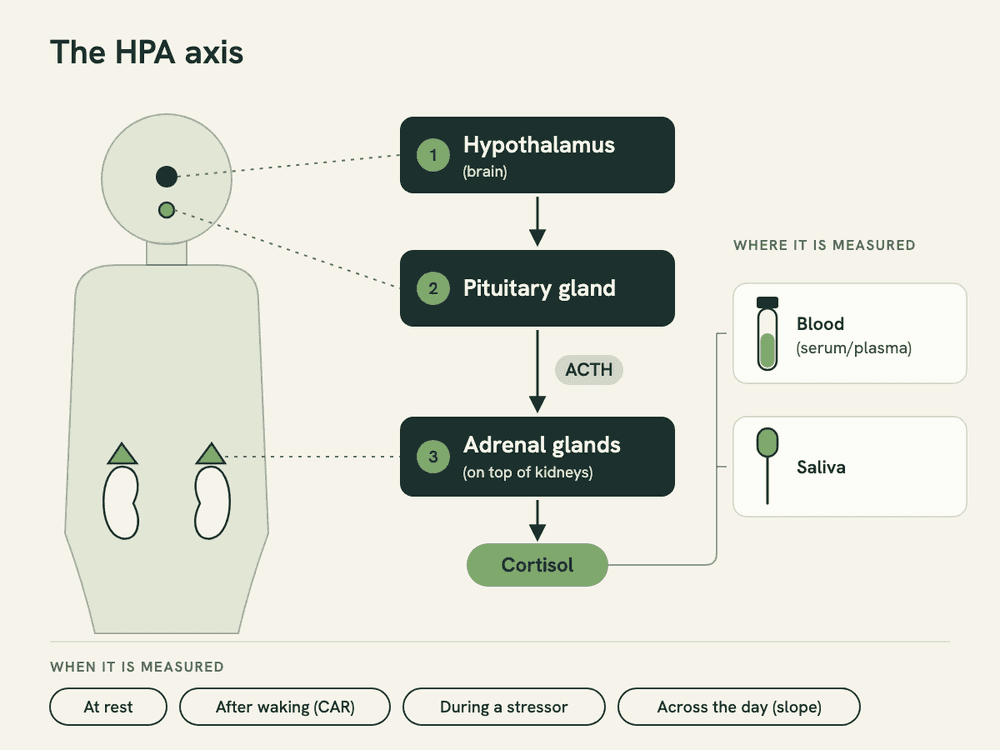
Cortisol is a steroid hormone made by your adrenal glands. It sits at the end of a three-step chain called the HPA axis (hypothalamus, pituitary, adrenal): the hypothalamus in your brain signals the pituitary gland, the pituitary releases a hormone called ACTH, and ACTH tells the adrenals to release cortisol. Cortisol also follows a daily rhythm. As the MedlinePlus guide to cortisol testing explains, levels are normally highest in the morning and much lower by around 4 p.m., and blood for a cortisol test is usually drawn twice in one day for that reason. Why a cannabinoid would touch this chain at all is a question about the receptors described in our endocannabinoid system explainer.
"Cortisol" in a study can mean several different measurements, and the cannabis findings change depending on which one you look at:
- **Blood (serum or plasma) cortisol:** a blood draw, one snapshot at a time. This is what the intravenous THC studies used.
- **Saliva cortisol:** a swab that is easy to repeat many times a day, so it is the usual choice for stress tests and daily-rhythm studies.
- **Cortisol awakening response (CAR):** the rise in cortisol in the first half hour or so after you wake up, measured by sampling at waking and again about 30 minutes later.
- **Stress-task reactivity:** how much cortisol climbs during a lab stressor, such as giving a speech and doing mental arithmetic in front of evaluators.
- **Diurnal slope:** how steeply cortisol falls from morning to evening. A flatter slope means less difference between your morning and evening levels.
Keep these apart and most of the confusion clears up. "Weed raises cortisol" is usually a claim about resting blood cortisol after a dose. "Weed lowers cortisol" is usually a claim about how much cortisol jumps during a stress test, or how high it climbs after waking, in people who already use cannabis regularly. Those are different questions, and they have different answers.
Does THC raise cortisol? What one dose did in the lab
The clearest evidence comes from Yale, where researchers gave THC into a vein under double-blind conditions. In a 2004 study of 22 healthy people who had been exposed to cannabis but did not have a cannabis use disorder, THC at 2.5 mg and 5 mg increased plasma cortisol, alongside increased anxiety and changes in perception. The effects were transient. The published abstract does not report how large the cortisol rise was. The anxiety side of a strong dose has its own explanation in why weed can make you paranoid.
A 2009 analysis that pooled several of those Yale lab studies gives the fuller picture. It covered 76 adults, 36 healthy controls and 40 frequent cannabis users, who received intravenous THC at 1.5, 2.5 or 5 mg, with plasma cortisol measured at baseline and about 70 minutes later. THC raised cortisol in a dose-dependent way, an effect driven mainly by the 5 mg dose, and on active-dose days the normal decline in cortisol across the day was reduced. Both groups started at similar baseline cortisol, but frequent users showed a smaller rise (a group difference at p = 0.05). The authors offer two explanations: tolerance from regular use, or differences that existed before the cannabis use. Frequent users also had lower baseline prolactin, another hormone made by the pituitary gland. The limits are real: intravenous THC is not how people use cannabis, and few women were studied. A dose shifts other parts of your physiology too, which is covered in what weed does to your blood pressure, and how long a weed high lasts covers the time course of a dose in general.
Swallowed THC gave a different picture. In a University of Chicago lab study of 42 adults aged 18 to 40 who used cannabis occasionally, participants took a capsule of placebo, 7.5 mg or 12.5 mg THC, 2.5 hours before the Trier Social Stress Test (a speech and mental arithmetic in front of evaluators). Neither dose changed salivary cortisol, either in the 2 hours before the test or in response to it. The 7.5 mg dose made the test feel less distressing, while the 12.5 mg dose increased negative mood overall and impaired performance on the task. With about 14 people per group, the authors note the study was small for detecting cortisol differences. It shows a direction in one lab task, not a dose anyone should aim for. The way lower and higher THC doses can push mood in opposite directions is explored in whether weed is a depressant.
Weed and cortisol: every human study in one table
Here are the human studies behind this page, side by side. The direction of the cortisol result depends on three things you can read across each row: whether people got a dose in the lab or were compared by their usual habits, the route, and who was tested. Every dose listed was a research condition, not a suggested amount, and the CBD doses are far above what consumer products contain.
| Study | Design | Who | Cannabinoid, dose, route | Cortisol result | Caveat |
|---|---|---|---|---|---|
| D'Souza 2004 | Double-blind, randomized | 22 healthy, cannabis-exposed adults | THC 2.5 or 5 mg, intravenous | Up | Size of rise not in abstract |
| Ranganathan 2009 | Pooled double-blind lab studies | 36 controls, 40 frequent users | THC 1.5 to 5 mg, intravenous | Up, dose-dependent; smaller rise in frequent users | Intravenous route; few women |
| Childs 2017 | Randomized, double-blind | 42 occasional users | THC 7.5 or 12.5 mg, oral capsule | No change before or during a stress test | About 14 per group |
| Cuttler 2017 | Cross-sectional, randomized stress task | 40 users, 42 non-users | Usual use, no lab dose | No rise under stress in users | Cannot show cause |
| Somaini 2012 | Cross-sectional | 14 dependent, 14 abstinent 6 months, 14 controls | Dependent use, no lab dose | Higher at rest, weaker reaction to unpleasant images | 14 per group |
| Martin 2026 | Randomized trial of progesterone vs placebo | 148 adults with cannabis use disorder | No cannabis for 1 week, checked by saliva tests | Bigger stress-test rise linked to a longer wait before using again | No non-users; no reading from before stopping |
| Glodosky 2026 (online 2024) | Naturalistic, one ordinary day | 39 users, 43 non-users | Users' own cannabis | Blunted CAR, flatter slope, higher afternoon; dipped after use | No placebo; tolerant users |
| Huizink 2006 | Prospective cohort | 1,768 Dutch children aged 10 to 12 | Onset at 9 to 12 vs 13 to 14 | Lower rise after waking in early starters | Small effect; most had used 1 to 3 times |
| van Leeuwen 2011 | Cohort, one wave | 591 adolescents | Ever used; or 5+ times in past year | Lower reactivity to a social stress task in both groups | Direction of effect unclear |
| Zuardi 1993 | Double-blind | 11 volunteers | CBD 300 or 600 mg, oral | Normal morning fall much smaller (stayed higher) | Tiny, older study; only 4 got 600 mg |
| Hundal 2018 | Randomized | 32 volunteers high in paranoid traits | CBD 600 mg, oral | No change in stress-induced rise | Selected sample |
| Zhang 2026 | Randomized crossover | 12 healthy adults | CBD 750 mg twice daily for 3.5 days, oral | Up, within the normal range | Methylphenidate also given on the last day |
| Hurd 2019 | Randomized, placebo-controlled | Adults abstinent from heroin | CBD 400 or 800 mg, oral, once daily for 3 days | Smaller cortisol rise to drug cues | Clinical group; drug-cue stressor |
Does weed lower cortisol? Daily use and the blunted response
A 2021 review of cannabis and the stress system sums up the two halves of the answer. Acute cannabinoid exposure raises basal stress hormones in both rodents and humans, while chronic cannabis use in humans is associated with dampened stress reactivity, a blunted cortisol awakening response and a flatter daily cortisol slope. The review also notes that only a few studies have measured the awakening response. It is a narrative review rather than a systematic one, written by the same research group behind two of the studies below, so read it as a map of the field, not a final verdict.
The study most often quoted on page one of search results is a 2017 Washington State University experiment. It compared 40 chronic cannabis users with 42 non-users, and randomly assigned each person to either the Maastricht Acute Stress Test (a hand in ice water combined with mental arithmetic under evaluation) or a no-stress version of the same task. Non-users who got the stressor had higher salivary cortisol and higher stress ratings, as expected. Users showed no increase in cortisol and a significantly smaller increase in how stressed they said they felt. The design matters here: people were randomized to the stress test, not to cannabis. Users chose to be users, so the study cannot tell whether cannabis caused the difference or whether people with a quieter cortisol response are more likely to use cannabis regularly in the first place.
“Future research is needed to determine whether this helps to confer resiliency or vulnerability to stress-related psychopathology as well as the mechanisms underlying this effect.”
A small Italian study of cannabis dependence found a related pattern with a twist. It compared 14 people actively dependent on cannabis, 14 who had been abstinent for 6 months and 14 controls, measuring plasma ACTH and cortisol while they looked at unpleasant images. Cannabis users, especially active ones, showed signs of an overactive HPA axis but a weaker hormonal reaction to the images, which the authors describe as persistent hyperactivity of the HPA axis and an impaired hormonal reaction to negative emotions. With 14 people per group, all of the users dependent on cannabis, it describes dependent use, not occasional use, and the authors flag the small sample themselves.
The newest data come from outside the lab. In a Washington State study published online in 2024, researchers followed 39 regular users and 43 non-users through an ordinary day, collecting saliva and stress ratings at eight time points while participants wore a 24-hour sensor. Regular users had a blunted cortisol awakening response, a flatter slope across the day and higher afternoon cortisol, and part of that pattern was related to waking up later. Users also gave samples before and after their own cannabis, and their cortisol and self-rated stress dipped afterward, but the study had no placebo, users chose what and when to use, and they were tolerant regular users, so it cannot show what a dose does to stress. This is the honest source of the "weed lowers cortisol" answer, and it is a long way from a treatment finding. Because wake time shaped the morning curve, sleep habits matter to how you read it; going to bed high has its own trade-offs.

Which came first? The teenage cohort studies
If cannabis users have a smaller cortisol response, did cannabis cause it? Two Dutch reports from the TRAILS cohort suggest the arrow may point at least partly the other way. In a study of 1,768 children aged 10 to 12, researchers sampled saliva at waking, 30 minutes later and at 8 p.m., then followed the children for 2 years. Children who started cannabis early (at 9 to 12) had lower cortisol 30 minutes after waking than those who started at 13 or 14 (odds ratio 0.93, 95% confidence interval 0.86 to 0.99). Some early starters may already have tried cannabis by the time they were sampled, so the study cannot fully order the two. But most early and later starters had used only a handful of times (the 2021 review counts 53% of early starters at one to three uses), and the review judges it unlikely that so little use caused the difference; a blunted morning rise may instead predict early use. The effect was small, and the study was observational.
A later TRAILS analysis of 591 adolescents put them through a social stress task with four cortisol samples. Teens who had ever used cannabis showed lower cortisol reactivity than those who had not (odds ratio 0.68, 95% confidence interval 0.55 to 0.85), and so did repeated users, defined as five or more times in the past year (odds ratio 0.74, 95% confidence interval 0.53 to 0.98). As the 2021 review points out, that is light use, unlikely on its own to have changed the stress response, and the review suggests the blunting may be a risk factor for use rather than a result of it. None of this is a reason to see early cannabis use as harmless or helpful. It means a low cortisol pattern and cannabis use travel together, and nobody has yet untangled which drives which.
Does CBD lower cortisol?
In healthy or non-clinical volunteers, the few human studies that measured cortisol after CBD point up or nowhere, not down. In an 11-person double-blind study from 1993, cortisol on placebo fell from 11.0 to 7.1 µg/dL over 2 hours, the normal morning decline. After CBD that decline was significantly smaller: cortisol went from 10.5 µg/dL at baseline to 9.9 two hours after 300 mg and 11.6 after 600 mg, a dose only 4 people received, with wide variation between them. In a 2018 trial of 32 volunteers high in paranoid traits, a virtual-reality stressor raised cortisol, and 600 mg of CBD did not change that rise. And in a 2026 crossover trial of 12 healthy adults, 750 mg of CBD twice a day for 3.5 days, a dose the authors call relatively high and above what over-the-counter supplements and many clinical settings use, raised plasma cortisol compared with placebo (a CBD-to-placebo ratio of about 1.6 in men and 1.9 in women), though all hormone levels stayed within physiological ranges; every participant also received methylphenidate on the last day for a separate study aim. The one drop we found came from a clinical group: in a trial of people abstinent from heroin, 400 or 800 mg of CBD a day for 3 days reduced the cortisol rise triggered by drug cues, a specific patient group and stressor that say nothing about everyday stress. All of these doses are far above what consumer CBD products contain, so none of them describe what a typical product would do. At lower amounts, the 8-week beverage trial covered in our review of CBD and stress research, which paired 30 or 60 mg of CBD with L-theanine, found no CBD effect on cortisol.
What happens to cortisol when you take a break?
Less is known here than you might expect. A PubMed search we ran in October 2026 (cannabis or marijuana, abstinence or withdrawal, and cortisol: 14 records) turned up two studies that measured the hormonal stress response in people who had stopped using cannabis, and neither compared it with the same people's levels from before they stopped. The Italian study above tested people 6 months after they quit, and by then their hormonal reaction to unpleasant images had only partly recovered compared with controls. A 2026 randomized trial of 148 adults with cannabis use disorder kept participants off cannabis for a week, checked by twice-daily saliva drug tests, while they took either progesterone (the hormone the trial was testing) or placebo, then gave them the Trier Social Stress Test. Across the whole sample, people whose cortisol rose more during the test went longer before using cannabis again and used on fewer days in the two weeks that followed. That is an association, the trial had no non-users for comparison, and it has no cortisol reading from before people stopped, so it cannot show what a week off does to cortisol. Neither study can tell you what your own cortisol will do during a two-week pause. What does change during a break, from tolerance to sleep, is laid out in our guide to taking a tolerance break.
If stress is the real question
Many people searching this are really asking whether cannabis can take the edge off stress. The cortisol data do not answer that in cannabis's favor, in either direction: a single dose raised cortisol, and the blunting seen in regular users has no settled meaning. Human research does not show that cannabis or CBD treats stress or anxiety. The NIMH fact sheet on stress suggests everyday steps that do not depend on any substance:
- 1Keep a journal.
- 2Use an app that offers relaxation exercises, such as deep breathing or visualization, or tips for practicing mindfulness.
- 3Exercise, and eat healthy, regular meals.
- 4Stick to a sleep routine and make sure you get enough sleep.
- 5Avoid excess caffeine, such as soft drinks or coffee.
- 6Identify and challenge negative and unhelpful thoughts.
- 7Reach out to friends or family members who help you cope in a positive way.

What nobody has measured yet
- Routes compared head to head. The dose-dependent cortisol rise on this page comes from intravenous THC, and the one oral THC study found no change; we found no trial comparing smoked, vaped and eaten THC with cortisol as an outcome.
- Women. The 2009 pooled Yale analysis included few women, and the 2021 review notes that much of what is known about sex differences comes from rodents.
- Cause and effect in daily users. Every study of regular users compares people who chose to use with people who did not; no randomized long-term study exists.
- What blunting means. Whether a smaller cortisol reaction protects people or leaves them more vulnerable is an open question, in the researchers' own words.
- Cortisol before and after stopping. We found no study that measured the same people's cortisol while they were using and again in the first weeks after they stopped; the one trial that tested cortisol after a week off had no reading from before.
- CBD alone at everyday amounts. Except for one 8-week beverage trial pairing CBD with L-theanine, human CBD studies measuring cortisol used 300 to 1,500 mg a day; we found none testing CBD alone at typical consumer doses with cortisol as the main outcome.
Frequently asked questions
Not in controlled dosing studies. A single intravenous dose of THC raised cortisol, and oral THC at 7.5 or 12.5 mg did not change it in one 42-person study. The "lowers" answer comes from people who use cannabis regularly: they show a smaller cortisol reaction to stress and a flatter daily curve, and in one naturalistic study their cortisol dipped after use. That study had no placebo and involved tolerant users, so it cannot show what a dose does to stress.
Acutely, yes, in the lab. In Yale studies, intravenous THC at 2.5 to 5 mg raised plasma cortisol, more at higher doses, measured about 70 minutes after the dose. Frequent users showed a smaller rise. A study of oral THC capsules (7.5 and 12.5 mg) found no measurable change in salivary cortisol, though it was small.
Not in healthy volunteers. At 300 to 600 mg, CBD made cortisol's normal morning decline much smaller in one small 1993 study; 600 mg did not change a stress-induced rise in a 2018 trial; and 1,500 mg a day raised cortisol within the normal range in a 2026 trial. An 8-week trial of a lower-dose CBD and L-theanine beverage found no CBD effect on cortisol. The one drop we found was in people abstinent from heroin, where 400 to 800 mg reduced the cortisol rise to drug cues, a clinical finding that does not carry over to everyday stress. These doses are far above typical consumer products.
In observational studies, regular users show a smaller cortisol awakening response (the rise in the half hour after waking) and a flatter slope across the day. In a 2024 study, part of that pattern was tied to waking up later. There are no randomized data, so it is not clear how much is due to cannabis itself.
Nobody knows yet. The researchers who found it in daily users said further work is needed to tell whether it confers resiliency or vulnerability. A cortisol rise is part of a normal response to acute stress, and in Dutch teenagers a low cortisol pattern was linked to starting cannabis earlier. It should not be read as being calmer.
Very little is known. Among people who had been dependent on cannabis, the hormonal reaction to unpleasant images had only partly recovered 6 months after quitting, in one small study. In a 2026 trial, adults with cannabis use disorder took a stress test after a week without cannabis, and those whose cortisol rose more went longer before using again, but the trial had no cortisol reading from before they stopped. No study we found has tracked the same people's cortisol from regular use through the first weeks of a break.
No. A cortisol test is not designed to detect drug use. Clinicians order it to check for conditions such as Cushing's syndrome or Addison's disease, and the cannabis-related differences in studies are group averages, not something a single test result can reveal.
Human research does not show that cannabis treats stress, and the cortisol data do not settle the question either way. In one lab study a 7.5 mg THC capsule made a stress test feel less distressing while 12.5 mg worsened mood, and neither changed cortisol. If stress is affecting your daily life, the steps above and a conversation with a health care provider are better starting points.
Where to go next. If your question is really about CBD and stress rather than THC and cortisol, our evidence review of CBD and stress walks through the human trials, including the 8-week trial in which cortisol did not change, with the limits of each study spelled out.
Writing about hemp, wellness and the small rituals that keep us balanced.