Tolerance Break: What the Brain Scans Show About THC
A tolerance break changes something measurable in heavy daily smokers. But the timeline everyone quotes comes from a few small brain-scan studies, mostly of men who smoked, and no study can tell you how long your own break should be. Here is what they found.

A tolerance break, or t-break, means pausing THC for a while so it affects you the way it used to. The idea rests on something real: in people who smoke cannabis every day, brain scans show fewer available CB1 receptors, the receptors THC acts on, and that difference fades after time without cannabis. But the timeline repeated across the internet comes from a handful of small scans of heavy smokers, and none of them can tell you how long your own break should be.
Here is the short version before the detail. The "about four weeks" figure comes from a 2012 NIH brain-imaging study that rescanned 14 men after 13 to 32 days without cannabis. The "2 days" figure matches a 2016 Yale study of men with cannabis dependence, in which the difference between 10 men and non-users was no longer statistically significant after two days, which is not the same as being back to normal. Nobody in these studies was given THC again after the break to see whether it felt stronger, and a 2020 review from Maastricht University calls what is known about the frequency, dose and duration of use needed to lessen tolerance "very limited". So this page reports what was measured, in whom, and what it cannot tell you. It does not give you a break length, a schedule or an amount to come back to.
What tolerance is, and why it is not one thing
NIDA's cannabis research summary describes tolerance as needing more cannabis to get the effect you want. The biology behind that is thought to involve CB1 receptors, which sit throughout the brain as part of the endocannabinoid system (how that system and its receptors work has its own explainer). THC binds to CB1 and partly activates it, which makes it a partial agonist. CBD does not act at CB1 in the same way, which is why this page is about THC, and why one fits the receptor and the other does not is covered separately. In animals, repeated THC reduces the number and signaling of CB1 receptors, a process called downregulation. The authors of the 2012 NIH study write that in rodents this downregulation is thought to underlie tolerance, and that the exact role of CB1 receptors in tolerance and withdrawal in humans is unclear. That is the honest starting point: the receptor change is measurable in people, and whether it fully explains what you feel is still an open question.
Tolerance is also uneven. A 2018 systematic review of human studies found that regular users show the most tolerance to cannabis's acute effects on thinking and memory, in some studies to the point of no measurable acute effect, and only partial tolerance to its intoxicating, psychosis-like and cardiac effects. A 2008 lab study at the VA Connecticut Healthcare System shows the same pattern. Researchers gave intravenous THC or placebo, double-blind, to 30 frequent cannabis users and 22 healthy controls. The frequent users reacted less to THC's psychosis-like, perception-altering, cognition-impairing and anxiety-producing effects, and to its rise in the stress hormone cortisol, but not to its euphoric effects. As a single comparison between two groups, the study cannot show whether that blunting was built up by use or was there to begin with. It is still a useful caution about the word itself: tolerance to one effect of THC does not mean tolerance to all of them.
The brain scans behind the tolerance break timeline
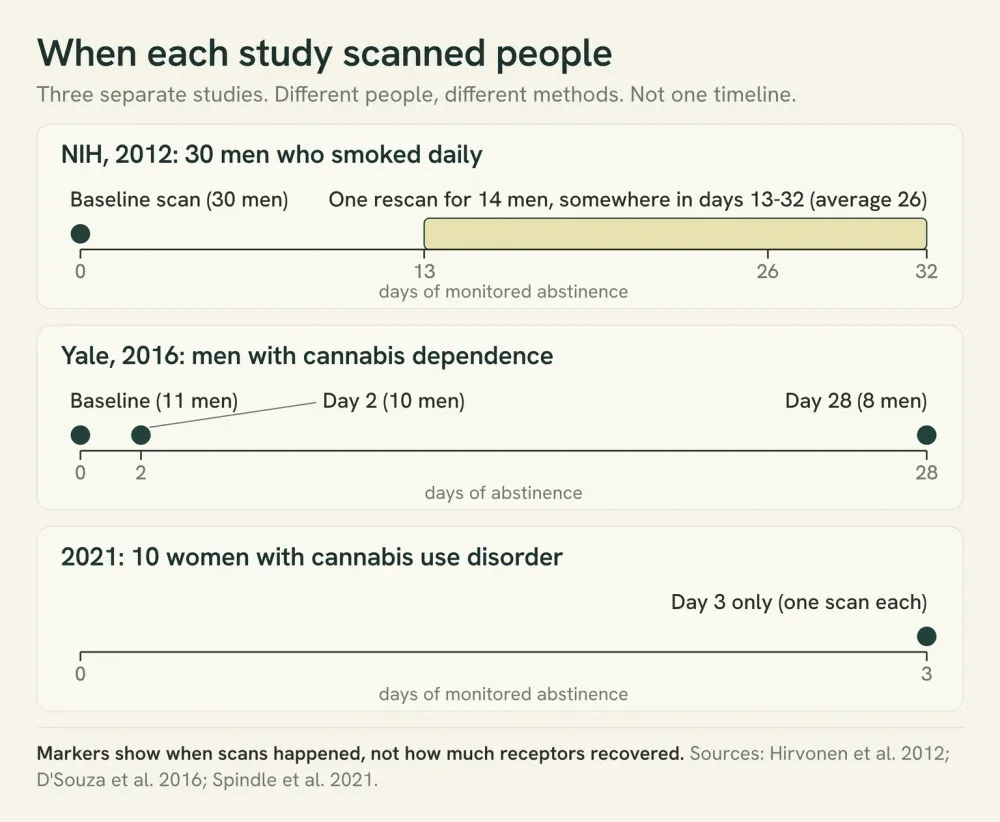
The tolerance break timelines we read online paraphrase a few positron emission tomography (PET) studies. In a PET scan, a volunteer receives a small amount of a radioactive tracer that binds to CB1 receptors, and the scanner measures how much binds in each brain region. Three details change how far you can take any result: who was scanned, which tracer was used (three different tracers appear below), and when the scans happened relative to the last use. Besides the NIH and Yale studies, two more show up in this literature: a 2021 PET study of 10 women with cannabis use disorder and a 2015 Belgian study of 10 chronic cannabis users. They used different people, different methods and different time points, so they belong in separate rows, not on one shared timeline.
| Study | Who was scanned | When | What it found | What it cannot tell you |
|---|---|---|---|---|
| NIH, 2012 (Molecular Psychiatry) | 30 men who had smoked daily for about 12 years on average; 28 non-users | A baseline scan; 14 of the men scanned again after 13-32 days of monitored abstinence (average 26) | About 20% lower binding in the neocortex and limbic cortex, no difference in deeper regions; at the rescan, back to normal in most regions that had been low | When within those 13-32 days the change happened, or anything about women, occasional users or edibles |
| Yale, 2016 (Biological Psychiatry: CNNI) | Men with cannabis dependence: 11 at baseline, 10 at day 2, 8 at day 28; non-users for comparison | Baseline, then day 2 and day 28 of abstinence | 15% lower at baseline in almost all regions; the gap was no longer statistically significant at day 2, and no significant difference at day 28 | Whether day 2 meant full recovery: 10 men is too few to show that, and the authors say it is not known whether recovery continues past four weeks |
| 2021 (Addiction Biology) | 10 women with cannabis use disorder; 10 female non-users | Once, after 3 days of monitored abstinence | Still lower in the hippocampus, amygdala, cingulate and insula | How long recovery takes in women; it is not a fair comparison with the men scanned at day 2 |
| Belgium, 2015 (Addiction Biology) | 10 chronic users, average age 26; 10 non-users | Once, within the first week after last use | 11.7% lower overall, clearest in the temporal lobe, cingulate cortex and nucleus accumbens | Anything about recovery: nobody was scanned a second time |
Where "2 days" and "four weeks" really come from
Start with the four weeks. The 2012 NIH study scanned 30 men who had smoked cannabis daily, an average of 10 joints or blunts a day for about 12 years, and compared them with 28 people who had used cannabis fewer than 10 times in their lives. In the smokers, CB1 receptor binding was about 20% lower in the neocortex and limbic cortex, and no different in deeper structures such as the basal ganglia, midbrain, thalamus, pons and cerebellum. Binding tended to be lower in men who had smoked for more years. Then 14 of the men stayed on a secure, continuously monitored research unit and were scanned again after 26 days on average, with a range of 13 to 32 days. By then binding had returned to normal levels in most of the regions that had been low. That is where "about four weeks" comes from, and the paper's title calls the downregulation "reversible and regionally selective". Because each man had a single rescan somewhere inside a 19-day window, the study cannot tell you at what point in that window the change happened. It is also not "28 days": that number belongs to a different study.
Now the two days. The 2016 Yale study scanned men who met the older DSM-IV criteria for cannabis dependence: 11 men at baseline, 10 on day 2 of abstinence and 8 on day 28. They stayed on an inpatient unit through day 2, then continued as outpatients with urine checks, and they were compared with non-users scanned the same way. At baseline, CB1 receptor availability was 15% lower than in non-users in almost all brain regions, a large difference in statistical terms (Cohen's d = -1.11). After two days without cannabis, the group difference was no longer statistically significant, and at day 28 there was still no significant difference. With 10 people, "no longer significant" means the change was fast enough that the study could no longer detect a gap. It does not mean every receptor was back to normal. In the authors' words, the downregulation "begins to reverse surprisingly rapidly upon termination of cannabis use". They also write that it is not known whether receptor recovery continues beyond four weeks, or whether lower availability is a state linked to use rather than a trait some people had to begin with.
Women are almost absent from this research. The 2021 study scanned 10 women with cannabis use disorder after two supervised cannabis-smoking sessions in the lab followed by three days of monitored abstinence, and compared them with 10 women who did not use cannabis. Receptor availability was still lower in four regions: the hippocampus, amygdala, cingulate and insula. The same study found that among the non-users, women had higher CB1 availability than men in every brain region examined. Each woman was scanned once, so the study says nothing about how long recovery takes in women, and its authors call for future scans at several points during abstinence. It is also not a fair head-to-head with the Yale men at day 2: different people, a different diagnostic label and a different analysis. Reading "still lower at day 3 in women" against "not significant at day 2 in men" as proof that women recover more slowly would go beyond both papers. The Belgian study adds one more snapshot. Its 10 chronic users, scanned within the first week after their last use, had 11.7% lower availability overall, clearest in the temporal lobe (12.7%), the anterior and posterior cingulate cortex (12.6% and 13.5%) and the nucleus accumbens (11.2%). Nobody in it was scanned a second time.
A receptor scan is not how high you feel
Even taken together, these scans measure one thing: how much tracer binds to CB1 receptors in a given brain region. A tolerance break is about something else, which is how THC feels when you use it again. The distance between those two is larger than the timelines we read admit, and it shows up in what the studies did not do.
- Nobody was given THC after the break. None of these PET studies re-dosed participants to test whether the effects felt stronger.
- The NIH, Yale and 2021 studies scanned people who smoked. Our PubMed search on September 14, 2026 found no imaging study of receptor change after abstinence in people who eat cannabis.
- No occasional users. The NIH authors wrote that they were unsure whether moderate and occasional smoking would produce similar downregulation.
- The two studies that scanned people again after time without cannabis included only men. The one study of women we found scanned once.
- Receptor levels and withdrawal did not line up the same way in two studies. The NIH study found no link; the Yale study did.
On that last point, the details matter. In the NIH study, how low someone's receptor binding was did not significantly correlate with the withdrawal or craving they reported on admission. In the Yale study, the authors report a strong negative correlation on day 2, the day withdrawal is expected to peak: among the 10 men, lower receptor availability went with more withdrawal. (The coefficient printed in their results, rho = 0.665, carries no minus sign, so the direction rests on the authors' own wording.) Two small studies, two answers, and neither is large enough to settle the question. That uncertainty, more than any single number, is why no study can hand you a break length. The Maastricht review states that cannabis tolerance is most likely in people who use high doses continuously, at a high pace, for a prolonged period, and that knowledge of the frequency, dose and duration needed to achieve, maintain or lessen tolerance is very limited. A site that tells you your break should last a set number of days based on how much you use is going beyond the evidence.
Why the first days of a break are the hard part
If receptors were the whole story, a break would be simple. What usually makes it hard is withdrawal. A 2003 University of Vermont study followed 18 heavy cannabis users through 5 days of using as usual and then 45 days without cannabis, with 12 former users as a comparison group. The symptoms observed included aggression, anger, anxiety, decreased appetite, decreased body weight, irritability, restlessness, shakiness, sleep problems and stomach pain. Onset typically came in days 1 to 3, effects peaked in days 2 to 6, and most effects lasted 4 to 14 days. These are observations from 18 people using the cannabis of the early 2000s, not a schedule your own break will follow.
A 2022 clinical review in the journal Addiction puts those findings in a wider frame. It describes withdrawal in approximately half of regular and dependent cannabis users, with symptoms typically beginning 24 to 48 hours after stopping and peaking on days 2 to 6, and notes that some symptoms can last up to three weeks or more in heavy users. It adds three points worth knowing before a break. No medication is currently approved specifically for medically assisted cannabis withdrawal. Withdrawal symptoms may lead people back to cannabis use. And withdrawal may be more complicated for people who also live with a mental health condition or use other substances. NIDA's own list of withdrawal symptoms is broader than the 2003 study's: anger, irritability, aggression, feeling nervous or anxious, restlessness, decreased appetite or weight, depression, insomnia, strange or unsettling dreams, headaches, sweating, abdominal pain and tremor.
How common withdrawal is depends on who is counted. NIDA cites one study estimating that 12.1% of people who frequently use cannabis experience withdrawal. A 2020 meta-analysis of 47 studies and 23,518 people pooled a figure of 47% among regular users, but 17% in general-population samples, 54% in outpatient samples and 87% in inpatient samples, and the studies it combined varied enormously. These figures come from different samples using different definitions, so they describe different groups rather than one true rate. Our look at whether CBD is addictive sets the same evidence beside what is known for CBD. If sleep is the part of a break that bothers you most, our guide to sleep during cannabis withdrawal covers it in detail.
What happens when people actually take tolerance breaks
The imaging studies above tracked abstinence closely, much of it on research units. Real tolerance breaks happen at home, and we found only a few studies that follow them. University of Washington researchers interviewed 15 young adults and surveyed 66 more who used cannabis at least twice a week. In the interviews, the time frames people described for their breaks were variable but brief and temporary, withdrawal was an early barrier, and positive outcomes occurred with longer breaks. The University of Vermont's T-Break Guide, a self-directed set of daily activities, advice and encouragement, was built around 21 days. In a feasibility study of 125 cannabis users aged 18 to 29, recruited through universities, those who used the guide "a lot" completed the 21-day break more often than those who did not use it (84% vs 57%) and were more likely to plan a future break (32% vs 11%). The analysis compared groups that chose how much to use the guide, without randomization, and the authors call for more rigorous designs, so it cannot rule out that the most motivated people were also the ones who used the guide most. The 21 days is the length that guide chose. It is not a number any brain scan produced.
One study we found looked at what came next, and its result is worth knowing before you plan a break. A six-month study of 170 young adult recreational cannabis users, 55.9% of them women, with an average age of 21, found that taking a t-break was associated with an increase in hazardous cannabis use and in cannabis use disorder severity at six months. Among breaks taken for other reasons, a longer break was associated with less hazardous use, lower severity and less frequent use. This is an association, not proof that a t-break causes anything. Breaks were self-reported, looking back, and one plausible explanation runs the other way: people whose use is already climbing may be the ones who reach for a tolerance break. The authors conclude that people who take t-breaks may be important targets for intervention and prevention. For you, it suggests one honest question to ask: is this break a reset, or a pause before using more?

Tolerance break claims to ignore
The tolerance break pages we read repeat a few specific claims. On September 14, 2026, we traced each one to its apparent source or searched PubMed for human studies behind it. Where we say we found nothing, that is a record of our search, not proof that no study exists anywhere.
| The claim | Where it seems to come from | What the evidence says |
|---|---|---|
| THC stored in fat leaves your body in 7-10 days | Seller timelines; one footnotes a Forbes article and the 2012 NIH scan study, which contains no fat figure | We found no study behind it. In a 2013 NIH lab study, THC was still measurable in the blood of some heavy daily smokers at days 26 and 30 |
| Receptors are back to normal after 48 hours | The 2016 Yale study of men with cannabis dependence | In 10 men, the gap from non-users was no longer statistically significant at day 2. That is not proof of full recovery |
| The sweet spot is 7-14 days, or 21 days, depending on how much you use | Tiers on seller sites; 21 days is the length a university guide chose | We found no study testing these tiers. A 2020 review calls knowledge of what lessens tolerance very limited |
| CBD resets THC tolerance or eases a break | Some seller and clinic pages | We found no human study testing CBD on THC tolerance. Nothing is approved to treat cannabis withdrawal |
| Microdosing prevents tolerance, or a six-day protocol resets it | Widely shared online | We found no published test of either |
| A tolerance break clears you for a drug test | Timelines that say THC leaves your system after a set number of days | No date can be promised. Detection depends on the test and the person |
The fat claim deserves a closer look, because it sounds so exact. THC is fat-soluble, and in a 2009 study in rats that had been given THC, food deprivation and the stress hormone ACTH raised THC levels in the blood. That is animal evidence, and it does not tell you what dieting or exercise does in people. In people, a 2013 NIH study kept 30 men who smoked cannabis every day on a secure research unit for up to 33 days and drew their blood daily. Of 11 participants at day 26, only one was negative for THC, and 2 of 5 were still THC-positive at day 30. That is about detection in blood, in a lab, with shrinking numbers of participants. It says nothing about how high anyone would feel, and it is not a drug-test window. If a test is on your mind, our guide to CBD and drug tests explains why detection depends on the test and the person, and why no one can promise you a date.
Two other claims come from the wellness side of the market. Some sellers suggest swapping in CBD to get through a break or to reset tolerance. We could not find a human study testing CBD on THC tolerance, and NIDA states that there are currently no FDA-approved medications for the treatment of cannabis use disorder or for medically assisted withdrawal. Nothing is approved to treat cannabis withdrawal, and that includes CBD, ours included. The idea that microdosing prevents tolerance, and a widely shared "six-day protocol", fare no better: we could not find either tested in a published study. Planntz sells a full-spectrum tablet that contains delta-9 THC, which is one reason we think this page should be straight with you.
When a tolerance break is harder than it should be
A break that keeps ending early is information, not a character flaw. Tolerance and withdrawal are themselves among the signs NIDA lists for cannabis use disorder, which, as NIDA notes, the DSM-5 psychiatric manual defines as a pattern of use that leads to clinically significant impairment or distress. Only a clinician can diagnose it, and no checklist on a website can. If a break has been much harder than you expected, the questions below, drawn from the signs NIDA lists, are worth thinking about honestly and worth bringing to a doctor or counselor.
- Do you often use more cannabis, or for longer, than you meant to?
- Have you tried to cut down or stop and not been able to?
- Does getting, using or recovering from cannabis take up a lot of your time?
- Do you have strong cravings for it?
- Do you keep using even though it is causing problems in your life?
- Have you given up activities that used to matter to you?
- Do you use in situations where it could be physically risky?
- Do you keep using even though you know it is harming your physical or mental health?
The 2022 review in Addiction gives one more reason not to go it alone: withdrawal may be more complicated for people who also live with a mental health condition or use other substances. If that describes you, our suggestion is to talk with a clinician before stopping on your own. Help on the treatment side is real. NIDA says behavioral interventions such as cognitive behavioral therapy, motivational enhancement therapy and contingency management can be effective in treating cannabis use disorder. In the US, FindTreatment.gov lets you search for treatment near you, and if you are in crisis you can call or text 988 to reach the 988 Suicide & Crisis Lifeline.

What is still unknown about tolerance breaks
Here is the honest edge of the evidence on this page, as of our reading on September 14, 2026.
- How long it takes for THC to feel the way it once did. No imaging study here gave people THC again after a break.
- Whether edibles, vapes or occasional use produce the same receptor change. The people scanned were chronic or dependent users.
- How receptor recovery unfolds in women over time. The one study of women we found scanned once, at day 3.
- Whether lower receptor availability is a state caused by use or partly a trait present beforehand. The Yale authors list this as not known.
- Whether tolerance breaks change long-term use. The guide study measured finishing a break, and the six-month study we found is observational.
One thing does not depend on any of these gaps. If a break is much harder than you expected, that is worth taking seriously, and the help lines above work the same way whatever the next study shows.
Questions people ask about tolerance breaks
No study can answer that for you. The numbers people quote come from brain scans of heavy daily smokers: 14 men rescanned after 13 to 32 days in a 2012 NIH study, and 10 men whose difference from non-users was no longer statistically significant after 2 days in a 2016 Yale study. Neither study measured whether THC felt different afterward. A 2020 review describes knowledge of the frequency, dose and duration of use needed to lessen tolerance as very limited, and the popular 21 days is the length a university guide chose, not a finding about receptors.
What 2 days showed, in one study of 10 men with cannabis dependence, is that their CB1 receptor availability was no longer statistically different from non-users. With so few people, that shows a fast change, not full recovery, and the authors wrote that the full time course of receptor recovery still needs to be characterized. Nobody in that study was given THC again, so it did not test whether a 2-day break makes the effects feel stronger.
Those are documented cannabis withdrawal symptoms. In a 2003 study of 18 heavy users who stopped, symptoms such as irritability, anxiety, sleep problems and decreased appetite typically began in days 1 to 3, peaked in days 2 to 6 and mostly lasted 4 to 14 days. A 2022 clinical review adds that some symptoms can last up to three weeks or more in heavy users. Our guide to sleep during cannabis withdrawal covers the sleep side in detail.
THC is fat-soluble, and in rats that had been given THC, food deprivation and a stress hormone raised THC levels in the blood. In a 2013 NIH study of 30 men who smoked daily, THC was still measurable in the blood of some of them at days 26 and 30. We found no study behind the claim that fat-stored THC leaves in 7 to 10 days. Detection in blood is not the same as feeling an effect, and none of this is a drug-test window.
We could not find a human study testing CBD on THC tolerance, and nothing is approved to treat cannabis withdrawal, CBD included. If a break is harder than you expected, talk to a doctor or counselor, or call SAMHSA's National Helpline at 1-800-662-4357, which is free and confidential.
That has not been studied in a way that could give you a number. The six-month study of t-breaks we found, of 170 young adults, reported that taking a t-break was associated with more hazardous use later, while longer breaks taken for other reasons went with less. It is an association, not proof that breaks cause harm, but it is a reason to notice whether breaks are turning into a routine pause before using more.
No one can promise you a date. How long THC stays detectable depends on the test and the person, so a break of any particular length is not a drug-test plan. Our guide to CBD and drug tests explains why detection varies and what no product or timeline can guarantee.
Nobody knows yet. The NIH, Yale and 2021 PET studies scanned people who smoked cannabis, and our PubMed search on September 14, 2026 found no imaging study of receptor change after abstinence in people who eat cannabis. The NIH authors also wrote that they were unsure whether moderate and occasional smoking produces the same change.
If your question is really about CBD rather than THC, the answer differs in important ways. Our guide to CBD dependence, tolerance and withdrawal walks through what the research shows for CBD, and why THC is a different story.
Writing about hemp, wellness and the small rituals that keep us balanced.