Do Women Feel THC More? In a 44-Person Trial, Occasional-Use Men Felt It Most
A UCLA placebo-controlled trial published October 29, 2026 gave 44 adults smoked cannabis at 0%, 4% and 10% THC. Women did not report stronger effects than men; occasional-use men reported the most unpleasant ones. Frequency findings were exploratory.

A placebo-controlled trial from UCLA, published online on October 29, 2026 in Neuropsychopharmacology, tested whether women feel smoked THC more than men do. In 44 adults, they did not. The 10 men who used cannabis only occasionally reported the most unpleasant effects, even though their blood THC was similar to that of occasional-use women. It is one small trial of low-strength flower, and it cannot tell you how much anyone should use.
What the UCLA team did
The paper is a randomized controlled trial titled Sex- and frequency-dependent acute pharmacokinetic and pharmacodynamic effects of smoked cannabis, published online on October 29, 2026 in Neuropsychopharmacology by first author Stephanie Lake, senior author Ziva D. Cooper and colleagues at the UCLA Center for Cannabis and Cannabinoids (doi 10.1038/s41386-026-02571-3). It is open access, and we read the full text, not only the abstract. The design has a long name, and each word matters. Randomized means the order of the three cigarettes was assigned by chance. Double-blind means neither the participants nor the staff running the sessions knew which strength was in use. Placebo-controlled means one of the three cigarettes contained essentially no THC. Crossover means every participant smoked all three, on separate days, so each person serves as their own comparison. The authors describe it as the first study to experimentally investigate both sex and cannabis use frequency together.
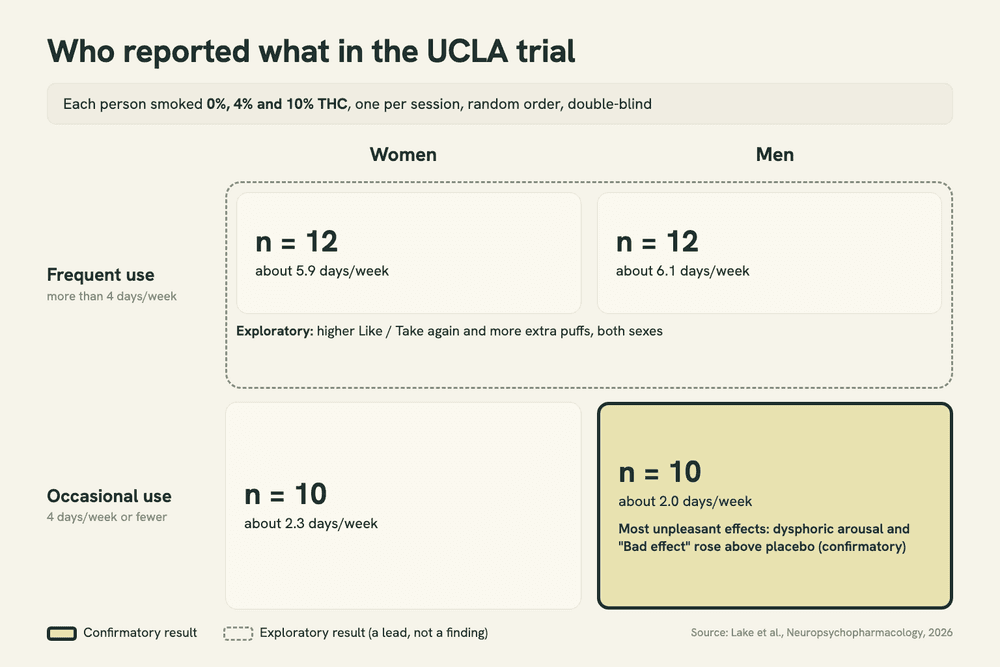
The 44 healthy adults were split evenly by sex and, within each sex, by how often they used in the past month. On average, the frequent groups used about 6 days a week (6.1 for men, 5.9 for women) and the occasional groups about 2 (2.0 for men, 2.3 for women). The women's sessions were timed to the mid-to-late follicular phase of the menstrual cycle, when estradiol is high and progesterone is low: the point where the authors expected a sex difference to be largest. People seeking treatment for their cannabis use, people with current pain, and people with a BMI under 18.5 or over 34 were excluded.
| Element | What the trial did |
|---|---|
| Participants | 44 healthy adults aged 21 to 55: 22 women, 22 men |
| Groups | Per sex: 12 frequent users (more than 4 days a week) and 10 occasional users (4 days a week or fewer) |
| Strengths | 0%, 4% and 10% THC (about 0, 20 and 60 mg of THC available in the cigarette), one per session, in random order |
| Cannabis | Supplied by NIDA; about 560 mg of an 800 mg cigarette smoked with timed, paced puffs |
| Sessions | Three 6-hour outpatient sessions (9:00 to 15:00), at least 48 hours apart, each after 21 hours without cannabis |
| Measures | 44-item mood and physical-effect scales (0 to 100), drug-effect ratings ("Strength", "Good effect", "Bad effect", "Like", "Take again"), heart rate, blood pressure, temperature, and plasma THC, 11-OH-THC and THC-COOH |
| Choice task | At 165 minutes, the option to buy 1 to 3 more puffs of the same strength at $1 a puff from study earnings |
| Women's timing | Mid-to-late follicular phase, confirmed by blood hormones; no hormonal birth control |
| Registration | NCT04385082, registered May 2020 |
The trial was registered on ClinicalTrials.gov in May 2020 as NCT04385082, a study called CanSex. The 44 people in this paper are its pharmacokinetic sub-component, one slice of a larger trial. The registry lists 161 participants enrolled, a start date of July 8, 2021 and completion on July 30, 2026. It also names a pain outcome, measured with a cold pressor test (holding a hand in ice water), that is not part of this paper. No results are posted on the registry yet.
What it found, with every result labelled
Before the numbers, one distinction decides how much weight each can carry. Some results came straight out of the trial's main statistical models; we call those confirmatory. Others came from follow-up tests the authors ran on statistical trends, and those are exploratory. The trial had about 80% power to detect a moderate overall effect of cannabis, but only large differences between subgroups, and each subgroup held just 10 or 12 people. So every row below carries its label, and so does every sentence in this article that mentions an exploratory result.
| Finding | Status | Numbers |
|---|---|---|
| Active cannabis (4% and 10%) raised subjective effects and plasma THC and metabolites | Confirmatory | p < 0.05 |
| Dysphoric arousal (unpleasant mood ratings) rose only in occasional-use men | Confirmatory (p = 0.004) | +20.4 points at 4% (13.0 to 27.8) |
| "Bad effect" ratings followed the same pattern | Confirmatory (p = 0.001) | Rose only in occasional-use men |
| "High" was higher in occasional-use men than in frequent-use men, averaged across strengths | Confirmatory | 21.6 points (5.5 to 37.7) |
| At 4%, occasional-use men rated "High" above occasional-use women and above frequent-use men | Exploratory | 32.3 points (9.8 to 54.9) and 29.2 points (7.5 to 50.8) |
| Sedation and impairment rose only in the occasional group | Confirmatory (p = 0.016) | +15.3 points at 4% |
| Within the occasional group, the sedation rise held only in men | Exploratory | +22.3 points at 4% |
| Heart rate, adjusted for blood THC, rose only in the occasional group | Confirmatory (p = 0.039) | +20.4 bpm at 4% (7.0 to 33.8) |
| Within the occasional group, the heart-rate rise held only in men | Exploratory | +32.5 bpm at 4% (15.6 to 49.4) |
| Peak plasma THC at 4% was higher in frequent users than occasional users | Confirmatory (p = 0.014) | +42.3 ng/mL (8.9 to 75.7) |
| Among frequent users, men had higher plasma THC at 4% than women | Exploratory | +57.1 ng/mL (9.8 to 104.3) |
| 11-OH-THC was higher in men than women, and in frequent than occasional users | Confirmatory across strengths; concentration at 4% exploratory | Not summarized as one number |
| "Like" and "Take again" rose only in frequent users, regardless of sex | Exploratory (trends p = 0.095 and 0.060) | Partly driven by occasional users' higher placebo "Like" (18.4 points) |
| Frequent users were more likely to buy extra puffs of active cannabis | Exploratory (trend p = 0.057) | 20.8%, 37.5% and 54.2% of frequent users at 0%, 4% and 10% |
The clearest signal, then, is about the 10 occasional-use men. On the confirmatory tests, they were the only group whose dysphoric arousal and "Bad effect" ratings rose above placebo. That was not because more THC reached their blood: the authors note that these men responded more strongly despite peak plasma THC and 11-OH-THC similar to occasional-use women. Why, the trial cannot say. The authors raise one alternative they could not rule out. The occasional-use women were slightly older and had been using cannabis for longer (14.6 years since first use, against 9.8 for occasional-use men), so they may have carried more tolerance for reasons unrelated to sex. With 10 people in each of those groups, chance cannot be ruled out either.
One more pattern runs through the results. On most measures, the 10% cigarette did not produce clearly bigger effects than the 4% one, a flat or even inverted strength-response. The 10% cigarette also took more puffs to finish, 12.4 against 7.8 on average, and the authors suspect people took smaller puffs of the stronger cigarette, a kind of self-titration. Puff size was not measured, so that is their interpretation, not a result.
How often you use shaped the results
If sex did not line up the way the usual story predicts, use frequency did on several measures. Frequent users had higher peak plasma THC at 4%, by 42.3 ng/mL (our explainer covers how THC moves through and clears from the blood). They also had higher levels of 11-OH-THC, the active metabolite the body makes from THC. Yet with more THC in their blood, they reported less of some effects: sedation and impairment rose above placebo only in the occasional group, the heavy, slowed-down feeling people often call couch-lock. In the model adjusted for blood THC, heart rate rose above placebo only in the occasional group too. Our report on an earlier trial that tracked heart rate after THC and CBD explains why a single session's heart-rate change is a measurement, not a verdict on safety.
More THC in the blood with fewer effects is the pattern researchers associate with tolerance, and it matches older work. In a 2009 study comparing 12 occasional and 12 heavy cannabis users, smoked THC impaired occasional users on tracking, divided attention and stop-signal tasks, but heavy users only on the stop-signal task; its authors concluded that cannabis use history strongly determines the behavioral response to a single dose of THC. Our guide to how tolerance builds and what taking a break can reset walks through that mechanism. Keep in mind that the new trial measured single sessions. It shows how frequent and occasional users differed on the day, not how tolerance develops over time.
The finding most likely to be summarized as "frequent users want more" is also the most tentative. In an exploratory analysis of statistical trends (p = 0.095 and 0.060), "Like" and "Take again" ratings rose above placebo only in the frequent group, and sex did not change that. Part of the gap came from the other side: occasional users rated the placebo cigarette higher on "Like" (18.4 points). In the self-administration task, also exploratory (trend p = 0.057), frequent users were more likely to buy extra puffs of active cannabis (54.2% of them at 10%, against 20.8% after placebo), while occasional users were most likely to buy after placebo. The authors read this, cautiously, as "suggesting misuse-liability related to frequency, independent of sex." Ratings like these are laboratory markers researchers use for misuse liability, the pull a drug has to be used again. They are not a diagnosis, and they say nothing about any individual reader's risk.
Why it cuts against the usual story
Search for whether women get higher than men and most of what you find says yes, often pointing to hormones. Much of that idea comes from animals. The rat studies the authors summarize in their introduction found that female rats recognize THC at lower doses, self-administer cannabinoid drugs faster and in larger amounts, show sensitivity that depends on estradiol, and produce more 11-OH-THC. A 2018 review of sex differences in cannabis effects, published in the same journal, set that preclinical picture alongside the human data. Rat findings are a reason to test a question in people. They are not an answer about people.
“These findings contrast with previous evidence of greater cannabis sensitivity among females.”
The human evidence before this trial was already mixed, and the way THC was taken differed from study to study. Here is what the earlier human studies found, with the design details that limit each one.
| Year, journal | Who and how | What it found by sex | Main limit |
|---|---|---|---|
| 2014, Drug and Alcohol Dependence | Pooled 4 studies; 35 men, 35 women, daily smokers; 3.27% to 5.50% THC smoked | Women rated "Good" and "Take again" higher; no difference in "High"; heart rate rose equally | Secondary pooled analysis; daily users only |
| 2017, Pharmacology Biochemistry and Behavior | Retrospective; 18 men, 12 women; oral THC 5 to 30 mg | Women more sensitive at 5 mg, men more sensitive at 15 mg | Small and retrospective |
| 2020, Psychopharmacology | 91 adults aged 19 to 25, using 1 to 4 days a week; 12.5% THC smoked as they chose | Women smoked less and had lower blood THC, with the same effects as men | Unbalanced (17 women in the active group) |
| 2021, Addiction Biology | Pooled 4 trials; 27 men, 23 women, infrequent users; oral and vaporized THC 5 to 25 mg | Women had a higher peak drug effect and higher 11-OH-THC, and felt more anxious and restless | Different routes; pooled |
| 2022, Addiction Biology | Pooled 2 trials; 21 men, 19 women; vaporized THC 13.75 mg with or without CBD | "An absence of systematic sex differences" | One moderate dose, vaporized |
| 2023, Addiction Biology | Pooled 2 trials; 55 men, 13 women, at least weekly users; about 25 mg THC smoked | Women rated strength, liking, take-again and good effect higher; self-administration not different | Only 13 women; same lab as the new trial |
| 2024, Psychopharmacology | Crossover trial; 56 adults; oral dronabinol 10 mg | Women rated their high higher (p = 0.05); other effects similar | One oral pharmaceutical dose |
Two of the studies that pointed toward women come from this same research group: a 2014 pooled analysis of daily cannabis smokers and a 2023 pooled analysis of two smoked-cannabis trials, which included only 13 women. Among infrequent users, a 2021 pooled analysis of oral and vaporized THC also leaned toward women. On the other side, a 2020 study of 91 young adults smoking cannabis as they chose found women reached the same effects at lower blood THC, a 2022 pooled analysis of vaporized THC reported no systematic sex differences, and a small retrospective study of oral THC found the direction flipped with dose. A 2024 crossover trial of oral dronabinol, a pharmaceutical form of THC, found women rated their high higher, right at the edge of statistical significance (p = 0.05).
Put together, the human record was never a clean "women feel it more." What the new trial adds is a design built for the question: balanced by sex and by frequency, with every person getting every strength and placebo, and with women tested at a fixed point in their cycle. It does not overturn the earlier studies. It disagrees with some of them, in a different sample, and that disagreement is now on the record for the next trial to resolve.
What this study does not tell you
- It is not dose guidance. The 20 mg and 60 mg figures describe the THC available in the study cigarettes, not an amount anyone should use.
- It does not show that women can handle more or that men should use less. It describes 44 adults at one site, with 10 or 12 people in each subgroup.
- It tested smoked flower only. Edibles, vapes, concentrates and CBD products were not studied.
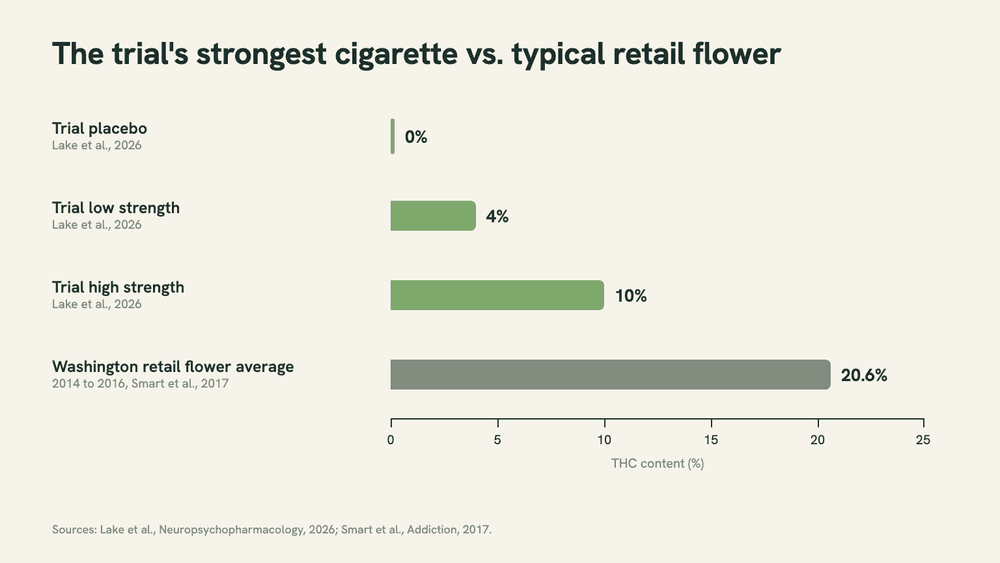
- The strengths were 4% and 10% THC, below the 20% or more the authors say is typical of commercial cannabis.
- Women were tested in one phase of the menstrual cycle, and women using hormonal birth control were excluded, so other phases and contraceptive users remain open questions.
- Each strength was a single session. Long-term tolerance, dependence and everyday use were not measured.
- Several of the sex and frequency results are exploratory, with no correction for multiple comparisons.
- Puff size was not measured, and the self-administration task was scored only as yes or no.
- Adverse events and the parent trial's pain results are to be reported elsewhere, not in this paper.
On potency: Washington State retail sales data from 2014 to 2016 put the average THC content of flower at 20.6%, about twice the trial's strongest cigarette. Effects at retail strengths could look different. Our explainer on whether the THC percentage on a label predicts how strong flower feels covers why that number is only part of the picture. And because this trial was about THC, it says nothing about CBD, which is a different molecule with a different profile; if dependence is your question there, see whether CBD is addictive.
Who ran it and who paid
We print the disclosures because you should be able to see them alongside the results. Listing them does not imply they changed the results, and the funding for this trial came from public and charitable sources.
What to watch next
The parent trial finished on July 30, 2026 with 161 people enrolled, so more papers should follow. The registry names pain response (measured with the cold pressor test) as a primary outcome, and the authors say adverse events will be reported elsewhere. They are direct about why their own result needs testing again, citing "our modest sample size and reliance on exploratory follow-up, the potential for unmeasured confounding, and that our findings did not extend to all observed outcomes." They call for larger samples and finer categories of use frequency than a single line at 4 days a week. Until then, this is one well-designed, small trial that disagrees with part of the earlier evidence.
Frequently asked questions
Not in this trial. Among 44 adults smoking identical cigarettes, women did not report a stronger high than men. Occasional-use men rated their high above frequent-use men, and in an exploratory comparison at 4% also above occasional-use women. Earlier pooled studies found women rated some rewarding effects higher, so one trial does not settle it.
The trial could not test that. Every woman was tested in the mid-to-late follicular phase, when the authors expected the largest difference, and the expected female sensitivity did not appear. Other phases, and women using hormonal birth control, were not studied.
The results fit that idea: frequent users had higher blood THC at 4%, yet sedation rose above placebo only in occasional users. These were single sessions, so the trial shows a difference between groups on the day, not tolerance developing over time.
The trial cannot explain it; their blood THC was similar to occasional-use women's. The authors note those women were slightly older and had used cannabis for longer, which could mean more tolerance unrelated to sex. With 10 people per group, chance is also possible.
No. Everyone smoked flower. Edibles, vapes, concentrates and CBD were not studied, and earlier studies of oral and vaporized THC reported different patterns by sex.
No. The cigarettes were 4% and 10% THC; the authors note commercial cannabis is typically 20% THC or more. Effects at retail strengths could differ.
NIH institutes (NIDA, NCCIH and NCATS), the Semel Charitable Foundation and trainee grants. Outside this work, the senior author reports receiving study drug from Canopy Growth Corp and True Terpenes and study-related materials from Storz & Bickel, and she is an associate editor of the journal that published it.
If this trial made you curious about your own pattern of use, the most useful next read is our guide to cannabis tolerance and tolerance breaks, which covers what frequent use does to how THC feels and what changes when you pause. We will update this page when the parent trial's other results are published.
Writing about hemp, wellness and the small rituals that keep us balanced.