WADA's 2027 Cannabinoid Rule: CBD Is Still Allowed, and the Blanket Clause Is Gone
WADA published its 2027 Prohibited List on September 21, 2026. CBD is still not prohibited and THC still is, in-competition. The sentence that banned all natural and synthetic cannabinoids is gone, and WADA has not said what that means for CBG, CBN or THCV.
The World Anti-Doping Agency (WADA) has rewritten the sentence that decides which cannabinoids can get an athlete sanctioned. In the 2027 Prohibited List, published September 21, 2026, cannabidiol (CBD) is still not prohibited, and THC still is, in-competition. What is gone is the opening clause that prohibited "all natural and synthetic cannabinoids." In its place is a ban defined by THC and by THC-like effect, with delta-8, delta-10 and HHC now named. None of it applies yet. The 2027 List takes effect January 1, 2027, and every test taken before then is judged under the 2026 wording.
This page reflects WADA's primary documents as we read them on September 23, 2026. WADA's announcement of the 2027 Prohibited List says the list was "approved by WADA's Executive Committee (ExCo) during its meeting on 10 September 2026 and enters into force on 1 January 2027." The List is one of the International Standards that are mandatory for every organization that has signed the World Anti-Doping Code. That means it binds your international federation and your national anti-doping organization, such as USADA in the United States. It is private sports governance that athletes accept by competing, not a law, and nothing on this page is legal advice. Whether CBD is legal where you live is a separate question, covered in our guide to where CBD stands under federal and state law.
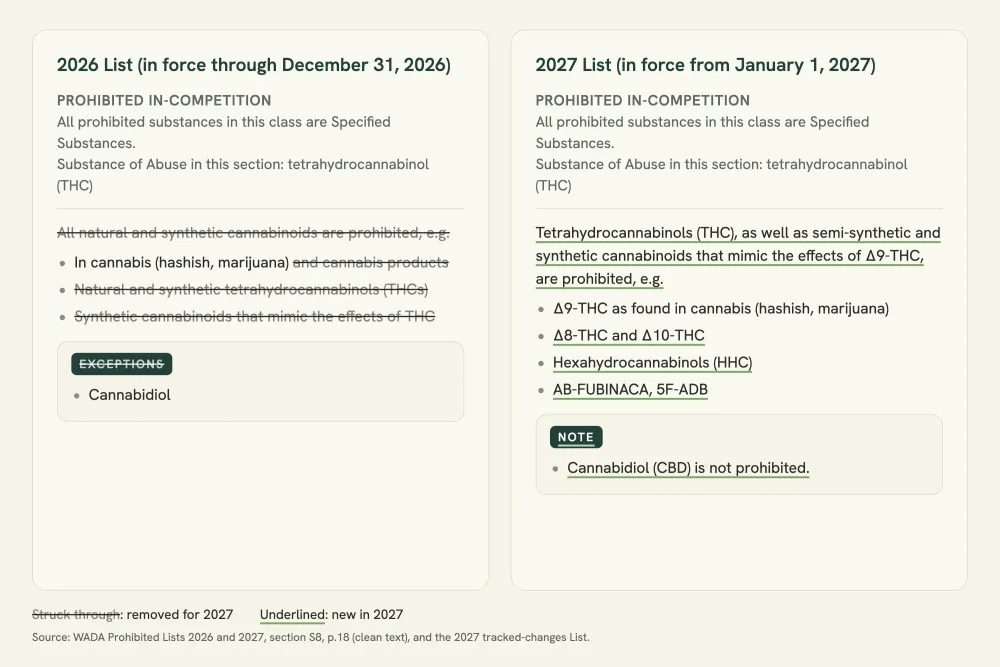
The 2026 and 2027 Prohibited List wording, side by side
WADA's release and the federation reposts that followed it summarize the cannabinoid change in one line about Δ9-THC-like effects and added examples. That undersells it. The operative sentence of section S8 changed. Below, each element of the 2026 Prohibited List, which governs every test through December 31, 2026, sits next to the matching element of the clean text of the 2027 Prohibited List, page 18, which governs from January 1, 2027.
| Element | 2026 List (through Dec 31, 2026) | 2027 List (from Jan 1, 2027) | What it means |
|---|---|---|---|
| Scope sentence | "All natural and synthetic cannabinoids are prohibited, e.g." | "Tetrahydrocannabinols (THC), as well as semi-synthetic and synthetic cannabinoids that mimic the effects of Δ9-THC, are prohibited, e.g." | A blanket ban with one exception became a ban defined by THC and by THC-like effect. |
| Cannabis example | "In cannabis (hashish, marijuana) and cannabis products" | "Δ9-THC as found in cannabis (hashish, marijuana)" | The words "and cannabis products" are gone. THC in any product is still prohibited. |
| THC variants | "Natural and synthetic tetrahydrocannabinols (THCs)" | Folded into the scope sentence, with "Δ8-THC and Δ10-THC" named as examples | Delta-8 and delta-10 are now named rather than implied. |
| Synthetics | "Synthetic cannabinoids that mimic the effects of THC" | Semi-synthetic and synthetic cannabinoids that mimic Δ9-THC, with "Hexahydrocannabinols (HHC)" and "AB-FUBINACA, 5F-ADB" named | "Semi-synthetic" is new, the benchmark is now Δ9-THC specifically, and HHC is named. |
| CBD | Box labeled "EXCEPTIONS": "Cannabidiol" | Box labeled "NOTE": "Cannabidiol (CBD) is not prohibited." | Same status. CBD is no longer an exception to a blanket ban, because the ban no longer reaches it. |
| When and how it applies | Prohibited in-competition; all Specified Substances; THC a Substance of Abuse | Prohibited in-competition; all Specified Substances; THC a Substance of Abuse | Unchanged. |
“Tetrahydrocannabinols (THC), as well as semi-synthetic and synthetic cannabinoids that mimic the effects of Δ9-THC, are prohibited, e.g.: Δ9-THC as found in cannabis (hashish, marijuana); Δ8-THC and Δ10-THC; Hexahydrocannabinols (HHC); AB-FUBINACA, 5F-ADB. NOTE: Cannabidiol (CBD) is not prohibited.”
Read the two scope sentences one after the other and the change is structural. The 2026 text starts from everything ("all natural and synthetic cannabinoids") and carves out one compound. The 2027 text starts from THC and adds only the semi-synthetic and synthetic cannabinoids that mimic the effects of Δ9-THC, the main intoxicating compound in cannabis. CBD no longer needs to be an exception, because nothing in the new sentence reaches it, and WADA says so anyway in a note. One small detail if you compare documents yourself: the clean list reads "Tetrahydrocannabinols (THC)" while the tracked-changes version reads "(THCs)". The clean list is the operative text, and it is the one we quote.
What WADA crossed out, and the reason it gives
WADA also publishes a tracked-changes version of the 2027 List that shows every deletion and addition. On page 18, five pieces of the 2026 S8 text are struck through:
- The opening clause: "All natural and synthetic cannabinoids are prohibited, e.g."
- The words "and cannabis products" in the cannabis example, which now reads "Δ9-THC as found in cannabis (hashish, marijuana)."
- The bullet "Natural and synthetic tetrahydrocannabinols (THCs)."
- The bullet "Synthetic cannabinoids that mimic the effects of THC."
- The box label "EXCEPTIONS", replaced by "NOTE", with "Cannabidiol" expanded to "Cannabidiol (CBD) is not prohibited."
In their place WADA added the new opening sentence, rewrote the cannabis example, and added three example bullets: Δ8-THC and Δ10-THC; hexahydrocannabinols (HHC); and two synthetic cannabinoids, AB-FUBINACA and 5F-ADB. The reason is one sentence in WADA's Summary of Major Modifications and Explanatory Notes for 2027: "The changes were made to reflect current scientific knowledge on the delta-9-tetrahydrocannabinol (Δ9-THC) like-effects of commonly encountered cannabinoids." Two limits on that sentence matter. WADA does not list which cannabinoids it considers Δ9-THC-like and which it does not. And the examples after "e.g." are illustrations, not a complete list, so a substance that is not named can still fall inside the sentence.
Delta-8, delta-10 and HHC are now named on the face of the List
These compounds were already prohibited in-competition before. Under the 2026 wording, delta-8 and delta-10 THC were covered as "natural and synthetic tetrahydrocannabinols," and HHC fell inside a clause that covered every cannabinoid except CBD. What 2027 changes is visibility: an athlete reading S8 now sees them by name. That matters because these compounds are usually sold as hemp-derived, and some buyers read "hemp" as a sign that a product sits outside the drug rules. Section S8 does not ask where a molecule came from. It asks whether the molecule is a tetrahydrocannabinol or mimics one. For the chemistry, we cover how delta-8 is made and how it differs from CBD, whether HHC is intoxicating and how HHC shows up on a drug test.
AB-FUBINACA and 5F-ADB belong to a different family: lab-made synthetic cannabinoid receptor agonists of the kind sold on the street as "spice" or "K2." They were already caught in 2026 as synthetic cannabinoids that mimic THC. Naming them is a clarification, not a new prohibition.
CBD: from exception to note, with a warning attached
CBD's status is the same in both years: not prohibited. The framing is what changed. In 2026 CBD was the single named exception to a ban on everything else. In 2027 the ban no longer reaches it, and WADA adds a note saying so. The explanatory note then adds the sentence every CBD user in tested sport should read twice.
“Cannabidiol is not prohibited. However, cannabidiol extracted from cannabis plants may also contain varying concentrations of THC, which remains a prohibited substance.”
That is WADA's own statement of the practical risk. The rule is about what is in your sample, not what is on the label, and a CBD product can carry THC by design (full-spectrum) or by contamination. How the three product spectrums map onto that risk, how the 150 ng/mL urine threshold works, and what to check before you buy are all in our guide to CBD and anti-doping rules for athletes. The difference between full-spectrum, broad-spectrum and isolate is laid out in our CBD spectrum guide. We are not re-deriving any of that here, because the 2027 List did not change it.
The open questions: CBG, CBN, CBC, CBDV, THCV and THCA
This is the part of the change that, as of September 23, 2026, neither WADA nor USADA has addressed in anything we could find. Under the 2026 List, the minor cannabinoids found in many hemp extracts, such as cannabigerol (CBG), cannabinol (CBN), cannabichromene (CBC) and cannabidivarin (CBDV), were prohibited in-competition because the opening clause prohibited "all natural and synthetic cannabinoids" other than CBD. That clause is gone. The 2027 sentence covers tetrahydrocannabinols, and it covers semi-synthetic and synthetic cannabinoids that mimic Δ9-THC. On its face, the "mimic" test attaches to semi-synthetic and synthetic compounds, and CBG, CBN, CBC and CBDV are natural. So the text that used to cover them no longer names them. WADA has not said what that means for them.
This is not an academic point. In a 2026 study in Medicine & Science in Sports & Exercise, Gillham and colleagues gave 36 healthy adults either a broad-spectrum CBD product at 150 mg per day or a placebo for 10 weeks (31 took CBD, 5 took placebo). The product contained trace CBG. In the CBD group, CBG showed up in 42% and CBDV in 68% of pre-exercise urine samples, rising to 74% and 84% after a 90-minute bout of moderate exercise. No Δ9-THC or its metabolites were found at any timepoint. The authors, writing under the pre-2027 List, described CBG and CBDV as WADA-prohibited. It is one product at one dose in a small group, and a detection in urine is not a sanction. What it shows is that "no THC in the sample" and "nothing prohibited in the sample" were not the same thing under the 2026 rule.
So why is the question still open rather than settled? Three reasons. First, the "e.g." list is not exhaustive, and WADA has not published any list of cannabinoids it considers outside S8. Second, the official explainers still describe the 2026 rule. As of September 23, 2026, WADA's own Prohibited List page, last updated in April 2026, still shows the 2026 S8 text, and its FAQ still says all natural and synthetic cannabinoids are prohibited except CBD. USADA's marijuana FAQ, last updated in October 2025, still lists cannabigerol, cannabichromene and cannabinol as prohibited in-competition. For 2026, both pages are still correct. USADA's Prohibited List page has posted the 2027 documents, but with no cannabinoid guidance. Third, WADA says its Athlete and ASP Guide to the 2027 List will be available in December. Whether it will address minor cannabinoids is not known. Until WADA or your anti-doping organization says something, anyone who tells you CBG or CBN is now permitted is reading more into the text than WADA has put there.
THCV and THCA sit even closer to the line. THCV (tetrahydrocannabivarin) is a tetrahydrocannabinol by name and by structure, and whether WADA reads "Tetrahydrocannabinols (THC)" to include it is not addressed; our page on what THCV is and how it compares with CBD covers the compound. THCA, the acid form of THC found in raw cannabis, raises the same question, and it is not addressed either (THCA compared with CBD). CBN is natural, so the "mimic" clause does not reach it on its face, but whether an anti-doping organization would treat it as THC-like is open. If detection is your concern, see whether CBG shows up on a drug test, how CBN behaves on a drug test and how CBDV compares with CBD.
“[I]f there is any doubt as to the status of a substance or method, it is important that they contact their respective Anti-Doping Organizations (International Federation or National Anti-Doping Organization) for advice.”
Questions to put to your anti-doping organization before January 1
If you are a tested athlete who uses a hemp product, or is thinking about one, these are the questions worth asking in writing. In the United States that means USADA. Elsewhere, ask your national anti-doping organization or your international federation.
- 1Under the 2027 S8 wording, are CBG, CBN, CBC and CBDV prohibited in-competition, and would a finding of any of them be reported as an adverse analytical finding?
- 2Does "Tetrahydrocannabinols (THC)" in the 2027 text include THCV and THCA?
- 3Does my international federation, league or event apply any cannabinoid rule stricter than the WADA List?
- 4Am I governed by WADA rules at all? The NCAA, US pro leagues and the US military run their own drug rules, and the answer can differ.
- 5Can I have your answer in writing, with a date, so I can show what I relied on?
THC metabolites and the new sanction scale
Two more changes touch THC directly. The first is in the List. Its introduction designates four Substances of Abuse (cocaine, heroin, MDMA and THC), and the 2027 version adds a clause, so the sentence now ends: "tetrahydrocannabinol (THC) or their metabolites, if their presence is consistent with the Use of a Substance of Abuse." WADA's summary calls this a clarification that "the presence of metabolites for Substances of Abuse should be taken into consideration in the results management process when relevant." WADA does not say how results managers will apply it, and we are not going to guess.
The second change is not in the List at all. It is in the 2027 World Anti-Doping Code, the rulebook that sets sanctions, which also takes effect January 1, 2027. The List decides what is prohibited; the Code decides what happens when a prohibited substance is found. Compared with the 2021 World Anti-Doping Code in force today, the Substance of Abuse article that applies to THC changes as shown below. The 2027 Code also sets four months for a subsequent violation in the same out-of-competition circumstances, which may be reduced to two months with an approved treatment program.
| Situation the athlete establishes | 2021 Code (through Dec 31, 2026) | 2027 Code (from Jan 1, 2027) |
|---|---|---|
| Use was out-of-competition and unrelated to sport, first violation | 3 months, which may be reduced to 1 month with an approved treatment program (Art. 10.2.4.1) | 2 months (Art. 10.2.3.1) |
| Use was in-competition but unrelated to sport | Use "shall not be considered intentional" (Art. 10.2.4.2). That rules out the sanction for intentional use; it does not mean no sanction. | Between 6 months and 2 years, "depending on the circumstances of the case" (Art. 10.2.3.2) |
What did not change
A rewrite of S8 is easy to over-read, so here is the other side of the ledger, as of September 23, 2026.
- CBD is not prohibited, in 2026 or in 2027.
- THC is prohibited in-competition in both years, and it is still a Substance of Abuse.
- Every substance in S8 is still a Specified Substance, and cannabinoids are still prohibited in-competition only.
- The in-competition period still starts, in principle, at 11:59 p.m. on the day before a competition.
- The THC urine threshold stays at 150 ng/mL of carboxy-THC, with a 180 ng/mL decision limit, under WADA's 2027 technical document.
- Strict liability is unchanged (Article 2.1.1 of the 2027 Code): you are responsible for any prohibited substance, or its metabolites or markers, found in your sample.
- No cannabinoid is on WADA's 2027 Monitoring Program, the watch list of substances WADA tracks without prohibiting.
- The 2026 List, including its blanket cannabinoid clause, governs every test through December 31, 2026.
The threshold lives in a separate technical document, not in the List. WADA's 2027 decision-limits technical document, dated March 17, 2026 and effective January 1, 2027, keeps carboxy-THC at a 150 ng/mL threshold with a 180 ng/mL decision limit; it was published in March, not alongside the List. The 2027 Monitoring Program covers some stimulants and narcotics, the GLP-1 drugs semaglutide and tirzepatide, and a few others, and no cannabinoid. What the 150 ng/mL figure means in practice is decoded in our anti-doping explainer for athletes who use CBD, which also covers the NCAA and the major US professional leagues, whose drug policies are their own. And if you serve, the US military prohibits hemp-derived products for service members no matter what WADA's List says.

How to check the rule yourself
You do not need to rely on us, on a federation repost or on a search summary. Every WADA document behind this page is public on WADA's site and linked above, and each one does a different job.
- The clean 2027 Prohibited List is the rule itself. Section S8 is on page 18; the Substances of Abuse sentence is on page 3.
- The tracked-changes 2027 List shows what was struck and added. Use it to compare, but quote the clean list.
- The Summary of Major Modifications and Explanatory Notes gives WADA's reasons, including the CBD contamination warning.
- The 2027 Monitoring Program lists what WADA watches without prohibiting. It contains no cannabinoid.
- The 2027 decision-limits technical document (TD2027DL) sets the carboxy-THC threshold: 150 ng/mL, with a 180 ng/mL decision limit.
- The 2027 World Anti-Doping Code sets sanctions and strict liability. It takes effect January 1, 2027, the same day as the List.
If a page you read says something different from the clean list, check its date first. As of September 23, 2026, several official FAQ pages still describe the 2026 rule, which is correct for 2026 and will need updating for 2027.
Questions people are asking
No. The 2027 Prohibited List, published September 21, 2026, says "Cannabidiol (CBD) is not prohibited." WADA's explanatory note adds that CBD extracted from cannabis plants "may also contain varying concentrations of THC, which remains a prohibited substance." The rule is about what is found in your sample, so a CBD product that contains THC can still lead to a positive test.
January 1, 2027. Until December 31, 2026, the 2026 List applies to every test, including its wording that "all natural and synthetic cannabinoids are prohibited" except cannabidiol. The revised World Anti-Doping Code takes effect on the same day.
Yes, in-competition, under WADA rules. The 2027 List names "Δ8-THC and Δ10-THC" as examples of prohibited cannabinoids. Under the 2026 List they were already covered as natural and synthetic tetrahydrocannabinols. WADA's 2027 decision-limits document sets a threshold only for carboxy-THC, and none for delta-8. Leagues and bodies that run their own drug lists, such as the NCAA, can differ from WADA.
Yes, in-competition. "Hexahydrocannabinols (HHC)" are named among the examples in section S8 of the 2027 List. Under the 2026 List, HHC was already covered by the clause prohibiting all natural and synthetic cannabinoids other than CBD.
That is unanswered as of September 23, 2026. The 2027 text no longer contains the sentence that prohibited all natural cannabinoids, but WADA has not said CBG is permitted, its list of examples is not exhaustive, and USADA's marijuana FAQ still lists CBG as prohibited under the current rule. Ask your anti-doping organization in writing before relying on either reading.
No. The threshold is set in a WADA technical document, not in the List. The 2027 version, dated March 17, 2026, keeps carboxy-THC at 150 ng/mL with a 180 ng/mL decision limit.
It depends on the case, and the hearing body decides. Under the 2027 World Anti-Doping Code, a first violation that the athlete can show came from out-of-competition use unrelated to sport carries two months, down from three under the 2021 Code. If the athlete can show the use was in-competition but unrelated to sport, the 2027 Code sets a range of six months to two years, depending on the circumstances. This is a summary of rule text, not legal advice.
A note on our own archive, because we would rather say it than have you find it. Our evergreen page on CBD in sports was written for the 2026 List. Its short answer, its figure of one "cannabinoid exempted by name" and its broad-spectrum warning about CBG, CBN, CBDV and THCV are correct through December 31, 2026, and they are flagged for a 2027 update. That page remains the place for spectrum-by-spectrum risk, the threshold math and the pre-purchase checklist. This one covers only what WADA changed on September 21, 2026.
Writing about hemp, wellness and the small rituals that keep us balanced.