
Does HHC Get You High? Yes, and the Label Cannot Tell You How Much
Yes. The useful question is how much, and that one is not answerable from the package. A jar labeled HHC holds two molecules in a ratio set by the manufacturer and printed on no label we could find, and the 70 to 80 percent figure page one repeats appears in no study.
Yes. If the question is does HHC get you high, the answer is yes, and that is the least useful true sentence on the internet. The question you are actually asking is how much, and that one has no answer on the package in your hand. Not because nobody has looked, but because a jar labeled HHC contains two different molecules in a proportion that changes from one manufacturer to the next, and the milligram figure printed on the front counts both of them together.
This page is about intoxication and impairment: what has been measured, in whom, by what route, and what that leaves unknown. Every count and every source here is dated to our own reading on September 11, 2026. Planntz makes CBD tinctures and sells no HHC product and no intoxicating cannabinoid product, so there is nothing at the bottom of this article to buy. We also publish no HHC amount and no serving suggestion, for a reason that becomes obvious about four sections down.
Does HHC get you high? Yes, and that is where every other page stops
Search this question and you will be told, page after page, that HHC is about 70 to 80 percent as potent as delta-9-THC. Line up the seven page-one results, as we did on September 11, 2026, and the number moves: 30 to 80 percent on one, 50 to 75 on another, 75 to 80 on a third. Not one of them names a study, a species, a route, a dose or a year for it. Two of the seven, both large health publishers, say the honest thing, that there is no peer-reviewed human research behind the descriptions being repeated, and then neither explains why the percentage keeps changing between pages.
Here is what a measurement of HHC actually looks like. In a 2025 paper in the Journal of Psychopharmacology, run by RTI International with two co-authors from the DEA's Diversion Control Division, adult male mice were given 9R-HHC, 9S-HHC or delta-9-THC by injection. 9R-HHC produced cannabimimetic effects on every measure of the standard tetrad battery and fully substituted for delta-9-THC in a drug-discrimination test, at a potency the authors describe as similar to THC across measures, except that 9R-HHC produced more hypothermia. 9S-HHC did not: it registered on two of the four tetrad measures, was less potent than delta-9-THC, and only partially substituted. These are mice, given injections, and the authors write their conclusion about people in the conditional.
Germany's Federal Institute for Risk Assessment assembled the whole animal record for exactly this question and published it as Opinion 019/2025 on June 4, 2025. Its bottom line is that the effects resemble those of delta-9-THC "although the potency is probably somewhat lower", a judgement resting on animal data and on one of the two forms of the molecule. The same document says HHC "has yet to be sufficiently toxicologically characterised", that there is "a particular lack of data in regard to acute or chronic toxicity", and that "no health-based guidance value can be derived". Those sentences are the state of the record. A percentage is not.
A jar labeled HHC contains two molecules, and the milligram number counts both
HHC is delta-9-THC plus two hydrogen atoms, and the place those hydrogens land creates a new left-or-right choice at carbon 9, which is why one name covers two molecules: 9R-HHC and 9S-HHC. PubChem's record for the compound shows the mass difference that follows, C21H30O2 at 314.5 for THC against C21H32O2 at 316.5 for HHC. That is all the chemistry this page needs. What hexahydrocannabinol actually is takes the molecule apart properly, including the natural-versus-synthetic argument and why HHC never appears on a standard hemp certificate.
The distinction between the two forms only matters outside a chemistry class because of what the mouse study above found, and the authors say the consequence themselves. Their final sentence is the argument of this entire article, and it is theirs, not ours.
“The differences in the pharmacology between the two HHC epimers may lead to a range of effects in human users depending on the ratio of the epimers consumed.”
Read that as a label problem rather than a chemistry curiosity. If the ratio between the two forms changes the effect, then the number printed on the package, which counts both of them together, is not reporting the thing you want to know. It is reporting the total mass of a mixture whose composition is undisclosed. A milligram figure is only a dose if the material behind it is one thing.
What the ratio does to the number on the package
So what are the real ratios? Every measurement we could locate is either European retail assayed by researchers, European seized material, or a laboratory's own bench product, and we could not find a single product label, in any market, that states the ratio at all. That is the finding. It is not that ratios are typically some particular number; it is that they vary widely and nobody prints them.
Two laboratories assayed the HHC products they had bought before giving them to anybody. In a 2025 controlled-administration study run at the University of Leipzig, the two products used were measured at 78 percent 9R and 22 percent 9S, with no residual THC detected; the same paper notes that an earlier team's product was 50/50. Neither figure was on either package.
One team running the same reaction from the same starting material twice got opposite answers depending on the acid and the clock. In a 2023 Scientific Reports paper on the synthesis and pharmacological activity of the HHC epimers, hydrochloric acid for two hours produced a 57:43 mixture favoring 9S, while p-toluenesulfonic acid for eighteen hours produced 61:39 the other way. The same team assayed four commercial HHC-containing items and found 9R to 9S ratios of 2.00, 2.02, 2.28 and 1.35 to one. The ratio is a manufacturing setting, not a specification.
A third measurement comes to us at one remove, and the wording matters. A Swedish forensic group writing in Drug Testing and Analysis in 2025 did not assay products itself; it reports that seized material labelled as HHC in Belgium had a 9S to 9R ratio ranging from 0.27 to 0.89, and then comments that this "poses an inherent risk of poisoning for consumers, as they will be unaware of the differences in strength between products". The same paper records that by the beginning of 2024, 24 European countries had identified HHC. A Polish laboratory that analyzed 1,186 cannabis-type samples seized between 2022 and 2024 found semisynthetic cannabinoids in 113 of them, with HHC the predominant compound and "consistently detected as a mixture of two epimers", typically 2.0 to 2.8 parts 9R to one part 9S (Drug Testing and Analysis, 2026, doi:10.1002/dta.70014, cited here as plain text because the publisher blocks automated access).
| Source | What was measured | Result |
|---|---|---|
| Leipzig study, 2025 | Two retail products bought in a hemp shop, assayed before use | 78% 9R and 22% 9S in both products |
| Leipzig study, reporting an earlier team | The product used in a previous controlled study | 50/50 |
| Scientific Reports, 2023, commercial items | Four commercial HHC-containing items, Table 1 | 9R:9S of 2.00, 2.02, 2.28 and 1.35 to 1 |
| Scientific Reports, 2023, bench synthesis | One starting material, two reaction settings | 57:43 S to R with HCl for 2 h; 61:39 R to S with pTSA for 18 h |
| Swedish group, 2025, reporting a Belgian seizure | Seized material labelled as HHC in Belgium | 9S to 9R ratio of 0.27 to 0.89 |
| Polish laboratory, 2026 | 1,186 seized cannabis-type samples, 2022 to 2024 | Always both epimers, typically 2.0 to 2.8 parts 9R to 1 |
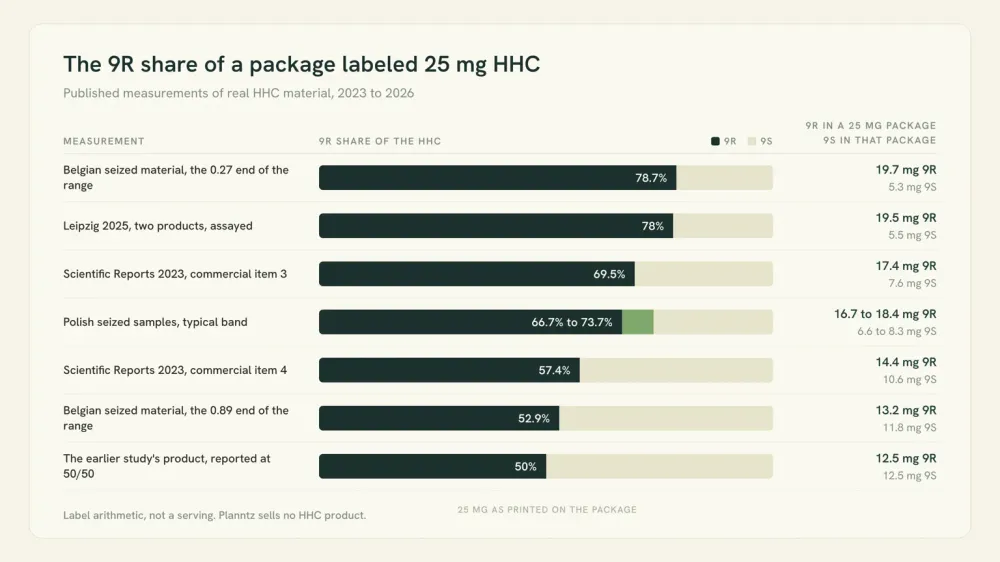
Now put those ratios against a label. The format below is the one that appears in the human literature, a fruit gum printed 25 mg HHC, and the arithmetic is label reading, not a serving: Planntz sells no HHC and this page recommends no amount of anything. Across the measurements of real material above, leaving aside the two bench reactions, the 9R share runs from 50 percent to 78.7 percent. So a package printed 25 mg holds somewhere between 12.5 mg and 19.7 mg of the form that fully substituted for THC in mice, and between 5.3 mg and 12.5 mg of the form that only partially substituted. The package prints one number. The ratio behind it is on no label we could find. That is not a dosing instruction; it is the reason a dosing instruction cannot be written. The only amounts we publish anywhere are for CBD, on our CBD dosage guide, where every figure comes from a labeled product with a certificate behind it.
| Measurement | 9R share of the HHC | 9R in a 25 mg package | 9S in that package |
|---|---|---|---|
| Belgian seized material, the 0.27 end of the range | 78.7% | 19.7 mg | 5.3 mg |
| Leipzig 2025, two products, assayed | 78% | 19.5 mg | 5.5 mg |
| Scientific Reports 2023, commercial item 3 | 69.5% | 17.4 mg | 7.6 mg |
| Polish seized samples, typical band | 66.7% to 73.7% | 16.7 to 18.4 mg | 6.6 to 8.3 mg |
| Scientific Reports 2023, commercial item 4 | 57.4% | 14.4 mg | 10.6 mg |
| Belgian seized material, the 0.89 end of the range | 52.9% | 13.2 mg | 11.8 mg |
| The earlier study's product, reported at 50/50 | 50% | 12.5 mg | 12.5 mg |
Where "70 to 80 percent as strong as THC" actually comes from
The percentage does have a history. It is just not a human one. The German risk-assessment opinion above walks the whole chain, and two of the entries in it have public records of their own: the 1980 structure-activity paper by Mechoulam and colleagues behind the rhesus monkey result, and a 1982 rabbit-model paper in the Journal of Medicinal Chemistry. The potency figures below are as the German opinion reports them. Here is the record, with the species and the route attached to every result, because that is the information the percentage deletes. Note the nomenclature: the older literature writes 9-beta and 9-alpha for the molecules this page calls 9R and 9S.
| Study and year | Species and route | Result against delta-9-THC | What limits it |
|---|---|---|---|
| Russell 1941 (Gayer test); Adams 1940 and 1942 (ataxia test) | Rabbits and dogs, intravenous | Roughly 20 to 50 percent as active | Purity and isomeric ratios were not characterised, and the Gayer test is no longer considered suitable |
| Edery 1971 and Mechoulam 1980 | Rhesus monkeys, intravenous | 9-beta (9R) about half the potency of THC; 9-alpha (9S) about 10-fold lower than 9-beta | Substances not completely isotopically pure, so the 9-alpha effects could reflect traces of 9-beta |
| Skinner 1979 | Mice, intraperitoneal, roughly 1:1 mixture of both forms | About one order of magnitude or more lower than THC, depending on the endpoint; no analgesic effect | A 1:1 mixture, which is not what measured products contain |
| Consroe 1982 | Rabbits bred to be seizure-susceptible to THC, by injection | About 50 percent of THC | A convulsion count in what the authors call a genetically unique and experimentally convenient line, not a measurement in a person |
| Marusich 2025 | Mice, intraperitoneal, the two forms tested separately | 9R similar potency to THC across measures; 9S less potent and only partially substituting | Mice, by injection, with the extrapolation to people written in the conditional |
Read down the third column and the problem is visible. The published animal record spans about one tenth of THC's potency to about the same as THC, and which answer you get depends on which form of the molecule was tested, in which species, by which route, in which decade. None of those cells says 70 percent, or 75, or 80. The figure the internet repeats is not a rounded version of one of these results. It is not in the record at all.
We are not going to replace it with a better percentage, and you should be wary of anyone who does. Every measurement above is an injection into an animal, and none of it is a person eating a gummy on a sofa. Converting an intravenous rabbit result into a consumer ratio is the move that manufactured the original number, and doing it more carefully does not make it a human measurement. We took the potency multiplier attached to THCP apart the same way, and the conclusion generalizes: a potency multiplier with no species and no route attached is a marketing artifact, not a finding.
What has actually been measured in people, counted on September 11, 2026
On a question this thin, counting is more honest than characterizing. Here are the counts, each with the query that produced it and the day we ran it, so you can rerun them and watch the numbers move as the field fills in.
The registry search is worth running yourself, and there is a trap in it we want you to avoid. Search the registry for the abbreviation HHC and you get 183 results, because those three letters also abbreviate several unrelated medical terms. Search the full chemical name, hexahydrocannabinol, and you get zero. On the same day, PubMed's index returned 151 records for the full name, 69 of them tagged as human, zero clinical trials, zero randomized controlled trials and four case reports; cannabidiol returned 477 clinical trials. Those are counts of two indexes on one date, and they say nothing about what the 69 human-tagged records contain, because we did not open 69 records. They also do not mean HHC does nothing. Absence of a study is not evidence of absence of an effect.
For scale on the other side of the ledger, a 2025 probability-based national survey of 1,523 US adults put lifetime HHC use at 1.5 percent (95% CI 1.0 to 2.1), against 7.7 percent for delta-8, 4.5 percent for CBN, 1.3 percent for CBG and 35.2 percent for CBD. HHC is a small category with a loud marketing footprint, and that combination reliably produces confident numbers and no data.
The six people, the three puffs, and the zero to eight
The Leipzig study is the closest thing to a human dosing experiment that exists, and its design is the honest part, so here it is exactly. Six healthy adults, three per route, under an approved ethics protocol. The oral group ate one fruit gum containing 25 mg HHC. The inhalation group took three puffs from a vape whose distillate was near 100 percent HHC. It was not blinded, it was not randomized, there was no placebo arm, and the authors describe their own results as preliminary in those words.
Effect was tracked on a 0 to 10 self-rating scale. In the oral group the maximum score ranged between 4.5 and 7. In the inhalation group, where all three people took the same three puffs of the same product, the maximum ranged between 0 and 8. Five of the six reported a psychoactive effect and all six reported a dry mouth. The authors' own reading of that spread is that "consumption statements do not have significance, since inhalation, absorption as well as effects have wide inter-individual fluctuations". Route also changed what reached the blood: the serum 9R to 9S ratio ran a median of 2.62 after eating and 3.02 after inhaling, even though both products went in carrying the same 78:22 ratio. That is a pharmacokinetic observation in six people, not a statement that either route is safer.
What poison centers have on file
A case series is not a rate. It counts the people who called, in the countries where somebody was counting, and it cannot tell you how often anything happens per user or per milligram. With that firmly in mind, these are the only systematic human records of what goes wrong. French poison centers published 37 HHC cases in Clinical Toxicology in 2024, and the Czech Toxicology Information Centre published 236 in Pharmacology Research and Perspectives in 2025. Two single-patient reports add something a series cannot: an analytically confirmed dissociative state in a 32-year-old man in Australia who ate one gummy "which had been sold as a THC product", and a 35-year-old man who had a tonic-clonic seizure and then a coma after vaping HHC products bought online, with severe rhabdomyolysis, acute kidney injury and 15 days in hospital, 11 of them in intensive care. He recovered without dialysis. Each of those two is n = 1, and neither is a rate.
- France, 37 cases between January 1, 2022 and May 31, 2023, and 19 of them fell in May 2023 alone. Route was ingestion in 24, inhalation in 10, both in 2, sublingual in 1. Median age 36.
- In that French series, neurological features appeared in 85 percent and cardiovascular features in 61 percent, 59 percent were hospitalized, severity was moderate in 16 and severe in two, and all cases with a known outcome recovered.
- The French authors' own caveats: exposure was self-reported, THC use likely contributed in a substantial proportion of cases, biological testing was done in only six of the 37, and the series probably overestimates moderate and severe cases.
- Czechia, 236 cases reported between May 17, 2022 and April 30, 2024, with 40 excluded, leaving 196 analyzed. Median age 18, range 1.5 to 73 years, and 39 children under 15, which the authors put at 19 percent of cases.
- In that Czech series, of the 196 analyzed, physician intervention was required in 172 (87.8 percent), and severity was mild in 119, moderate in 66 and severe in 12 (6.1 percent).
- The outcome was known for 103 of those Czech patients, and the authors report recovery in 98 percent of cases and no fatalities.
- Two single-patient reports sit at the far end: one analytically confirmed dissociative state that resolved within eight hours, and one seizure followed by coma and 15 days in hospital. Each of them is n = 1.
Do not read that list as a verdict in either direction. "Recovery in 98% of cases" and "no fatalities" are the Czech authors' own summary, and they sit next to 12 severe cases, 39 children under 15, and outcome data for only 103 of the 196 patients analyzed. Nothing in these numbers makes HHC safe and nothing in them makes it dangerous; they are counts of phone calls, not measurements of risk. The Australian case is the one that speaks most directly to this article, and it is a label story: the man's serum contained 9R-HHC and 9S-HHC and, in the authors' words, "no other pharmaceutical or psychoactive substance". He had been sold it as THC.

Driving, work and the law: three consequences, briefly
Driving first, because it is the consequence the evidence speaks to most directly. The Leipzig team ran standardized psychophysical tests, the kind used in impairment examinations: a modified Romberg, post-rotational nystagmus, pupil size, walk-and-turn, one-leg stand, finger-to-finger and finger-to-nose. Their conclusion is narrow and quotable: "the psychoactive effects of HHC were evident even at the low doses tested. Therefore, the assumption that HHC consumption bears a potential risk to road safety can be confirmed." They also write that a placebo-controlled design with more participants is necessary, and they note that the non-objective tests were carried out too early, especially for one participant, before the maximum effect. Six people, no placebo, preliminary by their own description, and it is still the only controlled human look at performance on this molecule that we could find.
HHC is already turning up in samples taken from real drivers. A French forensic series of 867 oral-fluid samples collected by traffic police between June and December 2023 found 16 positive for HHC, all male, aged 19 to 58, with a median oral-fluid concentration of 10 ng/mL. The authors are careful about what that shows: HHC was always found together with THC, and in the 11 cases with the highest THC to HHC ratios they write that impaired alertness "may be mainly due to THC". In Sweden, a re-analysis of 145 driving-under-the-influence blood cases that had screened cannabis-positive but confirmed negative for THC found HHC and its metabolites in 32 of them. Both sets were selected before they were counted, by police suspicion and by a screening result, so neither is a prevalence on the road. For the wider question of what impairment research can and cannot measure, our article on cannabinoids and driving does that work for CBD, which is a different molecule with a different record.
On testing at work, two sentences and a door. HHC is a distinct molecule from delta-9-THC, and whether a given workplace panel flags it depends on the assay and the laboratory rather than on what the package called the contents. Whether HHC shows up on a drug test is the page that handles detection, and none of the cut-offs, devices or detection windows belong on this one.
On the law, the short version, with the date we checked it. DEA published a final rule on May 4, 2026 giving hexahydrocannabinol its own schedule I entry at 21 CFR 1308.11(d)(115) under drug code 7220, and the rule states that it "does not affect the continuing status of hexahydrocannabinol as a schedule I controlled substance in any way". State law is a separate question, the federal hemp definition is separately in the middle of being rewritten, which we track on its own page, and the statutory picture for HHC specifically is its own article. We are not going to work out what any of it means for a product in your hand: that is not legal advice we are qualified to give, and the date we checked all of this is September 11, 2026.

What nobody has measured
This is the part most pages leave out, and on a molecule with a record this thin it is the most useful section on the page. Everything below is a gap in the published literature as of September 11, 2026, not a rhetorical flourish.
- 1No controlled comparison of HHC and delta-9-THC in the same people. Every potency figure you have read, including every one on this page, comes from animals given injections.
- 2No published dose-response curve in people. The largest controlled study used one dose per route, in three people per route.
- 3No product label, anywhere we looked, that states the 9R to 9S ratio. The mixture is the variable that matters and it is undisclosed by default.
- 4No acute or chronic toxicity characterization. In the German opinion's words, "no health-based guidance value can be derived".
- 5No US market survey of epimer ratios. Every ratio in this article is European retail, European seized material, or a laboratory bench.
- 6No duration-of-effect study. Nobody has published how long the effects last, only how serum concentrations moved in six people.
- 7No registered clinical trial anywhere in the world, on a registry search run September 11, 2026.
One more thing worth not generalizing. The record described here belongs to HHC and to nothing else that shares its shelf. A different converted cannabinoid with its own separate record shares the acronym style and none of the data, and the same is true of delta-8's own literature. Reading across them, borrowing a number from one molecule to reassure yourself about another, is exactly the error this page exists to interrupt.
Answering from what was measured rather than by assertion. In mice given injections, one of the two forms, 9R-HHC, produced effects on every measure of the standard tetrad battery and fully substituted for delta-9-THC in a drug-discrimination test, while the other form, 9S-HHC, registered on two of four measures and only partially substituted. In the only controlled human administration study we could find, five of six participants reported a psychoactive effect, with maximum self-ratings of 4.5 to 7 after eating a 25 mg gummy and 0 to 8 after three puffs of a vape; that study was not blinded and had no placebo arm. French poison centers have published 37 cases and the Czech center 236. No controlled comparison of HHC and THC in the same people has been published. Treat it as intoxicating.
Nobody has measured that in people. Germany's Federal Institute for Risk Assessment, reviewing the animal record in June 2025, says the effects resemble those of delta-9-THC "although the potency is probably somewhat lower", and that judgement rests on animal data and on one of the two forms of the molecule. The animal record itself runs from about half the potency of THC in rhesus monkeys by intravenous injection, to about one tenth in mice by intraperitoneal injection using a roughly 1:1 mixture of the two forms, to about the same potency as THC for 9R alone in mice in 2025. We are not going to convert that into a percentage, because a percentage hides the species, the route and which form was tested, and that is precisely how the 70 to 80 percent figure came to exist.
No duration-of-effect study has been published. What exists is concentration timing in six people: serum concentrations peaked 1.25 to 2 hours after eating a 25 mg gummy and 2 to 6 minutes after inhaling, and the self-rating curves followed the concentration curves, with the peak rating arriving later than the peak concentration in three of the six. That is n = 6, not blinded, described by its own authors as preliminary. Note what the two numbers show: route changed the time to peak concentration by more than an order of magnitude, and nothing printed on a package would have told you that.
We do not have a measurement to give you, and neither does anybody quoting you a percentage. No study has compared HHC and delta-8 in the same people, and we could not find one comparing them head to head in the same animals in the same laboratory either. Our delta-8 article, linked in the section above, covers that molecule's separate record.
It depends on the assay and the laboratory rather than on what the package called the contents, and no product can guarantee a test outcome in either direction. Cut-offs, devices and detection windows belong to our article on HHC and drug testing, linked in the section above, and this page deliberately publishes none of it.
DEA published a final rule on May 4, 2026 giving hexahydrocannabinol its own schedule I listing at 21 CFR 1308.11(d)(115) under drug code 7220, and the rule states that this "does not affect the continuing status of hexahydrocannabinol as a schedule I controlled substance in any way". State law is a separate question with its own regulator, this is not legal advice, and the date we checked is September 11, 2026. The full statutory picture is on our HHC legality page, linked in the section above.
Nobody has run the study that would answer that, and we are not going to answer it for them in either direction. The clearest statement in the official record is the German risk assessment's: HHC "has yet to be sufficiently toxicologically characterised", there is "a particular lack of data in regard to acute or chronic toxicity", and "no health-based guidance value can be derived". What we can tell you is what the human record contains, which is two poison-center series, a handful of case reports, one controlled study in six people, and no registered clinical trial as of September 11, 2026.
If you take one thing from this page, take the shape of the problem rather than a number. HHC is intoxicating, the size of that effect depends on the proportion between two molecules, and that proportion is set in a reactor and printed nowhere. Any page that answers "how much" with a percentage is answering a question the literature has never asked. Planntz sells no HHC, so the only thing we have to gain here is that you stop trusting a number that has no study behind it. If you want the same question asked about a cannabinoid with an actual evidence base, we answered it for CBD. If you want the map that shows where all of these molecules sit relative to each other, start at the cannabinoid atlas and work outward from there.
Writing about hemp, wellness and the small rituals that keep us balanced.