HHC Drug Test: What Three Devices Found in Six People
Page one gives two opposite answers and cites neither of the two papers sitting on it. A drug test is two tests: an antibody screen, then a confirmation that names one molecule. Here is what three devices did in six dosed adults, and what no study has measured.
Search for what an HHC drug test does and the first page of results hands you two opposite answers. One page tells you standard tests look for THC metabolites and not HHC. Another tells you HHC's metabolites are similar enough to cross-react. Both sentences sit on the same results page, neither cites a source, and if you have a test coming you have no way to choose between them. They disagree because neither is answering the real question. A drug test is two tests, and each one has a different relationship with this molecule. The first is an antibody screen, and whether it responds to HHC is a property of the antibody inside that particular device, not a property of HHC. The second is a confirmation that identifies a molecule by name, and the four stereoisomers of one of HHC's hydroxy metabolites were only synthesized and structurally confirmed in January 2026. This page reports what named studies measured with named devices, and it publishes nothing at all about affecting a result.
Does HHC show up on a drug test? The question has two halves
A urine drug test is two tests run in order, and almost every argument about HHC collapses if you treat them as one. The first is a screen, usually an immunoassay. It is an antibody test, and it does not identify molecules: it reports how strongly whatever is in a sample binds to an antibody raised against one particular shape, and compares that response to a threshold. A result at or above that threshold is presumptive, which is a technical word meaning the laboratory has not yet identified anything. The second test is a confirmation, done by mass spectrometry, and it does identify molecules. It reports named analytes, and only the named analytes its method was validated to report.
That two-stage structure is not specific to HHC, and this page does not rebuild it. If you want the general version, our guide to delta-8 and drug tests walks through what the screen is looking for and how a panel names one molecule, using a cannabinoid that is a positional isomer of THC. If you are here about CBD rather than HHC, the trace-THC pathway and the workplace procedure are covered in our guide to CBD and workplace drug testing. What this page owns is the part nobody else covers: what happens when the molecule in question is hexahydrocannabinol.
And HHC is a different problem from delta-8, for a reason worth two sentences. Delta-8 and delta-9 are isomers: the same atoms, with a double bond in a different place. HHC is not an isomer of THC at all. It is THC with two more hydrogen atoms added across that double bond, which removes the feature the 8 and the 9 refer to. Adding those hydrogens creates a new stereocenter at carbon 9, so the reaction does not produce one compound. It produces two, called (9R)-HHC and (9S)-HHC, in a ratio the manufacturing process decides. That single fact reorganizes this entire topic, and none of the consumer pages competing for this search mention it. For the chemistry itself, and how HHC is made, see what HHC is and how it is made.
What a screen is calibrated to, in the government's own words
Before the studies, it helps to see how a screen is built, because the US federal government writes it down. In the Mandatory Guidelines for Federal Workplace Drug Testing Programs, Authorized Testing Panels, published at 90 FR 4662 on January 16, 2025 and effective July 7, 2025, the cannabis row of the urine panel names its initial test analyte "Marijuana metabolite" and its confirmatory test analyte "Δ9THCC", which the same notification's list of abbreviations expands to "Δ-9-tetrahydrocannabinol-9-carboxylic acid". Now the part that matters for this article: the strings "hexahydrocannabinol" and "HHC" occur zero times in that document. HHS republished those same panels on March 13, 2026, at 91 FR 12308, stating that "The Department has made no revisions to the current drug testing panels" and that "There are no changes to the drug testing analytes, test cutoffs, and report nomenclature published in the January 16, 2025, Notification (90 FR 4662)." HHC occurs zero times there too.
The same notification carries a footnote that describes, in one sentence, exactly what an immunoassay is and why cross-reactivity is a design parameter rather than an accident.
“Immunoassay: The test must be calibrated with one analyte from the group identified as the target analyte. The cross-reactivity of the immunoassay to the other analyte(s) within the group must be 80 percent or greater; if not, separate immunoassays must be used for the analytes within the group.”
Read that footnote carefully and read its scope even more carefully. It is a design requirement for drug classes whose panel row groups several analytes together, and the cannabis row on that panel names a single analyte. So the 80 percent threshold is not a statement about HHC, it has nothing to do with the measured cross-reactivity percentages later in this article, and nobody should join those two things. What the footnote does tell you is the general shape of a screen: it is calibrated to one molecule, on purpose, and everything else it responds to, it responds to by resemblance. That is why the useful question is never whether HHC is on the panel. It is what the antibody in front of your specimen does when HHC's metabolites arrive. The parallel case, where the panel names one molecule and a very similar one turns up, is covered on our page about THCA and drug testing. Note the scope of all of this as well: these guidelines bind federal agency testing. A private, non-regulated employer writes its own program.
Six people, three devices, three different answers
The published record of giving HHC to a person and then measuring them is small enough to list by name. Four studies exist: six adults in Leipzig, six in Rome, two in Bern, and a self-administration study from Cologne whose abstract does not state how many people took part and whose full text is not openly reachable, so no participant count for it appears anywhere on this page. Not one of the four is a clinical trial. That is the entire human evidence base, and every confident day count you have read about HHC was written without it.
The most complete of the four is open access and worth reading in full. Höfert and colleagues, publishing in Scientific Reports in 2025, gave HHC to six healthy adults, three by each route, aged 25 to 30, under ethics approval 370/23-ek. The oral group ate one fruit gum containing 25 mg of HHC. The inhaled group took three puffs from an HHC vape whose distillate was close to 100% HHC. Both products were bought in a hemp shop and assayed before use: the (9R) to (9S) ratio was 78:22 in each, and no THC was detected in either. Serum was sampled to 48 hours, urine to five days, saliva to 48 hours. The study was not blinded, not randomized and had no placebo group. And then the researchers did the thing no consumer page has done: they ran three real screening devices, of three different kinds, on the samples. All three read negative in all six participants before consumption.
| Device | Matrix | Calibrated to | What it did in those six people |
|---|---|---|---|
| DrugWipe 5S | Saliva | THC at 5 ng/mL | Read positive in all cases, but only up to 10 minutes after consumption, which the authors say is presumably only due to residues of HHC in the mouth. One oral participant read positive again at 3 hours, when the measured saliva HHC was already below the threshold reported in earlier spiking work. |
| SureStep Multi-Drug | Urine | A THC carboxy metabolite | Read positive in all six at some point, in very different patterns. Of the three who inhaled: one was positive at a single timepoint (6 hours); one from 1 to 6 hours with a negative at 3 hours, from a dilute sample at a creatinine of 601 µmol/L; one only from 1 to 2 hours. After the oral dose: first positive at 2 hours, and still positive up to 72 hours. |
| Abbott Immunalysis THC Direct ELISA | Serum | A THC carboxy metabolite | Read positive for at least 24 hours in five of the six. For the three oral participants and one of the inhaling participants it was still positive at the last sample taken, so the authors write that detectability "could be possibly distinctly longer than reported here". |
The authors' own summary is the sentence to carry away from that table: "all immunological tests were able to detect single HHC consumption. However, as described above, each test has its own characteristics which has to be taken into account." They add that "there may be potential problems in recognizing the acute phase, especially in the case of inhalative consumption". And their limitations paragraph is the reason this page has no timetable in it. They call the results "preliminary", note that the study "only included a small number of subjects which limits statistical analyses", and write that only low doses and one-time consumption were examined, so that for "higher doses and multiple intakes, significantly higher concentrations, longer detection periods and more severe impairments are conceivable". In that study, in those six participants, at that one low dose, those devices read positive at those timepoints. That is a record of what an instrument did. It is not a schedule, and the people who ran it say so themselves.
The same study's mass spectrometry, which is a different instrument from the strips, filled in what the devices could not see. Saliva contained only parent HHC and no metabolites at all, detectable to 8 hours after the oral dose and 5 hours after inhaling. Urine contained both epimers in very low amounts plus 11-OH-HHC in every participant, with (9S)-HHC-COOH ranging from below the limit of quantitation to 8.92 ng/mL against (9R)-HHC-COOH from below the limit to 20.2 ng/mL. Serum (9R)-HHC peaked between 2.75 and 12.0 ng/mL after the oral dose and reached 179 ng/mL in one of the three who inhaled, a difference the authors attribute to inhalation technique. Six people, and that much spread. The study also measured impairment, which is a different question from detection and is not this page's: the road version of it lives on our page about CBD, THC and driving laws.
A second German group, in Cologne, ran its own self-administration experiment with vapes at 95% HHC and jellies containing 25 mg, quantified HHC and its metabolites in plasma, and then ran three devices of its own: a urine screen set at 25 ng/mL for the THC carboxy metabolite, a DrugWipe 5S oral-fluid device at 5 ng/mL for THC, and a CEDIA cannabinoid assay in plasma. Its urine device read positive up to 10 hours, and its oral-fluid device showed no cross-reactivity at all. Now hold those two studies side by side and look at the same saliva device. In Leipzig it read positive in all six for the first ten minutes and the authors put that down to residue in the mouth. In Cologne it did not cross-react. Both results are published, both concern the same device family, and the conditions were not identical. That pattern is not a scandal. It is the topic.
HHC is two molecules, and the antibody can tell them apart
The label says HHC. What is in the jar is a mixture of (9R)-HHC and (9S)-HHC, and the mixture is never even. In the Leipzig products it was 78 parts to 22. And the ratio does not stay where it started once a person swallows it: Di Trana and colleagues, in Pharmaceuticals in 2024, gave six non-user volunteers 25 mg of a deliberate 50:50 mixture, smoked in 500 mg of tobacco, and sampled whole blood and oral fluid to 3 hours and urine over the first 6 hours. Starting from an even split, (9R)-HHC ran about three times higher than (9S)-HHC in every matrix they measured, and oral fluid contained no metabolites at all. Their paper calls itself preliminary, the sample is six people, the exposure was smoked with tobacco, and the sampling stopped after hours rather than days. All of that is true and none of it changes the shape of the finding.
An antibody does not see "HHC". It sees a shape, and these two shapes differ at one carbon. Four laboratories have now put numbers on what that does to a screening device, and this is where the answer to the whole question lives. One naming warning before the numbers, though. The Japanese group below uses 9α and 9β where the European and American groups use (9R) and (9S). We have not verified how those two naming systems map onto each other, so each result below is printed in the labels its own paper used, and you should not translate one into the other.
- Dover, Delaware, 2024: on an Immunalysis Cannabinoids Direct ELISA in whole blood, calibrated at 5 ng/mL of the delta-9 carboxy metabolite, (9R)-HHC-COOH cross-reacted at 5 ng/mL where (9S)-HHC-COOH did not.
- Linköping, Sweden, 2024: on the ELISA used in that laboratory, tested from 5 to 200 ng/mL, cross-reactivity was 120% for 9R-HHC-COOH and 48% for 9S-HHC-COOH. The abstract does not name the assay's manufacturer.
- Japan, 2025: on three commercial urine panels at a nominal 50 ng/mL delta-9 calibration, the lowest concentration called positive was 100 to 500 ng/mL for 9α-HHC-COOH and 50 to 100 ng/mL for 9β-HHC-COOH.
- Leipzig, Germany: for the DrugWipe 5S saliva device, the positivity thresholds reported in earlier spiking work were 250 ng/mL for (9R)-HHC and 500 ng/mL for (9S)-HHC.
The first three of those results come from the US Armed Forces Medical Examiner System, which tested 24 analytes from 5 to 500 ng/mL and found only three carboxy metabolites cross-reacting at 10 ng/mL or below; from Sweden's National Board of Forensic Medicine, whose validation measured the 120% and 48% figures; and from Japan's National Research Institute of Police Science, which ran three named panel tests, Driven Flow THC L50, IVeX-Screen THC L50-S and AccuSign THC, and also reported one real user's urine reading positive on all three. The fourth is the Leipzig group's own reconciliation against the spiking thresholds already in the literature. In the three results that use the (9R) and (9S) labels, the antibody responded more strongly to the (9R) form. Whether the Japanese α and β labels line up with that is not something this article will claim.
Read every one of those numbers with its device attached, because none of them means anything without one. A cross-reactivity figure is a ratio measured against one assay's own decision point. It is not a property of HHC, it does not transfer to a device nobody tested, and it is not comparable with the milligram ratio printed on a product label, which is a completely different kind of number. The version of this argument for a different non-THC cannabinoid, where the fold-ratios have been measured for CBN, is on our page about CBN and drug tests.
Why two forensic laboratories published opposite answers
HHC products reached Sweden in 2022, and a laboratory there watched its own screening results change. Researchers at the Karolinska Institutet reported in the Scandinavian Journal of Clinical and Laboratory Investigation that the frequency of false positive screening tests for THC in oral fluid, and for its carboxy metabolite in urine, rose from under 2% to over 10%. They then confirmed cross-reactivity in spiking experiments with HHC, HHC-COOH, HHC acetate (HHC-O), hexahydrocannabihexol (HHC-H), hexahydrocannabiphorol (HHC-P) and THC-P, and in routine urine testing they measured HHC-COOH at up to 205 µg/L, with a mean of 60 and a median of 27. Their conclusion is blunt: "cannabis drug testing cannot rely on results from immunoassay screening, as it cannot distinguish between different tetra- and hexahydrocannabinols." Read that under 2% to over 10% figure for exactly what it is: one Swedish laboratory's caseload over a period, not anybody's personal probability.
Now the other result. A German group in Leipzig, the same team that would later dose the six participants above, evaluated the cross-reactivity of HHC, 11-OH-HHC, HHC-COOH and three analogues, HHC-P, HHC-O and H4-CBD, across five immunological screening tests for serum, urine and saliva. They reported that urine test strips and serum ELISAs "seem to be beneficial to detect HHC consumption in comparison with saliva tests", which agrees with the Leipzig device results above. And on the analogues they reported the opposite of the Swedish finding: "HHC analogs and H4-CBD showed no cross-reactivity with any of the tests."
Put the two side by side and the disagreement is narrower and far more useful than it looks. Both laboratories agree that HHC itself can set off a cannabis screen. Where they part company is the analogues: Swedish spiking work saw HHC-O, HHC-H and HHC-P cross-react, and the German panel saw no cross-reactivity from HHC analogues on any of its five tests. Neither is correcting the other, and neither is wrong. They used different assays, and cross-reactivity is a property of an antibody at a calibration, so two careful laboratories can publish opposite results about the same compounds and both be right about their own instruments. This is why the honest answer to "does HHC show up" is a question back: on which device, at which calibration, in which matrix.
One counterexample belongs here, because it proves the same point from the other direction and because it is about a different molecule. After a single 4 mg oral dose of HHCP, a close relative of HHC, in one THC-abstinent volunteer, the enzymatic immunoassays run on that volunteer's urine samples tested negative for cannabinoids, and the authors recommended adding HHCP metabolites to routine screening (Drug Testing and Analysis, 2025, doi 10.1002/dta.3871; the publisher blocks automated access, so that record is cited in plain text). That is one person and one molecule, and it must not be generalized to HHC. What it shows is that the response of a screening device to a novel cannabinoid is a measurement, not a deduction. Nobody can reason their way to it from a chemical structure.
The confirmation names a molecule, and one metabolite had no reference standard
A screen answers presumptive. A confirmation answers by name, and it can only name what is on its list. Here is where HHC's chemistry becomes awkward. One of its hydroxylated metabolites, 8-hydroxy-HHC, exists as four stereoisomers, and all four were first synthesized and structurally confirmed in a stereoselective synthesis paper published on January 13, 2026, in the journal Molecules. Its authors write that "the lack of reference standards has hindered pharmacokinetic and forensic studies", and they record what that meant in a working laboratory: in 2025 another group found three of the four stereoisomers in urine specimens submitted for cannabinoid testing, and, in this paper's words, "compound 3 was not identified at the time, as a reference standard was not available for confirmation". That is synthetic bench chemistry, with no people and no product in it. It says nothing about anybody's test result. What it tells you is that a confirmation laboratory can only report a molecule it has a certified standard for, and that for one of HHC's metabolites nobody had even made and confirmed all four forms until January 2026.
The problem is not confined to that one compound. A 2026 review written from the European Union Drugs Agency's vantage point counts over 30 semi-synthetic cannabinoids now under monitoring and names, among the analytical obstacles, the accessibility and affordability of certified reference materials and the presence of isomeric compounds, in products it describes as frequently mislabeled. A separate 2026 review in Pharmaceuticals states that conventional toxicology screening methods may fail to detect exposure to semi-synthetic cannabinoids, and that chiral chromatographic techniques are needed for metabolite identification and epimer differentiation. Both are reviews of a literature rather than measurements, and the first describes the European situation.
Where laboratories build the capability, it works. A method published in 2026 in the Journal of Analytical Toxicology screens whole blood by LC-QTOF-MS for 24 phytocannabinoids and semi-synthetic cannabinoids, with recoveries of 87% to 118%, matrix effects from 24% to 93%, and detection limits between 0.8 and 16 ng/mL. That is one laboratory's validated method described in a method paper. It is not a description of what any particular employer's laboratory runs, and you cannot assume that the panel handling a given specimen includes any of those compounds.
What laboratories found when they went back and looked
Four published re-analyses have gone back through real specimens with methods that can see HHC, and their reports are the closest thing anyone has to a picture of how often this turns up. Each one comes with a selection problem you have to read before the number. The US military's forensic laboratory examined 1,300 authentic urine specimens that had already screened positive by immunoassay, collected between April 2022 and May 2024. The Swedish laboratory whose cross-reactivity work appears above also re-examined 145 driving-under-the-influence blood cases that screened cannabis-positive and then confirmed negative for THC and its metabolites. The German group behind the five-test panel reported 321 serum and plasma samples from drivers in Western Saxony in the same paper. And a Swedish group, working out of the same city, identified 18 HHC metabolites across 16 authentic urine samples from cases with that same screen-positive, confirm-negative history, all of which had already been confirmed positive for HHC in blood.
| Laboratory and year | What was examined | What was found |
|---|---|---|
| Armed Forces Medical Examiner System, United States, 2025 | 1,300 authentic urine specimens that had already screened positive by immunoassay, collected April 2022 to May 2024 | HHC metabolites were present but uncommon. Among the 14 specimens containing HHC metabolites alone, (9R)-HHC-COOH was the most abundant stereoisomer in 12; (9S) predominated where the delta-8 and delta-9 carboxy metabolites were also present. |
| National Board of Forensic Medicine, Linköping, Sweden, 2024 | 145 driving-under-the-influence blood cases that screened cannabis-positive by ELISA and then confirmed negative for THC, 11-OH-THC and THC-COOH | HHC and its metabolites were confirmed in 32 of them, 22% of that already selected set. The authors note that presumptive positive cases are caught by the routine ELISA screening for cannabis. |
| Leipzig, Germany, 2024 | 321 serum and plasma samples from drivers suspected of cannabis use in Western Saxony | Both HHC diastereomers were found in 17 samples, 5.3%, at a mean (9R) to (9S) ratio of 1.99. (9R)-HHC ran from below the limit of quantitation to 35.35 ng/mL. |
| Linköping and collaborators, Sweden, 2025 | 16 authentic urine samples from cases that screened cannabis-positive in blood by ELISA, confirmed negative for THC and its metabolites, and were positive for HHC in blood | 18 HHC metabolites were identified. 99.3% of the hydroxylated metabolites were glucuronidated, and only 11-OH-HHC, 5'-OH-HHC and one further side-chain monohydroxy metabolite were present in all 16. |
Read those four rows for their selection rather than their percentages, because the selection is the finding. Every specimen in all four sets arrived at a research laboratory the same way: a screen flagged it and a confirmation did not find THC. That is the real-world signature of this question, and it is the opposite of the framing the search results sell. It is also the practical answer to "can a laboratory tell HHC apart from THC": in all four sets, a laboratory that went looking with a method able to separate the compounds found HHC and reported it by name.
The US military laboratory drew a conclusion from its own numbers that cuts against the alarm, and it deserves to be quoted rather than paraphrased. It found that an analytical panel containing the delta-8 and delta-9 carboxy metabolites "appears to be sufficient for revealing cannabinoid exposure within workplace monitoring and deterrence programs". Note the object of that sentence carefully. It is about what a deterrence program needs in order to reveal cannabinoid exposure. It is not a statement that such a panel identifies which molecule a person took, and the same paper's own 14 HHC-only specimens show that the two are different questions.
"I only took HHC" is not a testable premise
Everything above assumes you know what you took. In seized material that assumption fails often enough to matter. Of 1,186 cannabis-type samples seized in Poland between 2022 and 2024, semi-synthetic cannabinoids were found in 113, or 9.5%, with HHC predominating and consistently detected as a mixture of two epimers, (9R) prevailing at a typical ratio of 2.0 to 2.8 to 1 (Wrzesień-Tokarczyk et al., Drug Testing and Analysis, 2026, doi 10.1002/dta.70014; the publisher blocks automated access, so that record is cited in plain text). That is Polish seized material, not US retail, and it is not a market share. The mismatch runs the other way too: a 2026 case report, written up for a clinical reason this page does not cover, describes a 32-year-old man whose serum, after a single gummy sold as a THC product, contained both HHC epimers and no other pharmaceutical or psychoactive substance. That is one person, and it is here only for the label mismatch.
The consequence for this page is narrow and it is important. "I only took HHC" is a premise a laboratory cannot verify from a specimen, and one you cannot verify from a label either. The only document that says what was in a product is a certificate of analysis for that specific batch, and reading one is a learnable skill: our walkthrough on how to read a certificate of analysis goes through it line by line. For what HHC is, how it is manufactured and why it does not appear on an ordinary hemp certificate, see our comparison of HHC and CBD.
Why this page has no detection-window table
You have seen the table. Urine 3 to 7 days for occasional use and 15 to 30 days for heavy use, blood 24 to 48 hours, saliva 24 to 72 hours, hair up to 90 days. When we read the first page of results for this search on September 6, 2026, the full table was on the best consumer page there and a testing laboratory's page repeated the 90-day hair figure, and not one of those cells had an HHC study behind it. Those are THC numbers with a different molecule's name written above them. Rather than assert that, here are the searches, so you can run them and get a number to argue with.
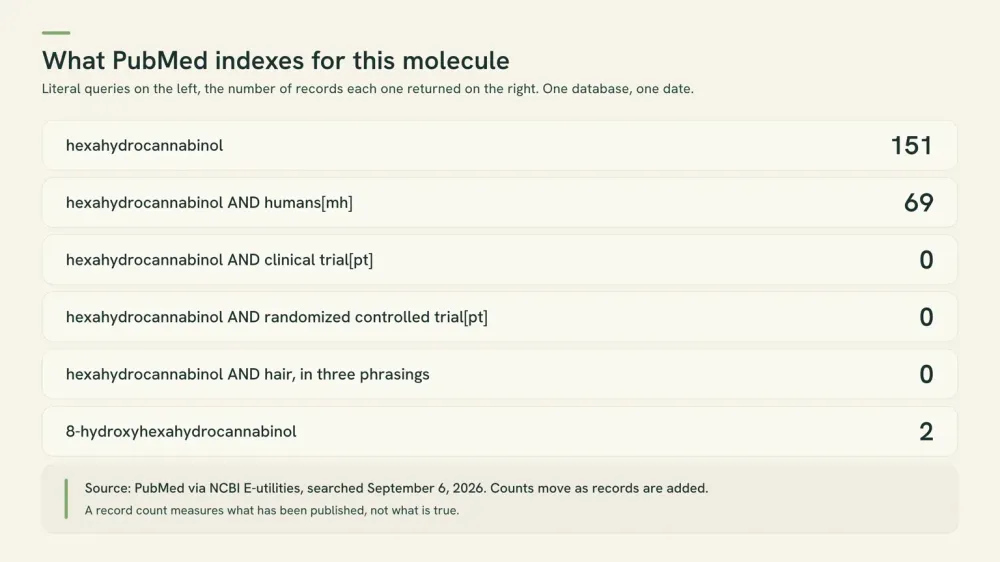
These are literal PubMed queries, run on September 6, 2026, with the counts they returned that day. The term hexahydrocannabinol returns 151 records. Adding the humans filter gives 69. Adding the clinical trial publication type gives 0, and randomized controlled trial gives 0. The term paired with hair returns 0 records under three different phrasings: hair, hair as an all-fields term, and keratin or hair follicle. And 8-hydroxyhexahydrocannabinol, the metabolite at the center of the confirmation problem described above, returns 2 records in the whole database. Two sentences have to travel with those numbers. First, PubMed indexes no study pairing hexahydrocannabinol with hair, which is a statement about what has been published and not a statement that a hair test cannot detect HHC. Second, the absence of a study is not evidence of the absence of an effect, in either direction: it is not evidence that windows are short and it is not evidence that they are long. Counts also move as records are added, so re-run them rather than trusting this paragraph's age.
Oral fluid gets its one sentence here too, and it is a strange one: in the two studies that ran saliva devices, one found ten minutes of positives it attributed to mouth residue and the other found no cross-reactivity, while the Leipzig mass spectrometry found parent HHC in saliva with no metabolites at all. That is the entire published picture for that matrix. If your real question is about CBD rather than HHC, the elimination side of it, which is a genuinely different molecule with different pharmacokinetics, is covered in how long CBD stays in your system.
What to ask before an HHC drug test, and what you can check
Nothing in this section is about changing an outcome. It is about understanding the one you are in, which is the part that is genuinely knowable in advance. Most testing programs will answer several of these if you ask, and some of them are printed in the policy document you were handed when you were hired.
- 1Which specimen the program collects. Urine, oral fluid, blood and hair are different tests with different targets, and nearly every measurement in this article was made in urine, serum or saliva.
- 2Whether the panel is the federal one or the employer's own. The HHS panel binds federal agency testing; a private, non-regulated employer writes its own program, and those are not the same document.
- 3Which analyte the confirmation names. "THC" is not an analyte. On the federal urine panel the answer is delta-9-tetrahydrocannabinol-9-carboxylic acid, and "hexahydrocannabinol" appears nowhere in that notification.
- 4Whether the confirming laboratory holds certified reference standards for HHC and its metabolites. A method reports only what it is validated for, and in 2025 one laboratory could not confirm an 8-hydroxy-HHC stereoisomer for want of a standard.
- 5Whether the confirmation method separates the two epimers. Chiral chromatography is what does that, and whether a given laboratory runs it is a question about that laboratory, with a real answer.
- 6Whether the result being described to you is a screen or a confirmation. A screen result is presumptive by design, the two stages answer different questions, and for this molecule they can disagree.
- 7What the certificate of analysis for the product actually reports, batch by batch. Label text is not that document, and an HHC product will not appear on an ordinary hemp certificate.
There is also a review step between the laboratory and the employer in regulated testing, with its own rules about what counts as an explanation and what does not. We do not rebuild it here: the delta-8 page walks that step through the federal documents, and it works the same way whichever cannabinoid started the conversation. None of this is legal advice, and a question about your own employment is a question for an attorney licensed where you live.
What this page cannot tell you
The honest limits here are large, and stating them is the point rather than the disclaimer. Six people took HHC in the study this article is built on, three by each route, once, at a low dose, and the authors call their own results preliminary. A second study of six smoked a 50:50 mixture with tobacco and sampled for hours rather than days. A third gave HHC to two volunteers. A fourth does not state its participant count in anything openly readable. The casework sets are all selected before they were studied: already screen-positive, already confirm-negative, already forensic. Three of the four came from European forensic casework rather than American workplace testing. The cross-reactivity figures are properties of named assays at named calibrations and do not transfer to devices nobody has tested. And this article cannot tell you what your own result will be. Nothing can: not this page, not a laboratory before it runs the specimen, and certainly not a product.
One disclosure, because it belongs on a page like this one. HHC is an intoxicant. Planntz does not sell it, does not sell delta-8, and does not sell any other intoxicating cannabinoid. We make CBD tinctures, and even about those the honest sentence is the one we print everywhere else: no product can guarantee a drug-test outcome. Our workplace drug testing guide for CBD users carries that statement and the residual risk in full, and it owns the entirely separate question of trace THC in a full-spectrum CBD product. This article exists because the question is asked constantly and answered badly, not because there is anything at the end of it to buy. It is not medical advice.
Two adjacent questions get one line each, because each has its own page. HHC's federal status is a separate subject with its own dates: it now carries a listing at 21 CFR 1308.11(d)(115) under drug code 7220, and the legal status of HHC covers what that means and when it took effect. Anti-doping is a third system again, with its own prohibited list and its own rules that do not follow employment law, and that side of things is covered in our page on CBD and anti-doping rules in sport.
It has to be answered in two halves, because a drug test is two tests. On the screen: an immunoassay calibrated to a THC metabolite can read positive after HHC, because cross-reactivity is a property of the antibody rather than of the molecule. In the six dosed participants in Leipzig, all three device families flagged a single use at some timepoint, and in Sweden the frequency of false positive THC screens rose from under 2% to over 10% in the period HHC products spread there. On the confirmation: the test identifies named analytes, and the US federal urine panel names delta-9-tetrahydrocannabinol-9-carboxylic acid, with the words hexahydrocannabinol and HHC appearing nowhere in that notification or in its March 2026 republication. Those two answers can differ for the same specimen, and that is the single most useful thing to understand about this question.
That question cannot be answered about a person, and any page that answers it is guessing. Nobody can tell you what a specific device, at a specific calibration, will do with a specific specimen, and this article makes no attempt to. What is published is what named devices did in named studies: a saliva strip calibrated to THC at 5 ng/mL read positive only for the first ten minutes and the authors attributed that to residue in the mouth; a urine device read positive in all six participants but at a single timepoint for one of them; a serum ELISA read positive for at least 24 hours in five of the six. It is also worth knowing what a positive screen is. It is a presumptive result, meaning nothing has been identified yet, and it is the beginning of a procedure rather than the end of one.
The day counts on the search results page were measured for THC and had the molecule's name swapped, and we can show you that rather than assert it: on September 6, 2026, PubMed returned 151 records for hexahydrocannabinol, 69 tagged as involving humans, zero indexed as a clinical trial and zero as a randomized controlled trial, and zero records at all pairing the molecule with hair under three different phrasings. What does exist is the Leipzig study, in six people, at one low dose, on one occasion: a urine device read positive at a single timepoint for one inhaling participant and up to 72 hours after the oral dose, and a serum ELISA was still positive at the last sample taken for four of the six. Its authors write that for higher doses and multiple intakes, longer detection periods are conceivable. This page publishes no waiting advice and no clearance guidance of any kind, and there is no evidence base from which anyone could responsibly write one.
Yes in principle, and it depends in practice. Mass spectrometry with chromatography separates them, and a whole-blood method published in 2026 covers 24 phytocannabinoids and semi-synthetic cannabinoids at detection limits from 0.8 to 16 ng/mL. Four published re-analyses that went back through real specimens with methods able to separate the compounds all found HHC and named it. But a confirmation only reports the analytes on its own list, and the list depends on the laboratory's validated method and on which certified reference standards it can obtain. All four stereoisomers of 8-hydroxy-HHC were only synthesized and structurally confirmed in January 2026, and that paper records a laboratory which had detected three of them in real urine and could not identify one of the three, because no reference standard was available to confirm it.
Saliva, one sentence: in the two studies that ran a saliva device, the Leipzig strip read positive only for about ten minutes and the authors attributed it to residue in the mouth, while a Cologne group reported no cross-reactivity on the same device family, and mass spectrometry found parent HHC in saliva with no metabolites at all. Hair, one sentence: PubMed indexes no study pairing hexahydrocannabinol with hair, under three different search phrasings, checked on September 6, 2026, so the 90-day figure that circulates has no HHC study behind it. Note precisely what that second sentence says. It is a statement about what has been published, not a statement that a hair test cannot detect HHC, and nobody should read it as reassurance.
Because both answers are true of different machines, and almost nobody writing about this says so. A Swedish laboratory reported cross-reactivity in spiking experiments with HHC, HHC-COOH, HHC-O, HHC-H, HHC-P and THC-P, and concluded that cannabis drug testing cannot rely on immunoassay screening because it cannot distinguish between different tetra- and hexahydrocannabinols. A German laboratory tested HHC analogues and H4-CBD across five screening tests and reported no cross-reactivity with any of them, while also finding that urine strips and serum ELISAs detect HHC consumption better than saliva tests do. Different antibodies, different calibrations, opposite results, and neither laboratory is wrong. That is why the only honest form of the answer names the device.
If you came here for a number of days, the most useful thing this page can do is tell you that the number does not exist and hand you the search it comes from. What does exist is a chemistry that explains why a screen and a confirmation behave differently for this molecule, a federal panel that names one analyte and does not name this one, and a short list of questions you can actually ask about your own program. For the two-stage procedure as it applies to CBD's own trace-THC pathway, including the residual-risk statement no product escapes, start with our page on what a workplace test measures in a CBD user. For the federal law underneath all of it, our hemp and CBD legality hub is where that side of the topic lives.
Writing about hemp, wellness and the small rituals that keep us balanced.