Do CBD Gummies Show Up on a Drug Test? The Answer Is on the Jar, Not the Format
A gummy is a dose someone else already chose. That is the whole difference, and it makes the real question milligrams of THC per day, not a percentage. Here is what was actually measured inside CBD gummies, and the one row worth reading before you buy.
Do CBD gummies show up on a drug test? Nobody can promise you an answer, including this page, and any page that gives you a clean yes or no is guessing. What can be settled is the question underneath it. A urine screen does not look at the shape of the thing you swallowed, and it does not look for CBD. It looks for one metabolite of delta-9 THC. So the only thing the gummy format changes is how many milligrams of delta-9 THC you can end up taking, and whether you are able to find out how many that is.
That reframe is the whole article, and it has a practical edge. A tincture is labelled in milligrams per millilitre, so the daily amount is a decision you make at the counter with a dropper in your hand. A gummy is labelled in milligrams per piece, and a factory made that decision months ago. You do not adjust a gummy. So the useful question is not does the format matter. It is how many milligrams of THC per day does this jar put in me, and can I find that out. The answer to the second half is printed on the batch certificate for the lot number on your jar, and it is the one check on this page that survives every product category on the shelf.
A gummy is a dose somebody else already decided
Start with the label, because the label is the difference. A tincture certificate prints a concentration. Our Full Spectrum Mango & Peach, batch 260310, reports 2.27 mg of delta-9 THC per millilitre, alongside 136 mg per package and 0.239%. At roughly 0.05 mL per drop, that comes to about 0.11 mg of delta-9 THC per drop. That last figure is our arithmetic rather than a printed value, and drop size varies with the dropper and with technique. Read the unit before you read the number, incidentally: our Lemon & Raspberry batch 260309 reports the same measurement per gram instead of per millilitre, so the two concentration columns are not directly comparable even inside one product line. The point is not the number anyway. The point is who chose it. Two drops or ten drops is a decision you make, in your kitchen, every time.
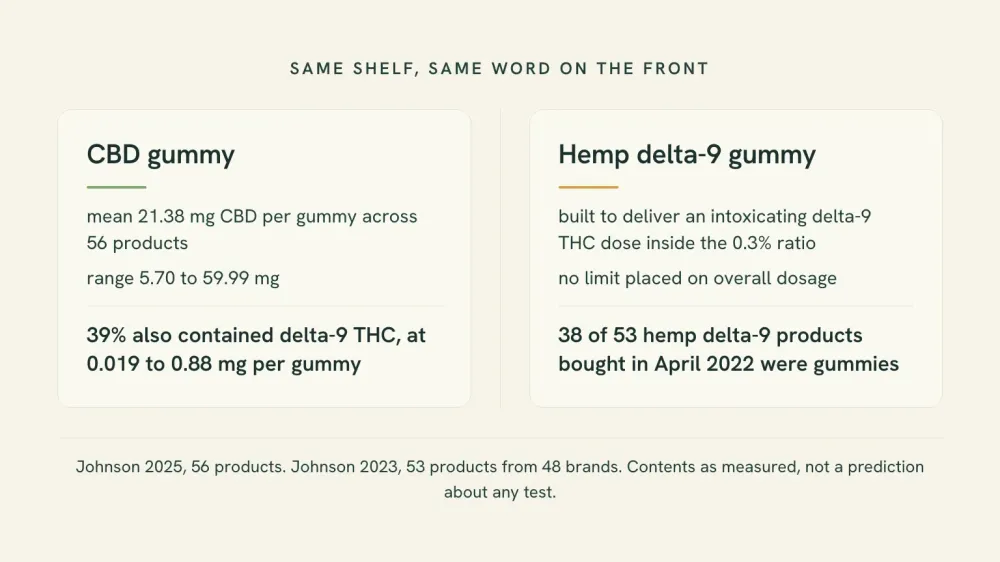
A gummy's number is set upstream, before you ever see the jar. A 2025 analysis in Cannabis and Cannabinoid Research bought 56 CBD gummy products from national brands online and measured them by liquid chromatography with tandem mass spectrometry. The mean was 21.38 mg of CBD per gummy, with a standard deviation of 11.16 mg and a range running from 5.70 to 59.99 mg. That is a more than tenfold spread across a shelf of things that all look like the same object. You do not titrate a gummy. You take one, or you take two.
- Milligrams per millilitre is a concentration. You set the dose by setting the number of drops. It is how a tincture states its strength, and how most batch reports print it as well.
- Milligrams per piece is a decision already made. The only lever you have left is how many pieces, and pieces come in whole numbers.
- Total per package and total per serving are two different numbers, they often appear on the same pack, and a certificate usually reports the first one.
- A percentage is a ratio against the product's own weight. It tells you nothing in milligrams until you know what the package weighs.
- What neither front label tells you is how much THC is in it. That number lives on the batch certificate, if there is one.
That is the only format comparison this page runs. Which format suits you, how quickly each one comes on, how long it lasts and what each costs per milligram are a genuinely different question, and we answer it in our side-by-side on CBD oil and gummies. Everything below is about one variable: the milligrams of delta-9 THC a format can put in you, and whether you can find out what they are.
Milligrams a day, not a percentage
A percentage is a ratio, and its denominator is the entire product. Federal law draws the hemp line at 0.3% delta-9 THC by dry weight, which means the same percentage describes very different milligram loads depending on how much product you are holding: a heavier item at the same ratio carries proportionally more THC. That is one sentence about something that deserves a page, and it has one, in our explainer on the dry weight basis and why the denominator does the damage. What matters here is the consequence. A ratio is not a serving.
The shape of the law matters more than its number. A 2023 analysis of hemp delta-9 products in the Journal of Cannabis Research puts it in a single clause: products "must contain no more than 0.3% delta-9 THC by dry weight, but no limit is placed on overall dosage and there is no requirement that products are tested." That is the authors' characterization of the federal statute as it stood when they published in 2023, and it is the sentence a shopper actually needs. The ceiling is on concentration. There is no federal ceiling on how many milligrams a package may hold, and no federal requirement that anybody measure it. Who funded that paper, and which laboratory ran it, are both disclosed in the next section, because both are relevant.
| What you are holding | Delta-9 THC per gummy, as measured | Two a day | Four a day |
|---|---|---|---|
| A gummy from the 61% that held none | Not detected | Not detected | Not detected |
| The lowest measured positive in the set | 0.019 mg | 0.038 mg | 0.076 mg |
| The level that 9 of the 56 products exceeded | More than 0.4 mg | More than 0.8 mg | More than 1.6 mg |
| The highest measured in the set | 0.88 mg | 1.76 mg | 3.52 mg |
Those columns are arithmetic, not biology, and the obvious next question is where a daily milligram figure starts to matter to a laboratory. The honest answer is that almost nobody has measured it. One controlled human experiment did vary THC in milligrams per day and then collect urine, and it used hemp food: 15 adults, four successive ten-day periods, and the rung between "nobody screened positive" and "one specimen did" sat between 0.45 and 0.6 milligrams a day. Different product, different matrix, different people, and a study now 25 years old, so do not carry it onto a gummy or onto yourself. It is reported in full, with its dose ladder and its limits, on our page about hemp seed oil and drug testing, which also carries the 2026 repeat of the same experiment.
Congress is itself moving from a percentage toward a milligram figure. Section 781 of Public Law 119-37, enacted in November 2025, would exclude from the federal definition of hemp any final hemp-derived cannabinoid product holding greater than 0.4 milligrams of combined total THC per container. A continuing appropriations bill signed on September 2, 2026 deferred most of that section to December 11, 2026, while section 781's own date remains November 12, 2026. Read that as a direction of travel and not as today's rule. What the change does to the definition of hemp itself, and where the dry weight arithmetic lands, is set out on our page about hemp-derived THC, which was written before the September deferral and carries the November date; the wider federal picture sits on our hub covering whether CBD is legal.
The gummy on the next shelf is not a CBD gummy
Two jars of gummies can sit side by side with the same word on both. One is a CBD gummy. The other is a hemp-derived delta-9 gummy, which is engineered to deliver an intoxicating dose of delta-9 THC while staying inside the federal ratio, because a large enough gummy can hold a real dose of THC and still weigh enough to sit under 0.3% of itself. They are sold beside each other, they rank beside each other, and they are described with the same three-letter word on the front of the pack. A reader who believes they bought the first thing may have bought the second, and nothing on the front of either pack is obliged to make the difference obvious.
This is not a niche. The 2023 analysis quoted above bought 53 hemp delta-9 products from 48 brands across 18 states in April 2022, and 38 of the 53 were gummies. Format is not incidental to that category. Format is the category. Three disclosures belong in this paragraph rather than in a footnote: the study was funded by a cannabis consumer website that employs two of its authors; the laboratory that ran the analysis, Infinite Chemical Analysis Labs, is the same laboratory that runs Planntz batches; and it is one sample per product from a single 2022 buying window. We are not reproducing the two brands the paper names, because the point is the category and not a pillory.
The federal government has said the plain part out loud, in the context of delta-8 rather than delta-9. In a consumer update on delta-8 THC, the FDA writes that some of these products "may be labeled simply as 'hemp products,' which may mislead consumers who associate 'hemp' with 'non-psychoactive'". That page is about delta-8, its content is current as of May 4, 2022, and we read it on September 5, 2026. The lesson transfers cleanly: the word hemp on a front label is a statement about a plant and a legal ratio. It is not a statement about what is in the jar. What the delta-8 isomer does to a workplace panel, and why its own metabolite complicates confirmation, is covered in our page on delta-8 and drug testing.
What has actually been measured inside CBD gummies
Page one of this search contains no measurement of THC in a gummy. Not one milligram figure on the results we could read on September 5, 2026, including the two sellers likeliest to carry one, which we fetched in full. Here is what the published record actually holds. The 2025 gummy analysis linked above examined 56 CBD gummy products bought online from national brands. Seventy percent of them held CBD more than 10% away from the dose printed on the packaging. Thirty-nine percent contained delta-9 THC, at concentrations the authors call highly variable, from 0.019 to 0.88 mg per gummy. Nine of the 56, about one in six, held more than 0.4 mg of delta-9 THC in a single piece.
Then the part nobody quotes. The same team opened ten of those products and measured gummies from the same bottle against each other. The coefficient of variation, which is simply the spread of a set of measurements expressed against their own average, ran from 2.1% to 27.1% for CBD and from 3.1% to 23.5% for delta-9 THC. The authors describe that analysis as exploratory and it covers ten of the 56 products, so hold it loosely. Hold it anyway, because of what it does to the premise this article is built on. A gummy is supposed to be a fixed dose unit, and in the ten bottles somebody actually checked, it was not even fixed. Two gummies from one jar are not guaranteed to be the same input as each other.
A second analysis lets you compare formats without changing the laboratory. A 2024 paper in Frontiers in Pharmacology bought 202 US CBD products online between October and December 2021, 48 of them gummies, and tested each against its label. Of those 48 gummies, 27 measured below 90% of their labelled CBD, 17 landed inside 90% to 110%, and 4 came in above 110%. Gummies were significantly more likely than tinctures, topicals or vapes to fall below their labelled potency (p < 0.001). Two things travel with that finding and are not optional: the work was sponsored by Jazz Pharmaceuticals, with several authors compensated by the company, and the paper's published percentages are all computed on its full sample of 202 products, so the gummy counts above are recomputed here against a denominator of 48.
One piece of housekeeping, because the whole internet leans on a single study for this question. The 2017 JAMA analysis that found THC in roughly 21% of products tested 84 CBD products bought online, of all kinds, tinctures and vape liquids and capsules together. It is a real finding and it is not a statement about gummies. It is already worked through, with its numbers, in our main guide to CBD and drug testing. Where the published record covers CBD products in general rather than gummies specifically, this page says so instead of quietly borrowing the number.
The sentence page one repeats, and the report that contradicts it
Here is the claim, quoted word for word from a page currently ranking on the first screen for this question, and confirmed by direct fetch on September 5, 2026. Several other results carry a version of it, which is why we are naming no site and no company: this is a claim pattern, not one brand's mistake. "Broad-spectrum and isolate CBD extract do not contain any THC whatsoever, so gummies containing these types of CBD are not drug testing concerns." The first half is an assertion about chemistry. The second half is a promise about your employer. Neither survives contact with a batch report, and the quickest way to show you that is to use ours.
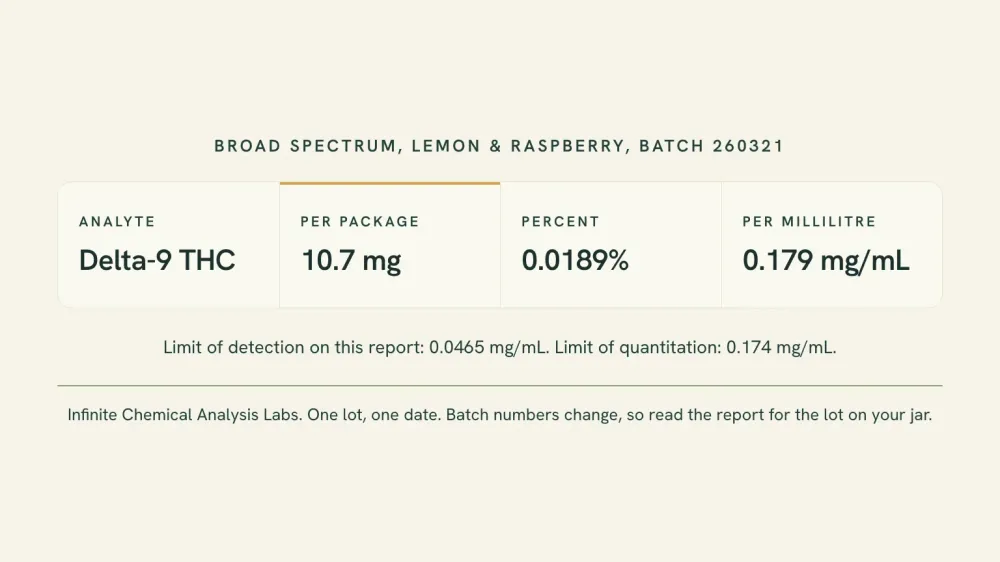
Planntz sells tinctures and no gummies, and our Broad Spectrum line prints that same spectrum word on all three flavors. Three batches, analysed by Infinite Chemical Analysis Labs in San Diego, do not all come back the same. Mango & Peach, batch 260320, reports delta-9 THC as non-detected and total THC as 0.000 mg per package. Natural, batch 260319, reports the same. Lemon & Raspberry, batch 260321, prints 10.7 mg of delta-9 THC per package, which the same report also states as 0.0189% and as 0.179 mg/mL. Same brand, same word on the front of the bottle, and one row out of three that does not agree with the other two.
| Batch | Product | Delta-9 THC on the certificate | Total THC on the certificate |
|---|---|---|---|
| 260320 | Broad Spectrum, Mango & Peach | Non-detected | 0.000 mg per package |
| 260319 | Broad Spectrum, Natural | Non-detected | 0.000 mg per package |
| 260321 | Broad Spectrum, Lemon & Raspberry | 10.7 mg per package, 0.0189%, 0.179 mg/mL | 10.7 mg per package |
That is one brand's evidence, so here is somebody else's. In the 2024 analysis above, only 68% of products sold as broad-spectrum met the definition of the product type printed on their own package, three broad-spectrum products contained THC, and two of those three were above 0.3%. The isolate figure in the same study was lower still. So the sentence page one repeats is not a small overstatement, it is a category error: a spectrum word describes an intention at the extraction stage, and a certificate describes a measurement on a finished lot. Which spectrum to buy when testing matters is a real decision with real trade-offs, and it is argued out properly in our guide to CBD and drug tests; this page is only here to retire the promise. And note what a non-detected row is and is not. It says an instrument did not find the compound down to that report's own detection limit, in that batch, on that day. What ND, LOD and LOQ actually mean is worth five minutes on our guide to reading a certificate of analysis. It is not a guarantee about you, and nothing on a certificate ever will be.
What the screen is actually looking for
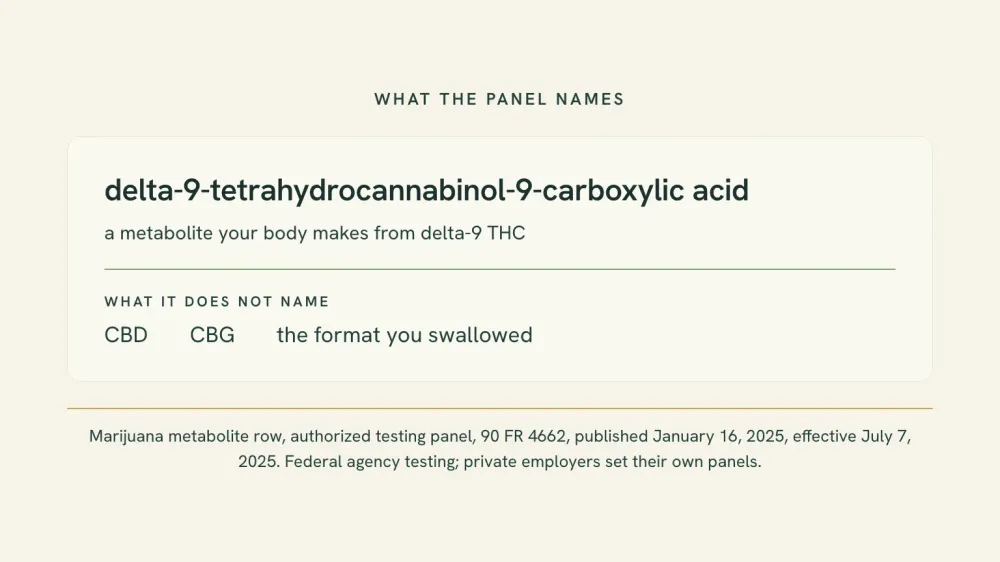
A federal workplace urine test does not look for THC as a category, and it does not look for CBD, for CBG, or for a gummy. It names one analyte: delta-9-tetrahydrocannabinol-9-carboxylic acid, a metabolite your body makes from delta-9 THC. The authorized testing panel HHS published at 90 FR 4662, on January 16, 2025 and effective July 7, 2025, carries it on the marijuana metabolite row, and the same rule changed the agency's own abbreviation for it, explaining that including the delta-9 designation distinguishes it from other compounds and naming delta-8-tetrahydrocannabinol-9-carboxylic acid and delta-8-tetrahydrocannabinol as the examples. That is a description of a procedure, not a prediction about a person. It binds federal agency testing; a private employer sets its own panel.
The closest thing to a human check on CBD itself is small, and it is not about gummies. In a 2020 crossover study in the Journal of Analytical Toxicology, six healthy adults took 100 mg of pure CBD by mouth or by vapor and gave urine before dosing and for five days afterward. Of 218 specimens collected after pure CBD, exactly one screened positive at the lowest of the three screening cutoffs used, and none reached the confirmatory cutoff. When the same volunteers took a CBD-dominant cannabis product that also contained 3.7 mg of delta-9 THC, four specimens confirmed positive. The paper is co-authored by staff of the federal office that administers workplace drug testing. Six people, a single acute dose, and not a gummy: it suggests the delta-9 THC riding along is what moves the number, and it says nothing at all about six weeks of two gummies a night.
Three refusals, said once and without moralising. This page carries no detection-window table, because how long a trace stays detectable depends on dose, frequency, body and cutoff, and flattening those four into a tidy grid manufactures a precision nobody has. Hair, saliva and blood are different matrices with different windows and different rules, and this page does not cover any of them. And two of the pages ranking for this question today publish advice on how to prepare for a test; we are not going to, because there is a better thing to do and it is the next section. If a result is ever disputed, the person whose job it is to review it is called a Medical Review Officer, and how a panel behaves toward related molecules and what an officer can and cannot accept are set out in our page on delta-8 and workplace panels.
The jar-to-COA check, in seven steps
This is the part that survives every product on the shelf, including the ones invented after this article was published. It takes about five minutes the first time and about ninety seconds after that, and it replaces a promise with a number you can read yourself.
- 1Find the lot or batch number printed on the jar itself, not the one featured on the website. A website shows you a certificate. The jar tells you which certificate applies to the candy in your hand.
- 2Find the certificate for that lot. A single certificate covering a brand, or a whole product line, rather than a batch, is a marketing asset and not a batch report.
- 3Read the delta-9 THC row and the total THC row in milligrams, per package or per serving, not only in percent. A percentage hides its denominator. Milligrams do not.
- 4Divide the per-package milligrams by the number of pieces the label says are in the jar. That is your milligrams per piece. Multiply it by how many you actually take in a day. That is the number this whole question was about.
- 5Check that the report names a laboratory, carries a date, and describes the sample as the finished product rather than the extract that went into it.
- 6If the THC row reads ND, find the report's own detection limit before you read it as zero. Non-detected describes what an instrument could see, not a certainty that there is none.
- 7If you cannot complete steps 1 to 3, stop. You have learned something real about that product's transparency. You have learned nothing at all about your test result.
Ours is the worked example because it is the one we can put in front of you. Every Planntz certificate prints delta-9 THC three ways: in milligrams per package, as a percentage, and as a concentration, which the reports give per millilitre or per gram depending on the batch, with the detection and quantitation limits beside it. The full set sits on our published lab results. Batch 260321 is the honest one to practice on: 10.7 mg per package, 0.0189%, 0.179 mg/mL, against a delta-9 detection limit of 0.0465 mg/mL on that same report. Which of those numbers matters to you depends entirely on what you are dividing by, which is the whole reason a gummy jar's piece count belongs in the arithmetic.
What this page cannot tell you
No controlled human study has ever given people CBD gummies and then collected their urine. That sentence is the honest floor under everything above it, and it appears on none of the page-one results we were able to read on September 5, 2026. The two closest experiments in the record are both on this page: a hemp food dose ladder in 15 adults from 2001, and an acute pure-CBD study in six adults from 2020. Neither used a gummy. Neither ran for the weeks that a nightly habit runs. Anybody telling you how many gummies it takes is extrapolating from one of those two, or from nothing.
Every product survey here is a snapshot with a purchase date attached. The 56-gummy analysis covers one buying window and does not name its brands. The 202-product analysis bought online between October and December 2021 and tested one sample per product. The hemp delta-9 survey ordered in April 2022. None of them tested a Planntz batch, and among the work cited here, one exploratory sub-analysis of ten products is the only place where anyone opened a bottle and compared its contents to each other. One disclosure, offered as a fact rather than as an argument: Planntz does not sell gummies, and nothing in that absence makes a tincture safer for a test.
Four things this page deliberately does not publish, with the reason in each case:
- A wait time, a taper or a schedule of any kind. Nothing in this literature supports one, and a number invented on a page like this one could cost somebody a job.
- A detection-window table. What stays detectable depends on dose, frequency, product and cutoff, and a grid flattens all four into a precision that nobody has measured for gummies.
- Any sentence you could hand to an employer as a defense. This is a guide to reading a label. It is not a document that speaks for you, and it should not be used as one.
- A promise about isolate. Lower is not the same as none, and no product category can guarantee a drug-test outcome, that one included.
No page can answer that, including this one, and any page that gives you a clean yes or no is guessing. What can be answered is what goes into the question. A workplace urine screen names one analyte, a delta-9 THC metabolite, and CBD is not it. The risk comes from delta-9 THC that is in the gummy, and how much that is depends on the batch. In a 2025 laboratory analysis of 56 CBD gummy products, 39% contained delta-9 THC, from 0.019 to 0.88 mg per gummy. The way to find your own number is the THC row on the certificate for the lot printed on your jar.
This is the question everyone asks, and it cannot be answered as a count of gummies, because a gummy is not a unit of THC. Two gummies from one jar and two from another are not the same input, and no controlled study has ever dosed people with gummies and measured their urine. The answerable version is milligrams of delta-9 THC per day: milligrams per gummy from the certificate, multiplied by how many you actually take. If the certificate does not give you that number, the honest conclusion is that the product will not tell you, not that the answer is zero.
Lower is not the same as none, and a word on a label is not a measurement. In a 2024 analysis of 202 products, only 68% of the items sold as broad-spectrum met the definition printed on their own package, three broad-spectrum products contained THC and two of those were above 0.3%. Our own line makes the same point without leaving the building: three Broad Spectrum batches, two reporting non-detected delta-9 THC and one reporting 10.7 mg per package. Which spectrum to buy when testing matters is a real decision, and it has its own page.
Not to the instrument. The screen looks for the same metabolite whatever shape you swallowed. The difference sits upstream of the laboratory. An oil is labelled in milligrams per millilitre and you choose the dose drop by drop; a gummy is labelled in milligrams per piece and someone else chose it. One exploratory analysis of ten products even found gummies inside the same bottle varying by up to 23.5% in delta-9 THC, so the fixed dose unit is not always as fixed as the label suggests.
No. A number on the front of a jar is a claim. A row on a batch report is a measurement, made by an instrument with a stated detection limit, on a specific lot, on a specific date. Non-detected means the instrument did not find the compound down to that limit, which is a different sentence from there being none. It is also worth checking that the report covers the finished product rather than the extract that went into it, because those can differ.
Different products, sold next to each other and often described with the same word. Hemp-derived delta-9 gummies are built to deliver an intoxicating dose while staying inside the federal ratio, and in one 2022 sample of 53 such products, 38 were gummies. Delta-8 has its own metabolite and its own confirmation problem, which is a separate topic with a separate page. The order of operations is the same in all three cases: read the front of the jar for the cannabinoid, then read the batch certificate for the milligrams.
If you take one thing from this page, take the arithmetic rather than the reassurance. Find the lot number on the jar, find the certificate for that lot, read the delta-9 THC row in milligrams, divide by the pieces in the jar, and multiply by your day. Our own certificates, including batch 260321, which makes the awkward point rather than the flattering one, are on our lab results page. The decision that sits above all of this, which spectrum to buy when a test matters, is worked through in our evergreen guide to CBD and drug testing.
Writing about hemp, wellness and the small rituals that keep us balanced.