Pectin vs Gelatin Gummies: What the Gelling Agent Changes
Pectin and gelatin are the two main ways a gummy holds its shape. Here is what that choice changes for heat, texture, storage and the label, the gel numbers behind it, and a five-step check for your own jar.
Pectin vs gelatin gummies differ in one ingredient: the gelling agent that holds each piece together. Gelatin is an animal protein that sets as it cools and loosens again with warmth. Pectin comes from citrus peel, apple pomace or beet pulp and sets by chemistry, with acid and sugar or with calcium. That changes how a gummy handles heat, how it chews and what its label tells you. On the human evidence we found, it does not change how fast or how strongly a gummy works.
If you are still choosing between a dropper and a chewable, our comparison of CBD oil and gummies as formats covers that decision. This page is for the moment you hold a jar and want to know what one word on the ingredient line changes: the gel numbers behind the heat question, what federal labeling rules require, what dose studies did and did not measure, and a five-step check. Everything here is food science and labeling, not a claim about what any gummy does for your health.
What a gelling agent does, and the other three options
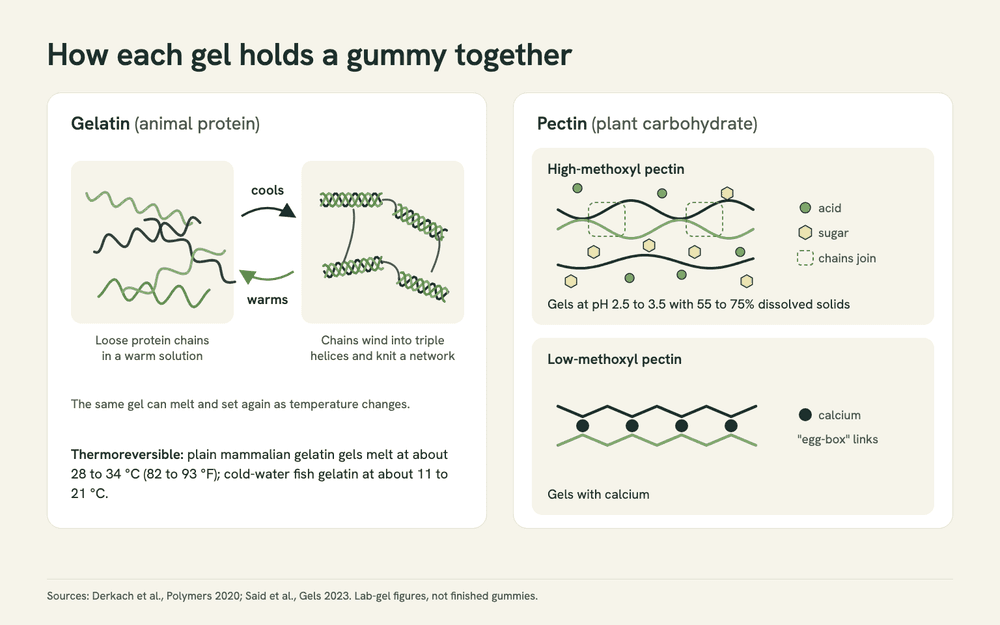
A gummy is mostly sugar and water; the gelling agent turns that syrup into a piece that keeps its shape. Gelatin, a protein made from animal collagen, does it physically: as a warm solution cools, its chains wind into helices that knit into what a 2020 review of mammalian and fish gelatin calls "a thermo-reversible viscoelastic hydrogel", a gel that melts when warmed and sets again when cooled. Pectin does it chemically. A 2023 review of how pectin gels form explains that the common high-methoxyl type gels at low pH (around 2.5 to 3.5) with 55 to 75% soluble solids such as sugar, while low-methoxyl pectin gels with calcium. These are the five gelling agents you are most likely to see on a gummy label.
| Gelling agent | Source | Federal food record | Worth knowing for gummies |
|---|---|---|---|
| Gelatin | Animal collagen: mammal (such as pig or cattle) or fish | 1975 outside-expert review (SCOGS report 58); no 21 CFR 184 listing | Plain lab gels melt below body temperature; tasters can tell it apart by texture |
| Pectin | Citrus peel, apple pomace or beet pulp | Affirmed GRAS in 1983, 21 CFR 184.1588 | Sets with acid and sugar (high-methoxyl) or calcium (low-methoxyl) |
| Agar | Red algae | Affirmed GRAS, 21 CFR 184.1115 | Capped at 1.2% of a soft candy |
| Carrageenan | Red seaweed | Food additive, 21 CFR 172.620 (not a GRAS affirmation) | Failed to hold shape in one lab's 3D-printed CBD gummy trials |
| Starch | Plants; often listed as modified starch | Not reviewed for this page | Feels different from gelatin; failed in the same 3D-printing trials |
FDA's 1983 rule affirming pectins as generally recognized as safe says pectin "is produced commercially by extracting citrus peel, apple pomace, or beet pulp" and allows it "with no limitation other than current good manufacturing practice". Gelatin has no listing in that part of the rules; its safety review is report 58 in FDA's database of the Select Committee on GRAS Substances (SCOGS), a 1975 conclusion FDA notes was made "by scientific experts outside of FDA". Agar, from red algae, is capped at 1.2% in soft candy, and carrageenan, from red seaweed, is regulated as a food additive. None of this makes a CBD gummy FDA-approved: these records cover the gelling agent as a food ingredient, and FDA's position is that CBD is excluded from foods and dietary supplements. The 3D-printing trials come from a 2025 lab study of a gelatin CBD gummy, where batches made with xanthan gum, pregelatinized starch or carrageenan "lacked the desired dimensional integrity".
Pectin vs gelatin gummies, side by side
| Question | Gelatin | Pectin |
|---|---|---|
| How it sets | Cools into a gel; warming undoes it | Acid plus 55 to 75% dissolved solids (high-methoxyl), or calcium (low-methoxyl) |
| Melts near body temperature? | Yes, in plain lab gels: about 28 to 34 °C for mammalian, lower for cold-water fish | Not by the same mechanism; no vetted melting figure for a pectin gummy |
| In a hot bag or mailbox | Softens; pieces can stick together | A supplier says it "may hold up better"; no figure published |
| Texture | Chewy and elastic | "Cleaner, shorter bite, with no chewiness" (CP Kelco, 2014) |
| What the label must say | "Gelatin", by common name | "Pectin", by common name |
| What the label may not tell you | Which animal; how much, if in a 2%-or-less group | How much, if in a 2%-or-less group |
Texture is the difference you notice first, and it is measurable. When 15 tasters sorted 13 commercial gummy-style candies by feel, they split them into gelatin and non-gelatin groups, and the lab traced the difference to a small amount of gelatin's triple-helix structure, about 3 joules per gram. Modified starch and pectin, the authors wrote, "impart different sensory characteristics than gelatin". In a 2014 trade article for supplement makers, a CP Kelco technical manager was blunter: "With pectin, one gets a much cleaner, shorter bite, with no chewiness and no elasticity." One row matters most to some readers: the label only has to say "gelatin", not which animal, and our guide to whether a CBD product can be halal explains how certification answers that.
Heat and shipping: why gelatin softens and what a melted jar means
Gelatin's melting is a feature in candy: it is why a gelatin gummy melts in your mouth. In plain lab gels of 6.67 to 10% gelatin, the 2020 review puts mammalian gelatin's melting point at roughly 28 to 34 °C (82 to 93 °F), below body temperature, and cold-water fish gelatin lower still, around 11 to 21 °C (52 to 70 °F). A finished gummy carries far more sugar than those lab gels, so its softening point is not these numbers, but the direction holds. Pectin is not built on that mechanism. In the 2014 trade article, the CP Kelco manager said pectin's melting point is higher than gelatin's, and the article added that in hot countries or stores without air conditioning, pectin gummies "may hold up better" than gelatin ones, which "may risk sticking together". That is a comparison, not a promise that pectin cannot soften, and we found no published melting figure for a pectin gummy.
The 2025 3D-printing study shows the same behavior in an actual CBD gummy. Its gelatin mix was prepared at 80 °C (176 °F) and printed at 38 °C (100 °F), and in a dissolution test the gummies softened at 37 °C and dissolved completely in under an hour in acidic and near-neutral buffers (pH 1.2 and 6.8). That is a beaker, not a person, and the study had no pectin arm, but it shows a gelatin gummy built to give way at about body temperature. Chocolate edibles face their own version of this problem, covered in our piece on how chocolate edibles deal with heat and bloom.
Moisture, stickiness and shelf life
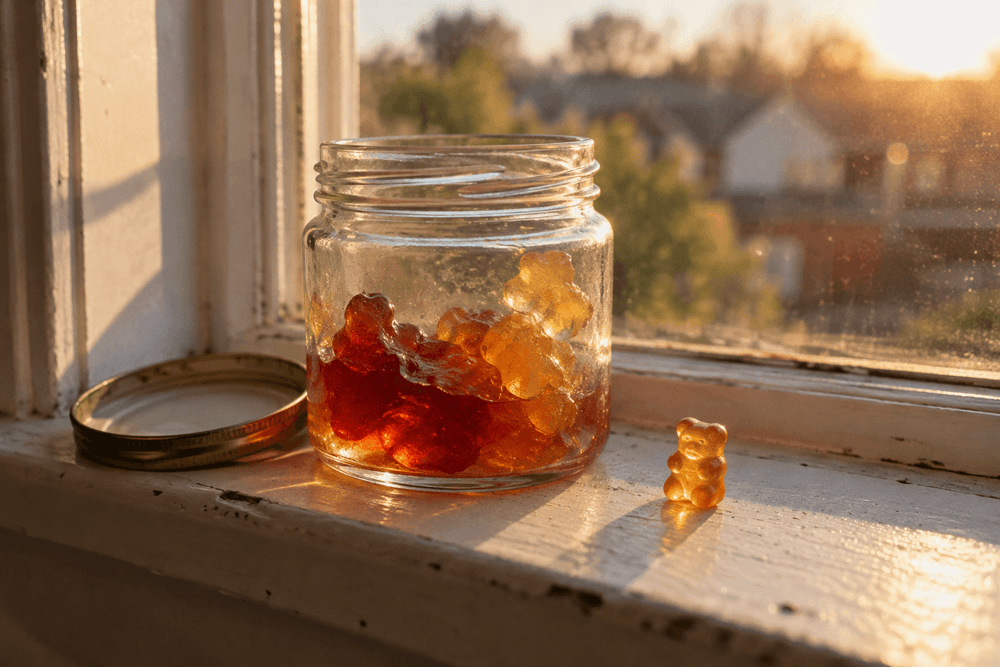
Heat is half the storage story; water is the other half. In pectin gels, sugar works partly by reducing the water available, and any sugar-rich piece can pick up or lose moisture from the air. Industry guides written for brand owners describe gelatin pieces that "sweat" and turn sticky and pectin pieces that dry out and crack; those are trade descriptions, not measurements, and we found no published shelf-life data comparing the two gels. The habits that protect a jar are the same either way, and they follow the logic of our guide to how long CBD oil lasts and how to store it:
- Keep the lid closed between uses, so the pieces are not trading moisture with room air.
- Store the jar somewhere cool and dry, away from windowsills, stoves, dishwashers and sunny shelves.
- Keep gummies out of a parked car, a beach bag or a summer mailbox, especially when the ingredient line says gelatin.
- Follow the label's storage line, and note the best-by date and batch number when you open the jar so you can match it to its lab report.
Can every piece carry the same dose?
Making a gummy means mixing an active ingredient into a hot, sticky mass and depositing it into hundreds of molds, each supposed to come out the same. For CBD, the mass is usually gelatin: a 2026 review of CBD in dietary supplements says CBD gummies "typically contain gelatine as a gelling agent" and that in that matrix "CBD is often dispersed rather than fully dissolved". Testing the finished piece is hard too: a 2023 analytical chemistry paper on cannabinoid edibles says matrices containing "sugars, fats, lipids, and carbohydrates" need "highly nuanced methods that must be developed for each matrix type". In September 2026, scientists in FDA's Human Foods Program published a Perspective on gummy dietary supplement manufacturing and testing, the authors' professional view rather than agency guidance. Its abstract sums up the problem:
“...gummy dietary supplements present various challenges in formulations, manufacturing, and analytical testing.”
The paper covers supplements in general, not CBD, and we read only its abstract, so we attribute nothing more to it. Measured data show why consistency matters. In a 2015 JAMA analysis of 75 edibles from three US cities, only 17% held THC within 10% of the label; 60% held less than stated and 23% held more, as our guide to what a 10 mg edible really contains explains. In a 2025 survey of 56 CBD gummy products, 70% of gummies missed the labeled dose by more than 10%, and in an exploratory look at 10 products, CBD varied from gummy to gummy in the same bottle (coefficient of variation 2.1 to 27.1%); our piece on CBD gummies and drug tests covers its THC findings. None of these studies recorded the gelling agent, so none of this variability can be pinned on pectin or gelatin. What you can check is your batch's lab report, using our walkthrough of how to read a certificate of analysis.
Does pectin or gelatin change how fast or how strong it feels?
This is where seller pages get ahead of the evidence. When we searched PubMed on October 22, 2026, pairing cannabinoid terms with gummy or edible terms and with pectin, gelatin, pharmacokinetic or clinical-trial terms, and checking every hit by title, we found no human study comparing cannabinoid absorption from pectin and gelatin gummies. The closest human record is a 2025 randomized crossover trial of a turmeric preparation given in capsules, drinks, a bar, an oat milk and pectin gummies: the gummy was bioequivalent to the capsule, while the oat milk raised dose-normalized exposure (AUC) by 76%. Three limits keep it from settling anything here: the active was turmeric, not a cannabinoid; there was no gelatin arm; and every author was affiliated with Givaudan. The beaker result above does not answer the question either, because dissolving in a buffer is not absorption in a person. Onset depends on far more than the gel, as our explainer on why edibles take so long to kick in shows.
What the ingredient line must tell you, and what it doesn't
Under 21 CFR 101.4, FDA's ingredient-listing rule, ingredients are listed by their common or usual name, in descending order of predominance by weight, and on a supplement panel non-dietary ingredients such as "excipients, fillers, artificial colors, artificial sweeteners, flavors, or binders" must still be listed, usually under "Other ingredients". That is where a gelling agent tends to sit. CBD's own status under these rules is contested, so treat them as the format most gummies follow, not as proof that any product is compliant. Our guide to reading a CBD product label covers the rest of the panel. For the gelling agent, four points:
- It appears by its common name: pectin, gelatin, agar or carrageenan.
- Its position usually shows how much there is relative to other ingredients, because the list runs from most to least by weight.
- Except in the 2% group: ingredients at 2% or less by weight may sit at the end after a phrase such as "Contains 2 percent or less of", where order no longer applies, so a late position may say nothing about how much is in a piece.
- "Gelatin" does not have to name the animal it came from. If that matters to you, ask the maker or look for a certification.
Read your jar: a five-step check
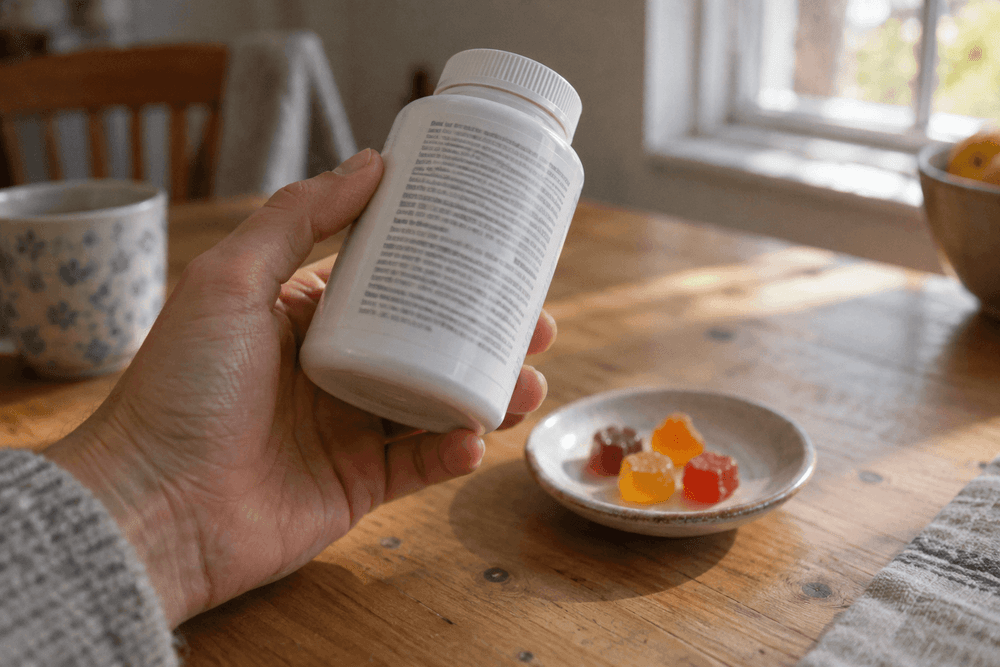
Everything above comes down to a few minutes with the jar in your hand. Run these five steps on any gummy, CBD or not:
- 1Find the gelling agent in the ingredients or under "Other ingredients": pectin, gelatin, agar, carrageenan or starch. Note whether it sits in a "2% or less" group.
- 2Read the storage line. Gelatin is the gel that softens with warmth, so a gelatin jar asks more of you in summer, in a bag or in the mailbox.
- 3Find the per-piece milligrams and the batch COA. The COA should match the batch number on the jar, and it is fair to ask whether the lab tested whole, finished pieces.
- 4Check whether it melted. If pieces fused, the per-piece figure no longer maps to what you break off.
- 5If the gelatin source matters to you, ask the maker. The label does not have to name the animal.
What we still don't know
Three gaps remain as of October 22, 2026. No human study we found compares cannabinoid absorption from pectin and gelatin gummies, so any claim that one works faster or harder is ahead of the evidence. None we found measured what melting and resetting does to an active ingredient. And the label-accuracy studies did not record the gelling agent, so whether either gel makes even dosing easier is unmeasured in the products people buy. We will update this page if that changes.
Frequently asked questions
Neither is better on any published human measure of effect. They differ in source, heat behavior and texture: gelatin is chewy and elastic and melts below body temperature in plain lab gels, while pectin gives a shorter bite and, according to an ingredient supplier, holds up better in heat. If you live somewhere hot or order in summer, that may matter more than texture.
Pectin itself is plant-derived: FDA's rule names citrus peel, apple pomace and beet pulp as its commercial sources. Whether a whole gummy is vegan depends on every other ingredient, so the full ingredient list and a third-party certification answer it. We make no vegan, halal or kosher verdict about any product.
They can soften and fuse. Plain mammalian gelatin gels melt around 28 to 34 °C (82 to 93 °F) in lab tests, and the 2014 trade article notes that gelatin gummies in heat may risk "sticking together (i.e., melting and resolidifying)". Pectin gummies may hold up better, but no published figure says they cannot soften. Keep any gummy out of hot places.
Gummies are sugar-rich gels that pick up or lose moisture from the air, and warmth softens gelatin. Keep the jar closed and store it somewhere cool and dry.
Only if you can still count whole pieces. If they fused into one mass, the per-piece figure no longer maps to what you break off, and we found no study on what melting does to the active itself, so ask the maker or replace the jar.
A coating is made of ingredients, so it belongs on the ingredient list like anything else in the piece; makers often coat gummies in powdered sugar, the 2014 trade article notes. We found no source on whether per-piece figures are measured with the coating on, so ask the maker whether the batch COA tested whole, finished pieces.
The gelling agent is worth knowing, but the numbers that decide what you take are the milligrams in each piece and the batch lab report behind them. For an example of what a per-batch document looks like, browse the certificates on our lab results page. And for the checklist we use for any CBD purchase, whatever the format, see our guide on how to choose a CBD oil you can verify.
Writing about hemp, wellness and the small rituals that keep us balanced.