What Is a Budtender? What They're Trained to Tell You
A budtender is the retail worker behind the counter at a licensed cannabis store. Here is what states require of them, what researchers heard when customers asked for health advice, and which questions the label and COA answer better.
A budtender is the person behind the counter at a licensed cannabis store. If you have ever asked one which product to buy, the more useful question is what that person is trained, and allowed, to tell you.
What is a budtender? A budtender is a retail sales worker at a licensed cannabis dispensary who checks IDs, explains product formats, reads labels with you, keeps each sale within state purchase limits and rings it up. The word blends "bud", the dried cannabis flower, with "bartender". Many states require a worker permit and a background check; fewer require structured training, and that training rarely covers medicine. A budtender is not a pharmacist or a clinician. Their most reliable answers come from the label and the batch lab report, the same documents our guide to choosing a CBD oil is built around.
Most of what ranks for this question is written for people who want the job, or by companies that sell budtender courses. This page is for the person on the other side of the counter. It draws on the state rules that define the job and on peer-reviewed studies, published from 2016 to 2026, in which researchers surveyed dispensary staff or called and visited stores as ordinary customers. The pattern those studies describe is about how the job is set up and trained, not about the honesty or effort of the people doing it.
What is a budtender, and what does the job involve?
Budtenders describe the job in fairly modest terms. In Washington focus groups with budtenders, workers named three parts to the role: giving customers a good experience, following state law, and explaining products. They described themselves as committed to keeping minors out of the store and to helping customers avoid getting more intoxicated than they meant to. Most did not see talking about pregnancy or driving as part of the job. In practice, a shift usually covers these tasks:
- Checking ID so that nobody under the legal age buys.
- Explaining formats: flower, pre-rolls, edibles, vapes, tinctures and topicals, and how they differ in general terms.
- Showing what is in stock and reading the package label with you: serving size, totals per package, packaging and test dates.
- Keeping each sale within the state's purchase limit.
- Running the register under the store's payment rules.
The register side of the job has its own quirks, including why so many stores still take cash only. The person at the counter is also not the same in every kind of store. Some medical programs put a clinician on site by rule: Pennsylvania's medical marijuana dispensary regulations require a physician or pharmacist to be available, in person or by live video, whenever a medical dispensary is open. In adult-use stores, the person helping you is a retail worker. That mix shows up in the research too: in a national survey covered below, 40% of the dispensary staff who answered were budtenders, 32% were managers and 13% were pharmacists.
What states require: permits, background checks and training
Budtenders are regulated, if at all, by the state they work in, and the rules differ more than most people assume. The clearest overview is a 2024 review of budtender rules in the 20 states that then had adult-use stores, which coded each state's rules as of September 2023. It found that 17 states required budtenders to be 21 or older, 16 required background checks, 12 required fingerprints and 13 charged fees ranging from $25 to $300. Only 7 states (Alaska, Illinois, Maryland, Massachusetts, Montana, New Jersey and Oregon) required structured training, and 5 more (Michigan, Missouri, Nevada, New York and Vermont) required employers to provide training. Few state websites said what the training actually covered.
Two states show what a more formal setup looks like. In Oregon, anyone who works for a licensed cannabis retailer needs a state Marijuana Worker Permit: applicants must be 21, pay $100 and pass the same test every worker takes, and a renewed permit lasts five years (permit page read October 2026; the permit rule, OAR 845-025-5500, took effect March 31, 2025). Massachusetts' cannabis establishment regulations, last amended effective November 22, 2024, require every establishment agent to receive at least eight hours of training a year, at least four of them from state-certified Responsible Vendor Training. At a store designated as a responsible vendor, agents who handle or sell adult-use cannabis must complete a Basic Core Curriculum within 90 days of hire.
Colorado is an example of a curriculum without a mandate. Colorado's rule on responsible vendor classes, effective December 1, 2022, says the curriculum must cover the health effects of marijuana use, including the effects in connection with pregnancy and breastfeeding, alongside ID checks and sales limits, and a companion rule sets at least two hours of instruction. The 2024 review did not count that class as mandatory for Colorado budtenders. The pregnancy topic arrived in the curriculum five years after the Colorado mystery-caller study described in the next section.
What researchers heard when they asked for health advice
The best-known study is also the oldest. In June and July 2017, researchers phoned 400 randomly chosen Colorado dispensaries posing as a woman eight weeks pregnant with morning sickness. 277 of them (69%) recommended a cannabis product. Of those 277, 65% based the recommendation on personal opinion (coded when the employee said "in my opinion" or told anecdotes) and 36% said cannabis was safe in pregnancy. Only 31.8% of all 400 suggested talking to a clinician before the caller asked, although 81.5% did at some point in the call. About 9% first said they could not recommend a product and then recommended one anyway. Stores with a medical license recommended a product more often than retail-only stores (83.1% vs 60.4%). About a quarter of the recommendations (26%) were for CBD-only products, which matters if you shop for CBD: the format did not change the advice-quality problem. At the time, the authors wrote, Colorado had no regulations about the advice dispensaries could give.
The same design has been repeated since. In an Arizona mystery-calling study from early 2024, 71.2% of 104 budtenders recommended cannabis for morning sickness; 85.6% encouraged a medical consultation, but only 34.6% did so before being prompted. Between February 2024 and January 2025, callers posing as pregnant customers reached 505 California budtenders. Four in five said smoking blunts (79.6%) or tobacco (79.2%) while pregnant was unsafe, but only 40.4% said the same about cannabis, 20.6% called it safe, 19.8% said they could not give advice and 44.0% suggested a doctor before being asked.
Pregnancy is not the only question researchers asked. In a secret-shopper study of 35 Bay Area dispensaries, with visits made in 2020 and results published in 2025, budtenders steered pain questions toward topicals (77.1%) and sleep questions toward edibles (60.0%). The reasons they gave included their own experience and a sense of which product works best, and the authors point to a lack of evidence behind most of those recommendations. Then, in July and August 2025, mystery shoppers visited 130 licensed stores in Los Angeles, Las Vegas, Denver, Portland and Seattle. Nearly nine in ten staff said cannabis helps with anxiety (88.5%) and insomnia (89.2%). Asked about nausea in pregnancy, 40.8% warned against use and 24.6% said it depends on the person or situation. ID was checked at 87.7% of stores. The authors concluded that retailers "frequently made prohibited health claims and minimized risks". From one state in 2017 to five cities in 2025, the pattern repeats.
| Study | Where, when, how | What the customer asked | What staff said | Main limit |
|---|---|---|---|---|
| Dickson et al., 2018 | Colorado, 400 stores, 2017, phone | Eight weeks pregnant with morning sickness | 69% recommended a product; 31.8% suggested a clinician unprompted | One state, 2017 |
| Madson et al., 2025 | Arizona, 104 budtenders, 2024, phone | Morning sickness | 71.2% recommended cannabis; 34.6% suggested a medical consultation unprompted | One state; 67% response rate |
| Young-Wolff et al., 2025 | California, 505 budtenders, 2024-2025, phone | Pregnant customer | 40.4% said cannabis was unsafe; 20.6% said safe; 44.0% suggested a doctor unprompted | One state; scripted calls |
| Hoang et al., 2025 | Alameda and San Francisco counties, 35 stores, 2020, in person | Pain; sleep | Topicals for pain 77.1%; edibles for sleep 60.0% | Two counties; one visit per store |
| Berg et al., 2026 | 5 US cities, 130 stores, 2025, in person | Anxiety; insomnia; nausea in pregnancy | 88.5% and 89.2% said it helps; 40.8% warned against use in pregnancy | One shopper per store |
These studies are evidence about the quality of advice at the counter, not about cannabis use in pregnancy. For that question, the FDA's consumer update on cannabis and CBD in pregnancy, current as of October 2019, strongly advises against using CBD, THC and marijuana in any form during pregnancy or while breastfeeding. Our page on CBD during pregnancy and breastfeeding covers the evidence and the clinical position, and the person to ask is your own clinician.
Where the advice comes from, and why it varies
One of the first surveys of dispensary staff, published in 2016 in Cannabis and Cannabinoid Research, found that 55% of the 55 respondents had some formal training for the job and 20% had medical or scientific training, yet 94% said they gave customers specific cannabis advice. Asked what their strain recommendations rested on, most of those who answered cited their own experience (71%) and scientific articles (68%), and none said they advised on medications other than cannabis. It was a small, self-selected sample, and three of the authors had consulted for cannabinoid companies. Its conclusion was balanced:
“...many dispensary staff are making recommendations consistent with current evidence, some are recommending cannabis that has either not been shown effective for, or could exacerbate, a patient's condition.”
A larger picture came in 2020. In a national survey of 434 dispensary workers, 74% said they base recommendations on the customer's condition, 70% on other customers' experiences, 63% on their own experience, 61% on employer training and 40% on input from a clinician. 42.2% said they always advise on safe storage and 37.6% always on common side effects, but only 20.3% said they always bring up medication interactions. Asked about customers with medical or psychiatric conditions, staff in the same survey said they preferred to involve the customer's own clinician. Pay structure is part of the setup too: a 2016 survey of 158 California budtenders found 56% had formal training, and trained budtenders were more likely to be paid sales commission (57% vs 16%).
When Harvard researchers interviewed 26 dispensary workers in 13 states, most described their workplace training as unstandardized and weak. Stores often hired for sales skills over knowledge of therapeutics, and nearly half of the workers asked for better, standardized training. Several of those authors had cannabis-industry ties. Most recently, in a 2026 study, 87 budtenders answered three patient scenarios (chronic pain, pregnancy with insomnia, PTSD) and had their advice scored against seven cannabis clinicians. Average agreement was 2.75 on a scale where the clinicians scored 5. Budtenders who scored higher on a cannabis knowledge test agreed more; holding a cannabis-related degree made no measurable difference.
Put together, the studies describe a retail job that routinely receives health questions without a shared standard for answering them. Plenty of budtenders cover storage and side effects, tell pregnant callers that smoking is unsafe and send people to a doctor. What varies is the training and the rules behind them, and that is something you can work around as a customer.
What a budtender can tell you well, and what to take elsewhere
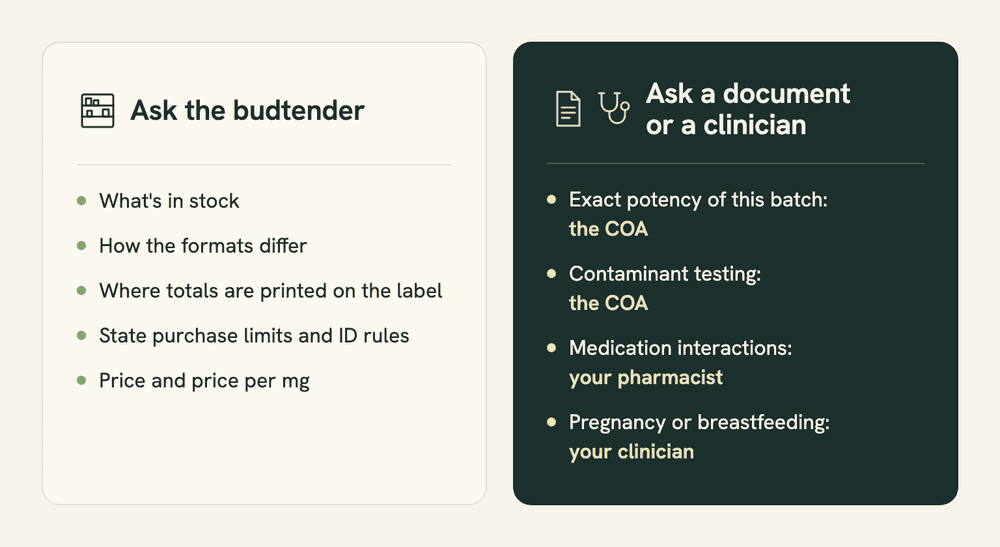
A budtender knows the store: what is on the shelf, how the formats differ in practice, how this store's labels are laid out and what the state lets you buy in one visit. That is real, useful knowledge, and it is worth asking for. Questions about your body, your medications or a medical condition belong with someone else. Medication questions go to your pharmacist, who can see everything else you take; our page on CBD and medications explains why some combinations need that check. No one in a store can tell you a product is approved to treat anything: the FDA has approved one CBD drug and has concluded that CBD products fall outside the definition of a dietary supplement.
Rules on health claims mostly target advertising, not conversation. Massachusetts bars stores from advertising curative or therapeutic effects unless they are supported by substantial evidence, and the researchers behind the five-city audit, coding state rules as of August 2025, found that Colorado, Oregon and Washington restrict health claims in cannabis advertising. Those rules were written for ads, not for what a clerk says at the counter. If you are new to cannabis altogether, our guide to what to expect the first time covers the basics a counter conversation tends to skip.
| Ask the budtender | Take it elsewhere |
|---|---|
| What is in stock in a given format and strength | Whether it is safe with your medication: your pharmacist |
| How flower, edibles, vapes, tinctures and topicals differ in general terms | Whether to use it while pregnant or breastfeeding: your clinician |
| Where serving size and per-package totals are printed on this store's labels | Whether it treats a condition: no retail worker can say that |
| The state purchase limit and ID rules | The exact potency and contaminant results for this batch: the COA |
| Price, and price per mg of the cannabinoid you want | Whether you will pass a drug test: no one can guarantee a result |
| The store's return and exchange policy | Whether a product suits a health condition you have: your clinician |
Questions to ask at the counter, and the document that answers each
The fastest way to get good information at any counter is to ask questions that have written answers. Each question below points to a document, or a person, that can answer it precisely. A good budtender will usually help you find the answer on the package or pull up the lab report.
| Ask | What answers it | What to check |
|---|---|---|
| What is the total THC or CBD per package, and per serving? | The label | Both numbers in mg, and how many servings the package holds |
| Can I see the COA for this batch? | The certificate of analysis | The batch number on the COA matches the one on the package |
| Was it tested for contaminants, and by which lab? | The COA's contaminant panels | Pesticides, heavy metals, residual solvents and microbes, with a named lab |
| When was it packaged and tested? | The label and the COA | Dates that are recent and consistent with each other |
| Will this interact with my medication? | Your pharmacist | Bring the full list of what you take, including supplements |
| Is this OK while pregnant or breastfeeding? | Your clinician | A conversation before you buy, not after |
| What is your return or exchange policy? | The store | Whether opened products can be returned at all |
For the label questions, our explainer on what a 10 mg edible actually contains walks through per-serving and per-package totals, and our look at whether THC percentage tells you much on its own covers the number most labels lead with. For the COA, start with how to read a certificate of analysis, and see what "third-party tested" should mean before you take the phrase at face value.
Red flags in budtender advice
Most counter conversations are routine. The lines below are worth a pause, whoever says them, because each goes past what any retail worker can know or promise. Product-side signals, such as how flower looks and smells, are a separate check covered in our guide to what good weed looks like.
- "This will cure or treat your condition." No product on a dispensary shelf is approved to treat a condition.
- "It's safe while you're pregnant." That is a question for your clinician, not the counter.
- "You won't fail a drug test." No one can guarantee a test result.
- "It won't interact with anything you take." Only a pharmacist who knows your medications can check that.
- No COA is available, or the batch number on the COA does not match the package.
- THC percentage is offered as the only measure of quality.
What it takes to become a budtender: age, permits, training
If you came here for the job, the state rules above are the job requirements. In most adult-use states that means being 21 (Connecticut and Montana set 18, and New York allowed 18 for roles without customer contact), passing a background check, often giving fingerprints and paying a fee of $25 to $300. Oregon's worker permit and Massachusetts' yearly training hours, described above, are the most formal versions.
What you know may matter more than what you hold. In the 2026 scenario study, budtenders' scores on a cannabis knowledge test predicted how closely their advice matched clinicians', while a cannabis-related degree did not. Pay figures you see online come from staffing and software companies, not a government survey, so treat them as estimates. And because so few states say what training must cover, the employer's own training program is often what shapes the job.
What this research cannot tell you
- Most studies captured one call or one visit per store, with one employee, so they show what a customer might hear, not store policy.
- Each covers one state or a few cities, between 2016 and 2025. Rules and training have changed in some states since.
- The staff surveys (2016 and 2020) rely on self-report and on who chose to answer.
- None measured what customers did after the conversation, or whether they were harmed or helped.
- Almost all studied licensed THC dispensaries, not hemp CBD shops, so the findings do not describe the CBD industry as a whole.
Frequently asked questions
A budtender is a retail worker at a licensed cannabis store who checks ID, explains product formats, reads labels with customers, keeps each sale within state purchase limits and runs checkout. In Washington focus groups, budtenders described the role as customer experience, following state law and product education. They are not clinicians, and most did not see pregnancy or driving advice as part of the job.
Usually not. In a 2016 survey of 55 dispensary staff, 20% reported medical or scientific training. A 2024 review found that, as of September 2023, only 7 of the 20 adult-use states required structured budtender training, and few state websites said what it covered. Some medical programs are different: Pennsylvania requires a physician or pharmacist to be available whenever a medical dispensary is open.
Many do offer health-related advice. In a 2025 audit of 130 stores, nearly nine in ten staff said cannabis helps with anxiety and with insomnia. But no retail worker is a substitute for a clinician, and state rules on health claims mostly cover advertising, not conversation. Take medication questions to your pharmacist and pregnancy or breastfeeding questions to your clinician, and use the budtender for products, labels and store rules.
It depends on the state. As of September 2023, 16 of the 20 adult-use states required a background check, 12 required fingerprints and 13 charged fees from $25 to $300. Oregon, for example, requires every worker at a licensed retailer to hold a state Marijuana Worker Permit: applicants must be 21, pay $100 and pass a test, and a renewed permit lasts five years.
Ask questions with written answers. What is the total THC or CBD per package and per serving? Can I see the COA for this batch, and does its batch number match the package? Was it tested for contaminants, and by which lab? When was it packaged and tested? Take questions about your medications to a pharmacist and questions about pregnancy or breastfeeding to your clinician.
Tipping is a custom, not a requirement. We found no state rule that requires it and no survey of typical amounts, so any percentage you see online is one store's or one company's opinion. If a budtender spent real time helping you, a tip is a kind gesture, but nothing about the sale depends on it.
In most states, 21. As of September 2023, 17 of the 20 adult-use states set the minimum age at 21; Connecticut and Montana set it at 18, and New York allowed 18-year-olds in roles without customer contact. Rules change, so check your own state's regulator.
The most reliable advice at any counter is printed on the package and in the batch lab report. Whether you buy at a dispensary or online, our CBD oil buyer's checklist turns those documents into a short set of checks you can use anywhere.
Writing about hemp, wellness and the small rituals that keep us balanced.