
Why Do Edibles Take So Long to Kick In? The Measured Clock
Edibles are slow because swallowed THC has to pass through your stomach, gut and liver first. Here is the measured timeline from controlled studies, what really changes it, how long effects last, and why taking more while you wait is the classic mistake.

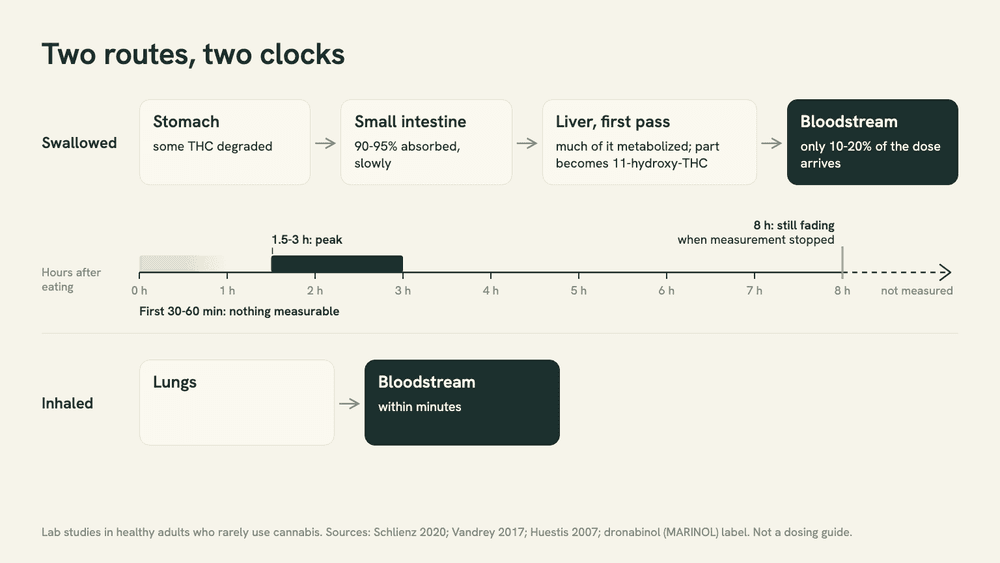
You ate an edible, an hour has gone by, and you feel nothing. That is not a dud. It is the route, and the route is why edibles take so long to kick in. In controlled studies of adults who rarely use cannabis, nothing measurable happened for 30 to 60 minutes after a THC brownie, effects peaked between 1.5 and 3 hours, and in one of those studies they were still fading 8 hours later, when the researchers stopped measuring. The one thing that reliably turns that wait into a bad night is taking more before the first amount has arrived.
The short answer to why edibles take so long to kick in: swallowed THC has to leave your stomach, cross the wall of your small intestine and pass through your liver before it reaches the rest of your body. Smoked or vaped THC goes from the lungs into the blood in minutes. This page lays out the measured clock from controlled studies rather than dispensary rules of thumb, explains each step of the delay, separates what genuinely shifts the timing from what is folklore, and covers how long an edible high lasts. It is written for adults 21 and over. It gives no amount to take and no tips to make an edible hit faster. One disclosure: Planntz sells a tablet that contains delta-9 THC, and nothing here is a timing or effect claim for it. If your question is about CBD rather than THC, how long CBD takes to work has its own page.
How long do edibles take to kick in? The measured timeline
The best measurements come from controlled lab studies, and most of them come from one group at Johns Hopkins. In a double-blind, placebo-controlled study published in Drug and Alcohol Dependence in 2020, 17 healthy adults who had not used cannabis for at least 60 days ate brownies containing different amounts of THC, or none, about an hour after a standard low-fat breakfast. They were assessed for 8 hours. The authors reported that effects "did not manifest until 30-60 min after ingestion, and peak effects occurred 1.5-3 h post-administration." An earlier study from the same group, published in the Journal of Analytical Toxicology in 2017, used 6 people per dose and no placebo arm, and found the same shape: effects began at 30 to 60 minutes, held a plateau from about 90 minutes to 3 hours, and "gradually decreased in severity until the 8-h time point." Eight hours was when observation ended, not when the effects did.
The table below puts those two studies next to four other reference points: the inhaled comparison from a 2018 JAMA Network Open study of smoked and vaporized cannabis run by the same research group, the FDA-approved prescribing label for dronabinol (a prescription capsule of synthetic THC in sesame oil, not an edible), a widely cited 2003 pharmacology review in Clinical Pharmacokinetics, and Health Canada's 2019 consumer information sheet on cannabis. Read it as a set of separate measurements, not one experiment.
| Route and source | First effects | Peak | How long | Who or what |
|---|---|---|---|---|
| Smoked or vaped (Spindle 2018) | Not reported separately | Blood THC and heart rate peaked within 30 minutes | Some effects and impairment up to about 6 hours on average | 17 healthy adults, infrequent users |
| Inhaled (Grotenhermen 2003) | Seconds to a few minutes | 15-30 minutes | Tapers off within 2-3 hours | Narrative review |
| Brownie, placebo-controlled (Schlienz 2020) | 30-60 minutes | 1.5-3 hours | Assessed for 8 hours | 17 adults, no cannabis use for 60+ days |
| Brownie (Vandrey 2017) | 30-60 minutes | Plateau from about 90 minutes to 3 hours | Still fading at 8 hours, when measurement stopped | 6 infrequent users per dose, no placebo |
| Swallowed THC (Grotenhermen 2003) | 30-90 minutes | 2-3 hours | About 4-12 hours, depending on dose and effect | Narrative review |
| Dronabinol capsule (FDA label) | About 30 minutes to 1 hour | 2-4 hours | Psychoactive effects 4-6 hours; appetite effect may last 24 hours or longer | Prescription synthetic THC, not an edible |
| Eaten or drunk cannabis (Health Canada) | 30 minutes to 2 hours | Full effects can take up to 4 hours | Up to 12 hours, some effects up to 24 | Regulator consumer guidance, 2019 |
Two things stand out. First, every source puts the first effects of swallowed THC somewhere between about 30 minutes and 2 hours, and the peak later still. That is the clock the rest of this page explains. Second, the inhaled row is a different kind of clock, not just a faster one: in the 2018 study, blood THC and heart rate returned to baseline within 3 to 4 hours, yet several effects and measurable impairment persisted for up to 6 hours on average. Keep in mind who was studied. These were mostly healthy people who rarely use cannabis, eating lab-made brownies at fixed amounts after a light breakfast. Your kitchen is not a lab, and the next sections explain why your clock can differ from these averages.
Why do edibles take so long to kick in? Stomach, gut wall, liver
A 2007 review in Chemistry & Biodiversity by Marilyn Huestis, then a researcher at the US National Institute on Drug Abuse, lists the reasons swallowed THC arrives late and in small amounts: "variable absorption, degradation of drug in the stomach, and significant first-pass metabolism to active 11-OH-THC and inactive metabolites in the liver." Put in the order your body meets them, there are three steps.
- 1The stomach. An edible has to be broken down and move on from your stomach before much THC can be absorbed, and some THC is degraded there.
- 2The small intestine. Absorption through the gut wall is slow and varies from person to person, but it is thorough: the dronabinol label says 90 to 95% of a swallowed dose is absorbed. The problem is not that THC fails to get in.
- 3The liver. Blood from the gut passes through the liver before it reaches the rest of the body. The liver metabolizes much of the THC on this first pass, so only 10 to 20% of the swallowed dose reaches general circulation, per the label.
The label puts it in one sentence: "Due to the combined effects of first pass hepatic metabolism and high lipid solubility, only 10 to 20% of the administered dose reaches the systemic circulation." The oldest head-to-head numbers point the same way. In a 1980 study in Clinical Pharmacology & Therapeutics, 11 healthy people received THC intravenously, by smoking, and in a chocolate cookie. About 6% of the THC in the cookie reached the bloodstream (plus or minus 3%), against about 18% when smoked (plus or minus 6%), and blood levels after the cookie were "low and irregular, indicating slow and erratic absorption." Once THC is in the blood it also spreads out into the body's tissues: the label gives an apparent volume of distribution of about 10 L/kg, which is pharmacology shorthand for a compound that leaves the bloodstream for fat and other tissues rather than staying in circulation. Inhaled THC skips the stomach, the gut wall and the liver's first pass entirely. It crosses from the lungs into the blood, which is why the inhaled rows in the table are measured in minutes.
That liver step is also why an edible is not simply a slower joint. Because the liver turns part of swallowed THC into an active metabolite, 11-hydroxy-THC, before it ever reaches your brain, an edible delivers a different mix of active compounds than smoking does. One observation from the 1980 study fits that picture: after oral THC, effects "occurred at much lower plasma concentrations" of THC than after smoking or an intravenous dose. What that metabolite is and how the route changes the balance are covered in our explainer on 11-hydroxy-THC, the metabolite your liver makes from swallowed THC. This page sticks to the clock.
Why your timing is not your friend's timing
Averages hide a wide spread. The 2007 NIDA review notes that after swallowed THC, "peak concentrations and time-to-peak concentrations varied sometimes considerably between subjects," and the dronabinol label describes its effects as "subject to great inter-patient variability." The 2017 brownie study shows how far that can go: two participants who ate the lowest-dose brownie never had detectable THC in their blood at any time point. Blood THC below a lab's detection limit is not the same thing as feeling nothing, and it does not mean the edible was inactive. It does mean that "my edible didn't work" can be a real experience, and it is still not a reason to take more in the same session.
Several things feed that spread, and most are poorly measured. Genes are one: the label reports "a potentially 2- to 3-fold higher dronabinol exposure" in people carrying variants that reduce the activity of CYP2C9, a liver enzyme that processes THC (the enzyme story is on the 11-hydroxy-THC page). Tolerance is another: the label notes that tolerance develops "to some of the pharmacologic effects" with chronic use, so a regular user's timing and intensity tell you little about yours. Sex and body composition are open questions. The 2020 study was too small to test sex differences, and in a small Colorado State University study of five store-bought edibles, none of the body composition measures the researchers took were consistently related to how THC moved through the body across all five.
What actually changes the clock: food, format and marketing
Food: later, not lighter
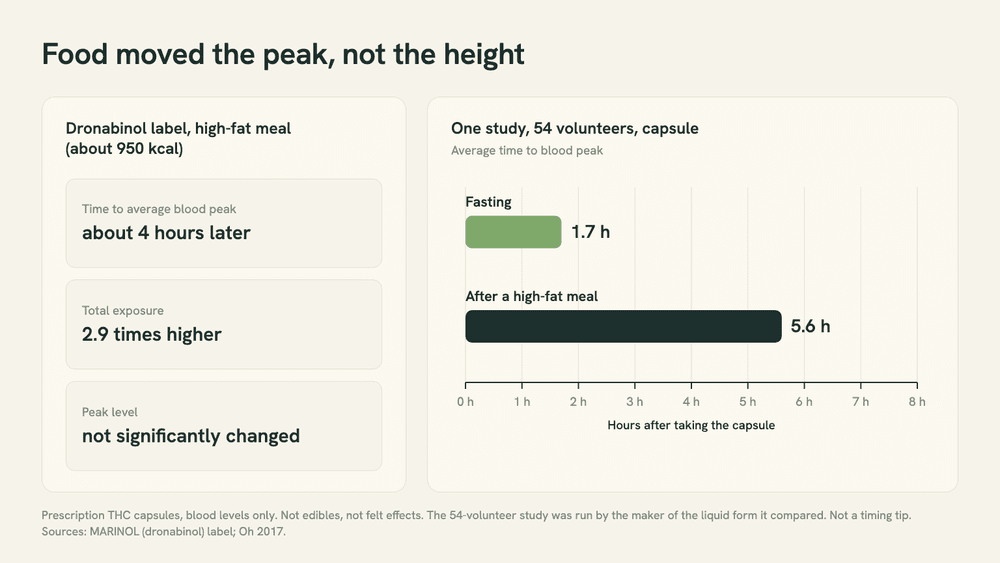
Many seller pages say an empty stomach makes an edible hit faster and harder, and a meal makes it smoother. The controlled data point somewhere else. The dronabinol label reports a food-effect study in which the capsule was taken with a high-fat meal of roughly 950 calories: "An appreciable food effect was observed, resulting in a 4-hour delay in mean Tmax and 2.9-fold increase in total exposure (AUCinf), but Cmax was not significantly changed." In plain terms, the average blood peak arrived about 4 hours later, the total amount of THC the body was exposed to nearly tripled, and the peak level itself did not change significantly. A 2017 study of 54 volunteers in Clinical Pharmacology: Advances and Applications found the same pattern: the average peak came at about 1.7 hours when the capsule was taken fasting and 5.6 hours after a high-fat meal, and food raised exposure about 2.1 to 2.4 fold. Every author of that study worked for INSYS Therapeutics, which made the liquid form it was testing. And in a 12-man study run by GW Pharma, the maker of a THC and CBD mouth spray, food delayed the peak of every compound measured by roughly 2 to 2.5 hours.
The honest reading has two halves. What was measured is blood levels from a pharmaceutical capsule of pure THC in sesame oil, or a spray, not a gummy or a brownie, and not how high anyone felt. No controlled study we found has tested a meal's effect on a consumer edible, and the brownie studies above gave everyone the same light breakfast. Within those limits, the practical meaning points the opposite way from the folklore: after a big, fatty meal, the "nothing is happening" stretch can get longer while the total amount you end up absorbing goes up. That is a reason for more patience after a meal, not a trick for timing. For the CBD side of this question, our look at the food effect for CBD covers the separate studies on that compound.
Holding it in your mouth
"Hold it under your tongue, it's faster" is repeated often and measured rarely. In a randomized, double-blind NIDA study published in Clinical Chemistry in 2011, nine cannabis smokers received either swallowed synthetic THC or a THC and CBD mouth spray designed to be absorbed through the lining of the mouth. The researchers found "no statistically significant differences in Cmax, time to maximum concentration or in the AUC" between similar oral and spray doses. That was a pharmaceutical spray in nine regular users, one co-author worked for the spray's maker, and it says nothing direct about lozenges or tinctures, but it is the closest test available. The 2017 brownie study adds a detail that explains where the belief may come from: THC showed up in participants' saliva almost immediately after they ate, which the authors attributed to "local topical residue" rather than to THC being absorbed into the body. THC in your mouth is not THC in your body.
Drinks, nano and fast-acting labels
Cannabis drinks and edibles sold as "fast-acting" or "nano" are a marketing category with little independent human data behind them. A 2024 critical review of 29 studies on cannabis beverages concluded that it "highlights the paucity and inconsistency of available research," and noted that beverages "also showed inaccurate cannabinoid labeling." The fastest onset figure in it, about 19 minutes, came from 35 survey respondents describing their own experience, not from a blood test. The Colorado State study mentioned above gave seven regular users five different store-bought edibles of the same labeled THC strength and saw blood THC peak anywhere from 35 to 90 minutes, and the edibles differed from each other in the first 20 to 30 minutes. That is seven people, all regular users, with a sugary glucose drink given 30 minutes in, and blood levels rather than how high anyone felt. It shows that formulation can shift the early blood curve. It does not show that any format makes the wait short enough to skip.
How long does an edible high last?
There is no single number, because "how long" depends on what you measure and how much THC was involved. The controlled studies give a floor rather than a ceiling: both Johns Hopkins brownie studies stopped at 8 hours, and in the 2017 study effects were still fading at that point, so 8 hours is when observation ended, not when the high did. The 2003 review puts the total at "about 4-12 hours, depending on dose and specific effect." It helps to think of three overlapping clocks.
- What you feel. In the 2017 brownie study, effects plateaued from about 90 minutes to 3 hours, then gradually eased and were still fading at the 8-hour mark.
- Impairment. It can outlast the obvious feeling. After inhaled cannabis, some impairment lasted up to about 6 hours on average, after blood THC and heart rate had already returned to baseline.
- The long tail. The dronabinol label lists psychoactive effects of 4 to 6 hours but says the appetite effect may continue for 24 hours or longer. Health Canada says effects of eaten cannabis can last up to 12 hours, some up to 24.
Because the tail is long, an edible taken in the evening can still be with you the next morning, which matters for work and for driving. If bedtime is part of your question, our look at what THC does to a night's sleep covers that separately. For comparison, CBD has a different profile, and how long CBD's effects last has its own evidence page.
My edible isn't working. Should I take more?
No. The wait is exactly when edibles go wrong. A 2016 RTI International review of edible cannabis written for policy makers put the problem plainly.
“The most prominent difference between ingestion and inhalation of cannabis extracts is the delayed onset of drug effect with ingestion. Consumers often do not understand this aspect of edible use and may consume a greater than intended amount of drug before the drug has taken effect, often resulting in profoundly adverse effects.”
The authors of the 2020 brownie study made the same point in their discussion: the delayed onset of oral cannabis makes it harder to judge how much you have taken and raises the chance of taking too much, and they singled out people new to cannabis as the group who most need to know it. Health Canada's consumer sheet says it can take up to 4 hours to feel the full effects of eaten or drunk cannabis, and adds: "Consuming more within this time period can result in adverse effects that may require medical attention." That 4-hour figure describes a full-effect window. It is not a timer after which more is fine.
Emergency data show what the delay can cost. A 2019 study in Annals of Internal Medicine reviewed charts at one Colorado hospital and found that from 2014 to 2016, edibles accounted for about 10.7% of emergency visits attributed to cannabis, while making up an estimated 0.32% of the THC sold in the state. Edible visits were more often for intoxication (48% vs 28% of inhaled visits), acute psychiatric symptoms (18% vs 11%) and cardiovascular symptoms (8% vs 3%). The limits matter: it is one hospital looking back at charts, exposure was self-reported, dose data were limited, the 0.32% is the authors' estimate, and the study did not measure whether those patients had taken more while waiting. For the full picture of too-high symptoms and when to call for help, see what to do if you or a friend is too high.

While you wait: a checklist
- Do not take more in the same session, however long it seems to be taking.
- Do not drive, ride a bike or operate anything that can hurt you or others, and do not ride with a driver who has taken THC.
- Do not add alcohol or other substances while you wait.
- Write down the time you ate it and what the package says per piece, so you are not guessing later.
- Stay somewhere familiar, ideally with someone you trust, and keep the rest of the package out of reach of children and pets.
The driving line is not a formality. In the 2020 brownie study, the higher doses produced marked impairment of thinking and physical coordination, and Health Canada tells people not to drive after using cannabis. Our guide to impairment and driving explains why feeling fine is not a reliable test. Alcohol makes the picture worse: in a 2026 driving-simulator study in JAMA Network Open, driving impairment and subjective intoxication were often greater when edibles and alcohol were combined than with either alone, and our page on mixing THC and alcohol, edibles included covers that trial and the combination in depth. If you are pregnant or breastfeeding, the question is not timing at all, and our page on pregnancy and breastfeeding covers what the evidence and medical guidance say.
Read the milligrams before you blame the timing
A lot of "it isn't working" and "it hit way too hard" moments are not about timing. They are about misreading what was on the label. THC edibles can print three different numbers, and each answers a different question. None of them tells you how a given amount will affect you, and whether the number on the label is accurate is a separate question worth reading about.
- Amount per piece or per serving: what one gummy, square or tablet is labeled to contain.
- Amount per package: the total in the whole container, which is the per-piece figure multiplied by the number of pieces.
- A lab report figure: a certificate of analysis measures a sample from the batch, and its total THC line is the lab's formula for adding up THC forms.
The package arithmetic is the one worth doing first: a tin of 40 pieces holds 40 times whatever one piece is labeled to contain, so a per-package number is never the amount in a single piece. Our own Full Spectrum CBD + Delta-9 tablets are a worked case. The tin prints THC per tablet and the tablet count, and the batch certificate reports a measured total THC figure per tablet that sits slightly above the label, which is the gap between the first and third bullets above. The tablets contain THC and are for adults 21 and over. We have no timing data for them, nothing on this page describes how they act, and nothing here suggests an amount of them or of any edible. How a THC tablet label prints its milligrams walks through that certificate line by line.
What the studies cannot tell you yet
- How edibles behave in regular users at real-world amounts. The controlled timing data are mostly infrequent users, lab brownies, fixed doses, a light breakfast and an 8-hour window.
- What a meal does to a consumer edible. The food-effect numbers come from pharmaceutical THC capsules and a mouth spray, measured as blood levels.
- Whether fast-acting, nano or beverage formats reliably shorten the wait. Independent human data are thin, and the beverage onset figure is self-reported.
- How sex, body fat and tolerance change your clock. The studies were too small to say with confidence.
- When an edible high fully ends. The brownie studies stopped measuring at 8 hours, and in the 2017 study effects were still fading.
It is also worth knowing who produced the evidence. The two brownie studies and the 2018 inhaled study come from one research program at Johns Hopkins, with co-authors from the federal office that administers workplace drug testing, and one of the lead researchers has declared consulting for companies working on cannabinoids. Two of the food-effect studies were run by the companies that made the THC oral solution and the mouth spray being tested. None of that makes the findings wrong. It means the picture rests on a small number of groups, and independent replication in real-world users would change how confident anyone can be.
Questions people ask about edible timing
In controlled studies of healthy adults who rarely use cannabis, nothing measurable happened for 30 to 60 minutes after a THC brownie, and effects peaked between 1.5 and 3 hours. Canadian public-health guidance gives a range of 30 minutes to 2 hours for first effects and says full effects can take up to 4 hours. A heavy, fatty meal can push the peak later still.
No. The delay itself is why people take too much: RTI International's review of edibles says consumers may take more than intended before the first amount has taken effect, often with profoundly adverse results. Health Canada warns that taking more before the full effect arrives can lead to effects that need medical attention. No hour figure is a timer for a second round in the same session.
In studies of dronabinol, a prescription THC capsule, the blood peak came hours earlier when it was taken fasting (about 1.7 hours vs 5.6 hours after a high-fat meal in one study), but the meal also raised total exposure 2 to 3 fold. Those were capsules, not edibles, and blood levels, not felt effects. The takeaway is patience after a meal, not a tip.
That has not been established. Gummies, chocolates and brownies that you chew and swallow follow the same route through the stomach and liver. A 2024 review called the research on cannabis drinks sparse and inconsistent, and its fastest onset figure was self-reported by 35 survey respondents. A THC mouth spray did not reach its blood peak faster than swallowed THC in a nine-person NIDA study.
Longer than most people expect. In a controlled brownie study, effects were still fading at 8 hours, when measurement stopped. A 2003 pharmacology review puts the total at about 4 to 12 hours depending on dose and effect, and Health Canada says up to 12 hours, with some effects lasting up to 24. Impairment can outlast the obvious feeling.
Absorption varies a lot between people. In one controlled study, two participants who ate the lowest-dose brownie never had detectable THC in their blood. Tolerance, a large meal that delays the peak, and what the edible actually contains versus its label can all play a part. None of that makes a second helping in the same session a good idea.
Swallowed THC passes through the liver first, which turns part of it into an active metabolite, 11-hydroxy-THC, before it reaches the brain. So an edible delivers a different mix of active compounds than a joint does, on a slower clock. Our 11-hydroxy-THC explainer covers the chemistry and the evidence.
It is possible. The dronabinol label says its appetite effect may continue for 24 hours or longer, and Health Canada says some effects of eaten cannabis can last up to 24 hours. Treat the next morning with the same caution about driving and anything else that needs a clear head.
Keep reading: how to read a label, from serving size to certificate, and what the evidence on CBD actually shows, our hub for evidence-led guides.
Writing about hemp, wellness and the small rituals that keep us balanced.