Inside Our Full Spectrum Tablets: The THC on the Certificate
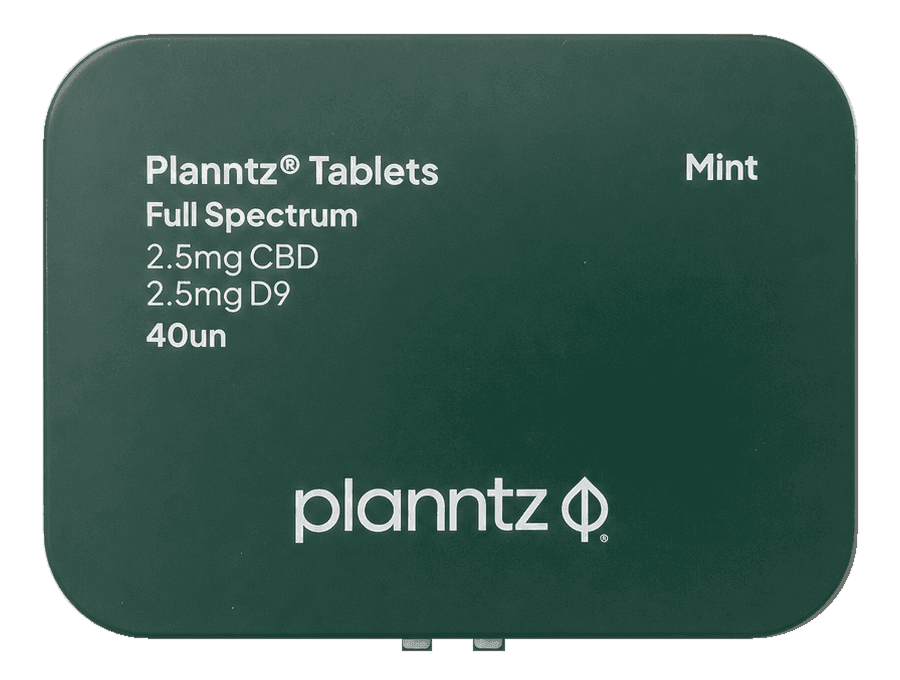
Our Full Spectrum tablets contain THC: each is labeled 2.5 mg of CBD and 2.5 mg of delta-9 THC. It is the first thing we have sold that is not a tincture, so here is its batch 260505 certificate, read row by row, including the parts we would rather not lead with.
We now sell a tablet, and it contains THC. Each one is labeled 2.5 mg of CBD and 2.5 mg of delta-9 THC, forty to a tin, and our product page says it in three words: contains THC. It is the first thing we have sold that is not a tincture, and the first where delta-9 THC is a labeled ingredient with a milligram amount on every unit. This page reads the tablet's certificate of analysis row by row, including the parts we would rather not lead with.
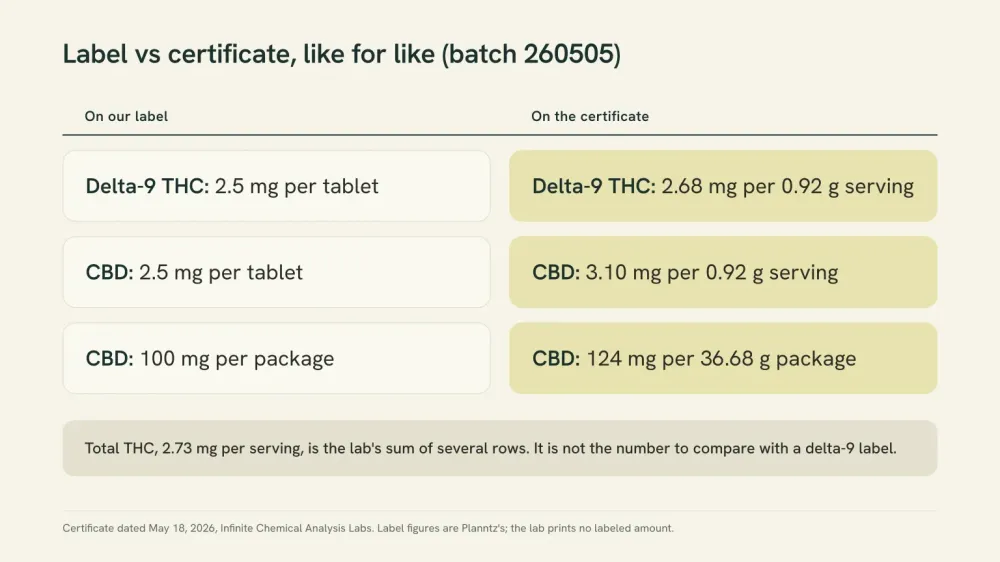
Here is the short answer. On the certificate for batch 260505, dated May 18, 2026, delta-9 THC measured 2.68 mg per serving against 2.5 mg on the label, and CBD measured 3.10 mg per serving against 2.5 mg. The certificate reports potency only, so it tells you how much of each cannabinoid is in the tin and nothing about contaminants. And 2.5 mg of delta-9 THC is not a trace amount. Most of what we have published on this blog was written about tinctures, and a tablet with THC printed on the lid changes how several familiar numbers read. That is why it gets its own page, and why the first section is about who should not take it.
Who should not take this tablet
Start with the people this product is not for. It is intended for adults 21 and older, and even among adults it is not for everyone. If you are drug tested, the answer is simple. The federal workplace drug-testing panels published by HHS look for delta9THCC, the compound your body makes from delta-9 THC, and this tablet contains delta-9 THC by design. If you are tested for work, the military or sport, this is not a product to take. Our guide to CBD and drug tests explains why no brand can promise a result either way, and the page on cannabinoid rules for athletes covers testing in competition.
Driving comes next. The FDA-approved label for dronabinol, a prescription synthetic form of delta-9 THC sold as MARINOL, tells patients: "Do not drive, operate machinery, or do other dangerous activities until you know how MARINOL affects you." That label is about a prescription medicine, and it says nothing about how this tablet affects any particular person. It is still the right floor for any product that contains delta-9 THC by design. Our page on cannabinoids, impairment and driving covers what happens behind the wheel and the per se laws some states apply.
If you are pregnant or breastfeeding, the FDA's consumer update on cannabis and CBD during pregnancy and breastfeeding says: "FDA strongly advises against the use of cannabidiol (CBD), tetrahydrocannabinol (THC), and marijuana in any form during pregnancy or while breastfeeding." That is a recommendation on a page marked content current as of October 16, 2019, and our page on CBD in pregnancy and breastfeeding explains what sits behind it. If you take any prescription medicine, tell the clinician who prescribes it before this tablet goes anywhere near your routine. What to ask about CBD and your medications lists the questions worth bringing to that conversation.
Then there is the tin itself. A mint in a tin is exactly the kind of thing a child reaches for. A 2023 analysis of US poison center data published in Pediatrics counted 7,043 edible cannabis exposures in children under six between 2017 and 2021, rising from 207 in 2017 to 3,054 in 2021. Of those, 97.7% happened in a residential setting, and 22.7% of the children were admitted to hospital. Those are poison center reports rather than a rate of harm, and they concern cannabis edibles in general, not hemp tablets and not this product. They are still the reason the tin belongs somewhere a child cannot reach.
In short, this tablet is not for you if any of these is true:
- You are under 21. The product is intended for adults 21 and older.
- You are drug tested for work, the military or sport. The tablet contains delta-9 THC by design, and no brand can promise a test result.
- You are about to drive, operate machinery or do anything else that needs your full attention.
- You are pregnant or breastfeeding.
- You take a prescription medicine and have not told the clinician who prescribes it.
- There are children in your home and nowhere to keep the tin out of their reach.
A tablet prints THC in a different unit
A tincture label is built around concentration: milligrams of CBD per milliliter of oil. A tablet works the other way round. The lid of this tin reads 2.5mg CBD and 2.5mg D9, where D9 means delta-9 THC, and the unit is the tablet. That is a per-unit milligram amount, set by us and printed on the package. The certificate then reads the same tin four ways: per serving, where a serving is 0.92 g; per package, 36.68 g; as a percentage; and in milligrams per gram. Our guide to reading a CBD label covers how label figures and certificate figures are meant to meet.
Here is why a percentage well below one percent and a milligram figure above the label can both be true of the same tablet. The certificate prints delta-9 THC at 0.291%, writes the same result as 2.91 mg per gram, and defines a serving as 0.92 g of product. Those are one measurement at three scales, not three measurements. Two cautions come with that. First, the certificate says serving and never says tablet; reading one serving as one tablet is our reading of the lab's unit, not the lab's words. Second, a percentage on a mint tablet is not a legal reading. The Tests Taken line lists potency only, with no moisture test, and how percentages relate to milligrams in federal hemp law is its own subject, which our explainer on hemp-derived THC takes apart. We do not draw a verdict from that number, and you should be wary of anyone who reads one off a certificate like this.
Batch 260505, row by row
The certificate for batch 260505 was issued by Infinite Chemical Analysis Labs in San Diego, which holds California license C8-0000047-LIC and classes the sample as an edible solid. Its header reads "Produced: May 18, 2026", and our product page repeats that wording. On this document the sample was collected, received and analyzed that same day, and the lab's CSO and its lab director both certified the results that day, so the date belongs to the certificate: no field on it states when the batch itself was made. The certificate also prints a link to the lab's records system, and the lab's hosted copy of this certificate carries the same numbers. Here are its rows, copied figure for figure. The last column is ours: the lab's record leaves the labeled-amount field blank for every row, so the label figures come from us, not from the lab.
| Row on the certificate | Per serving (0.92 g) | Per package (36.68 g) | Percent (%) | What to know |
|---|---|---|---|---|
| CBD | 3.10 mg | 124 mg | 0.337% ± 0.00333% | Our label: 2.5 mg per tablet, 100 mg per package |
| Delta-9 THC | 2.68 mg | 107 mg | 0.291% ± 0.00304% | Our label: 2.5 mg per tablet. This is the row the label describes |
| Delta-8 THC | 0.0550 mg | 2.19 mg | 0.00598% ± 0.0000487% | An analytical row, counted inside total THC. Not a labeled ingredient |
| Total THC | 2.73 mg | 109 mg | 0.297% ± 0.00309% | The lab's formula, which adds several THC rows. Not a second measurement |
| Total cannabinoids | 5.83 mg | 233 mg | 0.634% | Marked by the lab as beyond the scope of its accreditation |
| CBC, CBDA, CBG, CBGA, CBL, CBN, CBT, THCA, THCV | Not printed | Not printed | ND | Not detected by the method |
| CBDV | Not printed | Not printed | Not printed as a percent | The certificate prints < 1 mg/g and < LOQ: below the lowest amount the method can put a number on |
The row that trips people up is total THC. Our label names one molecule, delta-9 THC. The lab's total THC line is not a second measurement of it. It is the lab's own sum, printed at the foot of the page as "Total THC = Delta-10-THC + Delta-8-THC + (Delta-8-THCA x 0.877) + Delta-9-THC + THC-O-acetate + (THCA x 0.877)". On this batch that sum adds a small delta-8 row to the delta-9 row, and it prints 2.73 mg per serving and 109 mg per package. So the like-for-like comparison with the label is the delta-9 row, 2.68 mg per serving against 2.5 mg, and 2.73 mg is never the number to hold against a delta-9 label. The table leaves out the total CBD line, which uses its own printed formula, "Total CBD = CBD + (CBDA x 0.877)", and on this batch prints the same 3.10 mg per serving and 124 mg per package as the CBD row.
The panel also reports a delta-8 THC row of 0.0550 mg per serving and 2.19 mg across the package. It is a line on a lab report, counted inside the lab's total; the tablet is labeled and sold as CBD with delta-9 THC. The certificate does not say how that row came to be there, and we are not going to guess. It is a real quantified result, though: 0.0598 mg per gram against a limit of quantitation of 0.0427 mg per gram, so it sits above the smallest amount the method can put a number on. ND on the other rows means not detected, and CBDV reads below the limit of quantitation. If those abbreviations are new, our guide to reading a certificate of analysis, including LOD and LOQ walks through every panel. This page is that method applied to one real document.
CBD came in about 24% above the label, and that is not a bonus
CBD came in at 124 mg across the package against 100 mg on our label, about 24% high. Per serving the pair is 3.10 mg measured against 2.5 mg labeled. That is a variance, not a bonus: a label is a promise about what is in the tin, and missing high is still missing. Our product page presents the same result as over-delivering by about 24%, and we would rather call it what it is here. Delta-9 THC ran above the label too, at 2.68 mg per serving against the 2.5 mg labeled figure, about 7% above it. For a labeled THC ingredient, above the label is the direction a reader most needs to hear about, which is why it sits here next to the CBD result rather than only inside a PDF.
How far off is too far? A 2017 JAMA research letter that tested 84 CBD products bought online counted a label as accurate only if the measured CBD fell within 10% of it, either way. Of the 84, 30.95% met that band, and THC was detected in 18. By that yardstick our CBD result would not have counted as accurate, and we are saying so rather than calling it a bonus. Keep that study's limits in view: the products were bought in 2016, they were oils, tinctures and vaping liquids rather than tablets, and the 10% band was the study's own convention, not a legal tolerance.
What this certificate does not tell you
This certificate answers one question: how much of each cannabinoid is in the tin. It is worth being exact about everything it leaves open, because some of it cuts against us.
- No contaminant testing. The Tests Taken line lists potency only. No microbial, heavy metal, pesticide or solvent panel appears on this certificate.
- No pass or fail. Every row reads N/A in the pass/fail column, and there is no batch result line.
- The tincture certificate we compared it with, batch 260314 from the same lab, prints heavy metal and microbial results and a batch result. This one does not, and that absence says nothing either way about contaminants.
- Total cannabinoids, 233 mg per package, is marked beyond the scope of the lab's accreditation. Total THC and total CBD are on its accredited list.
- A serving is 0.92 g of product. The certificate never uses the word tablet.
- No manufacturing date and no origin. May 18, 2026 dates the certificate, and nothing on it records how any cannabinoid in the tin was produced.
- One batch. These numbers describe batch 260505 and no other.
We would rather you know that from us. The part you can check yourself is the lab. Infinite Chemical Analysis Labs is listed in Perry Johnson Laboratory Accreditation's public directory under accreditation number 95560, accredited to ISO/IEC 17025:2017, and page two of this certificate names its accredited potency method, POT-INST-005. Check the current status yourself; accreditation can change between assessments. What third-party tested actually means explains how to run that check for any lab named on any label.
109 milligrams and the December 11 figure
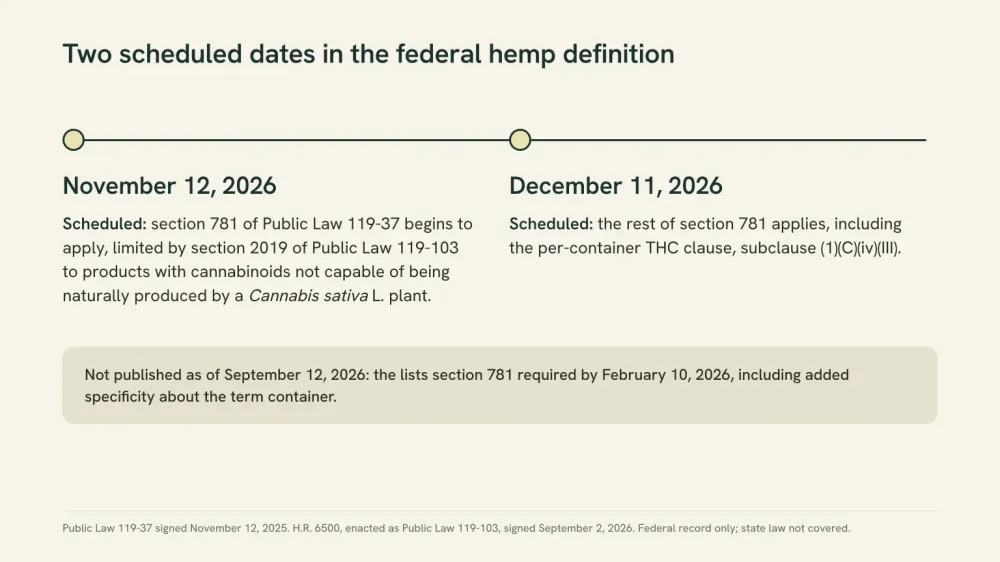
Federal hemp law has a change written into it, and one part of that change is expressed in milligrams per container rather than as a percentage. Section 781 of Public Law 119-37, signed November 12, 2025, will rewrite the federal definition of hemp; its text says it takes effect 365 days after enactment. One of its exclusions, subclause (1)(C)(iv)(III), is written to remove from that definition final hemp-derived cannabinoid products containing "greater than 0.4 milligrams combined total per container" of total tetrahydrocannabinols, including THCA, together with other cannabinoids that HHS determines have similar effects. The statute defines container as "the innermost wrapping, packaging, or vessel in direct contact with a final hemp-derived cannabinoid product", and lists examples that include a box and a can. The agency guidance meant to sharpen that definition has not been published, so we are not going to decide on our own what counts as the container for a tin of tablets.
A second law split the date. H.R. 6500, signed September 2, 2026 and enacted as Public Law 119-103, contains a section 2019 providing that, until December 11, 2026, section 781's amendments apply only to the products described in two subclauses, (1)(C)(ii)(I) and (1)(C)(iv)(I). Those are the exclusions for cannabinoids "not capable of being naturally produced by a Cannabis sativa L. plant". The per-container clause is not one of those, so it is not scheduled to apply before December 11, 2026. The piece that arrives November 12 asks whether a cannabinoid is one the plant cannot produce. The list meant to answer that has not been published either, and a potency certificate does not record where a molecule came from, so this page places no cannabinoid in this tin on either side of that line. Our news report on the delay to December 11 has the full calendar and the votes behind it.
Now the arithmetic, on printed numbers only. Set the certificate's 109 milligrams of total THC per package beside the statute's 0.4 milligrams per container and there is nothing to round: the tin is far above the figure. It is not an outlier in our catalog. Our tinctures' certificates were already set against that figure on the hemp ban page, where we ran the number on our own bottles, and most were above it; this tin's total joins that table rather than breaking from it. What any of that means for this product depends on pieces the government has not yet published: what the container is for a tin of tablets, which other cannabinoids HHS counts, and how the statute's total relates to a lab's own total THC formula. We are not going to guess.
We checked the Federal Register and the FDA's cannabis and CBD regulation page on September 12, 2026. The lists that section 781 required by February 10, 2026 have not been published, and the FDA page, whose footer reads content current as of July 16, 2024, does not reference section 781. A Congressional Research Service In Focus brief on changes to the statutory definition of hemp, updated August 17, 2026, lays out the exclusions and the lists FDA was required to publish. It predates the September 2 signing, so it still describes the December 11 split as a bill the Senate had passed. As of September 12, 2026, no other bill changing that date has become law. This is federal arithmetic with a date on it. State rules are a separate layer, and this page does not cover them. It is not legal advice, and it is not a forecast.
How to read the tin you have
You do not need to take our word for any of this. Here is the same reading as a checklist you can run on any tin of these tablets, with its certificate open beside it.
- 1Find the batch number on your package and open the certificate for that batch. This page reads batch 260505, and its numbers describe no other batch.
- 2Read the molecule on the label. The lid says 2.5mg D9, so the certificate row to compare is delta-9 THC, not total THC.
- 3Find the delta-9 THC row, read the per-serving column, and check how the certificate defines a serving. On batch 260505 a serving is 0.92 g.
- 4Use the per-package column for the whole tin and the per-serving column for one unit. Never hold a package figure against a per-tablet label.
- 5Read the Tests Taken line. If it says potency only, the certificate is not a contaminant report, and no row will carry a pass or fail.
- 6Look for asterisks and footnotes. On this certificate one marks total cannabinoids as beyond the scope of the lab's accreditation.
- 7Open the lab link printed on the certificate and confirm the lab's own copy shows the same figures.
- 8Look the lab up in its accreditation body's public directory and confirm the listing is current on the day you check.
Questions about the tablet
The label says 2.5 mg of delta-9 THC per tablet. The certificate for batch 260505 measured 2.68 mg of delta-9 THC per 0.92 g serving. Its total THC line reads 2.73 mg per serving, but that is the lab's own sum and also counts a small delta-8 row, so it is not the number to compare with the label.
That is the total THC line per package, meaning the whole 36.68 g tin, calculated with the lab's own formula. Delta-9 THC alone reads 107 mg per package. Neither figure is a per-tablet amount.
Treat them as a THC product. They contain delta-9 THC by design, and federal workplace drug-testing panels look for the compound the body makes from it. No brand can promise a result either way. If you are tested for work, the military or sport, this is not a product to take; our CBD drug test guide explains why.
The lab's potency method reports a panel of cannabinoids, and on this batch delta-8 THC was quantified at 2.19 mg across the package. It is an analytical line counted inside the lab's total THC figure. The tablet is labeled and sold as CBD with delta-9 THC, and the certificate does not say how that row came to be there.
Batch variance. We label 100 mg of CBD per package and the lab measured 124 mg, about 24% high. A 2017 study of 84 CBD products counted a label as accurate only within 10% either way, so by that yardstick this result would not count as accurate. We treat it as a miss, not a bonus.
No. It reports potency only: no microbial, heavy metal, pesticide or solvent panel, no pass or fail on any row, and no batch result. The tincture certificate we compared it with, from the same lab, does include heavy metal and microbial results. This certificate says nothing either way about whether contaminants are present.
It is the date a federal clause limiting total THC per container is scheduled to apply, under section 781 of Public Law 119-37 as limited by section 2019 of Public Law 119-103. This package's total THC is far above that statutory figure. The guidance on what counts as a container and the cannabinoid lists the law required have not been published, so we make no prediction. State law is not covered here, and none of this is legal advice.
If this page did its job, you can now read a THC figure on a certificate without being led by the biggest number on it. The same method works on any certificate of analysis for any product, and our complete guide to reading a COA is where it lives, from the potency panel to the safety panels this particular certificate does not include.
Writing about hemp, wellness and the small rituals that keep us balanced.