Is CBD Banned in Sports? What WADA, USADA and the NCAA Actually Say (2026)
CBD is the only cannabinoid the 2026 WADA Prohibited List exempts. Every other one, natural or synthetic, is prohibited in-competition. What that means for full spectrum, broad spectrum and isolate, what the NCAA changed, and what a batch COA cannot tell you.
No. Cannabidiol is not banned, and it is the only cannabinoid that is not. That is the entire good news, and most articles stop there. Section S8 of the World Anti-Doping Agency's list prohibits every other natural and synthetic cannabinoid in-competition, which means the question that decides anything is not whether CBD is banned in sports but what else is in the bottle you are holding. Everything on this page was checked against the 2026 editions on August 20, 2026. The Prohibited List is reissued every September and takes effect every January 1, so check the current list before you compete.
Four different rulebooks hide inside the phrase "banned in sports", and they disagree with each other. If your federation has adopted the World Anti-Doping Code, WADA's list governs you. If you compete for a US college, the NCAA runs its own list, and it changed. If you play in a professional league, a collective bargaining agreement decides. If your employer tests you, that is a fourth system entirely. None of these is law. Anti-doping rules are contractual obligations you accept by entering competition, not statutes, and this article is not legal advice. For the statute side of cannabis, see what federal and state law actually say about CBD. For everything below, the rulebook, not the law, is what can end your season.
Is CBD banned in sports? The rule in one screen
Here is section S8 of the 2026 Prohibited List, close to verbatim. Cannabinoids are prohibited in-competition. All substances in the class are Specified Substances. THC is designated a Substance of Abuse. "All natural and synthetic cannabinoids are prohibited", with three examples given: cannabis products including hashish and marijuana, natural and synthetic tetrahydrocannabinols, and synthetic cannabinoids that mimic the effects of THC. Then one line under the heading EXCEPTIONS, containing one word: Cannabidiol. That is the whole rule. It is short, and its shortness is the problem, because a hemp extract is not one cannabinoid.
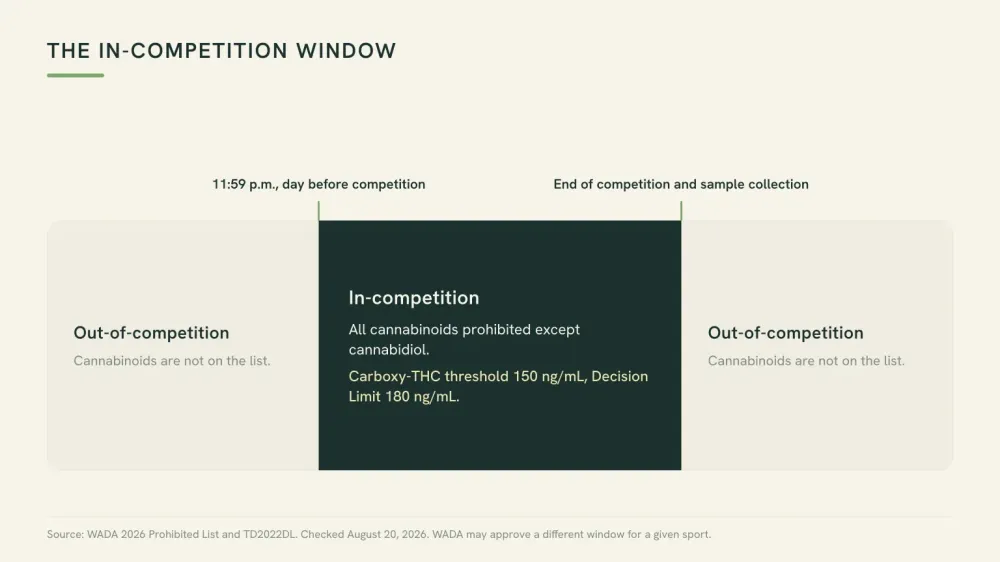
Two definitions inside it are worth pinning down. "In-competition" is not vague. The List defines it as the period beginning at 11:59 p.m. on the day before a competition you are scheduled to participate in, running until the end of the competition and the sample collection process. WADA may approve a different window for a given sport, so check yours. "Specified Substance" is a category from Code Article 4.2.2 covering substances more likely to have been consumed for a purpose other than enhancing sport performance. Do not read it as "less serious". And "Substance of Abuse" is a short list of four: cocaine, heroin, MDMA and THC.
The 150 ng/mL number, decoded
You will see "150 ng/mL of THC" in almost every article on this topic. It is close enough to be memorable and wrong in three ways that matter. The number comes from WADA's technical document on decision limits, TD2022DL, which is still the document in force for 2026, and it is worth reading the row properly.
| What people say | What the document says |
|---|---|
| 150 ng/mL of THC | 150 ng/mL of carboxy-THC, the main THC metabolite, defined as the free substance plus its glucuronide conjugated forms. Not THC itself. |
| Above the threshold means a positive | A laboratory reports an adverse analytical finding above the Decision Limit of 180 ng/mL, which sits above the 150 ng/mL threshold to account for measurement uncertainty. |
| The number is fixed | The Decision Limit is adjusted upward for concentrated urine. At a specific gravity of 1.022 it becomes 216 ng/mL. |
| It applies whenever you are tested | S8 is an in-competition prohibition. Out-of-competition, cannabinoids are not on the list. |
| Every cannabinoid has a threshold | THC is the only cannabinoid with one. Everything else in S8 is a presence rule. |
That last row is the one to carry with you. USADA states it without hedging in its marijuana FAQ: "All other cannabinoids (except cannabidiol) are prohibited in-competition in any amount, including natural cannabinoids (e.g., cannabigerol, cannabichromene, cannabinol, and others)." CBG, CBC and CBN by name, at any amount, with no threshold to fall under. If you have been reading the 150 ng/mL figure as a general allowance for hemp products, it is not one. It applies to exactly one molecule's metabolite.
The threshold is also more generous than it used to be, and WADA has explained why in its own words. When it approved the 2023 List, the agency wrote that the 150 ng/mL threshold "was increased in 2013 from 15 ng/mL" and that "the high level of cannabis required to trigger an Adverse Analytical Finding in competition today would be consistent with a significantly impaired athlete or a frequent user". That is an agency characterizing its own rule, not a promise about any product, and it says nothing at all about the cannabinoids that have no threshold.
Full spectrum, broad spectrum and isolate, mapped onto the rule
Most pages on this question stop at the rule and never get to the shelf, which is where the decision actually happens. The product vocabulary you see on a shelf (isolate, broad spectrum, full spectrum) describes which cannabinoids survive manufacturing. S8 describes which cannabinoids are prohibited. Lay one over the other and the answer for a tested athlete stops being abstract. Below are our own current batch numbers, printed on the COAs we publish, because it would be dishonest to run this comparison on somebody else's product. Every Planntz COA prints a 56.7 g package size and a milligrams-per-milliliter column, so nothing here is estimated except the per-drop figures, which assume a standard 0.05 mL dropper and vary with dropper and technique.
| Spectrum | What it contains by design | How S8 reads it | Real numbers, per 56.7 g package |
|---|---|---|---|
| CBD isolate | CBD only; other cannabinoids removed during manufacturing | The one exempted substance, on its own. The lowest-exposure category under this rule. | Planntz does not sell an isolate tincture, so we have no batch of our own to show you. |
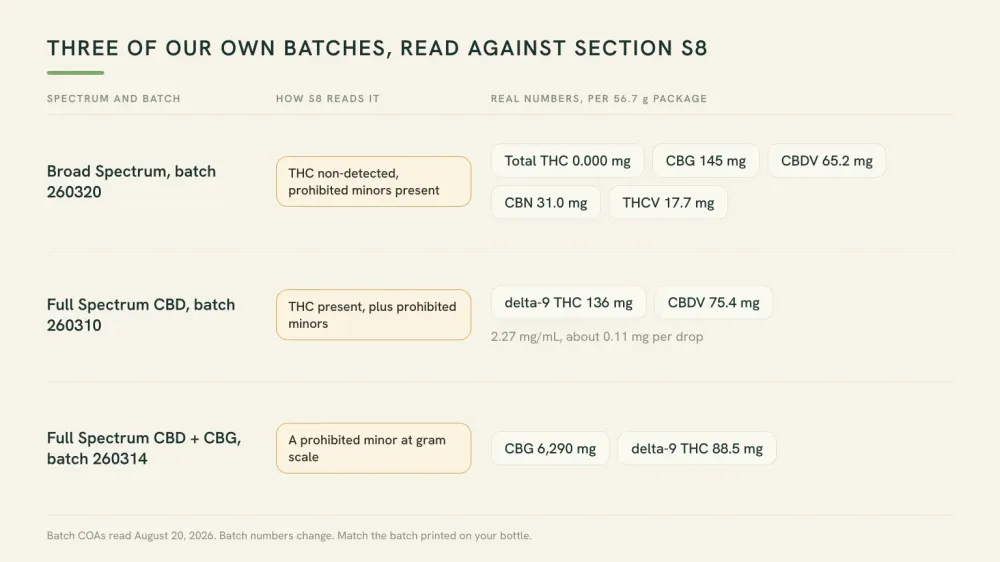
| Broad spectrum | THC removed, other minor cannabinoids retained | The retained minors are exactly the substances prohibited in-competition at any amount | Batch 260320 (Mango & Peach): Total THC 0.000 mg, non-detected. Also CBG 145 mg, CBDV 65.2 mg, CBN 31.0 mg, THCV 17.7 mg. |
| Broad spectrum, a different flavor of the same product | Same process, different batch and botanicals | Same reading as above, plus a measurable THC line | Batch 260321 (Lemon & Raspberry): delta-9 THC 10.7 mg (0.0189%), 0.179 mg/mL. Plus CBG 96.4 mg, CBDV 63.5 mg, CBN 28.2 mg, THCV 20.1 mg. |
| Full spectrum | Whole-plant extract, trace THC by design, below the 0.3% federal limit | THC is the one cannabinoid with a threshold; the minors present have none | Batch 260310: delta-9 THC 136 mg per package, 2.27 mg/mL, about 0.11 mg per drop. Plus CBDV 75.4 mg. |
| Full spectrum with a featured minor | A single minor cannabinoid added at gram scale | That featured minor is itself prohibited in-competition at any amount | CBD+CBG batch 260314: CBG 6,290 mg, plus delta-9 THC 88.5 mg. CBD+CBN batch 260311: CBN 4,110 mg, plus delta-9 THC 79.4 mg. |
Read the right-hand column against the rule and there is only one honest conclusion, so here it is plainly: under S8 as written, no Planntz tincture is a competition-clean product. The full-spectrum line carries delta-9 THC by design. The broad-spectrum line reports non-detected THC on two of three flavors, but every broad-spectrum batch still carries CBG, CBN, CBDV and THCV, which are precisely the "other cannabinoids" prohibited in-competition with no threshold to hide under. The CBD+CBG and CBD+CBN products carry a prohibited minor at gram scale. We sell these products and we are telling you the rule points away from them if you are tested in-competition. If you want the general version of the spectrum decision, outside this rulebook, the full guide to spectrum types covers it, and the 0.3% line between hemp and marijuana explains why a legal hemp product still contains THC at all.
What "non-detected" on a COA does and does not mean
Non-detected is not zero. It means the laboratory looked and found less than its own limit of detection, so what you actually learn is a ceiling, not an absence. On Broad Spectrum batch 260320 that limit of detection is 0.0460 mg/mL, which puts the ceiling on anything undetected at roughly 0.002 mg per drop. That is a genuinely small number, and it is still a number rather than a zero. Four other things a COA cannot do for you:
- It reports one batch. The next batch is a different plant material, a different run and a different report.
- It reports one unit, sampled once, on one day, by one laboratory.
- It reports what is in the bottle, not what ends up in your urine. Those are different measurements separated by your dose, your frequency of use and your own physiology.
- It says nothing about the cannabinoids that are present and prohibited. The THC row is the row everyone reads; the rest of the cannabinoid table is the row that matters under S8.
That is assuming the report is right about the product, which the published record says is not a safe assumption across the category. A 2024 analysis of 202 US retail CBD products in Frontiers in Pharmacology found that about a quarter did not meet the definition of the spectrum type printed on the package, and that only 68% of the broad-spectrum products matched their claimed definition. Three broad-spectrum products contained THC, two of them above 0.3%. That study was funded by Jazz Pharmaceuticals, tested a single unit per product, and bought its basket in late 2021, so it is not a verdict on any particular brand today. Earlier, a 2017 JAMA analysis of 84 CBD products sold online detected THC in 18 of them, at up to 6.43 mg/mL, and found only about 31% were labeled within 10% of their actual CBD content. That sample predates most of today's market. Both are reasons to read a batch-matched report rather than a marketing page: reading a COA line by line is the mechanical version, and what third-party tested actually guarantees is the skeptical version.
Strict liability: why "the label said THC-free" is not a defense
Anti-doping does not work like consumer protection. It does not ask whether you were misled by a label, and it does not ask what you meant to take. Article 2.1.1 of the World Anti-Doping Code puts the duty on you, and the Code's own comment names the doctrine that follows from it. It is also the sentence that should change how you shop.
“It is the Athletes' personal duty to ensure that no Prohibited Substance enters their bodies. Athletes are responsible for any Prohibited Substance or its Metabolites or Markers found to be present in their Samples.”
The Code's own comment on that article is where the doctrine gets its name. It says a violation is committed under Article 2.1 "without regard to an Athlete's Fault", and that the rule "has been referred to in various CAS decisions as 'Strict Liability'". Fault still matters, but only later, and only to the size of the consequence rather than to whether a violation happened. Here is the ladder as the 2021 Code sets it out, which remains the Code in force through 2026:
- Article 9: an in-competition violation in an individual sport automatically disqualifies the result obtained in that competition, including forfeiture of any medals, points and prizes. This applies regardless of fault.
- Article 10.2.4.1: if the athlete can establish that the ingestion or use occurred out-of-competition and was unrelated to sport performance, the period of ineligibility is three months.
- That three months may be reduced to one month if the athlete satisfactorily completes a Substance of Abuse treatment program approved by the anti-doping organization.
- Establishing out-of-competition use is the athlete's burden, not the agency's. "I bought it at a store" is not the same as establishing it.
Certification programs for sport supplements exist, and they are worth using where they exist, but USADA is explicit about what they are worth. In its guidance page 6 Things to Know About Cannabidiol, the agency writes that "third party certification reduces, but does not eliminate, the possibility that a product contains substances prohibited by WADA. The only way to have zero risk is to not use such products." To be unambiguous about our own position: no Planntz product is certified for sport, and Planntz is not affiliated with WADA, USADA or the NCAA. No such certification exists in our COA scope, and we are not going to imply one.
Sport testing and workplace testing are two different systems
Readers conflate these constantly, and so do most pages on this topic, which mix a 150 ng/mL sport threshold with workplace language without naming either system. They are different rulebooks, written by different people, with different analytes, different numbers and different consequences. The comparison below is deliberately shallow on the workplace side, because that is another article's job.
| In-competition anti-doping | Workplace testing | |
|---|---|---|
| Who writes the rule | WADA, adopted by your international federation and national anti-doping organization | Your employer, or a federal program for regulated roles |
| What binds you to it | A contract you accept by entering competition | Your employment agreement or a regulatory requirement |
| When it applies | From 11:59 p.m. the day before competition until the end of sample collection | Whenever the employer's policy permits a test |
| Measured analyte | Carboxy-THC in urine, free plus glucuronide conjugates | Also a THC metabolite, at a far lower cutoff |
| Threshold | 150 ng/mL, reported above a Decision Limit of 180 ng/mL | Roughly an order of magnitude lower than sport's threshold |
| Other cannabinoids | CBG, CBC, CBN and the rest are prohibited in-competition at any amount | Not what these panels are built to look for; see the workplace guide |
| Consequence | Disqualification of the result, forfeiture of medals and prizes, and a period of ineligibility | Whatever the employer's policy says |
One controlled study sizes the gap between those two columns better than any argument. In a Johns Hopkins crossover study published in the Journal of Analytical Toxicology, six healthy adults were given pure CBD (100 mg, oral or vaporized) and, on separate occasions, a vaporized CBD-dominant cannabis product containing 100 mg CBD and 3.7 mg delta-9 THC. After pure CBD, one of 218 urine specimens screened positive at the 20 ng/mL screening cutoff and none confirmed above the 15 ng/mL confirmatory cutoff. After the product carrying 3.7 mg of THC, nine specimens screened positive and four confirmed above that confirmatory cutoff. It is a six-person study, the THC arm was vaporized rather than swallowed, and 15 ng/mL is a workplace confirmatory cutoff, a tenth of sport's 150 ng/mL. Which is the point: it shows trace THC in a hemp product is measurable in urine, and it shows why you cannot read a workplace result as a sport result or the reverse. For the workplace half of your life, read how workplace drug testing handles CBD, and for the timing question underneath both, how long cannabinoids stay detectable.
The NCAA changed the answer, and most pages you will find have not
If you are a college athlete, almost everything ranking for this question is out of date. Several pages still quote the NCAA 2019-20 banned list and tell you cannabinoids are a banned drug class. They are not. Three primary documents settle it, and you can open all three: the 2026-27 NCAA banned-substances list, the 2026-27 NCAA Drug-Testing Manual, and the committee document that recommended removing the cannabinoids class. Here is what they say, checked on August 20, 2026.
- The 2026-27 banned-substances list names eight drug classes: stimulants, anabolic agents, beta blockers (banned for rifle and golf), diuretics and masking agents, and narcotics.
- The other three are peptide hormones, growth factors, related substances and mimetics; hormone and metabolic modulators; and beta-2 agonists. Cannabinoids is not one of the eight.
- The 2026-27 Drug-Testing Manual lists the same eight classes, and the word "cannabinoid" does not appear in it. Cannabis appears only in the drug-education chapter, as something schools should have a campus policy about.
- The manual's description of what the program actually tests for, year-round and at championships, names those same classes. Cannabinoids appear in neither menu.
- The committee document asked whether the NCAA would keep testing for substances in the cannabinoids class if the change went through, and answered in one word: "No." It also answered "No" to whether cannabinoids are performance-enhancing.
- The stated rationale: banning, testing and penalizing had been ineffective, the drug-testing program should address only performance-enhancing substances, and cannabis is better handled through harm reduction, similar to alcohol.
Pro leagues run their own systems
Professional leagues in the US are not WADA signatories for their own competitions, so their policies come out of collective bargaining and can differ sharply from everything above. Two concrete examples. In a joint announcement with the players' association on December 12, 2019, Major League Baseball removed "Natural Cannabinoids (e.g., THC, CBD and Marijuana)" from the program's Drugs of Abuse list, saying marijuana-related conduct would be treated the same as alcohol-related conduct, while adding testing for synthetic THC. And in December 2024 the NFL and the NFLPA raised the positive THC level from 150 ng/mL to 350 ng/mL, according to an Associated Press report published on NFL.com describing a memo sent to agents and players. That second one is reporting on a memo rather than published policy text, so treat the number as the AP's account of it.
The rule of thumb underneath all of this: if your governing body has adopted the World Anti-Doping Code, WADA's list governs you and everything above applies. If it has not, read your own policy document, because nothing on the WADA list transfers automatically, and a league can be looser than WADA on THC while still testing for something WADA ignores. One tool worth knowing and worth not over-trusting: Global DRO lets you check a medication against your sport and your country. Its own scope note says the tool "does not contain information on, or that applies to, any dietary supplements", so it will not tell you whether a particular hemp extract is clean, and neither will anything else.
- Under the WADA Code: cannabidiol exempt, every other cannabinoid prohibited in-competition, THC alone carrying a threshold.
- Under the NCAA's 2026-27 rules: cannabinoids are not a banned class, and the NCAA does not test for them. Your school or conference still might.
- Under a league CBA: whatever the CBA says, which in MLB's and the NFL's case is more permissive on natural cannabinoids than the WADA list.
- If more than one of these applies to you at once, and for college athletes on an international pathway it often does, the strictest one is the one that decides your season.
A pre-purchase checklist if you are tested in-competition
Everything above turns into eight things you can actually do before you spend money. Work through them in order.
- 1Confirm which rulebook applies to you: a WADA Code signatory, the NCAA, a league CBA, your employer, or more than one at once. They are different systems with different answers, and being under two at the same time is common.
- 2Find the batch number printed on the bottle and match it to a COA for that exact batch, not a generic "lab tested" page or a report with no batch on it.
- 3Read the Total THC line, not just the delta-9 line, and look for the formula footnote. Total THC normally means delta-9 plus THCA multiplied by 0.877, plus other tetrahydrocannabinols.
- 4Read the whole cannabinoid table, not just the THC row. Under S8, every non-CBD cannabinoid listed on that report is a substance prohibited in-competition at any amount.
- 5Where a value reads ND, find the LOD and LOQ columns and write the number down. ND means "below this number", not "zero".
- 6Check that the laboratory is named, that its accreditation is verifiable in an accrediting body's public directory, and that the report date is close to the batch date.
- 7If you are tested in-competition and want to minimize exposure, the conservative choice is a batch COA reporting non-detected THC. That reduces exposure. It does not make you safe: other cannabinoids remain prohibited and strict liability applies.
- 8Before you compete, check the current Prohibited List and ask your anti-doping organization in writing. USADA runs a Drug Reference Line for exactly this, and a written answer is worth more than a product page.
What nobody can tell you
Athletes are asking this question in real numbers, and the fear is already shaping behavior. In a 2025 survey of 80 elite Canadian athletes published in Frontiers in Nutrition, 38% had used CBD, oral tincture or oil was the most common form, and the single most commonly reported reason for never using it or for stopping was concern about an anti-doping rule violation. In the same survey, 96% of users agreed CBD "is safe" and 93% that it improved their sleep. Those are what athletes believe, collected by questionnaire from a self-selected group of 80 people; the survey did not measure whether anything happened. For the evidence side of that, what human studies of CBD and exercise recovery actually measured is a separate article, and it is careful about what those studies did not measure. This article makes no performance or recovery claim of any kind.
The warning is not new either. In 2019, two German researchers, one of them at a state chemical and veterinary testing laboratory, published a warning in the journal Sports against negligent use of cannabidiol by athletes, arguing that non-medicinal full-spectrum extracts can carry enough THC to trigger a doping positive. Their figure is THC above 2.5 mg per day in 10 of 28 commercial CBD products then sold on the German internet and retail market. It is a commentary rather than original research, 28 products is a small basket, and the market it describes is neither today's nor the US one. Its central point has aged well anyway, and USADA's own version of it is shorter: "the use of any CBD product is at the athlete's own risk." We cannot predict your test result. Neither can any brand, any certification, or any laboratory report on a batch you already swallowed.
Rules change every year: how to re-check this yourself
This page has a cutoff date because it has to. The Prohibited List is published every September and takes effect every January 1, and the NCAA reissues its list each academic year. Rather than trusting any article next season, including this one, run these four steps. They take about ten minutes. Step two uses the summary of major modifications that WADA publishes alongside each list; for the 2026 edition it listed no change to S8, which is how we know the cannabinoid rules carried over unchanged.
- 1Open the current Prohibited List PDF on WADA's site and read section S8 yourself. It is under half a page.
- 2Open the summary of major modifications published alongside it and search it for S8. If S8 is not listed there, the cannabinoid rules did not change that year.
- 3Re-read your national anti-doping organization's own cannabinoid guidance, because that is the wording that will be quoted at you. For US athletes that is USADA's marijuana FAQ.
- 4Check your own governing body, school or league policy separately. It is the one document nobody else can look up for you, and it is the one that decides your case.
One forward-looking note, so you are not surprised: the revised World Anti-Doping Code takes effect on January 1, 2027, and the 2027 decision-limits technical document, already published, keeps carboxy-THC at a 150 ng/mL threshold and a 180 ng/mL Decision Limit. Those are not the rules today. They are what is scheduled.
Questions people actually ask
No. Section S8 of the 2026 Prohibited List names cannabidiol as its only exception. Everything else in the section, natural or synthetic, is prohibited in-competition. WADA's summary of modifications for the 2026 List did not list any change to S8, so the cannabinoid rules carried over unchanged. Checked August 20, 2026; the list is reissued every September.
Nobody can tell you that, including us. The threshold is 150 ng/mL of carboxy-THC in urine, reported by a laboratory above a Decision Limit of 180 ng/mL, and how much of anything reaches your urine depends on the product, the dose, how long you have been taking it and your own physiology. Every other cannabinoid is prohibited at any amount, with no threshold at all. USADA's position is that the use of any CBD product is at the athlete's own risk, and that third-party certification reduces but does not eliminate the possibility that a product contains a prohibited substance.
Full spectrum contains delta-9 THC by design, below the 0.3% federal limit but never zero. On our own current Full Spectrum batch (260310) that is 136 mg of delta-9 THC per 56.7 g package, 2.27 mg/mL, about 0.11 mg per drop with a standard dropper. If you are tested in-competition, that is a real exposure, and the honest answer is that full spectrum carries residual risk. The minor cannabinoids in it are prohibited in-competition regardless of the THC line.
The question cannot be answered as asked, and any page that answers it yes is guessing. Broad spectrum means THC removed, and our Mango & Peach batch 260320 reports Total THC of 0.000 mg per package, non-detected against a limit of detection of 0.0460 mg/mL. But the same batch reports CBG 145 mg, CBDV 65.2 mg, CBN 31.0 mg and THCV 17.7 mg per package, and USADA states that all cannabinoids other than cannabidiol are prohibited in-competition in any amount. Removing THC reduces exposure to the one cannabinoid with a threshold. It does not make a product competition-clean.
No. The 2026-27 NCAA banned-substances list names eight drug classes and cannabinoids is not one of them, and the word cannabinoid does not appear in the 2026-27 Drug-Testing Manual. The committee that recommended the change answered its own question about whether the NCAA would keep testing for the cannabinoids class with a one-word "No". Your school or conference can still test you under its own policy, and if you also compete under a WADA Code signatory, that list still applies to you.
S8 is an in-competition prohibition, so cannabinoids are not on the list outside that window. The catch is the handover: USADA cautions that complete washout of those substances and their metabolites cannot be easily predicted, which is why out-of-competition use is not automatically a clean slate once the in-competition period starts at 11:59 p.m. the night before. For how long cannabinoids linger and what actually drives that, see our article on detection windows.
No, because CBD is not prohibited, so there is nothing to be exempted from. A therapeutic use exemption is the route for prohibited cannabinoids. USADA says it will consider TUE applications for medical marijuana and for FDA-approved cannabinoid medications, and that they must meet the criteria in the International Standard for TUEs. Being considered is not the same as being approved, and applying after a test is a much worse position than applying before.
Those leagues run their own programs rather than the WADA list. MLB and the players' association removed natural cannabinoids, listing THC, CBD and marijuana, from the program's Drugs of Abuse list in December 2019, while adding testing for synthetic THC. The NFL and NFLPA raised the positive THC level from 150 ng/mL to 350 ng/mL in December 2024, according to an Associated Press report of the memo. If you play at any level below or alongside those leagues, or in international competition, a different rulebook may apply to you at the same time.
The rule itself is one sentence long: CBD is exempt, everything else in the cannabinoid class is prohibited in-competition. What makes it hard is that hemp extracts are mixtures, that COAs describe a batch rather than a person, and that the Code puts the consequences of both facts on you. If your testing question is about work rather than sport, our guide to CBD and employer drug tests is the other half of this topic. If you want to see what a per-batch report actually looks like before you trust any brand's version of it, ours are published batch by batch on our lab results page, including every number in this article that does not flatter us.
Writing about hemp, wellness and the small rituals that keep us balanced.