CBD and Exercise Recovery: What Human Studies Actually Measure
Human trials do not show a reliable CBD recovery effect. This evidence-led guide separates soreness, function, biomarkers, and performance, then explains safety and sport boundaries.
CBD is often presented as a simple post-workout answer. Human research does not support that level of certainty. A few small studies report signals in particular recovery outcomes, while other controlled studies report no meaningful difference. The honest answer depends on what was measured, which CBD formulation was tested, who used it, and when.
Does CBD help exercise recovery? The short answer
Current human evidence does not establish that CBD reliably reduces post-exercise soreness, restores strength, changes muscle-damage markers, or improves the next performance. The small trials are too different and too limited to support one general recovery claim. A 2024 systematic review found only seven randomized studies with 134 participants through April 2024 and did not establish a post-load recovery benefit.
That conclusion is not the same as saying every study is negative or no person can notice a change. It means the positive signals have not become a dependable, replicated effect. The newest studies make the picture more interesting, not more certain: one small sublingual full-spectrum trial reported lower pain and less impairment in some measures, while a small topical trial found no clear benefit in its main outcomes.
Recovery is not one outcome
The word recovery compresses several questions into one. A person may feel less sore but show no difference in strength. A blood marker may change without better function. A runner may report the same soreness yet perform normally the next day. Unless those outcomes are kept separate, a narrow result can turn into a much broader marketing claim.
| Outcome family | What researchers may measure | What it does not prove by itself |
|---|---|---|
| Felt experience | Soreness, stiffness, fatigue, or pain with movement | That damaged tissue repaired faster or later performance improved |
| Function | Strength, torque, range of motion, or daily activity | That inflammation or muscle-damage markers changed |
| Biology | Creatine kinase, myoglobin, or inflammatory markers | That the person felt better or performed better |
| Next performance | Power, pace, endurance, or time to exhaustion | That soreness or underlying biology improved |
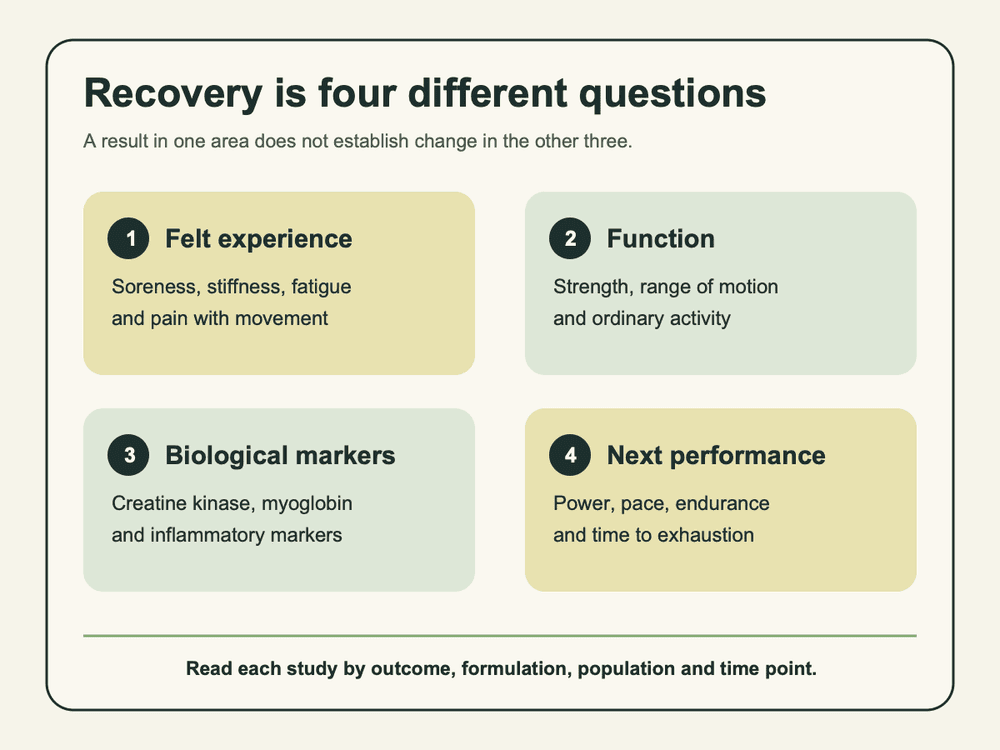
Timing matters too. Delayed-onset muscle soreness often changes over several days, and different biomarkers peak at different times. A result at 24 or 48 hours is not automatically a complete recovery curve. Training status also matters because people who repeat an unfamiliar exercise can experience less damage the next time, a pattern known as the repeated-bout effect.
The diagram accompanying this section uses four outcome families for a reason: it gives every headline a boundary. Before asking whether CBD helped recovery, ask which box changed, at which time point, and whether that change was reproduced in another study.
What the newest human trials found
A 2026 sublingual study reported preliminary favorable signals
A 2026 randomized feasibility trial enrolled healthy young adults who did not frequently perform lower-body resistance training. Twenty-nine participants completed the trial. They received either placebo or a full-spectrum hemp extract providing 67 mg of CBD per day, divided into two sublingual uses, for 15 days. Importantly, treatment began 10 days before researchers induced quadriceps muscle injury. This was a pretreatment protocol, not a study of taking CBD only after an ordinary workout.
The CBD group reported lower peak pain and pain with movement, and showed less impairment in some strength and disability measures at 48 hours. The estimated mean time to recovery was 4.4 days in the CBD group and 4.8 days with placebo, but the Cox regression with Kaplan-Meier estimates found no statistically significant between-group difference in time to recovery (B = -0.43; exp(B) = 0.65; 95% CI, 0.23-1.8). Those findings are worth following, but the study was designed to test feasibility rather than provide a definitive efficacy answer. The article reports descriptive effect sizes rather than a trial powered to establish a clinical benefit.
Several details narrow the result. Eight of the 37 randomized participants did not complete the study. The trial did not measure muscle-damage or inflammatory biomarkers. Blinding was imperfect: all placebo participants correctly guessed that they had received placebo. The product was a full-spectrum extract containing other hemp constituents, so the finding cannot be assigned with confidence to CBD alone or transferred to a different formula. The short study also cannot establish sustained safety.
A 2026 topical study found no clear benefit in its main outcomes
A separate 2026 randomized crossover trial tested a topical CBD gel in 15 physically active male physiotherapy students. Participants completed 100 drop jumps, then applied 2 grams of CBD gel or placebo gel to the quadriceps and hamstrings immediately after exercise and during 72 hours of follow-up. Researchers measured soreness, plasma myoglobin, and muscle torque.
The trial found no significant difference between CBD and placebo for delayed-onset muscle soreness, myoglobin, or concentric torque. An apparent isometric-torque difference was difficult to interpret because missing measurements were uneven and performance improved in the second period, consistent with a repeated-bout effect. The authors did not present it as dependable evidence of better recovery.
This was also a small, unpowered study. It included men only, used one gel, had a two-week washout that may have been too short for the exercise adaptation, and did not measure CBD or its metabolites in blood. The fair conclusion is that this topical protocol did not improve the main measured outcomes. It is not proof that every topical product is ineffective, and it does not show that an oral route is better.
A 2025 runner trial found no endurance or next-day recovery benefit
A 2025 randomized crossover trial studied 25 trained runners. Each participant received placebo, 50 mg of purified CBD, or 300 mg of purified CBD 1.5 hours before a 60-minute run at about 70 percent of maximum oxygen uptake, followed by a time-to-exhaustion test. Researchers also examined subjective experience, creatine kinase, myoglobin, next-day soreness, and sleep.
Neither CBD condition improved endurance, the subjective exercise experience, the measured biomarkers, next-day soreness, or sleep. Mild adverse events occurred in two placebo conditions, two 50 mg conditions, and six 300 mg conditions. The higher-condition reports included sleepiness or sedation as well as other symptoms, but a study this small cannot estimate how often a particular effect occurs in the broader population.
The running protocol was not designed to cause extensive muscle damage, and some biomarkers may peak after the sampled window. Many measured outcomes also increase the chance of an isolated false-positive finding. The article received a February 2026 correction for figure citations and placements, not for the reported study result. The useful conclusion remains narrow: acute purified CBD did not improve performance or the measured recovery outcomes in this trial.
What older controlled studies add
Earlier studies do not resolve the disagreement. They reinforce how sensitive the answer is to formulation, population, and outcome selection. A 2024 triple-crossover study followed 17 advanced athletes through repeated six-day high-intensity training periods. Participants used placebo, CBD oil, or a CBD solubilisate after training. A lower myoglobin increase appeared with CBD oil in one advanced-athlete subgroup, but not in the highly advanced subgroup, and there was no consistent performance or inflammatory benefit.
That biomarker signal is hypothesis-generating rather than a practical recovery answer. The sample was very small, pandemic disruption affected completion and treatment order, repeated exposure to the training could have changed later responses, and blood CBD was not measured. The study was funded by the company associated with the tested formulations. Funding does not invalidate a result, but it belongs in the context readers use to judge replication needs.
A 2022 placebo-controlled crossover trial studied 24 well-trained women after eccentric exercise. Participants received CBD isolate pills or placebo before and after exercise. The protocol found no difference in measured inflammatory cytokines, myoglobin, performance, or fatigue. The study offers valuable evidence in women, who remain underrepresented in sports research, but one population, route, and relatively high experimental amount cannot settle every CBD question.
A 2023 pilot study is sometimes included in recovery discussions, but its supplement combined CBD with CBG, beta-caryophyllene, branched-chain amino acids, and magnesium. Some subjective soreness and activity-interference measures differed, while objective recovery, sleep, and mood did not clearly improve. Because five potentially active ingredients were bundled together, the study cannot identify CBD as the reason for any difference. It was also funded by the product company, and most authors disclosed employment or stock interests.
| Study | Formulation and context | Main reading | Boundary |
|---|---|---|---|
| 2026 sublingual feasibility trial | Full-spectrum extract begun 10 days before induced muscle injury | Favorable preliminary signals in some pain and function measures | Small, not powered for efficacy, weak blinding, no biomarkers |
| 2026 topical crossover trial | CBD gel after drop jumps | No clear benefit for soreness, myoglobin, or concentric torque | 15 men, one gel, repeated-bout and missing-data concerns |
| 2025 runner crossover trial | Single purified CBD use before running | No endurance or next-day recovery benefit | Not a high-muscle-damage protocol; small sample |
| 2024 repeated-training crossover study | CBD oil or solubilisate after six days of training | One subgroup myoglobin signal, no consistent broader benefit | Very small, order imbalance, possible repeated-bout effect |
| 2022 female-athlete crossover trial | CBD isolate before and after eccentric exercise | No difference in inflammation, myoglobin, performance, or fatigue | One population and protocol; some missing samples |
| 2023 combination pilot | CBD plus four other active ingredients | Some subjective differences, no clear objective recovery benefit | Cannot assign any result to CBD |
Why the studies do not answer one universal question
It is tempting to place these trials in a positive or negative column and count them. That would ignore the fact that they are not repeated tests of one intervention. A full-spectrum sublingual extract begun before muscle injury is not the same intervention as a topical gel applied afterward. Purified CBD taken once before a run is not the same as a daily oil used across a training block. A supplement containing five active ingredients does not isolate CBD at all.
- Formulation: purified CBD, broad or full-spectrum extract, and multi-ingredient products contain different compounds.
- Route: swallowed, sublingual, and topical products produce different exposure and cannot be ranked from one small comparison.
- Timing: pretreatment, pre-exercise use, immediate post-exercise use, and repeated daily use answer different questions.
- Population: untrained young adults, trained runners, advanced athletes, men only, and women only may respond differently to the exercise itself.
- Exercise: induced eccentric damage, drop jumps, endurance running, and repeated high-intensity training do not create the same recovery demand.
- Outcome: soreness, function, biomarkers, and later performance should not be combined into one endpoint after the fact.
Small pilot and feasibility studies are valuable because they show whether a larger trial is practical and where a signal might exist. They are poor foundations for universal routines. A useful next research step would replicate the same clearly characterized formulation and protocol in a larger, adequately powered sample, preserve blinding, measure both subjective and objective outcomes, and publish the planned primary outcome before results are known.
Feeling less sore is not the same as recovering faster
Soreness is real and relevant. It can affect comfort, confidence, and willingness to move. But it is a subjective experience influenced by expectations, sleep, stress, previous training, and the unfamiliarity of the exercise. Less reported soreness does not by itself show faster tissue repair, reduced inflammation, restored strength, or better readiness for another hard session.
The reverse is also true. A biomarker can change without a noticeable difference in pain or performance. Creatine kinase and myoglobin are often used as indirect signs of muscle stress, but their levels vary considerably between people and across time. A subgroup difference in one marker should not become a promise that the whole person recovered faster.
This distinction protects readers from two common leaps: turning comfort into healing, and turning a laboratory number into a meaningful daily benefit. A credible recovery claim should identify the outcome, size and timing of the difference, comparison group, and uncertainty. If those details are absent, the claim is not ready to guide a decision.
Trial amounts and schedules are not consumer instructions
The studies used very different experimental amounts, routes, and schedules. Some began CBD before the damaging exercise, some used it afterward, and one tested a single use before endurance running. Those choices were made to answer a research question under supervision. Copying a trial amount does not recreate the trial's product chemistry, screening, monitoring, participant profile, or comparator.
Research also does not establish a universal before-workout or after-workout time. A positive signal under a 10-day pretreatment design cannot be converted into a same-day rescue schedule. A null topical trial cannot prove that swallowing CBD is the better choice. This article therefore does not recommend an amount, route, frequency, or timing for exercise recovery.
Safety belongs in the recovery conversation
CBD is not risk-free because it is nonintoxicating or sold without a prescription. FDA consumer guidance identifies potential liver injury, interactions with other medicines, changes in alertness, gastrointestinal effects, and mood changes. The agency has approved one prescription CBD medicine for specific seizure disorders, not consumer CBD products for exercise recovery.
A recent FDA randomized safety trial summary adds useful context. In that study, 151 healthy adults were assigned to receive a CBD solution at 2.5 mg per kilogram twice daily for 28 days and 50 were assigned to placebo. Eight CBD-assigned participants experienced ALT elevations above three times the upper limit of normal; FDA reported a Kaplan-Meier estimate of 5.6% (95% CI, 1.8% to 9.3%), compared with zero placebo participants. The participants were often asymptomatic, and the values normalized after CBD was stopped.
That was a particular high-exposure protocol. The 5.6% figure was a source-reported Kaplan-Meier estimate, not an incidence estimate for lower exposures or retail products. It does show why feeling well is not proof that liver effects are absent. It also undercuts the idea that a study amount can be copied without screening or monitoring. People taking prescription or over-the-counter medicines need an interaction review based on the actual medicine list and actual product.
A product label adds another layer of uncertainty. Different batches can vary in CBD amount, THC and other cannabinoid content, additional ingredients, and contaminants. A current batch-specific certificate of analysis can describe the sample a laboratory tested, but it cannot prove that the product improves recovery, that every batch is identical, or that an athlete will pass a drug test.
Competitive athletes have a separate risk
The 2026 World Anti-Doping Agency Prohibited List prohibits natural and synthetic cannabinoids in competition, with an exception for cannabidiol. The exception is often shortened to CBD is allowed. That sentence is incomplete because a retail product may contain THC or other cannabinoids, and the rule applies to the substance found in the sample rather than the marketing category on a bottle.
USADA guidance emphasizes strict liability: athletes are responsible for prohibited substances detected in their samples. Full-spectrum and even products marketed as THC-free can create uncertainty if contents differ from the label or if other prohibited cannabinoids are present. Third-party certification can reduce some quality risk, but it cannot guarantee that a product is free of every prohibited substance.
An athlete subject to testing should check the current rules of the relevant governing body and speak with qualified sport medicine or anti-doping personnel before using a cannabinoid product. Rules can change, and the timing of in-competition periods can depend on the sport. A favorable recovery headline does not remove that professional or eligibility risk.
When workout soreness needs medical care
Ordinary delayed-onset soreness usually follows unfamiliar or demanding exercise and improves with time. Severe or unexpected symptoms should not be managed by layering a supplement onto the problem. The CDC advises seeking immediate care for possible rhabdomyolysis symptoms such as muscle pain more severe than expected, dark tea- or cola-colored urine, or marked weakness and inability to complete usual tasks.
Those symptoms do not diagnose rhabdomyolysis by themselves; medical testing is needed. They are a reason not to wait for a recovery product to work.
Better questions for a clinician or pharmacist
A useful conversation starts with the problem rather than the product. Is the goal less soreness, better sleep, restored strength, or returning safely after an injury? Those goals may need different evaluation. If sleep is the real outcome, our CBD and sleep evidence review treats that as a separate question rather than proof of muscle recovery.
| Question | Why it matters | What to bring |
|---|---|---|
| What outcome are you trying to change? | Soreness, function, sleep, and return from injury are not interchangeable | A short symptom and training timeline |
| Could this be an injury or medical problem? | Severe or unusual symptoms need assessment rather than experimentation | Onset, severity, swelling, weakness, urine changes, and what activity triggered it |
| What medicines and conditions are relevant? | Interactions, liver health, and alertness can change risk | A complete medicine and supplement list |
| Are you pregnant or breastfeeding? | [FDA advises avoiding CBD](https://www.fda.gov/consumers/consumer-updates/what-you-should-know-about-using-cannabis-including-cbd-when-pregnant-or-breastfeeding) during pregnancy or while breastfeeding | The FDA guidance and a complete medicine and supplement list |
| What is actually in the product? | Formulation, other cannabinoids, and batch variation affect both evidence and risk | The label and current batch-specific laboratory report |
| Are anti-doping rules involved? | CBD's exception does not protect against other cannabinoid exposure | The sport, governing body, competition schedule, and current prohibited list |
| How would a meaningful change be tracked? | Natural recovery and changed training can look like a product effect | A predefined outcome and time frame, without changing several variables at once |
This does not turn CBD into a recommended experiment. It helps expose when the evidence does not match the goal or when the safety review is incomplete. A clinician may decide the priority is an injury assessment, medication interaction, sleep disorder, training-load change, or established recovery basics rather than a cannabinoid product.
Questions people still ask
Human evidence is mixed and too limited for a reliable general claim. One small 2026 full-spectrum feasibility study reported lower pain in a specific pretreatment protocol, while a small 2026 topical trial found no difference in delayed-onset soreness and other controlled trials found no clear soreness benefit.
No head-to-head evidence establishes a superior route for exercise recovery. The 2026 topical study was null for its main outcomes, while the favorable 2026 sublingual study used a different formulation, population, timing, and design. That is not a valid route comparison.
Research does not establish a universal timing rule. Pretreatment, pre-exercise, and post-exercise studies answer different questions, and their schedules are not personal instructions.
Current controlled human studies do not establish a dependable anti-inflammatory effect after exercise. Several studies measured cytokines or related biomarkers and found no clear difference. Laboratory mechanisms should not be turned into a treatment claim.
WADA's 2026 list excepts cannabidiol from the in-competition cannabinoid prohibition, but other cannabinoids remain prohibited and athletes are strictly liable for what appears in a sample. Product contamination or inaccurate labeling can still create risk.
No. A current batch-specific report may describe measured contents in the tested sample. It does not establish clinical benefit, guarantee every batch, eliminate interaction risk, or guarantee compliance with anti-doping rules.
The bottom line
CBD and exercise recovery is not a settled yes-or-no story. The strongest accurate summary is that human studies are small, heterogeneous, and mixed. A favorable signal in one full-spectrum pretreatment study sits beside null results in a topical trial, an acute runner trial, a female-athlete trial, and several objective outcomes. None justifies a universal recovery routine.
Read every claim by outcome, formulation, population, timing, and limitation. Then put medication safety, liver health, product contents, injury red flags, and sport rules ahead of the promise. That approach is less exciting than a recovery shortcut, but it is much closer to what the evidence can actually support.
Check the safety evidence, not just the recovery claim
Use current federal guidance as a starting point, then review medicines, liver concerns, and the actual product with a qualified clinician or pharmacist.
Read FDA CBD guidanceWriting about hemp, wellness and the small rituals that keep us balanced.