CBC vs CBG: One Is the Parent Molecule and the Other Is Its Child
Search results present CBC and CBG as two peers on a menu. In the plant they are one enzymatic step apart, and the step runs one way. Here is the branch, the July 2026 crystal structures, and what each row reads on our twelve batch certificates.
CBC vs CBG is usually presented as a choice between two peers on a menu: one for the day, one for the evening, each with its own personality. That framing is wrong at the level of the plant. Cannabigerolic acid, the acid form of CBG, is the raw material that the enzyme that makes CBC consumes. The two molecules are one enzymatic step apart, they are not siblings, and almost every real difference between them follows from that single fact, including why both are hard to find and why one of them shows up as a number on a lab report while the other does not show up at all.
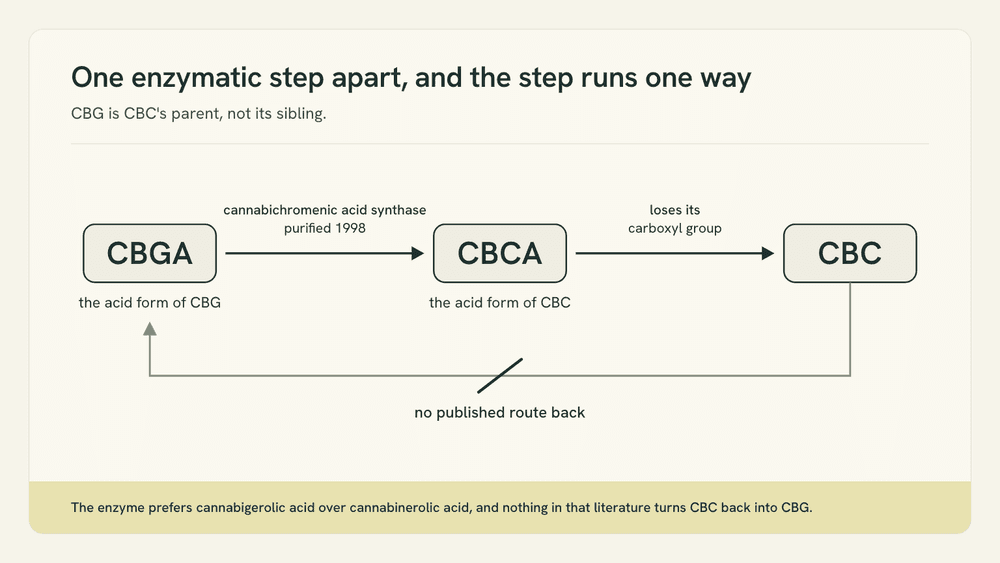
Here is the short version, up front. Three enzymes compete for the same precursor in the plant, and one of them, cannabichromenic acid synthase, takes cannabigerolic acid and turns it into the acid form of CBC. CBG is CBC's parent, not its sibling. Both molecules are scarce, but for opposite reasons: the plant spends CBG on its way to something else, while it commits very little to CBC in the first place, and light moves some of what it does make into a different molecule again. On a certificate of analysis the two rows behave nothing alike. Across the twelve batch certificates we publish, CBG carries a number on eight of them, from 17.5 mg to 6,520 mg per package, and cannabichromene reads ND on all twelve. And on the effects question, which is what most of this search result is actually about, there is no human study that compared them. Not a weak one. None.
One of these molecules is built out of the other
Start where the plant starts. Cannabigerolic acid, usually written CBGA, is the branch point of the whole cannabinoid family, and three enzymes pull from it. The first X-ray crystal structures of all three were published in July 2026 in Current Research in Structural Biology, and the paper states the arrangement plainly. Cannabichromene, cannabidiol and THC are the major compounds of interest, "each of which is synthesised in the plant from a common precursor cannabigerolic acid (CBGA)" by "predominantly three identified cannabinoid synthase (CSase) enzymes, CBCAS, CBDAS and THCAS", each of them "an FAD dependent oxidase of the Berberine Bridge Enzyme (BBE) family". Two things travel with that paper and belong in any summary of it. The enzymes were produced in a yeast, Komagataella phaffii, rather than read out of a living plant, and the work was funded by Jazz Pharmaceuticals, with two of its five authors giving the company as their affiliation. It is structural biology, which means it describes catalysts and not effects. The full branch, including what happens on the other two arms, is worked through on our page about the acid the whole family starts as.
The enzymology behind the word parent is older and more specific than any diagram. Cannabichromenic acid synthase was purified from the plant and characterized in 1998, and that paper reports which raw material the enzyme prefers (Morimoto and colleagues, Phytochemistry, doi 10.1016/s0031-9422(98)00278-7). The enzyme "catalysed the oxidocyclization of cannabigerolic acid and cannabinerolic acid to cannabichromenic acid", and while the Km values for the two substrates sat in the same order of magnitude, the Vmax for cannabigerolic acid was higher. The authors' conclusion is the sentence this whole comparison rests on: "cannabichromenic acid is predominantly formed from cannabigerolic acid rather than cannabinerolic acid." That is the direct chemical sense in which CBG is CBC's parent. The acid form of CBG is the preferred input to the reaction whose output is the acid form of CBC, which then loses its carboxyl group and becomes CBC. The described reaction runs one way, and nothing in that literature turns CBC back into CBG. A 1998 enzyme assay in a tube is also a statement about an enzyme in a tube and not about a bottle on a shelf. If what you want is CBG's own identity rather than its position in the pathway, what CBG is and why there is so little of it covers that separately.
Two of the three enzymes are 93 percent the same protein
Here is the number that no page on this search result carried when we read it on September 8, 2026, because the paper is from July of that year. Table 2 of those first crystal structures lists the sequence identity between the three synthases. The enzyme that produces CBC's acid and the enzyme that produces THC's acid are 93 percent identical. The enzyme that produces CBC's acid and the one that produces CBD's acid are 82 percent identical. CBD's and THC's are 84 percent. The authors' own framing is that the synthases "share high degrees of homology, and therefore their distinct specificities are governed by very subtle differences in sequence and therefore structure". The structures of the CBC and CBD synthases had never been solved before, at 2.43 and 1.70 angstroms respectively, and the THC synthase was re-solved at 2.33 angstroms against the one earlier structure the paper cites, deposited in 2012 at 2.75 angstroms.
That distinction matters because it is the shape of most bad cannabinoid writing: a fact about chemistry gets carried across into a claim about experience, and the seam is invisible unless you are looking for it. The chemistry here is genuinely striking on its own terms. Three enzymes that are 82 to 93 percent the same by sequence produce three molecules with three completely different reputations, and the difference between them lives in a handful of residues. What none of that tells you is how anything will feel, and any page that walks from a homology percentage to a mood word has left the evidence behind.
Two kinds of scarce, and the reasons are opposite
Both molecules get called rare, and that one word hides two different mechanisms. CBG is scarce in a finished plant because the plant spends it. CBGA is the substrate the three synthases pull from, and by harvest most of it has been converted into something else, which is why the CBG number on an ordinary hemp extract is a leftover rather than a target. The precursor's own page works through that arithmetic properly, and it is the reason a CBG-rich plant has to be a deliberate genetic decision rather than a lucky harvest.
CBC is scarce for the opposite reason: the plant does not commit much to it in the first place. A 2022 analysis of commercial cannabis flower reports many CBC-related genes alongside very little measured CBC, and reads that gap as a sign that the synthase may not be selective for the product it is named after (Smith and colleagues, PLoS One, 2022, PMID 35588111). Those are adult-use flower samples measured by dry weight rather than hemp extract in a bottle, and we are not re-deriving the dataset here, because our comparison of CBC and CBD already works through that reading and our page on what separates a major cannabinoid from a minor one owns the abundance argument and its 89,923 samples. Then there is a second exit that CBG does not have. In 1968, Crombie, Ponsford, Shani, Yagnitinsky and Mechoulam described a photochemical route from cannabichromene to cannabicyclol (Tetrahedron Letters, doi 10.1016/s0040-4039(00)76346-5), a different molecule entirely. That is a title-level fact from a preparative chemistry paper, and we are not attaching a rate, a half-life or a shelf life to it, because the paper does not supply one. A 2016 critical inventory of the phytocannabinoids makes a related point in general terms and keeps its own hedges: the diversity of these compounds "might be, at least in part" the result of non-enzymatic transformations induced by heat, light and atmospheric oxygen acting on a limited set of major constituents, and CBC is named as one of that set.
- CBG is scarce because it is spent. It is the substrate the plant consumes on its way to CBD, THC or CBC, so what remains at harvest is a remainder rather than a product.
- CBC is scarce because the plant barely commits to it. The published reading of a 2022 analysis of commercial flower samples is that its synthase does not appear to be selective for CBC production.
- CBC has an extra exit. A light-driven reaction described in 1968 converts cannabichromene into cannabicyclol, which is a different molecule with its own row on some potency panels.

CBC vs CBG, side by side: the table with no effects row
The pages on this search result converge on the same two rows: what each molecule does, and which one is better for what. We cannot fill either row for this pair, because nobody has compared these two molecules in people, and neither can anybody else, so this table does not pretend to. What it has instead is the set of things that genuinely differ, with the source of each cell stated where it matters. The last row is deliberately empty, and that emptiness is the most honest thing in the table.
| What is being compared | CBG (cannabigerol) | CBC (cannabichromene) |
|---|---|---|
| Position in the pathway | The precursor. Its acid form, CBGA, is what the three synthases pull from. | One of the three products. Its acid form is made from CBGA. |
| The enzyme involved | None, in this branch. CBGA is the starting material rather than a product. | Cannabichromenic acid synthase, purified in 1998, which prefers CBGA over cannabinerolic acid. |
| Why it is scarce in a finished plant | It is spent. Most CBGA has been converted into something else by harvest. | Little is committed to it, and the published reading of a large commercial flower dataset is that its synthase does not appear selective for it. |
| A second route out of the molecule | None described in this literature. | Yes. A light-driven conversion to cannabicyclol, described in 1968. |
| Published route to a plant that is rich in it | Yes. A 2021 paper describes CBGA dominance as a single recessive gene with a molecular marker. | No published equivalent. No marker and no commercially dominant chemovar at scale in the literature we found. |
| Published human record, counted September 8, 2026 | 573 PubMed title or abstract records, 9 carrying the randomized controlled trial publication type, and two small placebo-controlled studies of the molecule itself, in 12 and 34 adults. | 294 PubMed title or abstract records, 4 carrying that publication type, and no study that gave the molecule on its own. |
| What the row reads on our 12 batch certificates | Quantified on 8 of 12, from 17.5 mg to 6,520 mg per package. | ND on 12 of 12, at the quantitation limit printed beside each row. |
| Effects, and which one is better for what | Empty. No human study has compared the two, so there is nothing to put here. | Empty, for the same reason. Ranking them would require an experiment nobody has run. |
Read the last row again, because it is what makes the other seven useful. Everything above it is checkable: you can open the enzymology, count the database records, and read the certificate. The moment a page fills that final row in, it has stopped reporting and started deciding. The breeding row deserves one more note in passing, since it is the sharpest asymmetry in the whole table: the genetics behind a CBG-dominant plant are published and the genetics behind a CBC-dominant one are not, which is what the sourcing section below is about.
A number and an ND on the same page of the same report
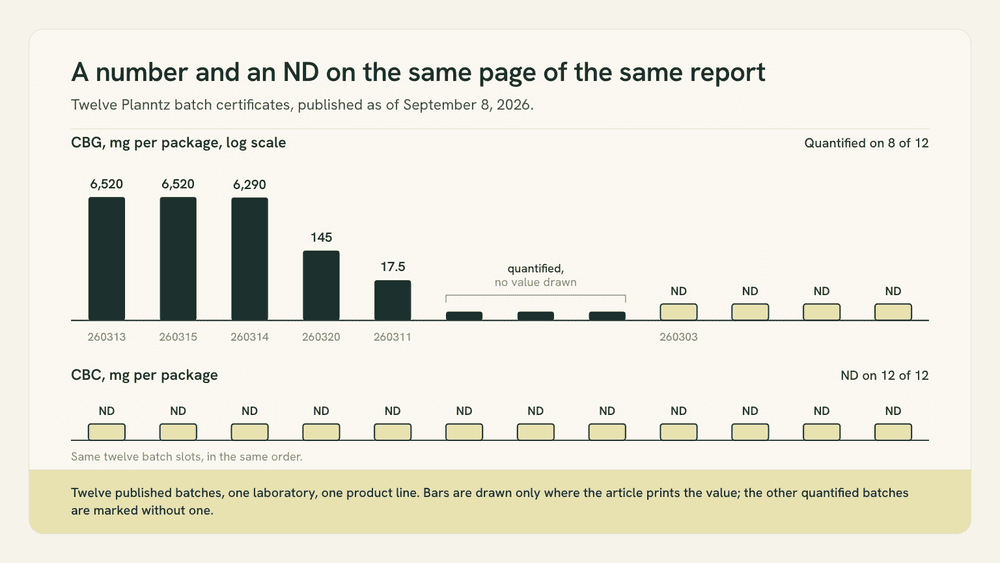
We can only speak for our own bottles, so here is what they say. Every Planntz tincture ships with a batch certificate from Infinite Chemical Analysis Labs in San Diego, licence C8-0000047-LIC, run by UHPLC with diode-array detection against a package size of 56.7 g. Cannabigerol and cannabichromene are both named analytes on that potency panel, which means both get a printed result on every certificate, every time, whether or not anything is found. Across the twelve batch certificates published as of September 8, 2026, CBG carries a number on eight of them. Cannabichromene reads ND on all twelve.
| Batch and product | CBG per package | CBC row | CBC limits printed beside it (LOD / LOQ) |
|---|---|---|---|
| 260313, CBD + CBG, Natural | 6,520 mg (106 mg/mL) | ND | 0.111 / 0.333 mg/mL |
| 260315, CBD + CBG, Lemon and Raspberry | 6,520 mg (110 mg/mL) | ND | 0.116 / 0.348 mg/mL |
| 260314, CBD + CBG, Mango and Peach | 6,290 mg (103 mg/mL) | ND | 0.0725 / 0.217 mg/mL |
| 260320, Broad Spectrum, Mango and Peach | 145 mg (2.39 mg/mL) | ND | 0.114 / 0.341 mg/mL |
| 260311, CBD + CBN, Mango and Peach | 17.5 mg (0.290 mg/mL) | ND | 0.114 / 0.344 mg/mL |
| 260303, Full Spectrum CBD, Natural | ND | ND | 0.117 / 0.350 mg/mL |
| All 12 published batches | Quantified on 8 of 12, from 17.5 to 6,520 mg per package | ND on 12 of 12 | Printed per batch, in mg/mL on ten certificates and in mg/g on the other two |
Two readings come out of that table and they point in opposite directions. The CBG column spans roughly 370 fold inside one small product line (6,520 mg against 17.5 mg), and the spread is the entire point: 17.5 mg on a CBD + CBN batch is a trace the plant left behind, while 6,520 mg on a CBD + CBG batch is a formulation decision somebody made on purpose. Those three CBD + CBG batches measured 6,290 to 6,520 mg against a label figure of 6,000 mg, which puts all three above the label rather than below it. The CBC column has no spread at all, because there is nothing in it to spread. That contrast is also why "CBG-rich" and "a CBC product" are not the same kind of sentence. One of them can be a plant decision or a blending decision, both of which leave a paper trail. The other, at any meaningful amount, is neither.
How a report states what it did not find is a document skill of its own, and it is worth learning before you spend money on any minor cannabinoid. One more row on the same page is worth naming and then handing off: CBGA, the acid this entire comparison starts from, also reads ND on all twelve certificates, which is what a decarboxylated extract looks like and which the precursor page linked earlier works through in full. The standing caveat applies to every figure above. These are twelve batches from one laboratory and one product line. They are evidence about those twelve batches and about nothing else in the category, and an ND row is not a quality claim in either direction. For completeness, the CBD + CBG bottle those gram-scale numbers come from is full spectrum, which means measurable trace THC: 0.142 percent on batch 260313, 0.156 percent on 260314 and 0.159 percent on 260315, all below the 0.3 percent federal threshold. What changes when the two cannabinoids are formulated into one bottle is a separate question, covered in our piece on taking CBD and CBG together.
The evidence on each side, counted on the same day
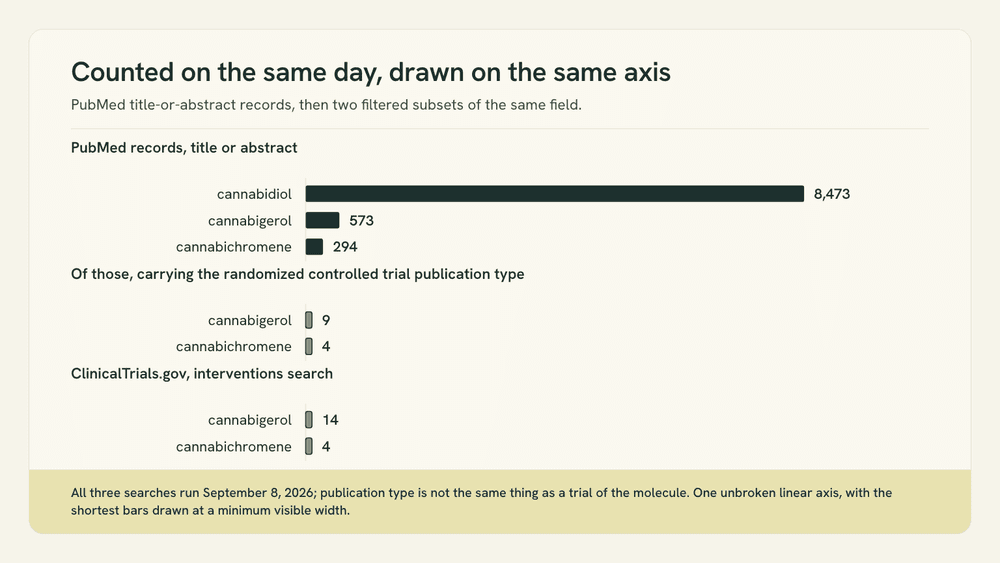
Counts move, so here is the date and the shape of the query. On September 8, 2026, a PubMed title-and-abstract search returned 573 records for cannabigerol and 294 for cannabichromene. For scale, cannabidiol returned 8,473 the same day. Filtered to the randomized controlled trial publication type, CBG returns 9 and CBC returns 4. Filtered to human studies, CBG returns 219 and CBC returns 92. On the trial registry, an interventions search returns 14 records for cannabigerol, and the same search for cannabichromene returns 4. One reading rule matters more than any of those figures: in PubMed, "randomized controlled trial" is a publication type, so what that filter returns are records that mention a molecule, not trials of it. We opened all nine CBG records the same day. One is the 2026 dose-ranging study described below. One is a 2024 placebo-controlled crossover trial of a single 20 mg dose. One is a 2024 human pharmacokinetic study comparing delivery systems. One is a 2023 placebo-controlled trial of a beverage powder combining CBD and CBG. One is a real-world-evidence study of multi-ingredient cannabinoid compositions, which is also one of the four on the CBC side. Two are drug-testing or pharmacokinetic studies of other products, one is a smoked-cannabis pharmacokinetic study, and one is a mouse cachexia study.
The single most useful source on this page was published in 2026 and no page one result cited it on the day we read them. In the Journal of Pharmacology and Experimental Therapeutics, researchers published a single ascending dose human laboratory study of oral cannabigerol. Twelve healthy adults received single doses of 0, 25, 50, 100 and 200 mg of CBG isolate suspended in medium-chain triglyceride oil, with placebo randomized into the dosing sequence and plasma sampled from 0.5 to 8 hours. What it reports: "No drug-related adverse events occurred." Subjective effects were "minimal", with three exceptions the authors name individually, namely significant decreases in self-reported ratings of Jittery and Active at 50 mg, a significant decrease in ratings of Calm at 100 mg, and increases in ratings of Appetite at 200 mg. Pharmacokinetics were dose-orderly, but with "significant individual variability". Liver function tests never exceeded the upper limit of normal after the highest single doses. The authors' own summary is the sentence worth carrying away: CBG was "well-tolerated with no robust pharmacodynamic effects", and "chronic dosing studies are needed".
Read the limits alongside it, because they are large. Twelve people, single doses, healthy adults, one laboratory, an isolate in MCT oil rather than a full-spectrum product, and no replication. One of the authors, Marcel Bonn-Miller, is affiliated with Charlotte's Web Inc., a hemp company, which is disclosed in the paper and belongs in any honest summary of it. What that study does is measure something carefully. What it does not do is establish a property of the molecule that you can carry across into a bottle on a shelf.
That is not the only human trial on the CBG side, and the other one points somewhere the marketing vocabulary does not. In 2024, Scientific Reports published a double-blind, placebo-controlled crossover field trial of a single 20 mg dose of hemp-derived CBG in 34 healthy adults, run at home over video calls with a one-week washout between the two sessions. Against placebo it reported lower ratings of anxiety overall and lower stress at one timepoint, better verbal memory, and no evidence of subjective drug effects or impairment, and its authors conclude that CBG "may represent a novel option to reduce stress and anxiety in healthy adults". Read the design with it: 34 people, one 20 mg dose, self-reported measures collected at home, healthy volunteers, and no replication. Our comparison of CBG against CBD works through that trial in full. None of it is a measurement of CBC.
The third piece of the CBG record is a survey, and its design is the whole story. In 2022, Cannabis and Cannabinoid Research published a survey of 127 US adults who had used CBG-predominant cannabis preparations in the previous six months. It is a self-selected online survey of people who had already chosen the product, so what it measures is what those respondents believed and reported, not what the molecule did. Their most common reported reasons for use were anxiety at 51.2 percent, chronic pain at 40.9 percent, depression at 33.1 percent and insomnia or disturbed sleep at 30.7 percent. That is a record of what people said they were using it for, not evidence that CBG does any of it, and the authors' own conclusion is that CBG-predominant preparations "should be studied in randomized controlled trials". The vocabulary this search result runs on does not appear on the list at all. Two more things belong beside it. All four authors of the 2024 trial are also authors of this survey, so the two documents are not independent readings of the field. And the survey's first author gives his affiliation as CReDO Science rather than a university, while the paper's disclosure statement records advisory relationships for two of the other authors and states that the rest declare none.
On the CBC side of the ledger there is no equivalent to weigh. Of the four PubMed records carrying the randomized-trial publication type, not one gave cannabichromene on its own: every one of them gave it alongside at least one other cannabinoid, which is why nobody can say what the molecule did by itself. The page that reads those four records one by one states what participants actually received in each. The most recent preclinical work that puts these molecules into the same experiment is a 2026 study comparing four minor cannabinoids on cultured mouse sensory neurons (Rabl and colleagues, PMID 42139799). That is the design, and it is all we will say about it here, because the result belongs to our CBG and CBN comparison, which covers it properly. Cultured mouse neurons at micromolar concentrations are not a person taking a tincture, in either direction.
Where energizing and calming came from, and what was actually measured
Read the pages on this search result side by side and a vocabulary appears that is remarkably consistent and remarkably unsourced. CBG is described as energizing, clarifying, motivating and alerting. CBC is described as calming, balancing, grounding and mood-brightening. Those eight words are doing an enormous amount of work, and none of the pages using them attaches a single one to a study. On the CBC side there is nothing available to attach, because none of the studies those searches return gave the molecule on its own. On the CBG side there are two small placebo-controlled trials, and neither supports the split, because what they measured points across the aisle rather than along it.
Set that vocabulary against what was actually measured. In the 2024 crossover trial, the molecule this search result calls energizing is the one that produced lower anxiety and stress ratings than placebo, at a single 20 mg dose in 34 people, which is the job page one hands to the other molecule. In the 2026 dose-ranging study, at 50 mg what reached significance was a decrease in self-reported ratings of Jittery and of Active, at 100 mg a decrease in ratings of Calm, and at 200 mg an increase in ratings of Appetite. Those are measured changes on named self-report scales, at single doses, in small samples, and they are not properties of cannabigerol. We are also not going to flip them into the opposite marketing sentence, which would be just as unsupported: a decrease in ratings of Active is not "CBG is not energizing", and a decrease in ratings of Calm is not a claim about anything. Two small trials landing on different scales in different directions is what an evidence base looks like before it settles, and the honest reading of each is the one its own authors published.
“Cannabigerol is well-tolerated while yielding few pharmacodynamic or psychoactive effects.”
Regulatory status is the other thing worth stating once and then leaving alone. Neither molecule is an active ingredient in any approved drug. FDA's own page on cannabis and cannabis-derived products says the agency has approved Epidiolex, which contains "a purified form of the drug substance CBD", for seizures associated with three named conditions, and answers the obvious follow-up plainly: "There are no other FDA-approved drug products that contain CBD." A query of the Drugs@FDA data on September 8, 2026 for products with cannabigerol or cannabichromene as an active ingredient returns no match for either. That is a database result rather than a verdict. It does not mean anyone reviewed and rejected either molecule, and it says nothing at all about whether they are legal to sell.
Sourcing: one has a published breeding route, the other usually has a reactor
There is a real asymmetry in how a concentrated version of each molecule can exist at all, and it is the most practical thing on this page. For CBG, a plant that is rich in it is an achievable genetic outcome with a published molecular marker: a 2021 paper in Genes describes CBGA dominance as inherited as a single recessive gene, potentially governed by a non-functioning allelic variant of the THCA synthase (Garfinkel and colleagues, PMID 33557333), and all three of its authors give a hemp breeding company as their affiliation, which belongs in the same sentence. We are not rebuilding that genetics here, because the CBG chemovar story lives on the CBG and CBN page. For CBC there is no published equivalent: no marker, no commercially dominant CBC chemovar at scale. So when a product is sold on a gram-scale CBC number, the useful question is not which farm grew it. It is which reaction made it, and that is a question worth asking a seller out loud before you pay.
That question also has a calendar attached to it in the United States, and here we state dates and stop. Section 781 of Public Law 119-37 rewrites the federal hemp definition, and a later section of the enrolled text of H.R. 6500 split its arrival into two dates. The operative sentence reads: "Until December 11, 2026, the amendments made by section 781 of division B of Public Law 119-37 (7 U.S.C. 1639o note) shall only apply with respect to products described in paragraphs (1)(C)(ii)(I) and (1)(C)(iv)(I) of section 297A of the Agricultural Marketing Act of 1946 (7 U.S.C. 1639o) (as amended by such section 781)." In practice one piece is in force from November 12, 2026, the exclusion for cannabinoids not capable of being naturally produced by a Cannabis sativa L. plant, and the rest arrives on December 11, 2026, including the total-THC standard and a 0.4 mg combined total per container ceiling on finished products. How any of that will be applied to any specific converted minor cannabinoid is unresolved, the relevant agency lists do not exist yet, and anyone telling you confidently what it will mean for a particular bottle is ahead of the record. What moved, what did not, and what is still missing is covered separately, and none of this is legal advice.
Seven lines to run on any CBC or CBG product
- 1Is the molecule a row on the potency panel at all? A certificate that never names cannabichromene or cannabigerol as an analyte cannot tell you whether either is in the bottle. It can only tell you what the laboratory was asked to look for.
- 2Does that row carry a number or an ND? An ND with a printed quantitation limit beside it is a real answer, and it is a different answer from a molecule the panel never tested for. Both beat any sentence on the product page.
- 3Is the batch on the certificate the batch in your hand? A certificate for a different batch is a document about a different jar, however good the numbers printed on it happen to be.
- 4Do the units match what you are comparing? Certificates print mg per package, mg/mL and mg/g, and the three are not interchangeable. Our own CBG column runs from 17.5 mg to 6,520 mg per package, so scale here is not a rounding detail.
- 5Does the seller name a conversion step anywhere? For CBG there is a published breeding route to a plant that is rich in it. For CBC there is not, so a gram-scale CBC figure deserves a straight answer about where that molecule came from.
- 6Does any effect claim name a study, a species and a year? Energizing and calming name none of the three. If a page cannot tell you who measured what, in whom, and when, treat the sentence as advertising copy rather than as a finding.
- 7Does the price track the milligrams? Work out the cost per milligram of the named minor cannabinoid, not the price per bottle. A bottle carrying 6,000 mg of a minor cannabinoid and one carrying 60 mg are not the same product.
What this comparison cannot settle
Here is what is not known, stated plainly, because on this topic the honest limits are most of the answer. No head-to-head human study of CBC against CBG turns up in any of the searches printed above, at any dose, in any population, for any outcome, which means any page that ranks them is ranking them on something other than a measurement. The dose-ranging study of oral CBG is twelve people taking single doses in one laboratory. The crossover trial is 34 people taking one 20 mg dose at home. Neither has been replicated, and the two did not move the same scales in the same direction. The survey is a survey: 127 self-selected respondents describing what they believed about a product they had already bought, and all four authors of the 2024 trial are on it too. And on CBC the record is thinner still, because none of the studies those searches return gave the molecule on its own.
The preclinical work has its own ceiling, and it is worth naming because that is where most of this page's certainty comes from. Every structural, enzymatic and cellular source here is non-human by design: proteins crystallized after being expressed in a yeast, an enzyme assay from 1998, a photochemistry paper from 1968, cultured mouse neurons. Those describe how the plant works and how molecules behave under controlled conditions. They do not describe what happens when a person swallows a tincture. Our certificates have a ceiling too: twelve batches, one laboratory, one product line, and those twelve say nothing about anybody else's bottle. The regulatory question about cannabinoids made outside the plant is genuinely open, with two dates on the calendar and no published agency lists behind them. And if the whole family tree these names belong to is what you actually came for, the map of the cannabinoid family is the better place to start than any two-way comparison.
CBC vs CBG: frequently asked questions
Structurally and biosynthetically, the difference is one enzymatic step, and the step runs one way. Cannabigerolic acid, the acid form of CBG, is the raw material that cannabichromenic acid synthase converts into the acid form of CBC, which then loses its carboxyl group and becomes CBC. The 1998 paper that purified the enzyme reported a higher Vmax for cannabigerolic acid than for the alternative substrate, and concluded that cannabichromenic acid is predominantly formed from cannabigerolic acid. So CBG is not a peer of CBC on a menu. It is the material CBC is made from, and everything else on this page, including why both are scarce and why one of them shows up on a lab report, follows from that.
Neither is THC. For CBG there are two measurements and they agree on this point. A 2026 dose-ranging laboratory study gave 12 healthy adults single doses of 25 to 200 mg of CBG isolate and concluded that it was well tolerated while yielding few pharmacodynamic or psychoactive effects. A 2024 placebo-controlled crossover trial of a single 20 mg dose in 34 adults reported no evidence of subjective drug effects or impairment. Both are small, neither has been replicated, and neither used a Planntz product. For CBC there is no comparable measurement at all, because nothing in the published record we searched gave the molecule on its own, so the honest answer is that nobody has run the experiment. Our comparison of CBC and CBD goes through the CBC human record in detail, record by record.
That question assumes a time-of-day property that neither molecule has been shown to have. What is on the record is narrower and does not line up with the marketing split. In the 2026 dose-ranging study of oral CBG, the significant subjective changes at 50 mg were decreases in self-reported ratings of Jittery and Active, at 100 mg a decrease in ratings of Calm, and at 200 mg an increase in ratings of Appetite, with the authors concluding no robust pharmacodynamic effects overall. In a 2024 crossover trial, a single 20 mg dose produced lower anxiety and stress ratings than placebo in 34 healthy adults. Those are measured changes on named scales at single doses in small samples, not a schedule, and we are not going to turn them into one. For CBC there is nothing at all to compare against.
For most bottles the question is moot, and the certificate is what tells you so. On the twelve batch certificates we publish, cannabichromene reads ND on all twelve while CBG carries a number on eight of them, ranging from 17.5 mg to 6,520 mg per package. So on our own line the answer is that one of the two is simply not there, and the way to check anybody else's is the potency panel for the batch code on your bottle rather than a claim on the label. What happens when two cannabinoids are deliberately formulated into the same bottle is a separate question, and we cover it on our page about taking CBD and CBG together.
Three reasons, in order of how much they matter. First, the plant barely commits to it: the published reading of a 2022 analysis of commercial flower samples is that the CBC synthase does not appear to be selective for CBC production, so the genes are there and the measured amounts are not. Second, there is no published breeding route to a CBC-dominant plant, while CBG has one with a molecular marker described in 2021. Third, CBC has an extra exit that CBG does not: a light-driven reaction described in 1968 converts cannabichromene into cannabicyclol, a different molecule. Nothing in that 1968 paper tells you how fast the reaction runs, so treat any shelf-life claim built on it with suspicion.
It is not three peers either. CBD and CBC are two of the three things the plant makes out of CBG's acid form, and THC is the third, so a three-way table quietly puts a precursor next to two of its own products. The useful way to read that comparison is as one parent and its children, which is also why the scarcity story is different for each of them. Our pages on CBG versus CBD and on CBC versus CBD take the two-way comparisons in full, and the cannabinoid family map is the place to see how all of them connect.
If one habit is worth taking away from this page, it is reading the row instead of the headline. Every certificate we publish is posted batch by batch at our lab results page, with the ND rows printed beside the quantified ones and the quantitation limit printed beside both. Find the CBG line, find the CBC line, and read the numbers next to them. That works on our documents, and it works just as well on everybody else's.
The CBG row, on a real batch report
Our Full Spectrum CBD + CBG tincture is 60 mL in coconut MCT oil, with 9,000 mg CBD and 6,000 mg CBG on the label, and every batch certificate is published in full, including the rows that read ND. It is full spectrum, so it carries trace THC below the 0.3 percent federal threshold.
Browse the Planntz tincturesWriting about hemp, wellness and the small rituals that keep us balanced.