CBD and CBG Together: What You Are Actually Buying When Two Cannabinoids Share One Bottle
For almost everyone who asks, taking CBD and CBG together means one bottle with two numbers on it and a ratio you cannot change after you buy it. Here is the arithmetic on two batch certificates, what has actually been measured in people, and a check you can run on any blend.
For almost everyone who searches for CBD and CBG together, the question is not really about pharmacology. It is about one bottle with two numbers on it. Hardly anybody stacks two separate tinctures; they buy a blend, and a blend is a fixed ratio that stays fixed for the life of the bottle. So the pharmacology answer is short, because very little of it has been measured in people, and the arithmetic answer is long, because it decides exactly what you get. This page does that arithmetic on two real batch certificates, prints the dated searches behind every claim about what has and has not been studied, and gives you a check you can run on any brand's blend before you pay for it.
Here is the short version, up front. People do take these two cannabinoids together, and in practice that means one product rather than two. No published trial has given CBD and CBG to people on their own. In the PubMed and registry searches we ran on August 26, 2026, printed further down this page so you can re-run them, exactly one randomized, placebo-controlled trial has given human volunteers a named CBD-and-CBG product, and that product contained five ingredients. The part nobody prints is not about effects at all. A blend does not add the second cannabinoid on top of the first. It substitutes. On two of our own batch certificates the CBD line falls by roughly as much as the CBG line rises, at a nearly unchanged total. That is a trade, not a bonus, and it is neither an upgrade nor a downgrade. It is a different formulation.
What taking CBD and CBG together actually means when you buy it
There are two ways to take two cannabinoids at once, and only one of them is common. You can buy two separate tinctures and take both, which keeps the proportion in your hands and doubles what you are paying attention to. Or you can buy one bottle that already contains both, which is what a shop means when it sells a CBD and CBG oil. Almost everyone does the second thing. That single choice is what makes this a shopping question rather than a chemistry question: the moment you buy a blend, somebody else has already decided the proportion between the two cannabinoids, and nothing you do afterwards changes it. Take more and you take more of both. Take less and you take less of both. If you want the family tree behind the names, our overview of the cannabinoids the plant actually makes covers it, and the difference between a cannabinoid that turns up in every extract and one that has to be formulated in is the subject of major versus minor cannabinoids.
So the useful questions are not the ones page one answers. They are: how much of each cannabinoid is in there, what did the first cannabinoid give up to make room, and does the batch certificate agree with the box. Neither CBD nor CBG is intoxicating, and a full-spectrum blend still carries the trace THC that any full-spectrum extract carries, which federal law caps at 0.3% delta-9 THC. Everything else on the label is arithmetic, and arithmetic is checkable.
The subtraction two certificates print
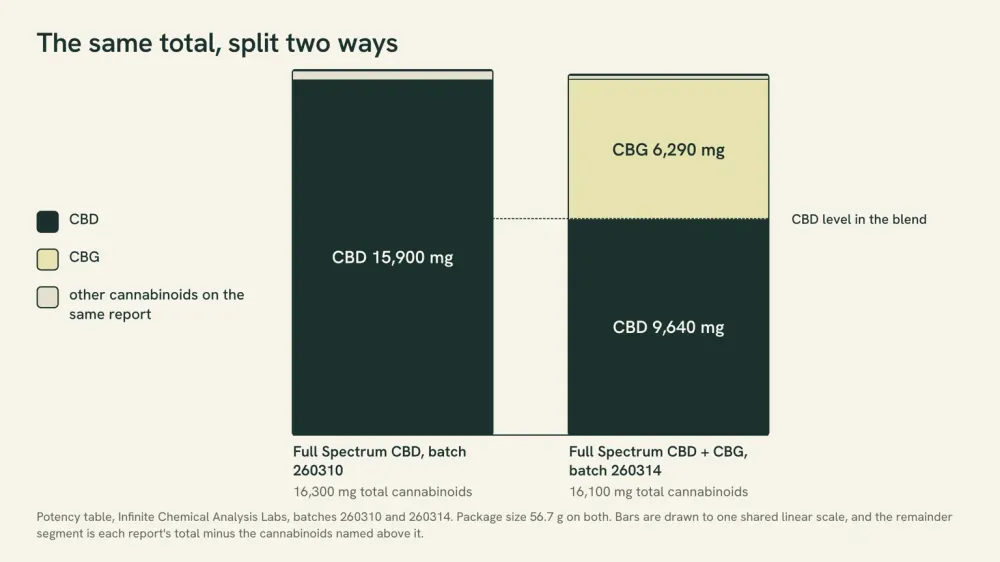
This is the paragraph nobody on page one writes, and you do not need a calculator for it. Take two Planntz bottles of the same flavor, the same 60 mL size, tested by the same laboratory: one is Full Spectrum CBD, the other is Full Spectrum CBD + CBG. Their labels say 15,000 mg of CBD in the first and 9,000 mg of CBD plus 6,000 mg of CBG in the second, which is 250 mg/mL against 150 mg/mL and 100 mg/mL. Now read what the certificates measured. Every figure in the table below is printed on the report itself, not derived by us.
| Row on the certificate | Full Spectrum CBD, batch 260310 | Full Spectrum CBD + CBG, batch 260314 |
|---|---|---|
| CBD | 15,900 mg per package (267 mg/mL) | 9,640 mg per package (158 mg/mL) |
| CBG | ND | 6,290 mg per package (103 mg/mL) |
| Total cannabinoids (potency table row) | 16,300 mg per package | 16,100 mg per package |
| Package size | 56.7 g | 56.7 g |
Now do the one subtraction those two documents allow. 15,900 minus 9,640 is 6,260 mg of CBD that is not in the second bottle, against 6,290 mg of CBG that is. The total cannabinoid line moves from 16,300 to 16,100. The CBG did not arrive on top of the CBD. It took the CBD's place. Three honest caveats travel with that sentence. These are two certificates from two different production runs of the same flavor, not one bottle measured twice. The near-match between 6,260 and 6,290 is the shape of a formulation decision rather than any law of nature. And the second report disagrees with itself about its own total: its potency table prints 16,100 mg per package, its summary box prints a Sum of Cannabinoids of 16,100 and a Total Cannabinoids of 16,200, while on the first report every one of those fields reads 16,300. We are printing the potency table's line for both, naming it, and leaving the 100 mg gap where the laboratory left it, because the argument does not depend on which total you take: roughly 6,260 mg of CBD is missing either way. If you want the per-drop version of this arithmetic, that lives on our drop-by-drop CBD calculator, and the molecule-by-molecule comparison of the two cannabinoids lives on CBG versus CBD. This page stays on the bottle.
How to read the ratio off any blend
The number that defines a blend is the ratio between its two cannabinoids, and almost no brand prints it. You can get it off any front panel in about thirty seconds, and the same five steps work on any brand's bottle, not just ours.
- 1Find the total milligrams of each cannabinoid on the front panel. A blend prints two numbers. Ours reads 9,000 mg CBD and 6,000 mg CBG.
- 2Divide each total by the bottle volume to get a concentration. In a 60 mL bottle those two figures come to 150 mg/mL of CBD and 100 mg/mL of CBG.
- 3Divide the two concentrations by each other. 150 divided by 100 is 1.5, so that label describes a 3:2 blend by mass. That is the ratio, and it is fixed.
- 4Compare the CBD concentration with the same brand's single-cannabinoid bottle. Ours is 250 mg/mL of CBD on its own, so the blend carries 100 mg/mL less CBD. That difference is the trade you are making, and every brand's version of it is different.
- 5Open the batch certificate for the code printed on your bottle and confirm both cannabinoids appear, at roughly the label figures. A blend that names a cannabinoid it cannot show you on a certificate has named a marketing ingredient.
Two footnotes on that arithmetic. First, a ratio is a formulation fact, not evidence that the ratio does anything: it tells you what is in the bottle and nothing at all about what happens next. Second, a label ratio is a mass ratio, while research papers usually speak in molar ratios, and for these two molecules the two are almost the same number. CBD has a molecular weight of 314.5 and CBG comes in at 316.5, so 150 mg/mL of CBD is 0.4769 mmol/mL and 100 mg/mL of CBG is 0.3160 mmol/mL. Divide those and you get 1.51, against a mass ratio of 1.50: close enough that the two ways of writing a ratio land on the same figure. That is a convenience of chemistry, not a finding. For the rest of what a multi-cannabinoid front panel is telling you, see how to read a CBD label, and for the certificate itself, how to read a COA.
What the certificate says the ratio actually was
Here is something you will not find on page one, or on most brand sites: the ratio printed on the box is a target, and the ratio on the certificate is a measurement, and they are not the same number. Divide the CBD figure by the CBG figure on each of our three CBD + CBG certificates and you get 1.53, 1.47 and 1.44, against a label ratio of 1.50. Those are three different flavors, which means three separate production runs, not three runs of one recipe, so the spread is not a trend in anything. We are not calling it good or bad. It is simply what a real ratio looks like once a laboratory measures it, and it is the reason a ratio deserves to be read off a certificate rather than believed off a box.
What has actually been measured in people
Now the evidence, and the honest way to size it is to count. On August 26, 2026 we ran the searches. A PubMed search for "cannabigerol" across all fields returns 668 records; restricted to title and abstract it returns 568, against 8,439 for "cannabidiol" in the same two fields. Adding the clinical-trial publication type to cannabigerol returns 9 records, and adding cannabidiol plus the human subject heading returns 5. Those counts move, so any refresh has to re-run them and reprint the date. Note which direction the asymmetry runs: CBG is not the better-studied of the two, and nothing here supports treating it as gentler or safer because it is less familiar. We opened all nine of those clinical-trial records by title instead of stopping at the number, because a count tells you nothing about what is in the set.
| What the participants received | How many of the nine | Where those records were published |
|---|---|---|
| CBD and CBG as the named pair, inside a five-ingredient formula | 1 | J Int Soc Sports Nutr 2023 |
| CBG on its own, as a single dose | 2 | Sci Rep 2024; Cannabis Cannabinoid Res 2024 |
| CBG alongside other cannabinoids, with no CBD-plus-CBG arm | 1 | Clin Ther 2026 |
| A broad-spectrum CBD product containing trace CBG | 1 | Med Sci Sports Exerc 2026 |
| Cannabis or CBD, with CBG only measured afterwards in urine or blood | 3 | Drug Test Anal 2022; Clin Chem 2016; Clin Chem 2017 |
| Nothing: the participants were 66 male rats | 1 | J Cachexia Sarcopenia Muscle 2019 |
So one record in that set gave people CBD and CBG as a deliberate pair, and it is worth characterizing properly. Peters and colleagues, publishing in 2023, ran a randomized, double-blind, placebo-controlled, repeated-dose pilot study in 40 exercise-trained adults, who took the formulation twice a day for 3.5 days. The formulation was not CBD and CBG. It was CBD 35 mg, CBG 50 mg, beta-caryophyllene 25 mg, branched-chain amino acids 3.8 g and magnesium citrate 420 mg, and those figures are a description of what was tested, not a suggestion of any kind. Five ingredients means nothing measured in that trial can be assigned to CBD, to CBG or to the pair. Its authors describe it as testing safety, tolerability and preliminary effects; its primary outcome was reported with an 85% confidence interval rather than the conventional 95%; adverse events were one in the active group and two on placebo; compliance was 100% and self-reported. It was funded by Canopy Growth Corporation, and five of its seven listed authors give Canopy Growth as their affiliation, with one of the other two at a different hemp company and one at a university. We are deliberately not repeating what it reported about its outcome, because a five-ingredient sachet cannot tell you about a two-cannabinoid tincture. If the underlying question is exercise recovery, the state of that evidence sits on our page about CBD and recovery, where it can be judged on its own terms.
Four registered studies, and not one tests just the two
Published papers are only half the picture, so we read the registry too. Querying ClinicalTrials.gov on August 26, 2026 for interventions naming both cannabigerol and cannabidiol returns 4 records (cannabigerol alone returns 14). None of the four has posted results. What makes them interesting is not their subject matter, which is clinical work in patient populations under medical supervision and is not what a shopper is buying. It is their composition, which you can read off the record in under a minute.
| Registry record | What the active arm receives | Control arm | Status and results |
|---|---|---|---|
| NCT07769164 | Three multi-ingredient formulas, every one containing THC alongside CBD, CBG and CBN, one also melatonin | Two placebo arms | Completed August 2024, registered August 2026, no results posted |
| NCT07016971 | A commercial high-CBG and CBD hemp extract oil that also contains CBC, sublingual, 12 weeks | None: single-arm, open-label | Recruiting, estimated completion 2029, no results posted |
| NCT04989413 | Up to CBD 133 mg plus CBG 66 mg plus THC 4 mg a day, split into two doses, 12 weeks | Placebo, quadruple-masked | Terminated, no results posted |
| NCT07592390 | A full-spectrum oil containing CBG 30 mg/mL, CBD 30 mg/mL and THC 3 mg/mL, 12 weeks | Placebo (MCT oil) | Recruiting, no results posted |
Read that table as a reader tool rather than as trivia. Three of the four add THC to the mix, one adds CBC, one adds melatonin, and one has no control arm at all. Which means that even in the research pipeline, nobody is currently testing CBD and CBG on their own against a placebo. Counting the arms on a registry record takes about thirty seconds and it is the single most useful check on any claim about a combination: if the active arm has four ingredients, the result belongs to the formula. One of the four, NCT04989413, stopped early, and its record explains why in its own words: "an interim analysis to rule out futility was positive, we completed active patients and stopped recruitment with 75 patients enrolled." We are quoting that rather than interpreting it, and we will note one thing without resolving it: the same record's enrollment field reads 110 actual. The record disagrees with itself, and until results are posted neither number is worth leaning on.
This is usually the point where an article invokes the entourage effect, and we are going to do it in one paragraph and move on. The phrase comes from a body of work whose best-known paper, Ethan Russo's 2011 review in the British Journal of Pharmacology, states its own central proposition conditionally: phytocannabinoid-terpenoid synergy, if proven. The author's listed affiliation on that paper was a pharmaceutical company developing cannabis medicines. More usefully, "entourage effect" is not one claim but three, and they need separate evidence, which is why the entourage effect and its three claims have a page of their own. Whatever you conclude there, it does not change anything in the section above: the pair itself has not been isolated in a trial.

The cell-culture paper page one is quoting
Search this topic and you will meet a sentence about a laboratory study of cancer cells being used to explain why a wellness blend is a good idea. The paper is real: a 2021 report in the journal Cells, on a laboratory glioblastoma-therapy question, run in human cell lines and stem-cell lines in dishes, with cannabinoids applied at 0.16 to 50 micromolar for 48 hours and read out with a standard viability assay. That is the entire model: cells in plastic, no animal and no person, on a clinical question that has nothing to do with anything you can buy, and nothing in it is a reason either to buy or to avoid a tincture. What is worth knowing is what the paper actually concluded, because it is the opposite of the sentence built on it. The authors ran a fractional inhibitory concentration analysis, on a scale where a value under 0.5 is called synergy and 0.5 to 4 is called additivity, and wrote: "FIC analysis revealed that CBD:CBG combinations resulted in an additive response in both GB cells and GSCs." Those two abbreviations are the two kinds of cell in the dish. Their Discussion says it again, calling the effect "additive, but not synergistic". So the paper being used to argue that these two cannabinoids amplify each other reports, in its own words, that in this experiment they did not.
Two more details from that paper are worth carrying, because they show why a dish cannot set a ratio for a bottle. First, the CBD to CBG ratio the paper calls optimal flipped depending on which cells were in the dish: 1:4 in the differentiated cell lines and 3:1 in the stem-cell lines, and the authors describe the first ratio as suboptimal for the second cell type. A ratio that reverses between two dishes in one paper cannot be read off a label as an effect. Second, the concentrations. The paper's half-maximal values in the differentiated lines were 22.0 micromolar for CBD and 28.1 micromolar for CBG. Multiply those by the molecular weights and, converting ourselves because neither document prints the result, 22 micromolar of CBD is roughly 6,900 ng/mL. For scale, a phase 1 study of purified pharmaceutical CBD reported a peak plasma concentration of 732.4 ng/mL on the first evening of its 750 mg twice-daily arm, in nine healthy adults taking 1,500 mg a day of a prescription-grade drug that is not a tincture. The concentration in the dish is therefore around nine times the highest peak measured in that arm, and a bath concentration and a blood concentration are not the same quantity in the first place. The cell paper also discloses funding from a pharmaceutical company, with one author affiliated to it.
Three things that do change when a second cannabinoid is on the label
None of the above means a blend and a single-cannabinoid bottle are the same object. Three things genuinely change, and all three are checkable rather than promissory.
- The concentration changes. At a similar total cannabinoid load there is less CBD in each milliliter, because the second cannabinoid occupies part of the total. That is arithmetic, not a value judgment.
- What a laboratory can find in you changes. In a 10-week study of 36 adults, 31 taking a broad-spectrum CBD product at 150 mg a day, CBG was detected in 42% of pre-exercise and 74% of post-exercise urine samples, and in none at baseline.
- The unanswered questions do not shrink. Nearly all the human interaction research concerns cannabidiol. Adding a second cannabinoid does not resolve those questions, and it does not create answers about the second cannabinoid either.
The urine finding comes from a 2026 randomized study in Medicine and Science in Sports and Exercise, and three limits travel with it: 31 of the 36 adults took the active product and only 5 took placebo, the product was a broad-spectrum CBD oil carrying trace CBG rather than a blend, and detecting a molecule in urine says nothing about what it did. It matters mainly to people who get tested, since anti-doping rules treat cannabidiol differently from the other cannabinoids. Our page on CBD and anti-doping rules carries the actual wording and the caveats, including the plain fact that no product can guarantee a test outcome. On the medication question, the framework, the enzymes and the drug categories are set out on CBD and medications, and the short version is the one worth acting on: if you take prescription medicine, ask your pharmacist or physician before adding any cannabinoid, blend or otherwise.
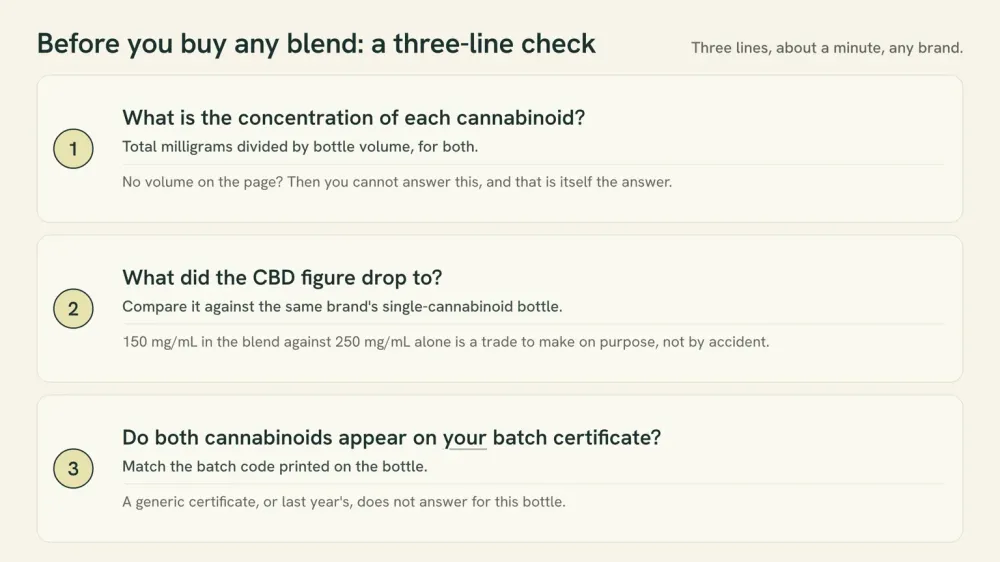
Before you buy any blend: a three-line check
You can run this on any brand, in about a minute, standing in a store or looking at a product page. It is deliberately not about effects, because effects are the part nobody can verify for you.
- 1What is the concentration of each cannabinoid? Total milligrams divided by bottle volume, for both. If the page gives you a total for the bottle and no volume, you cannot answer this, and that is itself the answer.
- 2What did the CBD figure drop to? Compare it against the same brand's single-cannabinoid bottle. A blend at 150 mg/mL of CBD beside a plain bottle at 250 mg/mL is a trade you should make on purpose, not by accident.
- 3Does the batch certificate show both cannabinoids, at roughly the label figures, on your batch code? Not a generic certificate, not last year's, not a summary graphic. The batch on your bottle.
That third line is where most blends fail, and it is the only one of the three that a brand controls entirely. Ours are posted per batch and per flavor, so you can pull the batch certificate for the bottle and read the two cannabinoid rows for yourself, exactly as we did in the table above. Run the same check on whatever you are comparing us against. If a brand names a cannabinoid on the front and cannot show it to you on a current certificate, the number on the front is a claim, not a measurement.
What this page cannot tell you
The honest limits are large and worth stating plainly. No published trial has given CBD and CBG to people on their own, so there is no human evidence about what the pair does that is separable from the formulas it has been tested inside. There is therefore no basis for choosing one ratio over another, which is why you will not find one here. CBG's own human record is thin: only two of the nine records above gave people CBG on its own, and one of them is a double-blind, placebo-controlled crossover field trial in 34 healthy adults run at home with a single 20 mg dose. One small crossover trial is a starting point, not a conclusion. What it measured, and how the two cannabinoids compare on evidence rather than on marketing, is laid out on our CBG and CBD comparison; the molecule itself, and why the plant makes so little of it, is covered separately. Our certificates are evidence about our bottles and about nothing else in the category. And nobody, including us, can tell you which formulation suits you: that part is genuinely unknown, and any page that pretends otherwise is selling you the pretense.
Questions people ask about CBD and CBG together
People do, and in practice it means one bottle rather than two. Neither cannabinoid is intoxicating, and a full-spectrum blend carries trace THC exactly as any full-spectrum extract does, under the same 0.3% delta-9 federal ceiling. The honest limit is that as of August 26, 2026 no published trial has given people CBD and CBG on their own, so the human safety record for the pair specifically rests on a single 40-person, 3.5-day pilot of a five-ingredient formula. If you take prescription medication, that is a conversation to have with your pharmacist or physician first, and our article on CBD and medications explains why.
Nobody can tell you, and the pages that hand you 1:1 or 2:1 are not citing anything. The one paper on that search page that did optimize a CBD to CBG ratio ran the experiment in cell culture and reached opposite answers in two cell types, 1:4 in one and 3:1 in the other, which is a good demonstration that a ratio is not a property you can transfer from a dish to a bottle. A ratio is a formulation fact. We publish no recommended ratio and no serving.
Yes, and that is the part nobody prints. On two of our own certificates the CBD row moves from 15,900 mg per package to 9,640 mg, while the potency table's total cannabinoid line moves only from 16,300 to 16,100. The second cannabinoid took the first one's place rather than being added on top. That is neither better nor worse, it is a different formulation, and the same subtraction is worth running on any brand's pair of bottles.
There is no evidence that answers this, so we will not invent one. The only real difference is control: two bottles let you change the proportion between the cannabinoids, and a blend fixes it for the life of the bottle. If the proportion matters to you, that is an argument for keeping it in your hands. If simplicity matters more, a blend is one thing to keep track of instead of two.
You will find both claimed in the same search, often on the same page. We are not going to assert either direction, because the evidence behind the two sides is not the same kind of evidence and neither is strong enough to carry a promise. Our CBG versus CBD comparison lays out the tally, including a small crossover trial in 34 healthy adults who were given a single dose of CBG on its own.
That is the entourage hypothesis, which is a proposal rather than a finding, and it is really three separate claims that need three separate kinds of evidence. Our entourage effect page splits them up. For this pair specifically, two facts are worth holding on to: the paper those search results point to reports an additive rather than synergistic response, in cells in a dish, and no registered study currently tests the two cannabinoids on their own against a placebo.
Anti-doping rules treat cannabidiol differently from the rest of the cannabinoid class, so a bottle that deliberately names a second cannabinoid is a different object under those rules. In a 10-week study in which 31 adults took a broad-spectrum CBD product and 5 took a placebo, CBG was detected in 74% of the post-exercise urine samples, and that was a product carrying only trace CBG. Detection is not the same as an effect and not the same as a workplace test, and no product can guarantee any test outcome. Our page on CBD in sports carries the actual rule.
If you take one thing from this page, make it the subtraction: two cannabinoids sharing one bottle means the first one gave up room, and the certificate will tell you exactly how much. That check works on every blend on the shelf, including one built around CBN instead of CBG, and if that is the choice in front of you then how CBG and CBN differ is the comparison to read next. Run the arithmetic first, read the batch certificate second, and treat any ratio recommendation you meet along the way as a claim that owes you a source.
Writing about hemp, wellness and the small rituals that keep us balanced.