CBG and CBN With Medications: "Minor" Is a Botany Word, Not a Safety Word
Lab studies show CBG and CBN each affect specific drug-handling enzymes, and not the same ones as CBD. We found no study that gave either to people with a medicine. Here is what is measured, what is only assumed, and what to ask your pharmacist.
If you take a prescription medicine and you own, or are considering, a CBD bottle that also carries CBG or CBN, you have probably read a dozen pages about CBD and your medications and almost nothing about the second cannabinoid in the bottle. This page is about CBG drug interactions and CBN drug interactions specifically: what laboratories have measured for each molecule, what is only assumed from CBD, and what nobody has tested. The organizing idea is simple. "Minor" is a botany word, not a safety word.
Here is the short answer. In laboratory studies, CBG and CBN each change the activity of specific enzymes your liver uses to clear medicines, and the enzymes they affect are not a copy of CBD's. On September 21, 2026, we could not find a single study that gave people CBG or CBN alongside a prescription medicine and measured what happened to the medicine. That does not make either molecule safe with your medication, and it does not make it dangerous. It makes it unmeasured, which is exactly the kind of situation a pharmacist is trained to reason through. This page publishes no dose, no timing rule and no list of drugs that are fine to combine, because the evidence cannot support any of them.
"Minor" describes the plant, not your bottle
Researchers use the word minor for cannabinoids that are less abundant in the cannabis plant than THC and CBD. A 2023 review of minor cannabinoids in Frontiers in Psychiatry defines them exactly that way, lists CBG and CBN among them, and notes that products now deliver isolated minor cannabinoids such as CBG and CBN. That is a statement about how much of a molecule a plant makes. It says nothing about how much of it is in a bottle, and nothing about how active the molecule is at the enzymes that clear your medicines.
Our own bottles make the point better than any definition. Planntz's Full Spectrum CBD + CBG holds 9,000 mg of CBD and 6,000 mg of CBG per 60 mL bottle, and our Full Spectrum CBD + CBN holds 8,000 mg of CBD and 4,000 mg of CBN. Our plain Broad Spectrum and Full Spectrum CBD bottles are a different case: where their certificates detect CBG or CBN at all, the amount is a small fraction of that. The gram-scale blends are the reason this page exists, not a recommendation: we sell a minor cannabinoid in quantities where the word minor stops describing anything, and until now our archive had no page on what that minor might do next to a medicine.
If the word minor has been doing quiet work in your head, our explainer on major versus minor cannabinoids takes it apart; the one line worth borrowing here is that minor describes abundance in the plant, not importance and not amount. For who these molecules are, our CBG profile explains why it gets called the mother cannabinoid, and our CBN profile covers where CBN comes from. If you own a blend, our guide to taking CBD and CBG together handles ratios and certificates. This page stays on one question: what the minor might do next to a medicine.
Two questions hiding inside one
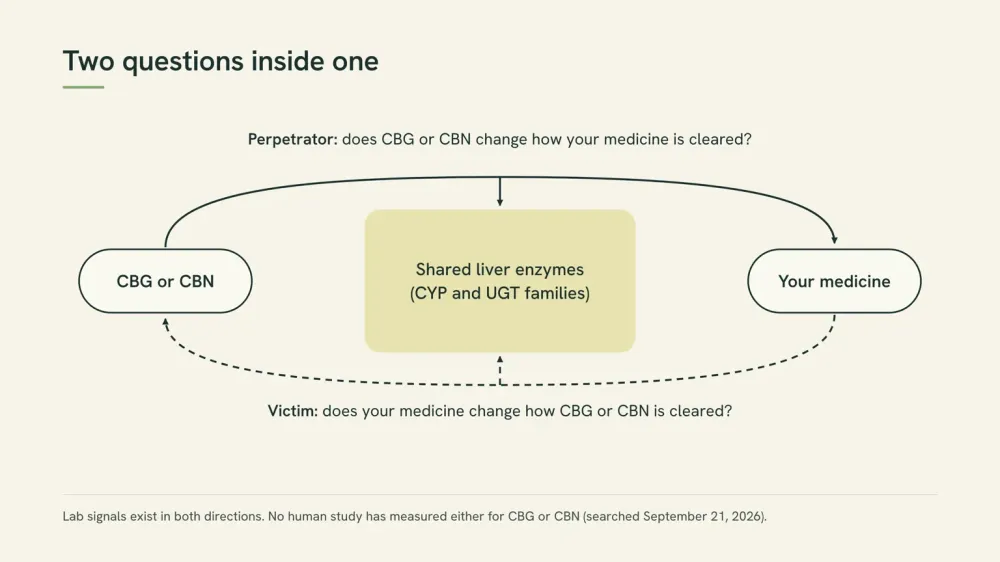
"Does CBG interact with my medication?" is really two questions, and pharmacologists keep them apart. The first is whether CBG or CBN changes how your body handles the medicine: the cannabinoid as perpetrator. The second is whether your medicine changes how your body handles the cannabinoid: the cannabinoid as victim. Most consumer writing on cannabinoids and drugs covers only the first. For a gram-scale minor the second matters too, because a bottle with 6,000 mg of CBG means CBG is the thing being cleared, day after day, by the same enzymes many medicines use. The groundwork, meaning what liver enzymes do, the four ways a CBD and medication interaction can happen and why a grapefruit warning is a flag rather than an answer, lives on our CBD medications page. This article does not repeat it.
- Perpetrator: CBG or CBN slows or speeds up an enzyme that clears your medicine, so the medicine's level could rise or fall. Most of the studies below measure this half.
- Victim: your medicine slows or speeds up an enzyme that clears CBG or CBN, so the cannabinoid's level could change. Almost nobody asks this half, yet both molecules are cleared by mainstream liver enzymes.
One thing that is not an interaction at all is showing up on a drug test. Detection has its own pages, on whether CBG can show up on a drug test and on the CBN drug-test question, and it is a different question from what a cannabinoid does to a medicine.
What has been measured for CBG, all of it in vitro
In vitro means in isolated enzymes, liver tissue preparations or cells in a dish, never in a person. Every CBG enzyme finding below is in vitro, and each comes with what it cannot tell you. Concentrations are given in micromolar (µM), a lab unit; lower numbers mean an effect at smaller amounts in the test tube, not in your blood. The most cited study is a 2021 AAPS Journal screen of twelve cannabinoids against six drug-metabolizing enzymes, run in single recombinant enzymes, which are commercial preparations that each contain one human enzyme. Its abstract reports that CYP2C9 was "inhibited by nearly all the cannabinoids", with estimated inhibition constants of 0.2 to 3.2 µM.
The paper's full text is paywalled, and the word cannabigerol does not appear in its abstract, which also makes it invisible to a title-and-abstract search. So the CBG-specific figure reaches us second hand, and we want to be exact about that. According to two later reviews that tabulate the paper's numbers, the 2026 British Journal of Clinical Pharmacology review of cannabinoid drug interactions and a 2025 review in Frontiers in Pharmacology, CBG inhibited CYP2C9 at around 1 µM, with minimal inhibition of CYP1A2, the caffeine enzyme. The 2023 minor-cannabinoid review reads the same screen as showing that most minors, CBG included, also inhibited or partially inhibited CYP2C19. The test used isolated enzymes, not people. The authors' own conclusion was that in vivo interaction studies "may be justified" for CYP2C9 drugs with a narrow therapeutic index, meaning drugs where a small change in blood level matters. We found none for CBG in people.
On the victim side, a 2022 enzymology study in the journal Biochemistry found that five human cytochrome P450 enzymes, CYP2J2, CYP3A4, CYP2D6, CYP2C8 and CYP2C9, rapidly convert CBG into its major metabolite, cyclo-CBG. That makes CBG a potential victim of any medicine that blocks those enzymes, which is the half of the question almost nobody asks. The same paper saw CBG compete for binding at CYP2D6 and CYP3A4 only in the 10 to 20 µM range, a weak signal, and binding is not the same measurement as slowing the breakdown of an actual drug.
A 2023 study in Toxicology and Applied Pharmacology compared CBD, CBN, CBG and CBC in human liver cells. CBN was transformed fastest, then CBG, then CBC, then CBD. CBG was handled mainly by direct glucuronidation, a second enzyme family (the UGTs, which attach a sugar group so the body can excrete a molecule), rather than by CYP enzymes alone. On the CYP side the study named CYP2B6, CYP2C9, CYP2C19 and CYP2D6 for CBG, and on the UGT side seven enzymes, including UGT1A9 and UGT2B7. Disclosure, in the same breath: one author is a chief executive with financial interests in CB21 Pharma, CBDepot and PharmaCan, another sits on CB21 Pharma's scientific board, and the laboratory was funded in part by CB21 Pharma and CBDepot.
A 2023 Swiss study in Medical Cannabis and Cannabinoids tested four cannabis extracts in pooled human liver microsomes, a lab preparation of liver enzymes. The extract made mostly of CBG inhibited CYP2C9 and CYP3A4 more strongly than the extracts containing both THC and CBD, and the THC-plus-CBD extracts did not match the combined potency of pure THC and pure CBD tested alone. The authors concluded that "it is difficult to foresee" the interaction profiles of such extracts. Pure CBG was not tested, so this is a finding about a CBG-rich extract, not the molecule. One author is a pharmacist who dispenses cannabis preparations, which the paper discloses. For anyone holding a blend, the finding that mixtures did not add up matters more than any single number.
The clearest evidence that CBD's enzyme story does not simply transfer came in 2026. In a Food and Chemical Toxicology study comparing CBG and CBD head to head in liver and skin cells, CBD switched on the AhR pathway, a cellular switch that turns up production of CYP1A enzymes, while CBG had, in the authors' words, "a negligible effect" on it. They call CBG "a poor modulator of the AhR/CYP1A pathway in vitro" and say its effect in the body "remains to be explored". Read that carefully, because it is easy to misread. It is one pathway in a dish, and it does not make CBG gentler than CBD: the same molecule inhibited CYP2C9 in the isolated-enzyme screen above. What it shows is that you cannot read CBG's behavior off CBD's. The study comes from the same research group as the 2023 liver-cell study, with the same disclosed interests in CB21 Pharma, CBDepot and PharmaCan and the same seat on CB21 Pharma's scientific board.
| Study | System | What CBG did | What it does not tell you |
|---|---|---|---|
| AAPS Journal, 2021 | Single recombinant enzymes; 12 cannabinoids, 6 enzymes | Inhibited CYP2C9 at about 1 µM, minimal CYP1A2 inhibition (as tabulated by two later reviews) | Isolated enzymes; CBG value read from reviews, full text paywalled |
| Biochemistry, 2022 | Recombinant CYPs, human liver microsomes | Converted to cyclo-CBG by CYP2J2, 3A4, 2D6, 2C8 and 2C9; weak binding at 2D6 and 3A4 (10 to 20 µM) | Metabolite identity and binding, not a drug's breakdown |
| Toxicology and Applied Pharmacology, 2023 | Human liver cells plus enzyme screen | Mainly glucuronidated; CYP2B6, 2C9, 2C19, 2D6 and seven UGTs involved | In vitro; authors with disclosed cannabinoid-company interests |
| Medical Cannabis and Cannabinoids, 2023 | Pooled human liver microsomes, four extracts | CBG-rich extract inhibited CYP2C9 and CYP3A4 more than THC plus CBD extracts | An extract, not pure CBG |
| Food and Chemical Toxicology, 2026 | Liver and skin cells | Negligible effect on the AhR/CYP1A pathway, unlike CBD | One pathway only; same disclosed interests as the 2023 liver-cell study |
| Journal of Inorganic Biochemistry, 2018 | Recombinant CYP2J2 | Phytocannabinoids including CBG inhibited CYP2J2 | Enzyme mostly outside the liver; the substrate was anandamide, not a drug |
What has been measured for CBN, including where labs disagree
CBN has a longer laboratory record. In a 2010 study in Biochemical Pharmacology using isolated human enzymes, CBN was a more potent inhibitor of CYP1A2 than CBD was, with an inhibition constant of 0.079 µM, while CBD was the stronger inhibitor of the related enzyme CYP1A1. That is a small, concrete example of the two molecules not behaving alike. A 2012 study by the same Japanese group found CBN inhibited CYP2C9 in human liver preparations about as strongly as THC, with inhibition constants of 0.88 to 1.29 µM, and one of the lab probes it used was S-warfarin's own breakdown reaction. That is a laboratory signal, not a measured change in anyone's warfarin.
A 2021 study in Drug Metabolism and Disposition, using engineered cell preparations that each overexpress one human enzyme, found CBN inhibited CYP2B6, CYP2C9 and CYP2E1 at around one to two micromolar; the 2026 review tabulates the values as 2.1, 1.4 and 0.92 µM. The same US laboratory then showed that the CYP family is not the whole story. In a companion paper on glucuronidation enzymes, CBN strongly inhibited UGT1A9, with a binding-corrected value of 0.51 µM in lab preparations, and also strongly inhibited UGT2B7. Most consumer interaction pages we read talk only about CYP enzymes. This is a reminder that the list worth asking about is longer.
Now the part no consumer page we read reports: the laboratories do not agree. CBN inhibited CYP2C9 in the 2012 Japanese study and in the 2021 US study, and it did not in the 2021 Australian screen described in the CBG section, which used single recombinant enzymes. The 2023 minor-cannabinoid review summarizes that screen as "All minor cannabinoids except CBN inhibited CYP2C9." The same screen did find CBN inhibited CYP1A2, at about 1 µM according to the 2026 review's table. Different enzyme systems produce different answers, and we are not going to pick a winner. When the lab record disagrees with itself, nobody can responsibly give you a yes or no.
On the victim side, CBN's own breakdown runs mainly through CYP2C9 and CYP3A4, according to a 2007 study in human liver microsomes, and a 2025 Journal of Medicinal Chemistry paper confirmed CYP2C9 as the main enzyme turning CBN into its dominant metabolite, 11-hydroxy-CBN. So a medicine that blocks CYP2C9 or CYP3A4 could, in principle, raise CBN levels. We found no study that has measured that in a person. With CBN as a possible perpetrator at CYP3A4, the record is thin and indirect: a 2025 structural study in the Journal of Biological Chemistry found CBN caused "only negligible spectral changes" at that enzyme, where THC and CBD produced strong binding signals. Binding and inhibition are different measurements, so that is not proof that CBN leaves CYP3A4 alone, and it is not a human result.
The newest CBN-specific result is the least intuitive. A human liver cell study published online ahead of print on August 28, 2026, in the European Journal of Drug Metabolism and Pharmacokinetics exposed primary human hepatocytes to THC, CBD, CBN or a mixture. Acute exposure to CBD, CBN or the mixture inhibited CYP1A2 activity in a concentration-dependent way. Chronic exposure to CBN and to the mixture at 3 µM produced "a significant (> 2-fold) increase in CYP1A2 activity". The authors saw no major inducing effect on CYP2D6 or CYP2C9. The study did not test CBG, and it is cells in a dish, not a person.
CYP1A2 is the main enzyme that clears caffeine, and our article on CBD and caffeine covers that enzyme in detail. It also clears melatonin. In a 2025 study in mice, CBN inhibited CYP1A2-driven melatonin metabolism and plasma melatonin exposure after an oral dose rose about four-fold. That was mice, and our comparison of CBN and melatonin sets out what it does and does not mean for people.
| Study | System | What CBN did | What it does not tell you |
|---|---|---|---|
| Biochemical Pharmacology, 2010 | Recombinant CYP1 enzymes, liver microsomes | Inhibited CYP1A2 (0.079 µM), more potently than CBD did | A lab constant, not a blood level |
| Drug Metabolism and Pharmacokinetics, 2012 | Human liver microsomes, recombinant CYP2C9 | Inhibited CYP2C9 about as strongly as THC (0.88 to 1.29 µM) | A lab probe reaction, not a patient on warfarin |
| Drug Metabolism and Disposition, 2021 (CYP) | Engineered cell microsomes | Inhibited CYP2B6, 2C9 and 2E1 at about 1 to 2 µM | In vitro only |
| Drug Metabolism and Disposition, 2021 (UGT) | Recombinant UGTs, liver and kidney microsomes | Strongly inhibited UGT1A9 (0.51 µM) and UGT2B7 | In vitro only |
| AAPS Journal, 2021 | Single recombinant enzymes | Inhibited CYP1A2 (about 1 µM); did not inhibit CYP2C9 | Disagrees with the two studies above on CYP2C9 |
| Life Sciences, 2007; Journal of Medicinal Chemistry, 2025 | Liver microsomes, expressed CYPs, metabolite analysis | Cleared mainly by CYP2C9 and CYP3A4 (victim side) | Not measured alongside a medicine in any study we found |
| Journal of Biological Chemistry, 2025 | Binding spectroscopy and crystallography | Negligible binding signal at CYP3A4 | Binding, not inhibition |
| European Journal of Drug Metabolism and Pharmacokinetics, 2026 (online ahead of print) | Primary human liver cells | Short exposure inhibited CYP1A2; chronic exposure at 3 µM more than doubled its activity | Cells in a dish; no CBG arm |
The human record, counted on September 21, 2026
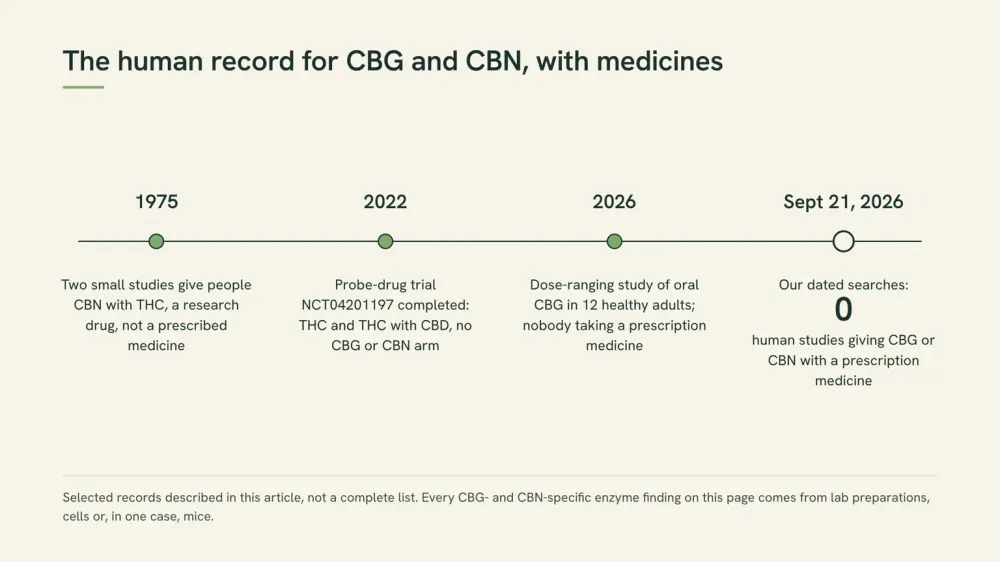
The most recent expert synthesis puts the state of play in one line. The 2026 British Journal of Clinical Pharmacology review, a narrative review of literature from 2018 to 2024, says CBN and CBG, "though less studied, show moderate CYP inhibition in vitro", and then: "Nevertheless, no clinical trials are currently available". Counting is more honest than an adjective, so here are our own counts, each with the day we ran it, so you can rerun them and watch the numbers move.
- PubMed, CBG plus drug-interaction terms, human filter: 3 records. We opened all three: a review, a botanical-extract lab study and an immunotherapy review. None gave people CBG with a medicine.
- PubMed, the same search for CBN: 11 records, including reviews, lab studies, a 1976 study of THC and a sleep review. None gave people CBN with a medicine.
- PubMed clinical-trial records: 10 mention CBG and 24 mention CBN, covering pharmacokinetics, sleep, anxiety, sport and drug testing. None is a drug-interaction trial.
- ClinicalTrials.gov: 15 registered studies list CBG as an intervention and 12 list CBN. None is designed to test an interaction with a medicine, and none in either list has posted results.
- A wider PubMed search for CBG and enzyme terms returned 20 records, several about corticosteroid-binding globulin, which shares the abbreviation. The 2021 CBG enzyme screen is not among them.
A human trial built to test cannabinoids against a cocktail of probe drugs, registered as NCT04201197 at Johns Hopkins and completed in July 2022, gave cannabis extracts containing THC, or THC with CBD, alongside five probe drugs, each chosen because one enzyme clears it: caffeine for CYP1A2, losartan for CYP2C9, omeprazole for CYP2C19, dextromethorphan for CYP2D6 and midazolam for CYP3A. It had no CBG or CBN arm. Its published results, from 18 adults, found measurable increases in several probe drugs after the CBD-containing product. That is a result about CBD, measured in people, and it is covered on our CBD medications page. It is not a result about the minors.
Go further back and the human record changes shape. In the 1970s and early 1980s, a handful of small studies gave people CBN together with THC, given as a research drug rather than as a prescribed medicine. One from 1975, in Clinical Pharmacology and Therapeutics, found the combination "produced no detectable changes" in the quality, intensity or duration of THC's effects. Another from the same year, in the journal Pharmacology, gave CBN with THC to five men and reported that CBN increased some of THC's effects, but that "these effects are small". The two disagree with each other, and neither involved a prescription drug.
For CBG, human pharmacology now exists, but not with medicines. A 2026 dose-ranging human study of oral CBG in the Journal of Pharmacology and Experimental Therapeutics gave twelve healthy adults a series of single doses and recorded no drug-related adverse events, with liver function tests that never exceeded the upper limit of normal after the highest doses. One of its authors is affiliated with Charlotte's Web, a company that sells hemp cannabinoid products. Nobody in the study was taking a prescription medicine, which is exactly the question this page is about, and the authors themselves write that chronic dosing studies are needed.
Why the CBD interaction list does not transfer, in either direction
It is tempting to read a CBD interaction page and assume it covers the CBG or CBN in your bottle too. Three findings above say it does not, by default. First, the molecules differ enzyme by enzyme: CBN was the more potent CYP1A2 inhibitor in the 2010 study, and CBG barely touched a pathway CBD switched on in the 2026 cell study. Second, a mixture is not the sum of its parts: in the 2023 Swiss extract study, extracts did not behave like their ingredients tested alone. Third, the CBD findings that matter most were measured in people, and nothing equivalent exists for the minors. The clearest marker of that gap is regulatory. The FDA-approved label for EPIDIOLEX, a prescription CBD medicine, carries a reviewed drug-interaction section, and there is no counterpart for CBG or CBN, because no CBG or CBN medicine has been approved.
It cuts both ways. If CBD's warnings do not automatically apply to CBG and CBN, neither do CBD's reassurances. Less studied is not the same as safer, and it is not the same as riskier either. It is a gap, and the 2023 review that gave us the definition of minor says so plainly.
“It is not clear from these in vitro studies whether minor cannabinoids inhibit the CYP450 system in a clinically meaningful way.”
One confident claim does circulate, and it has a traceable origin. Search-engine summaries repeat that CBG "would predictably have minimal drug interactions due to its limited CYP metabolism". That sentence comes from a US patent on CBG products granted on April 15, 2025, which argues that CBG is handled by a minor enzyme, CYP2J2. A patent is a legal claim of invention, not a measurement. Laboratory studies since 2022, including the 2022 and 2023 studies above, show CBG is also processed by CYP3A4, CYP2C9 and other mainstream liver enzymes. And being handled by CYP2J2 is not the same as leaving it alone: a 2018 study of that enzyme in the Journal of Inorganic Biochemistry describes the phytocannabinoids it tested, CBG among them, as "potent inhibitors" of CYP2J2's breakdown of anandamide, a compound the body makes itself.
What to bring to a pharmacist
None of this adds up to a rule you can apply at home, and it is not meant to. What it gives you is a sharper conversation. A pharmacist can look up which enzymes clear each of your medicines, which is the half of the question no cannabinoid article can answer for you. Bring the pieces below. If you are an older adult, our CBD guide for seniors covers the wider picture, and if one of your medicines is an anticoagulant, the CBD and blood thinners page explains why that class gets extra attention.
- 1The bottle or its label, showing the milligrams of each cannabinoid, both the CBD and the CBG or CBN.
- 2Your full list: prescriptions, over-the-counter medicines, supplements and anything else you take regularly.
- 3The enzyme question: "Is any of my medicines cleared mainly by CYP2C9, CYP2C19, CYP1A2, CYP3A4 or UGT1A9?" Those are among the enzymes where CBG or CBN have lab signals.
- 4The margin question: "Does any of my medicines have a narrow therapeutic index?" That is the category the 2021 screen's authors flagged for further study.
- 5Any label warning about grapefruit, or about other medicines that affect liver enzymes. It is a prompt to ask, not an answer.
- 6Whether you take a blood thinner. If you do, tell the clinic or prescriber who manages it.
- 7How you use the product: daily or occasionally, and since when. In the 2026 liver-cell study, exposure time changed the direction of CBN's effect.
One document that will not settle the question is the certificate of analysis. A COA tells you what is in the bottle, and knowing how to read a COA is worth the ten minutes, but it does not tell you how any of it interacts with a medicine. The same goes for the words full spectrum or broad spectrum on a label.
Our CBD side-effects guide lists what CBD itself can do, which is useful context when you are trying to tell whether a change comes from a new product on its own or from an interaction with something you already take.
Honest limits of this page
Everything specific to CBG and CBN on this page is in vitro, apart from one mouse study, a 1975 pair of studies with THC and one single-dose human study with no medicines. Inhibition constants and IC50 values are laboratory numbers, not blood levels, and we have not converted any of them into a statement about a person or a bottle. Several key papers are paywalled, and where a CBG or CBN number reached us through a review's table rather than the original paper, we have said so. Two of the CBG studies come from a group with disclosed cannabinoid-industry interests, and the one human CBG study has an industry-affiliated author.
The record will also move. The 2026 liver-cell study on CBN appeared online less than a month before we wrote this. Our counts are dated September 21, 2026, and a single well-designed human study giving CBG or CBN with a probe-drug cocktail would change this page more than everything above combined. Until then, the most accurate description is the one we started with: measured in the lab, assumed from CBD by much of the internet, and untested in people with medicines.
Questions about CBG and CBN drug interactions
No study we could find has tested that in people. In laboratory studies, CBG inhibited CYP2C9 at around 1 µM in isolated enzymes, according to two reviews that tabulate a 2021 screen, and it is itself broken down by several liver enzymes, including CYP3A4 and CYP2C9. As of September 21, 2026, we found no study that gave people CBG with a medicine. Bring the label and your medication list to a pharmacist.
In laboratory studies, CBN inhibited CYP1A2, CYP2B6, CYP2E1 and the glucuronidation enzyme UGT1A9, and it inhibited CYP2C9 in two of the three inhibition studies on this page that tested it. A 2026 human liver cell study found longer exposure raised CYP1A2 activity instead of lowering it. We found no study that has given people CBN with a medicine.
Nobody can say, and less studied is not the same as safer. In one 2026 cell study, CBG barely touched a pathway that CBD switches on, but CBG still inhibited CYP2C9 in isolated-enzyme tests. One pathway does not make a molecule gentler overall, and CBD has human interaction data that CBG does not.
The record is thin and indirect. A 2025 structural study saw only negligible binding signals from CBN at CYP3A4, unlike THC and CBD, but binding is a different measurement from inhibition, so it does not show CBN leaves the enzyme alone. On the other side, a 2007 study found CYP3A4 helps break CBN down. None of these is a human result.
That is a question for your pharmacist or prescriber, with the label in hand. A blend carries CBD's interaction picture plus a second cannabinoid that has not been tested with medicines in people, and a 2023 study found cannabis extracts did not behave like the sum of their ingredients. We cannot give you a yes or a no, and no website can.
CYP2C9, one of the enzymes CBG and CBN most often affected in the lab studies on this page, is the main enzyme that clears S-warfarin, and a 2012 study used that very reaction as a probe. That is a lab signal, not a measured bleeding risk. The authors of a 2023 extract study advised caution with coumarin-type anticoagulants, the family warfarin belongs to. If you take a blood thinner, tell the clinic that manages it about any cannabinoid product.
Both are cleared largely by CYP1A2, the enzyme CBN inhibited most potently in lab studies. In mice, CBN raised oral melatonin exposure about four-fold. There are no human data, and in human liver cells longer CBN exposure increased CYP1A2 activity, so even the direction is not settled.
Where to go next: for the CBD half of any blend, start with how CBD interacts with medications, including the human probe-drug study, the grapefruit warning and a record you can build before you call a pharmacist. For the CBG or CBN half, this page is the current state of the record, and the person who can apply it to your medicines is your pharmacist.
Writing about hemp, wellness and the small rituals that keep us balanced.