CBD and Caffeine: What a Drug-Interaction Trial Measured
CBD coffee is sold on the idea that CBD takes the edge off caffeine. The human measurements point the other way: in a Phase 1 drug-interaction trial, caffeine exposure roughly doubled when the same 200 mg dose was taken with steady-state pharmaceutical CBD.
CBD coffee is sold on a single idea: caffeine brings the alertness, and CBD takes the edge off it. The human research on CBD and caffeine points the other way. In a Phase 1 drug-interaction trial built to measure exactly this pair, steady-state pharmaceutical CBD left roughly twice as much caffeine in the blood from the same 200 mg dose, arriving later and clearing more slowly.
Two questions hide inside that opening, and they have very different answers. The first is how much caffeine ends up in your bloodstream. That is a pharmacokinetic question and it has been measured directly, in humans, twice. The second is whether caffeine feels any different, which has been measured once, in 54 people, and the answer was no detectable change. Nothing on this page is a reason to change what you drink or what you take. It is a description of what has actually been measured, with the sample sizes attached and the limits printed beside them. If cannabidiol itself is new to you, our plain-English primer on what CBD is covers the ground the rest of this assumes.
The short answer on CBD and caffeine
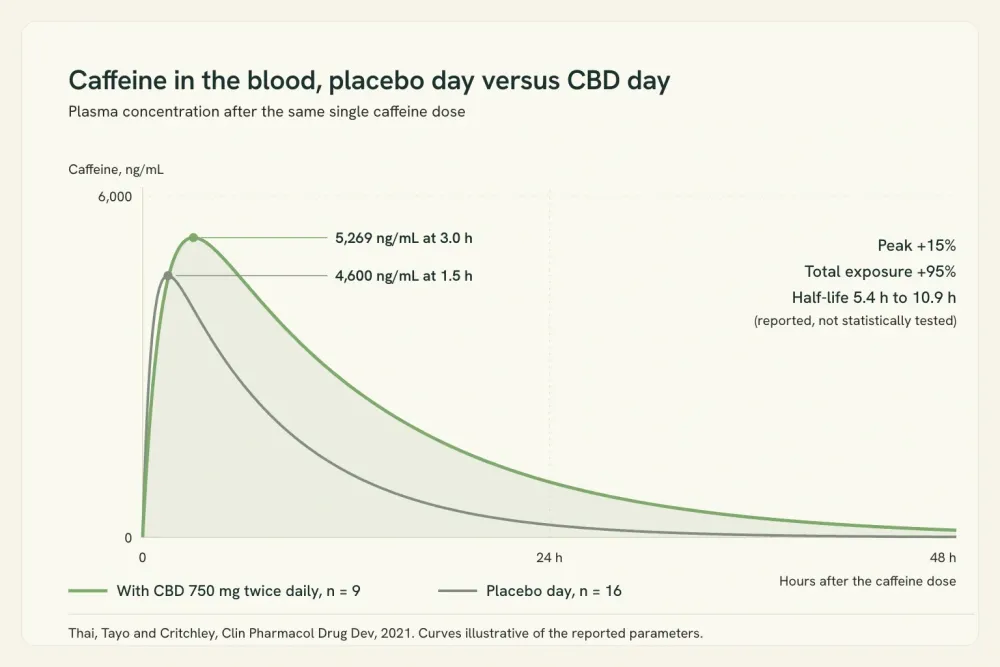
Exposure has been measured twice in humans, and both times it moved the same way. In a Phase 1 open-label drug-interaction trial run at a single site in the Netherlands between April and July 2019, 16 healthy adults took a single 200 mg caffeine tablet, then built up to a pharmaceutical CBD oral solution at 750 mg twice daily and repeated the same caffeine dose on day 26. Total caffeine exposure on the CBD day was about 95% higher, a geometric mean ratio of 1.95 with a 90% confidence interval of 1.62 to 2.35. Only nine of the sixteen finished, so that comparison is 16 people on the placebo day against 9 on the CBD day. Separately, a double-blind crossover study in 18 adults given a brownie containing 640 mg CBD and 20 mg THC followed by a five-drug enzyme probe cocktail found caffeine exposure up about 39%, with no change at the peak. Different designs, different doses, same direction.
Experience has been measured directly once in the whole human record set out below. Fifty-four young healthy adults who already drank more than 200 mg of caffeine a day took 200 mg of caffeine with either placebo or CBD at 25, 50, 80, 160 or 240 mg, and across a 140-minute session the combination did not alter self-reported drug effects. No negative effects emerged either, and the authors call their own result preliminary. So the honest summary is two sentences long. More caffeine stays in the blood for longer at a pharmaceutical CBD dose. The one study that asked people how they felt found nothing changed at consumer-scale doses. Neither of those sentences is "CBD takes the edge off caffeine", and nothing in the human record named below measures anything of the kind.
The whole human record here is small enough to name, so here it is. A PubMed search for cannabidiol combined with caffeine or paraxanthine, run on August 3, 2026, returned 34 records. Screening all 34 leaves four human studies in which both substances were actually given to people: the Phase 1 drug-interaction trial above in 16 healthy adults, which was reported twice (once for the caffeine result and once for liver safety), the probe-cocktail crossover in 18 adults, the subjective-effects study in 54 adults, and a THC-focused laboratory study in 20 adults that included caffeine. Everything else in that search is unrelated, or is in mice or zebrafish, which transfers to neither a person nor a product. That is the entire evidence base, and it is worth knowing how thin it is before anyone tells you what the combination does.
Caffeine runs on CYP1A2, and that is a different enzyme
Caffeine is not only a stimulant in this story. It is a laboratory instrument. A curated summary of the caffeine pathway, published in Pharmacogenetics and Genomics, puts it plainly: CYP1A2 is responsible for more than 95% of caffeine's primary metabolism, which is exactly why caffeine is used as a probe drug to measure what a new compound does to that enzyme. Roughly 70 to 80% of a caffeine dose is converted by CYP1A2 into paraxanthine. About 7 to 8% each goes to theobromine and theophylline, another 15% or so becomes a uric acid derivative, and under 3% leaves the body unchanged in urine. A normal caffeine half-life is 4 to 5 hours. That source is a curated pathway summary rather than a single experiment, which is what makes it a useful fixed reference point rather than a finding.
- Smoking speeds caffeine clearance up, and the pathway summary attributes that to its effect on CYP1A2 activity.
- Pregnancy and liver disease slow it down. In infants and neonates the half-life can stretch to as much as 100 hours.
- The FDA notes wide variation between people in both how sensitive they are to caffeine and how quickly they eliminate it.
- None of that involves CBD. It is the ordinary spread you already live inside before any supplement enters the picture.
This is where most CBD interaction content goes wrong on coffee. The standard drug-interaction story about CBD is a CYP3A4 and CYP2C19 story, and the page that covers CBD and prescription medications is built around exactly those two enzymes. Caffeine is not on that pathway. Copying the CYP3A4 explanation onto a coffee article produces text that sounds informed while describing the wrong enzyme. The same trap caught the alcohol version of this question, where ethanol is handled mainly by alcohol dehydrogenase and CYP2E1 instead, so what the three human alcohol studies actually measured had to be worked out on its own terms. One more everyday substance is cleared largely by CYP1A2, and we cover that pair in what happens when CBD and melatonin are taken together. Each of those pages owns its own substance. This one owns caffeine.
What the drug-interaction trial actually did
The trial was Phase 1, open-label and fixed single-sequence, which means everybody did the same thing in the same order and nobody was blinded. It ran at one site in the Netherlands between April and July 2019. Sixteen healthy adults enrolled, aged 18 to 60, ten women and six men, mean age 32.6 years. Anyone who had used a cannabinoid in the previous six months was excluded. Every methylxanthine source, meaning coffee, tea, cola, chocolate and energy drinks, was banned from admission to discharge, and even decaf was banned in the 96-hour windows around each caffeine day. That last detail matters more than it looks: these were people with caffeine completely washed out of their systems, which is not the state anyone reading this page is in.
- 1Day 1: a single 200 mg caffeine tablet with a placebo oral solution, then blood sampling at 16 timepoints out to 48 hours.
- 2Days 3 to 11: CBD titrated upward at home, from 250 mg once daily to 750 mg in the morning and 500 mg in the evening.
- 3Days 12 to 27: maintenance at 750 mg twice daily, which is 1,500 mg a day of a 100 mg/mL pharmaceutical CBD oral solution.
- 4Day 26: the same single 200 mg caffeine dose again, taken with the morning CBD dose, and the same 48 hours of sampling.
- 5Every dose was taken 30 minutes after the start of a meal, so this is a fed-state result rather than a black-coffee-before-breakfast result.
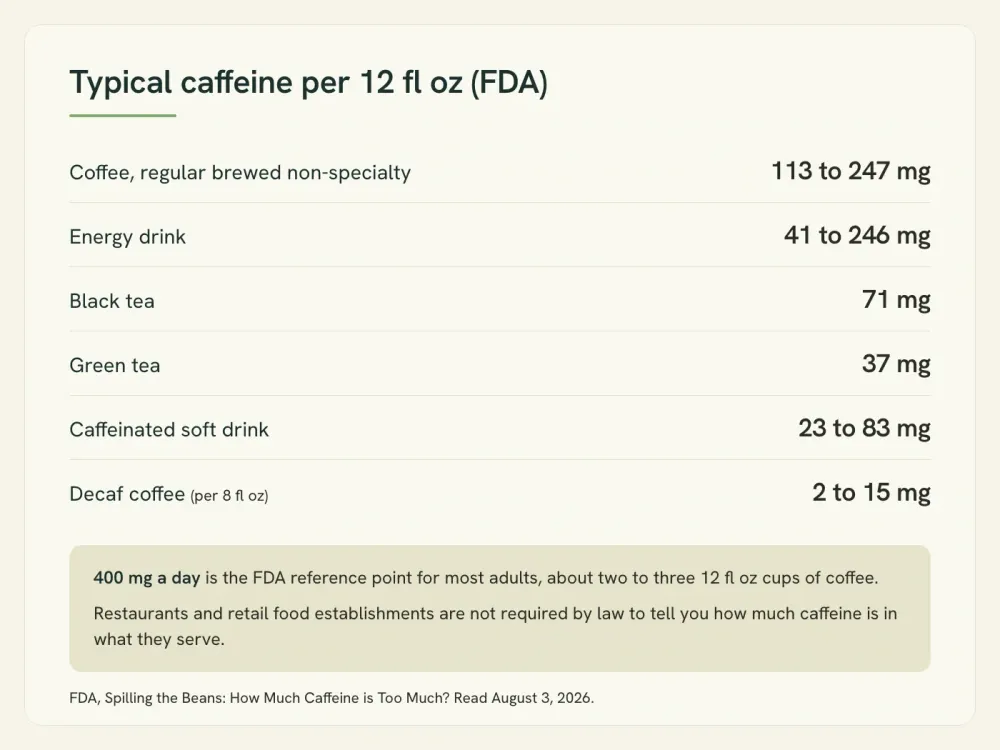
The caffeine dose is the ordinary part of that design. The FDA's consumer page on caffeine, which we read on August 3, 2026, puts a regular brewed 12-fluid-ounce coffee at 113 to 247 mg, so 200 mg sits comfortably inside a single large cup. The CBD dose is the part with no consumer equivalent, and the trial's own attrition shows why. Only 9 of the 16 completed. Six were withdrawn for liver enzyme elevations and one withdrew by choice. Fourteen of the sixteen had some adverse event, most commonly diarrhea in 8 of 16, mostly during the titration. One participant had a severe elevation, with ALT at 8.1 times the upper limit of normal. There were no deaths, no serious adverse events and no Hy's law cases, and the elevations were transient, generally normalizing 9 to 49 days after onset.
Those same 16 people were written up separately for liver safety, and the second paper is worth naming precisely because nobody quoting the caffeine result mentions it. It reports that 7 of the 16 (44%) had a peak ALT above the upper limit of normal, and 5 (31%) exceeded five times that limit, meeting international consensus criteria for drug-induced liver injury, at 1,500 mg a day of a prescription CBD oral solution taken for about three and a half weeks by healthy volunteers. Its authors concluded that clinicians should be alert to this potential effect. Two sentences is the right length for that here: it explains why the caffeine result rests on nine people, and it is why this page ends by pointing at a clinician instead of issuing advice. What CBD side effects actually look like in the first two weeks is the page that owns that subject. As for who paid, the trial was sponsored by GW Research Ltd, and all three authors are employees of GW Research who hold share options in GW Pharmaceuticals. There is no "the sponsor had no role" statement in the paper to set against that, because the authors are the sponsor's own staff.
The numbers: caffeine roughly doubled, and its metabolite's peak fell
| Measure | Placebo day | With CBD 750 mg twice daily | Ratio (90% CI) |
|---|---|---|---|
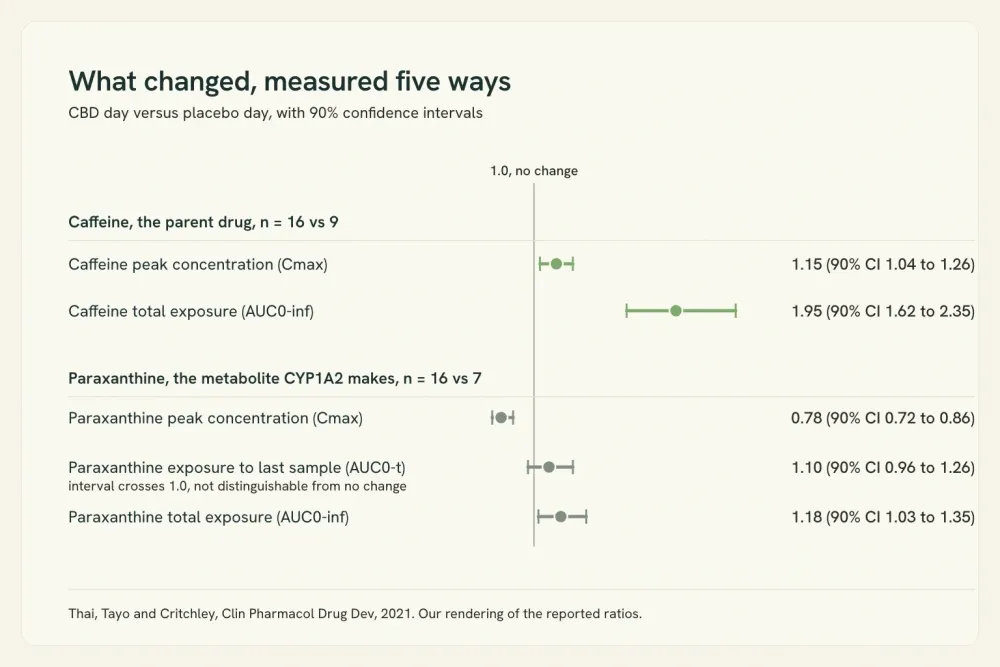
| Caffeine peak concentration (Cmax) | 4,600 ng/mL | 5,269 ng/mL | 1.15 (1.04 to 1.26) |
| Caffeine exposure to last sample (AUC0-t) | 39,969 ng·h/mL | 75,237 ng·h/mL | 1.88 (1.56 to 2.27) |
| Caffeine total exposure (AUC0-inf) | 40,856 ng·h/mL | 79,718 ng·h/mL | 1.95 (1.62 to 2.35) |
| Caffeine time to peak (median) | 1.5 h | 3.0 h | Shift of 0.58 h (0.01 to 1.50) |
| Caffeine half-life (mean) | 5.40 h | 10.9 h | Reported, not statistically tested |
| Caffeine apparent clearance (mean) | 5.55 L/h | 2.57 L/h | Reported, not statistically tested |
| Paraxanthine peak concentration (Cmax) | 1,227 ng/mL | 961 ng/mL | 0.78 (0.72 to 0.86), a 22% fall |
| Paraxanthine exposure to last sample | 21,454 ng·h/mL | 23,579 ng·h/mL | 1.10 (0.96 to 1.26), crosses 1 |
| Paraxanthine total exposure | 22,972 ng·h/mL | 27,038 ng·h/mL | 1.18 (1.03 to 1.35) |
| Metabolite to parent exposure ratio | 0.627 | 0.349 | Reported, not statistically tested |
Read across the caffeine rows and the shape of the change is obvious. The peak barely moved, up 15%. Total exposure nearly doubled. The peak arrived twice as late, and the drug took about twice as long to clear, with apparent clearance falling from 5.55 to 2.57 liters an hour. That combination describes a bottleneck at the exit rather than a bigger dose at the entrance: the same 200 mg went in, and it took much longer to get out. A sensitivity analysis restricted to the six participants with complete profiles landed in the same place, with a total exposure ratio of 1.87 and a peak ratio of 1.19.
The paraxanthine rows are missing from every consumer write-up of this trial, and they are the most informative rows in the table. Paraxanthine is what CYP1A2 turns caffeine into, and it accounts for the large majority of the dose. If CBD were somehow acting like extra caffeine, paraxanthine would rise along with it. Instead the metabolite's peak concentration fell 22%. Its exposure to the last measured timepoint rose only 10%, with a confidence interval running from 0.96 to 1.26, which crosses 1 and therefore is not distinguishable from no change at all. Only total exposure to infinity rose, by 18%. And the ratio of metabolite to parent dropped from 0.627 to 0.349. Less product, more substrate, slower turnover. That is what a partially blocked enzyme looks like from the outside, and it is why this result is a statement about CYP1A2 rather than a statement about coffee. Note the sample size on those rows before you carry them anywhere: seven people. The authors state the conclusion in one line, in the abstract: "These data suggest that CBD is an inhibitor of CYP1A2." What they wrote next, in the discussion, is the sentence worth carrying away.
“As such, there is a potential risk that a person who consumes high doses of caffeine over a short period alongside CBD may experience clinically significant caffeine-related side effects.”
Three things about that sentence deserve attention, because it is usually quoted with two of them removed. It says potential risk, not observed harm: nobody in this trial had a caffeine-related adverse event. It is conditional on high doses of caffeine over a short period, not on an ordinary cup. And the same authors wrote that their results suggest CBD is highly unlikely to be an inducer of CYP1A2, which is the reassuring half of the conclusion and is almost always left out. They also wrote that interactions between CBD and other drugs metabolized by CYP1A2 cannot be ruled out, which is a matter for a clinician rather than for a list on a website.
The second human measurement, and what the FDA-approved label says
The second human measurement used a completely different design and landed in the same direction, more weakly. Eighteen healthy adults ate a brownie in a double-blind randomized crossover, with arms at least a week apart. One brownie was placebo, one contained a CBD-dominant cannabis extract with 640 mg CBD and 20 mg THC, and one contained a THC-dominant extract with 20 mg THC and no CBD. Thirty minutes later each participant swallowed a validated five-drug probe cocktail: 100 mg caffeine for CYP1A2, 25 mg losartan for CYP2C9, 20 mg omeprazole for CYP2C19, 30 mg dextromethorphan for CYP2D6 and 2 mg midazolam for CYP3A. The CBD brownie modestly increased caffeine exposure and half-life by 32 to 39% and, in the authors' own words, had no effect on Cmax. The THC-only brownie did not inhibit any of the enzymes tested, which is a useful internal control: what moved the numbers was the CBD, not cannabis in general.
That ranking is worth holding onto, because it puts caffeine in proportion. Of the five pathways probed, CYP2C19 exposure rose 207%, CYP2C9 rose 77%, CYP3A rose 56%, caffeine's CYP1A2 rose 39%, and CYP2D6 did not move at all. Caffeine was the weakest of the four that changed. The regulator files it the same way. The FDA-approved prescribing information for the cannabidiol oral solution, which the research for this article read in full on August 3, 2026, carries the trial result on the label itself: coadministration of 750 mg twice daily with a single 200 mg dose of caffeine, described there as a sensitive CYP1A2 substrate, showed caffeine exposure increased by 15% for Cmax and 95% for AUC. The same label's interaction section classifies cannabidiol as a weak inhibitor of CYP1A2 and tells prescribers to consider a dosage reduction of CYP1A2 substrates where minimal concentration changes could lead to serious adverse reactions. Both things are true at once, and that is the point: a doubling of total exposure is a real measurement, and the regulator still files the compound as a weak inhibitor. That label describes a prescription medicine dosed at 10 to 25 mg/kg a day depending on the seizure disorder, and none of it transfers to a hemp tincture. If you take a prescription medicine, the useful move is to ask a pharmacist which enzyme clears it, not to match it against a list on a blog.
The cocktail study also ran a physiologically based pharmacokinetic model to ask where the interaction would disappear. Its output was that the lowest oral CBD dose predicted to be free of interactions with those probe drugs is 5 mg twice daily, and that 20 mg twice daily for a week would still cross the interaction threshold. That is a statement about a computer simulation rather than a measurement in a person, and it is not a dosing recommendation, from them or from us. Read what the same paper says immediately afterwards: for caffeine specifically, the model overpredicted the interaction by a factor of 2.2, and the authors write that the reason for the overprediction is not known. Of the five probes, caffeine is the one their model got wrong, which is a good reason not to treat any modeled milligram figure on this topic as a threshold you can act on.
Does CBD change how caffeine feels?
This is the question people actually have, and it has one direct human answer. Fifty-four young healthy adults who reported drinking more than 200 mg of caffeine a day were randomly assigned to take 200 mg of caffeine with either placebo or CBD at 25, 50, 80, 160 or 240 mg. They completed self-report measures at baseline and repeatedly across a 140-minute session, with general drug effects and anxiety as the primary outcomes. Few effects were observed, no negative effects emerged, and the authors' conclusion was that combinations of the tested doses of caffeine and CBD do not alter subjective drug effects. Their own word for the evidence is preliminary, and they say the results should be interpreted cautiously given the variability in outcomes.
The limits are real and are better stated than buried. It was a single session, run remotely by video call, using self-report only, with no blood levels and no cognitive or physiological measures, which the authors themselves call for next. Participants already drank caffeine daily and therefore carry tolerance. Two of the authors are employed by companies in this industry, one at Canopy Growth Corporation and one at Charlotte's Web. That disclosure cuts both ways and both halves belong on the page: an industry-affiliated team ran the study, and the result they published is a null one, which is the least commercially useful finding available on this topic.
There is a precedent that makes the gap between exposure and experience concrete, and the drug-interaction trial's own authors cited it for exactly this purpose. In 2005, seven healthy adults took a single 250 mg dose of caffeine with either fluvoxamine or placebo in a double-blind four-way crossover. Fluvoxamine cut caffeine's apparent oral clearance from 105 to 9.1 mL per minute and stretched its elimination half-life from 4.9 hours to 56 hours. Caffeine still produced its usual stimulant effects compared with placebo. And yet psychomotor performance, alertness and EEG effects attributable to caffeine were not augmented by the fluvoxamine. An eleven-fold change in half-life did not translate into a bigger felt effect in a laboratory. CBD roughly doubled it. Those authors were careful to add that their result does not rule out effects from repeated daily caffeine intake in people taking fluvoxamine, and with seven participants in 2005 that caution is the right one. For completeness, the other human laboratory study that put caffeine and CBD in the same person did so alongside THC, in 20 adults in a double-blind placebo-controlled crossover, and reported that caffeine produced minimal changes in the cannabinoid picture it measured. If you want the general version of the expectation-setting question, what CBD actually feels like is the page for it.
CBD and coffee: what the category actually claims
Search for CBD and coffee and most of what comes back is shops. The informational pages sitting among them run a consistent argument: caffeine gives you the alertness, CBD smooths off the edge, and the two work on the same system, so they balance each other. We checked what that last part rests on. Reading the search result on August 3, 2026, the two most prominent consumer pages each carried exactly one citation for it, and it was the same citation on both. So it is worth looking at that one paper closely, because the entire mechanism story in this category is standing on it.
The citation is a 2018 metabolomics trial published in the Journal of Internal Medicine. Forty-seven habitual coffee drinkers gave up coffee for a month, drank four cups a day in the second month, and eight cups a day in the third. Fasting serum was profiled for 733 metabolites, of which 115 were significantly associated with coffee intake, and five metabolic pathways came out enriched. The fifth was the endocannabinoid pathway, which the abstract lists as a novel link to coffee. The abstract's own conclusion is that these metabolites and pathways may provide new insight into the mechanisms by which coffee may be exerting its health effects. The direction of the change, which is the part everybody quotes, is not in the abstract at all. It comes from the university's news release about the study, which states in its own narration, not in a quotation from the researchers, that the neurotransmitters related to the endocannabinoid system decreased after drinking four to eight cups of coffee in a day, the opposite of what occurs after someone uses cannabis. The same release records the caveat: it is not known whether caffeine or another substance in coffee triggers the change, and the connection is offered as an alternative explanation worthy of further study.
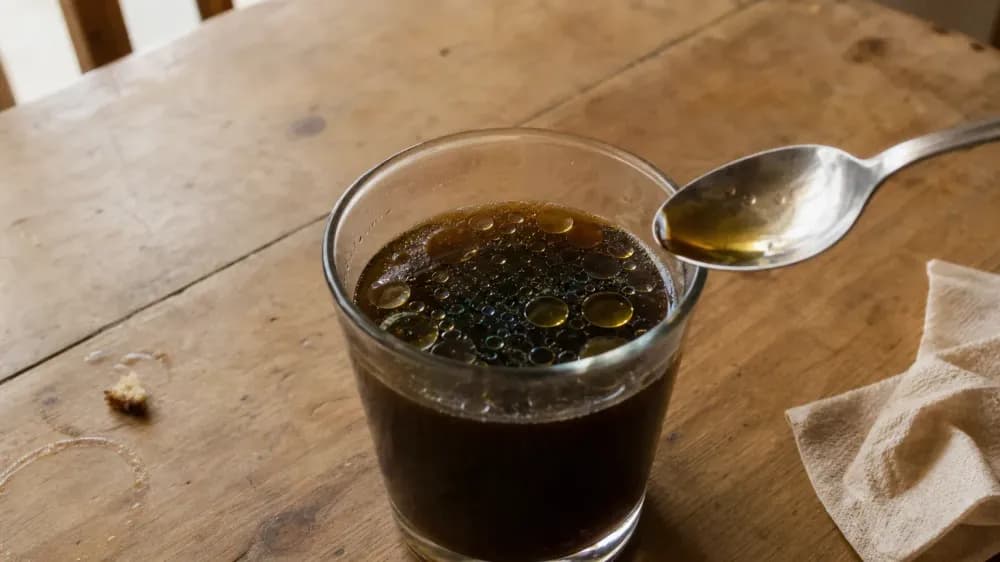
Now look at what that study can and cannot support. It gave people coffee. No cannabinoid was administered to anyone in it. It measured serum metabolites, not receptor activity. Its own authors call the link novel and the mechanism unknown, and the crispest version of the finding lives in a press release rather than in the paper. It is a genuinely interesting piece of work, and it says nothing whatsoever about what CBD does to caffeine, which is the claim it is being used to prop up. Our own position is easy to state, and it is why we can say this without a conflict: Planntz sells hemp tinctures and sells no CBD coffee, no caffeinated product and no energy product of any kind, so there is nothing for us to sell in the category this section is correcting. One practical note for anyone who tries the do-it-yourself version. A tincture in MCT oil will not dissolve into a water-based drink. It floats, and some of it coats the mug. That is why commercial products in this category use emulsions instead of plain oil, and what water-soluble and nano CBD labels actually mean covers that chemistry. No human study has measured CBD added to hot coffee, so how much of it you absorb that way is unknown rather than reassuring.
What this does and does not mean for your morning
None of this is an instruction to change anything. Before the practical list, one fact about caffeine on its own, because it is the reason the clearance window matters at all. In a study of 12 healthy sleepers who took 400 mg of caffeine in pill form at 0, 3 or 6 hours before their habitual bedtime, all three timings significantly disrupted sleep compared with placebo, and even at 6 hours caffeine reduced sleep by more than an hour. That figure comes from an in-home EEG monitor. The participants' own sleep diaries showed a smaller reduction of 41 minutes at the 6-hour timing, which only approached statistical significance at p = 0.08, so the objective measure caught something the subjective one did not. Twelve people, one study, and it is about caffeine, not about CBD. Here is how the rest of it cashes out.
- The caffeine number you think you drank is a guess. The FDA puts a regular brewed 12-fluid-ounce coffee at 113 to 247 mg, and restaurants are not required by law to tell you how much caffeine is in what they serve.
- The FDA cites 400 mg a day, about two to three 12-ounce cups of coffee, as an amount not generally associated with negative effects for most adults, while noting wide variation between people in sensitivity and clearance.
- Increased heart rate, palpitations, raised blood pressure, insomnia, anxiety, jitters, upset stomach, nausea and headache are the FDA's own list of signs of too much caffeine. Nothing on this page says CBD does anything about any of them.
- The measured exposure change came from 1,500 mg a day of a prescription oral solution taken for 24 days by healthy volunteers with caffeine washed out of their diet. It is not a description of a tincture serving.
- When you read that something increases caffeine exposure, check which measure moved. In this trial the peak rose 15%, total exposure rose about 95%, and the half-life roughly doubled without a statistical test.
- If you take a prescription medicine, ask a pharmacist or prescriber which enzyme clears it rather than matching it to a list online. That conversation is the whole practical action item on this page.
- This page gives no CBD amount and no timing rule, on purpose. Nobody has tested a spacing interval for this pair, so any number you read for it was invented by whoever printed it.
The honest limits
Take the headline number apart before you carry it anywhere. It comes from nine completers. The trial was open-label, so nobody was blinded, and it was fixed single-sequence, so the placebo day always came first, which means period effects cannot be cleanly separated from drug effects. The participants were healthy volunteers aged 18 to 60 who had had every source of caffeine removed from their diet for weeks. They took one 200 mg caffeine dose, not a habitual four cups a day. And they took a pharmaceutical CBD oral solution at 1,500 mg a day, with food, for more than three weeks. Every one of those choices makes the measurement cleaner, and every one of them makes it less like your morning. The authors' own stated limitation is the completion rate, and they note that the sensitivity analysis aligned with the primary analysis.
To see how far that dose sits from a consumer product, do the arithmetic. A 250 mg/mL tincture delivers roughly 12.5 mg of CBD in a standard 0.05 mL drop, so 1,500 mg a day works out to about 120 drops, roughly 6 mL a day, which would empty a 60 mL bottle in ten days. Drop size varies with the dropper and with technique, so treat that as a scale comparison and nothing else. It is here to show the distance between the trial and a tincture, not to suggest an amount: this page recommends none, and how much CBD people actually take is a separate conversation with its own evidence. One more design detail travels with the dose. Every dose in the trial was taken 30 minutes after the start of a meal, and whether you take CBD with food or without it changes how much of it gets absorbed, which is not incidental on a page about a morning routine that often happens before breakfast.
The literature also got this wrong before it got it right, which is worth knowing whenever you read a confident mechanism claim. A 2021 in vitro screen of twelve cannabinoids against the major cytochrome enzymes concluded that effects on CYP1A2 were limited enough that interactions in people would not be predicted. That was glassware, not people, and the human trial found one anyway. What still has not been measured is the scenario most readers are actually in: consumer-scale CBD, taken over weeks, alongside habitual daily coffee, with both blood levels and subjective effects recorded in the same people. Until somebody runs that study, the honest position is that we have two exposure measurements at doses far above consumer use, one preliminary subjective measurement at consumer-scale doses, and no measurement at all of the combination that matters most. For the timing half of the question, how long CBD takes to work and how long it lasts sets out the variables without inventing a schedule.
Common questions about CBD and caffeine
No measurement supports that. In the Phase 1 drug-interaction trial, total caffeine exposure went up about 95%, not down, and caffeine's half-life went from 5.4 to 10.9 hours. In the one study that asked people how they felt, 54 daily caffeine drinkers taking 200 mg of caffeine with CBD at 25 to 240 mg reported no change in subjective drug effects. So the exposure measurement points in the opposite direction from cancelling out, and the experience measurement points at no detectable difference. Neither one supports the phrase.
In that trial, yes, and by a lot. Mean half-life went from 5.40 hours on the placebo day to 10.9 hours on the CBD day, and median time to peak moved from 1.5 hours to 3.0 hours. Two cautions travel with those numbers. They come from the 9 people who completed a trial that enrolled 16, and the half-life change was reported without a statistical test. The CBD dose was 1,500 mg a day of a prescription oral solution taken with food for more than three weeks, which is not a consumer scenario, and nobody has measured whether a tincture-scale amount does anything similar.
Nobody can promise you a safety outcome and this page will not. Here is what the record shows. No participant in the drug-interaction trial had a caffeine-related adverse event, and the authors described a potential risk for someone consuming high doses of caffeine over a short period alongside CBD, which is a stated possibility rather than an observed harm. The FDA cites 400 mg of caffeine a day as an amount not generally associated with negative effects for most adults, while noting wide variation between people. The one genuinely useful action item is this: if you take a prescription medicine, raise it with a pharmacist or prescriber, because the medicine is the part of the picture an article cannot see.
Physically you can, but a tincture in MCT oil will not dissolve into a water-based drink. It floats in beads on the surface and some of it coats the mug. That is why commercial products in this category use emulsified or so-called water-soluble forms rather than simply stirring oil into a cup. No human study has measured CBD added to hot coffee, so how much of it you actually absorb that way is unknown rather than reassuring, and the amount left on the inside of the mug is not something you can estimate by eye.
That direction has barely been studied. The trials described here measured what CBD does to caffeine, not what caffeine does to CBD. The closest thing on record is a laboratory study in 20 adults that combined caffeine with THC and CBD and reported that caffeine produced minimal changes in the cannabinoid picture it measured, including subjective effects, performance and metabolism. That study was designed around THC rather than CBD, so treat the reverse direction as a genuine gap in the evidence rather than as an answer.
This page gives no number, because no study has tested a spacing interval for this pair. What determines the answer is real enough to describe, though. Caffeine's normal half-life is 4 to 5 hours and varies widely between people. Smoking clears it faster, pregnancy and liver disease clear it slower, and food shifts absorption for both substances. If your reason for asking is sleep, the caffeine timing evidence is more useful than any CBD rule: in 12 healthy sleepers, 400 mg of caffeine taken 6 hours before bed still reduced objectively measured sleep by more than an hour.
If you came here to find out whether your coffee and your CBD are fighting each other, the answer the measurements give is that they are not fighting, they are queuing. The same caffeine waits longer for the same exit. Whether you can feel that has been tested once, at consumer-scale CBD amounts, and the answer was no. The part of this that genuinely deserves a conversation is medicines rather than coffee, and what CBD drug interactions can and cannot mean is where that starts.
Writing about hemp, wellness and the small rituals that keep us balanced.