
CBD and Ambien: What the Label Warns, What Nobody Measured
A search on September 2, 2026 returns three PubMed records for zolpidem and cannabidiol, and none gave both to a person. Here is what Ambien's label measures about CYP3A4, why its two clearest sedation interactions involve no enzyme at all, and what its boxed warning says.

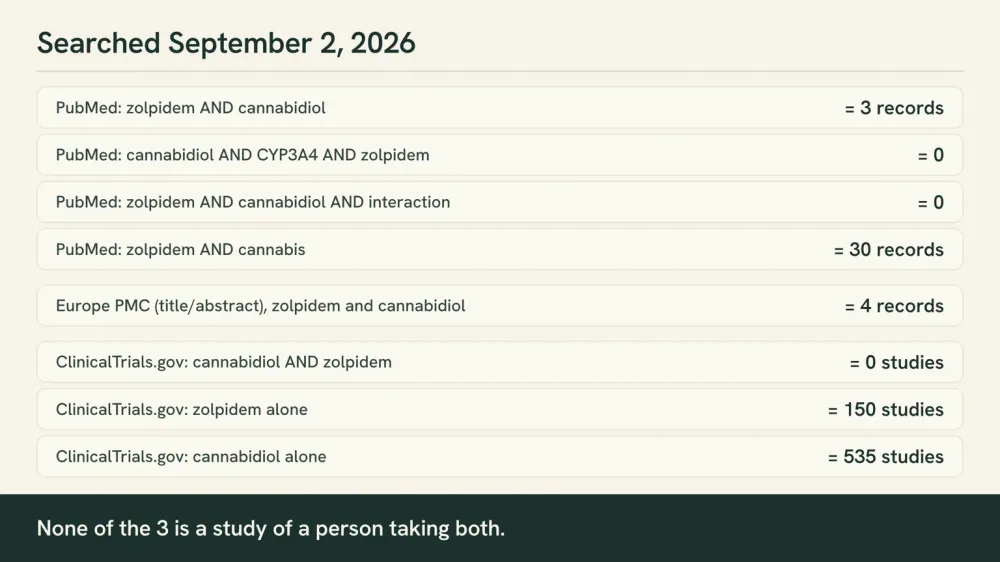
If you have an Ambien prescription and a bottle of CBD oil, you are asking about CBD and Ambien in the same evening, and the honest answer arrives in two parts. Almost nobody publishes the first one. Searched on September 2, 2026, PubMed returns three records for zolpidem and cannabidiol together, ClinicalTrials.gov returns none, and not one of them is a study in which a person took both. The second part runs the other way. Zolpidem's FDA label is unusually specific about what changes its blood level and what changes how awake you are, and those turn out to be two different lists.
Ambien is the brand name. Zolpidem is the molecule, and it is the name the label and the research use, so both appear on this page. The pages currently ranking for this question argue about one liver enzyme, CYP3A4, and several of them argue in both directions at once. Meanwhile the drug's own label leads with something else entirely: a boxed warning about things people do while they are not fully awake. This article is about people who take both, not about replacing one with the other. It is information, not medical advice, and it contains no instruction to start, stop, delay or change the amount of anything. If cannabidiol itself is new to you, start with what CBD actually is and is not; the general co-ingestion framework lives in our guide to CBD and prescription medications.
What a search for CBD and Ambien actually returns
Start with the measurement, because it is checkable and it takes about a minute. On September 2, 2026 we ran the same question across three databases. On PubMed, a search for zolpidem AND cannabidiol returned 3 records. Narrowing it to cannabidiol AND CYP3A4 AND zolpidem returned 0. Narrowing it instead to zolpidem AND cannabidiol AND interaction returned 0. Searching zolpidem AND cannabis returned 30, which is the shape of the whole problem: the literature that exists is about cannabis, not about cannabidiol. A Europe PMC title-and-abstract search for the same pair returned 4, the extra record being a rat preprint. And a ClinicalTrials.gov search for cannabidiol and zolpidem returned 0 studies, against 150 registered zolpidem intervention studies and 535 registered cannabidiol intervention studies. Counts move, which is why the queries and the date are printed here. Run them yourself.
The three PubMed records are worth opening, because none of them is what a reader would assume. One is a 2025 systematic review of sleep after total joint arthroplasty (Nithagon and colleagues, PMID 39254965, 7 randomized trials, 840 patients), in which zolpidem markedly improved sleep quality after total hip arthroplasty and topical cannabidiol did not improve it after total knee arthroplasty. Those are two different trials, two different operations and two different routes of administration, sitting in one table; note also that the paper's Results section says topical cannabidiol while its Conclusions say topical cannabis, and the Results section is the one we read. The second is a rodent polysomnography study in Neuropsychopharmacology (PMID 39528623), which is about cannabinol rather than cannabidiol, in rats, with zolpidem as a comparator in the same animals. CBN is a different molecule and our side-by-side reading of CBN and CBD covers it. The third is a review of emerging pharmacotherapy for cannabis use disorder (PMID 38717605), in which zolpidem appears only as half of the phrase nabilone plus zolpidem.
That last phrase points at the closest thing that exists, and it is not close. In a randomized inpatient crossover study published in 2016 (Herrmann and colleagues, PMID 27085870), 11 daily cannabis users spent three 8-day phases receiving zolpidem at night alone, zolpidem plus nabilone, or placebo. Both medication conditions reduced withdrawal-related sleep disruption, the combination also reduced mood and food-intake disruption, and neither condition altered cognitive performance. Nabilone is a synthetic analogue of THC and an approved antiemetic; cannabidiol is not a THC analogue, does not activate the same receptor and is not intoxicating. So when somebody did finally run a human study giving a cannabinoid alongside zolpidem, they used a different molecule, in a different population, for a different reason. Hold both halves of that at once: nobody has measured a risk here, and nobody has measured its absence either. An empty literature is a statement about what has been studied, not about what happens in your body.
What the label warns about first, and it is not the enzyme
Open the FDA-approved label for AMBIEN on DailyMed (sanofi-aventis U.S. LLC, structured product label version 26, effective April 15, 2025, read in full from the source document on September 2, 2026) and the first thing on it is a boxed warning, which is the most prominent warning FDA requires on a prescription label. It reads: "Complex sleep behaviors including sleep-walking, sleep-driving, and engaging in other activities while not fully awake may occur following use of AMBIEN. Some of these events may result in serious injuries, including death. Discontinue AMBIEN immediately if a patient experiences a complex sleep behavior." That last sentence is addressed to prescribers. We are reporting it, not issuing it.
Section 5.1 fills the warning in, and every clause of it matters to anyone thinking about what else is in the evening. The behaviors "may occur following the first or any subsequent use of AMBIEN". Other reported examples include "preparing and eating food, making phone calls, or having sex". "Patients usually do not remember these events." And postmarketing reports show they can occur "with AMBIEN alone at recommended doses, with or without the concomitant use of alcohol or other central nervous system (CNS) depressants". Section 4 then converts one occurrence into a permanent bar: the drug is contraindicated in patients "who have experienced complex sleep behaviors after taking AMBIEN".
Those sections exist because of a dated regulatory decision. On April 30, 2019, FDA added the boxed warning to eszopiclone, zaleplon and zolpidem and added the contraindication at the same time. The agency wrote that these behaviors "appear to be more common" with those three medicines than with other prescription sleep medicines, that serious injuries and deaths have occurred in patients with and without a history of such behavior "even at the lowest recommended doses", that "the behaviors can occur after just one dose", and that they can occur "with or without alcohol or other central nervous system depressants". The evidence behind the decision was a case series, and it has to be read in both directions at once.
Both halves belong in the same breath. Sixty-six serious cases identified across 26 years of reporting is rare against 26.6 million prescriptions in a single year, and spontaneous adverse-event reports are under-reported and carry no denominator, so no true rate can be calculated from them. The events themselves are exactly as serious as they sound: FDA's breakdown of the reported events includes falls (n=22), self-injuries (n=7), fatal falls (n=6), accidental overdoses (n=5), hypothermia (n=5), fatal motor vehicle collisions (n=4), gunshot wounds (n=3) and drowning or near drowning (n=2), among other reported categories. FDA also says plainly that "the underlying mechanisms by which these insomnia medicines cause complex sleep behaviors are not completely understood". Nothing in that record is attributed to cannabidiol, and nothing in it rules cannabidiol out either, because nobody collected that variable.
The CYP3A4 question, answered with the label's own numbers
Now the enzyme, because that is what page one argues about. CYP3A4 is one of the liver enzymes that clears zolpidem, and the consumer interaction entries say cannabidiol may increase or decrease its activity, so Ambien's level may go up or it may go down. That is a description of uncertainty formatted to look like a warning. The more useful move is to ask a different question: when a drug genuinely does change CYP3A4 activity, how far does zolpidem actually move? The label answers that in sections 7.1, 7.2 and 12.3, with numbers, and nobody on page one quotes a single one of them. Every row in the table below comes from that document. None of them is cannabidiol.
| Given with zolpidem | How the label characterizes it | Change in zolpidem exposure | Effect measured on the person | Tested against cannabidiol? |
|---|---|---|---|---|
| Ketoconazole 200 mg twice daily for 2 days, then a single 5 mg zolpidem dose | "a potent CYP3A4 inhibitor" | Cmax +30%, total AUC +70%, elimination half-life +30% | "an increase in the pharmacodynamic effects of zolpidem" | No |
| Itraconazole 200 mg at steady state, then a single 10 mg zolpidem dose (male volunteers) | CYP3A4 inhibitor | AUC +34% | "no pharmacodynamic effects of zolpidem detected on subjective drowsiness, postural sway, or psychomotor performance" | No |
| Rifampin 600 mg at steady state, then 10 mg zolpidem (female subjects) | CYP3A4 inducer | AUC -73%, Cmax -58%, half-life -36% | "significant reductions in the pharmacodynamic effects" | No |
| St. John's wort | CYP3A4 inducer | "may also decrease the blood levels of zolpidem", not quantified | Not quantified; concomitant use is "not recommended" | No |
| Sertraline 50 mg for 17 days, then 10 mg zolpidem for 5 nights (healthy female volunteers) | Not characterized as a CYP3A4 interaction | Cmax +43%, Tmax -53% | Not stated in the label | No |
| Fluoxetine 20 mg, multiple doses (healthy females) | Not characterized as a CYP3A4 interaction | Half-life +17% | "no evidence of an additive effect in psychomotor performance" | No |
| Imipramine | Not characterized as a CYP3A4 interaction | "no pharmacokinetic interaction other than a 20% decrease in peak levels of imipramine" | "an additive effect of decreased alertness" | No |
| Chlorpromazine | Not characterized as a CYP3A4 interaction | "no pharmacokinetic interaction" | "an additive effect of decreased alertness and psychomotor performance" | No |
| Alcohol | Not characterized as a CYP3A4 interaction | Not quantified in the label | "An additive adverse effect on psychomotor performance between alcohol and oral zolpidem was demonstrated" | No |
| Cannabidiol | Not addressed in this label | Not measured in this label | Not measured in this label | No |
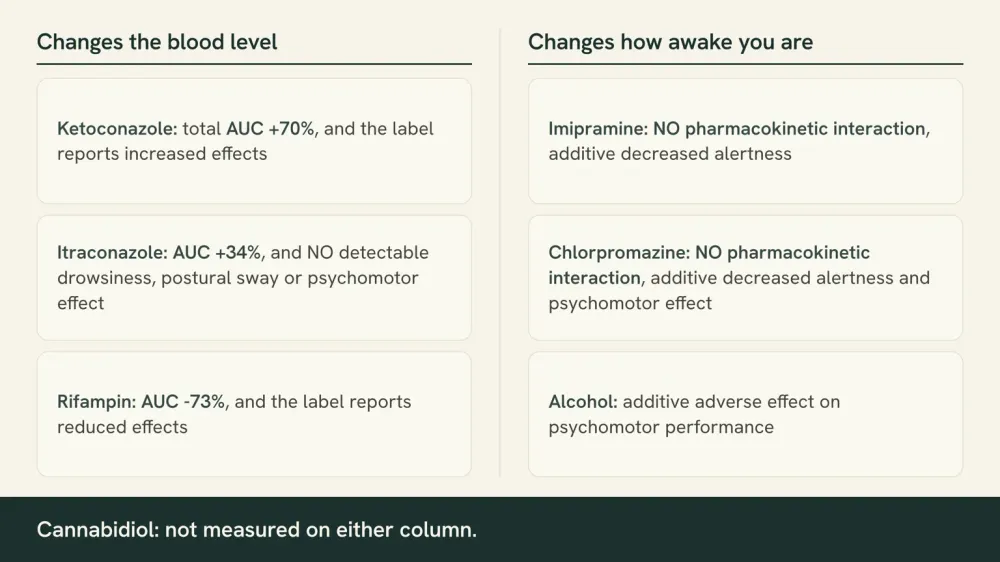
Read the third and fourth columns together and the tidy story falls apart. Ketoconazole, which the label calls a potent CYP3A4 inhibitor, raised total zolpidem exposure by 70% and did increase the drug's effects. Itraconazole, also a strong CYP3A4 inhibitor, raised exposure by 34%, and the label's sentence about what that did to the volunteers is: "There were no pharmacodynamic effects of zolpidem detected on subjective drowsiness, postural sway, or psychomotor performance." Read that exactly as written. No effect was detected, in one small single-dose study in male volunteers, and the same label still tells prescribers to consider a lower zolpidem dose when a potent CYP3A4 inhibitor is on board. It is not a finding that inhibiting the enzyme is harmless. It is certainly not a finding about cannabidiol.
So where does cannabidiol sit on that inhibitor scale? Real question, and it is not this page's question, because two of our articles already answer it from the same regulator's data: how strong a CYP3A4 inhibitor cannabidiol actually is works through the ketoconazole comparison, and what happened when cannabidiol was tested against a sensitive CYP3A4 probe drug reads the midazolam result. The one-sentence version, from the FDA-approved cannabidiol medicine's own label: 750 mg of cannabidiol twice daily did not change plasma concentrations of midazolam, the sensitive CYP3A4 probe. That is 1,500 mg a day of pharmaceutical cannabidiol given in epilepsy trials, not a consumer tincture, and midazolam is not zolpidem. Zolpidem's label then adds the limit that matters most here, in section 7.2: "The effect of drugs that induce or inhibit other P450 enzymes on the exposure to zolpidem is not known." Cannabidiol's better-documented enzyme effects are on CYP2C19 and CYP1A2, and the zolpidem label says out loud that it does not know what those do to this drug.
One more thing about that document, and it is the cleanest fact on this page. Nothing in the AMBIEN label mentions cannabidiol, cannabis, CBD or hemp. We ran all four strings against the whole structured product label on September 2, 2026 and every one of them returns zero occurrences. Be careful what that means. It is not FDA reviewing data on this pair and finding no interaction. It is FDA having reviewed no data on this pair at all. While you are in section 12.3, one other exposure fact is worth knowing: zolpidem is unusually sensitive to liver function. In eight patients with chronic hepatic insufficiency given a single 20 mg dose, twice the highest recommended dose, Cmax was about 2 times and AUC about 5 times higher than in healthy subjects, with a half-life of 9.9 hours against 2.2. That is a fact about zolpidem, and what is and is not known about CBD and the liver is its own page.
Two rows on that table have no enzyme interaction at all
Look at the imipramine and chlorpromazine rows again, because they are the most interesting lines on the whole label. For imipramine, the label reports "no pharmacokinetic interaction other than a 20% decrease in peak levels of imipramine", and then "an additive effect of decreased alertness". For chlorpromazine it reports "no pharmacokinetic interaction" and "an additive effect of decreased alertness and psychomotor performance". Nothing moved in the blood, and people were measurably less alert anyway. Alcohol has the same shape: the label does not quantify a pharmacokinetic effect and does report that "an additive adverse effect on psychomotor performance between alcohol and oral zolpidem was demonstrated". Fluoxetine is the mirror image, lengthening zolpidem's half-life by 17% while the label reports "no evidence of an additive effect in psychomotor performance".
That is the label separating two axes by itself. One axis is metabolic: does the other drug change how much zolpidem is in you. The other is behavioral: does the other drug make you less awake, whether or not it touches an enzyme. The second axis does not need an enzyme, and it is where most of the practical co-ingestion question actually lives. We are not going to rebuild that framework here, because two of our pages already cover it. What the labels in the muscle relaxant aisle actually warn about collects that sedation language drug by drug, and the sedating-antidepressant version of this question is the closest sibling to this page. Note the boundary while you are there: trazodone is a sedating antidepressant often prescribed off-label at night, while zolpidem is a nonbenzodiazepine hypnotic, one of the drugs commonly called Z-drugs, approved for short-term insomnia treatment and classified in section 9.1 of its label as a Schedule IV controlled substance under federal regulation. Different drugs, different labels. And for the third substance most likely to be in the same evening, what is known about CBD and alcohol is the page.
On the cannabidiol side of that behavioral axis, one document is worth naming and not stretching. Section 7.4 of the prescription cannabidiol label is titled "CNS Depressants and Alcohol" and says concomitant use "may increase the risk of sedation and somnolence". That sentence is written about a 10 to 20 mg/kg/day pharmaceutical product given to patients with severe childhood-onset epilepsy, which is a different exposure at a different scale in a different population from a consumer CBD oil. It is a reason the question is worth asking. It is not a measurement of what happens with zolpidem, and no such measurement exists.
Same receptor family, different seat
Here is the part almost nobody writes, and it is why the additive-sedation assumption deserves to be called an assumption rather than a mechanism. Section 12.1 of the Ambien label describes how the drug works: "Zolpidem is a GABA A receptor positive modulator presumed to exert its therapeutic effects in the short-term treatment of insomnia through binding to the benzodiazepine site of α1 subunit containing GABA A receptors, increasing the frequency of chloride channel opening resulting in the inhibition of neuronal excitation." Two things in that sentence carry weight. The label's own verb is "presumed". And zolpidem, despite not being a benzodiazepine, works by sitting in the benzodiazepine seat of one specific GABA-A receptor subtype, the kind built with an alpha-1 subunit.
Cannabidiol has also been reported to act at GABA-A receptors, and reportedly not in that seat. In a 2017 electrophysiology paper in Pharmacological Research (Bakas and colleagues, PMID 28249817), researchers used two-electrode voltage clamp on human recombinant GABA-A receptors expressed in Xenopus oocytes, which are frog egg cells used as a laboratory test bench. They reported cannabidiol as a positive allosteric modulator at the synaptic receptor subtypes with low micromolar potency, largest at receptors containing an alpha-2 subunit, and concluded that its effects "do not involve the classic benzodiazepine site". Every limit belongs in the same sentence as the finding: this is in vitro, in frog egg cells, on engineered human receptors, at micromolar concentrations, with no animal endpoint and no human behavioral endpoint anywhere in it. It is a statement about where a molecule binds in a dish.
The payoff is small and honest. "Same receptor, therefore same effect, therefore additive" is three assumptions stacked on each other, and the first one is already shaky at the level of which site is occupied. That does not mean the combination is fine and it does not mean it is dangerous. It means the mechanism argument the ranking pages make in a single sentence has never been tested at the level they are making it. The closest published number involving that exact seat is not zolpidem at all: the prescription cannabidiol label reports somnolence and sedation in 32% of treated patients against 11% on placebo, rising to 46% among patients also taking clobazam against 16% among those not, and clobazam is a benzodiazepine. Part of that gap is metabolic, since the same label reports cannabidiol raised the active clobazam metabolite roughly 3-fold, and our gabapentin page reads that pair of figures in context. It is the nearest analogue in existence, and it is still a different drug in a different population at a pharmaceutical dose.
Why a drug that raises zolpidem levels matters on this label
Section 5.2 lists what increases the risk of next-day psychomotor impairment, including impaired driving: "if AMBIEN is taken with less than a full night of sleep remaining (7 to 8 hours); if a higher than the recommended dose is taken; if coadministered with other CNS depressants or alcohol; or if coadministered with other drugs that increase the blood levels of zolpidem." That final clause is why the enzyme question is not academic, even though the searches printed above turned up no study measuring cannabidiol against it. The same section adds that because the drug "can cause drowsiness and a decreased level of consciousness, patients, particularly the elderly, are at higher risk of falls".
There is a specific number behind that clause, and it is the reason FDA changed this label's recommended doses. In its January 10, 2013 drug safety communication, FDA wrote that "zolpidem blood levels above approximately 50 ng/mL appear capable of impairing driving to a degree that increases the risk of a motor vehicle accident". Be precise about what that number is, because the same figure means something completely different elsewhere. This is 50 ng/mL of zolpidem measured in blood plasma. It is not a drug-test threshold, and it has nothing to do with the 50 ng/mL urine immunoassay screening cutoff for THC metabolites that turns up on workplace testing paperwork. Different drug, different sample, different purpose, same digits. In the pharmacokinetic trials FDA reviewed, covering roughly 250 men and 250 women, about 15% of women and 3% of men were above 50 ng/mL around 8 hours after a 10 mg immediate-release dose; after 12.5 mg of the extended-release product, about 33% of women and 25% of men were, and about 5% of patients were at or above 100 ng/mL.
What FDA did with that finding is a label fact, reported here and not restated as advice. On January 10, 2013 the agency told manufacturers that the recommended dose for women should be lowered from 10 mg to 5 mg for immediate-release products and from 12.5 mg to 6.25 mg for extended-release products, and that for men the labeling should recommend prescribers consider the lower doses. FDA confirmed the label changes on May 14, 2013 and added that patients taking the extended-release product should not drive or do anything requiring full mental alertness the day after taking it, because levels can remain high enough the next day to impair those activities. Section 8.6 of the current label gives the pharmacology: at the same dose, women's peak concentration and total exposure run about 45% higher than men's, because zolpidem clearance is lower in women. None of that is a dose recommendation from us. Your prescriber sets your dose, and those numbers are here to explain why this drug is dosed the way it is.
The driving question all of that raises is real, and it is bigger than this page, so we route it rather than answer it: what the research shows about CBD and driving, and what per se THC laws actually punish is where impairment and roadside law are treated. And because the falls sentence sits in the same section, the older-adult version of this whole question, including polypharmacy is worth reading if that describes you or a parent.

What the interaction checkers say, and what a classification is
A widely used consumer interaction checker classifies zolpidem plus cannabidiol as a moderate interaction, and says cannabidiol may increase or decrease CYP3A4 activity, so Ambien's level may fall or rise. That entry blocks automated access, so we describe it in plain text rather than linking it; the classification and the wording were confirmed through two independent search renderings on September 2, 2026. It is worth being clear about what such a classification is. It is a categorical flag applied from drug class and a proposed mechanism, built so a pharmacy system can raise an alert. It is not a measurement, not a probability, and not a statement about any particular amount. "May increase or decrease" is a description of uncertainty rather than a finding. For contrast, the drug's own label reserves its strongest language for something else entirely: a boxed warning and a contraindication, both for complex sleep behaviors, and neither of those mentions cannabidiol.
The second defect on that results page is a naming problem, and it is the correction this blog makes most often. Of the seven page-one results we read on September 2, 2026, two are about smoked whole-plant cannabis rather than cannabidiol, and one of those is an interaction entry for a different substance that simply ranks on a CBD query. The search counts say the same thing: zolpidem AND cannabis returns 30 PubMed records, zolpidem AND cannabidiol returns 3. Cannabis contains THC, which is intoxicating and impairs psychomotor performance on its own. Cannabidiol is a single compound and is not intoxicating. Whatever is true of the first is not automatically true of the second, and most of what a reader will find on this question is about the first.
Then there is the adverse-event record, which is where people expect the real answer to be hiding. A 2025 analysis in Pharmacology Research and Perspectives (Chapin and colleagues, PMID 39719832) did both halves of that search. It collected 20 published case reports of drug interactions involving cannabis or a cannabinoid in adults and scored each with the Drug Interaction Probability Scale, rating 9 probable, 8 possible and 3 doubtful. Zolpidem appears in none of those 20 case reports. It does appear in four rows of the paper's tables from FDA's adverse event reporting system, and two of those rows also list cannabidiol: both belong to a single 67-year-old taking eleven or twelve medicines at once, including morphine and alprazolam. Twenty case reports without zolpidem is weak evidence of anything, and a spontaneous report listing a dozen drugs is not evidence about which one did what.
The same paper does contain one quantified signal, and it needs stating carefully in both directions. Over a ten-year window, about a third (32.5%) of the medications co-mentioned with cannabis or CBD in those reports were controlled substances, and reports involving controlled substances carried a greater proportion of serious outcomes, including death, than reports involving noncontrolled ones (Fisher's exact test, p = 0.043). Zolpidem is a Schedule IV controlled substance, so it sits inside that group. Now the limits, which the authors state themselves: "We emphasize that FAERS data cannot supply information on drug or cannabis/CBD utilization, only what gets reported as an ADR to the FDA." There is no denominator, no controlled comparison, and heavy confounding both by polypharmacy and by the reasons controlled substances get prescribed in the first place. That is an observation about a category of reports. It is not a measured risk for a person, and reading it as one would be the exact mirror image of the reassurance this page also declines to give.
The last defect is the one worth naming loudest. Two of the pages ranking for this question tell readers they can use CBD and Ambien on different nights, or that a provider can determine an appropriate interval between the two. No published study exists from which any interval could be derived, so this page will not print one, and it is worth noticing that the pages publishing a number did not get it from a study either. A number with no measurement behind it is not caution. It is invention in a safety-colored font. The only timing rules on this page with a document behind them are zolpidem's own, and they are about sleep opportunity rather than about CBD.
Disclose, do not adjust
The instruction this page ends on is not ours. It is section 17 of the Ambien label, which tells prescribers to "ask patients about alcohol consumption, medicines they are taking, and drugs they may be taking without a prescription". The conversation is already built into the document; what is usually missing is the patient's half of it. And it is a common conversation to need. In a 2025 cross-sectional survey published in the Journal of Clinical Medicine (Geneau and colleagues, PMID 41227172), run in the adult and pediatric emergency departments of one Level 1 trauma center in eastern North Carolina, 254 of 681 eligible respondents (37.3%) reported CBD use in the household, and 69.7% of those reported concurrent use of at least one medication with potential interaction risk. Read the limits with it: single center, self-report, a convenience sample of people who came to an emergency department, household use rather than personal use, and "potential interaction risk" is a category assignment rather than a measured event. It does not tell you what happens across the country. It tells you the question gets asked a lot.
What makes that conversation useful is turning up with numbers instead of a noun. "I take CBD" is not something a pharmacist can act on. This is.
- 1The product and its form: oil held under the tongue, capsule, gummy, topical. Route changes exposure, and a topical is not an oral dose.
- 2The concentration printed on the label, in mg per mL, and the volume of one serving. That pair is what a pharmacist can use; the word CBD on its own is not a quantity.
- 3The arithmetic, worked once: a Planntz tincture is 60 mL at 250 mg/mL, and a standard dropper delivers about 0.05 mL, so 250 mg/mL times 0.05 mL is about 12.5 mg per drop. Drop size varies by dropper and by technique.
- 4How many servings a day, and how long you have been taking it. A one-off and a nightly habit are different exposures.
- 5When you last took it relative to the prescription, stated as a fact about your current routine rather than as a plan to change it.
- 6Everything else in the evening that is sedating: alcohol, antihistamines, melatonin, and anything prescribed for pain or anxiety.
- 7The batch certificate of analysis (COA) for the exact bottle you have. It is the only document that says what is actually in that bottle.
- 8Whether you have any liver condition, since zolpidem exposure is unusually sensitive to liver function and the label prints numbers for it.
- 9Ask the pharmacist as well as the prescriber. Pharmacists run the interaction software, they see the whole medication list, and the question is free.
Notice what is not on that list. There is no instruction to start, stop, delay, space out, halve or otherwise change the amount of anything, including the CBD. Changing a prescription is a clinical decision made by the person who wrote it, with your medication list in front of them. If you want the general treatment of amounts, our dosage guide covers how CBD serving sizes are actually calculated, and the co-ingestion hub explains why a list of drug names is not the answer to a CYP question. If your evening already includes other sleep products, what is known about taking CBD and melatonin together is the adjacent page.

What nobody knows
Four gaps, stated plainly, and each one cuts in both directions. First, no controlled study has given cannabidiol and zolpidem to the same person: as of September 2, 2026, PubMed returns three records for the pair and ClinicalTrials.gov returns none, which means there is no measured effect and no measured absence of one. Second, the enzyme direction has never been measured for zolpidem specifically; what exists is a null result against a different probe drug at pharmaceutical doses, plus the label's own admission that the effect of drugs acting on other P450 enzymes is not known here. Third, the receptor work that makes the mechanism sound plausible was done in frog egg cells with no behavioral endpoint, so it explains why the question is interesting and settles nothing about people. Fourth, the boxed-warning events are rare, seriously injurious, spontaneously reported and not attributed to any co-ingested substance, so nobody can tell you whether adding anything changes how often they happen. If you came looking for what human research says about CBD and sleep on its own, with its own limits, our sleep page holds that evidence; this article publishes none of it, because the question here is what happens when both are in the same evening, not whether either one works.
Common questions
That decision belongs to the person who prescribed it, and Ambien's own label sets up the conversation: section 17 tells prescribers to ask patients about alcohol, about their medicines and about drugs they may be taking without a prescription. What this page can add is what the evidence contains. Searched on September 2, 2026, PubMed returns three records for zolpidem and cannabidiol together and ClinicalTrials.gov returns none, and not one of them is a study in which anyone took both. That is neither permission nor a warning. It is the reason the answer has to come from someone who knows your full medication list.
Nobody has measured it. What has been measured is what named CYP3A4 inhibitors do to zolpidem, and the label prints those numbers: ketoconazole raised total exposure 70% and half-life 30%, with an increase in the drug's effects, while itraconazole raised exposure 34% and produced no detectable effect on drowsiness, postural sway or psychomotor performance. Cannabidiol is not on that list. The word does not appear in the Ambien label at all, which we checked against the whole document on September 2, 2026. Where cannabidiol sits on the CYP3A4 scale is worked through on our prednisone and buspirone pages. The honest answer for zolpidem specifically is that it has not been tested.
No published study supports any interval, so this page will not invent one, and it is worth noticing that the pages publishing a number did not get it from a study either. On September 2, 2026 the searches that would have produced such a study returned three records on PubMed and zero registered trials, and none of the three gave both substances to anyone. The only timing rules with a document behind them are zolpidem's own, and they are about sleep opportunity rather than about CBD: the label directs that the dose be taken immediately before bedtime with at least 7 to 8 hours remaining before the planned time of waking, as a single dose, and not re-dosed during the same night. Anything beyond that is a question for the prescriber or the pharmacist.
A checker classification is a categorical flag applied from drug class and a proposed mechanism, built to raise an alert in a pharmacy system. It is not a measurement, not a probability, and not a statement about any particular amount. The same entry says cannabidiol may increase or decrease CYP3A4 activity, which describes uncertainty rather than reporting a finding. For contrast, the drug's own label reserves its strongest language for something else: FDA added a boxed warning and a contraindication for complex sleep behaviors on April 30, 2019, and neither document mentions cannabidiol.
No, and the confusion is easy to trace. Of the seven page-one results we read on September 2, 2026, two are about smoked cannabis and one is an interaction entry for a different substance entirely. The counts say the same thing: a PubMed search for zolpidem and cannabis returns 30 records, while the same search for zolpidem and cannabidiol returns 3. Whole-plant cannabis contains THC, which is intoxicating and impairs psychomotor performance in its own right. Cannabidiol is a single compound and is not intoxicating. The literature people are quoting is about the first thing.
Sleepwalking is on Ambien's label, not on cannabidiol's. The complex sleep behaviors in the boxed warning are described as occurring following use of AMBIEN, and in FDA's April 30, 2019 review, 61 of the 66 serious cases it identified involved zolpidem, against 3 involving eszopiclone and 2 involving zaleplon. FDA also says the underlying mechanism is not completely understood, and that case series does not record what else the reporting patients were taking. So there is no evidence that cannabidiol causes complex sleep behaviors, and, on the September 2, 2026 searches printed above, no study that would have detected it if it contributed to them. If one happens, the label's instruction is to contact the prescriber immediately.
This page is about people who take both, and it takes no position on replacing a prescription, because that is a clinical decision made by a prescriber who knows the person. Two facts belong in that conversation. Zolpidem is classified in section 9.1 of its label as a Schedule IV controlled substance under federal regulation, so stopping it is a medical event rather than a preference. And what human research shows about CBD and sleep is a separate question with its own limits, which our CBD and sleep article covers. Nothing on this page should be read as a reason to change a prescription on your own.
Writing about hemp, wellness and the small rituals that keep us balanced.