
CBD and Prednisone: The Steroid Acts on the Enzyme Too
Page one answers CBD and prednisone with one sentence about CYP3A4, run in one direction. The steroid's own labeling runs it the other way as well, the 60 percent everybody quotes belongs to a different corticosteroid, and no human study of the pair turns up in our searches.

Search CBD and prednisone and page one answers with a single sentence, in almost identical words across a dozen sites: both go through CYP3A4, so CBD raises prednisone levels. That is half of what the steroid's own labeling documents, and the half it leaves out points the other way. The manufacturer's document says glucocorticoids are moderate inducers of that enzyme, and that giving one alongside other drugs the enzyme handles may speed those drugs up and lower their concentration. Cannabidiol is partly one of those drugs. So there are two arrows on paper, aimed in opposite directions, and in the searches printed further down this page, neither one has ever been measured in a person taking both.
This page reports documents. Five prednisone labelings on DailyMed, the FDA-approved labeling for pharmaceutical cannabidiol, budesonide's labeling, FDA's own table of enzyme inhibitors and inducers, five small human crossover studies published between 1986 and 2000, and four dated PubMed searches you can re-run in a browser. It publishes no amount of CBD, no schedule, no separation window and no ratio, because none of those exist in a source we could check for this pair. If cannabidiol itself is new to you, start with cannabidiol, from the beginning, and if you want the general framework, how CBD interactions are usually described is the parent page for all of this.
Which kind of steroid this page is about
Steroid is two different conversations, and pages answering "CBD and steroids" slide between them without saying so. Prednisone is a glucocorticoid, and the labeling settles it in the opening line of its DESCRIPTION section: "PredniSONE Tablets contain prednisone which is a glucocorticoid. Glucocorticoids are adrenocortical steroids, both naturally occurring and synthetic, which are readily absorbed from the gastrointestinal tract." That is a different class of molecule from the anabolic steroids people mean in a gym context, with a different job and a different set of problems. Clinicians prescribe it across a long list of inflammatory and autoimmune conditions, and this page takes no position on any of them. It is also not an anti-inflammatory of the ibuprofen kind: the same labeling keeps a separate subsection for NSAIDs, so its own authors treat the two as different drugs. If that was your question, the NSAID version of this question is a different page.
The second thing worth knowing before any enzyme talk is that the tablet you swallow is not the active drug. The labeling for prednisone delayed-release tablets from Dr. Reddy's Laboratories, SPL version 5, says it in section 12.3 under Metabolism: "Prednisone is completely converted to the active metabolite prednisolone, which is further metabolized mainly in the liver and excreted in the urine as sulfate and glucuronide conjugates. The exposure of prednisolone is 4-6 fold higher than that of prednisone." The same section reports a terminal half-life of 2-3 hours for both prednisone and prednisolone from that delayed-release formulation. A separate document, a 1990 review of prednisone and prednisolone pharmacokinetics in Clinical Pharmacokinetics, describes the two as interconvertible and says the interconversion is not a limiting factor even in patients with severely impaired liver function. Those are two documents and two sentences, not one, and neither of them names a cytochrome P450 enzyme for that conversion.
Which produces a checkable consequence, and it is the first thing on this page that page one gets wrong. Not one prednisone labeling we opened on August 19, 2026 names a single CYP enzyme in its description of how the drug is metabolized. In the labels that mention CYP3A4 at all, the language sits entirely inside the drug-interaction section, and it is written about corticosteroids as a class rather than about prednisone's own clearance. "Prednisone is metabolized by CYP3A4", the premise underneath nearly every page ranking for this search, is not in the document those pages are implicitly citing.
What the prednisone labeling actually says about the enzyme
The document is the prednisone tablet labeling from PAR Health USA on DailyMed, SPL version 36, DailyMed publication date August 10, 2026, with an XML effective time of July 31, 2026. We read it on August 19, 2026, and the Major Pharmaceuticals labeling carries it word for word. The passage sits under PRECAUTIONS, Drug Interactions, in a subsection headed Hepatic Enzyme Inducers, Inhibitors and Substrates. It is four sentences long, and it travels whole here because each half of it is quoted somewhere on its own and neither half is the paragraph.
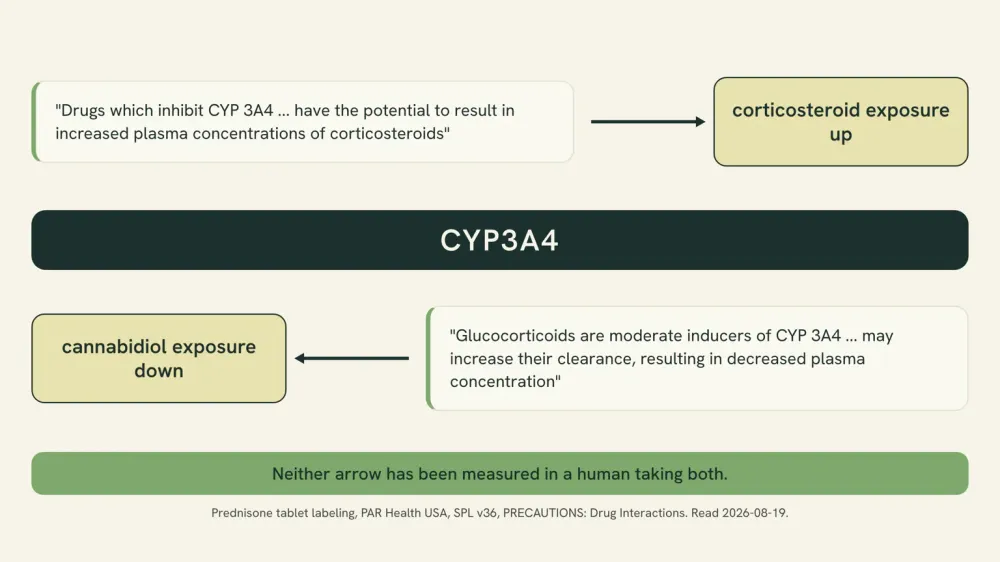
“Drugs which induce cytochrome P450 3A4 (CYP 3A4) enzyme activity (e.g., barbiturates, phenytoin, carbamazepine, rifampin) may enhance the metabolism of corticosteroids and require that the dosage of the corticosteroid be increased. Drugs which inhibit CYP 3A4 (e.g., ketoconazole, itraconazole, ritonavir, indinavir, macrolide antibiotics such as erythromycin) have the potential to result in increased plasma concentrations of corticosteroids. Glucocorticoids are moderate inducers of CYP 3A4. Co-administration with other drugs that are metabolized by CYP 3A4 (e.g., indinavir, erythromycin) may increase their clearance, resulting in decreased plasma concentration.”
Read the fourth sentence again, because it is the one nobody quotes and the only one that is about your CBD rather than about your steroid. It says the glucocorticoid may increase the clearance of other drugs that CYP3A4 handles, lowering their plasma concentration. Cannabidiol is partly one of those drugs: a physiologically based model of cannabidiol's clearance assigned roughly 38% of it to CYP3A4, 21% to CYP2C19, 11% to CYP2C9, 16% to UGT1A9, 10% to UGT2B7 and 4% to UGT1A7, and that is a model rather than a measurement in people. So the steroid's manufacturer has written down a mechanism by which the steroid could lower cannabidiol exposure, in the same paragraph where it writes down the mechanism by which a strong inhibitor could raise corticosteroid exposure. Page after page in this cluster explains what CBD does to somebody else's drug. This is the rarer case, where the other drug's own document says the other drug does something to the enzyme CBD depends on.
Two more entries in that same drug-interaction section earn their place here. Under Antibiotics the labeling says: "Macrolide antibiotics have been reported to cause a significant decrease in corticosteroid clearance." That is the manufacturer, not our editorial preference, pointing at a drug class this blog already covers, and erythromycin and clarithromycin have their own page. And under Ketoconazole sits the sentence that half the internet has built this topic on, which gets its own section below.
Not every prednisone label carries that paragraph
Here is something we did not see on any page one result for this search on August 19, 2026, and that you can verify in about five minutes: the paragraph above is not in every prednisone labeling. We opened five of them on DailyMed on August 19, 2026. Two carry the induction sentence. Three carry the ketoconazole sentence. Two have no CYP subsection at all, and one of those two has no drug-interaction section at all. Prednisone is an old generic made by many companies, and generic labeling is not identical across labelers, so a sentence quoted from one manufacturer's document is a statement about that document.
| Labeling (labeler, SPL version) | "Glucocorticoids are moderate inducers of CYP 3A4" | The ketoconazole 60 percent sentence | A "discontinue ... abruptly" warning |
|---|---|---|---|
| PAR Health USA, prednisone tablets, v36 | Present | Present | Present |
| Major Pharmaceuticals, prednisone tablets, v8 | Present | Present | Present |
| ANI Pharmaceuticals, prednisone tablets, v9 (no drug-interaction section at all) | Absent | Absent | Not found in our read |
| Amneal, prednisone tablets, v14 (drug-interaction section present, no CYP subsection) | Absent | Absent | Not found in our read |
| Dr. Reddy's, prednisone delayed-release, v5 | Absent | Present, in section 7.8 | Not recorded in our read |
That variation is not a scandal. It is how generic labeling works, and it has a practical use. What your leaflet says about CYP3A4 depends on who made your tablet, and you can find out. DailyMed is free and run by the National Library of Medicine, the manufacturer's name is printed on your pharmacy label, and the document takes one search to open. Read the Drug Interactions section end to end rather than the sentence a blog lifted out of it. And note what we are not claiming: five labelings is a sample, and we have no idea what the ones we did not open say.
Moderate inducer is a defined term, and the number is bigger than it sounds
"Moderate" in that sentence is not a vibe. It is a regulatory category with a number attached. FDA's table of substrates, inhibitors and inducers, which we read on August 19, 2026, defines it in the note under Table 2-3: "Strong and moderate index inducers are drugs that decrease the AUC of sensitive substrates of a given metabolic pathway by ≥80 percent and ≥50 to <80 percent, respectively." So the word the steroid's labeling chose describes a category defined by roughly halving a sensitive drug's exposure. Two limits belong in the same breath. First, FDA's own CYP3A row names carbamazepine, phenytoin and rifampin as strong index inducers and leaves the moderate column empty, printed as a dash. Second, the word prednisone does not appear anywhere on that page, and neither does corticosteroid, glucocorticoid or cannabidiol. FDA says the tables are "not intended to be an exhaustive list" and that these are index drugs chosen to design studies with. Absence from the table is not a finding that prednisone induces nothing, and it is not a finding that cannabidiol inhibits nothing either.
An inducer has actually been measured against cannabidiol in people, and it sits at the strong end: the FDA-approved labeling for pharmaceutical cannabidiol reports that rifampin, a strong CYP3A4 and CYP2C19 inducer, decreased cannabidiol and 7-hydroxy-cannabidiol plasma concentrations by approximately 32% and 63%, and adds that the impact of such changes on efficacy is not known. That is one sentence here on purpose, because rifampin belongs to the drug class where an inducer has actually been measured against CBD, which covers it properly. What it gives this page is scale. Rifampin is strong. The word in the steroid's labeling is moderate, which is a weaker category by FDA's own numeric definition. And we found no equivalent measurement with a glucocorticoid, so the induction arrow on this page is a mechanism written in a label rather than a number measured in a person.
The 60 percent in the label belongs to a different steroid
The same drug-interaction section has a subsection headed Ketoconazole. It is two sentences. Page one quotes the first.
“Ketoconazole has been reported to decrease the metabolism of certain corticosteroids by up to 60%, leading to increased risk of corticosteroid side effects. In addition, ketoconazole alone can inhibit adrenal corticosteroid synthesis and may cause adrenal insufficiency during corticosteroid withdrawal.”
Now look at the words "certain corticosteroids". That hedge is doing enormous work, and five small human studies say exactly what it is holding up.
The 60 percent comes from a 1986 crossover study in six normal subjects who were given 20 mg of methylprednisolone intravenously with and without ketoconazole 200 mg a day for six days. Methylprednisolone clearance fell about 60%, its AUC rose 135%, its mean residence time rose 66%, and cortisol suppression was prolonged. A second study, in eight normal subjects given 15 or 30 mg of intravenous methylprednisolone with a week of ketoconazole, found clearance down 46% and mean residence time up 37%. Those authors recommended halving the methylprednisolone dose, which is a recommendation about methylprednisolone given with an antifungal and is not advice to anybody reading this page.
Now the same antifungal against the steroid this page is actually about. In four healthy men given 20 mg of prednisone by mouth with ketoconazole 200 mg for six days, prednisolone clearance was 160 plus or minus 38 against 148 plus or minus 23 mL/h/kg, which is not a significant difference, and mean residence time, terminal slope, volume of distribution, renal excretion and the cortisol AUC ratio were all unchanged as well. Those authors called their own result preliminary, and n was four. Six healthy volunteers given 14.8 mg of prednisolone intravenously with the same six-day ketoconazole course produced the same answer: clearance 96 plus or minus 11 against 90 plus or minus 11 mL/h/kg, no significant change in mean residence time, volume of distribution or protein binding, and no change in the suppression of cortisol, basophils or helper T lymphocytes. The 1989 authors put the contrast in their own words: ketoconazole "minimally alters prednisolone clearance in contrast to the significant ketoconazole-methylprednisolone interaction previously reported."
Then the strongest available test. Itraconazole is one of the two drugs FDA uses as its strong CYP3A index inhibitor. In a double-blind randomized two-phase crossover in ten healthy subjects, four days of itraconazole 200 mg a day raised the AUC of a 20 mg oral dose of prednisolone by 24% and its half-life by 29%, both at p below 0.001, while Cmax and Tmax were unaffected and morning cortisol ran at 73% of the placebo phase. Their conclusion, verbatim: "The observed minor interaction between itraconazole and oral prednisolone is probably of limited clinical significance. The susceptibility of prednisolone to interact with CYP3A4 inhibitors is considerably smaller than that of methylprednisolone, and itraconazole and probably also other inhibitors of CYP3A4 can be used concomitantly with prednisolone without marked changes in the effects of this corticosteroid." For contrast inside the same drug class, budesonide's own labeling says: "Concomitant oral administration of a strong CYP3A4 inhibitor (ketoconazole) caused an eight-fold increase of the systemic exposure to oral budesonide."
| Corticosteroid and route | Inhibitor | Population and year | What changed |
|---|---|---|---|
| Methylprednisolone, 20 mg intravenous | Ketoconazole 200 mg/day for 6 days | 6 normal subjects, 1986 | Clearance down about 60%, AUC up 135%, mean residence time up 66%, cortisol suppression prolonged |
| Methylprednisolone, 15 or 30 mg intravenous | Ketoconazole 200 mg/day for 1 week | 8 normal subjects, 1987 | Clearance down 46%, mean residence time up 37% |
| Prednisolone, from prednisone 20 mg by mouth | Ketoconazole 200 mg for 6 days | 4 healthy men, 1989 | No significant difference in clearance (160 +/- 38 against 148 +/- 23 mL/h/kg), and nothing else moved either |
| Prednisolone, 14.8 mg intravenous | Ketoconazole 200 mg for 6 days | 6 healthy volunteers, 1991 | No significant change in clearance (96 +/- 11 against 90 +/- 11 mL/h/kg), or in cortisol, basophil and helper T cell suppression |
| Prednisolone, 20 mg by mouth | Itraconazole 200 mg/day for 4 days | 10 healthy subjects, 2000 | AUC up 24%, half-life up 29% (both p<0.001); Cmax and Tmax unaffected |
| Budesonide, oral | Ketoconazole | Stated on budesonide's own labeling, section 7.1 | Eight-fold increase in systemic exposure |
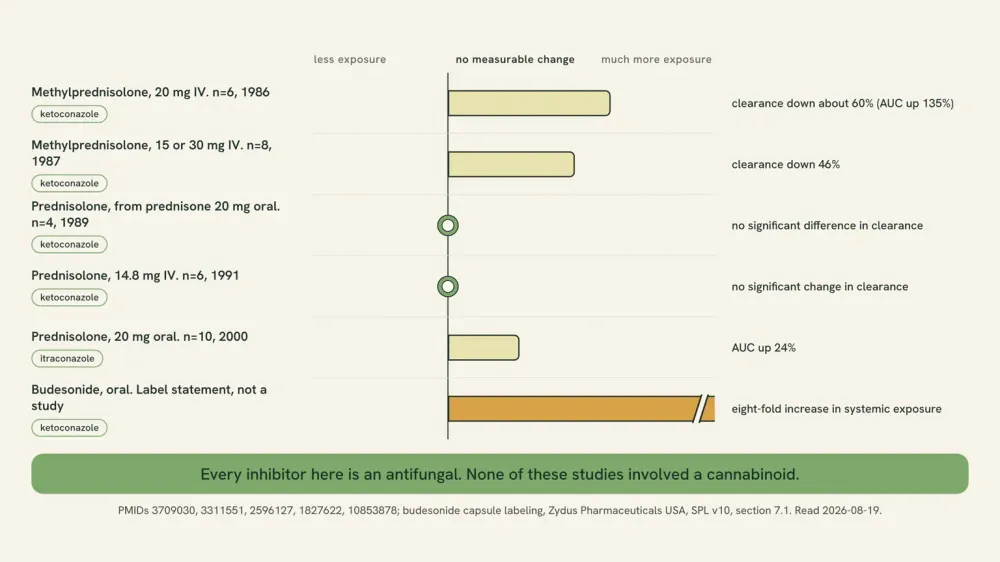
Two honest qualifications belong in the same breath as those numbers. First, the human record is not perfectly unanimous. The 1990 Clinical Pharmacokinetics review linked above lists "subjects taking ketoconazole" among the situations producing increased unbound prednisolone concentrations, and unbound concentration is a different measurement from the total clearance that the two crossovers found nothing on. Both belong on the page and we are not picking a winner. Second, and this is the sentence that separates this page from everything ranking above it: ketoconazole and itraconazole are antifungals, they are classified inhibitors at the strong end of the scale, and cannabidiol is not one of them and is not in that classification at all. A 60 percent, a 46 percent, a 24 percent or an eight-fold figure earned by an antifungal cannot be handed to CBD by analogy, in either direction. What these studies are good for is narrower and more useful: they show that corticosteroid is not one thing, that the labeling's "certain corticosteroids" hedge is load-bearing, and that the number page one repeats is not prednisone's number.
The other direction: what CBD has done to CYP3A4 in people
For the arrow to run from CBD toward the steroid, it has to go through CYP3A4, and the two best human answers we could find on whether cannabidiol touches that enzyme disagree with each other. The FDA-approved cannabidiol labeling reports no change in midazolam, which it calls a sensitive CYP3A4 substrate, at 750 mg twice daily. A 2023 randomized probe-cocktail study in 18 healthy adults, who ate a single cannabis-extract brownie containing 640 mg of CBD and 20 mg of THC, found midazolam AUC 56% higher, a ratio of 1.56. Set that against FDA's own cutoffs, printed in the note under Table 2-2: a moderate inhibitor raises a sensitive substrate's AUC at least 2-fold and a strong one at least 5-fold. A ratio of 1.56 sits below the floor for moderate. That arithmetic is ours against FDA's stated numbers and is not an FDA classification, and the study's product contained THC and was a single acute dose in healthy volunteers.
There is also a plausible reason the two answers differ. Work in human hepatocytes published in 2025 proposes the reconciliation that cannabidiol inhibits CYP3A4 acutely and induces it with longer exposure, which is a cell-culture finding rather than a measurement in a person. Sit with what that implies: on this enzyme the direction of a cannabidiol effect may not even be fixed, which is a poor foundation for the confident sentence page one keeps writing. The wider drug list, grapefruit and the CYP3A4 and CYP2C19 framework live on the parent page and are not re-derived here.
One thing worth doing yourself, on any page in this category. On August 19, 2026 the single page-one result that printed a PubMed identifier beside its claim that CBD inhibits CYP3A4 cited PMID 21356216. That identifier is real, and it resolves to a 2011 laboratory study of cannabidiol against recombinant CYP3A enzymes and pooled human liver microsomes. No person, no dose, no plasma. So the most sourced-looking page on the search results was supporting a claim about people with a test tube, and finding that out took under a minute. Any page that gives you an identifier is a page you can audit.
What has actually been published about the two together
Here are the searches, printed so you can re-run them. On August 19, 2026, a PubMed search for cannabidiol AND prednisone returned 5 records, and a search for cannabidiol AND prednisolone returned 4. One record appears in both, so the union is 8. We resolved every one of the eight titles rather than counting them and moving on, and we also ran the wider search that could have falsified all of this: (cannabidiol OR "CBD") AND (prednisone OR prednisolone) returns 19 records on the same date, of which the 11 extras are mostly CBD matching common bile duct. None of the 19 is a human co-administration study. Here is what the eight actually are.
- A 2025 randomized, double-blind, placebo-controlled veterinary trial in client-owned dogs with high-grade lymphoma, 25 enrolled and 19 completing, testing a CBD and CBDA rich hemp oil during one CHOP chemotherapy cycle.
- A 2024 study in rats with a pulmonary fibrosis model, using metabolomics and bacterial gene sequencing, in which prednisone was one treatment arm and cannabidiol was three separate dose arms. They were never given together.
- A 2020 case report of one dog, a four-year-old Labrador, with a probable cutaneous adverse drug reaction to a hemp oil containing CBD.
- A 2020 narrative review of animal models of infantile spasms, listing corticosteroids as first-line and cannabidiol among second-line options. No co-administration.
- A 2020 case report of one woman, aged 56, who developed Stevens-Johnson syndrome with toxic epidermal necrolysis two days after taking a commercial CBD oil sublingually, and who died of septic shock.
- A 2020 case report of one man, aged 28, with acute respiratory failure from lipoid pneumonia after using a street-purchased THC vape cartridge.
- A 2013 study in mice with experimental autoimmune encephalomyelitis, testing nasal drug delivery, in which prednisolone was a separate arm.
- A 2007 bibliography of clinical trials in progress, in which both drug names appear as index entries.
In all eight, the two are never being tested together in a person. Four are animal work: rats, mice, one dog, and a randomized trial in dogs. One is a review listing both as separate treatment options. One is a 2007 bibliography. And in the three records where a human being is present, the steroid is the treatment for a reaction attributed to a cannabinoid product rather than something anyone chose to take alongside it. In the Stevens-Johnson case report the treatments are listed as "topical cyclosporine, prednisone, moxifloxacin, and erythromycin ointment", and we are deliberately not telling you which route the prednisone took, because the source does not say. In the lipoid pneumonia report the product was a THC vape cartridge rather than CBD, and the paper states that "All six patients reported to date received intravenous corticosteroids and survived to hospital discharge." Each of those two reports describes a single patient, and a case report is an association rather than a cause. That pattern, a corticosteroid used to treat a reaction attributed to a cannabinoid product, is also the shape of the one live page on this blog that named a corticosteroid when we checked the corpus in August 2026: when a corticosteroid is the treatment for a reaction.
The record nearest to a real co-administration experiment is the randomized veterinary trial, and the species goes in the same sentence as the numbers: dogs. Twenty-five client-owned dogs enrolled, 19 completed, and the drug it measured was doxorubicin rather than prednisone. The hemp oil did not significantly affect doxorubicin AUC within the intervention group; between groups, AUC did not differ at week 0 and did differ at week 5, with the placebo group at 572.6 nM/h (448.3 to 731.2). No serious adverse events, and no difference in quality of life. Prednisone is in that trial only because it is the P in the CHOP protocol. A fourth search on the same day, for cannabidiol with corticosteroid and either pharmacokinetics or drug interactions, returns 7 records, and only one of those seven is a laboratory experiment putting cannabidiol in front of a corticosteroid's activation step. It used an inhaled steroid (beclomethasone dipropionate), a different enzyme family (a carboxylesterase, not a CYP), and human lung tissue in a dish, at micromolar concentrations: CBD inhibited the hydrolysis with an IC50 of 36.8 micromolar, and the authors' own model expected the effect of orally administered CBD to be of no clinical relevance.
Where the two drugs' side effects overlap
This part has an immediate practical use. If you start CBD while you are taking a corticosteroid and something changes, you will want to know which one to blame, and the honest answer is that several of the candidate symptoms sit on both lists. That is not an interaction. It is an attribution problem, and it is one of the better reasons to make sure the prescriber knows before anything changes rather than after. The two columns below come from two different documents and two different populations and are not comparable rates: the left is the prednisone labeling's adverse-reaction list, which prints no rates at all, and the right is from the controlled trials behind the cannabidiol labeling, at 20 mg/kg/day in 238 patients with Lennox-Gastaut or Dravet syndrome against 227 on placebo, nearly all of whom were also taking other antiseizure drugs. That is pharmaceutical cannabidiol at a prescription dose, not a hemp tincture.
| Symptom | In the prednisone labeling's adverse-reaction list | In the cannabidiol trials, 20 mg/kg/day against placebo |
|---|---|---|
| Diarrhea | Listed. The labeling prints no rate. | 20% against 9% |
| Appetite and weight | Both directions listed: "anorexia which may result in weight loss" and "increased appetite and weight gain" | Decreased appetite 22% against 5% |
| Liver enzymes | "Elevation in serum liver enzyme levels (usually reversible upon discontinuation)" | Transaminase elevations 16% against 3% |
| Sleep and alertness | Insomnia listed | Somnolence 25% against 8%; fatigue, malaise and asthenia 12% against 4% |
| Mood | Mood swings and irritability listed | Not among the reactions quoted here |
| Nausea, dizziness, headache | All three listed | Not among the reactions quoted here |
If you want the CBD side of that table on its own, with what the trials actually reported and how often, what CBD's side-effect profile looks like has it. The liver row in particular is handled properly on what the liver trials measured rather than re-derived here, and it deserves the extra reading, because the corticosteroid labeling and the cannabidiol labeling both carry a liver-enzyme line and a reader who sees a raised result has two plausible explanations and no way to choose between them alone.
What to actually do: a disclosure checklist
Everything above converges on one behavior, and it is not a schedule. It is disclosure, done well enough to be useful to the person receiving it. Here is the version that works at a pharmacy counter, and not one of these steps involves changing the amount of anything. If you are taking several prescriptions at once, that page is worth reading beside this one, and if what you actually came for was amounts, how amounts are usually discussed is the page that owns them. This one publishes none.
- 1Write down what you are actually taking: the product type, which cannabinoid it lists, the concentration in mg per mL, and the amount per serving printed on the label.
- 2Bring the batch certificate of analysis if the product has one. A COA tells a pharmacist what is in the bottle in a way that marketing copy on the front label does not.
- 3Tell the clinician who prescribed the steroid, and separately tell the pharmacist who dispenses it. They see different parts of your record, and a pharmacist often catches the interaction question first.
- 4Note the manufacturer's name from your pharmacy label and bring it, then ask them to read the drug-interaction section of that manufacturer's own document, since not all of them carry the same paragraph.
- 5Write down the date you started CBD, and the date of any change to it. An attribution question is close to unanswerable without a timeline.
- 6Do not change the steroid. Not the amount, not the timing, not the number of days, and not on the strength of anything you read online, this page included.
- 7Note new symptoms as they happen rather than from memory, especially the ones on both lists: diarrhea, appetite change, tiredness, sleep changes and mood changes.
- 8Take any new symptom to the prescriber rather than to a search box, and mention the CBD in the same breath so nobody has to guess.

The red flags, in the label's own words
These are the labeling's list rather than ours, and they are about the steroid rather than about CBD, which is exactly why they belong on a page people arrive at while taking one. Under Information for Patients, quoted whole: "Patients should be warned not to discontinue the use of corticosteroids abruptly or without medical supervision. As prolonged use may cause adrenal insufficiency and make patients dependent on corticosteroids, they should advise any medical attendants that they are taking corticosteroids and they should seek medical advice at once should they develop an acute illness including fever or other signs of infection. Following prolonged therapy, withdrawal of corticosteroids may result in symptoms of the corticosteroid withdrawal syndrome including, myalgia, arthralgia, and malaise." The WARNINGS section adds that adrenocortical insufficiency may result from too rapid a withdrawal and that this relative insufficiency can persist for up to 12 months after treatment stops.
- Fever, or any other sign of infection, while you are taking a corticosteroid. The labeling tells patients to seek medical advice at once and to tell whoever is treating them that they are on a corticosteroid.
- Muscle pain, joint pain or malaise after any interruption in the steroid, which the labeling names as symptoms of the corticosteroid withdrawal syndrome.
- Any hospital visit, surgery, dental procedure or urgent care episode: say out loud that you take a corticosteroid, including if you stopped one recently.
- A new rash or anything that looks like an allergic reaction after starting a new cannabinoid product. Both skin-reaction case reports in this small literature, one in a person and one in a dog, are exactly that.
- A symptom on both lists that is getting worse rather than settling. That is a call to the prescriber, not a reason to run an experiment on your own dose.
What nobody can tell you about CBD and prednisone yet
Here is the shape of the uncertainty, stated plainly, because it is the finding rather than a disclaimer. The steroid's manufacturer has written down a mechanism by which the steroid could lower cannabidiol exposure. The same four sentences write down a mechanism by which a CYP3A4 inhibitor could raise corticosteroid exposure. Neither has been measured in a human being taking cannabidiol and prednisone. The measurements that do exist come from antifungals, and what they show is a class splitting apart: an eight-fold rise for one corticosteroid and nothing measurable for another, under the same enzyme and the same drug. Cannabidiol is not in FDA's inhibitor classification at all, the one human midazolam ratio available for it sits below the floor for moderate, and the two human answers described above disagree with each other.
So the net effect in one specific person is not predictable from anything published, and any page that hands you a direction is telling you more than the evidence supports, including when the direction it hands you is the reassuring one. Two things follow, and neither is a wait window. The first is that the idea of using CBD to need less of a corticosteroid, or to get off one, has nothing behind it and runs directly against the instruction printed in the drug's own document. The second is that the two people who can see your whole picture, the prescriber and the pharmacist, are the ones who need to know that CBD is part of it.
No published human study of that pair turned up in our searches. On August 19, 2026, PubMed returned five records for cannabidiol with prednisone and four for prednisolone, and not one is a person taking both on purpose. What exists is a labeling paragraph documenting arrows in both directions: glucocorticoids described as moderate inducers of CYP3A4, and CYP3A4 inhibitors described as capable of raising corticosteroid concentrations. Neither arrow has been quantified for this combination. That makes this a conversation with the prescriber and the pharmacist rather than a number from a blog, and it is not a reason to change how you take the steroid.
We publish no window, and the pages that publish one are not citing anything. Two results on page one for this search on August 19, 2026 told readers to separate the two by a few hours, with no source attached to the number. Enzyme induction is also not a same-day phenomenon: it develops over days as the liver makes more enzyme, and it fades over days after the trigger is removed, so a gap measured in hours is not the variable people think it is. The useful step is telling the prescriber and the pharmacist and letting them decide whether anything should change.
That is what page one says, and the human record does not support it as stated. Prednisone is converted to prednisolone, and of the three corticosteroids with human numbers on this page, prednisolone is the one that moved least under CYP3A4 inhibition. Itraconazole, which FDA uses as a strong CYP3A index inhibitor, raised oral prednisolone AUC by 24% in ten healthy adults. Ketoconazole did not significantly change prednisolone clearance in two small crossovers of four and six people, while the same drug cut methylprednisolone clearance by about 60% in six. Every one of those perpetrators is an antifungal. Nothing in the records our searches returned on August 19, 2026 tests cannabidiol against prednisone or prednisolone in a person, so this is a statement about what is unknown rather than a reassurance.
The prednisone labeling states plainly that corticosteroids, including prednisone tablets, suppress the immune system and increase the risk of infection with any pathogen. That is the steroid's own document, about the steroid. No human study establishes a comparable claim about cannabidiol in either direction, so pages that assert it, including the ones using it as a warning about combining the two, are going past the evidence. We are not going to assert it either, or deny it. The actionable part comes from the label regardless: while you are taking a corticosteroid, fever or other signs of infection are a reason to seek medical advice at once.
No. Nothing we could find in the published record supports it, and this is the specific idea the page exists to head off. The labeling's instruction is flat: "Do not stop taking this medicine without first talking to your doctor. Avoid abrupt withdraw of therapy." Stopping a corticosteroid abruptly after prolonged use can cause adrenal insufficiency, and the same document notes that a relative insufficiency can persist for up to 12 months after treatment ends. Nothing in the records our searches returned measures cannabidiol against prednisone or prednisolone in a person, and the decision to reduce or stop a corticosteroid belongs to the prescriber who started it.
Corticosteroid is not one thing, and that is the most transferable finding on this page. On budesonide's own labeling, a strong CYP3A4 inhibitor produced an eight-fold rise in systemic exposure. On prednisolone, the same drug produced nothing measurable in two small human studies. Methylprednisolone sits between them, at roughly a 60% fall in clearance in six volunteers. The only corticosteroids we found numbers for are methylprednisolone, prednisolone and budesonide, so we are not going to invent rows for dexamethasone or hydrocortisone. This page covers the oral systemic steroid, and the right person to ask about yours is the one who prescribed it.
Writing about hemp, wellness and the small rituals that keep us balanced.