CBD and Ibuprofen: What the Research Actually Shows
Nineteen PubMed records contain both cannabidiol and ibuprofen, and none measured either drug in a person. Here is the dated search, the four clearance routes, what the FDA-approved CBD label reports about each, and the instruction that has a document behind it.
Can you take CBD and ibuprofen together? Several of the pages ranking for that question answer with a number: wait two to four hours. We went looking for the study that number came from. On August 9, 2026, a PubMed search for cannabidiol and ibuprofen returned nineteen records, and not one of them gave a person both drugs and then measured either one in blood. There is nothing underneath the interval. What does exist is an FDA-approved drug label with real measurements on it, and those measurements point somewhere the retail pages never look.
Here is the short answer before the detail. Nobody has published a human pharmacokinetic study of this pair, so no page can honestly hand you a schedule, and this one is not going to invent a better one. The enzyme every seller gestures at, CYP2C9, was actually tested in people on the cannabidiol label, and the probe drug did not move. The routes that do carry a label instruction are different ones, and the largest change any of them produced in a person was 35%, in a transplant medicine rather than in ibuprofen. The instruction that is genuinely supported is printed on the ibuprofen box itself: ask a doctor or pharmacist before use if you are taking any other drug. You are also not unusual for asking. In a nationally representative survey of 1,008 American adults who had ever used CBD, fielded in late 2023 and published in 2026, ibuprofen was the single medication most often named as one people combine with or replace using CBD, at 4.8% of ever-users (95% CI 3.6 to 6.3), ahead of Tylenol at 3.9%. If you want the plain chemistry first, our hub on what cannabidiol actually is covers it, and the general framework for CBD alongside prescriptions lives on our page about CBD and other medications.
How long after CBD can you take ibuprofen? Here is the search
A claim about an entire literature needs its own search rather than somebody's impression of one, so here is ours in full. Database: PubMed. Date: August 9, 2026. Query: cannabidiol AND ibuprofen. Records returned: 19. You can open the same search yourself and check the number against the one we got. Adding the humans filter drops it to 8. Restricting to records whose title or abstract mentions pharmacokinetics or a drug interaction leaves 4, and those four are a survey, a computational paper, a drug-bulletin article and a rat absorption study. Widen the drug side to naproxen and to the whole nonsteroidal anti-inflammatory class with the same filter and you get 10. Cannabidiol and naproxen together return 2. There is no version of that search that produces a human pharmacokinetic study of the pair, because none has been published.
The nineteen deserve describing rather than rounding down to zero, because what they are is the actual state of the evidence, and it is not nothing. It is simply not what a wait time would need.
- Four are in vitro work in cells: a phytocannabinoid and NSAID combination in lung cells, a vulvar carcinoma apoptosis study, an antiviral entry assay, and a chiral NMR paper touching the TRPA1 channel.
- Five are animal models: a rat knee inflamed with complete Freund's adjuvant, zebrafish larvae, a music-and-analgesia experiment, a rat absorption cocktail, and one further rat pain model discussed below.
- Four are formulation or analytical papers: microencapsulation, film-forming skin systems, a saliva Raman assay, and a computational network-pharmacology paper.
- Six are clinical or secondary literature: the US survey, an eight-person dental pilot, a randomized emergency-department trial, a multicriteria decision analysis, a research-roundup article and a 2007 nursing overview.
The most scientific-looking result on the first page of search results for this question illustrates the problem better than any of them. It is a 2022 rat study on peripheral cannabinoid receptors and systemic ibuprofen, and it does not contain CBD. The cannabinoid in the experiment is WIN 55,212-2, a synthetic agonist at the CB1 and CB2 receptors, injected into the paws of Wistar rats at 3, 10 and 30 micrograms alongside subcutaneous ibuprofen, in a formalin test analyzed isobolographically. The synergy it reports was reversed 45% by a CB1 blocker and 76% by a CB2 blocker, which means it depends on receptor agonism, and cannabidiol has no agonist entry at CB1 or at CB2 in the IUPHAR pharmacology database at all. Its only cannabinoid-receptor record there is as a negative allosteric modulator at CB1, which dampens signalling at that receptor rather than switching it on, as our page on how cannabinoids bind, or fail to bind, the CB1 and CB2 receptors sets out. Pulled from Europe PMC on August 9, 2026, the full text of that paper contains the word cannabidiol exactly once and the letters CBD exactly once, both outside the experiment. A rat's paw and a different molecule, and it is the closest thing to pharmacology anyone ranking for this query has.
CBD and ibuprofen: what "the same liver enzymes" actually means
Start with what the documents do not say, because it is checkable in a minute and none of the pages we were able to open on August 9, 2026 had done it. We read the EPIDIOLEX prescribing information, the label for the only cannabidiol medicine the FDA has approved, in the full structured product listing published on DailyMed, version 35, effective May 29, 2026. In the whole document the word ibuprofen appears zero times. NSAID appears zero times. Nonsteroidal and anti-inflammatory appear zero times. Then we read it in the other direction: the prescription ibuprofen tablet label, the over-the-counter ADVIL Drug Facts and the ibuprofen injection label all returned zero hits for CYP and zero for cytochrome. The claim that these two share liver enzymes is not printed on either drug's label. Absence from a label is a labelling convention rather than a safety finding, which is exactly why the rest of this section goes to the studies instead of stopping there.
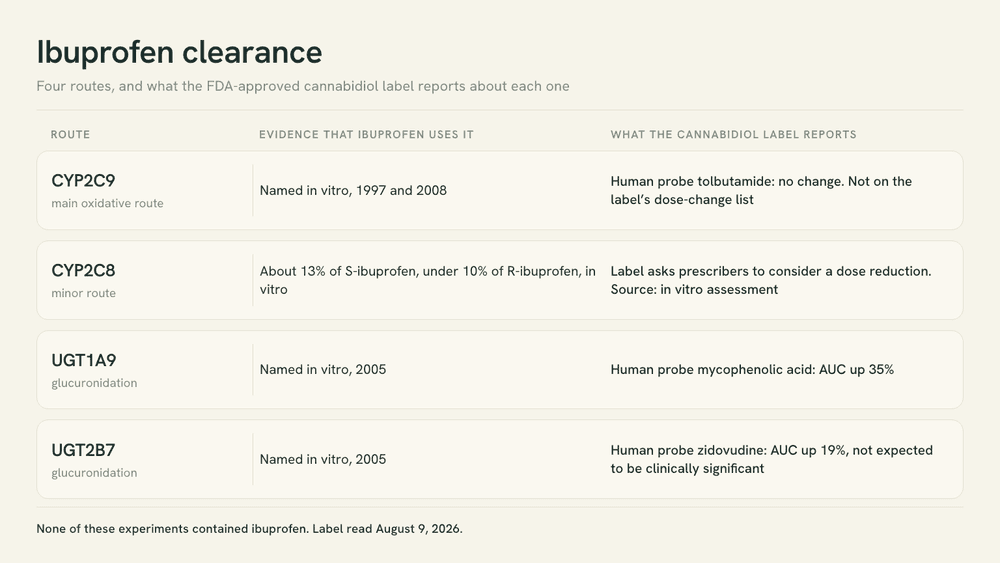
Ibuprofen's main oxidative route really is CYP2C9, and the evidence for that is laboratory evidence. In human liver microsomes and cDNA-expressed enzymes studied in 1997, CYP2C9 preferentially formed the S-hydroxy metabolites while CYP2C8 favored R-2-hydroxyibuprofen. A 2008 reaction-phenotyping study, also in vitro, found that at low concentrations only CYP2C9 formed appreciable amounts of the hydroxy metabolites and concluded that CYP2C9 inhibition and genotype are expected to have an impact on the pharmacokinetics of S-ibuprofen. So far the popular story holds. Then the cannabidiol label tests that exact enzyme in people, and reports the opposite of what the story predicts. Coadministration of EPIDIOLEX at 7.5 mg/kg twice daily with a single 500 mg dose of tolbutamide, described in the label as a moderately sensitive CYP2C9 substrate, "did not result in changes in plasma exposures of tolbutamide" compared with tolbutamide given alone. CYP2C9 substrates do not appear anywhere in the label's list of drug classes whose dosage prescribers are asked to consider changing.
That null has a counter-datum, and the two travel together or not at all. In a randomized crossover study in 18 healthy adults published in 2023, participants ate a brownie containing 640 mg of CBD and 20 mg of THC and then took a probe cocktail that included losartan, which is also a CYP2C9 substrate. The geometric mean ratio of losartan's area under the plasma concentration curve rose 77% against placebo. Two human experiments, one enzyme, opposite directions, and the distance between them is large: different products, different amounts, one of them containing THC, and two different probe drugs, neither of which is ibuprofen. We tell the losartan story in full on our page about CBD and blood pressure medication, because that is where the drug it actually concerns lives. What the pair means here is narrower and more useful: the enzyme most often named in this conversation has been measured in people twice, with cannabidiol, and the results do not agree.
The route the label does attach an instruction to is CYP2C8, and the origin of that instruction is worth knowing. Section 7.2 says: "Concomitant use of EPIDIOLEX may cause clinically significant interactions with CYP2C8 substrates. Consider a reduction in dosage of CYP2C8 substrates, as clinically appropriate, if adverse reactions are experienced when concomitantly used with EPIDIOLEX." Where does that come from? From section 12.3, under the heading In Vitro Assessment of Drug Interactions: "Cannabidiol has the potential to inhibit CYP2B6 and CYP2C8, and to induce CYP2B6 at clinically relevant concentrations." There is no human CYP2C8 probe study anywhere on the label. And on ibuprofen's side, the 2008 phenotyping work concluded that CYP2C8 plays a minor role in clearing both enantiomers, under 10% of R-ibuprofen and about 13% of S-ibuprofen, again in vitro. So the one flagged route is a minority pathway on the ibuprofen side and a plate result on the cannabidiol side.
Keep the size of that in perspective, because in vitro inhibition is a mechanism and not an effect size. The same label ran two strong enzyme blockers against cannabidiol itself and got small numbers back: itraconazole moved cannabidiol exposure by less than 10%, fluconazole by 22% and 24%, and the label's own words for the result are "still considered not to be clinically meaningful". A finding in a dish tells you a molecule can touch an enzyme. It does not tell you by how much, in a person, at the amounts anyone actually takes. We worked that limiter through in detail on our page about CBD and antibiotics, and it applies here without modification.
The route the retail pages never mention is glucuronidation, and it is the one with the largest human number attached to it. Ibuprofen is substantially cleared as a glucuronide: a 2005 study using twelve individually expressed UGT enzymes plus pooled human liver microsomes reported that "Inhibitory studies in pooled HLMs support the role of UGTs 1A1, 1A3, 1A9, 2B4, and 2B7 in the glucuronidation of ibuprofen, flurbiprofen, and ketoprofen", in vitro. The cannabidiol label happens to carry human probe data on exactly two of those. With mycophenolate mofetil 1500 mg, mycophenolic acid, a UGT1A9 substrate, rose 16% in Cmax and 35% in AUC. With zidovudine 300 mg, a UGT2B7 substrate, exposure rose 7% in Cmax and 19% in AUC, which the label says is "not expected to be clinically significant". Section 7.2 states that cannabidiol is an inhibitor of UGT1A9 and asks prescribers to consider a dose reduction of UGT1A9 substrates where minimal concentration changes may lead to serious adverse reactions. The label prints the negative beside it too: cannabidiol does not inhibit the UGT1A1, UGT1A3, UGT1A4, UGT1A6 or UGT2B17 isoforms.
| Route ibuprofen uses | Evidence that ibuprofen uses it | What the cannabidiol label says about that route | Measured in people? |
|---|---|---|---|
| CYP2C9, the main oxidative route, stereoselective toward the S-enantiomer | Human liver microsomes 1997 and reaction phenotyping 2008, both in vitro | Tolbutamide probe: no change in plasma exposures. CYP2C9 substrates are not on the section 7.2 dose-change list | Yes, and it is a null. A different probe, losartan, rose 77% in AUC in a separate trial |
| CYP2C8, a minor route: about 13% of S-ibuprofen and under 10% of R-ibuprofen | Reaction phenotyping 2008, in vitro | Section 7.2 asks prescribers to consider a dose reduction of CYP2C8 substrates. Its source is section 12.3, In Vitro Assessment of Drug Interactions | No human probe study exists on the label |
| UGT1A9, glucuronidation | Twelve expressed UGTs plus pooled human liver microsomes, 2005, in vitro | Cannabidiol is an inhibitor of UGT1A9; section 7.2 asks for a dose-reduction consideration | Yes. Mycophenolic acid AUC up 35%, Cmax up 16% |
| UGT2B7, glucuronidation | Same 2005 in vitro study | Zidovudine exposure up 19% in AUC and 7% in Cmax, which the label calls not expected to be clinically significant | Yes |
| Renal excretion of the metabolites | Ibuprofen's own label: rapidly metabolized and eliminated in the urine, excretion virtually complete 24 hours after the last dose | Nothing | Not applicable |
Read the table as a whole and the honest summary is uncomfortable for everyone selling an answer. Every row is about a different drug standing in for ibuprofen. The largest change any of them produced in a person was 35%, and it happened in a transplant medicine. The one route where the enzyme everyone names was actually tested in people produced no change at all. And ibuprofen itself has never been in any of these studies. The reverse direction, whether ibuprofen changes cannabidiol, is unmeasured as well; the closest thing is modelling published in 2023 that partitions cannabidiol's own clearance as CYP3A4 38%, CYP2C19 21%, UGT1A9 16%, CYP2C9 11%, UGT2B7 10% and UGT1A7 4%. That is a physiologically based model built out of laboratory data rather than a trial, and its own simulations over-predicted two antifungal interactions, so it is a hypothesis about where cannabidiol goes, not a measurement of what ibuprofen does to it.
What it looks like when something really does block that enzyme
It helps to see the shape of a real CYP2C9 interaction, because it sets the bar the CBD version would have to clear. In a randomized crossover study in 12 healthy male volunteers published in 2006, each man took a single 400 mg oral dose of racemic ibuprofen alone, and again after voriconazole and after fluconazole, two prescription antifungals that inhibit CYP2C9. S-ibuprofen exposure went to 205% of control with voriconazole and 183% with fluconazole. Peak concentration went to 122% and 116%. The half-life of the S-enantiomer went from 2.4 hours to 3.2 and 3.1 hours. The geometric mean AUC ratios were 2.01 (90% CI 1.80 to 2.22) and 1.82 (1.72 to 1.91), both well outside the 1.25 boundary regulators use for bioequivalence. The R-enantiomer barely moved, which is exactly what stereoselective metabolism predicts.
Now look at what that study has that the CBD claim does not. A named inhibitor. A named substrate, which is ibuprofen itself rather than a stand-in. A dose for each. A design. A confidence interval. A stated threshold that the result crosses. Nothing in the cannabidiol literature has any of that for this pair. Notice the direction too: a real CYP2C9 blocker raises ibuprofen exposure rather than lowering it, which is the opposite of the vague implication that CBD somehow makes a painkiller work less well. Voriconazole is a prescription antifungal rather than a hemp extract, and its numbers are printed here to show what a measured interaction looks like, not to be transferred to anything, so that an unmeasured one stops sounding equally solid.
What a sourced timing rule actually looks like
Ibuprofen's own label carries a real, measured timing rule, which makes the comparison unusually clean. It is about aspirin. In the pharmacodynamic studies described in the prescription label, ibuprofen 400 mg taken once daily 2 hours before an immediate-release 81 mg aspirin dose for 6 days left serum thromboxane B2 inhibition at 53% at 24 hours after the day-6 aspirin dose. Moved to 8 hours before, the interaction was still observed but minimized, at 90.7%. Taken 2 hours after aspirin, but not concomitantly and not 15 or 30 minutes after, inhibition was 99.2% and the label describes no interaction. With enteric-coated aspirin and ibuprofen three times daily it fell back to 67%. That is what a sourced interval contains: a named pair, a dose for each, a defined gap, a measured endpoint and a percentage. It is a rule about aspirin and ibuprofen, it is quoted here for its shape rather than as advice, and it does not transfer to any other pair. Aspirin, antiplatelets and anticoagulants are their own subject, and we handle them on the page about CBD and blood thinners.
Two facts about ibuprofen's timing are worth knowing on their own terms, and neither of them is a schedule for anything else. The same label reports that peak serum concentrations arrive one to two hours after a dose, that the serum half-life is 1.8 to 2.0 hours, and that urinary excretion of the drug and its metabolites is virtually complete 24 hours after the last dose. Ibuprofen is a short-acting drug. That is a fact about ibuprofen. A half-life is not a spacing rule, and converting one into an interval for a second substance nobody has studied alongside it is precisely the move this page exists to correct.
The overlap that is real, and it is the gut
There is a genuine shared surface between these two products, and it is not the bloodstream. Prescription ibuprofen carries a boxed warning, the strongest warning the FDA applies to a label, and it reads in part: "NSAIDs cause an increased risk of serious gastrointestinal adverse events including bleeding, ulceration, and perforation of the stomach or intestines, which can be fatal. These events can occur at any time during use and without warning symptoms. Elderly patients are at greater risk." The same boxed warning also covers cardiovascular thrombotic events. The mechanism the label gives for how ibuprofen works at all is the clue to why: its mode of action, like that of other NSAIDs, "may be related to prostaglandin synthetase inhibition", and prostaglandins are among the things that maintain the stomach lining.
On the other side, diarrhea is the adverse reaction reported most often for cannabidiol, and the honest version of that number includes the placebo columns. In the pooled controlled trials on the cannabidiol label, diarrhea was reported by 9% of patients at 10 mg/kg per day, 20% at 20 mg/kg per day, and 9% of patients on placebo. In the tuberous sclerosis trial it was 31% against 25% on placebo. At the lower dose the drug figure and the placebo figure are the same number, which is the sort of detail that disappears from a summary. Two randomized trials in adults are more pointed: one published in 2022 and one published in 2023, run at one center in two different upper-gastrointestinal cohorts at 20 mg/kg per day of pharmaceutical cannabidiol for four weeks, whose adverse-event data are posted in the trial registry as diarrhea in 8 of 25 against 1 of 23 in one cohort and 12 of 21 against 2 of 23 in the other, while fatigue was reported by identical numbers of people in the cannabidiol and placebo arms of both cohorts and nausea differed by at most one person. Those were oral solutions dosed by body weight in people with diagnosed conditions, which is not a hemp tincture, and we take the whole question apart on whether CBD causes diarrhea. The rest of the adverse-effect picture sits on our page about CBD side effects.
There is one more contributor to the gut question that has nothing to do with either drug's pharmacology, and we will print it even though it complicates our own category. The certificate of analysis for a 60 mL Planntz tincture prints a package size of 56.7 g. After the cannabinoids, most of what remains is coconut MCT oil, roughly 41 g in a whole bottle, which works out to about 33 to 37 mg of carrier oil per drop across the four tinctures. The published literature that reports abdominal pain and loose stools from MCT works in grams, with protocols in the range of 12.5 g on day one and 25 g per day, and about 1 g per kilogram of body weight established as safe in dietary use. Tens of milligrams sits far below any amount that literature studied. Far below studied amounts is not the same thing as cannot matter to one person, which is why individual sensitivity is a real answer and an arithmetic dismissal is not.
Put the two sides together and the practical problem is not that they multiply, because nobody has shown that they do. It is attribution. Two entirely different mechanisms are landing in the same organ, and if something goes wrong you will not immediately know which product to tell your doctor about. One of the two possibilities is the one with the boxed warning. That is the whole reason to name both when you describe a symptom, and it is a far better use of the overlap than any claim about a bleeding risk that no study has attached to cannabidiol.
Stop and get help: the signs the label itself lists
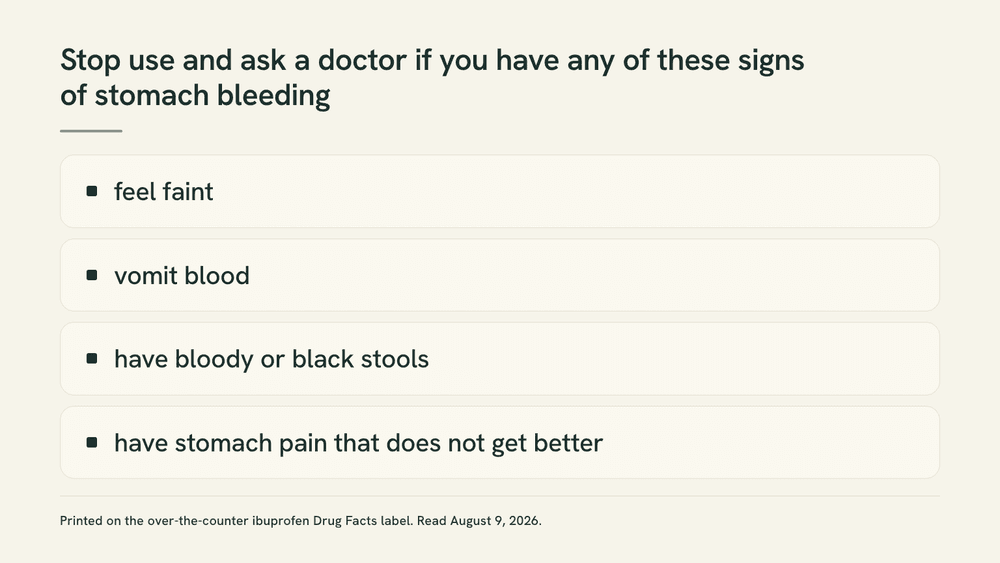
These are not our words and they are not a general wellness caution. They are the stop-use signs printed on the over-the-counter ibuprofen Drug Facts label, which is the most useful document on this entire subject and the one that none of the pages we were able to open on August 9, 2026 quotes. The ADVIL Drug Facts label opens with a stomach bleeding warning: this product contains an NSAID, which may cause severe stomach bleeding. Then it lists what to watch for. If any of these appear, the label's own instruction is to stop use and ask a doctor.
- You feel faint.
- You vomit blood.
- You have bloody or black stools.
- You have stomach pain that does not get better.
The same label prints the risk list that makes those signs more likely, and it is worth reading with your own situation in mind rather than in the abstract. The chance of severe stomach bleeding is higher if you are age 60 or older, have had stomach ulcers or bleeding problems, take a blood thinning (anticoagulant) or steroid drug, take other drugs containing prescription or nonprescription NSAIDs such as aspirin, ibuprofen or naproxen, have 3 or more alcoholic drinks every day while using the product, or take more of it or for a longer time than directed. Note which rows are on that list and which are not: alcohol is there, and cannabidiol is not, because no regulator has had a reason to put it there. The general problem of stacking things that act on the same surface is worked through on our page about CBD and alcohol. The label also sets limits on how long the product is meant to be used at all: stop and ask a doctor if pain gets worse or lasts more than 10 days, or if fever gets worse or lasts more than 3 days.
CBD vs ibuprofen: should you just use CBD instead?
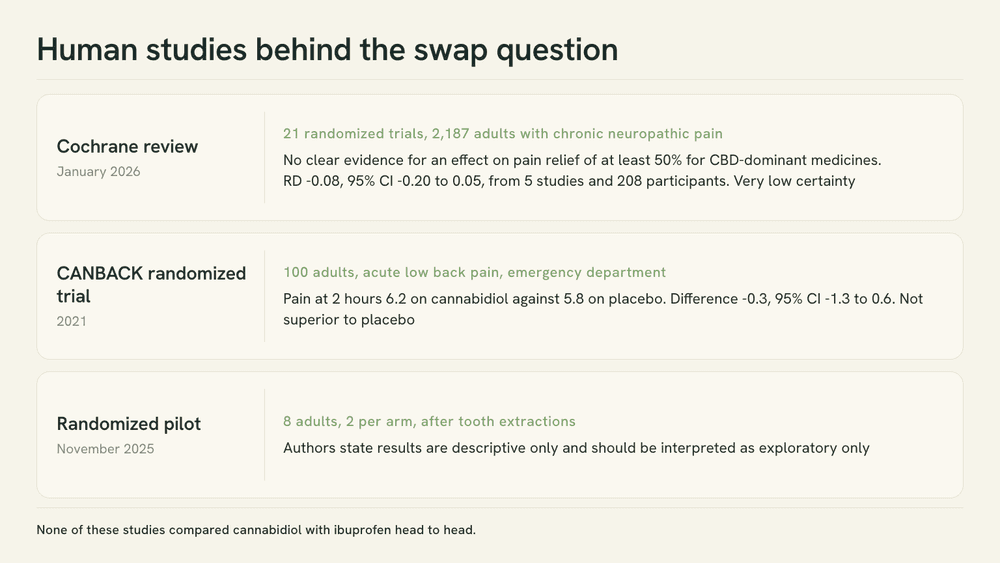
The most prominent result for this question is framed as a comparison of anti-inflammatories, which turns the decision into a swap. A reader asking that deserves the evidence rather than a dodge, and the evidence is not flattering to our own category. A Cochrane review published on January 19, 2026 pooled 21 randomized trials in 2,187 adults with chronic neuropathic pain. Its row for CBD-dominant medicines reads: "There is no clear evidence for an effect on pain relief of at least 50% (RD -0.08, 95% CI -0.20 to 0.05; 5 studies, 208 participants; very low-certainty evidence)." The limits belong in the same breath as the finding. Chronic neuropathic pain is not the headache, the period cramp or the sore knee people reach for ibuprofen for. The CBD-dominant estimate rests on five studies and 208 people. The certainty is graded very low, which is the lowest grade the system has. For the balanced THC and CBD products the same review reported three low-certainty increases, in global impression of change (RD 0.07), in pain relief of at least 30% (RD 0.07) and in withdrawals due to adverse events (RD 0.05), and then wrote in that same sentence that these effects were not clinically relevant.
The acute end of the question has a trial too. The CANBACK trial, published in 2021, randomized 100 adults arriving at a tertiary emergency department in Melbourne with acute non-traumatic low back pain to a single 400 mg oral dose of cannabidiol or to placebo, on top of the standard analgesia everyone received. Mean pain at two hours was 6.2 (95% CI 5.5 to 6.9) on cannabidiol and 5.8 (5.1 to 6.6) on placebo, an absolute difference of -0.3 (95% CI -1.3 to 0.6) on a 0 to 10 scale. Length of stay was 9.0 hours against 8.5, oxycodone use in the four hours before and after was similar, and reported side effects were similar. The authors' conclusion: "CBD was not superior to placebo as an adjunct medication for relieving acute non-traumatic low back pain in the emergency department." One dose, one condition, one hospital, 100 people, and an adjunct design rather than a head-to-head. It is a null result from a real trial, which is more than the substitution frame usually has on either side.
Two more results are worth naming, because they are what the internet is quoting when it says CBD and NSAIDs work together. A randomized pilot published in November 2025 is the only study among those nineteen records that put oral cannabidiol beside an ibuprofen-based regimen in people, after tooth extractions. It randomized eight adults across four arms, two people per arm, and its authors write that "results are descriptive only", that "Baseline imbalance was observed", and that "Findings should be interpreted as exploratory only". We are reporting its design and its own caveats and nothing else, because two people per arm cannot support a direction in either direction. The synergy headline, meanwhile, comes from a 2022 cell-culture study in macrophages and lung epithelial cells, where the NSAID in the synergistic result is diclofenac rather than ibuprofen, the cannabinoid is a standardized mix of CBD, CBG and THCV, the paper notes that treatment "reduced COX-1 and COX-2 gene expression but not their enzymatic activity", and the authors close by saying the combined activity "needs to be examined in pre-clinical studies and clinical trials". Cells in a plate, a different drug, and the authors asking for the studies that would make it a finding.
The most recent animal comparison is the one that spoils the tidy story in both directions, so we will print it rather than skip it. In male rats given complete Freund's adjuvant in the knee and then four daily doses of ibuprofen, CBN, THCV or CBD, all three phytocannabinoids reduced mechanical hyperalgesia, and the same paper reports that "administration of CBD reduced body weight and elevated blood monocyte and granulocyte levels above those of the CFA-injected control animal group". The authors' own conclusion nominates the other two cannabinoids: "We conclude that CBN and THCV may have potential in managing inflammatory pain." Those are rats, in a model of an inflamed joint, and none of it transfers to a person or to a tincture. Where this leaves the swap question is simple and a little unsatisfying: an over-the-counter analgesic has a regulated indication and a known effect size, cannabidiol does not, and nobody should stop a medicine that is working on the strength of a supplement blog, including this one. If your context is soreness after training rather than a medical condition, we set out what is and is not known about CBD and recovery.
What to actually do: the disclose checklist
There is no protocol at the end of this page, because a protocol would imply a body of evidence that does not exist. What there is instead is a ten-minute conversation with somebody who has your whole list in front of them. You do not need an appointment to ask a pharmacist a question, you do not need to justify the supplement, and interactions are literally their subject. Take the following.
- 1Both actual containers, or clear photographs of the front and the back of each. The strength, the batch and the other ingredients live on the panel, not in your memory.
- 2The exact question, so it does not get answered generally: the FDA-approved cannabidiol label calls cannabidiol an inhibitor of UGT1A9, and ibuprofen is cleared partly by that route. Does that matter for me?
- 3Every other medicine you take, prescription and over the counter, plus every supplement in the cupboard, including the ones that feel too minor to mention.
- 4Your own gastrointestinal history: ulcers, reflux, any previous bleeding, and anything that has ever made a painkiller sit badly.
- 5Whichever of the label's own risk rows apply to you: age 60 or older, a blood thinner or a steroid, another NSAID already in the house, or 3 or more alcoholic drinks a day.
- 6How long you have already been taking each one, and how long you expect to keep going. The over-the-counter label sets its own limits at 10 days for pain and 3 days for fever.
Notice what is not on that list: a gap between the two, a change to either amount, and any suggestion that you delay or drop something. None of those are ours to give, and none of them has a study behind it. What the list does is make the conversation specific, and a specific question gets a specific answer from a pharmacist in a way that "is CBD okay with painkillers" never will.
What this page is not about
Three neighboring questions come up constantly and each belongs somewhere else on this site, because collapsing them here would make all four answers worse. Acetaminophen, sold as Tylenol, is a different molecule with a different safety profile and a liver story of its own; it was the second most named medicine in the same 2023 survey, at 3.9% of CBD users, and we cover it where the liver evidence already lives, on whether CBD is bad for your liver. Aspirin is an NSAID, but it is also an antiplatelet drug taken for a cardiovascular reason, and the timing rule quoted earlier turns on that second property, which is why the anticoagulant and antiplatelet question is handled in full on the blood thinners page rather than here. Naproxen, sold as Aleve, is a different NSAID in the same class carrying the same boxed warning, and the literature there is emptier still: cannabidiol and naproxen appear together in exactly two PubMed records as of August 9, 2026, neither of them a human study of the pair. Advil and Motrin are ibuprofen, so everything above applies to them without modification.
One last correction, because it is probably the claim that brought you here. Several consumer pages state that CBD increases ibuprofen's bleeding risk. The sentence they are echoing comes from a 2019 review of federally approved CBD product labels, which observed that UGT1A9 and UGT2B7 substrates "are also among the most common medications used such as acetaminophen and ibuprofen", and that even everyday over-the-counter medicines like naproxen and ibuprofen "could lead to significant side effects (e.g., bleeding)". The same paper says of the underlying enzyme data: "The clinical relevance of this activity has not been assessed." That is a correctly hedged hypothesis inside a review, and it has been flattened into a flat safety claim on retail pages that do not quote the hedge. The bleeding risk in the warning you have read is ibuprofen's own, documented in its boxed warning, and no study has attached an increase in it to cannabidiol.
No study has measured what happens when a person takes both, so anyone who answers that question with yes or no is filling a gap rather than reporting a result. What is documented is each drug separately: ibuprofen carries a boxed warning about gastrointestinal bleeding, ulceration and perforation, and diarrhea is the adverse reaction reported most often on the FDA-approved cannabidiol label. The instruction that is actually supported is the one printed on the ibuprofen box: ask a doctor or pharmacist before use if you are taking any other drug. Take both containers with you so the conversation is about what is actually in them.
Several pages publish an interval, commonly two to four hours. As of a PubMed search run on August 9, 2026, cannabidiol and ibuprofen appear together in 19 records and none of them is a human pharmacokinetic study of the pair, so there is nothing for any interval to be derived from, including a different interval from us. Ibuprofen itself is short-acting: its label reports peak serum concentrations one to two hours after a dose and a serum half-life of 1.8 to 2.0 hours. That is a fact about ibuprofen, not a spacing rule for a second substance, and turning one into the other is exactly the error worth avoiding. Ask a pharmacist rather than a search result.
Partly, and the specifics run against the popular version. Ibuprofen's main oxidative route is CYP2C9, established in laboratory studies of human liver tissue, and the FDA-approved cannabidiol label reports that a CYP2C9 probe drug, tolbutamide, did not change at all when the two were given together in people. The routes the label does flag are CYP2C8, which laboratory work puts at about 13% of S-ibuprofen and under 10% of R-ibuprofen and whose label caution comes from an in vitro assessment, and UGT1A9, where a human probe drug rose 35% in AUC. Ibuprofen was not in any of those experiments. A separate trial using losartan, another CYP2C9 substrate, did find a 77% rise in AUC with a high-dose CBD and THC product, so the human data on that enzyme disagree with itself, which is worth knowing and is not the same as a finding about ibuprofen.
They are not the same kind of object. Ibuprofen has an FDA-approved indication and a mechanism its own label describes, related to prostaglandin synthetase inhibition. For cannabidiol, a Cochrane review published in January 2026 pooled 21 randomized trials in 2,187 adults with chronic neuropathic pain and found no clear evidence of an effect for CBD-dominant medicines on the outcome of at least 50% pain relief, a risk difference of -0.08 with a 95% confidence interval of -0.20 to 0.05, from 5 studies and 208 participants, at very low certainty. A separate randomized trial gave a single 400 mg dose of cannabidiol to emergency-department patients with acute low back pain and concluded it was not superior to placebo. Nothing here supports treating one as a replacement for the other, and nobody should stop a medicine that is working on the strength of a blog post.
No study shows that. The sentence people quote comes from a 2019 review of approved CBD product labels, which noted that some of the same enzymes are involved and that over-the-counter naproxen and ibuprofen could lead to significant side effects such as bleeding. The same paper states that the clinical relevance of that enzyme activity has not been assessed. A hedged hypothesis in a review is not a finding. The bleeding risk in the warning is ibuprofen's own and it is serious on its own terms: the prescription label says those events can occur at any time during use and without warning symptoms. Anticoagulants, antiplatelets and aspirin are covered on our page about CBD and blood thinners.
Advil and Motrin are ibuprofen, so everything on this page applies to them unchanged. Naproxen, sold as Aleve, is a different NSAID in the same class with the same boxed gastrointestinal warning, and the research is thinner still: cannabidiol and naproxen appear together in exactly two PubMed records as of August 9, 2026, neither a human study of the pair. Tylenol is acetaminophen, a different molecule with a different safety profile, and the question belongs with the liver evidence rather than here; it was the second most named medicine in the same 2023 survey of CBD users, at 3.9%, which is why it has its own treatment on our page about whether CBD is bad for your liver.
Writing about hemp, wellness and the small rituals that keep us balanced.