Is CBD a Blood Thinner? What the Word Means and What the Studies Measured
Page one says CBD blocks thromboxane and extends clotting time. That sentence traces to a 1980 paper where the result was THC's, in broken-open platelets. Here is what the word blood thinner means, what has actually been measured, and why the real risk is metabolic.
Is CBD a blood thinner? Two things are true at once, and page one of this search almost never prints both. Cannabidiol is not an anticoagulant and it is not an antiplatelet, so it does not belong to the drug category people mean when they say blood thinner. And it can still raise the blood level of a drug that does, which is a documented risk with nothing to do with clotting chemistry. Get those two sentences in the right order and the rest of this question becomes readable.
You are probably here for one of three reasons: you take a prescription blood thinner, you have a procedure coming up, or someone told you that cannabis affects clotting. Page one does not settle it. Read across the first few results and you will find one saying cannabidiol has no significant effect on blood clotting, another saying it interferes with the synthesis of thromboxane A2 and produces measurable extensions in clotting time, and a third saying it slows platelet activity. Not one of them names a species, a preparation, a concentration or a number of subjects for any of it. This page does. It answers the property question, what cannabidiol does to blood, and it hands the separate question of what cannabidiol does to the drugs that thin blood to the page that covers it drug by drug.
Before any of the science, here is a check you can run yourself in about a minute, because it is the fastest way to see the shape of the problem. One of the pages ranking on this question hangs its two most alarming sentences, that cannabidiol produced measurable extensions in clotting time and that it can inhibit thrombin activity, on a single reference: PubMed ID 35521023, a 2022 review in Hospital Pharmacy titled Potential Drug Interactions Between Cannabinoids and Its Derivatives and Oral Anticoagulants. We read that paper in full on August 22, 2026. It is a review of four case reports. The words platelet, thromboxane, clotting time and bleeding time do not appear in it at all, and where thrombin appears it is dabigatran's drug target in a comparison table rather than anything that was measured. There is no clotting-time experiment in that paper and no thrombin assay. The claim and the citation are not about the same thing, and you can confirm that in one click without taking our word for any of it.
Is CBD a blood thinner? The category has a definition
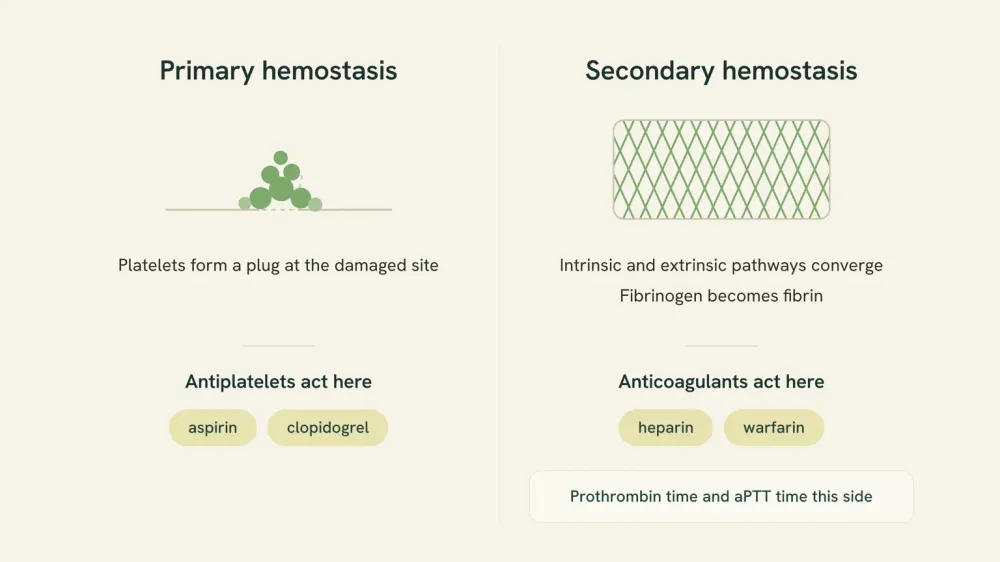
Start with what the phrase means to the people who prescribe them. MedlinePlus, the National Library of Medicine's consumer health service, defines blood thinners as medicines that prevent blood clots from forming, then splits them into two groups. Anticoagulants, heparin and warfarin among them, slow down your body's process of making clots. Antiplatelets, aspirin and clopidogrel among them, prevent blood cells called platelets from clumping together to form a clot. Two classes, two targets, two different things happening in your bloodstream. That distinction does all the work on this page.
The two targets have proper names, and knowing them is what lets you read any claim about cannabinoids and clotting. The StatPearls chapter on coagulation pathways describes primary hemostasis as an aggregation of platelets forming a plug at the damaged site of exposed endothelial cells, and secondary hemostasis as the intrinsic and extrinsic pathways, which converge at a common point to form the common pathway. The common pathway activates fibrinogen, converting it into fibrin. Plug first, mesh second. Antiplatelet drugs work on the plug. Anticoagulants work on the mesh. When a laboratory measures prothrombin time or activated partial thromboplastin time, it is timing the mesh, not the plug, which is why those two numbers will matter later in this article.
Now the detail that decides everything downstream. The StatPearls chapter on antiplatelet medications explains that aspirin irreversibly inhibits the cyclooxygenase enzyme activity in the prostaglandin synthesis pathway, and that this prostaglandin is a precursor of thromboxane A2, which works by inducing platelet aggregation and vasoconstriction. Low-dose aspirin, 75 mg to 150 mg, can induce complete or near-complete inhibition of COX-1. The thienopyridines, clopidogrel among them, act somewhere else entirely: they selectively inhibit adenosine-diphosphate-induced platelet aggregation by irreversibly inhibiting the platelet P2Y12 receptor. So when a website says a compound interferes with thromboxane A2 synthesis, it is not making a vague wellness statement. It is saying the compound works the way aspirin works. Our page on CBD and ibuprofen covers the over-the-counter side of that same pathway.
| Drug class | What it acts on | Named examples | Molecular target |
|---|---|---|---|
| Anticoagulant | The clotting cascade, the second half of hemostasis: the mesh | Heparin, warfarin | The pathways that converge on the common pathway and convert fibrinogen into fibrin |
| Antiplatelet | Platelets, the first half of hemostasis: the plug | Aspirin, clopidogrel | Aspirin: COX-1, and through it thromboxane A2. Clopidogrel: the platelet P2Y12 receptor |
Notice what is not in that table: cannabidiol. It is not a licensed anticoagulant, it is not a licensed antiplatelet, and outside one FDA-approved prescription solution it is not a drug in the regulatory sense at all. What cannabidiol actually is is a plant molecule with a long list of enzyme interactions, and the enzyme half of the story is exactly where the documented risk lives. Sitting outside both drug classes is a classification fact and nothing more. It is not a statement that combining cannabidiol with an anticoagulant carries no risk, because the risk that has actually been documented does not run through clotting at all.
Where the thromboxane sentence actually comes from
Fix the chemistry first, because the version of the claim circulating on page one calls thromboxane A2 a protein essential for blood clotting. It is not a protein. PubChem's record for thromboxane A2 gives its molecular formula as C20H32O5 and its molecular weight as 352.5. It is a short-lived lipid built from arachidonic acid, which is why aspirin reaches it through an enzyme in the prostaglandin pathway rather than by blocking a receptor. A page that gets the class of molecule wrong has not read the primary source, and that turns out to be the pattern here rather than the exception.
Now the trace. A PubMed search run on August 22, 2026 pairing cannabidiol with thromboxane returns exactly one record. We ran it twice in the same session to be sure the count reproduced. The record is White and Tansik, published in Prostaglandins and Medicine in 1980, and opening it does two things to the claim at once.
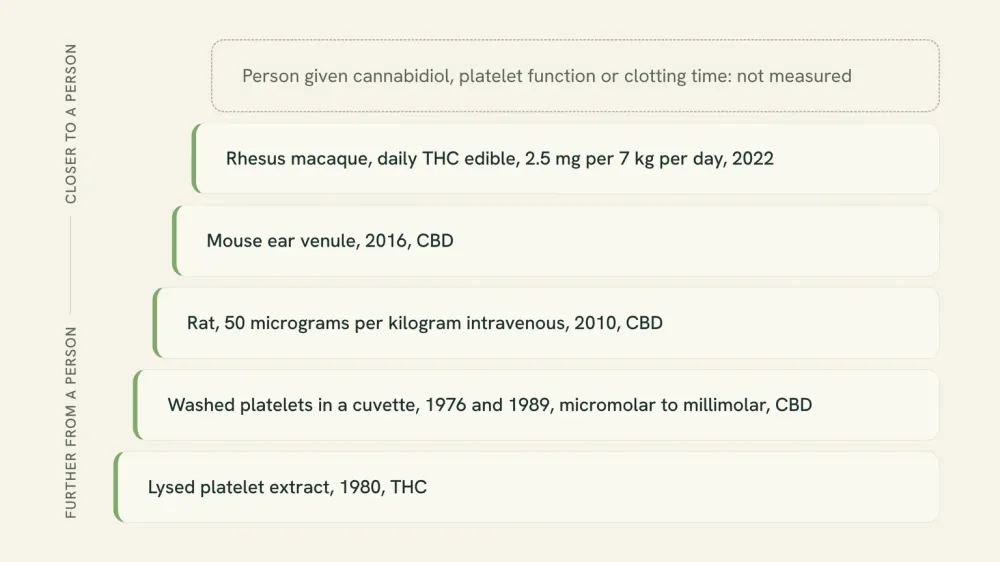
First, the thromboxane result in that paper is not cannabidiol's. In the authors' words, when radiolabeled arachidonate was incubated with lysed platelet extracts, THC inhibited both thromboxane synthetase and prostaglandin cyclooxygenase. THC, not CBD. Second, cannabidiol's reported action in the same paper is a different action in a different preparation: both THC and cannabidiol caused a marked stimulation of phospholipase A2 when incubated with intact human platelets, with cannabidiol about 1.5 times as potent as THC in the same concentration range, 10 to 80 micromolar. The abstract states no concentration at all for the thromboxane-synthetase experiment, so nobody, including us, can attach that range to it. The sentence on page one has the wrong molecule and the wrong preparation, and the paper behind it is 46 years old.
That micromolar range is worth converting, because it decides whether any of this can reach a person. Cannabidiol's molecular weight is 314.5, per its own PubChem record. Ten micromolar therefore works out to roughly 3,145 nanograms per milliliter, and 80 micromolar to roughly 25,160. For comparison, in a 2018 pharmacokinetic study in healthy adults, nine people per arm given 750 mg of the FDA-approved cannabidiol oral solution reached a peak plasma concentration of 290.8 nanograms per milliliter on the first morning, and 750 mg is a pharmaceutical dose used in a controlled trial rather than a consumer amount. The bottom of the 1980 experiment's range is therefore about eleven times the peak that dose produced. The EPIDIOLEX label adds that protein binding of the cannabidiol and its metabolites was greater than 94% in vitro, so the fraction circulating free is smaller again. A bath concentration and a plasma concentration are not the same quantity and comparing them is a sanity check rather than a calculation. As a sanity check, it fails badly.
The modern version of the claim is a thesis nobody can read
The 1980 paper does not account for everything on page one. The more detailed version of the claim, the one that names collagen, ADP and arachidonic acid as agonists, calls the effect dose-dependent, and adds calcium mobilization and Syk phosphorylation, is far more specific than anything in the 1980 abstract. So we went looking for its source. It matches a 2024 doctoral thesis from the University of Reading on the effects of the phytocannabinoids cannabidiol and cannabigerol on platelet modulation, thrombus formation and inflammatory responses, deposited on July 10, 2024, doi 10.48683/1926.00117258. The full text is marked Restricted to Repository staff only. Whoever is repeating its mechanism has not read it, because it cannot be read.
The public abstract can be read, and it is considerably more modest than its echo. It reports that cannabidiol and cannabigerol, at the concentrations used, 1.56, 3.125, 6.25, 12.5 and 25 micromolar, reduced platelet aggregation when stimulated by a variety of agonists, blocked granule release and intracellular calcium mobilisation, and decreased thrombus formation on a collagen-coated surface under arterial flow conditions. It also reports, in the same abstract, that cannabidiol and cannabigerol had modest effects on the haemostasis of mice. A thesis is not a peer-reviewed paper. Its concentrations sit in the same micromolar band as the 1980 work, which we have already converted. And its living-animal result is a mouse, described by its own author as modest.
There is a cheaper way to see the same gap. Two PubMed searches run on August 22, 2026 return nothing at all: cannabidiol with Syk, zero records, and cannabidiol with platelet and calcium, zero records. The most mechanistically detailed sentence on page one has no peer-reviewed, PubMed-indexed source behind it in either of the two vocabularies it uses. That does not make the thesis wrong. It means the claim reached you at a level of confidence the literature has not earned yet, which is a different problem and a more common one.
What has actually been measured with cannabidiol, and in what
Five experiments make up the entire readable cannabidiol-and-platelet literature. They span 40 years, they disagree with each other, and every one of them is missing from the pages that summarize them. Here they are with the detail page one leaves out.
| Year and journal | Preparation | Species | Concentration or dose | What moved | What did not |
|---|---|---|---|---|---|
| 1976, Thrombosis and Haemostasis | Washed platelets, and separately platelet-rich plasma | Human | Up to and above 10 micromolar | ADP-induced aggregation of washed platelets, with THC clearly more potent than CBD | Collagen- and thrombin-induced aggregation of washed platelets, hardly affected. In platelet-rich plasma, serotonin release and irreversible aggregation, not affected at all |
| 1980, Prostaglandins and Medicine | Lysed platelet extracts, and separately intact platelets | Human | 10 to 80 micromolar for the phospholipase A2 result. The abstract gives no concentration for the thromboxane result | Thromboxane synthetase and cyclooxygenase, inhibited by THC in the lysed extracts. Phospholipase A2, stimulated by CBD in intact platelets | Nothing was measured in circulating blood, and nothing in a person |
| 1989, Journal of Pharmacy and Pharmacology | Platelets in a cuvette | Human and rabbit | 1 millimolar down to 10 micromolar | Adrenaline- and ADP-induced aggregation, dose-dependently. Order of potency CBG, then CBD, then olivetol, then THC, then CBN, with CBG's IC50 at 270 micromolar | Aggregation induced by tetradecanoylphorbolacetate, not inhibited by any of them except olivetol |
| 2010, British Journal of Pharmacology | Intravenous dosing inside a coronary occlusion model | Rat, male Sprague-Dawley | CBD 10 or 50 micrograms per kilogram, intravenous | Collagen-induced aggregation, attenuated by the 50 microgram dose given before ischemia | The same dose given at reperfusion instead: no effect |
| 2016, BioFactors | Thrombosis in ear venules, plus flow cytometry on human platelets | Mouse, plus human platelets in vitro | Not printed in the abstract we read. Dosing was single, and once daily for three days | Anandamide, an endocannabinoid the body makes itself, significantly accelerated thrombus growth | CBD neither increased nor reduced activation of platelets, and was not associated with induction of thrombosis |
Two of those rows deserve a second look. The oldest is also the most honest about its own limits. A 1976 paper in Thrombosis and Haemostasis reports that collagen- and thrombin-induced aggregation of washed platelets are hardly affected by the cannabinoids, and that in platelet-rich plasma, the more physiological of its two media, serotonin release and irreversible aggregation caused by either ADP, collagen or thrombin are not affected by the cannabinoids. Then it adds the sentence that should end most citations of it: when the cannabinoids are present at concentrations higher than 10 micromolar, the platelets aggregate non-reversibly, apparently due to lysis. At the top of the range the compound was destroying platelets rather than inhibiting them, and a destroyed platelet aggregates for reasons that have nothing to do with pharmacology.
The 1989 study is quoted far more often than it is read, and the thing worth printing from it is the ranking. Formukong and colleagues, in the Journal of Pharmacy and Pharmacology, tested human and rabbit platelets from 1 millimolar down to 10 micromolar and found that all of the cannabinoids partially inhibited primary aggregation and totally inhibited secondary aggregation when adrenaline was the agonist. For ADP-induced aggregation the order of potency was cannabigerol, then cannabidiol, then olivetol, then THC, then cannabinol, with the half-maximal concentration for the most potent of them, cannabigerol, at 2.7 x 10⁻⁴ M. That is 270 micromolar, which is roughly 27 times the bottom of the 1980 range we already converted. Cannabidiol was not even the strongest of them, in a cuvette, at concentrations nothing swallowed produces.
The two living-animal experiments point in different directions, and neither animal is a person. A 2010 rat study in the British Journal of Pharmacology is the actual source of the sentence CBD reduces platelet aggregation. It gave male Sprague-Dawley rats cannabidiol at 10 or 50 micrograms per kilogram intravenously, 10 minutes before a 30-minute coronary occlusion or 10 minutes before reperfusion, and reported that 50 micrograms per kilogram given prior to ischemia, but not at reperfusion, attenuated collagen-induced platelet aggregation compared with control. Same dose, same animals, same measurement, different moment, no effect. Six years later a mouse study in BioFactors put cannabinoids into a living clotting system and watched what happened: anandamide, but not CBD, significantly accelerated thrombus growth, and CBD neither increased nor reduced activation of platelets. The compound that moved the needle in that experiment was one the body already makes.
Now put the whole result set on the table rather than the convenient members of it. A PubMed search for cannabidiol and platelet on August 22, 2026 returns 31 records, and a search pairing cannabidiol with bleeding time, prothrombin time or INR returns 7. We opened both sets. The hemostasis members of the 31 are the five experiments in the table above plus one chart review we come to in the next section; the rest are nanoparticle formulation papers, psychiatry papers using inflammation ratios, an equine anti-doping screen and drug-interaction reviews. Of the 7, five are the warfarin case reports and reviews that belong to the interaction literature and two are veterinary. What that adds up to is specific, and it is the sentence this page exists to publish: no published human study measures what cannabidiol does to platelet function or to a clotting time. The single human platelet finding that exists is a count, and it required a second drug.
The one human platelet finding is a count, and it needed a second drug
There is exactly one human study connecting cannabidiol to a platelet measurement, and it is not about clotting. A 2020 chart review in Epilepsia looked at 87 patients under 21 prescribed FDA-approved cannabidiol at a single center between January and August 2019. Among those 87, nine, which the authors put at 10%, developed thrombocytopenia, meaning a low platelet count, with a platelet nadir range of 17,000 to 108,000. Each of those nine children was on combination therapy of cannabidiol with valproic acid. No children on cannabidiol without valproic acid, zero of 57, developed it, while nine of the 23 on the combination developed platelets below 110,000 per microliter, at P below .0001.
Read what that is before deciding what it means. It is a retrospective chart review at one center, in children with severe epilepsy, on a prescription medicine dosed by body weight, and the signal appears only alongside a second drug. The authors' own conclusion is a request rather than a finding: if this finding is confirmed, they write, clinicians should perform close monitoring. And a count is not a function. A platelet count says how many platelets are in a volume of blood. Aspirin does not change the count at all, it changes what the platelets do, and nothing in this study measured what they do. That is why this finding and the sentence in the previous section, that no published human study measures cannabidiol against platelet function or a clotting time, can both be true. Valproic acid brings a liver question with it as well, and every hepatic question on this blog lives on our page about whether CBD is bad for your liver rather than here.
Does CBD thin your blood? Somebody measured the thickness
Blood thinner is a metaphor. No anticoagulant makes blood physically thinner; it slows a chemical process. But blood does have a measurable thickness, its viscosity, and one group has actually measured that with cannabidiol in it, which makes this the only experiment in the whole literature that addresses the search phrase literally. A 2022 paper in the Journal of Cannabis Research drew whole blood from 24 healthy non-smokers, 14 female and 10 male, aged 21 to 42, spiked it with cannabidiol or THC at 0, 2.5, 25, 50 and 100 nanograms per milliliter, and ran it through a viscometer at 37 degrees Celsius at a shear rate of 62.8 per second. Note the concentrations: unlike everything in the previous section, this range is one a person plausibly reaches.
Viscosity went up, not down. In the authors' words, blood viscosity increased significantly with increasing concentrations of both THC and CBD from 25 ng/ml up to 100 ng/ml, ranging from 5.46 plus or minus 0.24 to 9.91 plus or minus 1.10 millipascal-seconds for cannabidiol. There was no significant increase in elasticity for either compound measured separately. Two caveats belong in the same breath and the authors supply both. The same paper reports that THC and CBD affected red cell morphology resulting in complete disintegration at the highest concentrations, which is a caveat on the top of its own range. And its stated limitation is that the study was conducted in vitro rather than in vivo. Blood was spiked in a tube. Nobody swallowed anything. It remains the only published measurement of the thing the phrase literally describes, and it points the opposite way to the phrase.
Is THC a blood thinner? Is weed? Is marijuana?
Those are three phrasings of one question and they reach a cannabidiol reader for a real reason: full-spectrum hemp extracts contain trace THC, always below the 0.3% federal limit, along with minor cannabinoids including CBG and CBN. If any of those did something to clotting, it would matter here. At the molecular level the closest thing to an answer is the 1989 ranking above, and it is not the ranking page one implies: cannabigerol beat cannabidiol, which beat THC, which beat cannabinol, in a cuvette, between 1 millimolar and 10 micromolar. At the exposures a person reaches, none of that ordering has any bearing on anything. For the molecules themselves, see how CBD and THC differ, and if you arrived here on the marijuana phrasing, what separates hemp from marijuana covers the botanical and legal half of it.
The best-controlled experiment in this entire literature is not about cannabidiol at all. A 2022 study in the American Journal of Physiology, Cell Physiology gave ten rhesus macaques, seven female and three male, aged 6.7 to 12.7 years, one research-grade THC cookie a day on an empty stomach, with each animal serving as its own control. Its Methods section says the animals were slowly titrated up to 2.5 mg per 7 kg per day, over roughly three months in the females and roughly seven in the males. Its Results section writes 2.5 mg per kg per day once, for the female cohort, and since those two figures cannot both be right we use the Methods number and flag the discrepancy rather than splitting the difference. The platelet findings are real: reduced platelet surface-area coverage and aggregate size on collagen under flow, dose-dependent inhibition of aggregation to two different agonists, less alpha-granule secretion, and, in the seven females only, reduced GPVI-mediated thromboxane secretion. Seven and three is a small split, so the sex-specific result is the least powered thing in the paper.
Then the same paper did the thing nobody quoting it mentions. It took platelet-poor plasma from the same animals and measured prothrombin time and activated partial thromboplastin time, the two standard clotting-cascade timings, the second of the two columns from earlier in this article. The sentence is one line long: we did not observe any differences in either clotting times for animals on chronic edible THC. Platelet activity moved. The cascade did not move. That single distinction, inside the study most often used to argue that cannabis thins blood, is the whole answer to this question, and it is the reason the phrase blood thinner keeps producing the wrong conversation. A null result in ten animals is not proof of no effect, and it is still the only in-vivo clotting-time measurement anyone has under chronic cannabinoid dosing.
In people, the largest platelet-pathway measurement points the other way entirely. A 2024 review of clinical assay results in the American Journal of Surgery pulled 793 trauma patients who had both a thromboelastography-with-platelet-mapping result and a urine drug screen between 2019 and 2023. Arachidonic-acid inhibition was lower in the THC-positive patients, 23.9 plus or minus 27.0 against 34.3 plus or minus 35.3, at P below 0.001, while ADP inhibition showed no association at all, 32.5 plus or minus 27.1 against 30.8 plus or minus 28.4, at P equals 0.536. The authors write that their data are the first to suggest a clinically measurable increase in platelet reactivity in THC-positive trauma patients. Two honest caveats: the abstract does not print the size of the two groups, so we cannot tell you the split, and the standard deviations are larger than the gap between the means, which is what a population-level shift detected in a large sample looks like rather than something you would see in one patient. What makes it worth printing at all is what that assay is for. The StatPearls chapter on thromboelastography says the platelet mapping assay was developed to predict the inhibitory effect of antiplatelet agents, such as aspirin and clopidogrel, by evaluating platelet aggregation in the presence of adenosine diphosphate or arachidonic acid. The arachidonic-acid channel exists to detect aspirin and the ADP channel exists to detect clopidogrel. Cannabis users were measured on the two exact pathways the two commonest blood thinners act on, and neither channel showed thinning.
A second trauma center ran the same kind of study and found nothing. A 2026 cohort in The American Surgeon propensity-matched 302 trauma patients at one level-one center between October 2019 and December 2023, 76 cannabinoid-positive and 226 negative. In the matched analysis, no difference was observed in rates of venous thromboembolism, 7.4% against 4.4% at P equals .683, nor in platelet count, a median of 260 in both groups at P equals .790, and no significant differences were found between the groups on coagulation profiles, complications or other outcomes. The authors grade their own work level of evidence IV. Two retrospective cohorts, in the same population, with the same design, one showing a signal and one showing nothing, is what an unsettled question looks like from the inside, and it is a more useful thing to know than either result on its own.
One 2026 experiment complicates the inhibits-aggregation argument from the inside, and its authors label it a pilot study. Human platelets exposed to two cannabis extracts, in the journal Platelets, showed dose-dependent platelet activation characterized by increased CD62P expression, annexin V binding, mitochondrial depolarization and ATP depletion, consistent with metabolic stress. Aggregation in response to ADP, collagen and arachidonic acid was impaired, which sounds like the familiar claim until you read the authors' interpretation: a pre-activated or refractory phenotype. Platelets that are already spent, in other words, not platelets being protected. Blocking CB1 and CB2 with antagonists did not attenuate the activation, so it was not cannabinoid-receptor pharmacology at all, and the authors state that these findings require confirmation in vivo to determine their clinical relevance. The direction cardiology worries about is the same one: a 2026 review in The American Journal of Medicine lists a prothrombotic state characterized by enhanced platelet activation among the mechanisms by which marijuana is thought to precipitate acute myocardial infarction, while noting that prospective cohort data remain conflicting. That review is about smoked marijuana, not about hemp cannabidiol, and the concern in it is clots forming rather than blood failing to clot.
| Study | Design | Who or what | What was measured | Result |
|---|---|---|---|---|
| Am J Physiol Cell Physiol, 2022 | Controlled in vivo, each animal its own control | 10 rhesus macaques, 7 female and 3 male, on a daily THC edible titrated to 2.5 mg per 7 kg per day | Platelet aggregation, granule secretion and thromboxane secretion, plus prothrombin time and aPTT | Platelet activity fell. Clotting times did not: no differences observed in either |
| Am J Surg, 2024 | Retrospective review of clinical assay results | 793 trauma patients with thromboelastography platelet mapping plus a urine drug screen | Arachidonic-acid and ADP inhibition, the aspirin channel and the clopidogrel channel | Less inhibition on arachidonic acid in THC-positive patients, 23.9 against 34.3, P below 0.001. No difference on ADP, P equals 0.536 |
| Am Surg, 2026 | Retrospective cohort, 1:1 propensity matched, level of evidence IV by the authors' own label | 302 trauma patients at one level-one center, 76 cannabinoid-positive and 226 negative | Venous thromboembolism, platelet count and the coagulation profile | No difference. VTE 7.4% against 4.4%, P equals .683. Platelet count median 260 in both groups, P equals .790 |
| Platelets, 2026 | Pilot study, in vitro exposure of human platelets to two cannabis extracts | Extracts of stated composition, one at 10.4% THC and 14.7% CBD, one at 25.5% THC and 0.04% CBD | Activation markers, aggregation, and whether CB1 and CB2 antagonists blocked the effect | Dose-dependent activation with metabolic stress. Aggregation impaired but read by the authors as pre-activated or refractory. Antagonists did not attenuate it |
Vasodilation is not anticoagulation
A recurring sentence on page one is that cannabidiol causes vasodilation, widening of the blood vessels, which may improve blood flow. Set aside whether that happens in a person and notice what kind of claim it is: a statement about the diameter of a vessel, not about whether blood clots inside it. Those are two different measurements and only one of them has anything to do with the phrase blood thinner. Where cannabidiol has actually been tested on human arteries, the tissue was sitting in a bath. A 2020 study in the Journal of Hypertension used human pulmonary arteries obtained from patients during resection of lung carcinoma, plus rat small mesenteric arteries, mounted for wire myography. Cannabidiol induced almost full concentration-dependent vasorelaxation in both, an effect reduced by stripping the endothelium and by cyclooxygenase inhibitors, and less potent in tissue from hypertensive, overweight and hypercholesteremic patients. No clotting endpoint of any kind was measured, because that is not what the experiment was for. We are not telling you cannabidiol does anything for circulation. We are telling you that a relaxing artery in a dish is not a clotting result and cannot honestly be reported as one.
The review most often cited for cannabidiol and the cardiovascular system says the same thing about its own evidence, if you read as far as its conclusion. A 2013 review in the British Journal of Clinical Pharmacology compresses its entire platelet evidence base into one sentence: early studies showed that CBD increases phospholipase A2 expression and lipooxygenase products in platelets and that CBD inhibits adenosine or epinephrine stimulated platelet aggregation, and more recently, collagen stimulated platelet aggregation. The three references behind that sentence are the 1980 biochemistry paper, the 1989 cuvette study and the 2010 rat experiment, all three already in the table above. Its own conclusion calls these preclinical data and says further work is required to strengthen this hypothesis, establish mechanisms of action and whether similar responses to CBD would be observed in humans. That was 13 years ago. The question it asked is still open, which is the most reliable finding on this page.
The risk that is documented runs the other way
Here is the sentence this page exists to publish. The risk is not that cannabidiol thins your blood. It is that cannabidiol can raise the level of a drug that does. Cannabidiol inhibits several of the liver enzymes that clear other medicines, and when the medicine being cleared is one that already slows clotting, more of that drug in the bloodstream is the problem. That is a pharmacokinetic risk, not a hematological one, and it exists whether or not cannabidiol touches a platelet. A 2023 systematic review of case reports in Pharmacotherapy, PMID 37740600, states the position bluntly: overall, with the exception of warfarin, evidence supporting an interaction between cannabinoids and anticoagulants is non-existent. The warfarin evidence is a handful of case reports in which INR rose, graded very low quality by the authors themselves, and it is still the strongest thing anybody has on this question.
That whole column belongs to another page and we would rather link it than re-derive it badly. The interaction question, drug by drug covers warfarin, the direct oral anticoagulants, aspirin and clopidogrel, what INR monitoring actually measures, and what those case reports do and do not show. The wider enzyme framework covers why grapefruit keeps appearing in this conversation and which drug classes the same mechanism touches. Neither of those pages, and not this one, will tell you to start, stop, space out or change a medication. That is a decision with a bleeding outcome attached to it, and it belongs to the person who prescribed the drug and to a pharmacist who can see your full list.
What to watch for, and who to ask
The list below is not a list of cannabidiol side effects, and reading it as one would be a mistake. It is the list MedlinePlus publishes for people who are taking a blood thinner, and it is here because if you are one of those people, these are the signs that matter regardless of what else you take. The same page adds one instruction worth more than any article: make sure that your health care provider knows all of the medicines and supplements you are using. Call your provider if you notice any of the following.
- Menstrual bleeding that is much heavier than normal
- Red or brown urine
- Bowel movements that are red or black
- Bleeding from the gums or nose that does not stop quickly
- Vomit that is brown or bright red
- Coughing up something red
- Severe pain, such as a headache or stomachache
- Unusual bruising
- A cut that does not stop bleeding
- A serious fall or bump on the head
- Dizziness or weakness
If you take a blood thinner and you are considering a cannabidiol product, or you already take one, the useful next move is not reading another website. It is giving a pharmacist enough information to answer properly in one conversation. Pharmacists do this check for free, they have the interaction databases open in front of them, and they are the fastest route to a real answer. Bring these five things.
- 1The exact name and strength of every prescription you take, copied off the bottle rather than from memory, with the anticoagulant or antiplatelet first.
- 2Every over-the-counter product and supplement as well, since aspirin, NSAIDs, fish oil and several herbal products sit in the same conversation.
- 3The cannabidiol product itself, or photographs of its label and its certificate of analysis, so the amount per serving and the spectrum are on the table instead of assumed.
- 4How long you have been taking it and how often, because a one-off and a daily routine are different questions with different answers.
- 5Any monitoring you already have scheduled, an INR check above all, since a measurement that was going to happen anyway is the cheapest way for a clinician to see whether anything actually changed.
What nobody knows yet
The honest summary of this literature is short, and stating it plainly is more useful than any of the confident sentences on page one. Nobody has given cannabidiol to people and measured their platelet aggregation, prothrombin time, activated partial thromboplastin time or bleeding time. The dated searches printed above are the evidence for that statement, and you can re-run them in a browser in under a minute. Everything that does exist about cannabidiol and platelets is a cuvette, a mouse, a rat or a restricted thesis, at concentrations at least an order of magnitude above the peak a large pharmaceutical dose produced in healthy adults. And the human cannabis data, which is not the same thing as cannabidiol data, disagrees with itself across two trauma cohorts that used the same design in the same kind of population.
Three things would move this. A controlled human study that administers cannabidiol and measures a clotting endpoint, which does not exist today. Prospective rather than retrospective cannabis data, since a urine drug screen records recent exposure and not dose, not product and not route. And in-vivo confirmation of the 2026 in vitro work, which its own authors ask for in the paper. Until then the useful posture is the one this article has taken throughout: cannabidiol is not in either blood-thinner drug class, the interaction risk through the liver is documented and is a separate thing entirely, and anything you are told with more confidence than that is being told to you without a source. For the wider picture of what is and is not documented about the molecule, our overview of CBD side effects keeps the general list.
No, in the sense the word actually has. Blood thinner covers two drug classes: anticoagulants, which slow the clotting cascade, and antiplatelets, which stop platelets clumping together. Cannabidiol is a licensed member of neither, and no published human study measures what it does to platelet function or to a clotting time. That is a statement about drug classification, and it is not a statement that combining it with an anticoagulant is without risk. Cannabidiol can raise the blood level of a drug that thins blood, and that interaction, rather than any clotting property, is the concern the evidence actually supports. Take that question to the prescriber.
Nobody has measured a clotting time in a person given cannabidiol, so human data cannot answer it directly. The closest measurement of thickness itself is a 2022 study that spiked whole blood from 24 healthy adults in a tube, where viscosity went up rather than down, from 5.46 to 9.91 millipascal-seconds between 25 and 100 nanograms per milliliter, and whose authors state that it was conducted in vitro rather than in vivo. So the literal reading of the phrase has one measurement behind it and it points the wrong way. None of that changes the separate, documented risk: cannabidiol can raise the level of a drug that does thin blood, which is a conversation for your prescriber.
The evidence is split and none of it is a clean yes. In ten rhesus macaques eating a daily THC cookie titrated to 2.5 mg per 7 kg per day, platelet activity fell, and in the same animals prothrombin time and activated partial thromboplastin time did not change at all. In 793 trauma patients, those testing positive for THC showed less inhibition on the arachidonic-acid channel, 23.9 against 34.3, which means more platelet reactivity rather than less, and no difference on the ADP channel. A second cohort of 302 trauma patients found no difference in clots, in platelet count or on the coagulation panel. Across all of it, the clotting cascade has never been shown to move.
In a dish, at concentrations a person does not reach, sometimes. The readable set is five experiments: a 1976 washed-platelet study, a 1980 enzyme study in broken-open platelets, a 1989 cuvette study running from 1 millimolar down to 10 micromolar, a 2010 rat experiment at 50 micrograms per kilogram intravenously, and a 2016 mouse study in which cannabidiol did nothing in either direction. There is also a 2024 doctoral thesis whose full text is restricted. The only human platelet number is a platelet count, from a chart review of 87 children on prescription cannabidiol, in which all nine of the low counts occurred in children also taking valproic acid. No published human study measures platelet function or a clotting time with cannabidiol. None of that is a reason to treat cannabidiol as harmless alongside an anticoagulant, because the documented risk runs through the liver rather than through platelets, and it is a conversation for your prescriber.
The claim traces to a single 1980 paper, and in that paper the thromboxane-synthetase inhibition is THC's rather than cannabidiol's, measured in lysed platelet extracts rather than in circulating blood. Cannabidiol's reported action there was stimulating phospholipase A2 in intact platelets at 10 to 80 micromolar, which converts to roughly 3,145 to 25,160 nanograms per milliliter, against a peak of 290.8 nanograms per milliliter in healthy adults given 750 mg of the pharmaceutical solution. Thromboxane A2 is also a lipid, formula C20H32O5, not a protein, which is a quick way to tell whether a page read its own source.
That is not a question this or any website can answer, because it is a decision about your medicines made by the people performing the procedure. What this page can give you is the property half of it: there is no measured effect of cannabidiol on platelet function or on clotting time in humans, in either direction, so the clotting literature does not settle the question by itself. Surgical and anesthesia teams ask what you take, supplements included, for reasons that include drug interactions and sedation. Tell them exactly what you take and let them decide. Do not start, stop or change any prescribed medicine on the strength of an article.
Writing about hemp, wellness and the small rituals that keep us balanced.