CBD Before Surgery: What to Tell Your Anesthesiologist
The guideline written for this exact situation gives no stop window for oral CBD, and the anticoagulant claim traces to a study that reports its result for THC and cannabinol. Here is where every number comes from, and the five things your anesthesiologist needs.

CBD before surgery is one of the few cannabidiol questions with a real deadline attached, and the internet answers it with a number: stop 72 hours before, or a week, or two weeks. The one professional-society guideline written for this exact situation publishes no such number for oral cannabidiol. What it does publish, at its highest grade of evidence, is an instruction to tell your anesthesiologist what you take, and a list of the five things to say. This page is about where every number came from, and how to have that conversation well.
You are probably reading this with a date on the calendar, and four questions in a specific order: do I have to stop, how many days, what do I say, and can I use it afterward. All four are answered below. The distinction that makes them answerable is one that almost no page makes: nearly everything published about cannabinoids and surgery was measured in people using cannabis, usually THC-dominant and often smoked, and then applied unchanged to someone who takes a cannabidiol tincture at night. Those are two different patients, and only one of them has been studied.
CBD before surgery: the one instruction that is always right
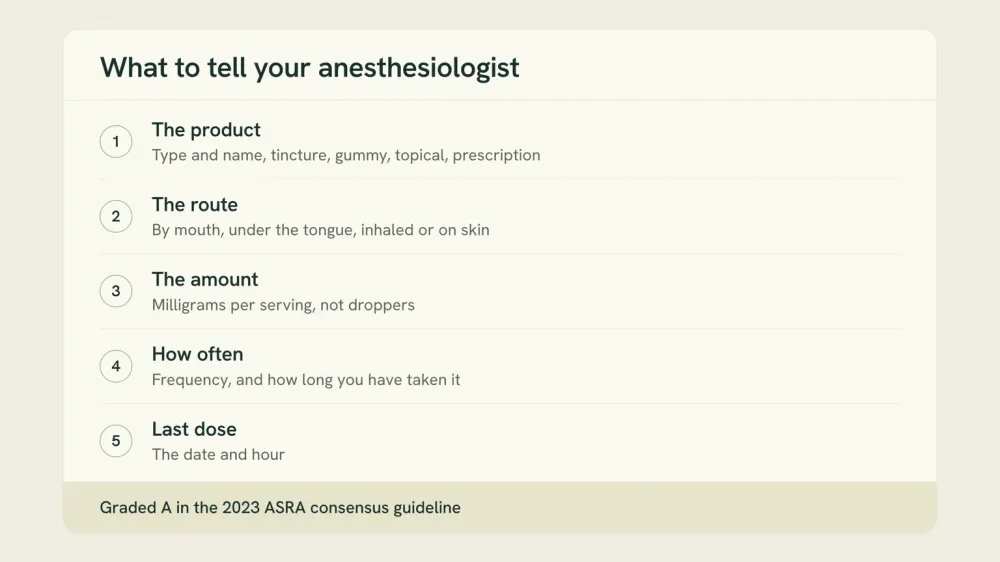
Start with the instruction that holds no matter what you take, how much of it, or what your operation is: tell your anesthesiologist. That is not a soft suggestion invented for a blog. It is the highest-graded recommendation in the professional guideline written for surgical patients on cannabinoids, and it asks for five specific things: type of cannabis or cannabinoid product, time of last consumption, route of administration, amount, and frequency of use. The American Society of Anesthesiologists puts the same instruction in plainer language on its patient page about cannabis and surgery: it is important to tell your anesthesiologist about your cannabis use before surgery to avoid safety risks. The same page adds the sentence people actually need to hear first. They will not judge your behavior, and they will share the information only with medical team members who need to know.
This needs saying because people do not say it. In a 2024 survey of 249 US adults who had used cannabis and used healthcare in the previous five years, cannabis never came up at all in about 28% of encounters, and when it did come up the clinician was the one who raised it only about 15% of the time. Anticipated stigma was significantly associated with not telling. In 135 consecutive patients seeking elective aesthetic procedures, fewer than a third of the active marijuana or nicotine users reported that use during their clinical encounters. Both studies are small, both are about cannabis rather than cannabidiol, and both are self-report in one setting. The pattern still survives the caveats: in this room, the failure mode is silence, not the molecule.
What the guideline actually says, and the recommendation that is missing
The document is the 2023 ASRA Pain Medicine consensus guideline on the perioperative management of patients on cannabis and cannabinoids, published in Regional Anesthesia and Pain Medicine, volume 48, issue 3, pages 97 to 117. Its abstract records the machinery: the American Society of Regional Anesthesia and Pain Medicine charged a working group in November 2020, the committee answered nine key questions by a modified Delphi method in which a consensus recommendation required at least 75% agreement, and 100% consensus was achieved on third-round voting. The abstract's one-line summary of the whole exercise is that surgical patients using cannabinoids are at potential increased risk for negative perioperative outcomes. That is the sentence the consumer pages should be quoting. The graded recommendations underneath it are the part nobody quotes at all.
One practical note about how we read it, because it matters. The full text is paywalled: the journal page, the publisher's PDF and the DOI all refuse automated access. The recommendation text below comes from the guideline's published recommendation summary, designed and created in participation with the American Society of Regional Anesthesia and Pain Medicine, page last updated May 5, 2026, and read on August 27, 2026. Two of its items were cross-checked independently, the acute-intoxication recommendation against a separate peer-reviewed paper and the two-hour rule against the ASA patient page above. The grades are the guideline's own. A means good evidence for or against recommending the intervention. C means poor-quality evidence. I means the evidence was insufficient or conflicting and no recommendation could be made either way.
| Recommendation, as the guideline states it | Grade | What it actually covers |
|---|---|---|
| Universal screening for cannabinoids should be performed prior to surgery and should include type of cannabis or cannabinoid product, time of last consumption, route of administration, amount, and frequency of use. | A | The pre-operative conversation. This is the guideline's strongest recommendation and it is about asking, not about stopping. |
| We recommend delaying elective surgery for a minimum of 2 hours after cannabis smoking because of increased perioperative risk of acute myocardial infarction. | C | Smoked cannabis only, and cardiac risk only. It is the single timing number in the entire document. |
| With other cannabinoids routes (non-smoking) of administration, consider weighing the risks and benefits before proceeding with elective surgery given the temporal association of cannabis usage and adverse cardiovascular effects. There is a lack of published data to recommend a specific duration. | I | Every oral, sublingual, edible and topical product, including CBD tinctures. No duration exists to give you. |
| We recommend that the frequent cannabis user be counseled on the potentially negative effects on postoperative pain control. Low-dose, medically supervised use likely has a lower risk of negative effects. | A | Counseling for frequent users, and it is about postoperative pain rather than about abstinence. |
| We cannot recommend for or against the routine tapering of cannabis and cannabinoids in the perioperative period. | I | Tapering, which is the thing nearly every consumer page tells you to do. The panel declined, on the record. |
Two more things are worth lifting out of that document. It also recommends postponing elective surgery for a patient who is acutely intoxicated, which is a same-day question rather than a countdown. And in the recommendation summary we read, cannabidiol is named in a single statement, where the direction is reassuring rather than alarming: the risk of postoperative cannabis withdrawal is considered to be less with individuals consuming CBD dominant products, which the guideline defines by ratio as more than ten parts CBD to one part THC, at moderate certainty. Notice what kind of question that is. It is a certificate-of-analysis question, not a marketing one. A COA prints total CBD and total THC in the same units, so the ratio is a division you can run yourself on your own batch report, and our guide to reading a certificate of analysis shows where those two rows sit.
Stop 7 days before: where each number actually comes from
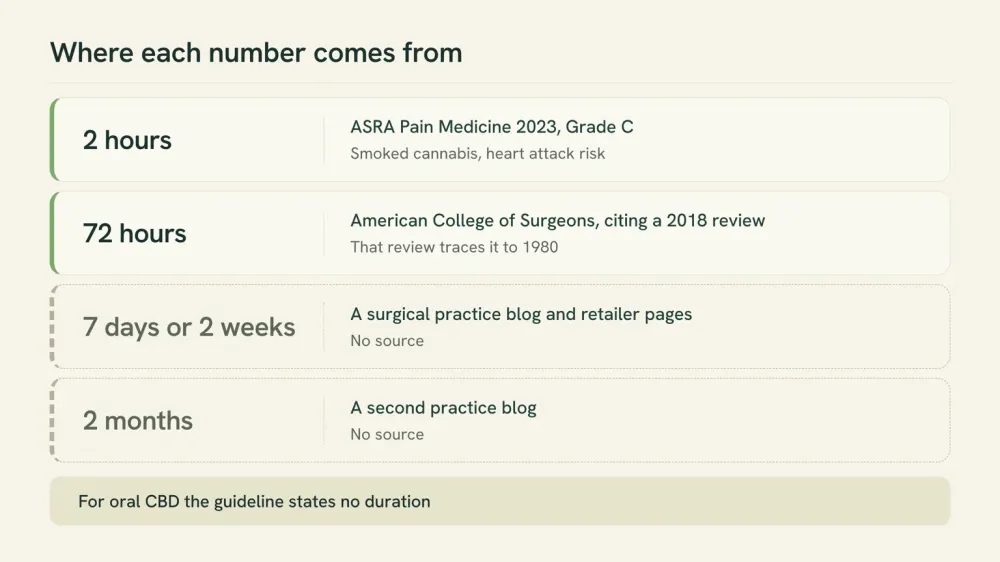
Every number you have read about this came from somewhere, and the somewhere is checkable. We took each stop-taking window that appears on the first page of this search, found the document that states it, and then followed that document to whatever it cites. Here is the whole ladder in one table.
| The number | Who states it | What it is based on | What it actually applies to |
|---|---|---|---|
| 2 hours | ASRA Pain Medicine, in the 2023 consensus guideline | A Grade C recommendation, which is the guideline's own label for poor-quality evidence | Smoked cannabis, and the stated reason is the risk of acute myocardial infarction |
| 72 hours | The American College of Surgeons, on its patient page about marijuana and surgery | The sentence carries reference 10 of the page's 10 references. Reference 10 is not a study of timing: it is a 2018 narrative review, which is the next row | Marijuana products. CBD appears on that page only inside two topical neuropathy references |
| 72 hours, one level down | A 2018 narrative review in Heliyon, which is the reference that sentence points to | The review attributes it to Dickerson's review, PMID 6258374, AANA J 1980, three pages, no abstract in PubMed | Cannabis, in 1980, decades before CBD existed as a consumer product category |
| 7 days, or two weeks | A surgical practice blog and several CBD retailer pages | No citation. The only citation anywhere in that section is the 2007 rat and test-tube study in the next section | Unattributed. The two-week version is stated for CBD products specifically |
| 2 months | A second surgical practice blog | No citation | Stated for THC-containing products |
| No window at all | The American Society of Anesthesiologists, on its patient page | It gives the 2-hour smoking rule, then says you may be advised to stop smoking one or more days before surgery unless you use it for a medical reason | It never states a window for CBD, and it says to consult the team before stopping medical use |
Follow the second row down and the pattern becomes visible. The American College of Surgeons page states, in its own words, that it is recommended to stop using marijuana products 72 hours before surgery. The sentence does carry a citation, and the citation is the interesting part: it points to reference 10 of the page's ten references, which is not a study of timing but a 2018 narrative review in Heliyon. That review is where the 72 hours comes from, and it attributes the recommendation to Dickerson's review; the review's own sentence reads that anesthesia should be avoided in any patient with cannabis use within the past 72 hours. Dickerson's review was published in 1980, runs three pages in a nurse anesthetists' journal, has no abstract in PubMed, and is about cannabis. So the most-repeated number in this search is sourced, and following the source lands 46 years back, in a journal article written before consumer CBD existed as a category. The same 2018 review also reaches two conclusions the internet skipped entirely: in vitro and in vivo studies were contradictory regarding prothrombic or antithrombotic effects, and marijuana use is problematic to surgeons, left without evidence-based approaches.
We are not going to add a seventh number to that table. This page publishes no stop window of its own, because there is not one to publish for oral cannabidiol and because the person who can weigh your procedure, your other medicines and your history is not a website. If the question underneath yours is really how long the compound itself lingers, that is a different question with actual pharmacokinetics behind it, and we cover it in how long CBD stays in your system. Whatever that page says about elimination, it is not a pre-operative instruction either.
CBD and anesthesia: what has actually been measured
The fear underneath this search is usually specific: that you will need more anesthetic than the team expects, or wake up during the operation. That has been studied, in cannabis users. A 2025 systematic review and meta-analysis pooled eight studies and 2,268 adult patients and found propofol requirements significantly higher in cannabis users, with an average additional dose of 47.33 mg overall, 30.57 mg intraoperatively under general anesthesia, and 53.02 mg for endoscopic sedation. Its authors do not oversell it. They write that the lack of standardized definitions for propofol requirements and the heterogeneity across studies necessitate caution in interpretation. Note also who was pooled: eight studies of cannabis users. It is not a measurement of anybody taking cannabidiol on its own.
The best-controlled look at inhaled anesthetics points somewhere else. A 2024 propensity-score-matched cohort study in Anesthesiology screened 22,476 patients aged 65 and over and matched 1,340 of them, 268 cannabis users against 1,072 non-users, with exposure identified from clinical notes by natural language processing. Time-weighted average MAC, the standard measure of inhaled anesthetic concentration, was 0.58 against 0.54, a difference of 0.04 with a 95% confidence limit of 0.01 to 0.06 and a p-value of 0.020. A post hoc comparison of bispectral index values, a processed EEG measure of anesthetic depth, found no difference at all: 44 against 45. The authors' conclusion is unusually plain. These data do not support the hypothesis that cannabis users require clinically meaningfully higher inhalational anesthetics doses. They also note that an observational study cannot separate a true requirement from the anesthesia team simply giving a little more once they know somebody uses cannabis.
So where does cannabidiol itself sit in all this? A 2025 review in Anesthesia and Analgesia maps the state of play and is blunt about it: little is known regarding the pharmacological interactions between cannabis and general anesthetics, and consequently there is not a solid consensus among anesthesiologists on the perioperative management of these patients. The review notes that some animal studies have demonstrated that phytocannabinoids, THC, cannabidiol and cannabinol, potentiate the anesthetic effects of inhalation and intravenous anesthetics, and that clinical studies and case reports have consistently shown increased requirements of GABAergic anesthetic drugs, isoflurane, sevoflurane, propofol and midazolam. Read the direction of those two sentences against each other. In animals, cannabidiol makes anesthetics stronger. In people, cannabis users get given more. Different species, different molecules, different kinds of evidence, and nobody has closed the gap.
We went looking for the study that would close it. On August 27, 2026 we searched PubMed for cannabidiol together with anesthesia, which returns 105 records, and for cannabidiol together with perioperative, which returns 58, and opened the first 25 of each by relevance. What comes back is reviews, the ASRA guideline itself, cannabinoid pharmacology, animal and veterinary work including an isoflurane induction study in rats and a sedation trial in cats being spayed, and trials of cannabidiol for pain after an operation. The nearest thing to the study we wanted is a 2024 trial in the Journal of Endodontics that gave a cannabidiol-rich cannabis extract before a root canal, and what it measured was anxiety and pain afterward rather than anything about the anesthetic. We did not find a study that takes a group of people who use cannabidiol and nothing else and measures what their anesthetic looked like. That is an absence of evidence rather than evidence of absence, and it cuts both ways: it is also why no page, including this one, can tell you that oral CBD does nothing under anesthesia. The effect an anesthetist is listening for here is sedation, and the full adverse-effect picture lives in our guide to CBD side effects.
Two different patients, one search result
Here is the substitution running through almost every page on this topic. Two very different people type cbd before surgery into a search box. One smokes or eats THC-dominant cannabis daily, sometimes in amounts nobody has counted. The other takes roughly 25 mg of cannabidiol at night and has never used cannabis in their life. The perioperative literature is almost entirely about the first person, and it gets applied, unchanged and unlabeled, to the second.
Two more studies fill in that first column. A 2025 propensity-matched cohort in Regional Anesthesia and Pain Medicine matched 504 older surgical patients, 126 cannabis users against 378 non-users at a median age of 69, and found higher median pain scores in the first 24 hours, 4.68 against 3.88, and about 12.5 mg more oral morphine equivalents, a median of 42.50 against 30.00. And a 2025 retrospective cohort of 288,923 adults undergoing noncardiac surgery found the cardiovascular signal was concentrated rather than general: higher in patients with a diagnosed cannabis use disorder, adjusted odds ratio 1.26, higher in recreational users who already carried high cardiac risk, 1.41, and absent in recreational users whose baseline cardiac risk was low, 0.87 with a confidence interval crossing 1. All of it is cannabis, identified from records and notes, at single centers, and all of it is association rather than cause.
| Question | What has been measured in frequent cannabis users | What has been measured in people taking CBD only |
|---|---|---|
| Anesthetic requirement | About 47 mg more propofol pooled across 8 studies, and a MAC difference of 0.04 that the authors call not clinically meaningful | Nothing. No human study has measured it |
| Pain and opioid use in the first 24 hours | Pain 4.68 against 3.88 and 12.5 mg more oral morphine equivalents, in 504 matched older patients | Nothing before surgery. Three randomized trials of CBD given after an operation, two of them null, are in the section below |
| Cardiovascular events after surgery | Higher with cannabis use disorder (aOR 1.26) and in high-cardiac-risk recreational users (1.41); no association at low baseline risk (0.87) | Nothing measured in a perioperative setting |
| Withdrawal after the operation | Highest risk in people consuming high or unknown quantities of THC-containing products, per the guideline | The guideline considers the risk less for CBD-dominant products, above ten parts CBD to one THC; the ASA page says studies suggest minimal withdrawal risk for CBD-only products |
| Intoxication on the day | The guideline recommends postponing elective surgery in an acutely intoxicated patient, and delaying at least 2 hours after smoking | CBD is not intoxicating; full-spectrum products still carry trace THC below the 0.3% federal limit, which is a disclosure item |
| Bleeding and clotting | Not among the guideline's nine questions at all; the review the ACS cites calls the in vitro and in vivo evidence contradictory | No human measurement exists, and the preclinical results disagree with each other. See the next section |
Two honest caveats about that middle column, because they decide how much of it applies to you. The two cohort studies were run in adults aged 65 and over at single health systems, with exposure worked out from clinical notes rather than measured, and age changes a lot of the arithmetic around medicines, which is the subject of our guide for older adults. And the guideline's own statements about worse postoperative pain, more opioid use and hyperalgesia are written about chronic THC use. Not about cannabidiol. Every time you see one of those findings attached to CBD on another page, that swap has happened somewhere upstream.
Does CBD thin your blood before surgery?
This is the paragraph on nearly every page about CBD and surgery, and the useful thing to do with it is to follow its own citation. The most-copied version says that research has found cannabidiol has an anticoagulant effect, and it hyperlinks that phrase to a 2007 paper in Phytomedicine titled Anticoagulant effects of a Cannabis extract in an obese rat model. Open it. The work is an in vitro thrombin assay plus clotting times in lean and obese rats, and the abstract enumerates its results: the extract, THC and CBN showed considerable inhibition of thrombin-induced clot formation in vitro, with IC50 values of 600, 87 and 83 micrograms per milliliter for the extract, THC and CBN respectively. Its concluding sentence names Cannabis sativa and the cannabinoids THC and CBN. Cannabidiol was in the panel of cannabinoids tested, and it is in none of the reported results and not in the conclusion.
That is not a clearance, and it would be dishonest to sell it as one. The paper did not test cannabidiol and find nothing; it simply reports its effect for three other things. And the preclinical work that does involve cannabidiol disagrees with itself. In a 1989 cuvette study of human and rabbit platelets, aggregation induced by adenosine diphosphate was inhibited with an order of potency of CBG, then CBD, then olivetol, then THC, then CBN, which does put cannabidiol above THC. The only concentration that paper prints for that comparison is CBG's IC50, and it is 270 micromolar, which is a cannabinoid level reached in glassware and not in a person. In a 2016 study that watched clots grow in living mice and measured activation on human platelets by flow cytometry, anandamide accelerated thrombus growth while cannabidiol neither increased nor reduced activation of platelets. And the clearest platelet result published in an anesthesiology journal belongs to THC, in 2004, and it runs the other way entirely: THC increased the expression of glycoprotein IIb-IIIa and P selectin on human platelets in a concentration-dependent manner, which the authors called a procoagulatory effect.
Now the fact that should have settled this paragraph years ago. The professional guideline does not discuss bleeding. On August 27, 2026 we term-searched its published recommendation summary for bleed, coagul, platelet, hemostas and warfarin, and got zero hits for each of the five. That is a search of the recommendation summary rather than of the paywalled full text, and it is still striking. The topics its nine questions cover, in the abstract's own list, are perioperative screening, postponement of elective surgery, concomitant opioid and cannabis use, implications for parturients, intraoperative adjustment of anesthetics and analgesics, postoperative monitoring, cannabis use disorder and postoperative concerns. Hemostasis is not one of them. The full platelet literature, with the concentration arithmetic that puts those cuvette numbers in perspective, lives on our page about whether CBD thins your blood. The concrete version of this question is different and more answerable: if you already take an anticoagulant, which one matters, and a 2023 systematic review of case reports (PMID 37740600) concluded that with the exception of warfarin, evidence supporting an interaction between cannabinoids and anticoagulants is non-existent. Our page on CBD and blood thinners takes that drug by drug.
What to actually tell your anesthesiologist
The guideline's Grade A recommendation is effectively a form, and the ASA patient page asks for the same information in conversational order: what products, what methods, how often and in what amounts, when was the last time, and whether you are using it to manage pain. Here is the version worth writing on a piece of paper and taking with you, because none of it is easy to reconstruct from memory in a pre-op bay at 6 a.m.
- 1The product, by name and type: a full-spectrum hemp tincture, a broad-spectrum oil, a gummy, a capsule, a topical, a vape, or a prescription cannabidiol solution. They are not interchangeable to the person asking.
- 2The route: by mouth, under the tongue, inhaled or on the skin. The guideline treats smoking differently from every other route, so this one changes the answer.
- 3The amount, in milligrams per serving, not in droppers or squirts. A dropper is a container, not a dose, and two products at the same volume can differ tenfold.
- 4How often, and for how long you have been taking it. Daily for two years reads very differently from twice last month.
- 5The time of your last dose, to the hour if you can manage it. This is the field the guideline asks for that people most often skip.
- 6The THC status: non-detected on the batch report, a trace below the 0.3% federal limit, or an actual THC product. Say which, and say plainly if you do not know.
- 7Everything else that sedates: alcohol, sleep aids, antihistamines, opioids, gabapentin or pregabalin, plus every prescription you take. Bring the bottle and the batch certificate of analysis if you have them.
In practice that is one sentence long. Something like: I take two drops of a whole-plant hemp tincture that the label puts at 250 mg of CBD per milliliter, so roughly 25 mg, once at night, by mouth. My last dose was 9 p.m. yesterday. It is full spectrum, so there is trace THC below 0.3%, and here is the batch certificate of analysis. The reason the certificate matters more than the marketing is measurable: a 2017 analysis in JAMA of 84 CBD products from 31 companies bought online found only about 31% were labeled within 10% of their actual cannabidiol content, and THC was detected in 18 of the 84. The FDA makes the same point in one sentence on its consumer page about cannabis-derived products: the agency has tested the chemical content of cannabinoid compounds in some of the products, and many were found to not contain the levels of CBD they claimed. Our guides to reading a CBD label and to working out how many milligrams you are actually taking cover the trip from a bottle to a number.
One more reason the list is worth writing down. The team is not screening you for a lifestyle. They are building a picture of everything in you that depresses the central nervous system, because those effects stack under sedation. The FDA-approved cannabidiol label warns that concomitant use with other CNS depressants, including alcohol, may increase the risk of sedation and somnolence, and it reports somnolence and sedation, including lethargy, in 32% of patients taking the drug against 11% on placebo. Those numbers come from children and young people with severe epilepsy on milligram-per-kilogram prescription dosing alongside other antiseizure medicines, and they do not transfer to a tincture; we keep the two apart in our comparison of prescription cannabidiol and CBD oil. The reason the question gets asked does transfer, which is also why alcohol belongs in the same disclosure. A pre-surgical drug screen is a separate matter again, and we cover it in our guide to CBD and drug testing.
CBD after surgery: what three randomized trials measured
The second half of this visit is usually the recovery question: can I use it afterward, for the pain. Three randomized, double-blind, placebo-controlled trials with dozens of patients each have given cannabidiol to people after an operation, and the largest of them has been published twice, once at two weeks and again at a year. A fourth study exists, a pilot with two people in each arm, and it is at the end of this section. None of the consumer results we read on August 27, 2026 named any of them. Two of the three found nothing. The third found something that lasted a day.
| Trial | Patients | What was given | Result |
|---|---|---|---|
| 2022, American Journal of Sports Medicine, after arthroscopic rotator cuff repair | 99 analyzed | A buccally absorbed tablet, 25 mg three times a day under 80 kg or 50 mg three times a day over 80 kg, for 14 days | Day 1 pain 4.4 against 5.7, P = .04. No significant difference by day 2, none at day 7 or 14, no difference in opioid consumption, no difference in liver function tests |
| 2024, Orthopaedic Journal of Sports Medicine, the same patients one year later | 83 of the 99 (83.8%) | The same 14-day course, a year earlier | No significant differences in pain (0.8 against 1.2, P = .38), function, satisfaction, or the proportion reaching an acceptable symptom state |
| 2022, Journal of Arthroplasty, after total knee replacement | 80, in four arms | Topical CBD, essential oil, both, or placebo, three times daily for two weeks, on top of standard multimodal analgesia | Did not reduce pain or opioid consumption, or improve sleep scores. On day 2 the CBD arm reported more pain than the essential-oil arm, 69.9 against 51.0, P = .013 |
| 2023, Journal of Urology, after ureteroscopy with a stent | 90, randomized 1:1 | 20 mg a day of the FDA-approved cannabidiol oral solution, for 3 days | In the authors' words, safe but ineffective compared with placebo in reducing post-ureteroscopic stent discomfort or opioid usage |
Read the first row carefully, because it is the one quoted as a win. The 2022 trial was multicenter, double-blind and placebo-controlled, which is as good as this literature gets, and its industry collaborator was the company making the buccal tablet, a relationship the one-year follow-up paper discloses. What it found was 1.3 points of difference on a visual analog scale on a single day, with no change in how much opioid anyone took, and nothing at all by day two. The topical knee-replacement trial and the ureteroscopy trial are flat nulls, and the second of those is worth reading as a safety result as much as an efficacy one. The newest addition to the pile is a pilot with two people in each arm after a dental extraction, whose own authors write that the results are descriptive only; we cover it on our page about CBD and ibuprofen.
Notice what all of them have in common. A fixed schedule of a specific formulation, given inside a trial, under supervision, after one named procedure, on top of the standard pain plan rather than instead of it. None of them is a person deciding on their own to take a tincture in a recovery room. The ASA's own line on restarting is that research has not established when it is safe to resume smoking weed following surgery, and it adds that anesthetic can affect your judgment for up to 24 hours, that coughing can put stress on incisions, affect blood pressure and increase the risk of bleeding, and that adding cannabis to opioids, benzodiazepines, sleep aids, gabapentin or pregabalin could worsen the impact. Anything you take after a procedure, exactly like anything you took before it, is a question for the team that operated on you.
Red flags: when to call the surgical team instead of reading
- Your surgery is in the next 24 hours and nobody on the team knows what you take. Call the pre-operative number today rather than working it out from a website.
- Your cannabidiol was prescribed. A prescribed antiseizure medicine is not a supplement question, and it is not one to change on your own initiative.
- You take an anticoagulant or an antiplatelet drug: warfarin, apixaban, clopidogrel or another. Say so plainly, because it changes the question and the answer depends on which drug.
- You use THC products daily, or in amounts you have never counted. That is the group the withdrawal, pain and anesthetic findings on this page are actually about.
- You smoked or vaped cannabis today. The guideline's two-hour rule exists for a cardiac reason, and the team needs the hour, not a rough idea.
- You do not know how many milligrams are in your serving. Bring the bottle and the batch certificate of analysis to the appointment and let them read it.
- You were told to stop something and are unsure why, or for how long. Ask the person who told you. Never work around a clinician's instruction with an article.
What is still unknown
Most of this subject is uncertainty, and the guideline is the document that says so out loud. Its only timing number is graded C. The two questions consumers care about most, whether to taper and how long to abstain from non-smoked routes, are both graded I, the label for evidence too thin or too conflicting to support a recommendation in either direction. That is not a loophole to read around. It is the honest state of a field, published by the people best placed to know it, and it is the reason a website confidently telling you seven days should make you more suspicious, not less.
The specific holes, in the order they matter to you. We found no measurement of anesthetic requirement, depth of anesthesia, blood loss or recovery in people who use cannabidiol and nothing else, which is why every outcome number on this page carries the word cannabis. No controlled interaction trial of cannabidiol with an anticoagulant turned up in the 2023 systematic review that went looking for one; the warfarin signal rests on case reports that its reviewers themselves grade very low quality. No human study measures what cannabidiol does to a clotting time. And the products are not standardized, so two people saying I take CBD may be describing amounts that differ by a factor of ten. Until those studies exist, the useful thing you can do is not to guess at a countdown. It is to make sure the people holding the scalpel know exactly what is in you, in milligrams, and when you last took it. That instruction is graded A. Nothing else on this page is.
The guideline written for this situation does not say to, and it does not say not to. In its own words, it cannot recommend for or against the routine tapering of cannabis and cannabinoids in the perioperative period, and for non-smoked routes there is a lack of published data to recommend a specific duration. Both of those are graded I, meaning the evidence was insufficient or conflicting. That makes this a clinical decision, made by your anesthesiologist or surgeon with your chart, your procedure and your other medicines in front of them. What you can do beforehand is arrive with the five facts ready: the product, the route, the amount in milligrams, how often you take it, and when you last took it. If the team gives you an instruction, that instruction is the one that applies to you.
No professional guideline publishes a number for oral cannabidiol. The numbers circulating online trace to three places. Two hours is real and traceable: it is the 2023 ASRA guideline's Grade C recommendation, it applies to smoked cannabis, and its stated reason is the risk of acute myocardial infarction. Seventy-two hours sits on the American College of Surgeons patient page, where the sentence cites a 2018 narrative review, and that review traces the number to a three-page 1980 article about cannabis in a nurse anesthetists' journal. Seven days, two weeks and two months appear on practice blogs and retailer pages with no source at all. If your surgical team has given you a number, theirs is the one that counts.
What has been measured is cannabis, not cannabidiol. Pooled across eight studies and 2,268 patients, cannabis users were given an average of 47.33 mg more propofol. The best-controlled study of inhaled anesthetics, 1,340 propensity-matched patients aged 65 and over, found a MAC difference of 0.04 and no difference in bispectral index, 44 against 45, and its authors concluded the data do not support the idea that cannabis users require clinically meaningfully higher inhaled doses. Animal work suggests cannabidiol can potentiate anesthetics, and that has not been reproduced in people. Searching PubMed on August 27, 2026 for cannabidiol with anesthesia and with perioperative returns reviews, the guideline, animal and veterinary work and post-surgical pain trials, but no study of anesthetic requirement in people who take cannabidiol and nothing else.
Nobody has measured it in a person. The claim that cannabidiol is an anticoagulant is usually sourced to a 2007 study run in test tubes and obese rats, and that paper reports its anticoagulant result for the cannabis extract, THC and cannabinol; cannabidiol is in the panel tested and in none of the reported results. That is not the same as testing it and finding nothing. The preclinical platelet studies also contradict one another: a 1989 cuvette experiment ranked cannabidiol above THC at inhibiting the aggregation triggered by adenosine diphosphate, and a 2016 experiment in living mice and on human platelets found cannabidiol neither increased nor reduced platelet activation. Bleeding is not among the nine questions the 2023 guideline addresses at all. If you take an anticoagulant or antiplatelet drug, that is a separate and much more concrete question, and it belongs at the top of your disclosure.
Three randomized placebo-controlled trials with dozens of patients each have tested it after an operation, and the largest was reported again at one year. A topical trial in 80 patients after knee replacement found no reduction in pain, opioid consumption or sleep scores. A trial of 20 mg a day of the FDA-approved cannabidiol solution in 90 patients after ureteroscopy concluded it was safe but ineffective against placebo. A 99-patient trial after rotator cuff repair found lower pain on day one only, 4.4 against 5.7, with no difference in opioid use, and at one year the same patients showed no differences in pain, function or satisfaction. All of them gave a fixed formulation on a fixed schedule inside a trial, on top of standard pain management. Anything you take after a procedure is a question for the team that operated on you, particularly while you are on prescription painkillers.
Cannabidiol itself is not what a standard test looks for; those tests target THC metabolites, and full-spectrum products contain trace THC, so a positive result is possible rather than impossible or guaranteed. Our drug-testing guide covers the mechanics. Worth knowing for this setting specifically: the 2023 guideline recommends against routine testing here, stating that universal toxicology screening for cannabinoids is not currently indicated based on insufficient available evidence, which it grades D. The screening it does recommend, at Grade A, is asking you. In other words, the system is designed around your answer, which is a good argument for making the answer accurate.
If you want the wider picture behind the one sentence in this article about anticoagulants, including the liver-enzyme mechanism that drives most cannabidiol interactions and the classes of medicine it touches, that is the subject of our guide to CBD and medications. It is the right next read before your pre-operative appointment, because the list you take in should cover everything you swallow, not only the hemp.
Writing about hemp, wellness and the small rituals that keep us balanced.