CBD and Blood Thinners: Why the Answer Depends on Which One
Page one gives one verdict for a whole class of drugs. Warfarin is the only blood thinner with published human case reports, only two of seven involved CBD, and the one case with a bleed involved smoked marijuana. Here is what the drug labels say, and what nobody has measured.
Search CBD and blood thinners and you get one verdict for an entire class of drugs. That class contains at least four different metabolic stories, and the one printed on your bottle decides which story you are in. Here is what the published human evidence actually says, drug by drug, including the parts that cut against the frightening version and the parts that cut against the reassuring one.
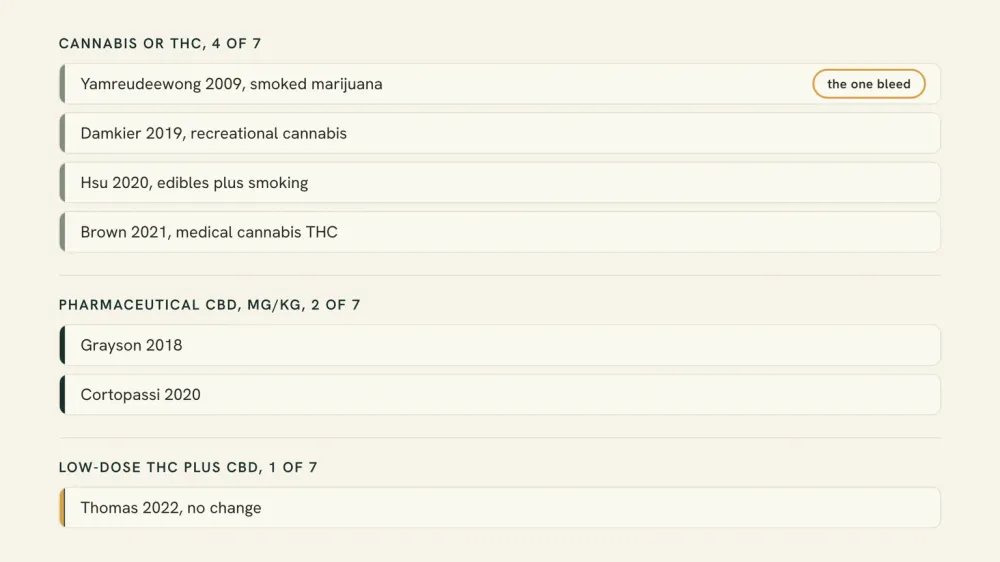
The short answer, before the detail. Warfarin is the only blood thinner with published human reports of an interaction with a cannabinoid, and there are seven of them, all single-patient case reports. Only two involved CBD, and both used FDA-approved pharmaceutical cannabidiol dosed by body weight in patients with epilepsy. Four involved cannabis or THC. The one case in which a person actually bled was smoking marijuana. For apixaban and rivaroxaban there is a plausible route on paper and no interaction study at all. For clopidogrel, the concern printed in the FDA-approved CBD label points the other way, toward less drug effect rather than more bleeding. None of that makes CBD fine with any of these medicines. It makes the honest answer specific instead of general, and the specifics belong to the clinician who manages the prescription.
Does CBD thin your blood? Start by fixing the question
No published human study describes cannabidiol acting on platelet function or on clotting factors. A PubMed search on August 4, 2026 pairing cannabidiol with platelet aggregation, coagulation and hemostasis returned 25 records, and essentially none of them measures a clotting endpoint with CBD in a person. If you want the plain chemistry first, our hub on what cannabidiol actually is covers it. The one-line version for this page: CBD is not described anywhere in the literature as a blood thinner.
What the literature does describe is pharmacokinetic, which is a different kind of claim. The proposal is that a cannabinoid slows the liver's clearance of an anticoagulant a person is already taking, so that drug's own effect gets bigger. "The medicine you already take behaves as if the dose went up" and "this substance thins blood" are two different statements with two different consequences. Somebody who takes no anticoagulant is not in this story at all. It is also why one verdict for the whole class cannot be right: this is a claim about particular enzymes and particular transporters, not a claim about blood. The general framework sits on our page about how CBD interacts with other medications. This page takes the blood thinners one at a time.
CBD and blood thinners: the metabolic route decides the answer
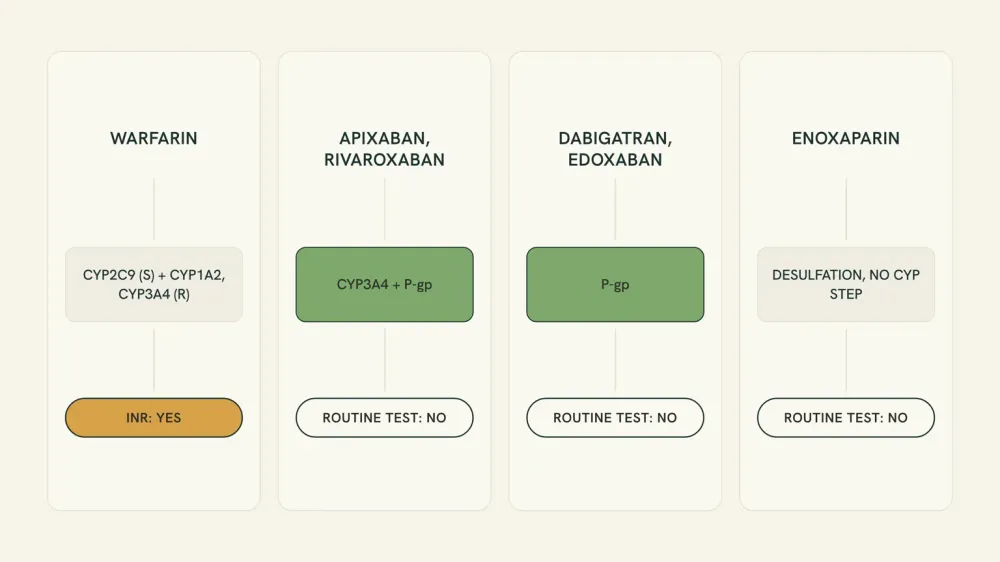
Which blood thinner is in the bottle is the question that changes the answer, and it is the one page one never asks. Every drug below has an FDA-approved label, and that label states how the body clears it. Set those against the label for Epidiolex, the FDA-approved cannabidiol oral solution, which lists the routes prescribers are told to consider a dose change for: CYP1A2, CYP2B6, CYP2C8, CYP2C19, UGT1A9 and orally administered P-glycoprotein substrates. P-glycoprotein, usually shortened to P-gp, is not an enzyme at all. It is a pump in the wall of the gut that throws drug molecules back out before they finish being absorbed. It matters here more than most articles admit, because it is the pathway shared by nearly every modern blood thinner on the list.
| Medicine | What its own label says about clearance | Is that route on the CBD label's list? | Routine test of the drug's effect? |
|---|---|---|---|
| Warfarin (Coumadin, Jantoven) | The more potent S-enantiomer is metabolized by CYP2C9; the R-enantiomer by CYP1A2 and 3A4 | CYP1A2 yes. CYP2C9 no, and the CBD label reports a negative CYP2C9 study | Yes. INR, by design |
| Apixaban (Eliquis) | Metabolized mainly via CYP3A4, minor contributions from CYP1A2, 2C8, 2C9, 2C19, 2J2; substrate of P-gp and BCRP | P-gp yes. CYP3A4 is not on the list | No. The label says clotting tests are not useful for monitoring it |
| Rivaroxaban (Xarelto) | Substrate of CYP3A4/5, CYP2J2, and the P-gp and ABCG2 transporters | P-gp yes. CYP3A4 is not on the list | No. The label says PT, INR, aPTT and anti-factor Xa monitoring is not recommended |
| Dabigatran (Pradaxa) | Not a substrate, inhibitor, or inducer of CYP450 enzymes; the prodrug is a substrate of the efflux transporter P-gp | P-gp yes | No. INR cannot be interpreted the way it is for warfarin |
| Edoxaban (Savaysa) | Substrate of P-gp; minimal metabolism via hydrolysis, conjugation and oxidation by CYP3A4 | P-gp yes | No |
| Enoxaparin (Lovenox), injected | Metabolized in the liver by desulfation and depolymerization; no CYP enzyme named anywhere in that section | No | Not routine. Anti-factor Xa levels may be used in specific situations |
| Clopidogrel (Plavix), an antiplatelet | A prodrug whose active metabolite is formed mostly by CYP2C19, with contributions from CYP1A2, CYP2B6 and CYP3A | CYP2C19 yes, and in the opposite direction: less activation, not more | Not routine |
| Aspirin, an antiplatelet | Irreversibly inactivates COX-1 by acetylation; rapidly hydrolyzed in plasma to salicylic acid | No. The effect does not depend on a CYP-cleared parent drug | Not routine |
Two things fall out of that table, and neither appears on the first page of search results. The first is that the two drugs with the most plausible route on paper, apixaban and rivaroxaban, are the ones with no routine blood test that would reveal a change. The second is that warfarin, the drug everyone worries about, is the one you can actually see, because INR is measured as part of ordinary care. That is a visibility ranking, not a risk ranking, and it explains a lot about why the published evidence looks the way it does: warfarin has case reports partly because warfarin has a number attached to it.
CBD and warfarin: what the seven case reports actually say
The spine of this topic is a 2023 systematic review in Pharmacotherapy that searched six databases from inception through May 2023. It generated 959 citations, removed 440 duplicates, screened 519, and found seven case reports evaluating an interaction with warfarin. Its summary sentence is blunt: with the exception of warfarin, the authors write, evidence supporting an interaction between cannabinoids and anticoagulants "is non-existent". Within warfarin, anticoagulation levels went up in six of the seven cases. A maximum INR change was available in five of the seven reports, and across those five it ranged from +0.4 to +9.61. Hemorrhage was identified in one of the seven reports (14.2%) and thrombosis in none. Four cases involved a reduction in weekly warfarin dose of between 22% and 31%.
Now the part no consumer page prints: those seven reports are not seven CBD reports. Four of them involved cannabis or THC, taken as smoked marijuana, as recreational cannabis, as edibles plus smoking, and as an increase in a medical cannabis dose. Two involved CBD, and in both it was FDA-approved pharmaceutical cannabidiol oral solution prescribed for epilepsy and dosed per kilogram of body weight. The seventh involved a low-dose oromucosal preparation containing both THC and CBD, and it is the case that found nothing at all. The review characterizes the doses across this literature as either extremely high, giving thresholds above 260 mg a day of THC or above 600 mg a day of CBD, or simply unknown.
The one case that included an actual bleed was a 56-year-old man who had taken warfarin for eleven years after mechanical heart-valve replacement, and he was smoking marijuana. His INR reached 10.41 alongside an upper gastrointestinal bleed with a hemoglobin of 6.6 g/dL, and he was readmitted later at an INR of 11.55 with a nosebleed and bruising. The amount of marijuana he smoked was never quantified, in either admission. One patient, no measured dose, and the substance was not CBD. That single case is where the entire "CBD causes bleeding" genre comes from.
| Case report | Patient | What was actually taken | Dose, as reported | Peak INR | Bleed? |
|---|---|---|---|---|---|
| Yamreudeewong 2009 | 56-year-old man, 11 years on warfarin | Smoked marijuana | Not quantified | 10.41, then 11.55 on readmission | Yes. Upper GI bleed, hemoglobin 6.6 g/dL |
| Grayson 2018 | 44-year-old man, epilepsy after a stroke | Pharmaceutical CBD oral solution, compassionate-use program | Started 5 mg/kg/day, titrated toward 40 mg/kg/day | 6.86, at 10 mg/kg/day | No. Followed clinically without bleeding complications |
| Damkier 2019 | 27-year-old man | Recreational cannabis | Not quantified | 4.6 | Not reported |
| Hsu and Painter 2020 | 35-year-old man, stable on warfarin 10 mg/day since 2010 | Edible cannabis plus smoking, over one month | Not quantified | 7.2 | No. Denied any signs and symptoms of bleeding |
| Cortopassi 2020 | 46-year-old man, warfarin after a DVT, epilepsy | Pharmaceutical CBD | Not given in the abstract | Not given in the abstract | Not stated |
| Brown 2021 | 67-year-old man using medical cannabis for chronic pain | Medical cannabis, THC | A dose increase of 7.35 mg THC | 5.2, on a home self-test device | No. No evidence of bleeding |
| Thomas 2022 | 85-year-old patient | Oromucosal oils, THC plus CBD | 0.3 mg THC and 5.3 mg CBD once daily | No change | No |
The most-quoted CBD case deserves its numbers stated in order, because they are usually collapsed. The patient is a 44-year-old man with Marfan syndrome, a mechanical mitral valve and epilepsy following a stroke, enrolled in an open-label compassionate-use program for FDA-approved cannabidiol oral solution and taking two antiseizure medicines alongside it. He started at 5 mg/kg/day of that pharmaceutical oral solution and was titrated up by 5 mg/kg every two weeks toward 40 mg/kg/day. His INR was 2.22 at baseline. At 5 mg/kg/day it was 2.96. The 6.86 that gets quoted everywhere occurred at 10 mg/kg/day, which at his body weight of 105.5 kg was about 1,056 mg of pharmaceutical cannabidiol in a day. His warfarin was reduced from 7.5 mg/day to 5.36 mg/day, approximately 30%, and the report states he was followed clinically without bleeding complications. One co-author was affiliated with the manufacturer of the CBD medicine involved. The second CBD case is a 46-year-old taking warfarin after a DVT who was started on the same pharmaceutical cannabidiol for intractable epilepsy and needed a nearly 20% warfarin dose reduction. Its abstract gives neither a peak INR nor a milligram-per-kilogram dose, so neither is stated here.
The cannabis cases fill in the rest of the picture. They are a 27-year-old with a mechanical heart valve whose INR reached 4.6 after recreational cannabis, a 35-year-old who had been stable on 10 mg of warfarin a day since 2010 and reached an INR of 7.2 after a month of edibles and smoking, and a 67-year-old using medical cannabis for chronic pain whose INR read 5.2 after a 7.35 mg increase in his THC dose, measured on a home self-test device rather than in a laboratory. None of the three bled. And then there is the seventh report, the one that found nothing: an 85-year-old patient taking an oromucosal product providing 0.3 mg of THC and 5.3 mg of CBD once daily, roughly 0.064 to 0.072 mg/kg/day of CBD, from October 2018 to September 2019, with no meaningful change in INR and no change to the warfarin dose across those eleven months.
The part the mechanism story leaves out
Almost every page on this topic explains the warfarin concern the same way: warfarin's more potent form is cleared by the enzyme CYP2C9, CBD blocks CYP2C9, therefore warfarin levels rise. The first half is straight from warfarin's own FDA-approved label, which states that the more potent S-enantiomer is metabolized by CYP2C9 while the R-enantiomer is metabolized by CYP1A2 and 3A4, and that inhibitors of CYP2C9, 1A2 and 3A4 have the potential to increase the effect, meaning increase INR, of warfarin. The label also says its list of interacting drugs is not all-inclusive, and it does not name cannabinoids anywhere.
The second half has been tested in people, and it came back negative. The FDA-approved CBD label reports that coadministration of that medicine at 7.5 mg/kg twice daily with a single 500 mg dose of tolbutamide, a moderately sensitive CYP2C9 substrate, did not result in changes in plasma exposures of tolbutamide compared to tolbutamide administered alone. Keep the units attached: 7.5 mg/kg twice daily is 15 mg/kg/day of a pharmaceutical oral solution, roughly 1,125 mg a day for a 75 kg adult, in a program built around severe epilepsy. A whole-document search of that label on August 4, 2026 returned zero occurrences of the word warfarin, and CYP2C9 substrates are not on its list of routes to consider a dose change for. The same label also reports no change in midazolam, the standard sensitive CYP3A4 probe, at 750 mg of cannabidiol twice daily.
That is not the end of it, and this is where honesty costs something. A 2023 randomized crossover study in 18 healthy adults gave a brownie containing a cannabis extract with 640 mg of CBD and 20 mg of THC, then a five-drug cocktail designed to probe five liver enzymes at once. There, the CYP2C9 probe drug losartan rose 77% in total exposure, and the CYP2C19 probe rose 207%. So one human probe study says nothing happened to a CYP2C9 substrate and another says a CYP2C9 substrate went up by more than three quarters. They are not the same experiment: one used pharmaceutical CBD alone at steady dosing, the other a single dose of a cannabis extract that also contained THC, in 18 people, against a different probe drug. Neither used warfarin. The correct conclusion is that the enzyme step everybody states as settled fact is not settled, in either direction, and that one negative probe study is not a safety finding.
The only population-level estimate that exists is inconclusive in the same specific way. A 2025 longitudinal cohort study in Age and Ageing followed 12,599 Ontario seniors holding an authorized cannabis prescription between 2014 and 2019 using administrative and clinical data. Among 378 patients exposed to cannabis and warfarin, the risk of bleeding was 1.19, 95% CI 0.71 to 1.98, compared to 1,646 controls: 7.40% (28 of 378) against 6.56% (108 of 1,646). The authors' own limitation deserves quoting whole rather than half: "Although a non-significant increase in the risk of bleeding was observed in individuals concomitantly exposed to medical cannabis and warfarin, it remains a concern regarding the seriousness of the event and the fact that a statistical power issue could not be excluded." This is medical cannabis rather than CBD, in Canadians aged 65 and over, in claims data rather than a trial, and two of the authors disclose cannabis-industry ties while the paper states the funders and companies listed were not involved in any aspect of the design or write-up and that all analysis was performed independently from them. It is also a study of bleeding, the outcome, rather than of INR, the number. Those are not the same thing, a distinction we worked through in detail in what happens when CBD and alcohol are studied together.
“Very low-quality data support a potential drug-drug interaction with warfarin and both THC and CBD. Clinician recognition of this potential interaction is important. Available evidence supports the need to conduct a drug interaction study between cannabinoids and warfarin to clarify the existence of an interaction.”
CBD and Eliquis or Xarelto: a plausible route with no way to see it
Two statements about these drugs are circulating on the first page of search results and both are wrong. The first is that apixaban and rivaroxaban do not rely on the cytochrome P450 system. The apixaban label says apixaban is metabolized mainly via CYP3A4 with minor contributions from CYP1A2, 2C8, 2C9, 2C19 and 2J2, and that it is a substrate of the transport proteins P-gp and breast cancer resistance protein. The rivaroxaban label says rivaroxaban is a substrate of CYP3A4/5, CYP2J2, and the P-gp and ATP-binding cassette G2 transporters. Both labels carry instructions about combined P-gp and strong CYP3A4 inhibitors: apixaban's calls for a 50% dose reduction, rivaroxaban's says such combinations increase exposure and may increase the risk of bleeding. Those rules were written for strong inhibitors such as ketoconazole and ritonavir. CBD has never been tested against either anticoagulant.
The second wrong statement is that no interactions were found with apixaban, rivaroxaban or aspirin. Nothing was found because nothing was looked for, and those are different sentences. A PubMed search on August 4, 2026 combining the four direct oral anticoagulants, apixaban, rivaroxaban, dabigatran and edoxaban, with cannabidiol, cannabis or cannabinoid returned nine records, and not one of them is a drug-interaction study. They are unrelated case reports plus three volumes of a clinical-trials bibliography. That search takes about a minute to rerun and you should rerun it rather than take our word for it. Absence of a study is not evidence of no effect, and it is not evidence of an effect either.
Where the FDA-approved CBD label does have something to say about drugs like these, it says it about transport rather than enzymes. It reports that concomitant use with orally administered everolimus results in an approximately 2.5-fold increase in plasma exposures of everolimus, at 12.5 mg/kg of that pharmaceutical oral solution twice daily in healthy adults, and that increases in exposure of other orally administered P-gp substrates such as sirolimus, tacrolimus and digoxin may be observed. Apixaban, rivaroxaban, dabigatran and edoxaban are all P-gp substrates. Everolimus is not an anticoagulant and nobody has run the equivalent study with one. Meanwhile there is no routine number to look at: the apixaban label states that changes observed in clotting tests at the expected therapeutic dose are small, subject to a high degree of variability, and not useful in monitoring the anticoagulation effect of apixaban, and the rivaroxaban label states that monitoring its anticoagulation effect with a clotting test or anti-factor Xa activity is not recommended.
Dabigatran, edoxaban and the heparins: different chemistry, same unknown
The dabigatran label says dabigatran is not a substrate, inhibitor, or inducer of CYP450 enzymes, which is where most consumer pages stop reading. The same label also says the prodrug dabigatran etexilate is a substrate of the efflux transporter P-gp, and P-gp is precisely the pathway the CBD label does flag. Not a CYP drug is not the same as not relevant. Edoxaban sits in the same position: a P-gp substrate with minimal metabolism via hydrolysis, conjugation and oxidation by CYP3A4. The dabigatran label adds a detail worth carrying: INR is relatively insensitive to dabigatran exposure and cannot be interpreted the way it is used for warfarin monitoring, so the familiar number does not transfer between drugs.
Enoxaparin and the other injected heparins are the cleanest separation on this page. The label describes enoxaparin as primarily metabolized in the liver by desulfation and depolymerization to lower molecular weight species with much reduced biological potency, and no CYP enzyme appears in that section at all. It also notes that prothrombin time and activated partial thromboplastin time are not adequate for monitoring its anticoagulant effect. A different clearance route is not a guarantee of anything, because nobody has studied this pairing either. What it does mean is narrower and more useful: the liver-enzyme mechanism that drives the whole warfarin discussion does not apply to this drug.
Aspirin and Plavix are not blood thinners in the same sense
Anticoagulants slow the clotting cascade. Antiplatelets stop platelets from clumping together. Everyday language calls both of them blood thinners, and usually that shorthand is harmless. Here it is not, because the two antiplatelets people ask about are cleared nothing like warfarin. Aspirin's label describes the mechanism as the acetyl group of aspirin binding with a serine residue of cyclooxygenase-1, irreversibly inactivating the enzyme, and states that aspirin is rapidly hydrolyzed in the plasma to salicylic acid. The antiplatelet effect does not depend on a CYP-cleared parent drug, so the liver-enzyme story simply does not reach it. There is also no study of CBD with aspirin, in either direction. Not studied is not the same as no interaction, and this page will not print the second sentence while meaning the first.
Clopidogrel runs the other way, and this is the point most articles get backwards. It is a prodrug: it does nothing at all until the liver converts it, and its label says the active metabolite is formed mostly by CYP2C19, with contributions from several other enzymes including CYP1A2, CYP2B6 and CYP3A. Its boxed warning is about diminished antiplatelet effect in patients with two loss-of-function alleles of the CYP2C19 gene, and the label already warns that concomitant use of drugs that inhibit that enzyme results in reduced plasma concentrations of the active metabolite of clopidogrel and a reduction in platelet inhibition. The FDA-approved CBD label calls cannabidiol a moderate inhibitor of CYP2C19 and names clopidogrel by name: for CYP2C19 substrates such as clopidogrel where efficacy is mainly due to their active metabolites, it says, concomitant use may decrease plasma concentration of the active metabolites and may therefore decrease efficacy, and it tells prescribers to consider a dosage increase of such substrates as clinically appropriate. Read that direction carefully. The labelled concern is less drug effect, not more bleeding.
Two limits belong in the same breath as that paragraph. It is a labelling precaution built from enzyme data, not an observed clinical outcome, and no trial has measured what happens to a person taking both. A 2020 review of cannabis with anticoagulant and antiplatelet agents screened 665 articles and found four case reports, one in vitro study and one pharmacokinetic paper of relevance in the entire literature. Its clopidogrel sentence is explicitly a prediction: cannabidiol inhibits CYP2C19, the isoenzyme responsible for transforming clopidogrel into its active thiol metabolite, and the authors write that this interaction could lead to subtherapeutic levels of active metabolite and possibly increased stroke risk. No clinical antiplatelet outcome data sits behind it. The nearest thing to a case is a 2023 geriatric teaching case describing a 76-year-old man taking clopidogrel and aspirin after a heart attack who had been using CBD oil up to three times a day for knee pain and asked to keep using it in rehabilitation. His care team advised him against it because of the potential clopidogrel interaction and prescribed acetaminophen for the knee instead. No adverse event occurred, no CBD amount was recorded, and nothing was measured. That is a clinical team's precautionary decision, reported here as exactly that and as nothing more.
The dose gap: what the studies used versus what is in a bottle
Every figure above comes from pharmaceutical cannabidiol dosed by body weight, or from cannabis whose dose was never measured. Almost nobody takes CBD that way. A standard dropper delivers roughly 0.05 mL per drop, so an oil at 250 mg/mL works out to about 12.5 mg of CBD per drop, and a 60 mL bottle holding 15,000 mg contains roughly 1,200 drops. Drop size genuinely varies with the dropper and with technique, which is why it is worth taking a minute to work out the milligrams in one drop of your own oil and to check what the milligram number on a label actually refers to before comparing anything. With that conversion in hand, the published exposures look like this.
| Published exposure | What it actually was | Same amount, expressed in drops of a 250 mg/mL oil |
|---|---|---|
| The case report on day 28, when INR reached 6.86 | About 1,056 mg/day of pharmaceutical cannabidiol oral solution (10 mg/kg/day at 105.5 kg), in a patient with epilepsy | About 84 drops in a single day |
| The same case at its highest titration step | About 4,220 mg/day (40 mg/kg/day at 105.5 kg) | About 338 drops a day, more than a quarter of a 60 mL bottle, daily |
| The FDA label's negative CYP2C9 probe study | 7.5 mg/kg twice daily, so 15 mg/kg/day, roughly 1,125 mg/day for a 75 kg adult | About 90 drops in a single day |
| The systematic review's threshold for an extremely high CBD dose | Above 600 mg/day | About 48 drops a day |
| The case that showed no change at all | 5.3 mg of CBD a day, about 0.064-0.072 mg/kg/day, for roughly eleven months | Well under one drop a day |
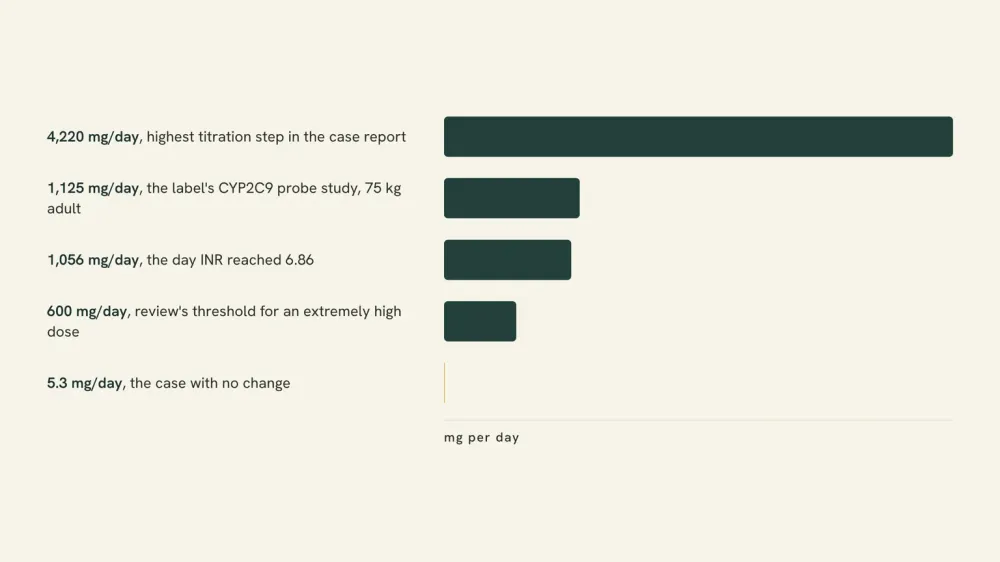
The doses in the published cases are not doses anybody buys in a bottle of oil. Reaching the exposure at which the most-cited case report's INR jumped would take roughly eighty-four drops of a 250 mg/mL oil in a single day, which would empty a 15,000 mg bottle in about two weeks, and the case that showed nothing at all involved about 5 mg a day for eleven months. A much smaller exposure makes a large interaction less likely. It does not make it impossible, and nobody has measured the consumer-scale case: no study has ever tested a tincture-scale amount of CBD against any anticoagulant. That is the sentence the sellers will not write, and it cuts both ways on purpose. Nothing in this section is a recommendation of any amount for anyone taking a blood thinner.
What "cannabis and bleeding" headlines usually turn out to be
The largest bleeding event ever linked to a cannabis product was not caused by a cannabinoid. In March and April 2018, more than 150 patients presented to hospitals in Illinois with coagulopathy and bleeding diathesis, and a New England Journal of Medicine report on 34 of them found that preliminary tests of patient serum and drug samples pointed to brodifacoum, a long-acting rodenticide anticoagulant, as the likely adulterant. In that series, anticoagulant tests were positive for brodifacoum in 15 patients (100% of those tested), difenacoum in 5 (33%), bromadiolone in 2 (13%) and warfarin in 1 (7%). One patient died from complications of spontaneous intracranial hemorrhage. Those were illicit synthetic cannabinoids adulterated with rat poison, and the episode has nothing to do with hemp-derived CBD. It is the clearest available illustration that "a cannabis product was involved" and "the cannabinoid did it" are two different claims. It is also not a reason to relax about warfarin: the case reports above still stand on their own.
What is still genuinely unknown
The honest state of this literature is small and lopsided. There is no interaction study of cannabinoids and warfarin, which is exactly what the 2023 review asks for in its conclusion. There is no interaction study of CBD with any direct oral anticoagulant, with any heparin, with aspirin or with clopidogrel. The human evidence is seven single-patient case reports, two probe-drug studies that disagree with each other about CYP2C9 (one of them inside the FDA-approved CBD label, the other an independent 2023 crossover trial in 18 healthy adults), and one claims-data cohort that was not statistically significant and may have been underpowered. A 2024 systematic review screened 4,600 reports and found 31 in which cannabinoids altered pharmacokinetics or produced adverse events across 16 narrow-therapeutic-index medicines, warfarin among the four most widely reported, but a review of reports inherits whatever happens to get reported and cannot tell you how often nothing happened.
Zoom out one level and the picture is familiar: the NCCIH overview of cannabis and cannabinoids says of one common consumer use after another that there has been little research in people, and interactions are no exception. Bleeding, for what it is worth, does not appear among the adverse effects that are actually documented for CBD itself. What nobody can tell you is what happens with your medicine, at your amount, in your body. That is not a gap this page can close, and it is the reason the next section is the only instruction in the article.
When to call, and what to bring
Signs of bleeding belong to a clinician rather than to a search engine, and they are not CBD-specific. In the published case reports, the bleeding that did appear looked like gastrointestinal blood loss, a nosebleed and bruising. Any of the following is a call to whoever manages the anticoagulant, whether or not CBD is anywhere in the picture.
- Bruising that shows up without a knock, or that keeps spreading
- A nosebleed or bleeding gums that will not stop
- Blood in urine or stool, or stool that turns black
- Coughing up or vomiting blood
- A sudden severe headache, confusion, or any head injury while taking an anticoagulant
- For anyone who tests INR: a reading outside the range the clinic set, especially a new one
Coughing up or vomiting blood, and any sudden severe headache, confusion or head injury while taking an anticoagulant, are emergency-department situations rather than a phone call. The rest are reasons to ring the clinic and describe what you are seeing. Separately, if the conversation you want is the planned one rather than the emergency one, it goes a great deal better with the specifics in hand.
- 1The exact name and strength of the anticoagulant or antiplatelet, from the pharmacy label rather than from memory
- 2The milligrams of CBD per serving and per bottle, and whether the oil is full spectrum, broad spectrum or isolate
- 3How often it is taken, and for how long it has been taken already
- 4Anything else in the cabinet that touches the same enzymes: this conversation is rarely about two things
- 5Whether the prescription is managed by a dedicated anticoagulation clinic, since that clinic, not the blog, is the right place for the decision
No published human study describes cannabidiol acting on platelet function or on clotting factors. The concern in the literature is a different one: that CBD might slow how the liver clears a blood thinner someone is already taking, so that drug's own effect becomes larger. A 2023 systematic review found seven case reports of that happening, all with warfarin, and rated the evidence very low-quality. If you take no anticoagulant, this literature has nothing to say about you.
That is a question for the prescriber, and the honest starting point is that nobody has measured it. Both apixaban and rivaroxaban are CYP3A4 and P-glycoprotein substrates according to their own FDA-approved labels, and the FDA-approved CBD label does flag orally administered P-glycoprotein substrates. But a PubMed search on August 4, 2026 combining the four direct oral anticoagulants with cannabidiol, cannabis or cannabinoid returned nine records and not one interaction study. There is also no routine blood test for either drug's effect: apixaban's label says clotting tests are not useful for monitoring it, and rivaroxaban's says monitoring is not recommended.
Warfarin is the only anticoagulant with published human reports, so it is the only one where there is anything to weigh. Anticoagulation levels rose in six of seven case reports. Two of those seven involved CBD, and both used FDA-approved pharmaceutical cannabidiol at milligram-per-kilogram doses in patients with epilepsy, which is roughly eighty-four drops of a 250 mg/mL oil per day in the most-quoted case. The review's own conclusion is that a proper interaction study is needed and has never been done. This is a conversation with the clinician or anticoagulation clinic that manages the INR, before anything changes.
Nobody knows, because it has never been studied. What can be said is mechanical: aspirin works by irreversibly acetylating the COX-1 enzyme and is rapidly hydrolyzed in plasma to salicylic acid, so the liver-enzyme mechanism behind the warfarin discussion does not apply to it. Any page that tells you no interaction was found with aspirin is describing an absence of studies as though it were a result.
This is the one that runs in the opposite direction. Clopidogrel is a prodrug that CYP2C19 converts into its active form, and it carries a boxed warning about diminished antiplatelet effect in people who cannot make that conversion. The FDA-approved CBD label calls cannabidiol a moderate inhibitor of CYP2C19, names clopidogrel specifically, warns that concomitant use may decrease the plasma concentration of the active metabolite and therefore decrease efficacy, and tells prescribers to consider a dosage increase of such substrates as clinically appropriate. So the labelled concern is less drug effect rather than more bleeding. It is a labelling precaution built from enzyme data, not an observed outcome in patients.
It is the clearest difference between the two CBD case reports and the negative one. The case that produced an INR of 6.86 involved about 1,056 mg of pharmaceutical cannabidiol in a day, roughly eighty-four drops of a 250 mg/mL oil. The case that showed no change at all involved about 5.3 mg a day for eleven months, well under a single drop. A far smaller exposure makes a large interaction less likely. It does not make it impossible, and no study has measured a tincture-scale amount against any blood thinner, so the honest answer stops there.
Writing about hemp, wellness and the small rituals that keep us balanced.