CBD and Statins: What the Seven Labels Actually Say
We read the current FDA label for seven statins on August 15, 2026. Three name CYP3A4, one names CYP2C9 as its main route, one names no CYP enzyme at all, and not one of the seven mentions cannabidiol. Here is what that changes, and what nobody has measured.

You take a statin every morning and there is a bottle of CBD in the kitchen. The question behind every search for CBD and statins is whether those two belong in the same day. Most pages that try to answer it do so at the level of the class, as though every statin were the same drug. Their own FDA labels say otherwise, and that is where a useful answer starts.
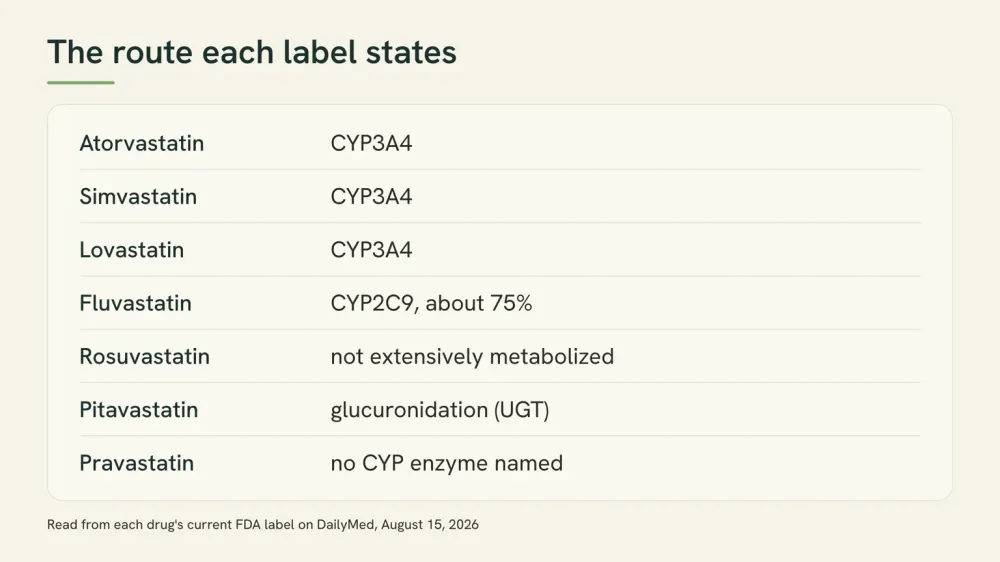
Here is the short version, up front. On August 15, 2026 we read the current FDA-approved label for seven statins, section by section, and they do not describe one road through the body. Three name CYP3A4 as the enzyme that clears the drug. One names CYP2C9 as its main route, about 75% of it. One says it is "not extensively metabolized" at all. One is cleared principally by glucuronidation, a completely different mechanism, with "only minimal metabolism by the cytochrome P450 system." And one names no cytochrome P450 enzyme anywhere in the document. In all seven labels, the word cannabidiol appears zero times. In the other direction, the word statin appears exactly once in the FDA-approved cannabidiol label, and it is inside the word cystatin C, a kidney marker in a sub-study. Nobody has published a measurement of what CBD does to any statin in a person. That is not a clearance and it is not a reason to panic. It is a reason to tell the clinician who prescribed your statin, and the pharmacist who fills it, that you take CBD.
A statin is a class, not a drug
Every drug people call a statin blocks the same target: HMG-CoA reductase, the enzyme your liver uses early in the process of making cholesterol. That shared target is why the class exists and why the drugs get discussed as a group.
What they do not share is the route the drug molecule itself takes through your body. Two things decide that: which enzyme breaks the drug down, and which transporter proteins carry it into and out of liver cells. Both are properties of the molecule, not of the target it hits. So a sentence like "CBD interacts with statins" is the wrong shape of answer. It is a claim about a class, and clearance is a property of a drug.
That is not a small distinction, and it is the reason a general framework like the one in our guide to CBD and prescription medications, where the enzyme story properly lives, cannot finish this question on its own. To finish it you need the label of the drug in your hand.
What each of the seven labels actually says
Every row below was read from the drug's own current Structured Product Label on DailyMed, the National Library of Medicine's public label repository, on August 15, 2026. For each one we worked from the label's own table of contents, read the metabolism and drug interaction sections, then searched the whole document for CYP3A4, CYP2C9, OATP, transporter, grapefruit and cannabidiol. The version number and publication date are in the last column, because a drug label is a document that gets revised.
| Statin (label read) | Stated metabolic route | Transporters the label names | Grapefruit on the label | Label version |
|---|---|---|---|---|
| Atorvastatin (LIPITOR) | "In vitro studies suggest the importance of LIPITOR metabolism by cytochrome P450 3A4" | OATP1B1, OATP1B3, P-gp, BCRP | Quantified: AUC ratio 1.37 with 240 mL a day and a 40 mg dose | Viatris, v8, published 2026-07-15 |
| Simvastatin (ZOCOR) | "Simvastatin is metabolized by CYP3A4" | OATP1B1 (simvastatin acid) | Quantified twice: AUC ratio 1.9 with single-strength juice, 16 with double-strength | Organon, v11, published 2025-04-03 |
| Lovastatin (Lupin, generic) | "Lovastatin is a substrate for cytochrome P450 isoform 3A4 (CYP3A4)" | None named | Quantified twice: mean AUC up 1.94-fold and 15-fold in two studies | Lupin, v17, published 2026-05-07, old pre-PLR format |
| Rosuvastatin (CRESTOR) | "not extensively metabolized"; the major metabolite is formed "principally by cytochrome P450 2C9" | OATP1B1, BCRP | Not mentioned. The word grapefruit returns zero hits | AstraZeneca, v14, published 2026-05-13 |
| Pravastatin (Aurobindo, generic) | Isomerization and enzymatic ring hydroxylation. No cytochrome P450 enzyme named anywhere | OATP1B1 | Measured: AUC down 1.8%, Cmax up 3.7% | Aurobindo, v8, published 2026-08-03 |
| Fluvastatin (LESCOL XL) | In vitro data: CYP2C9 "primarily involved" at about 75%, CYP3A4 about 20%, CYP2C8 about 5% | None named | Not mentioned. The word grapefruit returns zero hits | Sandoz, v1, published 2024-08-05 |
| Pitavastatin (LIVALO) | "The principal route of pitavastatin metabolism is glucuronidation"; "only minimal metabolism by the cytochrome P450 system" | None named | Measured: AUC up 15%, Cmax down 12% | Kowa, v12, published 2026-06-17 |
The three CYP3A4 members are the ones most articles have in mind when they write about statins and enzymes. Atorvastatin's label puts it carefully in section 12.3: "In vitro studies suggest the importance of LIPITOR metabolism by cytochrome P450 3A4, consistent with increased plasma concentrations of LIPITOR in humans following co-administration with erythromycin, a known inhibitor of this isozyme." Simvastatin's label is blunter, at "Simvastatin is metabolized by CYP3A4," and its section 4 contraindicates taking it with strong CYP3A4 inhibitors as a defined class. The current lovastatin label calls the drug "a substrate for cytochrome P450 isoform 3A4 (CYP3A4)" and adds that "Strong inhibitors of CYP3A4 can raise the plasma levels of HMG-CoA reductase inhibitory activity and increase the risk of myopathy."
Lovastatin is also a small lesson in how to read a label at all. The version we read (Lupin, version 17, published May 7, 2026) is still written in the old format that predates the modern numbered structure: no section 7 Drug Interactions, no section 12.3, no numbered sections at all. Its table of contents runs DESCRIPTION, CLINICAL PHARMACOLOGY, INDICATIONS AND USAGE, CONTRAINDICATIONS, WARNINGS, PRECAUTIONS, ADVERSE REACTIONS, OVERDOSAGE, DOSAGE AND ADMINISTRATION and HOW SUPPLIED, and not one of those headings carries a number. Its route statement sits under PHARMACOKINETICS, inside CLINICAL PHARMACOLOGY, and its interaction content under PRECAUTIONS, Drug Interactions. Two drugs in the same class, two different eras of labeling. If an article tells you to check section 7 of your statin's label, that instruction simply does not work on this document.
The other four say something different about the same enzyme. Rosuvastatin's label states that the drug is "not extensively metabolized; approximately 10% of a radiolabeled dose is recovered as metabolite," that the major metabolite is "formed principally by cytochrome P450 2C9," and that its clearance "is not dependent on metabolism by cytochrome P450 3A4 to a clinically significant extent." Pravastatin's label goes further and names no cytochrome P450 enzyme anywhere: searched on August 15, 2026, CYP3A4, CYP2C9, CYP2C19 and CYP2D6 all return zero hits, and its stated pathways are isomerization and enzymatic ring hydroxylation. Fluvastatin's label points at a different enzyme entirely, and labels its own evidence as it does so: "In vitro data indicate that fluvastatin metabolism involves multiple Cytochrome P450 (CYP) isozymes. CYP2C9 isoenzyme is primarily involved in the metabolism of fluvastatin (approximately 75%), while CYP2C8 and CYP3A4 isoenzymes are involved to a much less extent, i.e., approximately 5% and approximately 20%, respectively." So fluvastatin's document does mention CYP3A4, as a minor contributor, not as the route. And pitavastatin's label leaves the cytochrome system almost entirely: "The principal route of pitavastatin metabolism is glucuronidation via liver uridine 5'-diphosphate glucuronosyltransferase (UGT) with subsequent formation of pitavastatin lactone. There is only minimal metabolism by the cytochrome P450 system."
One thing the table should not be read as saying is that the four non-CYP3A4 statins have no interactions. Rosuvastatin's section 7.1 calls it "a substrate of CYP2C9 and transporters (such as OATP1B1, BCRP)." Pravastatin's own interaction table shows cyclosporine raising its exposure by 282% and clarithromycin by 110%, in a document with no cytochrome P450 enzyme in it at all. Pitavastatin's shows cyclosporine at 4.6-fold and erythromycin at 2.8-fold. "Not a CYP3A4 drug" means one specific thing, and it does not mean nothing gets in the way. Where a label says nothing, we report nothing: lovastatin's, fluvastatin's and pitavastatin's labels name no transporter, which is an absence in those three documents on the day we read them, not a finding that those drugs are not transported.
The same inhibitor, three different answers
If you want one line that shows why a class-level answer fails, take itraconazole, an antifungal and one of the reference-grade strong CYP3A4 inhibitors. Three of these labels report what it did to their own drug in a human study, and the three results do not agree with each other.
Read that carefully, because it is three separate documents reporting three separate studies at different doses and for different durations, not one experiment with three arms. That is precisely the point. The same inhibitor is a major event for one statin, close to a rounding error for the second, and moves the third in the opposite direction. There is no way to know which of those three shapes applies to you without knowing which drug is on your prescription, and no page on the internet can know that.
CBD and statins: what has actually been measured in people
The argument you meet on the search results page runs like this: CBD inhibits cytochrome P450 enzymes, statins are cleared by cytochrome P450 enzymes, therefore CBD raises statin levels. The first two clauses are defensible. The third is where it stops being evidence and starts being arithmetic performed on a metaphor.
The best-documented human data on CBD and drug-metabolizing enzymes belongs to the FDA-approved cannabidiol oral solution, because approval required a regulator-reviewed interaction program. We re-read that label, version 35, on August 15, 2026. Section 12.3 reports that coadministration at 750 mg twice daily "with a single dose of midazolam (2.5 mg), a sensitive CYP3A4 substrate, did not result in changes" in midazolam concentrations. A separate study in the same section, run at a different dose of 7.5 mg/kg twice daily, reports that tolbutamide, "a moderately sensitive CYP2C9 substrate," also showed no change in plasma exposures. Section 7.2 states plainly that "Cannabidiol is a moderate inhibitor of CYP2C19." And in one place the label does report a large rise: at a different dose, 12.5 mg/kg twice daily, coadministration with "the P-gp and CYP3A4 substrate everolimus (5 mg)" produced an approximately 2.5-fold increase in everolimus mean Cmax and AUC.
Notice what that does and does not settle. The enzyme the cannabidiol label singles out is CYP2C19, and CYP2C19 is named by none of the seven statin labels; it matters for a different set of prescriptions, which is why it turns up in the sertraline conversation rather than this one. The enzyme three statins depend on, CYP3A4, is exactly where the label's own human probe study found nothing. And the single large result on that label belongs to everolimus, a drug the label describes as both a P-gp and a CYP3A4 substrate, which happens to be the same dual description atorvastatin's section 7.1 gives itself. That adjacency is the sharpest fact on this page, and it is a question to put to a pharmacist, not a prediction to act on.
It helps to know what regulators mean by the word inhibitor. In FDA's table of substrates, inhibitors and inducers, a strong inhibitor is one that increases the AUC of a sensitive index substrate at least 5-fold, and a moderate inhibitor one that increases it at least 2-fold and less than 5-fold. FDA adds, of that same table, that it "provides examples of clinical index inhibitors and is not intended to be an exhaustive list." Against those cutoffs, the largest human CYP3A4-probe result for CBD we could find is a 2023 trial in 18 healthy adults (PMID 37313955), in which a brownie containing 640 mg of CBD together with 20 mg of THC raised midazolam AUC by 56%, a ratio of 1.56. That sits below FDA's floor for "moderate" and nowhere near the 5-fold that defines "strong." That comparison is our arithmetic against FDA's published cutoffs, not an FDA classification of cannabidiol, and because the trial gave CBD together with THC, CBD's own contribution is not isolated in it.
The companion FDA table for healthcare professionals is where grapefruit juice gets classified. It sits there as a "3A moderate inhibitor," one of five non-drugs on the list alongside St. John's wort, curcumin, diosmin and tobacco smoking. Searched on the same day, that table returns zero hits for cannabidiol and zero for cannabis. That absence is not a finding of no effect, and this page carries a caveat of its own, in its own words: "The field of metabolic and transporter pharmacology is rapidly evolving, thus the examples in Table 1 are a guide and not considered a comprehensive list of all possible drugs and other substances (e.g., foods, including dietary supplements) that fit these categories." What the silence means is that the classification does not exist, which is a different and more honest statement.
Underneath all of this sits a set of in vitro experiments, and they disagree with each other. In a 2021 screen of 12 cannabinoids against 6 enzymes run by the Lambert Initiative at the University of Sydney (PMID 34181150), the authors concluded that effects on CYP2D6, CYP1A2, CYP2B6 and CYP3A4 metabolism "were limited so in vivo DDIs mediated by these isoforms would not be predicted," and pointed instead at a different enzyme: "CYP2C9-mediated metabolism was inhibited by nearly all the cannabinoids with estimated Ki values of 0.2-3.2 microM" (micromolar). A second 2021 paper, on cannabinoid metabolites as inhibitors of the major hepatic CYP450 enzymes (PMID 34493602), reports the opposite emphasis, that CBD "competitively inhibited CYP3A4, CYP2B6, CYP2C9, CYP2D6, and CYP2E1," and a 2011 study (PMID 21356216) put CBD's IC50 for CYP3A4 at 11.7 micromolar. All three are experiments in tubes, using recombinant enzymes and microsomes. There is no person in any of them, no blood concentration you could compare yourself to, and no statin.
That CYP2C9 detail matters more on this page than it does on most, because CYP2C9 is fluvastatin's main route by its own label and the minor one named by both rosuvastatin's and pitavastatin's. So the in vitro study that points away from CYP3A4 points straight at the enzyme governing a different corner of this class. And then the human check runs the other way again: the FDA-approved cannabidiol label's own CYP2C9 probe study, with tolbutamide, found no change. Both halves are true at the same time. That is what an unsettled question looks like from the inside, and no amount of confident phrasing on a product page changes it.
The transporter half almost nobody covers
Enzymes are only half the map. A statin has to get into the liver cell before it can be cleared, and that job belongs to transporter proteins. Four of the seven labels name at least one. Atorvastatin's section 7.1 calls the drug "a substrate of CYP3A4 and transporters (e.g., OATP1B1/1B3, P-gp, or BCRP)," which is four transporters in a single sentence. Simvastatin's says "Simvastatin acid is a substrate of the transport protein OATP1B1." Rosuvastatin's names OATP1B1 and BCRP. Pravastatin's, the label with no enzyme in it, calls the drug "a substrate of the transport protein OATP1B1." The remaining three name none, which again is silence in a document rather than a negative result.
Now put that against what has been measured for CBD. A dated search of PubMed on August 15, 2026 for cannabidiol together with OATP1B1, OATP1B3 or SLCO1B1 returns exactly one record: an in vitro screen of three commercial cannabis oils across 12 human transporters, published in Cannabis and Cannabinoid Research in 2022. It was run in HEK293 cells and membrane vesicles, and it tested whole oils rather than isolated CBD. The most CBD-rich of the three contained 19 mg/mL of CBD and 0.84 mg/mL of THC in MCT oil.
Its results are worth translating into the labels' own vocabulary. ABCG2 is the gene name for BCRP, which both atorvastatin's and rosuvastatin's labels name; two of the three oils inhibited it, and the reported IC50 for the CBD-rich product was 4.5 micromolar based on its CBD content. SLCO1B1 is OATP1B1, named by four of the seven statin labels, and SLCO1B3 is OATP1B3, which atorvastatin's names alongside it; those, the paper reports, were "modestly inhibited by high concentrations" of the products. And ABCB1 is P-glycoprotein, which atorvastatin's label also names: the three products "did not inhibit ABCB1." Hold that last result next to the cannabidiol label's everolimus finding, a 2.5-fold rise in a drug that same label calls a P-gp and CYP3A4 substrate. A cell assay and a human study are pointing in different directions, and we are not going to pretend to resolve that here.
The authors make the statin connection themselves, in their results: "OATPs are involved in elimination of endogenous and xenobiotic substrates, including bilirubin, thyroid hormones, antibiotics, anticancer drugs, and cholesterol lowering statins, so any impact on transporter function could translate into a meaningful DDI." Their very next sentence is the limit on it: the products "only modestly inhibited OATP transporter function in comparison with rifampicin." Read the disclosure in full as well, both halves of it. "This research was funded by Canopy Growth Corporation," four of the authors are named as Canopy Growth employees, and two more are named as inventors on several patents involving cannabinoid therapeutics; the paper carries no statement that the sponsor had no role in the work. Worth saying plainly: the company that makes the tested products paid for the study, and the finding on the transporters that matter most here is a cautious one, which is not the direction a sponsor is usually accused of buying.
Grapefruit is the right analogy, and here is where it stops
Most people on a statin have heard the grapefruit warning, and it is a genuinely good way into this question, because it is the same kind of question: a food that inhibits an enzyme, taken with a drug that enzyme clears. It is also the clearest available picture of what a measured interaction looks like on paper. Here is what the seven labels actually print.
- Simvastatin: AUC ratio 16 with 200 mL of double-strength juice three times a day and a 60 mg single dose; 1.9 with one 8 oz glass of single-strength juice and a 20 mg single dose.
- Simvastatin acid, the active metabolite, in those same two studies: 7 at the high dose and 1.3 at the low one.
- Lovastatin: mean AUC up 15-fold in 10 subjects at 80 mg with double-strength juice, and 1.94-fold in 15 subjects at 40 mg with a single 8 oz glass.
- Atorvastatin: AUC ratio 1.37 and Cmax ratio 1.16 with 240 mL once a day and a 40 mg single dose. A footnote reports AUC up to 2.5 with excessive consumption of 750 mL to 1.2 liters a day.
- Pitavastatin: AUC up 15% and Cmax down 12%, in the same table where cyclosporine raises it 4.6-fold.
- Pravastatin: AUC down 1.8% and Cmax up 3.7%. Measured, and essentially nothing.
- Rosuvastatin and fluvastatin: the word grapefruit does not appear in either label. That is silence, not a finding of no effect.
Two things about that list matter more than the individual numbers. The first is how much the preparation of the juice does. Lovastatin's own label reports a 15-fold rise with double-strength juice three times a day and a 1.94-fold rise with one ordinary glass, and both simvastatin's label and lovastatin's then print the same caveat about the gap between their two studies; simvastatin's reads, verbatim, "The effect of amounts of grapefruit juice between those used in these two studies on simvastatin pharmacokinetics has not been studied." FDA's own footnote makes the same point about the food itself: its effect "varies widely among brands and is concentration-, dose-, and preparation-dependent," and the same juice can be classified as a strong CYP3A inhibitor in one preparation and a moderate one in another.
The second is where the analogy stops, and it stops hard. Every number above exists because somebody gave a named volume of a named preparation of juice to human volunteers alongside a named dose of a named statin, and measured the result. Not one of those four things exists for CBD and a statin. No volume, no product, no statin dose, no ratio. That is the entire difference between a warning printed on a federal label and an inference drawn from a mechanism, and it is why this page will not tell you that CBD does to your statin what grapefruit does. It is also why the honest instruction here is the boring one: mention it to your prescriber, the way you would mention that you drink grapefruit juice.
The number nobody has: what is actually in the literature
The phrase "moderate drug interaction" sits on the first page of results for this question. Here is what is actually indexed, with the searches printed so you can re-run them yourself. All of them were run against PubMed on August 15, 2026, and every result set was opened rather than counted.
Searching cannabidiol AND (statins OR atorvastatin OR simvastatin) returns 6 records. All six are: a 2026 review of cannabinoid drug interactions, an HPLC assay-validation paper, a "Top 20 Research Studies of 2022 for Primary Care Physicians" digest, a pharmacogenetics paper on CBD response in treatment-resistant epilepsy, a bench paper on cholesterol and glycine receptors, and a 2005 clinical-trials bibliography. Not one of them is a study of CBD given with a statin. Widening the query to all seven statin names returns 14 records and adds no interaction study at all: the extra eight are two versions of an autism psychopharmacology review, a fragile X treatment review, and five more clinical-trials bibliographies.
Two further searches matter because of what gets claimed about them. The query cannabidiol AND statin AND (case report OR "case reports") returns 0 records. There is no indexed case report of a CBD and statin interaction. And cannabidiol AND rhabdomyolysis returns exactly 1 record, a 2026 case report of poisoning with hexahydrocannabinol; cannabidiol appears in it only because that cannabinoid is manufactured from CBD, and no statin is involved anywhere in the case.
The most recent expert synthesis is worth opening rather than counting. A 2026 narrative review of cannabinoid drug-drug pharmacokinetic interactions in the British Journal of Clinical Pharmacology promises this topic in its abstract, listing "statins, beta-blockers, warfarin, insulin analogues and metformin" among the cardiometabolic treatments it covers. Its methods section describes a search of PubMed, Scopus and Google Scholar for English-language publications from 2018 to 2024. What it delivers on statins is two sentences, both in section 4.3.6.
“THC, CBD and CBN inhibit CYP3A4, potentially increasing the exposure and duration of action of drugs such as antiarrhythmics, statins, calcium channel blockers and nitrates. Inhibition of CYP2C9 can similarly affect the metabolism of medications like warfarin, NSAIDs and additional statins.”
Read those two sentences again: they point at two different enzymes, they name no individual statin, and both are hedged with "potentially." In the full text, searched on August 15, 2026, atorvastatin, simvastatin, rosuvastatin, pravastatin, lovastatin, fluvastatin, pitavastatin and OATP all return zero hits, and the class word turns up only in the abstract, the introduction and those two sentences, never as an individual drug. The review's own table of the clinical cannabinoid interaction studies it collected does not contain a single statin; the pool does include an everolimus study and a warfarin case in an 85-year-old patient whose listed conditions include hyperlipidemia, so a statin patient appears, but the drug under study is warfarin. None of that is a flaw in the review. It is an accurate reflection of what exists.
Two claims circulating on consumer pages should be corrected head on, because you will meet them. The first is that CBD raises levels of atorvastatin and simvastatin but not pravastatin or rosuvastatin, written as though it were a research finding. No such measurement exists for any of those four drugs. It is an inference drawn from the routes in the table above, dressed up as data, and it is usually followed by a suggestion to switch statins, which is not a suggestion any article should be making. The second is that there are case reports of statin-related muscle pain in people who started using CBD. The search above returns zero. Also on that first page are several patent applications pairing cannabidiol with a statin, one of them titled around synergistic combinations; a patent application is a claim filed with a patent office, not a result, and none of the dose figures inside them belongs in a health article.
The muscle symptoms belong to the statin
There is a reason an exposure question matters with this class at all, and it is written on the labels. Atorvastatin's section 5.1 says the drug "may cause myopathy (muscle pain, tenderness, or weakness associated with elevated creatine kinase [CK]) and rhabdomyolysis." The risk factors it lists include "age 65 years or greater," uncontrolled hypothyroidism, renal impairment, concomitant use with certain other drugs, and a higher dose of the statin itself. That is the statin's own labeled risk, described in its own document, and it is why older adults taking several prescriptions at once are the readers this question actually finds.
Notice how the labels handle the symptoms, because consumer pages routinely fuse them and the labels do not. In the counseling section, muscle symptoms sit under the heading Myopathy and Rhabdomyolysis, where patients are told to report "unexplained muscle pain, tenderness or weakness particularly if accompanied by malaise or fever." Dark urine sits somewhere else entirely, under Hepatic Dysfunction, in a list that reads "fatigue, anorexia, right upper abdominal discomfort, dark urine or jaundice." Two different problems, two different sections, and merging them into one scary list is a mistake that makes both harder to act on. The liver half overlaps with ground we have already covered in detail, in what the trials measured about CBD and liver enzymes, and it gets one sentence here rather than a second treatment.
What to actually do with all of this
None of the above tells you to change anything, and this section will not either. What it does is turn a vague worry into a specific conversation. The one useful action is disclosure: a prescriber and a pharmacist can only account for something they know you take, and a CBD product is a supplement that does not appear in your pharmacy record unless you put it there. Bring numbers rather than the word CBD, which on its own tells them nothing. A tincture label usually prints two figures, total milligrams in the bottle and milligrams per milliliter, and the second is the one somebody can actually work with. If that is unfamiliar territory, reading the mg figure off your own bottle is ten minutes well spent before the appointment.
- 1The statin's name and its strength, exactly as printed on the prescription, for example atorvastatin 20 mg rather than "my cholesterol pill."
- 2That you take a CBD product, how often you take it, and how long you have been taking it.
- 3The CBD figure from the product's own label, in milligrams per serving and milligrams per milliliter.
- 4Whether it is full spectrum or broad spectrum, and what the batch certificate of analysis reports for THC.
- 5Everything else you take, including other supplements, over-the-counter medicines, and grapefruit juice.
- 6Any new or unexplained muscle pain, tenderness or weakness, and when it started.
- 7Ask for it to be written into your medication record, so the next prescriber sees it too.
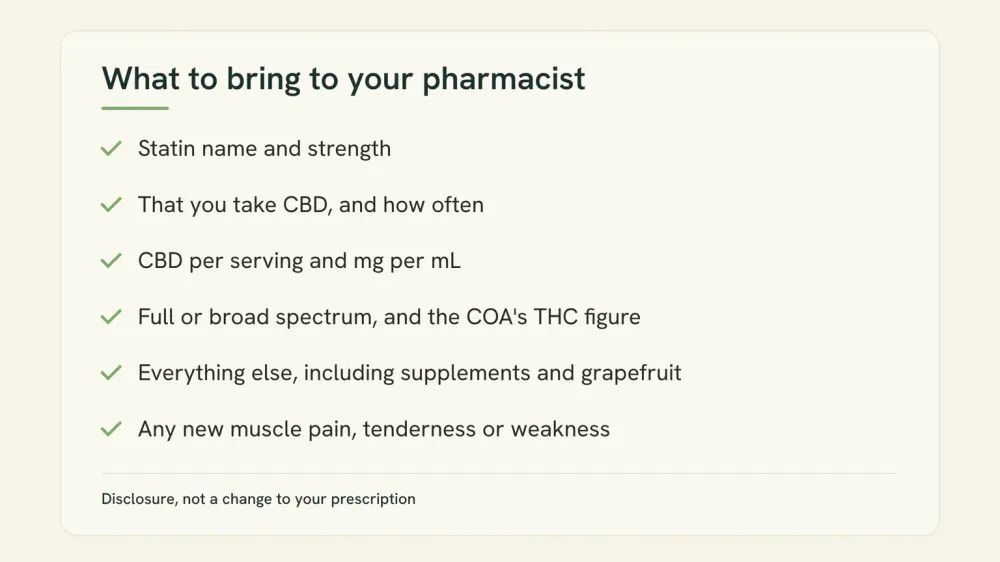
What is deliberately not on that list: a dose, a gap between the two, a time of day, or any hint that one statin suits CBD better than another. This page ranks nothing and recommends nothing. Whether anything about your prescription changes is a decision for the person who prescribed it, and a statin is not an optional part of your day.
What this page does not say
Being clear about the shape of the evidence is part of the answer, not a disclaimer bolted onto it. Nobody has published a study measuring what CBD does to any statin in a person. The routes in the table are a reason to ask a question, never a prediction of an outcome, and mechanisms that look decisive in a tube have repeatedly failed to show up in people: the cannabidiol label's own CYP3A4 and CYP2C9 probe studies are the closest human tests that exist, and both of them found nothing.
Three more limits, stated plainly. Nothing here tells you to stop, start, delay, space out, skip or change the dose of a statin or of a CBD product. Planntz makes no claim that CBD affects cholesterol, cardiovascular risk or heart health; this is a page about taking two things at once, not a heart-health page, and the patent filings on the results page do not change that. And every label finding here is dated: we read these documents on August 15, 2026, in the versions printed in the table, and labels get revised. If your prescription is a different one, the same method applies to the same question asked about blood pressure medication and to anticoagulants and antiplatelets, which split the same way.
Atorvastatin's own label describes it as a substrate of CYP3A4 and of the transporters OATP1B1, OATP1B3, P-gp and BCRP, so it is one of the statins where an enzyme or transporter question is reasonable to raise. What is missing is any measurement: nobody has published a study of CBD given with atorvastatin. The FDA-approved cannabidiol label reports no change in midazolam, the standard CYP3A4 probe drug, at 750 mg twice daily, and an approximately 2.5-fold rise in everolimus, which that label calls both a CYP3A4 and a P-gp substrate. Together those facts are a good reason to tell your prescriber and pharmacist that you take CBD. They are not a basis for concluding that CBD raises atorvastatin levels, because nobody has measured it.
Their labels describe different routes, which is not the same thing as a safety ranking. Rosuvastatin's says the drug is not extensively metabolized, with about 10% of a dose recovered as metabolite, and that its clearance is not dependent on metabolism by CYP3A4 to a clinically significant extent. Pravastatin's names no cytochrome P450 enzyme anywhere in the document. Both are still transporter substrates, and pravastatin's own interaction table shows cyclosporine raising its exposure by 282%. Since nobody has measured CBD against any statin, this page does not rank them, does not call any of them safer, and does not suggest switching. Which statin you take is a decision for the clinician who prescribed it.
It is the right kind of question and the wrong kind of evidence. Grapefruit's effect is printed on the labels with everything you would need to check it: the strength of the juice, the volume, the statin, its dose and the resulting exposure ratio, running from 16 for simvastatin with double-strength juice down to a 1.8% fall for pravastatin. FDA classifies grapefruit juice as a moderate CYP3A inhibitor and notes that its strength depends on the preparation. CBD has none of that against any statin: no volume, no product, no dose, no ratio, and no entry in FDA's tables in any inhibitor category, which FDA itself describes as guides rather than complete lists. The analogy tells you what kind of question you are asking. It does not answer it.
Muscle pain, tenderness and weakness with elevated creatine kinase are documented adverse reactions of the statins themselves, described in section 5.1 of these labels, with risk factors that include being 65 or older. Nothing on this page says or implies that CBD causes them. Searched on August 15, 2026, PubMed holds no case report of a CBD and statin interaction, and the only record joining cannabidiol to rhabdomyolysis is a 2026 poisoning case involving a different cannabinoid, with no statin involved. New or unexplained muscle symptoms are worth reporting to your prescriber promptly whatever else you take, and that advice does not change because CBD is in the picture.
Cholesterol medication covers several different drug families, and as this page shows, even inside the statins the labels describe several different routes. A general answer is therefore not a useful answer. The useful version is specific: which drug, at which strength, read off your own prescription, asked of your pharmacist with the CBD product's own numbers in front of them. That is a five-minute conversation and it beats any article, including this one, because it is about your prescription rather than a class.
This page is about taking two things at the same time. It is not about cholesterol. Planntz makes no claim that CBD affects cholesterol, cardiovascular risk or heart health, and we are not aware of human evidence that would support one. Several patent applications pairing cannabidiol with a statin turn up in the search results for this topic; a patent application is a claim filed with a patent office, not a study result, and it is not evidence of anything having been measured. Whether you need a statin, and at what dose, is a decision for the clinician who prescribed it, and it is not one to make from a search results page.
The essentials: the statin's name and strength, that you take a CBD product and how often, the CBD figure from its own label in milligrams per serving and milligrams per milliliter, whether it is full or broad spectrum and what the batch certificate of analysis says about THC, and everything else you take including other supplements and grapefruit juice. Then ask for it to go into your medication record. You are asking them to account for it, not asking permission to change anything, and that distinction is what makes the conversation easy to have.
Writing about hemp, wellness and the small rituals that keep us balanced.