CBD and Turmeric: The Liver Record and the 2000% Number
Nobody has published a study of people taking cannabidiol and turmeric together. What is documented is turmeric's own liver-injury record, the enzyme-inhibiting job that black pepper does in the capsule, and what the famous 2000% figure was measured against.
Can you take CBD and turmeric together? Nobody has published a study of people taking both, so the honest answer has to start somewhere else: with what each substance's own record says. One of the two has a named chapter in the federal reference work on drug-induced liver injury, graded at the top of that book's evidence scale. It is not the cannabinoid.
That is not an alarm, and this page will not tell you to start anything, stop anything or move anything two hours apart. It is a statement about where the evidence sits. Two things about this pair are genuinely documented, and neither of them is the thing page one talks about. Turmeric has an adjudicated liver-injury case series from a national network. And the black pepper extract that most turmeric capsules include is an inhibitor of drug-metabolizing enzymes rather than an inert carrier, which is precisely why it is in there. The combination itself has never been measured in a person. If you want the background on the cannabinoid half, what cannabidiol actually is covers it. This page is about the other bottle, and about the one number the whole category quotes.
What we sell, and what we do not
Planntz sells CBD tinctures. We do not sell turmeric, curcumin, black pepper extract or any product containing them, and we are not planning to. Say that out loud before the case series rather than after it, because the easiest article in the world to write is one where a competing supplement turns out to be frightening and ours does not. So here is the counterweight first, in other people's words.
Turmeric has a long dietary history and one of the largest clinical literatures of any botanical. When the United States Pharmacopeia's expert committee on dietary supplement admission and labeling reviewed the hepatotoxicity question, its 2026 review opened the ledger with this: numerous clinical trials involving turmeric or curcuminoid supplements have not reported organ toxicity or serious adverse events, and published case reports of clinically apparent liver injury often involve concomitant medications or supplements. Scale belongs in the same paragraph. In national survey data collected between January 2017 and March 2020 from 9,685 US adults, turmeric was the most used of six botanicals with a liver signal, with 236 users, ahead of green tea at 92 and ashwagandha at 28, and the authors estimated that 15,584,599 US adults (95% confidence interval 13.0 million to 18.6 million) had used at least one of the six in the previous 30 days.
What page one of this search actually says
We read the search results on 22 August 2026, before writing a word of this. For the query that people actually type, eight of the eight results returned were commercial: seven brands selling a CBD-plus-turmeric product and one piece of trade press. Broaden the phrasing and a US patent application joins them. There is no pharmacist on page one, no regulator, no hospital, no medical journal and no independent publisher. That is not a complaint about sellers. It is the reason a page like this one is worth writing: everyone answering the question has something to sell, so the parts of the answer that do not help a sale go missing.
Four of the eight pages were fetchable in full and we read those four line by line. Several of them describe the two substances as working better together than separately, which on the cannabinoid side is a specific technical claim with a specific evidence base, and where we adjudicate the cannabinoid version of that claim is its own page. Nobody has extended it to turmeric with human data, so we are not going to either. The table below records what those pages assert, whether they cited anything for it, and what we found when we checked. The middle column is the interesting one.
| What the page says | Sourced on that page? | What we found when we checked |
|---|---|---|
| The two "enhance each other's effects" | No citation on the pages we could open | No human study of the pair exists. The dated search is printed further down this page |
| Benefit claims for pain, mood and digestion | One page links two general articles about CBD, neither about the pair | These are the category's claims, not ours. We do not make them and we do not repeat them |
| "Black pepper increases the bioavailability of curcumin by 2000%" | Yes. One page links the 1998 paper, correctly | The number is real. Its baseline is a serum level the paper calls undetectable or very low |
| Both are suitable for daily use at recommended doses | No citation | NCCIH's own turmeric page carries a liver sentence about highly bioavailable curcumin formulations |
| Take turmeric in the morning and CBD about two hours later | No citation | We found no study behind any spacing interval, so we give no timing advice at all |
| Nothing at all about liver injury, DILI or hepatotoxicity | Not found in our read of any of the four pages we fetched in full | This is the article |
One of those pages does cite identifiable records, and checking them takes about a minute, which is a skill worth more than anything else on this page. Copy the identifier, paste it into PubMed, read the title, and ask whether the paper is about the thing the sentence claimed. Here is the trap that nearly caught us doing exactly that on this search: a PMC ID is not a PMID. PubMed Central identifiers and PubMed identifiers are both plain integers, they do not correspond, and dropping the letters turns one paper into a completely different one. PMC3518252 is a 2012 nutrition study of a lipidated curcumin supplement. PMID 3518252 is a 1986 surgery paper about radiotherapy complications. Same digits, unrelated documents. When we first read this search we made that slip ourselves and had to catch it, which is why it is here rather than in a footnote.
The 2000% number, and the sentence printed next to it
Every page selling this combination quotes the same figure, and almost none of them names the paper. It traces to a single 1998 study in Planta Medica, from the Department of Pharmacology at St. John's Medical College in Bangalore. Read at the source, the human comparison is this: after a 2 g dose of curcumin alone, serum levels were, in the paper's own words, either undetectable or very low. With 20 mg of piperine given at the same time, concentrations were higher from 0.25 to 1 hour after dosing, with the paper reporting P less than 0.01 at 0.25 and 0.5 hours and P less than 0.001 at 1 hour, and it states that the increase in bioavailability was 2000%.
Three things sit next to that number in the source and travel with it nowhere else. The first is the baseline: a 2000% increase over an undetectable quantity is a bigger undetectable quantity, and the paper says which one it started from. The second is the measure. The abstract says increase in bioavailability and reports timed serum concentrations; it does not separate that into peak concentration, time to peak or total exposure over time, which are three different claims that get swapped for one another constantly. The third is the arm size, and here we print a negative rather than a number: the abstract does not report how many volunteers were in the human experiment, and the full text sits behind a publisher that served an automated-traffic block when we tried to read it on 22 August 2026. So the most quoted figure in this category comes from a paper whose human sample size is not recoverable by the people quoting it. There is a 154% in the same abstract, and it belongs to the rat arm, at 2 g of curcumin per kilogram with 20 mg of piperine per kilogram. Per kilogram is not a human dose and that number never belongs in a human sentence.
The number has not reproduced. In 2025 an independent group gave nine healthy men three curcumin formulations at about 570 mg plus one at 2,280 mg, with and without piperine, in a crossover design. Plasma unconjugated curcumin came in below 2 nM in most cases, including at the high dose and in the piperine combinations. The best-performing formulation reached 6.7 to 38 nM at 30 minutes, which the authors describe as still 100-fold lower than the concentrations used in vitro to show biological effects. Their abstract says piperine addition provided no benefit, and their discussion goes further: based on a single study by Shoba and colleagues, piperine has become a commonly used additive, but their results and those of others, in their words, clearly demonstrate that addition of piperine is useless. Nine men is nine men, it is a single crossover, and nobody in it took cannabidiol.
A 2023 study in Frontiers in Nutrition came at it from the other end, sampling 47 people who were already using their own curcumin products in daily life, with plasma drawn before and 1.5 hours after their own dose. Curcumin and its metabolites measured 1.0 to 18.6 ng/mL, rising to 25.4 ng/mL after deconjugation, which the authors state is still significantly below, by a factor of 1,000, a plasma concentration that would be expected to have a beneficial health effect. Their sentence about adjuvants is one line long: the use of adjuvants like piperine did not result in higher curcumin plasma concentrations. That study is observational, it is one time point, and the products were whatever the participants had bought, which cuts both ways: less control, more real life.
There is a supply-side explanation for some of this. A 2026 study in Pharmaceutical Biology put eight marketed turmeric supplements through USP-aligned dissolution testing in simulated fasted and fed gastric and intestinal fluid, in vitro rather than in people, and reported that all products exhibited poor dissolution overall, with no formulation achieving greater than 40% total release. Several products marketed as enhanced formulations, the authors write, demonstrated poor disintegration and low bioaccessibility. A simulated gut is a model of a gut and eight products is eight products, but the direction is consistent with what the human sampling found. If this correction feels familiar, it is the same one we make on our own side of the aisle: what a CBD absorption multiplier is measured against runs the identical arithmetic on nanoemulsion claims, and the arithmetic does not care which molecule you point it at.
Black pepper is not a delivery trick, it is an enzyme inhibitor
Here is the part the category skips. Piperine, the compound extracted from black pepper, is not a carrier or a solvent or a shuttle. It raises curcumin levels by slowing down the enzymes that would otherwise clear curcumin out. In human liver microsomes and recombinant enzymes, in vitro, a 2008 study in Drug Metabolism and Disposition reported piperine as a relatively selective noncompetitive inhibitor of CYP3A with a half-maximal inhibitory concentration of 5.5 micromolar and an inhibition constant of 5.4 micromolar, while a curcuminoid extract inhibited a spread of enzymes (sulfotransferase, CYP2C19, CYP2B6, glucuronidation, CYP2C9 and CYP3A) at half-maximal concentrations from 0.99 to 25.3 micromolar. Those authors were careful about where they expected it to matter: an oral curcuminoid and piperine combination, they predicted, is most likely to inhibit those enzymes within the intestinal mucosa rather than throughout the body.
Two later laboratory papers sharpen the mechanism without leaving the dish. A 2020 in vitro study characterized piperine as a mechanism-based, time-dependent inactivator of CYP3A, meaning it does not merely occupy the enzyme but disables it, and a 2002 in vitro paper reported piperine inhibiting P-glycoprotein in Caco-2 cell monolayers and CYP3A4 in human liver microsomes. All of that is enzymes in glassware, and it is labelled that way here because the distance between an enzyme assay and a person is exactly where this category's confidence comes from. CYP3A is the same enzyme family this cluster spends most of its pages on, and our parent page on CBD and medications explains what the cytochrome P450 system does and why an inhibitor of it is worth knowing about, so we are naming the enzyme once here and handing the framework over.
In people, the two direct tests of that mechanism disagree with each other, and the disagreement is the honest headline. A randomized, placebo-controlled six-way crossover in eight healthy volunteers, published in the British Journal of Clinical Pharmacology in 2013, gave a commercial standardized preparation of 4 g of curcuminoids plus 24 mg of piperine four times across two days, then probed metabolism with midazolam, flurbiprofen and paracetamol. It found no meaningful changes in plasma peak concentration, total exposure, clearance, elimination half-life or metabolite levels, and no effect on midazolam's sedative action, concluding that short-term use is unlikely to result in a clinically significant interaction involving CYP3A, CYP2C9 or the paracetamol conjugation enzymes. Worth noting inside that same study: unconjugated curcuminoid and piperine concentrations in plasma were consistently below the assay thresholds, which is the absorption problem showing up inside the interaction study.
A 2014 study in twenty healthy volunteers, published in DARU, points the other way. Fourteen men and six women took piperine 15 mg or placebo for three days and then a single 10 mg dose of midazolam. Sedation lasted 188 plus or minus 59 minutes after piperine against 102 plus or minus 43 minutes after placebo, a difference the authors report at p below 0.0001, and midazolam half-life was longer with piperine at 1.88 plus or minus 0.03 hours against 1.71 plus or minus 0.04. One caution we owe you, because it is inside the abstract itself: one results sentence describes clearance as higher with piperine while the printed values (33.62 plus or minus 0.4 mL/min with piperine against 37.09 plus or minus 1.07 without) and the conclusion both describe it as lower. We are following the conclusion. The design is also thin: three blood samples fitted to a one-compartment model, and clearance values an order of magnitude below what midazolam normally shows. Neither the 2013 study nor the 2014 one involved cannabidiol.
Two further human datasets point in directions the seller narrative never mentions, and a third line of evidence is not human at all. In breast cancer patients taking tamoxifen, a 2019 study in Cancers reported that adding curcumin 1,200 mg three times daily lowered exposure to endoxifen, tamoxifen's active metabolite, by 7.7% over 24 hours (95% confidence interval minus 15.4 to 0.7, p equals 0.07), and that adding piperine 10 mg three times daily on top lowered it by 12.4% (95% confidence interval minus 21.9 to minus 1.9, p equals 0.02). Down, not up, in one specific drug and one specific patient group, and nothing in that result transfers to any other medicine. A 2024 phase I study used curcumin 2 g deliberately, as a probe inhibitor of the BCRP transporter, in 26 analysed participants out of 29 enrolled, and measured the active metabolite of the study drug rising 24% in peak concentration, 21% in exposure to last measurable point and 20% in total exposure, which the investigators judged not clinically meaningful. And a 2024 physiologically based model, a computer simulation rather than a measurement, predicted that 20 mg of piperine a day for seven days would raise exposure to six of ten simulated CYP3A4 substrate drugs by more than 25%, the largest being simvastatin at 59%. Simulated numbers are predictions about people, not observations of them.
| Study | Design and how many people | What was measured | Direction it moved |
|---|---|---|---|
| Volak 2013 (PMID 22725836) | Randomized, placebo-controlled six-way crossover, 8 healthy volunteers | Midazolam, flurbiprofen and paracetamol after 4 g curcuminoids plus 24 mg piperine | No meaningful change in any parameter measured |
| Midazolam study 2014 (PMID 24398010) | Controlled volunteer study, 20 healthy adults | Midazolam 10 mg after piperine 15 mg daily for 3 days | Sedation longer (188 vs 102 minutes); clearance lower per the conclusion |
| Hussaarts 2019 (PMID 30909366) | Patients on tamoxifen, curcumin 1,200 mg three times daily with or without piperine 10 mg three times daily | Endoxifen exposure over 24 hours | Down 7.7% with curcumin (p=0.07); down 12.4% adding piperine (p=0.02) |
| Phase I crossover 2024 (PMID 39316278) | Open-label fixed-sequence crossover, 29 enrolled and 26 analysed, curcumin 2 g as a BCRP probe | Active metabolite of one investigational drug | Up 24% peak, 21% exposure to last point, 20% total; judged not clinically meaningful |
| PBPK model 2024 (PMID 39456737) | Computer simulation, no people, piperine 20 mg/day for 7 days | Ten simulated CYP3A4 substrate drugs | Six of ten predicted above a 1.25 exposure ratio, simvastatin the largest at plus 59% |
One federal document records which substances are on the interaction list and which are not. The FDA keeps a table for healthcare professionals of drugs and other substances that interact with cytochrome P450 enzymes and transporter systems. We read it on 22 August 2026, when its footer said content current as of 05/29/2026. Its own introduction says the table also includes five other substances that interact with these systems: St. John's wort, curcumin, diosmin, tobacco smoking and grapefruit juice. Curcumin's row has exactly one entry, and it is not a CYP at all: it lists curcumin as a BCRP inhibitor, which is a transporter. Cannabidiol does not appear in that table, and neither does cannabis. Read that carefully in both directions, because an absence of entries is not a finding of no effect, a point the page that reads that same FDA table row by row already makes at length, and where you will also find that the 3A moderate inhibitor grade in that table belongs to grapefruit juice rather than to curcumin.
What the Drug-Induced Liver Injury Network reported
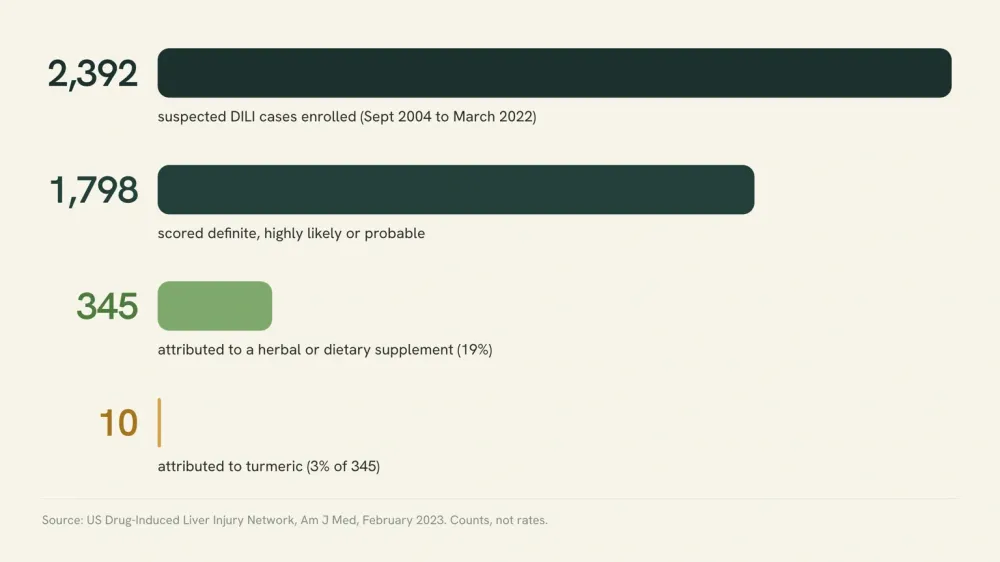
In February 2023 the American Journal of Medicine published ten cases of liver injury attributed to turmeric, from the US Drug-Induced Liver Injury Network. The network is a prospective, multicenter observational study funded by the National Institute of Diabetes and Digestive and Kidney Diseases and run through academic centers including Thomas Jefferson, Mount Sinai, Duke, the University of North Carolina, Michigan, Indiana and Vanderbilt. Its denominators matter more than its headline, so here they are in the paper's own order. Between September 2004 and March 2022 the network enrolled 2,392 suspected cases of drug-induced liver injury. It formally adjudicated 2,278 of them. It scored 1,798 as definite, highly likely or probable. Of those 1,798, it attributed 345 (19%) to a herbal or dietary supplement. And of those 345, it attributed 10, which is 3%, to turmeric. All ten enrolled in 2011 or later, and six of the ten since 2017.
Eight of the ten were women and two were men; nine were White and one was Black. The median age was 56, with a range of 35 to 71, and the median body mass index was 26.7. Seven used alcohol, none of them to excess, and none of the ten had underlying liver disease. Their stated reasons for taking turmeric were arthritis, pain relief, and general health or well-being. They had been taking it for a median of 86 days before the laboratory abnormality appeared, with a range of 38 to 429 days. Nine of the ten had symptoms, most often jaundice, nausea and abdominal pain; there was no fever and no rash, and itching was not prominent. Initial median ALT was 1,140 U/L, alkaline phosphatase 164 U/L and total bilirubin 2.5 mg/dL, with peak median bilirubin reaching 4.0 mg/dL. The injury was hepatocellular in nine of the ten and mixed in one. Five were hospitalized. One died of acute liver failure. Nobody needed a transplant, and none of the nine seen at five months or later had chronic liver injury.
The chemistry is the part that makes this a label story as much as a liver story. The network retrieved the actual product from 7 of the 10 patients and sent them to the National Center for Natural Products Research at the University of Mississippi to verify that the ingredients matched the product label and to search for contaminants and common hepatotoxins. Turmeric was confirmed in all seven. Black pepper was detected in three of those seven, and appeared on the label of a fourth product that could not be tested. No green tea, no Garcinia cambogia, no Polygonum multiflorum and no other common hepatotoxin turned up in any of them. All ten patients were also sequenced for HLA class I and class II genes, and seven carried the variant HLA-B*35:01, two of them homozygously, giving 9 of 20 alleles among the ten. The authors set that against published US allele frequencies of 0.056 in people of White European ancestry and 0.069 in Americans of African ancestry.
What the authors do not do is blame the black pepper. Their discussion notes that no cases of hepatotoxicity from piperine ingestion alone have been reported, which they say makes that possibility less likely, and then asks for studies of turmeric taken together with piperine. That is a request for research, not a result, and the two are easy to blur when you are summarizing. They apply the same discipline to their own genetics finding, writing that the small sample size of this case series limited the genetic analysis. And they refuse the growth claim their own title flirts with.
“The small number of cases and DILIN's non-population-based approach to enrollment limit confidence in a statement that the frequency of turmeric-associated liver injury is increasing in frequency.”
The most recent single description is a 2024 case letter in a Spanish gastroenterology journal, indexed as a case report rather than a study. A 35-year-old woman developed jaundice in December 2023 after taking an over-the-counter supplement tablet containing 60 mg of curcumin and 10 mg of black pepper, twice daily for two months, with the stated aim of recovering faster after CrossFit sessions. Her ALT was 2,230 U/L, AST 916 U/L, total bilirubin 10.5 mg/dL and direct bilirubin 8.0 mg/dL, with normal coagulation. Viral and autoimmune workups were unremarkable except that she was a carrier of HLA-B*35:01. Causality scored 8 points on the CIOMS and RUCAM scale, which reads as probable. She was advised to stop, her enzymes trended down, and three months later she was asymptomatic with normal liver enzymes. That is one person, described once. A case report is a description of what happened to somebody, and it is never a rate.
LiverTox grades turmeric A, and what that grade is not
LiverTox, the NIH's reference work on drug-induced liver injury, carries a chapter on turmeric that it last updated on 16 June 2025. Its likelihood-score line reads: A, recently established as a well-documented cause of clinically apparent liver injury. A is the top of that scale. In the same section the chapter says that turmeric appears to have become the most common cause of clinically apparent, herbal-related liver injury in the United States, and then, two sentences later, that the incidence of clinically apparent liver injury from turmeric is not known but is probably very rare, in the range of 1 in 10,000 to 1 in 100,000 persons exposed. Those two sentences are both true and neither of them travels alone. The second one is explicitly an estimate of something the chapter has just called unknown.
The chapter also describes the shape of the injury, which is the practically useful part. Onset runs from a few weeks to as long as eight months but is typically 1 to 4 months. Aminotransferases are often above 1000 U/L. Most cases resolved completely without evidence of chronic injury or bile duct loss. It records that cases have been described with unadulterated ground turmeric powder and even with turmeric herbal teas, so this is not purely a story about concentrated extracts, and it notes that means of increasing curcumin bioavailability using piperine or lipid nanoparticle delivery were subsequently linked to several cases of liver injury. Usually is not always: the fatal case in the network's series is in this same literature, and LiverTox's own outcome section states that reexposure to turmeric should be avoided, because recurrence and more severe liver injury can occur with rechallenge.
| LiverTox chapter | Last update on the chapter | Likelihood score | What that score means in the book's own words |
|---|---|---|---|
| Turmeric (NBK548561) | 16 June 2025 | A | Recently established as a well-documented cause of clinically apparent liver injury |
| Ashwagandha (NBK548536) | 3 December 2024 | B | Likely cause of clinically apparent liver injury |
| Cannabidiol (NBK548890) | 16 February 2023 | E* | Unproven but suspected rare cause of clinically apparent liver injury, particularly with high doses |
It is tempting to read those three rows as a scoreboard, and they are not one. The grade describes how well the published evidence establishes that a substance can cause liver injury, not how dangerous it is or how likely you are to be hurt by it, and our page on stacking a supplement with CBD works through that scale in detail rather than us restating it here. The comparison readers actually want, between turmeric's liver record and cannabidiol's, cannot be made cleanly in either direction, because the two records are not the same kind of document: cannabidiol's is led by randomized, placebo-controlled trials that have arms and a denominator and dose by milligram per kilogram, while turmeric's is an adjudicated case series with no population denominator at all, so the exposures, the denominators and the study designs differ on all three axes and cannot be ranked against each other. We keep everything hepatic about cannabidiol on its own page and publish no new analysis of it here. What survives the comparison is narrower and more durable than a verdict about either product: natural is not a safety category, and a substance you can buy in a grocery store can still have a chapter in this book.
The other side of the ledger
The USP expert committee review quoted at the top of this page did more than balance the ledger. Having read the case literature and the regulatory responses, it recommended adding a cautionary statement to the USP turmeric and curcuminoid monographs, and it wrote the statement out in full. It is worth reading as written, because it is a standards body's attempt to say the useful thing without saying either too much or too little, and because it is a recommendation rather than a US regulation.
“Liver problems have been reported very rarely in people taking supplements containing turmeric and/or curcuminoids. Consult your health-care practitioner before using this product if you have a history of liver problems. Stop using this product if you develop symptoms such as abdominal pain, dark urine, or jaundice (yellowing of the skin or eyes), and seek medical advice.”
The same review tabulates what regulators elsewhere already require, which is the context most US coverage of this topic leaves out. The United States is not on the list.
- European Medicines Agency: its herbal monograph advises that use is not recommended in bile duct obstruction, cholangitis, liver disease, gallstones and other biliary diseases.
- Australia's Therapeutic Goods Administration: required label text stating that in very rare cases Curcuma species or curcumin may harm the liver.
- The same Australian text then instructs users to stop and see a doctor for yellowing skin or eyes, or unusual fatigue, nausea, appetite loss, abdominal pain, dark urine or itching.
- Italy: the Ministry of Health made label warnings mandatory by decree of 26 July 2019 and strengthened them in 2022.
- Health Canada: reviewed 12 Canadian cases, all of which had confounding factors, alongside more than 60 international cases including 3 deaths, 2 of them attributed to turmeric-related hepatotoxicity.
- The same review states that spontaneous adverse-event databases cannot be used to determine incidence, prevalence or comparative risk, which is why none of the counts above is a rate.
And not everyone accepts that the signal is real. A 2021 review in Frontiers in Pharmacology is titled, with no ambiguity at all, Curcuma longa Hepatotoxicity: A Baseless Accusation. Its authors re-scored published cases using the RUCAM causality method and argued that it would be reasonable to speculate that the suspected toxicity of Curcuma longa could be due to the concomitant presence of piperine itself, and that human trials will be necessary to settle this dispute. Read it as a dated dissent rather than a rebuttal of the current record: it was published two years before the network's ten-case series appeared, and four years before the June 2025 update of the LiverTox chapter that carries the A grade. It also renders the 1998 result as a 20-fold increase in serum curcumin, which is a neat demonstration that 2000% and 20-fold are one number wearing two costumes, and that the costume changes how big it sounds.
Four questions to ask the other bottle
This is the part we can be most useful about, because it is the same work we ask you to do on our own products. The four questions we teach for a CBD label transfer to a turmeric label almost word for word, and in our reading most turmeric labels answer fewer of them. Run them in order, on whatever is in your cupboard.
- 1How much of this is curcuminoids and how much is turmeric root powder? LiverTox puts curcumin at 1% to 6% by dry weight of whole turmeric extracts. The USP committee puts curcuminoids at roughly 2% to 9% of turmeric, depending on origin.
- 2Is the extract standardized, and to what? The USP review says supplements typically use extracts standardized to at least 90% curcuminoids, at dosages up to 3,000 mg a day. Compare that target against the total capsule weight.
- 3Is there a bioavailability system in there, and at what inclusion rate? The published case records print real numbers: 5 mg of black pepper alongside 1,000 mg of curcumin in one, and 10 mg alongside 60 mg of curcumin twice daily in another.
- 4Did anyone independent test it, and for which analytes? A certificate of analysis is evidence about the things the laboratory measured, on the batch it measured, and about nothing else.
Question one is doing more work than it looks like. LiverTox and the USP committee give overlapping but different ranges (1% to 6% and roughly 2% to 9%), and they are describing slightly different things, so keep each range attached to the document it came from rather than fusing them. The practical consequence is the same either way: a label reading 1,000 mg turmeric and a label reading 1,000 mg curcuminoids can differ by more than an order of magnitude in the compound people are actually buying, and both are on shelves right now. LiverTox adds that commercial preparations of turmeric and curcumin vary widely in curcuminoid content and that the recommended daily dose varies widely, from 100 to more than 1,000 mg daily, which is a description of a market rather than a recommendation to anybody.
Question four is where the answers get thinnest. A 2023 method paper in Molecules checked commercial curcumin supplements by solid-state carbon-13 NMR, confirmed by X-ray powder diffraction and HPLC, and identified a product that contained synthetic curcumin instead of the genuine extract. That is one product in one method-development paper, not a market survey, and we are naming nothing. The better model to copy is the network's own procedure, described earlier: send the actual bottle to an independent natural-products laboratory and ask whether the contents match the label. That is what a certificate of analysis is supposed to be, and what third-party tested actually means explains how to tell a real one from a badge. One honest note specific to this category, which applies to products we do not sell and could just as easily apply to ours if we were careless: when a CBD-plus-turmeric product publishes a certificate, check whether the analyte list covers the turmeric at all, because a cannabinoid panel does not, and the turmeric half is then unverified by the very document the buyer is trusting. Read the analyte list before you read the numbers, and match the batch code on the certificate to the batch code on the bottle.
What research on CBD and turmeric together actually is
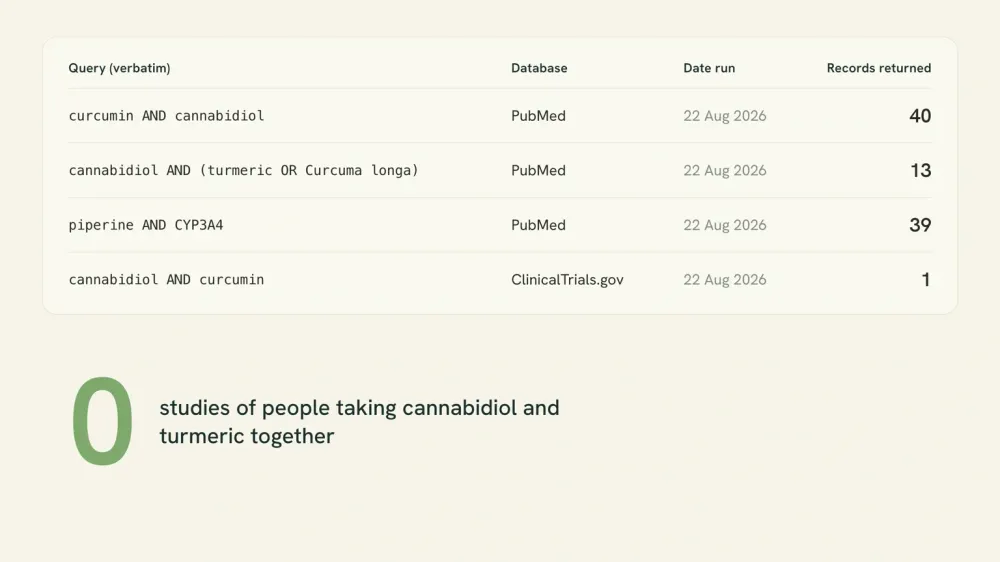
Here are the searches, with their dates, so you can rerun them rather than trusting us. On 22 August 2026 at 20:01 UTC we ran the query "curcumin AND cannabidiol" against PubMed and got 40 records. We resolved all 40 and read the abstract of every one that could plausibly have put both substances into the same experiment. Not one of them is a study of people taking cannabidiol and turmeric together. The set is mostly narrative and systematic reviews of natural products in neurodegeneration, epilepsy, stroke and cancer, molecular docking and other in silico work, nanoparticle and micelle formulation chemistry, and cell-line experiments. The same afternoon, the query "cannabidiol AND (turmeric OR Curcuma longa)" returned 13 records of the same character, and "piperine AND CYP3A4" returned 39, of which three are human studies and the rest are laboratory work, animal pharmacokinetics or modelling.
It is worth describing the four records that come closest, because how close they get is the actual finding. The one record in those 40 that puts all three substances in a single experiment is a 2023 in vitro study that gave CBD or CBG plus curcumin plus piperine to HCT116 and HT29 human colon adenocarcinoma cell lines, in dishes, and reported that the two cell lines gave divergent responses. The closest thing to an absorption finding is a 2017 preclinical rat study in which a piperine-containing lipid pre-concentrate raised oral CBD exposure about 6-fold against a CBD solution; that is rats, and it is one engineered formulation rather than two bottles taken together. The remaining two are surveys, one of people recalling what they took and one of dog owners recalling what they gave.
| Record | What it actually is | Distance from the question |
|---|---|---|
| PMID 37180710 (Front Pharmacol, 2023) | In vitro: two human colon adenocarcinoma cell lines given CBD or CBG plus curcumin plus piperine | Cells in a dish, and the authors report the two lines responding differently |
| PMID 28736128 (Eur J Pharm Sci, 2017) | Preclinical rat study: a piperine-containing lipid pre-concentrate versus a CBD solution | Rats, and an engineered formulation rather than two products taken together |
| PMID 29607695 (ALS FTD, 2018) | Human survey of self-reported ALS reversals, listing curcumin and cannabidiol among many substances | Both appear on a list of things people said they took. Not co-administration and not a measurement |
| PMID 32304175 (Vet Comp Oncol, 2020) | Online survey of 345 dog owners about CBD products, mushroom extracts and turmeric | Dogs, and their owners' recall of what they gave them |
The trials registry says the same thing from a different angle. Queried the same day for cannabidiol with curcumin, and again for cannabidiol with turmeric, it returned the same single record both times. That one study puts cannabidiol, turmeric and black pepper into the same capsule: an industry-sponsored exploratory investigation with 36 participants, a single group, no allocation and no masking, completed in June 2022, testing a softgel containing broad-spectrum hemp extract, a terpene complex, clove bud oil, black pepper berry essential oil and curcumin turmeric root essential oil. Its registered title names sleep, stress and focus, and its primary outcomes are questionnaire scores for stress and for mood. With no control arm and no blinding it cannot attribute anything to anything, and it is also a label-literacy exhibit in its own right: turmeric root essential oil is not a standardized curcuminoid extract, and the two are not interchangeable just because the same plant is named on both.
Who should talk to a pharmacist first
This page has not told you to take anything, to stop anything, or to shift anything by two hours, and it is not about to. There is no measured interval to recommend, no ratio and no amount, because nobody has run the study that would produce one. The action the evidence above genuinely supports is duller and more useful than any of that: tell a pharmacist what is in both bottles, by name and by amount, and let them check it against your medicine list. A pharmacist is the right professional for an over-the-counter supplement question, and they have the interaction databases open in front of them. Bring the actual labels or photographs of them, including the supplement facts panel, because the ingredient that matters here is often the one printed smallest.
One sentence of regulatory context, in NCCIH's words rather than ours, from the federal consumer summary on turmeric: unlike drugs, dietary supplements are not approved by the US Food and Drug Administration before they are sold to the public. Cannabidiol occupies its own peculiar spot in that framework, which is a whole subject and lives on how the FDA currently treats CBD. The same NCCIH page carries the two sentences that matter most here, and they belong together: conventionally formulated oral turmeric or curcumin that has not been modified to enhance bioavailability is likely safe in the recommended amounts for up to 2 or 3 months, and highly bioavailable formulations of curcumin, which enhance the body's ability to absorb the curcumin, may harm your liver. Note which half of the market that second sentence is about, and note that the enhancement it describes is usually piperine.
Some situations are not for a website to analyze at all, and the right move is to say so and point. If you take an anticoagulant or antiplatelet medicine, start with the page that handles bleeding risk properly and finish with your prescriber. If you have gallbladder or biliary disease, the European monograph quoted above already says use is not recommended, and that is a conversation with the clinician who manages it. If you have surgery scheduled, tell your prescriber and your surgical team everything you take, supplements included, and let them make the call. If you have existing liver disease of any kind, both bottles are a question for the clinician managing it and not for a comparison article. And there is one more overlap worth knowing about because it causes confusion rather than danger: NCCIH lists nausea, reflux, stomach upset, diarrhea and constipation among the reported effects of oral turmeric, which overlaps with what some people report from CBD and which we cover in why CBD sometimes upsets a stomach. Add a second bottle and you have two candidates for the same symptom and no way to tell them apart.
- Yellowing of the skin or of the whites of the eyes.
- Dark urine, or pale stools.
- Unusual fatigue, nausea or loss of appetite.
- Abdominal pain, particularly in the upper right side.
- Itching without a rash.
- NCCIH's own instruction for these symptoms, quoted: stop consuming turmeric or curcumin products immediately and talk with your health care provider.
Nobody has published a study that gave both to the same people, so no honest answer begins with yes or no. Run the search yourself: the PubMed query "curcumin AND cannabidiol" returned 40 records on 22 August 2026, and not one of them is a trial of the combination. What is documented is separate. Turmeric has an adjudicated liver-injury case series from the US Drug-Induced Liver Injury Network, and the black pepper extract in most turmeric capsules inhibits drug-metabolizing enzymes in laboratory assays. Neither of those tells you what happens when a particular person adds one bottle to another, because the variable that decides that is the rest of your medicine list. That makes it a pharmacist question, and it is the kind of question a conversation at the counter can settle.
The number is real and it is from 1998. A study in Planta Medica gave 2 g of curcumin with and without 20 mg of piperine and reported the increase in bioavailability as 2000%, without saying whether that was a peak concentration, a time to peak or a total exposure over time. Now read the sentence beside it: without piperine, serum curcumin was, in the paper's own words, either undetectable or very low. A 2000% increase over an undetectable quantity is a bigger undetectable quantity. The abstract does not report how many people were in the human arm, and the full text sits behind a publisher that blocked automated access when we tried on 22 August 2026, so the sample size is not something the people quoting the figure can check either. The 154% sometimes quoted alongside it is the rat arm of that same paper, at 2 g of curcumin per kilogram, and it is not a human number. Two independent human studies since 2023 measured what piperine adds and found nothing; the 2025 authors wrote in print that the addition of piperine is useless.
That question does not have a yes or a no, and anyone who hands you one is guessing. LiverTox, the NIH reference work on drug-induced liver injury, grades turmeric A, which it defines as recently established as a well-documented cause of clinically apparent liver injury, and says turmeric appears to have become the most common cause of clinically apparent herbal-related liver injury in the United States. In the same section it says the incidence is not known but is probably very rare, in the range of 1 in 10,000 to 1 in 100,000 persons exposed. Both sentences are true at once. The 2026 USP expert-committee review supplies the other half of the ledger: numerous clinical trials of turmeric and curcuminoid supplements have not reported organ toxicity or serious adverse events. The injury that has been described is usually hepatocellular, typically appears 1 to 4 months after starting, and usually resolves after stopping, with rare severe exceptions including one death among the ten cases in the network's series.
Nobody has measured it. What has been measured is what curcumin and piperine do to other drugs, which is a different sentence. In laboratory assays using human enzymes, in vitro, piperine inhibits CYP3A and P-glycoprotein, and curcuminoids inhibit a spread of enzymes including CYP2C19, CYP2C9 and the conjugation enzymes. In people the results disagree: a randomized crossover in eight volunteers found no meaningful change across three probe drugs, while a study in twenty volunteers found longer midazolam sedation after three days of piperine. In breast cancer patients, curcumin lowered exposure to tamoxifen's active metabolite by 7.7% over 24 hours, and adding piperine lowered it by 12.4%. Cannabidiol is handled by enzymes in the same family, which is why the question is a reasonable one to ask, and our page on CBD and medications explains that framework. Reasonable is not the same as measured, and nothing above involved cannabidiol.
Several sellers say to take turmeric in the morning and CBD about two hours later. We looked for a study behind that interval and did not find one, so we are not going to repeat it or invent a different one. No published research has measured the two together at any spacing, which means there is no interval to recommend and no evidence that spacing changes anything at all. It is also the wrong variable to be optimizing. If you take prescription medicine, what decides whether this combination matters is what else is on your list, not what time the capsule goes down. Take both labels to a pharmacist and spend the effort there instead.
It is a variant of a human leukocyte antigen gene, part of the machinery the immune system uses to identify what belongs in the body. In the ten-case series from the US Drug-Induced Liver Injury Network, seven of the ten patients carried it, two of them homozygously, which works out to 9 of 20 alleles; the authors set that against published US allele frequencies of 0.056 in people of White European ancestry and 0.069 in Americans of African ancestry. A 2024 case letter describes another carrier. The authors of the case series state plainly that the small sample size limited the genetic analysis. Nobody is recommending a consumer test, including us, and no such test appears in any of the turmeric labeling requirements the USP committee reviewed. Note also that the one patient in that series who died did not carry the allele, so carrying it is not the whole explanation and not carrying it is not protection.
Often it does not, and that is worth checking before you trust it. A certificate of analysis is evidence about the analytes a laboratory measured, on the batch it measured, and in this category the panel is usually a cannabinoid panel: CBD, the minor cannabinoids, THC, and depending on the product, pesticides, heavy metals and residual solvents. Curcuminoid content is a different assay on a different instrument. If it was not run, the certificate tells you nothing about how much curcumin is in the capsule, whether the extract matches what the label claims, or whether a black pepper extract is present and at what level. Read the analyte list first, then the numbers, then match the batch code on the certificate against the batch code printed on the bottle in your hand.
Writing about hemp, wellness and the small rituals that keep us balanced.