CBD and Kava: Two Liver Warnings, and No Study of the Pair
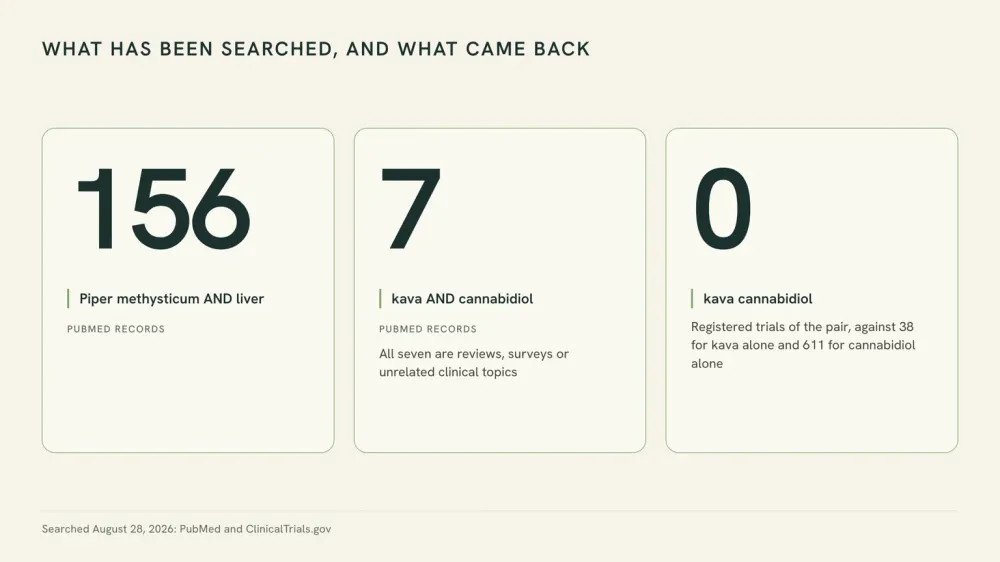
Two substances with their own liver warnings, sometimes sold in the same bottle. On August 28, 2026 PubMed returned 156 records for kava and the liver and 7 for kava with cannabidiol, and not one of the 7 gave both to a person. Absence of a study is not absence of a risk.
Kava and CBD share shelf space now, sometimes inside the same bottle, and most of the pages explaining how to take them together are published by companies that sell one of the two. Search kava vs CBD and you are offered a comparison; search CBD and kava and you are offered a how-to. Here is the short answer. Each substance has its own documented liver signal, each is described as sedating by a federal document, and as of August 28, 2026 there is no published study and no registered clinical trial that has given both to a human being and measured anything at all. That is a gap in the evidence, not a clean bill of health.
So the boundary, stated before anything else. This article will not tell you how to combine kava and cannabidiol, in what order, or how long to leave between them, because nothing has been published that an instruction like that could be built from. You will find no amount of either substance on this page, no interval and no schedule. What you will find is every document that does exist, with its date attached: a 2002 federal consumer advisory, a 2020 FDA toxicology memorandum, an NIH monograph, a 2026 CDC surveillance report, a European regulatory assessment, three human enzyme studies, and a set of literature searches printed with their queries so you can re-run them. This is education, not medical advice, and the only action it asks of you is to tell a clinician what you actually take.
What kava actually is, and what kava means on a US shelf
Kava is a plant, and the federal reference work on drug-induced liver injury describes it plainly. LiverTox, the NIH database of drug-induced liver injury, in a chapter last updated on April 10, 2018, says kava kava is an herbal derived from roots of the plant Piper methysticum, the intoxicating pepper plant, a member of the pepper family found in the Western and South Pacific. It is prepared from the roots of the plant, which are ground into a fine pulp to which water is added. The active ingredients, the monograph says, are kavapyrones or kavalactones, which have effects similar to alcohol, such as relaxation, talkativeness and euphoria. That is the traditional article: a root, water, and a drink shared socially.
The chemistry matters more than it sounds, and the most detailed federal account of it is not a web page. On August 11, 2020, FDA's Center for Food Safety and Applied Nutrition put a toxicology memorandum on kava on the record, reviewing more than 800 publications up to July 2020. It counts eighteen kavalactones isolated and identified from kava root extract, of which six (kavain, dihydrokavain, methysticin, dihydromethysticin, yangonin and desmethoxyyangonin) account for approximately 95 to 96% of the total kavalactones in the lipid resin. It notes that dried rootstock runs 3 to 20% kavalactones depending on the age of the plant and the cultivar. And it states the line that the whole liver argument turns on: in general, kavalactones have low water solubility.
Low water solubility is why the solvent changes the product. A 2026 laboratory study, a validated chromatography comparison of aqueous and ethanol kava extracts made from the same biomass, reported distinct profiles for the two: dihydrokavain alone constituted over 67% of the kavalactone content of the water extract, while the ethanol extract was enriched in methysticin and yangonin. Read that narrowly. It is a chemistry finding in human liver cells and enzyme assays, not in a person, and the paper's own position is that whether the enzyme changes it measured are clinically meaningful is unresolved. It is also not a safety ranking, which is the sentence that has to follow every extraction paragraph ever written about kava. NIH's National Center for Complementary and Integrative Health, on a page last updated in April 2025, puts it this way: the first reported cases involved medicinal or dietary supplement products that had been extracted with alcohol or acetone, but other cases have involved kava beverages prepared with water.
So when a US label says kava, it can mean several quite different products, and the surveillance and survey literature describes the range.
- A traditional aqueous preparation. Ground root, water, and a drink, which is the classical article LiverTox describes in its April 2018 chapter.
- Capsules, tinctures and standardized extracts. FDA's 2020 memorandum says commercially available kava formulations have been primarily ethanol, methanol or acetone extracts, standardized to a specified kavalactone content.
- Concentrated shots and tonics. The CDC's April 2026 kava report describes commercial products as unregulated and says kavalactones can be present at two to ten times the concentrations found in traditional preparations.
- Blends. The 2026 survey literature describes concentrated kava products sold online and in convenience stores in liquid shots or tonics, sometimes blended with other psychoactive botanicals, and it names CBD and kratom as examples.
- Kava bars and ethnobotanical tea rooms. In the 2026 survey described just below, 31.7% of the respondents with lifetime kava use said they bought kava at an ethnobotanical tea bar and 40.6% bought it online.
The two substances are not strangers to each other in practice, which is the reason this page exists at all. In a cross-sectional survey of 368 adults recruited through digital flyers, Reddit and X between December 2023 and July 2024, 180 reported lifetime kava use, and of those 180, 72.2% also reported having used CBD at some point. Every qualifier in that sentence is load-bearing. It is lifetime use, self-reported, in a convenience sample of adults who already use psychoactive botanicals, so it is not a population prevalence, and the authors say plainly in their discussion that it is unclear the extent to which kava was concurrently used in real-time with other substances. It tells you the pairing is common enough to deserve an honest page. It does not tell you that anybody took the two at the same moment.
The liver warnings, in the documents that created them
The document everyone gestures at is real, it is specific, and FDA no longer hosts it. On March 25, 2002 the agency issued a consumer advisory titled Kava-Containing Dietary Supplements May be Associated With Severe Liver Injury. Both of the paths where it used to live now return 404, so we read the full text from an Internet Archive snapshot of FDA's retired food-safety site on August 28, 2026, and its title and date are independently confirmed inside two later federal documents, the 2020 memorandum above and the 2026 CDC report below. The advisory says FDA is advising consumers of the potential risk of severe liver injury associated with the use of kava-containing dietary supplements. It records that kava-containing products have been associated with liver-related injuries including hepatitis, cirrhosis and liver failure in over 25 reports of adverse events in other countries, that four patients required liver transplants, and that in the United States FDA had received a report of a previously healthy young female who required liver transplantation. It names the regulators then acting: Germany, Switzerland, France, Canada and the United Kingdom. And in the same passage it says that although liver damage appears to be rare, FDA believes consumers should be informed of this potential risk. Both of those halves are the document, and a page that prints one without the other is not quoting it.
One sentence in that 2002 advisory matters more on this page than anywhere else it gets quoted. Persons who have liver disease or liver problems, or persons who are taking drug products that can affect the liver, should consult a physician before using kava-containing supplements. Hold that thought for two sections.
The case series behind the advisory has its own federal write-up, and it is worth reading for the size of the numbers rather than the drama of them. CDC's report of November 29, 2002 on hepatic toxicity possibly associated with kava-containing products in the United States, Germany and Switzerland counted a total of 11 patients who used kava products, had liver failure and underwent subsequent liver transplantation, and it records that FDA issued its consumer advisory in response to five such case reports, four in Europe and one in the United States. Note the word in the title: possibly. These are case reports and a suspected association, not established causation, and eleven is eleven.
LiverTox is where that record gets graded. It gives kava a likelihood score of A, which it defines as a well known cause of clinically apparent liver injury. What an A grade is and is not is already worked through on our page about CBD taken alongside turmeric, which carries the same grade, and this article will not re-derive it. What the kava chapter adds is shape. Between 50 and 100 cases of clinically apparent liver injury have been published or discussed in the literature. Patients typically present with fatigue, nausea, elevations in serum aminotransferase levels and jaundice 2 to 24 weeks after starting use of the product. The pattern of enzyme elevations is hepatocellular, and in most instances the injury subsides within 1 to 3 months of stopping the herbal product. Then the monograph prints two sentences that have to travel together, and almost never do: the estimated frequency of clinically apparent liver injury due to kava is less than 1 in 1,000,000 daily doses, and spontaneous reporting is believed to capture less than 1% of severe adverse events from the use of dietary supplements. A frequency estimate built on a reporting system that catches under one event in a hundred is a floor, not a measurement. And the chapter prints the counterweight too: advocates of the herbal have strongly rejected these numbers, disputing both their accuracy and the causality assessment process.
The largest case review sits inside the FDA memorandum rather than in a paper of its own. The memo summarizes a World Health Organization review of 93 case reports of presumed kava-related hepatotoxicity, in which 79% of cases involved women with an average age of 45, 7 patients died and 14 received liver transplants, with 8 cases assessed as probable associations and 53 as possible. The memo lists WHO's risk-factor conclusions, which include the use of organic extracts, excessive dose, heavy alcohol intake, pre-existing liver disease and genetic polymorphisms of cytochrome P450 enzymes, and it records a nonrandom effect indicated by a higher rate for the organic extracts than for synthetic products. Note where all of that arrived from: this is FDA's 2020 rendering of a WHO review of case reports, most of them graded possible rather than probable, and none of them involving cannabidiol. And read the extraction contrast inside that risk-factor list the way NIH reads it, because this is the half that gets dropped: the first reported cases involved products extracted with alcohol or acetone, but other cases have involved kava beverages prepared with water.
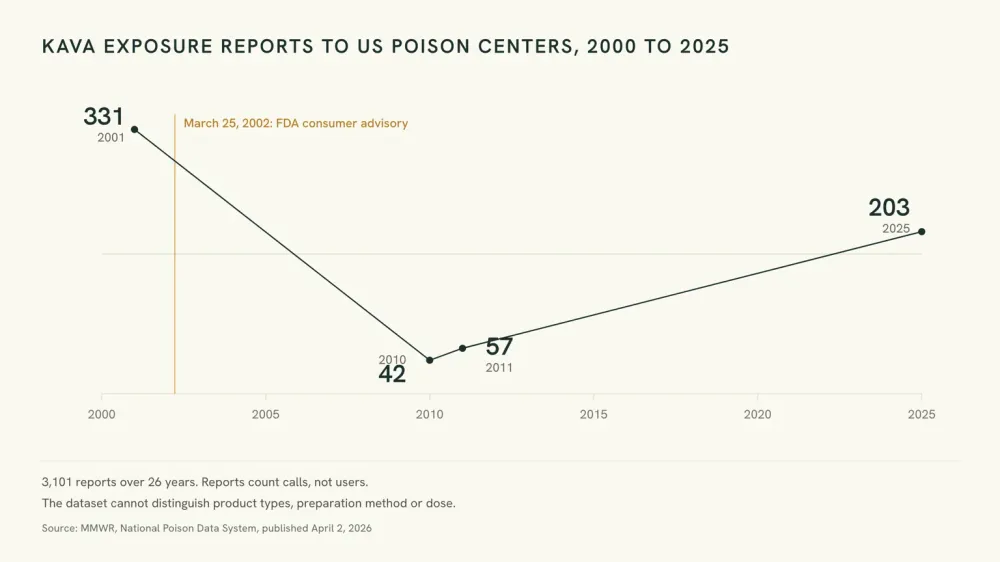
Those figures come from the CDC's April 2, 2026 analysis of 26 years of kava exposure reports to US poison centers, published in MMWR. The shape inside them is the interesting part. The 2002 advisory is visible in the data as an 87% collapse in reports over the following decade, and the rise since 2011 has come with worse outcomes: serious medical outcomes went from 12% of reports in 2000 to a high of 39% in 2024 and 32% in 2025. Among the 1,754 single-substance kava exposures, the effects recorded were gastrointestinal, neurologic (drowsiness or lethargy, dizziness, agitation) and cardiovascular (tachycardia), and moderate elevation of AST or ALT appeared in 29 of them, which is 1.7%. Now the limits, in the report's own words. Reporting to poison centers is voluntary. NPDS generic codes do not permit distinction among product types, so it was not possible to capture information on product type, including preparation method or dose. A poison-center report is a phone call, not a diagnosis and not a count of users. And one more thing, which we checked ourselves: cannabidiol appears nowhere in that report. Absence from a dataset that never looked for something is not a finding about it.
CBD's own side of the ledger, in one paragraph
Kava is not the only substance in this question with a hepatic record, and it would be dishonest to write a liver page about a pair and look at only one of them. The prescribing information for the FDA-approved cannabidiol drug, which we re-read at DailyMed on August 28, 2026 (structured label version 35, effective May 29, 2026), carries a hepatic injury section stating that the drug can cause dose-related elevations of liver transaminases, with ALT above three times the upper limit of normal in 13% of treated patients at 10 and 20 milligrams per kilogram per day against 1% of patients on placebo. Hold that number to its context: it describes a prescription medicine given to people with severe epilepsy, most of them taking other antiseizure drugs, at 10 to 25 milligrams per kilogram per day under medical supervision, which is not a consumer tincture in either direction. The full reading of CBD's own hepatic evidence, including the animal work, the human trials and the four expert bodies that publish four different daily limits, lives on our page asking whether CBD is bad for your liver, and this page will not rebuild it. If cannabidiol itself is new to you, start with what CBD actually is.
Kava vs CBD: what has actually been measured about the two together
This is the part nobody on this search result publishes, and because a claim about an entire literature should be reproducible, every search below is printed with its query, its database and its date. All of them were run on August 28, 2026, PubMed through NCBI E-utilities and the registry through the ClinicalTrials.gov API.
| Search | Database | Records on August 28, 2026 | What it tells you |
|---|---|---|---|
| Piper methysticum AND liver | PubMed | 156 | Kava's liver literature is large, decades old and still growing |
| kava AND hepatotoxicity | PubMed | 114 | The narrower hepatotoxicity slice of that same literature |
| kava AND cannabidiol | PubMed | 7 | All seven resolved and named below. Every one is a review, a survey or an unrelated clinical topic, and none gives both substances to a person |
| (kava OR kavalactone OR "Piper methysticum") AND (cannabidiol OR CBD) | PubMed | 9 | Adds two further reviews. Same conclusion |
| (kava OR "Piper methysticum") AND (cannabis OR cannabinoid OR cannabidiol) | PubMed | 35 | The widest sensible net. All 35 resolved, and not one is a co-administration study of the pair |
| The same search restricted to human studies | PubMed | 28 | Restricting to humans does not produce one either |
| kavalactone AND cytochrome P450 | PubMed | 17 | The enzyme layer, and almost all of it is in vitro |
| kava cannabidiol, and three other phrasings | ClinicalTrials.gov | 0 | No registered trial of the pair under any phrasing we tried |
| kava, as a control | ClinicalTrials.gov | 38 | Proof the zero above is not a broken query |
| cannabidiol, as a control | ClinicalTrials.gov | 611 | The same proof from the other direction |
A count with nothing behind it is not evidence, so here are all seven records by what they are. Three are reviews of pharmacotherapy for anxiety disorders (Med Lett Drugs Ther 2023, Front Psychiatry 2020, BMC Psychiatry 2020). One is a systematic review of cannabis as anxiogenic or anxiolytic (J Transl Med 2020). One is a systematic review of chronic cannabis use and exercise performance (J Cannabis Res 2020). One is a review titled Beyond Cannabis: Plants and the Endocannabinoid System (Trends Pharmacol Sci 2016). And one is a kratom motivations survey of 5,152 valid responses (Am J Drug Alcohol Abuse 2022) that names kava and cannabidiol in a single list of things people report taking before or alongside kratom. Widen the query and the two records it adds are a cannabis and endometriosis survey (PLoS One 2021) and a review of plant-based medicines for anxiety (CNS Drugs 2013). Every one of the nine is a review, a survey or an unrelated clinical topic. Not one of them gave both substances to a person and measured anything. That is the licensed statement on this page, and it is licensed by a printed, dated, reproducible set of searches rather than by a superlative. It is a statement about what has been looked at, and nothing more.
The registry agrees, and the controls show the zero is real rather than a typing error: kava alone returns 38 studies and cannabidiol alone returns 611, while all four phrasings of the pair return nothing. There is exactly one registered human study putting kava together with anything, and it deserves to be named precisely. NCT07583407 is a pharmacokinetic study in 18 healthy adults that started on May 4, 2026 and was still recruiting when we read the record on August 28, 2026. Its partner substance is kratom, not CBD. Its lead sponsor is Botanic Tonics, LLC, an industry sponsor, and its arms are named formulations of the sponsor's own kava-and-kratom tonic. No results have been posted. The record also disagrees with itself: the structured design field reads PARALLEL while the official title describes a randomized, double-blind, three-period crossover study, and we are not going to quietly pick one for you. The kratom half of all this belongs to our page on CBD and kratom. The point here is smaller and sharper. A commercial sponsor is paying to measure kava with kratom, and nobody, commercial or academic, has registered kava with cannabidiol.
The different-systems reassurance is not a finding
The most repeated reassurance on this search result runs roughly like this: kava works on GABA and CBD works on the endocannabinoid system, so they act on different systems and you are not doubling down on the same pathway. It is a tidy sentence with no citation attached, and the preclinical pharmacology does not support it in either direction. In 2012, a paper titled Kavalactones and the endocannabinoid system: the plant-derived yangonin is a novel CB1 receptor ligand tested five natural kavalactones and nine synthesized analogues against human recombinant receptors in vitro. Only yangonin showed affinity for the human recombinant CB1 receptor, with a Ki of 0.72 micromolar and selectivity against CB2, where the Ki was above 10 micromolar; none of the compounds strongly inhibited the two endocannabinoid-degrading enzymes tested. The authors' own conclusion is carefully hedged, and it is worth carrying over intact: the affinity suggests that the endocannabinoid system might contribute to the complex human psychopharmacology of the traditional kava drink. That is receptors in a dish, and one kavalactone out of the six that do almost all the work.
There is a second report in the same direction, and it is further from a person rather than closer. A 2026 study in ovariectomized mice describes desmethoxyyangonin, another of those six kavalactones, as a cannabinoid receptor 2 agonist, with its effects on bone-forming and bone-resorbing cells abolished by a CB2 antagonist, which the authors read as CB2-mediated action. Mice, cell culture and a bone-density model: nothing about the liver, nothing about sedation, nothing about cannabidiol. Put the two papers together and the honest conclusion is narrow and it is the sharpest sentence on this page. This is not evidence that kava and CBD interact in people. It is evidence that the tidy separate-pathways story is unmeasured too, and that neither side of this argument has the measurement.
The enzyme layer behaves the same way, and it is the layer most often quoted backwards. In test tubes, kava inhibits a long list of drug-metabolizing enzymes. FDA's 2020 memorandum summarizes that work: a whole organic kava extract normalized to 100 micromolar kavalactones inhibited CYP2C9, CYP2C19 and CYP3A4 most markedly, by 78 to 92%, with significant decreases in the activities of CYP1A2 (56%), CYP2D6 (73%) and CYP4A9/11 (65%). Individual kavalactones tested at 10 micromolar varied, with methysticin and dihydromethysticin most potent while kavain did not inhibit these enzymes at all, and a second group reported methysticin, desmethoxyyangonin and yangonin as potent inhibitors of several isoforms. Across the three preparations one of those groups tested, the memo records that the aqueous extract was the least potent. Every one of those figures is a bath concentration in human liver microsomes or in hepatocytes, and none of them is a person.
Three times, somebody put probe drugs into human beings around kava, and the three answers do not agree with each other. In a 2005 study in 12 healthy volunteers given a kava kava extract for 28 days alongside a midazolam, caffeine, chlorzoxazone and debrisoquine cocktail, kava produced significant reductions of approximately 40% in CYP2E1 only. In a 2005 research letter titled Traditional aqueous kava extracts inhibit cytochrome P450 1A2 in humans, six regular consumers of traditional water-based kava in New Caledonia were phenotyped with five probe drugs during kava drinking and again after 30 days of abstinence; as FDA's memorandum renders that work, the finding was inhibition of CYP1A2 with no effect on the phenotypic markers of CYP2C19, 2D6, 2E1 or 3A4. And a later study in 16 volunteers over 14 days found significant CYP2D6 inhibition for goldenseal but not for the other extracts it tested, kava among them. Twelve people, six people, sixteen people, three different preparations, three different answers. None of the three involved cannabidiol.
LiverTox draws the whole enzyme section together in a single sentence: although in vitro studies suggest that kavalactones inhibit several cytochrome P450 isoenzymes, human studies suggest that it is an inhibitor of CYP2E1 alone, and that its effects are modest. Read that carefully, because it is exactly where an article like this one can go wrong. Neither CYP2E1 nor CYP1A2 is the route cannabidiol is principally handled by, and that is not a reassurance, because nobody has measured the two together in a person. A narrower enzyme footprint than the test tubes predicted changes what you would expect to happen; it does not tell you what does happen, and no study has looked. How enzyme interactions work at all, and which medicines the question genuinely applies to, belongs to our hub on CBD and prescription medications. This page names the isoforms and stops there.
The sedation question, as behavior rather than mechanism
Both substances are described as sedating, and the useful evidence here is behavioral rather than mechanistic, because behavior is what has actually been counted. The strongest single measurement is a population-based case-control study of road traffic injuries in Fiji, published in 2016, which compared drivers of crash vehicles with drivers of control vehicles. 23% of case drivers and 4% of control drivers reported consuming kava in the 12 hours before, and driving following kava use was associated with a four-fold increase in the odds of crash involvement: an odds ratio of 4.70 with a 95% confidence interval of 1.90 to 11.63, and a population attributable risk of 18.37%. The scope is exactly what it says. Fiji, traditional kava drinking, self-reported exposure, one country, one road network, and nothing about any combination. The same authors report that, acknowledging limited statistical power, they did not find a significant interaction with concurrent alcohol use, and they label that null result underpowered themselves.
Read it next to what came a year earlier, because the pair shows you an evidence base while it is still forming. A 2015 systematic review by the same group, searching to August 2014, found no studies quantifying the effects of kava on motor vehicle crashes or related injury. What it found instead were four experimental studies using computer-based driving simulation, no statistically significant adverse changes attributable to kava, weak evidence of slowed reaction time, and one study in which visuo-motor performance on driving simulation was significantly impaired when kava was consumed with alcohol. Its conclusion was that the contribution of kava to crashes was unknown. The following year the case-control study measured four-fold odds. Neither result cancels the other. The second one is what the first asked for, and that is what a forming evidence base looks like from the inside.
US forensic toxicologists have documented the same thing case by case, and the laboratory detail in their report answers a question people ask separately. A 2019 series of four Iowa drivers evaluated by Drug Recognition Experts after self-reported kava use records that the subjects' urine screened negative for common drugs of abuse by immunoassay analysis, that kavalactones were only found when two of the samples were run on liquid chromatography-tandem mass spectrometry and gas chromatography-mass spectrometry, and that the subjects exhibited poor driving behavior and signs of intoxication. The authors conclude that consumption of kava can hinder one's ability to operate a vehicle safely. Four cases is a case series, not a rate. It also means a routine negative screen after kava tells you nothing about impairment, which is a different question from whether CBD products can affect a workplace test, and that one has its own page.
Now the two federal documents that describe the same shape of risk and never mention each other. NCCIH's kava page says kava should not be used together with other substances that have sedative effects, such as benzodiazepines or alcohol, and that if you take any type of medicine you should talk with your health care provider before using kava or other herbal products. The FDA-approved cannabidiol label's somnolence and sedation section reports somnolence and sedation in 32% of treated patients against 11% on placebo in its controlled studies, and says that other CNS depressants, including alcohol, could potentiate the somnolence and sedation effect. NCCIH's list does not name CBD. The label does not name kava. Two federal documents, one shape of risk, and this particular pair appears in neither of them.
- Driving is the one place kava alone has a measured population signal, and it is a four-fold increase in crash odds in one country's case-control study, not a US figure.
- Standard drug-of-abuse immunoassays do not look for kavalactones, so a negative screen after kava says nothing at all about whether someone is impaired.
- Both substances are described as sedating by a federal document, and neither of those documents has ever been asked about the other one.
- The mechanism of combining sedating things is not this page's subject. It has its own page, and so does alcohol, and both are linked in the paragraph directly below this list.
Those three routes, in order: the general framework for combining sedating substances is worked through on the page on CBD alongside muscle relaxers, ethanol has its own page, and drowsiness as a reported effect of CBD itself sits with the side effects CBD itself reports. This section stays on behavior on purpose, because behavior is the part that has been counted.
Where the regulators landed, and when
Kava's regulatory status has moved at least three times in twenty years, in more than one country, and almost every summary online freezes it at whichever moment suits the summary. So every row below carries its own date and its own limit, and the third column is there because the limits are where the errors live.
| Date | What happened | What it does not mean |
|---|---|---|
| March 25, 2002 | FDA issued a consumer advisory that kava-containing dietary supplements may be associated with severe liver injury, citing over 25 foreign adverse-event reports and four transplants | Not a ban and not an enforcement action. Kava remained on sale, and the same advisory says liver damage appears to be rare |
| 2002 onward | Medicinal products were withdrawn from national markets in the Czech Republic, France, Spain, the UK, Hungary and Portugal, and Germany's BfArM revoked marketing authorizations, as recorded by EMA in 2017 | Six national actions in Europe, dated 2002. They say nothing about US law and they were not the end of the story |
| November 29, 2002 | CDC counted 11 patients who used kava products, had liver failure and received a transplant, and recorded that FDA acted on five case reports | Case reports and a possible association, in CDC's own word. Not established causation, and small numbers |
| 2015 | German administrative courts cancelled the 2002 revocation for the ethanolic preparations, a decision EMA records in its own assessment and which researchers who dispute the regulatory case reported the same year | A court ruling on the regulator's reasoning. It is not a finding that kava is safe, and it did not cover every preparation |
| November 21, 2017 | EMA's herbal committee concluded that an EU herbal monograph for Piperis methystici rhizoma cannot be established, the benefit-risk balance for oral use in anxiety disorders being unfavourable | A European scientific assessment of kava medicines. It is not a US position and not a statement about cannabidiol |
| 2019 | A renewed German ban on kava extract preparations as herbal medicinal products, reported in a 2021 peer-reviewed paper | Reported by researchers who publicly dispute the regulatory case. We did not confirm it at the German regulator |
| August 11, 2020 | FDA's food-additive office concluded there is no basis to consider kava GRAS in conventional foods, making it an unapproved food additive when used that way | About conventional foods and drinks, not dietary supplements. FDA did not ban kava, and it is still sold in the US as a supplement |
| October 2016, as cited in that memo | Australia restricts kava in registered products to water-based extracts and caps the daily kavalactone content | A foreign restriction built on the extraction distinction. It is not a US rule, and water preparations are not absent from the case record |
| April 2, 2026 | CDC published an analysis of 3,101 kava-related reports to US poison centers over 2000 to 2025, naming ethanol, benzodiazepines and kratom as co-involved substances | Poison-center reports count calls, not users, and do not establish causation. The dataset cannot distinguish product types at all |
| As of our read, August 28, 2026 | Kava is not controlled or scheduled under the Controlled Substances Act, per the regulatory statement in a 2026 peer-reviewed survey paper | A journal's characterization, not a DEA document. State and local rules vary and this page does not try to list them |
Three of those rows deserve a sentence of their own. The European history is not a rumor: the European Medicines Agency's herbal committee published its final assessment report on Piper methysticum rhizoma on 21 November 2017, and it records that the medicinal products were withdrawn from EU national markets since 2002 based on safety concerns, that Germany's BfArM also revoked in 2002 the market authorizations for kava-containing products, and that a court decision from 2015 cancelled the revocation of marketing authorizations for the ethanolic preparations. Researchers who dispute the regulatory case against kava reported that ruling in 2015, writing that two German administrative courts decided the regulator's ban was inappropriate as a consumer-safety measure and that the ruling could be considered final for the German market, with no further appeal pursued. The same group reported in 2021 that preparations of kava extract as herbal medicinal drugs were banned in Germany in 2002 and again in 2019. Read both papers for what they are: peer-reviewed work by authors who argue the regulatory case against kava was unjustified, not neutral reporting. The 2019 re-ban is their statement, and we did not independently confirm it at the German regulator.
On the US side, the sentence to be careful with is the one about FDA. Its 2020 memorandum concludes that there is enough toxicological data demonstrating that indiscriminate use of kava as a recreational or relaxation beverage is not safe for human consumption, and that there is no basis to conclude that the use of kava as an ingredient in conventional foods is generally recognized as safe, so the office considers kava an unapproved food additive when used as an ingredient in conventional foods. That is a statement about foods and drinks. It is not a ban, and kava is still sold in the United States as a dietary supplement. The 2026 survey paper quoted earlier supplies the other half: kava is not controlled or scheduled under the Controlled Substances Act by the DEA, and may be considered by FDA to be an old dietary ingredient. State and local rules vary and this page does not try to list them. Australia sits at the other end of the same argument, and FDA's memorandum records it: registered kava products there are limited to water-based extracts, with a cap on the daily kavalactone content. Which is where the NIH sentence has to come back one more time, because the same NCCIH page that describes those first cases as alcohol or acetone extracts also says other cases have involved kava beverages prepared with water. Extraction changes the chemistry. It does not close the question.

What a certificate of analysis can and cannot settle here
A reader who has learned to check a lab report will want to check one here, and the honest answer is that a certificate settles less than you would like and considerably more than nothing. Start with what is measurable about kava products. A 2022 analysis of 28 commercial kava products, covering capsules, tinctures, traditional aqueous suspensions and dried powders, quantified six kavalactones and two flavokavains in each one. It found great variation in the total and relative abundance of the analyzed kavalactones and flavokavains across the preparations, and, more importantly for anybody standing in front of a shelf, that the kavalactone abundance in the product label could differ up to 90% from the experimental measurements. Its authors conclude that more rigorous and comprehensive quality control of kava products is required. That is 28 products, one laboratory, one time point, and up to 90% is the far end of a range rather than a typical error.
The CBD aisle has its own version of the same problem, and it would be dishonest to print one number and not the other. In a 2017 JAMA analysis of 84 CBD products sold online by 31 companies, only 30.95% were accurately labeled, meaning within 90 to 110% of the stated cannabinoid content; 42.85% contained more CBD than the label said and 26.19% contained less, and THC was detected in 18 of the 84. That is a 2017 online sample and the market has changed since, but the lesson transfers cleanly in both directions: neither aisle can be trusted on a label alone, and any page comparing the two substances by their label figures is comparing two numbers that have both been measured wrong at scale.
- A certificate of analysis tells you what one laboratory found in one batch of one product. That is real information, and most kava products on a US shelf do not come with one.
- It cannot tell you what two products do together, because no laboratory has tested this pair and no assay exists for the question. A clean batch report and an unmeasured combination are two different facts.
- It can settle the number you are being sold. Our own tinctures print 15,000 mg of CBD in a 60 mL bottle, which is 250 mg/mL, because a third-party laboratory measured that batch and the report is public.
- At roughly 0.05 mL per drop that works out to about 12.5 mg of CBD per drop, and drop size varies by dropper and by technique. Those are concentrations, not a suggested amount, and this page suggests no amount of anything.
- Ask a kava bottle the same four questions you would ask a CBD bottle: which batch, tested by whom, measuring what, and can you see the report. Most of the time you will not get four answers.
If certificates are new to you, how to read a certificate of analysis line by line covers the mechanics and what third-party tested actually certifies covers the scope, which is the part most people get wrong. Neither of them, and nothing else on this site, can tell you what happens when two substances meet in one person. That is what a study is for, and for this pair there is not one, which is a gap in the evidence rather than a clearance.
Red flags, and what to tell a clinician
Two honest sentences before the list. This page cannot tell you what your risk is, because the study that would answer that has never been run. What it can do is hand you the symptom list a federal advisory printed and the timeline a federal monograph printed, so that you can recognize something worth a phone call rather than a search box.
- Jaundice, meaning yellowing of the skin or the whites of the eyes, and brown urine. Those are the two signs FDA's 2002 advisory names first, and they are the ones that should not wait.
- The advisory's non-specific list, in its own order: nausea, vomiting, light-colored stools, unusual tiredness, weakness, stomach or abdominal pain, and loss of appetite.
- Time is not reassurance. LiverTox reports that patients typically present 2 to 24 weeks after starting the product, so I have been taking it for months is not a reason to rule it out.
- Unusual drowsiness, dizziness or confusion, particularly before driving or operating anything. That is the one behavior with a measured population signal for kava on its own.
- Anything frightening, at any hour: in the United States, Poison Control is 1-800-222-1222, free and staffed 24 hours a day. If someone is hard to wake or breathing slowly, call 911.
Who is telling you this, and what we could not check
An article that spends this long on what other people did not check owes you its own list, so here is everything we could not verify, as of August 28, 2026. Two automated consumer interaction databases carry an entry for this pair, and both refused every request we made: we could not read either page, so this article does not quote them, does not repeat the severity grade a search summary attributed to them, and does not link them. FDA no longer hosts its own 2002 kava advisory at a live address, and both current paths return 404, so the text we quote comes from an Internet Archive snapshot, corroborated by two later federal documents that cite the advisory by its title and date. The 2019 German re-ban is reported by researchers who publicly dispute the regulatory case against kava, and we did not confirm it at the German regulator. The CDC's poison-center dataset states in its own limitations that its codes cannot distinguish product types, so nothing in it separates a water preparation from a concentrated extract. The registry record for the one relevant registered study contradicts itself between a structured field and its own title, and we printed both rather than choosing. And the instructional pages ranking for this question are, with few exceptions, published by companies that sell one of the two substances, which is a fact about incentives rather than an accusation about any particular page. It is also why this article names documents and dates instead of naming sites.
Nobody knows, and that is the accurate answer rather than a dodge. On August 28, 2026, PubMed returned 7 records that mention kava and cannabidiol in the same paper, and every one of them is a review, a survey or an unrelated clinical topic; not one gave both substances to a person. ClinicalTrials.gov returned zero registered trials of the pair under four phrasings, against 38 studies for kava alone and 611 for cannabidiol alone, so the zero is real rather than a broken search. What is documented is separate: each substance has its own hepatic record and each is described as sedating by a federal document, and neither of those documents names the other substance. Absence of a study is not absence of a risk, and a page telling you the combination is fine is telling you something no one has measured.
There is no head-to-head measurement to quote, so this page does not rank them and makes no claim that either substance relieves anxiety. Human evidence is limited and mixed on both sides, and they have never been compared in the same people. What is on the regulatory record runs in one direction only: on 21 November 2017 the European Medicines Agency's herbal committee concluded that an EU herbal monograph for kava could not be established, the benefit-risk balance for oral use in anxiety disorders being unfavourable. That is a 2017 European assessment of kava medicines. It is not a statement about cannabidiol, it is not a US position, and it is not a reason to substitute one substance for another, which is a decision for a clinician rather than a search result.
Nobody has compared them head to head in people, so there is no measurement to quote. They are not even described in the same units: kava products are characterized by kavalactone content and CBD products by milligrams of cannabidiol, and both aisles have documented label-accuracy problems. A 2022 analysis of 28 commercial kava products found that label figures could differ from measured content by as much as 90%, and a 2017 JAMA analysis of 84 CBD products found only 30.95% accurately labeled. Add the fact that commercial kava products have been described by CDC as carrying kavalactones at two to ten times the concentration of a traditional preparation, and stronger stops being a question a label can answer in either aisle.
As of our read on August 28, 2026, kava is not controlled or scheduled under the Controlled Substances Act, and it is sold in the United States as a dietary supplement. In a memorandum dated August 11, 2020, FDA's food-additive office concluded that there is no basis to consider kava generally recognized as safe in conventional foods, which makes it an unapproved food additive when used that way. That is a statement about foods and drinks rather than about supplements, and it is not a ban: FDA did not ban kava. State and local rules vary, they change, and this page does not try to list them.
It was restricted, then partly unrestricted, then reportedly restricted again, and every one of those steps has a date. Products were withdrawn from six named EU national markets from 2002, the Czech Republic, France, Spain, the UK, Hungary and Portugal, and Germany's regulator revoked marketing authorizations that year. But the European Medicines Agency's own assessment of 21 November 2017 records that a court decision from 2015 cancelled that revocation for the ethanolic preparations. Researchers who dispute the regulatory case report a renewed German ban in 2019; that report is theirs and we did not confirm it at the German regulator. Separately, EMA's 2017 committee concluded that an EU herbal monograph could not be established. The status has moved more than once, which is exactly why every claim on this page carries a date.
Extraction changes the chemistry, and the case record does lean one way. The WHO review that FDA's 2020 memorandum summarizes lists organic extracts among its risk factors and notes a higher rate for organic extracts than for synthetic products, and a 2026 laboratory comparison found that water and ethanol extracts of the same biomass have distinct kavalactone profiles, with dihydrokavain alone making up over 67% of the water extract. But water is not a clearance, and NIH says so directly. NCCIH's page, last updated April 2025, states that the first reported cases involved products extracted with alcohol or acetone, but other cases have involved kava beverages prepared with water. And none of the extraction question has been measured alongside cannabidiol at all.
Kava is not on standard drug-of-abuse panels. In a 2019 series of four Iowa drivers evaluated for impairment after kava use, routine immunoassay screens came back negative for common drugs of abuse, and kavalactones only turned up when two of the samples were run on liquid chromatography-tandem mass spectrometry and gas chromatography-mass spectrometry. Two things follow. A negative screen after kava is not evidence that someone is unimpaired, which is the point the forensic authors were making. And whether CBD products can affect a workplace test is a completely separate question with a different answer, covered on our page about CBD and drug tests, linked in the sedation section above.
If you came here to decide something, the decision this page supports is a conversation rather than a schedule. The two next reads that will actually move you forward are CBD's own hepatic evidence, read at the dose level, which covers the half of this question that does have human trials behind it, and the framework for how enzyme-based interactions work at all, which covers the half this page deliberately refused to re-derive. Then take the actual list of what you take, in the actual containers, to a clinician or a pharmacist. On this particular pair, that is the whole recommendation, and anybody offering you more than that is offering you something nobody has measured.
Writing about hemp, wellness and the small rituals that keep us balanced.