CBD and Muscle Relaxers: What Each Label Actually Says
We read the current FDA label for five commonly prescribed muscle relaxants on August 24, 2026. No two describe the same route out of the body, two never use the word cytochrome, and the prescription cannabidiol label names tizanidine. Nobody has measured the pair in people.
There is a prescription muscle relaxant in the cabinet and a bottle of CBD on the counter, and the question is simple enough to ask in six words. The internet answers a different one. Search for CBD and muscle relaxers and almost every result on page one tells you whether CBD relaxes muscles, which is not what you asked. What you asked is what happens if you add CBD on top of a drug a doctor already prescribed, and the answer starts with which drug that is.
Here is the short version, up front. On August 24, 2026 we read the current FDA label for five of the skeletal muscle relaxants Americans are most often prescribed, seven documents in total, and they do not describe one road out of the body. Tizanidine's label names CYP1A2. Carisoprodol's names CYP2C19. Cyclobenzaprine's says the drug is excreted primarily as glucuronides and names three cytochromes on one oxidative pathway. Baclofen's says the drug leaves through the kidney unchanged, and the word cytochrome appears zero times in it. Methocarbamol's describes dealkylation and hydroxylation and never uses the word cytochrome either. The FDA-approved prescription cannabidiol label happens to name one of those enzymes out loud, and in the same sentence it names tizanidine. Meanwhile the words cannabidiol, cannabis, cannabinoid, marijuana, hemp and CBD return zero hits in every one of the seven relaxant labels, and no published study has measured what cannabidiol does to any of these five drugs in people. So the honest answer is not a yes and not a no. It is: find out which one you are actually on, then tell the prescriber and the pharmacist that you take CBD.
Muscle relaxer is a category, not a mechanism
The drugs most often handed over when a clinician says muscle relaxer include cyclobenzaprine, carisoprodol, methocarbamol, tizanidine and baclofen. Those five are the ones this page reads, and they are grouped by what people take them for rather than by anything they share chemically. Their labels do not even fully agree on what they are taken for.
- Cyclobenzaprine (Flexeril, Amrix): acute, painful musculoskeletal conditions, with a labelled limitation of use of up to two or three weeks.
- Carisoprodol (Soma): acute, painful musculoskeletal conditions, with the same two or three week limitation, and a Schedule IV controlled substance.
- Methocarbamol (Robaxin): acute, painful musculoskeletal conditions. The label we read carries no comparable two or three week limit.
- Tizanidine (Zanaflex): management of spasticity, which is a different clinical problem from a strained back.
- Baclofen (Ozobax, Lioresal): spasticity resulting from multiple sclerosis, and the label adds that it may also be of some value in spinal cord injury.
So two of the five are prescribed for spasticity from a neurological condition, three are prescribed for a short course after an acute injury, and two of those three carry a labelled limit of two or three weeks. Those are different clinical situations on different time horizons, which already makes any single answer about muscle relaxers unlikely to be worth much.
The looseness goes further than that, and one of these five says so about itself. Here is what the current FDA label for methocarbamol tablets filed by Granules Pharmaceuticals states about how the drug works, in its CLINICAL PHARMACOLOGY section, read on August 24, 2026.
“The mode of action of methocarbamol has not been clearly identified, but may be related to its sedative properties. Methocarbamol does not directly relax tense skeletal muscles in man.”
That is a prescription skeletal muscle relaxant telling you, in the regulator-reviewed document that governs how it may be marketed, that it does not directly relax skeletal muscle. The same section adds that it has no direct action on the contractile mechanism of striated muscle, the motor end plate or the nerve fiber. If the category is that loose inside a pharmacy, it is worth being careful about what anyone means by it outside one. We come back to that at the end of this article, because it is the reason this page refuses a frame the rest of page one accepts.
What each label says about how the drug leaves your body
Every row below comes from that drug's own current Structured Product Label on DailyMed, the National Library of Medicine's public label repository. We read each document whole on August 24, 2026, took the section numbers from the label's own table of contents rather than from anywhere else, and then searched the full text for cytochrome, CYP1A2, CYP2C19, CYP3A4, CYP2D6, glucuronide, renal, grapefruit, cannabidiol, cannabis, hemp and CBD. There are seven relaxant labels for five drugs, because cyclobenzaprine and baclofen each have both an older tablet label and a modern label for a different product. The general framework for how cannabidiol shares enzymes with prescription drugs lives in our guide to CBD and prescription medications, and the same per-drug method applied to a different class is in what seven statin labels actually say.
| Muscle relaxant (label read) | What its own label says about clearance | Where that sentence sits in the label | What the cannabidiol label says about that enzyme | Measured against CBD in people? |
|---|---|---|---|---|
| Tizanidine (ZANAFLEX, Covis Pharma US, v6) | "Approximately 95% of an administered dose is metabolized. The primary cytochrome P450 isoenzyme involved in tizanidine metabolism is CYP1A2." | Section 12.3, Pharmacokinetics | "Cannabidiol is a weak inhibitor of CYP1A2", and tizanidine is one of the two example substrates the very same sentence names | No |
| Carisoprodol (SOMA, Viatris Specialty, v20) | "The major pathway of carisoprodol metabolism is via the liver by cytochrome enzyme CYP2C19 to form meprobamate." | Section 12.3, Metabolism | "Cannabidiol is a moderate inhibitor of CYP2C19." | No |
| Cyclobenzaprine (IR tablets Teva v6; AMRIX ER v31) | "Cytochromes P-450 3A4, 1A2, and, to a lesser extent, 2D6, mediate N-demethylation, one of the oxidative pathways for cyclobenzaprine." The same paragraph says the drug is excreted primarily as glucuronides via the kidney. Note the spelling: a search for CYP returns nothing on either label | IR label, CLINICAL PHARMACOLOGY, Pharmacokinetics. AMRIX section 12.3. Both labels carry these sentences | Cannabidiol is a weak inhibitor of CYP1A2, one of the three enzymes named here. The word cyclobenzaprine appears zero times in the cannabidiol label | No |
| Baclofen (tablets Upsher-Smith v8; OZOBAX DS v2) | "Baclofen is excreted primarily by the kidney in unchanged form." The word cytochrome appears zero times in both labels we read, and so does P450 | Tablets, CLINICAL PHARMACOLOGY. OZOBAX DS, section 12.3 | No enzyme is named here, so there is nothing to ask the cannabidiol label about. The word baclofen appears zero times in it | No |
| Methocarbamol (tablets, Granules, v10) | "Methocarbamol is metabolized via dealkylation and hydroxylation. Conjugation of methocarbamol also is likely." The word cytochrome appears zero times in the whole document | PHARMACOKINETICS. This label has no numbered sections at all | No enzyme is named here, so there is nothing to ask the cannabidiol label about. The word methocarbamol appears zero times in it | No |
Line the five up and no two of them describe the same route out of the body. Two of the five, baclofen and methocarbamol, never use the word cytochrome at all. And the search for cannabidiol, cannabis, cannabinoid, marijuana, hemp and CBD returned zero hits in every one of the seven relaxant documents. So did grapefruit, which on other drug classes is the shortcut a label uses to warn about this exact enzyme family.
There is a structural finding here that is worth more than it looks, and it changes the advice you will read elsewhere. Three of the seven documents, the immediate-release cyclobenzaprine tablet, the baclofen tablet and the methocarbamol tablet, are still written in the older pre-PLR label format. Their tables of contents run DESCRIPTION, CLINICAL PHARMACOLOGY, INDICATIONS AND USAGE, CONTRAINDICATIONS, WARNINGS, PRECAUTIONS, ADVERSE REACTIONS, OVERDOSAGE, DOSAGE AND ADMINISTRATION, HOW SUPPLIED. There is no section 7 and no section 12.3 on any of them. So an instruction of the form check section 7 of your label simply does not work on those documents: the interaction text lives under PRECAUTIONS, Drug Interactions, and the clearance route lives under CLINICAL PHARMACOLOGY, Pharmacokinetics. Cyclobenzaprine and baclofen each also have a modern label for a different product, the extended-release capsule and the oral solution, and those do carry numbered sections. For methocarbamol, the only label we read was one of the old ones.
One thing the table cannot do for you. A shared enzyme is a reason for a pharmacist to look, not evidence that anything happens. Two drugs can travel the same road for years and never get in each other's way, and the only way to know is to measure it in people. That is the measurement that does not exist here, and the rest of this article is mostly about what stands in for it.
Tizanidine: the one the cannabidiol label names out loud
Tizanidine is the sharpest row on the page. The Zanaflex label from Covis Pharma US states in section 12.3 that approximately 95% of an administered dose is metabolized, and that the primary cytochrome P450 isoenzyme involved in tizanidine metabolism is CYP1A2. The same section reports a bioavailability of about 40% because of extensive first-pass hepatic metabolism, a half-life of about 2.5 hours, and roughly 30% protein binding. Almost the entire dose goes through the liver, and one enzyme does most of the work. When a drug is built that way, whatever happens to that enzyme happens to the drug.
That enzyme is not an obscure one on this site. CYP1A2 is the enzyme behind what CBD does to caffeine, and the overlap is not a coincidence. FDA's own table of clinical index substrates for drug developers lists exactly two drugs in the CYP1A2 row: caffeine and tizanidine. Those are the two molecules the agency nominates as the yardstick for measuring what anything else does to this enzyme. Cannabidiol has been measured against one of them, twice, in humans. It has never been measured against the other.
Now the part that no consumer page on this topic appears to have read. The FDA-approved prescription cannabidiol oral solution has a label of its own, and section 7.2 of that label reads: "Cannabidiol is a weak inhibitor of CYP1A2", followed immediately by "Increases in exposure of certain CYP1A2 substrates (e.g., theophylline, tizanidine) may be observed when concomitantly used with EPIDIOLEX." The regulator-reviewed cannabidiol document names tizanidine, by name, as its worked example. It then tells prescribers to consider a dosage reduction of CYP1A2 substrates where minimal concentration changes may lead to serious adverse reactions, as clinically appropriate. Read who that instruction is addressed to. It is written for a clinician holding a prescription pad, about a product taken at 750 mg twice daily for severe childhood epilepsy, and it is not a direction to anybody reading a blog.
Worth recording what else that same document does and does not contain, searched on August 24, 2026. The word tizanidine appears once. Cyclobenzaprine, baclofen, carisoprodol and methocarbamol appear zero times each, and the phrase muscle relax does not appear anywhere in it. One of the five drugs on this page is named in the cannabidiol label. The other four are not.
What potent means, and where cannabidiol actually sits
Tizanidine's label also carries a contraindication, and this is where most of the internet's confusion comes from. Section 4 says the drug is contraindicated in patients taking potent inhibitors of CYP1A2, such as fluvoxamine or ciprofloxacin. Read that twice. It is written against two named drugs. It is not a statement about cannabidiol, and converting it into one would mean inventing a contraindication that no regulator has written and no study supports.
The same label then tells you what it means by potent, which is the genuinely useful part. Section 12.3 reports two interaction studies, 10 healthy subjects in each, a single 4 mg dose of tizanidine. Fluvoxamine raised tizanidine peak concentration 12-fold, exposure 33-fold, and half-life 3-fold. Ciprofloxacin raised peak concentration 7-fold and exposure 10-fold. Those numbers are what the word potent is doing in that sentence, and they belong to fluvoxamine and ciprofloxacin. They cannot be attached to anything else, and on this page they never are.
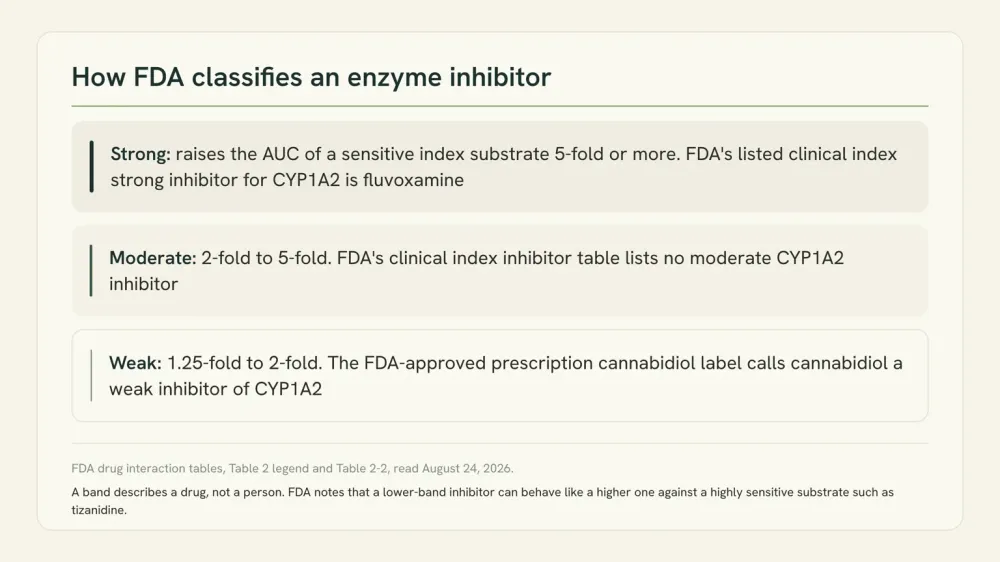
FDA puts numbers on the categories, which is what lets you place anything on the scale. On its table of examples for healthcare professionals, a strong inhibitor is defined as a drug that increases the AUC, meaning total exposure, of a sensitive index substrate of that pathway by 5-fold or more; a moderate inhibitor by 2-fold to 5-fold; and a weak inhibitor by 1.25-fold to 2-fold. In the companion developer table, fluvoxamine is the listed clinical index strong inhibitor of CYP1A2, and the moderate column of that same index table is empty.
So where does cannabidiol sit? On the enzyme's other index substrate, the cannabidiol label prints its own measurement in section 12.3: coadministration of 750 mg twice daily with a single 200 mg dose of caffeine increased caffeine exposure by 15% for peak concentration and 95% for AUC compared with caffeine given alone. A 95% increase in AUC is a ratio of 1.95, which lands inside the weak band, and that is where the label's own word weak comes from. It is not a marketing adjective. It is a number wearing a category name.
Read as a trial rather than as a label sentence, the same measurement is thinner than it sounds. It was a Phase 1 open-label fixed-sequence drug interaction trial published in 2021: 16 healthy adults enrolled and 9 completed, cannabidiol titrated to 750 mg twice daily as the prescription oral solution, with 6 participants withdrawn for liver-enzyme elevations. The caffeine exposure ratio was 1.95 with a 90% confidence interval of 1.62 to 2.35, and caffeine's half-life stretched from 5.4 hours to 10.9. The placebo day always came first, and the trial was sponsored by the manufacturer's research arm with author-employees. For scale, because this is the number that gets dropped: 750 mg twice daily is 1,500 mg of a pharmaceutical solution a day. A Planntz tincture at 250 mg/mL puts about 12.5 mg of CBD in a standard drop, so 1,500 mg a day is roughly 120 drops a day, or about a whole 60 mL bottle every ten days. That is arithmetic about a trial dose, not a suggestion about anything, and nothing on this page tells you what to take.
A second, independent human measurement points the same direction and puts this enzyme near the bottom of the list. In a randomized crossover study in 18 healthy adults, participants ate a brownie containing 640 mg of CBD and 20 mg of THC and then took a five-drug probe cocktail. Ranked by how much each probe drug's exposure rose against placebo, the order the authors print is omeprazole for CYP2C19 at 207%, losartan for CYP2C9 at 77%, midazolam for CYP3A at 56% and caffeine for CYP1A2 at 39%, with no inhibition of CYP2D6 at all. On the enzyme that clears tizanidine, in other words, the brownie sat at the bottom of the four it did inhibit. Note the product: a single dose of a cannabis extract containing THC, not isolated cannabidiol. The authors also report that their own physiologically based model came within 26% of every one of those observed interactions except the caffeine one.
None of that is a clean bill of health, and this is the paragraph the reassuring version of this article leaves out. FDA's clinician table carries a footnote that reads: "Ciprofloxacin is generally classified a moderate CYP 1A2 inhibitor based on totality of evidence; however, it can sometimes behave like a strong inhibitor (i.e., increase AUC more than 5-fold) when it interacts with certain CYP 1A2 substrates that are considered highly sensitive (e.g., tizanidine)." Of every drug the agency could have picked as its example of a highly sensitive substrate, it picked this one. Meanwhile the 90% confidence interval around cannabidiol's own caffeine result, 1.62 to 2.35, reaches into the moderate band. And FDA states plainly that its tables are a guide and "not considered a comprehensive list of all possible drugs and other substances (e.g., foods, including dietary supplements) that fit these categories", which is precisely the category a hemp extract falls into. Cannabidiol is absent from those tables. Absence from a list the agency itself says is not comprehensive is not a finding in either direction.
There is one more tier on tizanidine's own label that almost nobody quotes. Section 7.3 addresses other CYP1A2 inhibitors, naming zileuton, fluoroquinolones other than the strong inhibitors already contraindicated, the antiarrhythmics amiodarone, mexiletine, propafenone and verapamil, plus cimetidine, famotidine, oral contraceptives, acyclovir and ticlopidine, and says their use "should be avoided". If use is clinically necessary, the label says therapy should be initiated at the 2 mg dose. Cannabidiol is not on that list either. What the two tiers show is that the label thinks in gradations and that a prescriber already has a documented playbook for the middle of the range. As for what the top of the range looks like in a real person rather than a trial, there is a 2022 case report of ciprofloxacin given to a patient on tizanidine whose authors note that the interaction is often overlooked by physicians. One patient, and the other drug is an antibiotic, not anything cannabis-derived.
Carisoprodol: the enzyme the cannabidiol label calls itself a moderate inhibitor of
Carisoprodol, sold as Soma, is the other row where the enzymes line up on their own. Its label says in section 12.3 that the major pathway of carisoprodol metabolism is via the liver by cytochrome enzyme CYP2C19 to form meprobamate, and adds in the next sentence that this enzyme exhibits genetic polymorphism. Carisoprodol's own half-life is about 2 hours. Meprobamate's is about 10, so the metabolite outlasts the parent by roughly five to one.
Section 7.2 of the same label is titled CYP2C19 Inhibitors and Inducers, and it says that co-administration of CYP2C19 inhibitors, such as omeprazole or fluvoxamine, with Soma could result in increased exposure of carisoprodol and decreased exposure of meprobamate. Section 7.2 of the cannabidiol label says: "Cannabidiol is a moderate inhibitor of CYP2C19." So carisoprodol's label names a category and the cannabidiol label puts cannabidiol in it. Then carisoprodol's label finishes the paragraph with a sentence hardly anybody quotes: "The full pharmacological impact of these potential alterations of exposures in terms of either efficacy or safety of SOMA is unknown." The manufacturer is saying the practical consequence is unknown for the two inhibitors it does name. CYP2C19 is the same enzyme that carries the case ground in what we know about CBD and sertraline.
Notice also that the label's two examples are not the same strength as each other. FDA's clinician table classifies omeprazole as a weak CYP2C19 inhibitor, and fluvoxamine as a strong one. A category name in a label is a doorway, not a dial setting, and two drugs standing in the same doorway can be an order of magnitude apart.
The label does print a number for what a slow CYP2C19 looks like, and it comes from genetics rather than from a drug. Section 12.3 states that patients who are poor CYP2C19 metabolizers have a 4-fold increase in exposure to carisoprodol and a concomitant 50% reduced exposure to meprobamate, and section 8.8 puts the prevalence of that genotype at roughly 3% to 5% in Caucasians and African Americans and 15% to 20% in Asians. That is genotype data, not a drug interaction, and it must be read as such. It is simply the closest thing printed on the label to a picture of what a blocked enzyme would do to this particular drug. Nobody has measured cannabidiol against carisoprodol in people. The human measurement that does exist on this enzyme is the brownie study above, and its CYP2C19 reading came from omeprazole, a probe drug chosen because it is easy to measure. A probe result is a statement about the enzyme, not a prediction about every drug that uses it, and carisoprodol's own label says the practical consequence is unknown even for the inhibitors it names.
- Carisoprodol is a Schedule IV controlled substance, stated in section 9.1 of its own label.
- Its metabolite meprobamate is a sedative in its own right. The label reports that a 350 mg dose of carisoprodol produces about 30% of the meprobamate peak seen after a single 400 mg dose of meprobamate, in 24 healthy subjects.
- Section 5.1 warns about sedation and about additive effects when the drug is taken with other CNS depressants.
- Blocking CYP2C19 pushes carisoprodol up and meprobamate down, which is the direction the label describes for the inhibitors it names. The label then says the practical consequence of that shift is unknown.
Baclofen and methocarbamol: where this framework does not apply
Baclofen is the clean row, and it is clean in a way that will look familiar if you have read our piece on CBD and gabapentin, where the cytochrome story also fails to explain the drug. Both the baclofen tablet label from Upsher-Smith and the Ozobax DS oral solution label say, in near-identical words, that baclofen is excreted primarily by the kidney in unchanged form and that there is relatively large intersubject variation in absorption or elimination. Searched whole on August 24, 2026, the word cytochrome appears zero times in either document, and so does P450. The oral solution's half-life is about 5.7 hours, and its section 7 has exactly one subsection, 7.1 CNS Depressants and Alcohol, which is not about metabolism at all.
Methocarbamol is off the same map by a different chemistry. Its label says the drug is metabolized via dealkylation and hydroxylation, that conjugation of methocarbamol also is likely, and that essentially all methocarbamol metabolites are eliminated in the urine, with a half-life of 1 to 2 hours. Note the label hedging its own route with the word likely, which is unusual and honest. The word cytochrome does not appear anywhere in the document, and its drug interactions text names only CNS-acting drugs, alcohol and pyridostigmine bromide.
Two cautions before anyone reads those two rows as good news. Label silence is not biological absence: a document that does not name an enzyme is telling you what the manufacturer submitted and the agency reviewed, not what is chemically impossible. And we read two baclofen labels and one methocarbamol label, on one day. Other manufacturers' labels for the same molecules can and do read differently, which is why the honest form of this claim is that the cytochrome question does not apply to these two on the documents we read. The sedation question is a separate one, and it applies to everything on this page.
Cyclobenzaprine: three enzymes, one pathway, no cytochrome in the interactions section
Cyclobenzaprine is the least conclusive of the five and the row most often reported wrongly. Both the immediate-release tablet label from Teva and the Amrix extended-release capsule label carry the same two sentences, quoted here from the immediate-release label: "Cyclobenzaprine is extensively metabolized, and is excreted primarily as glucuronides via the kidney. Cytochromes P-450 3A4, 1A2, and, to a lesser extent, 2D6, mediate N-demethylation, one of the oxidative pathways for cyclobenzaprine." Read the second half carefully. Those three enzymes mediate one oxidative pathway, and the sentence before it says the primary excretion route is glucuronide conjugation, which is a different chemistry entirely. There is a trap in the typography too: both labels spell it P-450, so a search of either document for the string CYP returns nothing, and anyone grepping for CYP1A2 on a cyclobenzaprine label will conclude, wrongly, that no enzyme is named.
What neither label ever does is come back to those enzymes. The Drug Interactions text of the immediate-release label and section 7 of the Amrix label contain no cytochrome at all. What they contain is pharmacology of a different kind: MAO inhibitors, contraindicated and described in life-threatening terms; serotonin syndrome with SSRIs, SNRIs, tricyclics, tramadol, bupropion, meperidine, verapamil and MAO inhibitors; a statement that the drug may enhance the effects of alcohol, barbiturates and other CNS depressants; seizure risk alongside tramadol; and guanethidine. Cannabidiol is on none of those lists, and the serotonergic list is not a general list of things to keep away from the drug. The half-life is worth knowing while you think about it: about 18 hours for the immediate-release tablet, from a study in 18 subjects with a range of 8 to 37 hours, and about 32 hours for the extended-release capsule. That is a drug still in the system the following day.
That leaves the glucuronidation half of cyclobenzaprine's route, the half its own label calls primary and the half nobody discusses. There is no laboratory work on cannabidiol and cyclobenzaprine's glucuronidation at all, which is the same zero the PubMed table below reports for the pair. The nearest thing to it was done in recombinant enzymes and human liver and kidney microsomes, not in people, and the drug used was oxazepam, a benzodiazepine. In those preparations CBD, THC and THC metabolites inhibited oxazepam glucuronidation, and a static model predicted exposure ratios of 1.25 to 3.45. That is a tube experiment about a different molecule, and the UGT enzymes it names belong to oxazepam, not to cyclobenzaprine, whose label does not specify which UGT handles it. It cannot be carried across, and this paragraph exists mainly so that nobody carries it across.

What the research literature actually contains
Everything above is documents. Here is the part that decides how much weight documents should carry, which is the state of the published research. We ran the searches on August 24, 2026 through NCBI's E-utilities, printed the query strings below so you can reproduce them, and then opened the records rather than reporting counts, because a count tells you nothing about what the records are.
| PubMed query, run August 24, 2026 | Records | What those records actually are |
|---|---|---|
| cannabidiol AND cyclobenzaprine | 0 | Nothing indexed |
| cannabidiol AND carisoprodol | 0 | Nothing indexed |
| cannabidiol AND methocarbamol | 0 | Nothing indexed |
| cannabidiol AND Flexeril | 0 | Nothing indexed |
| cannabidiol AND Robaxin | 0 | Nothing indexed |
| cannabidiol AND tizanidine | 11 | Multiple sclerosis spasticity literature in which tizanidine appears as a comparator or as background therapy. Ten of the eleven are reviews, consensus papers or case-review compilations. One is an interventional trial, and it tested a spray containing both THC and CBD |
| cannabidiol AND baclofen | 25 | The same eleven, plus alcohol-use-disorder pharmacotherapy reviews, more MS and spasticity papers, a stiff-person-syndrome case report and a traumatic-brain-injury case report. None is a cannabidiol and baclofen interaction study |
| cannabidiol AND (muscle relaxant OR muscle relaxants) | 31 | MS spasticity papers again, plus animal vascular and intestinal pharmacology matching on the phrase smooth muscle relaxation: rabbit pulmonary arteries, CB1-knockout mice, mouse intestinal contractility. None concerns a skeletal muscle relaxant drug |
| (cannabidiol OR cannabis OR cannabinoid) AND (cyclobenzaprine OR flexeril) | 3 | Two fibromyalgia pharmacotherapy reviews and one comparative-effectiveness report on nonopioid treatments for chronic pain. None studies the pair |
The tizanidine and baclofen sets are the interesting ones, and they are not what their numbers suggest. Every one of the eleven cannabidiol and tizanidine records is multiple sclerosis spasticity literature in which tizanidine is a comparator or a background therapy patients were already taking. Ten of the eleven are reviews, consensus papers or case-review compilations. The single interventional trial among them, a Phase 3 crossover study in 68 patients with multiple sclerosis published in 2024, did not test CBD: it tested nabiximols, an oromucosal spray containing both THC and CBD. Baclofen and tizanidine appear in it only in the eligibility criteria, because patients had to already be taking an oral antispasticity agent. And the trial missed its primary endpoint. The least-squares mean change in lower-limb muscle tone was minus 0.23 on the spray against minus 0.26 on placebo, a treatment difference of 0.04 with a p value of 0.7152. Its sponsor was the pharmaceutical company developing the spray, and four authors are current or former employees holding stock.
Before writing any sentence about absence we ran a deliberately wide guard search: cannabidiol or cannabis or cannabinoid or marijuana, joined to any of the five drug names, joined to pharmacokinetics or drug interactions. It returns 14 records, and every title was resolved in a single call. Not one of the 14 is a cannabinoid and relaxant pharmacokinetic interaction study. They are a trigeminal neuralgia pharmacotherapy review, a cohort study of opioids and muscle relaxants with no cannabinoid in it at all, a benzodiazepine screening study, an oral-fluid mass spectrometry methods chapter, and nine rodent, rabbit or receptor pharmacology papers, the newest of them from 2018. The closest human record anywhere in the search space is a 2012 drug-discrimination study in eight cannabis users given baclofen alongside oral THC, in which 50 mg of baclofen substituted for the THC stimulus and both baclofen doses shifted THC's effects leftward and upward. The cannabinoid there is THC rather than CBD, the outcome is what the drug felt like rather than what the blood levels did, and the sample is eight people.
So the supported sentence is narrow, and its exact shape matters more than its force. On August 24, 2026, searching PubMed for cannabidiol together with any of these five drugs returns no study that measured what one does to the other in people. Not that no records exist. They exist, in reasonable numbers, and they are about something else.
The one thing every label here agrees about is drowsiness
For all the divergence above, there is one column where every document lines up. Baclofen's oral solution label reports that drowsiness and sedation have been reported in up to 63% of patients taking baclofen. Carisoprodol's label reports that in the low back pain trials, 13% to 17% of patients who received Soma experienced sedation compared with 6% of patients who received placebo, and the same section notes post-marketing reports of motor vehicle accidents associated with its use. Tizanidine's label says its CNS depressant effects with alcohol and other CNS depressants may be additive. And the cannabidiol label has a section titled CNS Depressants and Alcohol stating that concomitant use may increase the risk of sedation and somnolence. Those percentages belong to their own drugs and do not add up into a combined figure. Drowsiness is also the most consistently reported effect of CBD itself, which is covered in what the research says about CBD's side effects, and it is the same reason the alcohol question keeps coming up.
Note what that overlap is and is not. Neither side of it names the other, so it is inferred from two separate warnings rather than measured in anybody. If you want human impairment data instead of a label warning, the closest published evidence on a sedating everyday drug taken with CBD is collected in our article on CBD and Benadryl, which is where that literature lives on this site.
The additive question has been measured at scale for this drug family, and when it was, the co-drug was an opioid rather than CBD. Nine retrospective cohort studies in US Medicaid data compared skeletal muscle relaxants taken alongside an opioid, in cohorts of 349,543 concurrent hydrocodone users, 139,458 oxycodone users and 218,967 tramadol users. Against methocarbamol as the reference drug, the adjusted hazard ratios for injury that reached significance were carisoprodol at 1.86 (1.23 to 2.82) and tizanidine at 1.73 (1.09 to 2.73) in one oxycodone cohort, baclofen at 1.51 (1.01 to 2.26) and cyclobenzaprine at 1.48 (1.03 to 2.11) in one tramadol cohort, and, pointing the other way in a differently constructed tramadol cohort, tizanidine at 0.62 (0.42 to 0.90) together with metaxalone at 0.69 (0.49 to 0.97), a sixth relaxant this page does not otherwise cover. Every other hazard ratio in the nine cohorts was statistically nonsignificant. None of those numbers may be attached to cannabidiol: this is claims data about opioids, with confounding by indication, and the authors hedge their own conclusion with the words if confirmed by future studies. It is here for the shape of the result rather than the size of it. Even when this question is measured properly, the answer arrives per drug rather than per class, which is the shape of everything else on this page. Opioids taken with CBD are their own question, handled in CBD and oxycodone.
Why this page will not call CBD a muscle relaxer
Search for CBD and muscle relaxers and page one answers a different question. Nearly every result asks whether CBD is a muscle relaxer, and several state outright that it is. This page will not, and the reason is not caution. Cannabidiol is not approved as a muscle relaxant, it is not a labelled treatment for muscle spasm or spasticity, and there is no version of that sentence that survives contact with the documents quoted above. If you needed a demonstration of how loosely the phrase gets used even where it is regulated, methocarbamol's label already gave it: a prescription drug in exactly this category states that its mode of action has not been clearly identified and that it does not directly relax tense skeletal muscles in man.
The substitution question underneath all of this is real, though, and it deserves an honest answer rather than silence. A survey of 763 people with rheumatic conditions in the United States and Canada found that 62.5% reported substituting medical cannabis for a medication, including 54.7% for NSAIDs, 48.6% for opioids, 29.6% for sleep aids and 25.2% for muscle relaxants. Read the limits in the same breath as the number: the data are self-reported and cross-sectional, participants were recruited through patient advocacy groups, no products were verified, the authors state that causality cannot be determined, and substitution was associated with THC use and with inhaled routes rather than with anything resembling a hemp tincture. A quarter of substituters swapping a muscle relaxant is a real behavior worth reporting. It is not an argument for doing it, and swapping a prescription is a decision that belongs to the person who wrote it. If you landed here because your legs hurt after training rather than because you hold a prescription, that is a different topic entirely and it is handled separately in our piece on CBD and recovery.
What to actually do with this
None of the above resolves into a rule, and it should not. It resolves into a short list of things you can do this week, and one thing this page will not tell you to do at all.
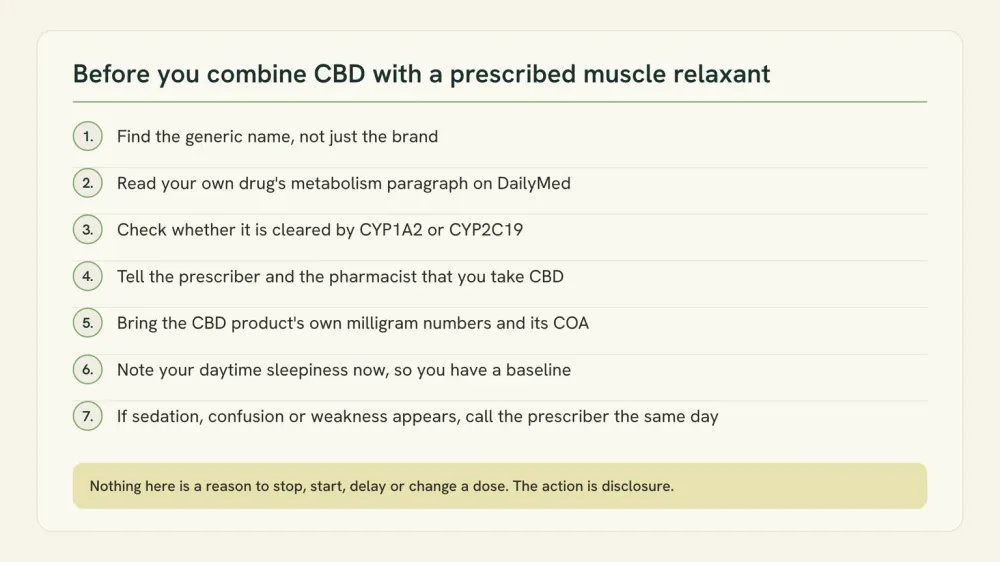
- 1Find the generic name, not just the brand. Flexeril and Amrix are cyclobenzaprine, Soma is carisoprodol, Zanaflex is tizanidine, Robaxin is methocarbamol, Lioresal and Ozobax are baclofen.
- 2Look your own drug up on DailyMed and read the metabolism paragraph. On three of the seven labels we read there is no section 12.3, so read under CLINICAL PHARMACOLOGY instead.
- 3Check whether your relaxant is one of the two cleared by CYP1A2 or CYP2C19, because those are the two enzymes the cannabidiol label places cannabidiol on.
- 4Tell the prescriber and the pharmacist that you take CBD, and say how much and how often. Neither label mentions the other, so they will be reasoning from the enzyme, not looking it up in a table.
- 5Bring the CBD product's own numbers: milligrams per bottle, milligrams per milliliter, and whether the certificate of analysis reports any THC.
- 6Write down what your daytime sleepiness looks like now, before anything changes, so that if it changes later you have a baseline rather than a guess.
- 7If sedation, confusion, weakness or trouble staying awake appears, call the prescriber the same day. Do not try to work out which one caused it on your own.
And here is the thing this page will not tell you to do: change anything. Not stop the relaxant, not start it, not skip a dose, not move a dose, not leave some number of hours between the CBD and the prescription, and not switch to a different relaxant because of something you read here. Those are all prescribing decisions, every one of these five drugs has language in its own label about how it is discontinued, and none of that language is reproduced here as instructions. The single verb that belongs to you is disclose.
Questions people ask about CBD and muscle relaxers
The honest answer is that it depends which one, and that nobody has measured it. Tizanidine is cleared mainly by CYP1A2 and carisoprodol by CYP2C19, and the FDA-approved prescription cannabidiol label describes cannabidiol as a weak inhibitor of the first and a moderate inhibitor of the second. Baclofen leaves the body through the kidney unchanged and its labels never use the word cytochrome. Methocarbamol's label names no cytochrome either. Cyclobenzaprine sits in between: three enzymes named for one oxidative pathway, with glucuronidation as the primary excretion route. As of August 24, 2026, no published study has measured cannabidiol against any of the five in people. That does not add up to a yes or a no. It adds up to finding out which drug you are actually on, then telling the prescriber and the pharmacist that you take CBD before anything else happens.
Nobody has published a measurement. A PubMed search for cannabidiol and cyclobenzaprine returned zero records on August 24, 2026, and so did the same search for Flexeril. What the label says is narrower than most pages imply. Cyclobenzaprine is excreted primarily as glucuronides via the kidney, and cytochromes P-450 3A4, 1A2 and, to a lesser extent, 2D6 mediate N-demethylation, described as one of the oxidative pathways. The drug interactions sections of both the immediate-release and the extended-release labels name no cytochrome at all: they are about MAO inhibitors, serotonin syndrome with serotonergic drugs, alcohol and other CNS depressants, tramadol and guanethidine. Cannabidiol is on none of those lists. Worth knowing that the tablet's half-life is roughly 18 hours, so the drug is still present the next day.
No drug label says so, and the wording matters, because four separate facts have to sit together before that answer is useful, and it is not a statement that the combination is fine. First, tizanidine's label contraindicates potent inhibitors of CYP1A2 and names two of them, fluvoxamine and ciprofloxacin, with fluvoxamine having raised tizanidine exposure 33-fold in 10 healthy subjects. Second, the FDA-approved cannabidiol label calls cannabidiol a weak inhibitor of CYP1A2, which by FDA's numeric definitions is two bands below potent, and that same label still names tizanidine as an example substrate. Third, FDA notes in its own footnote that a drug generally classified as a moderate CYP1A2 inhibitor can sometimes behave like a strong one against substrates it calls highly sensitive, and the example it reaches for is tizanidine. Fourth, nobody has measured the pair in people. Those four facts do not produce a verdict, and any page handing you one has left one of them out. They produce a conversation with the prescriber.
The metabolic story does not apply. Both baclofen labels we read say the drug is excreted primarily by the kidney in unchanged form, and neither contains the word cytochrome or the string P450 anywhere. That removes the enzyme question. It does not remove the sedation question. Baclofen's oral solution label reports drowsiness and sedation in up to 63% of patients, its only drug interaction subsection is titled CNS Depressants and Alcohol, and the cannabidiol label has a section with essentially the same title. Sedation is the overlap worth raising with the prescriber, and no published study has measured the combination in people. Label silence is also not biological absence: it tells you what was submitted and reviewed, not what is chemically impossible.
No. Cannabidiol is not approved as a muscle relaxant, it is not a labelled treatment for muscle spasm or spasticity, and this site does not present it as one. It is worth knowing how loose the phrase is even inside a pharmacy. Methocarbamol, a prescription drug in exactly this category, states in its own FDA label that its mode of action has not been clearly identified, that it may be related to its sedative properties, and that it does not directly relax tense skeletal muscles in man. If a prescription product in the class says that about itself, a hemp extract should be held to at least the same standard of evidence, and right now that evidence does not exist.
That is not a decision this page can make, and it is not one to make alone. Each of these drugs has language in its own label about how it is discontinued, and several of them are prescribed as a defined short course for a reason. The useful action is disclosure: tell the clinician who prescribed the relaxant, and the pharmacist who filled it, that you take CBD, how much and how often, and let them decide whether anything should change. Nothing on this page is a reason to alter a prescription, and no timing gap between CBD and a prescribed medicine is published or implied here.
If one thing is worth carrying out of all this, it is that muscle relaxer is a word about a purpose rather than a description of a drug, and the useful answer begins the moment you replace it with a generic name. The broader framework for how cannabidiol shares enzymes with prescription drugs sits in the drug interaction hub, the plain-language starting point for what cannabidiol is and is not is our introduction to CBD, and this page will be updated the day somebody finally runs the measurement. Until then the best document in the room is the label of the drug in your hand, and the best reader of it is the person who prescribed it.
Writing about hemp, wellness and the small rituals that keep us balanced.