CBD and Oxycodone: What the Label Says, What Mice Showed
Oxycodone's FDA label names two liver enzymes and never uses the word cannabidiol. The only pharmacology study of the pair was run in mice, and its second finding, accelerated tolerance on repeated dosing, is the one nobody quotes.
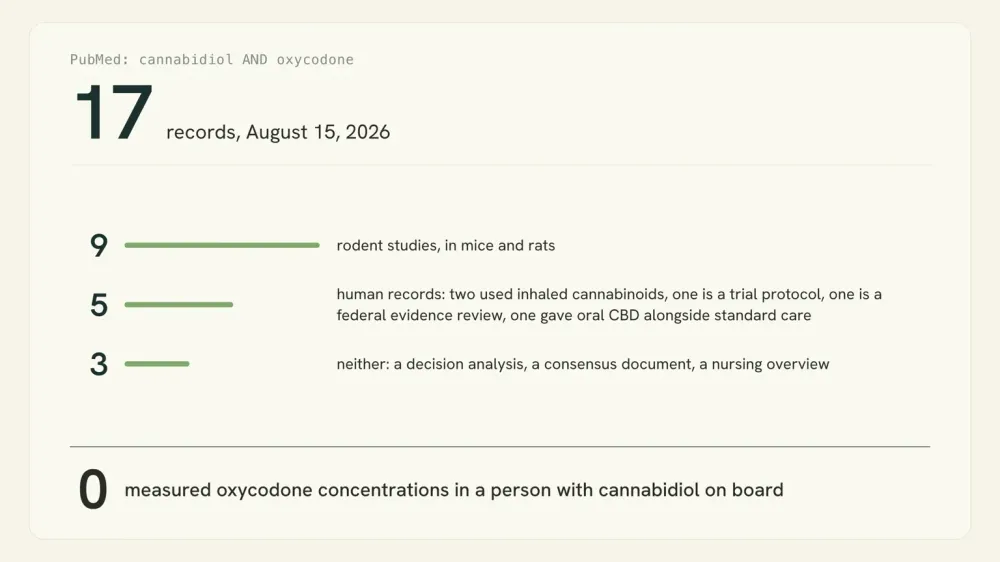
If you have an oxycodone prescription in one hand and a bottle of CBD oil in the other, the question underneath a search for CBD and oxycodone is short: will this hurt me. The honest answer has a shape, and it is not the shape page one gives it. On August 15, 2026 a PubMed search for cannabidiol AND oxycodone returned 17 records, and not one of them reports what happens to oxycodone in a person's bloodstream when cannabidiol is on board. Nine of the 17 are rodent studies. The one paper that measured the pair directly did it in male C57BL/6J mice, and its second finding points the opposite way from the reason most people run this search.
Here is what this page is and what it is not. It reports documents: the FDA-approved prescribing information for oxycodone, the one pharmacology paper that has ever been run on this exact pair, and the human studies people cite as though they were about this pair. It publishes no amounts, no ratios and no waiting windows for either substance, because none exist in a source we could check and inventing one would be worse than saying so. The single instruction on this page is the one oxycodone's own label gives: tell your prescriber and your pharmacist what you are taking, and do not adjust a dose on your own. If cannabidiol itself is new to you, start with what CBD actually is and come back.
What has actually been measured, and what has not
Start with a check you can run yourself in about thirty seconds. On August 15, 2026 at 12:01 UTC we queried PubMed for cannabidiol AND oxycodone through the E-utilities search endpoint, so the number is reproducible rather than eyeballed off a results page. The count came back 17. PubMed expands that query itself, into a translation that picks up the MeSH terms and the supplementary concept records for both drugs, so this is not a narrow phrase search quietly missing papers. Seventeen records is the entire indexed literature on this pair, and we resolved all 17 titles rather than counting them and guessing what was inside, because a count you have not opened is not a finding.
Nine of the 17 are rodent studies, in mice and rats: place preference, self-administration, an operant orofacial thermal pain assay, the gut symptoms of withdrawal. Four of those nine, all in rats or mice, report cannabidiol changing how much oxycodone the animals took or how strongly they preferred the place where they received it, and that is where the idea you may have arrived with comes from. It is also where it stops, because those are animals in operant chambers. Three of the 17 are neither: a multicriteria decision analysis, a Brazilian neurology consensus document and a 2007 nursing overview. The remaining five are the human end of the file, and not one of them measured oxycodone concentrations in a person taking cannabidiol. One randomized crossover used inhaled THC. One open-label trial used inhaled whole cannabis. One is that trial's published protocol. One is a federal evidence review of cannabis for chronic pain. And one, the CANBACK trial, randomized 100 emergency department patients with acute low back pain to a single 400 mg oral dose of cannabidiol or to placebo on top of standard analgesia, and its abstract reports oxycodone use in both groups. So people have taken both, and nobody should tell you otherwise. What nobody has published is a measurement of oxycodone concentrations in a person's blood with cannabidiol on board. Our page on CBD alongside over-the-counter painkillers works through the CANBACK trial in full.
How your body clears oxycodone, according to its label
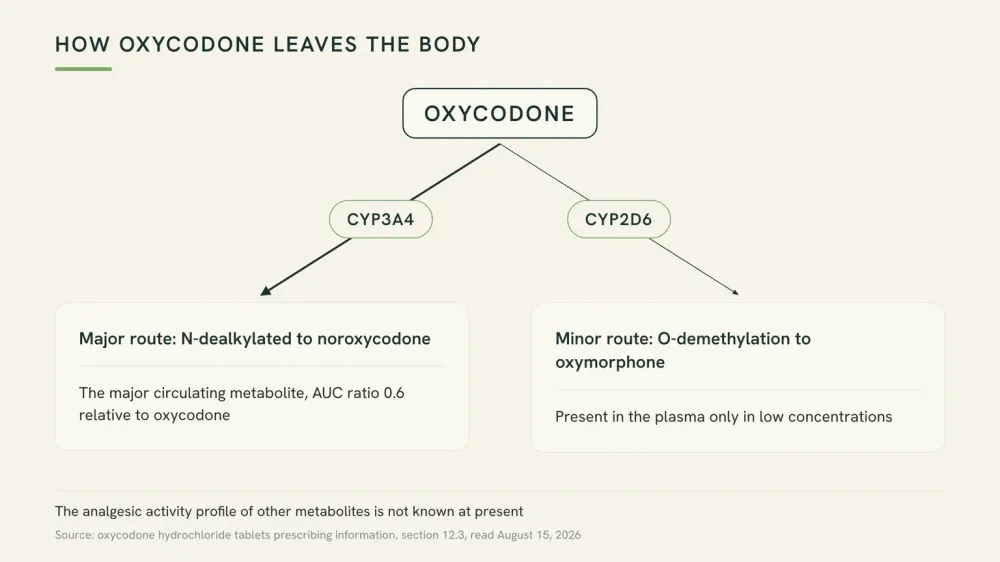
Everything in this section comes from one document: the FDA-approved prescribing information for oxycodone hydrochloride tablets published by SpecGx LLC, version 36, effective August 7, 2026, which we downloaded as XML from DailyMed and read on August 15, 2026. Its pharmacokinetics section, 12.3, describes two exits under the heading Metabolism, and here it is in the label's own words: A high portion of oxycodone is N-dealkylated to noroxycodone during first-pass metabolism, and is catalyzed by CYP3A4. Oxymorphone is formed by the O-demethylation of oxycodone. The metabolism of oxycodone to oxymorphone is catalyzed by CYP2D6. Note the verb on the major route. It is N-dealkylation, not N-demethylation, which is the word most summaries print, and the difference matters only because it tells you whether the page you are reading opened the document.
The label then does two things the summaries skip. First it tells you how much of each metabolite is actually around: The major circulating metabolite is noroxycodone with an AUC ratio of 0.6 relative to that of oxycodone. Oxymorphone is present in the plasma only in low concentrations. Then it declines to say what those metabolites do: The analgesic activity profile of other metabolites is not known at present. You will read elsewhere that one of oxycodone's metabolites is weak and the other is far more potent. The mouse paper further down does describe them as less active metabolites, and that is the paper's characterization, made in mice. The label makes neither claim. Two documents, two evidentiary weights, and this page keeps them apart rather than blending them into one confident sentence.
| What the label reports | Figure | What is being measured |
|---|---|---|
| Oral bioavailability | About 60% to 87% | The portion of an oral dose that reaches the systemic circulation |
| Apparent elimination half-life | 3.5 to 4 hours | How long it takes the concentration to fall by half |
| Time to steady state | Approximately 18 to 24 hours | How long repeated dosing takes to level off |
| Plasma protein binding | About 45% | The fraction carried on plasma proteins rather than free |
| Noroxycodone, the major circulating metabolite | AUC ratio 0.6 relative to oxycodone | Total exposure to the metabolite against total exposure to the parent drug |
| Oxymorphone in plasma | Present only in low concentrations | The label gives no ratio for this one |
| Free oxycodone in urine | Up to 19% | Percentage of a dose recovered in urine, not of clearance |
| Conjugated oxycodone in urine | Up to 50% | Percentage of a dose recovered in urine |
| Free oxymorphone in urine | 0% | Percentage of a dose recovered in urine |
| Conjugated oxymorphone in urine | Up to 14% | Percentage of a dose recovered in urine |
| Effect of a high-fat meal | 27% increase in AUC | Total exposure after food against total exposure fasted |
Two enzymes, and what the label already says about blocking both
Oxycodone's label opens with a boxed warning, the strongest warning the FDA uses, and one of its sections is titled Cytochrome P450 3A4 Interaction. It reads: The concomitant use of oxycodone hydrochloride tablets with all cytochrome P450 3A4 inhibitors may result in an increase in oxycodone plasma concentrations, which could increase or prolong adverse reactions and may cause potentially fatal respiratory depression. Now the counting, with the rule stated in the same breath so it cannot drift: these are case-insensitive string counts in the extracted text of that one label version, on that one date. CYP3A4 appears 21 times. CYP2D6 appears 3 times. Respiratory depression appears 65 times. And cannabi, CBD, marijuana and hemp appear zero times each, as do the phrase strong CYP3A4 and the words dietary supplement. So the class statement is broad, the examples beneath it are prescription drugs, and cannabidiol is not in the document at all. This page will not tell you that CBD is covered by that warning, and it will not tell you that CBD is excluded from it. The label is silent, and reading a verdict into a silence is how most of page one gets written. The general framework lives on our guide to CBD and prescription medications, which also owns the grapefruit question. Worth knowing before you ask it: grapefruit appears zero times in this label too.
Section 7 carries the interaction table, and the row people quote is not quite the row that exists. Its title is Inhibitors of CYP3A4 and CYP2D6. Both enzymes, one row. Its Clinical Impact column reads: The concomitant use of oxycodone hydrochloride tablets and CYP3A4 inhibitors can increase the plasma concentration of oxycodone, resulting in increased or prolonged opioid effects. These effects could be more pronounced with concomitant use of oxycodone hydrochloride tablets and CYP2D6 and CYP3A4 inhibitors. The row then adds that this applies particularly when an inhibitor is added after a stable dose has been reached. Read that twice, because it settles something the internet argues about. Blocking both enzymes at once is not a scenario the label failed to imagine, and the label does not say the two directions cancel each other out. It says the effects could be more pronounced. The examples named in that same row are macrolide antibiotics such as erythromycin, azole antifungal agents such as ketoconazole, and protease inhibitors such as ritonavir. Those are prescription drugs with dedicated interaction studies behind them, which is exactly why the row exists, and exactly why turning an instruction written around ketoconazole into an instruction about a hemp extract would be an inference the document does not make.
The same row's Intervention column is the sentence that lets this page refuse to give you a number without being evasive about it: If concomitant use is necessary, consider dosage reduction of oxycodone hydrochloride tablets until stable drug effects are achieved. Evaluate patients at frequent intervals for respiratory depression and sedation. Every verb there has a prescriber as its subject. Consider, evaluate, monitor at intervals: those are things a clinician does with your chart and a follow-up appointment, not things anyone does at a kitchen table with a dropper. That is not caution for legal reasons, it is what the document says and who it says it to. Amounts of CBD, for any purpose, live on our dosage guide, and even there they are not an instruction about a prescription opioid.
Two neighboring pages sharpen the boundary, because the same two enzymes behave differently depending on the drug they are acting on. On CBD and Adderall, CYP2D6 appears as an enzyme that takes a drug apart, so slowing it down would leave more of the parent drug around. Here CYP2D6 does the opposite job: it is a bioactivation step, building oxymorphone out of oxycodone, and the label says oxymorphone is present in plasma only in low concentrations. On CBD and trazodone, CYP3A4 produces a metabolite the literature has characterized in detail. Here it produces one the label expressly declines to characterize. Two enzymes, three different situations, which is why a generic sentence about CBD and the cytochromes tells you very little about any particular medicine.
What cannabidiol has been measured to do to these enzymes in people
There is one human study that tested a cannabidiol-dominant extract against a panel of liver enzymes at once, and it is worth knowing exactly what it did. In a 2023 randomized crossover study in 18 healthy adults, published in Clinical Pharmacology and Therapeutics, participants ate a brownie on separate occasions: one with placebo, one containing 640 mg of cannabidiol plus 20 mg of THC, and one containing 20 mg of THC alone. Thirty minutes later they swallowed a cocktail of five probe drugs, each chosen because one particular enzyme clears it: caffeine, losartan, omeprazole, dextromethorphan for CYP2D6 and midazolam for CYP3A. The cannabidiol brownie raised midazolam's exposure by 56% and its peak concentration by 28%, and had no effect on its half-life. Midazolam is the standard CYP3A probe. It is not oxycodone, the extract contained THC as well as cannabidiol, the dose was a single one, and n was 18. Nothing there transfers cleanly to a hemp CBD oil, and nothing there transfers at all to an opioid.
The same study's other result is the one nobody quotes, and it is the reason this page will not sell you a tidy story about two enzymes pulling in opposite directions. Against dextromethorphan, the CYP2D6 probe, the cannabidiol brownie had no effect on exposure, on peak concentration or on half-life. The authors say it three ways. The results report no effect on dextromethorphan's exposure, its peak concentration or its half-life. The discussion puts it like this: of the two brownies containing a cannabis extract, the CBD one precipitated interactions with all the CYP probes, except DXM (CYP2D6). And the summary says it significantly inhibited the activity of all CYPs tested except CYP2D6. For the enzymes it did affect, they report the rank order CYP2C19 above CYP2C9 above CYP3A above CYP1A2, by 207%, 77%, 56% and 39% respectively, in those same 18 adults. So in the only human measurement available, the CYP3A half of the oxycodone story has a number attached to it on a different drug, and the CYP2D6 half has a zero.
That is not what the test tubes said. In a 2011 study in Drug Metabolism and Disposition, cannabidiol competitively inhibited CYP2D6 activity in recombinant enzyme and in pooled human liver microsomes, with apparent Ki values of 1.16 to 2.69 micromolar, and it was the most potent of the three major cannabinoids tested. The same laboratory reported in a companion paper on the CYP3A isoforms that cannabidiol most potently inhibited CYP3A4 and CYP3A5 in vitro, with IC50 values of 11.7 and 1.65 micromolar. Those are enzymes in a tube: no person, no dose, no blood level, and both papers come from one research program rather than two independent confirmations. The in vitro literature does not even agree with itself. A 2021 screen of twelve cannabinoids against six enzymes in the AAPS Journal concluded that CYP2D6, CYP3A4, and CYP2B6 were either not affected or only partially inhibited by the cannabinoids, and that in vivo interactions mediated by these isoforms would not be predicted. Three laboratory studies, two answers, and one human study whose CYP2D6 result sides with the third.
The one study of CBD and oxycodone, and the half nobody quotes
In 2026, Biomedicine and Pharmacotherapy published the only pharmacology study that has been run on cannabidiol and oxycodone together. The work was done in male C57BL/6J mice, using behavioral experiments plus qPCR. Its first finding is the one every consumer page has picked up: acute administration of CBD in male C57BL/6J mice inhibited the metabolism of oxycodone into its less active metabolites, leading to a three-fold increase in total oxycodone exposure and a 50% increase in peak concentration. Total exposure and peak concentration are the abstract's own words, and we are keeping them rather than relabeling them AUC and Cmax as though the abstract had. The authors add, hedge intact, that acutely, this interaction appeared to extend the analgesic efficacy of a single oxycodone dose. In mice.
Then comes the sentence almost nobody reports, and it points the opposite way from the reason most people run this search. In contrast, sub-chronic co-administration of CBD and oxycodone accelerated the development of tolerance to oxycodone analgesia, but not morphine. Repeated dosing did not extend anything. It shortened the runway, and the morphine arm belongs in the same sentence because it is the specificity control: whatever happened, it did not happen with an opioid the authors describe as not being metabolized by these enzymes. Their mechanism statement carries its own hedge and we are not going to remove it: this potential drug-drug interaction between oxycodone and CBD is possibly mediated by CYP2D6 and CYP3A4 enzymes, which are inhibited by CBD, and which are responsible for oxycodone, but not morphine metabolism. Possibly mediated. In mice. Tolerance is a word with a life of its own online, and what it means for cannabidiol itself is a separate question covered on whether CBD is addictive.
Two limits belong here, and one of them is a limit of our own reading. First, the authors' translational statement, which is the most useful sentence in the paper for anyone standing in a kitchen with two bottles: these findings suggest that CBD alters the analgesic efficacy of oxycodone and future translational studies are required to observe if this occurs at lower nutraceutical doses of CBD and in humans. They are flagging both gaps themselves, the species and the dose. Second, ours. The full text of this paper is published open access, but the only copy sits on a publisher's site that blocked every automated route we tried on August 15, 2026, and there is no PubMed Central copy, no repository version and no preprint. So this article prints the species, the arms and the abstract's own words for each measure, and it does not print the group sizes, the milligram-per-kilogram doses or the dosing schedule, because the freely readable record does not state them. Any page that gives you those numbers should tell you where it read them.

The human trials people cite, and what they actually tested
Four human studies get quoted in this conversation, usually without their designs attached. Here they are with them. A randomized crossover trial in the British Journal of Anaesthesia gave 18 healthy volunteers inhaled cannabis after either placebo or 20 mg of oral oxycodone and measured their breathing directly. An open-label randomized trial in fibromyalgia ran oxycodone, inhaled cannabis and the combination for six weeks. The CANBACK trial is the one from the search section. And the federal living systematic review of cannabis and other plant-based treatments for chronic pain, updated by the Agency for Healthcare Research and Quality in July 2025, pooled the randomized trials of oral CBD. The table sets out who was in each one and what each one actually measured.
| Study | Who took part | What was given | What it found |
|---|---|---|---|
| Randomized crossover, British Journal of Anaesthesia, 2023 | 18 healthy volunteers, mean age 22, 9 of them female | Inhaled cannabis, 21.8% THC and 0.1% cannabidiol, after placebo or after 20 mg oral oxycodone | Oxycodone produced a 30% decrease in ventilation at raised carbon dioxide; the inhaled cannabis did not change it after either pretreatment. The second inhalation slightly increased sedation |
| CANBACK randomized trial, Medical Journal of Australia, 2021 | 100 emergency department patients with acute non-traumatic low back pain | A single 400 mg oral dose of cannabidiol or placebo, added to standard analgesia | Oxycodone use during the four hours preceding and the four hours after receiving CBD or placebo was similar for the two groups, as were reported side effects. CBD was not superior to placebo for the pain |
| Open-label randomized trial, Frontiers in Pain Research, 2024 | People with fibromyalgia over six weeks: 23 on oxycodone, 29 on inhaled cannabis, 29 on both | Inhaled cannabis containing 6.3% THC and 8% CBD, self-titrated, with or without oxycodone | The authors' conclusion: cannabis combined with oxycodone offered no advantage over either treatment alone, except for a reduction in opioid tablet intake; however, the overall drug load was the highest in the combination group. Moreover, cannabis was poorly tolerated and led to treatment discontinuation in one-third of participants treated with cannabis |
| AHRQ Comparative Effectiveness Review 250, 2025 update | Systematic review, searches through April 28, 2025: 29 randomized trials (N=2,579) and 15 observational studies (N=49,453) | Cannabis and other plant-based treatments for chronic pain, not for an interaction | Synthetic or purified oral CBD alone was not associated with decreased pain intensity (4 randomized trials, N=334, mean difference 0.40, 95% CI -0.14 to 1.00, moderate strength of evidence). Evidence on the impact of cannabis on use of opioids remained insufficient |
Now the sentence all four share: not one of them measured oxycodone concentrations in a person taking cannabidiol. The anesthesia trial is the closest thing to reassurance in this whole literature, and it is also the clearest illustration of why reassurance does not travel. The cannabis variety was 21.8% THC and 0.1% cannabidiol, which makes it a THC study with CBD as a rounding error, delivered by inhalation, to 18 young healthy volunteers, under laboratory conditions, on one endpoint. The authors' own conclusion is about THC: in humans, THC has no effect on ventilatory control after placebo or oxycodone pretreatment. And even there, sedation rose after the second inhalation. Nothing in that result licenses a claim about swallowing a CBD oil. The fibromyalgia trial is the only one that ran the combination for weeks, and 18 of the 58 participants in its cannabis arms, roughly a third, withdrew within two to three weeks because of the severity of adverse events.
The half that is not about enzymes
The enzyme conversation is the interesting one. The dangerous one is simpler, and it is why the boxed warning exists at all: Concomitant use of opioids with benzodiazepines or other central nervous system (CNS) depressants, including alcohol, may result in profound sedation, respiratory depression, coma, and death. That sentence is about named drug classes, and cannabidiol is not one of them, so what it gives you is a framework rather than a finding. Section 5.3 spells the class out and names gabapentinoids, gabapentin or pregabalin, alongside non-benzodiazepine sedatives and hypnotics, anxiolytics, tranquilizers, muscle relaxants, general anesthetics, antipsychotics and other opioids. We worked that framework through on CBD taken with gabapentin, which owns it, and there is no reason to rebuild it here. On cannabidiol's own side, somnolence and sedation are among the effects most consistently reported in controlled trials, and our page on CBD side effects keeps that list. Two things that both make people sleepy is not the same claim as a measured interaction, and this page will not upgrade it into one. It is a reason to know the signs.
- Unusual sleepiness, or someone who drifts off mid sentence and cannot be fully woken.
- Slow, shallow or noisy breathing, or long pauses between breaths.
- New confusion, slurred speech or unsteadiness on the feet.
- Pinpoint pupils.
- Blue, gray or purple lips, fingertips or skin.
- Limpness, or no response to their name or to a firm squeeze of the shoulder. That is a 911 call, not a wait-and-see.
Oxycodone's label also has an answer to what happens if it goes wrong, and it puts that answer early, in section 2.2, before any of the pharmacology: Inform patients and caregivers about opioid overdose reversal agents (e.g., naloxone, nalmefene). Discuss the importance of having access to an opioid overdose reversal agent, especially if the patient has risk factors for overdose (e.g., concomitant use of CNS depressants, a history of opioid use disorder, or prior opioid overdose). Naloxone appears nine times in this label and nalmefene nine times. Whether that conversation applies to you is a question for your prescriber, and it is a reasonable one to raise at the same appointment where you mention the CBD. If the question in your head is really about cannabidiol on its own rather than about the opioid, how much CBD is too much is a different page with a very different risk profile.
The other opioids people ask about
This page owns oxycodone, and it owns oxycodone because oxycodone's label describes a two-enzyme route that most of the shelf does not share. It does not extend its reading to other opioids, and neither should you. The table below is a map, not an assessment. One neighboring substance is worth a link rather than a row: kratom is the other non-prescription product with an opioid-receptor story attached to it, and it has a page of its own.
| What people search | What it is | What this page can say |
|---|---|---|
| OxyContin, oxycodone extended release | The same molecule in a controlled-release formulation | The same label sections apply: the same two enzymes, the same boxed warning, the same section 7 row. Nothing here is about the release profile itself |
| Percocet, oxycodone with acetaminophen | A combination product: oxycodone plus acetaminophen | It adds a second drug and therefore a second question. Acetaminophen is not analyzed on this page |
| Hydrocodone, Vicodin, Norco | A different opioid, often combined with acetaminophen | Named for orientation only. No finding on this page has been tested on hydrocodone |
| Morphine | A different opioid | In the mouse study above, the accelerated tolerance happened with oxycodone and not with morphine, which those authors describe as not being metabolized by CYP2D6 and CYP3A4. That is a finding in mice, about mice |
| Codeine | A different opioid | Named for orientation only. This page publishes no analysis of it |
What to tell your prescriber and your pharmacist
The instruction on this page is not our invention. It is printed in oxycodone's own FDA-approved Medication Guide, in the list of things to tell your healthcare provider before taking it: taking prescription or over-the-counter medicines, vitamins, or herbal supplements. Taking oxycodone hydrochloride tablets with certain other medicines can cause serious side effects that could lead to death. A CBD oil is a herbal supplement in the sense that sentence means, whatever the marketing on the bottle says. And section 17, the patient counseling section, closes the loop: Patients should be advised not to adjust the dose of oxycodone hydrochloride tablets without consulting the prescribing healthcare provider. Disclose, do not adjust. That is the whole protocol, and the only skill involved is making the disclosure specific enough to be useful.
- 1Bring the actual bottle to the appointment, or a photo of the front and the back of the label. A pharmacist can work with a product; nobody can work with the words CBD oil.
- 2Write down the concentration printed on it. Planntz Broad Spectrum and Full Spectrum CBD tinctures state 250 mg/mL in a 60 mL bottle; other brands state theirs differently. The number on your own bottle is the one that matters.
- 3Say whether it is broad spectrum, full spectrum or an isolate, and whether the label reports THC. Full spectrum products carry trace THC below the federal 0.3% limit.
- 4Say how long you have been taking it and how often, including whether it is daily or occasional.
- 5Bring the batch certificate of analysis if the brand publishes one, or the link to it.
- 6Ask the pharmacist to add the CBD product to your medication profile, so that the interaction checker they run actually has it.
- 7Ask your prescriber whether they want to monitor anything, and what they want you to watch for at home.
- 8Change nothing on your own. No dose change on either side, no skipped dose, no gap engineered between the two, and no stopping a prescribed opioid because of something you read online.
What we still do not know
It helps to see how ordinary the label's dual-enzyme row is in real practice, and how completely absent this article's subject is from it. A 2024 audit in the European Journal of Clinical Pharmacology went through 254 oxycodone treatment episodes in hospital cancer patients between September 2021 and September 2022. In 227 of those 254 episodes, 89.4%, at least one pharmacologically relevant interacting drug was on board, and 210 episodes, 82.7%, carried an interaction the authors judged clinically relevant. They identified 80 distinct interacting drugs. Twenty-one episodes, 8.3%, contained a double interaction, and those 21 episodes held 23 double interactions between them, of which 6 combined a CYP2D6 inhibitor with a CYP3A4 inhibitor. Note that 21 counts episodes and 23 counts interactions; they are different objects and they must not be fused. We searched that paper's full text for cannabi, CBD, cannabidiol, cannabis and herbal, and all five return zero. So the situation the label's row describes happens every week in hospitals, with prescription drugs, and the substance you came here about does not appear in the record at all. That is a population of hospital cancer patients, not the general public.
The rest of the honest list is short. The laboratory studies disagree with each other about whether cannabidiol touches CYP2D6 and CYP3A4 at all, and the one human test of the CYP2D6 half came back negative, which means the neat two-direction story you may have arrived with is not supported at the level of a person. That same human study noted that two of its 18 participants were poor CYP2D6 metabolizers by genotype, a reminder that people are not interchangeable on this enzyme. Nobody has run this in people at the amounts a consumer product delivers, and the mouse paper's own authors are the ones asking for that work. We could not read that paper's full text, so its group sizes and doses are not in this article. Silence in a regulatory document is not a safety finding either: cannabidiol appearing zero times in oxycodone's label tells you what has been submitted to a regulator, not what happens in a body. And finally, the frame this page refuses: nothing here says or implies that cannabidiol treats pain, that it lets anyone take less of a prescribed opioid, or that it is an alternative to one. The one human trial that measured oxycodone use alongside oral cannabidiol found it similar in both groups, and the 2025 federal review found the evidence on cannabis and opioid use insufficient.
Nobody has measured that in a person. In male C57BL/6J mice, acute cannabidiol produced what the 2026 paper calls a three-fold increase in total oxycodone exposure and a 50% increase in peak concentration. In 18 healthy adults, a brownie containing 640 mg of cannabidiol and 20 mg of THC raised the exposure of a different drug, the CYP3A probe midazolam, by 56% and its peak by 28%. Oxycodone was not in that study, and mice are not people. On August 15, 2026 a PubMed search for cannabidiol AND oxycodone returned 17 records and none of them reports oxycodone concentrations in a person taking cannabidiol.
That is a decision for the person who wrote the prescription, and this page will not make it for them. What we can tell you is what oxycodone's own label instructs. Its Medication Guide asks patients to tell their healthcare provider about prescription and over-the-counter medicines, vitamins and herbal supplements before taking it, and its patient counseling section says patients should be advised not to adjust the dose of oxycodone hydrochloride tablets without consulting the prescribing healthcare provider. Disclose, and do not adjust. If the answer you get is no, that is a clinical judgment made with your history in front of them, which is more than any web page has.
There is no evidence that it does, and the two human datasets that touched the question point away from it. In the CANBACK trial, where 100 emergency department patients received a single 400 mg oral dose of cannabidiol or placebo on top of standard analgesia, oxycodone use during the four hours preceding and the four hours after was similar for the two groups, and cannabidiol was not superior to placebo for the pain itself. The Agency for Healthcare Research and Quality's 2025 evidence review found that synthetic or purified oral CBD alone was not associated with decreased pain intensity across 4 randomized trials and 334 participants, and that evidence on the impact of cannabis on use of opioids remained insufficient. Changing an opioid dose is a prescriber's decision, and doing it on your own carries its own risks.
Respiratory depression is what oxycodone's boxed warning is about, and the phrase appears 65 times in the label we read on August 15, 2026. The only randomized human test of a cannabinoid against oxycodone-induced respiratory depression used inhaled cannabis containing 21.8% THC and 0.1% cannabidiol in 18 healthy volunteers, and found that the cannabis did not change ventilation after either placebo or 20 mg of oral oxycodone, although sedation rose after the second inhalation. That is a different molecule and a different route from a CBD oil you swallow, and its reassurance does not transfer. Learn the signs instead: unusual sleepiness, slow or shallow breathing, confusion, pinpoint pupils, blue lips, or someone who cannot be woken. That is a 911 call.
Grapefruit appears zero times in the oxycodone label we read on August 15, 2026, which surprises people who have heard the grapefruit rule attached to every CYP3A4 story they meet. Grapefruit belongs to our guide on CBD and prescription medications, which owns that question across the whole drug list. Ask your pharmacist about your specific medicine rather than applying a general rule to it, and remember that a rule about one food does not tell you anything about a supplement.
Not here, and that is deliberate. The SAMHSA National Helpline is 1-800-662-4357: free, confidential and available 24 hours a day, with referrals to local treatment. If you are in crisis, call or text 988. This article does not analyze opioid dependence, withdrawal or tapering, and stopping or reducing a prescribed opioid without your prescriber carries its own risks. If you suspect an overdose in yourself or in anyone else, call 911, and Poison Control is at 1-800-222-1222.
Writing about hemp, wellness and the small rituals that keep us balanced.