CBD and Adderall: The CYP2D6 Row on the Label Nobody Quotes
The Adderall label carries a named CYP2D6 Inhibitors entry with an instruction written for prescribers, and CBD is not named on it. Here is what both labels say, what a single human probe study measured, and why urine pH makes one changed day uninterpretable.
Search CBD and Adderall and you will meet two answers that cannot both be right: that there are no known interactions between them, and that CBD blocks the liver enzymes clearing Adderall so it hits harder and lasts longer. The document that settles the shape of the question is the one nobody on the first page quotes. Adderall's FDA-approved label carries a named interaction entry titled CYP2D6 Inhibitors, with an instruction attached to it. And that entry does not name CBD. Both of those facts are true at once, and almost everything written about this pair loses one of them.
Most people reading this hold a stimulant prescription, usually for ADHD, and are wondering whether a hemp CBD product belongs anywhere near it. That is a fair question and it has a real answer, but the answer is not the one being sold. This page does one thing: it reads the primary documents, prints what they say, and marks the exact point where the documents stop and speculation starts. If you want the general framework first, it lives in the general framework for CBD and prescription medications, and this article is about the one enzyme that framework usually skips.
The row on the Adderall label nobody quotes
There are two current manufacturer labels for this molecule and they are built differently, which is the first useful thing to know. The immediate-release product, ADDERALL tablets from Teva Pharmaceuticals, version 21, is an old-format label with no numbered sections at all. Its table of contents runs BOXED WARNING, DESCRIPTION, CLINICAL PHARMACOLOGY, INDICATIONS AND USAGE, CONTRAINDICATIONS, WARNINGS, PRECAUTIONS, ADVERSE REACTIONS, DRUG ABUSE AND DEPENDENCE, OVERDOSAGE, DOSAGE AND ADMINISTRATION, HOW SUPPLIED, and its own cross-references read see WARNINGS and see DRUG INTERACTIONS rather than see 7.1. So if you have ever seen a page cite section 7.1 of the Adderall tablet label, that section does not exist. The extended-release product, ADDERALL XR from Takeda Pharmaceuticals America, version 38, is in the modern format and does have numbered sections, with the interaction table at 7.1, Table 4. Two manufacturers, two formats, and the entry below is word for word identical on both.
“CYP2D6 Inhibitors: The concomitant use of Adderall and CYP2D6 inhibitors may increase the exposure of Adderall compared to the use of the drug alone and increase the risk of serotonin syndrome. Initiate with lower doses and monitor patients for signs and symptoms of serotonin syndrome particularly during Adderall initiation and after a dosage increase. If serotonin syndrome occurs, discontinue Adderall and the CYP2D6 inhibitor.”
Read that entry three times and you get three separate facts, and the pages arguing about this pair usually take one and drop the other two. First, it is a class entry. It warns about CYP2D6 inhibitors as a category, and it does not name any product: the words cannabidiol, CBD, cannabis, marijuana and hemp appear zero times in either label. Second, the sentence beginning Initiate with lower doses is written to a prescriber about drugs already established as CYP2D6 inhibitors. It is the label telling a clinician how to start a prescription, in the clinician's second person. It is not a dosing instruction to you, this article does not restate it as one, and if you read it that way on some other page, that page made an error you should not inherit. Third, the risk this entry names is not simply more stimulant. It is serotonin syndrome, which has its own section on the same label and its own list of drugs, and that list is worth a section of its own further down.
How to find that row yourself in about two minutes
None of this requires a subscription or a login, and running the check yourself is worth more than trusting our transcription of it. DailyMed is the National Library of Medicine's archive of FDA-approved labeling, and it holds the current structured product label for essentially everything sold with a prescription in the United States. Here is the sequence, written so it works on any drug, not just this one.
- 1Go to DailyMed and search the exact brand or generic name printed on your bottle, not the name you use in conversation.
- 2Pick the right product. Immediate-release tablets and the extended-release capsule are separate labels from separate manufacturers, and their interaction tables are not the same length.
- 3Read the version number and the publication date at the top of the record. A label quoted in a blog post is not necessarily the label in force today.
- 4Open the document's own table of contents and take the section numbering from there. Never take a section number from a search result or a competitor page.
- 5On a modern label, go to 7 DRUG INTERACTIONS. On an older label with no numbered sections, go to PRECAUTIONS and then to Drug Interactions inside it.
- 6Read the headings, not only the drug names. Most interaction entries are written about classes, so the drug you care about may be covered without ever being named.
- 7Search the whole document for the words you expect to find: cannabidiol, CBD, cannabis, hemp, grapefruit. On all four stimulant labels we read, every one of those returns zero.
What the label actually says about how amphetamine is cleared
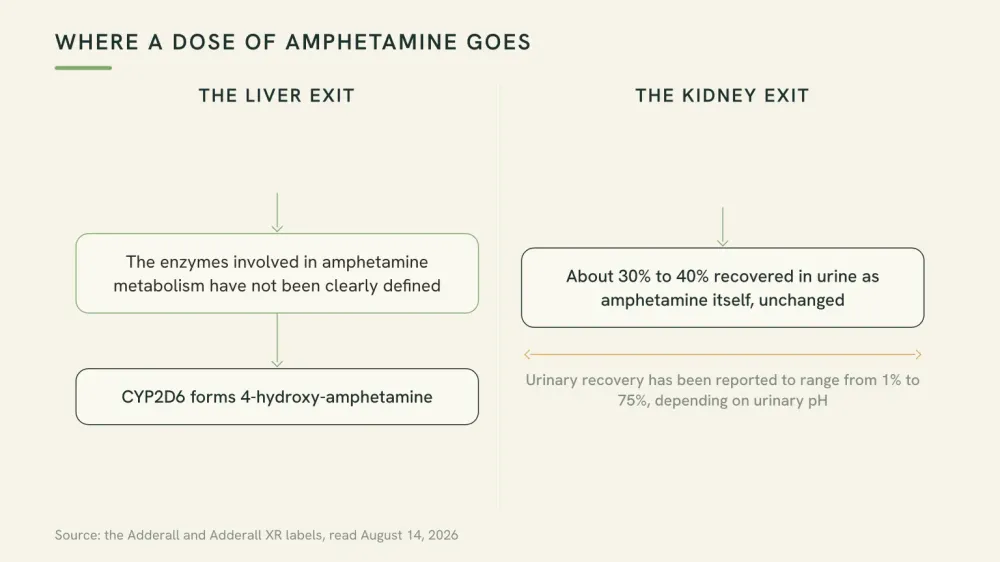
This is where the popular explanation goes specifically wrong, and the label corrects it in one sentence. Under CLINICAL PHARMACOLOGY on the immediate-release label, and at 12.3 on the extended-release one, the metabolism paragraph reads: Although the enzymes involved in amphetamine metabolism have not been clearly defined, CYP2D6 is known to be involved with formation of 4-hydroxy-amphetamine. Since CYP2D6 is genetically polymorphic, population variations in amphetamine metabolism are a possibility. Notice what is being credited and what is not. CYP2D6 is credited with one specific step, the formation of one metabolite. The label explicitly declines to say which enzymes do the rest. And at normal urine pH, roughly 30% to 40% of a dose is recovered in the urine as amphetamine itself, unchanged, having never been metabolized by anything. A snippet currently on the first page of results calls CYP2D6 the main enzyme responsible for the breakdown of amphetamine. The label it is describing says the enzymes have not been clearly defined, and those are not the same claim.
The polymorphism sentence matters more than it looks. CYP2D6 is one of the enzymes where people genuinely differ by genotype, and the label says so in order to warn that amphetamine handling varies across a population. Hold onto that, because the one human study on the CBD side of this question removed exactly those people from its analysis.
The same section also contains the best in vitro lesson in this whole article, and it is about amphetamine rather than CBD. In vitro experiments with human microsomes, the label reports, indicate minor inhibition of CYP2D6 by amphetamine itself, and minor inhibition of CYP1A2, 2D6 and 3A4 by one or more of its metabolites. Then it refuses to carry that forward: due to the probability of auto-inhibition and the lack of information on the concentration of these metabolites relative to in vivo concentrations, no predications regarding the potential for amphetamine or its metabolites to inhibit the metabolism of other drugs by CYP isozymes in vivo can be made. The spelling of predications is the label's. That is a regulator-approved document declining to turn a glassware result into a statement about people, on its own molecule, and it is the standard the rest of this page holds CBD to.
One more correction, and it is the cheapest to check. The mechanism nearly every CBD page reaches for is CYP3A4. We downloaded the current label for four stimulants and for the FDA-approved cannabidiol medicine on August 14, 2026 and searched each concatenated document case-insensitively. CYP3A4 appears zero times on all four stimulant labels. It appears 13 times on the cannabidiol label. The enzyme the internet keeps invoking is real, and it is on the wrong document.
| String searched | Adderall (Teva) | Adderall XR (Takeda) | Vyvanse (Takeda) | Ritalin (Novartis) | Epidiolex (Jazz) |
|---|---|---|---|---|---|
| CYP2D6 | 9 | 11 | 6 | 0 | 0 |
| CYP3A4 | 0 | 0 | 0 | 0 | 13 |
| cannabidiol or CBD | 0 | 0 | 0 | 0 | not applicable |
| cannabis, marijuana or hemp | 0 | 0 | 0 | 0 | 0 |
| grapefruit | 0 | 0 | 0 | 0 | 0 |
| urinary pH | 2 | 3 | 2 | 0 | 0 |
The determinant nobody on page one mentions: urine pH
Here is the paragraph that is free for the taking and that none of the page-one results we read on August 14, 2026 prints. Amphetamine has a pKa of 9.9, which in plain terms means how much of it is charged, and therefore how much the kidney can hold onto, depends heavily on how acidic your urine is. The label spells out the consequence: alkaline urine pHs result in less ionization and reduced renal elimination, and acidic pHs and high flow rates result in increased renal elimination. Then it prints the number that makes the point unanswerable. Urinary recovery of amphetamine has been reported to range from 1% to 75%, depending on urinary pH. That is the same molecule, the same dose, and a seventy-five-fold spread in how much leaves by the renal route, driven by something no interaction table can control for.
The label does not leave that abstract. Its interaction table names Acidifying Agents, whose stated effect is to lower blood levels and efficacy of amphetamines, and Alkalinizing Agents, which increase blood levels and potentiate the action of amphetamine. Section 2.7 of the extended-release label goes further and names the household example: acidifying agents, for example ascorbic acid, decrease blood levels. The same table also reports that with a proton pump inhibitor, omeprazole is the example given, the time to maximum concentration of amphetamine is decreased compared with the drug given alone. And the interaction entry for alkalinizing agents carries an instruction: co-administration of Adderall and gastrointestinal alkalinizing agents should be avoided. That instruction, like the CYP2D6 one, is written to prescribers. It is not this article telling you to change what you eat, drink or supplement, and you should not read it that way.
What it does give you is the reason a very common piece of evidence is worthless. When somebody writes that their stimulant felt different on the day they took CBD, that observation has a long list of candidate causes sitting on the label itself: vitamin C, an antacid, a reflux medicine, what they ate, how much they drank, and how much of the dose left through the kidney rather than the liver that day. A single changed day cannot distinguish between them. Neither can a hundred anecdotes collected from people who were not measuring urine pH, which is every anecdote you will find online.
The label's interaction table, with the column nobody adds
Below is the label's interaction list, rendered honestly. Each row carries one named class, the label's own stated effect for it, and a last column that is the entire point of the exercise: whether CBD has ever been measured against that entry. The extended-release label's Table 4 has exactly seven rows. The immediate-release label's list is longer and adds entries the newer table dropped, among them Antihistamines, Antihypertensives, Lithium Carbonate, Meperidine, Methenamine Therapy and Veratrum Alkaloids. Two products of the same molecule, two interaction tables of different length, one identical CYP2D6 entry. That is normal, it is what happens when labels are written decades apart under different formatting rules, and it is worth knowing before you treat any single table as the complete answer.
| Named class, the label's own heading | The label's own stated effect | Measured against CBD? |
|---|---|---|
| MAO Inhibitors | Concomitant use of MAOIs and CNS stimulants can cause hypertensive crisis; contraindicated within 14 days | No |
| Serotonergic Drugs | Increases the risk of serotonin syndrome | No |
| CYP2D6 Inhibitors | May increase the exposure of Adderall and increase the risk of serotonin syndrome | No |
| Acidifying Agents | Lower blood levels and efficacy of amphetamines | No |
| Alkalinizing Agents | Increase blood levels and potentiate the action of amphetamine; co-administration should be avoided | No |
| Tricyclic Antidepressants | Striking and sustained increases in the concentration of d-amphetamine in the brain | No |
| Proton Pump Inhibitors | Time to maximum concentration of amphetamine is decreased compared to when administered alone | No |
| Antihistamines | Amphetamines may counteract the sedative effect of antihistamines | No |
| Antihypertensives | Amphetamines may antagonize the hypotensive effects of antihypertensives | No |
| Lithium Carbonate | The anorectic and stimulatory effects of amphetamines may be inhibited by lithium carbonate | No |
Is CBD a CYP2D6 inhibitor? Four documents, in order
Start with what the phrase means to a regulator, because the label's entry is a regulatory category and not a figure of speech. FDA maintains a reference table of substrates, inhibitors and inducers for drug development, and it defines the tiers by measurement: strong and moderate inhibitors are drugs that increase the AUC of sensitive index substrates of a given metabolic pathway at least 5-fold and at least 2-fold to under 5-fold, respectively. Its clinical index inhibitors of CYP2D6 are fluoxetine and paroxetine as strong, and mirabegron as moderate. Its sensitive index substrates for CYP2D6 are desipramine, dextromethorphan and nebivolol, and amphetamine is not among them. The word cannabidiol appears zero times on that page, read the same day. Two limits belong in this paragraph and not in a footnote: FDA states plainly that the table is not intended to be an exhaustive list, so being absent from it is not a clearance, and those classifications describe fluoxetine and paroxetine, not CBD. Nothing measured with those two drugs transfers here.
Second document, and it is the one that surprised us. The FDA-approved cannabidiol prescribing information, version 35, has a section devoted to the effect of cannabidiol on other drugs, and it enumerates what prescribers should watch: clobazam, stiripentol, orally administered P-glycoprotein substrates, and substrates of CYP1A2, CYP2B6, CYP2C8, CYP2C19 and UGT1A9. Its in vitro assessment section adds that cannabidiol has the potential to inhibit CYP2B6 and CYP2C8, and to induce CYP2B6, at clinically relevant concentrations. Searched case-insensitively on August 14, 2026, the string CYP2D6 appears zero times in that entire label. The regulator has read the cannabidiol dossier in detail, has listed five enzymes and a transporter by name, and did not put cannabidiol in the class the Adderall label warns about. The limit, in the same paragraph: that label describes a prescription medicine given at milligram-per-kilogram doses for specific seizure disorders. It is a statement about that drug at those doses, not a safety finding about a consumer hemp product.
Third, a human experiment that put a CYP2D6 probe drug and a large CBD dose into the same people. A 2023 study in Clinical Pharmacology and Therapeutics gave 18 healthy adults, in a double-blind randomized crossover with arms at least a week apart, a brownie containing either placebo, a CBD-dominant cannabis extract with 640 mg CBD and 20 mg THC, or a THC-dominant extract, and then 30 minutes later a validated five-drug probe cocktail: 100 mg caffeine for CYP1A2, 25 mg losartan for CYP2C9, 20 mg omeprazole for CYP2C19, 30 mg dextromethorphan for CYP2D6 and 2 mg midazolam for CYP3A. In the authors' words, the CBD and THC brownie inhibited CYP2C19 greater than CYP2C9 greater than CYP3A greater than CYP1A2, but not CYP2D6, with probe exposure increases of 207%, 77%, 56% and 39% respectively, and it had no effect on dextromethorphan's AUC, peak concentration or half-life. Four limits belong in this same paragraph. It never gave anyone amphetamine, and dextromethorphan is a probe rather than a stimulant. Two participants were identified as CYP2D6 poor metabolizers and excluded from further analysis, so the CYP2D6 result is n = 16 and the people removed are precisely the population the Adderall label's polymorphism sentence is about. It was a single dose of a cannabis extract containing THC, not isolated CBD. And 640 mg in one sitting is not a consumer serving of anything. The authors' own study highlights record the honest headline: the in vitro literature had predicted CBD would inhibit CYP2D6, and in people it did not.
Fourth, the counterweight, and it is glassware. A 2011 paper in Drug Metabolism and Disposition titled cannabidiol as a potent atypical inhibitor for CYP2D6 tested recombinant CYP2D6 and pooled human liver microsomes in vitro and found CBD the most potent of the three major cannabinoids examined, with an IC50 of 6.52 micromolar against the range of 4.01 to 24.9 micromolar across the cannabinoids tested, and competitive inhibition with an apparent Ki of 1.16 to 2.69 micromolar. That is where the whole popular claim comes from. It is also, in the same sentence, an in vitro experiment: no person, no swallowed dose, no amphetamine and no blood level anywhere in it, and the human probe study above did not reproduce it.
There is one more human record, and it is a single case report, which is what it must be called in the same breath as its finding. A 2022 report in the Journal of Clinical Psychopharmacology proposes a potential drug-gene-drug interaction between cannabidiol, a CYP2D6 gene variant known as star-4, and fluoxetine. The PubMed and Europe PMC records carry the title, authors and DOI but no abstract, and the publisher's page is paywalled, so what can responsibly be said about it comes from a 2023 review in the European Journal of Internal Medicine that describes it and classifies it as a case report: two patients received CBD together with fluoxetine, only one had severe adverse events, and in that patient, who carried two copies of the star-4 variant, the authors propose the three-way interaction. Every limit that matters is in that sentence. It is one patient. The other drug is fluoxetine, which FDA already classifies as a strong CYP2D6 inhibitor in its own right, and nothing measured with fluoxetine can be attributed to CBD. The genotype is a specific one, named in the report's own title, and this page makes no claim about how common it is. And the authors' own word for the interaction is potential.
Put those four documents in a line and you get an answer that is neither of the two on offer. The class warning on the stimulant's label is real and it is not decorative. CBD's membership in that class is not established in people: one in vitro paper says yes, the human probe study described above says no for that probe, the regulator's own cannabidiol label does not list the enzyme at all, and one single case report describes a patient on a different drug with a specific genotype. That is a genuinely unresolved question, and a page that resolves it for you in either direction has told you something the evidence does not contain.

The serotonin-syndrome list is not a CBD list
The CYP2D6 entry points at serotonin syndrome, so it is worth reading the section it points to. This is the warning that tells you which drugs a prescriber is actually watching when they think about this risk, and it is printed in full on both labels.
“Serotonin syndrome, a potentially life-threatening reaction, may occur when amphetamines are used in combination with other drugs that affect the serotonergic neurotransmitter systems such as monoamine oxidase inhibitors (MAOIs), selective serotonin reuptake inhibitors (SSRIs), serotonin norepinephrine reuptake inhibitors (SNRIs), triptans, tricyclic antidepressants, fentanyl, lithium, tramadol, tryptophan, buspirone, and St. John's Wort.”
Count the names on that list and then notice which one is missing. Eleven drugs and drug classes are named, and CBD is not one of them, nor is any cannabinoid, nor is any botanical other than St. John's Wort. Three of the eleven are pages we have already worked through from their own primary documents: lithium, which turns up twice on this one label, once here and again as its own interaction row, and the SSRIs sitting on that same list. Buspirone is on the list too. The section ends with a sentence written to prescribers, not to patients: in these situations, consider an alternative non-serotonergic drug or an alternative drug that does not inhibit CYP2D6. That is a prescribing decision made by the person holding your chart, which is exactly why the instruction on this page is to tell them, and never to act.
The symptoms are worth knowing regardless of what else you take, because serotonin syndrome is a medical emergency and the label groups them clearly. These are its own categories and its own examples.
- Mental status changes, for example agitation, hallucinations, delirium and coma.
- Autonomic instability, for example a fast heart rate, swings in blood pressure, dizziness, sweating, flushing and a raised body temperature.
- Neuromuscular symptoms, for example tremor, rigidity, muscle jerks, exaggerated reflexes and loss of coordination.
- Seizures.
- Gastrointestinal symptoms, for example nausea, vomiting and diarrhea.
- If several of these appear together, this is an emergency. Call 911 in the United States, or your local emergency number.
Which one is causing this? The overlapping effects
One reason people misread their own experience here is that the two substances have effects with the same names. This is an attribution problem, not an incidence comparison, and the table below should be read that way: it puts two labels side by side, names the section each word appears in, and says nothing at all about how often anything happens. Read the sections as carefully as the words, because the overlap is smaller than it looks. Two of the five rows are named on both labels, one is named on both but in different sections, and two are named on only one of them. The reactions in the cannabidiol column come from controlled trials of a prescription medicine at milligram-per-kilogram doses in severe epilepsy, which is not what a consumer product delivers or how it is used.
| Effect | On the stimulant's label | On the FDA-approved cannabidiol label |
|---|---|---|
| Decreased appetite | Anorexia and weight loss may occur as undesirable effects, in ADVERSE REACTIONS | Decreased appetite, in 6.1 |
| Diarrhea | Diarrhea, in ADVERSE REACTIONS | Diarrhea, in 6.1 |
| Disturbed sleep | Insomnia is named in the label's dosage guidance, not in its ADVERSE REACTIONS list | Insomnia, sleep disorder and poor quality sleep, in 6.1 |
| Dry mouth | Dryness of the mouth, and unpleasant taste, in ADVERSE REACTIONS | Not among the most common reactions enumerated in 6.1 |
| Fatigue | Not listed in ADVERSE REACTIONS on this label | Fatigue, malaise and asthenia, in 6.1 |
That overlap has a practical consequence: if something changes after you add a product, the change does not come with a label on it. The stimulant side is on the prescription's own document, the CBD side is covered in the effects CBD itself reports, and appetite in particular belongs to the appetite question on the CBD side rather than to this page. Two other numbers from the stimulant's own label belong here for context and nowhere else: CNS stimulants cause an increase in blood pressure, a mean increase of about 2 to 4 mm Hg, and heart rate, a mean increase of about 3 to 6 bpm, and the label adds that some patients may have larger increases. Those are the stimulant's figures, not a comparison with anything, and what the blood pressure question actually turns on is a separate page with its own evidence.
One line from the same label belongs here without commentary. Adderall carries a boxed warning, the strongest warning FDA uses, which states that it has a high potential for abuse and misuse, which can lead to the development of a substance use disorder, including addiction. That is a fact about the prescription, printed by its manufacturer. What the dependence record on CBD actually says is a different body of evidence on a different page, and putting the two in the same paragraph is not an argument that one substitutes for the other. Nothing on this page suggests replacing, reducing or delaying a prescribed medicine, and a hemp product is not a stand-in for one.
Why CBD and Adderall is not the same question as CBD and Ritalin
People searching this question often hold a different prescription, and the three most common ones do not share an answer. Vyvanse is the interesting case: its own label says lisdexamfetamine is not metabolized by cytochrome P450 enzymes, and that it is converted to dextroamphetamine and l-lysine primarily in blood due to the hydrolytic activity of red blood cells. And yet that label still carries a CYP2D6 Inhibitors entry, because the entry is about exposure to dextroamphetamine, the active metabolite of Vyvanse. The prodrug bypasses the liver on its way in; the drug it becomes does not. Ritalin is a different molecule with a different exit: methylphenidate is metabolized primarily by de-esterification to ritalinic acid, which has little or no pharmacologic activity, and the string CYP does not appear anywhere in that label. So CBD and Ritalin and CBD and Adderall are not the same question, because methylphenidate's label does not name a liver enzyme at all.
| Stimulant | What its own label says about clearance | Carries a CYP2D6 Inhibitors entry? | Measured against CBD? |
|---|---|---|---|
| Adderall and Adderall XR (mixed amphetamine salts) | The enzymes involved in amphetamine metabolism have not been clearly defined; CYP2D6 forms 4-hydroxy-amphetamine; 30% to 40% recovered unchanged in urine | Yes | No |
| Vyvanse (lisdexamfetamine) | Not metabolized by cytochrome P450 enzymes; converted to dextroamphetamine in blood by the hydrolytic activity of red blood cells | Yes, and it is about the active metabolite, dextroamphetamine | No |
| Ritalin (methylphenidate) | Metabolized primarily by de-esterification to ritalinic acid, which has little or no pharmacologic activity | No; the string CYP appears zero times in the whole label | No |
What has been searched for, and what came back empty
A claim that nothing has been studied is a claim about an entire literature, so here are the searches, with the date, so you can rerun them. On PubMed on August 14, 2026: cannabidiol AND amphetamine returned 80 records, and 34 with both terms restricted to titles and abstracts. cannabidiol AND CYP2D6 returned 16, and 15 restricted to titles and abstracts. cannabidiol AND dextroamphetamine returned 6. cannabidiol AND lisdexamfetamine returned 1. cannabidiol and methylphenidate together in titles and abstracts returned 7, and 3 when narrowed to pharmacokinetics or interaction. And the load-bearing one: cannabidiol, amphetamine and pharmacokinetics, all three restricted to titles and abstracts, returned zero records. Nobody has measured what CBD does to amphetamine blood levels in a human being.
The counts are only publishable because we opened what is inside them. Of the six cannabidiol AND dextroamphetamine records, one is a 2023 bioinformatics paper on cocaine addiction, one is a 2005 mouse study, and four are papers from 1975 and 1976 about THC, marihuana and learning. The single clinical study in the set is a 1976 crossover in Clinical Pharmacology and Therapeutics that gave subjects 10 mg per 70 kg of dextroamphetamine and a marihuana cigarette delivering 50 micrograms per kg of THC, and reported that heart rate and blood pressure increased in an additive manner. Fifty years later that remains the closest thing to a human co-administration study, and it contains no cannabidiol at all: it is smoked marihuana, in 1976. The broader picture is mapped by a 2022 scoping review in Psychopharmacology, which searched four databases for cannabinoid and amphetamine co-exposure from 2000 to 2020 and found 25 articles, 15 preclinical and 10 human. Its human studies assessed natural ongoing cannabis and methamphetamine use or dependence and showed, in the authors' words, mostly enhanced harms across a range of outcomes. Read the limit with it: that is non-medical amphetamine and methamphetamine use, mostly whole cannabis rather than isolated CBD, and none of it is about a prescribed stimulant taken as directed.
Which brings us to the sentence the category is built on, and the correction this page owes you. The most-repeated claim about this pair is that CBD takes the edge off a stimulant: the jitters, the anxiety, the appetite, the crash. No human study has measured whether CBD changes how a prescribed stimulant feels, and this page will not claim that it does. That is not a hedge and it is not softened with may. It is the result of the searches printed above, run and dated, and if any page tells you otherwise, ask it for the trial.
What to tell your prescriber
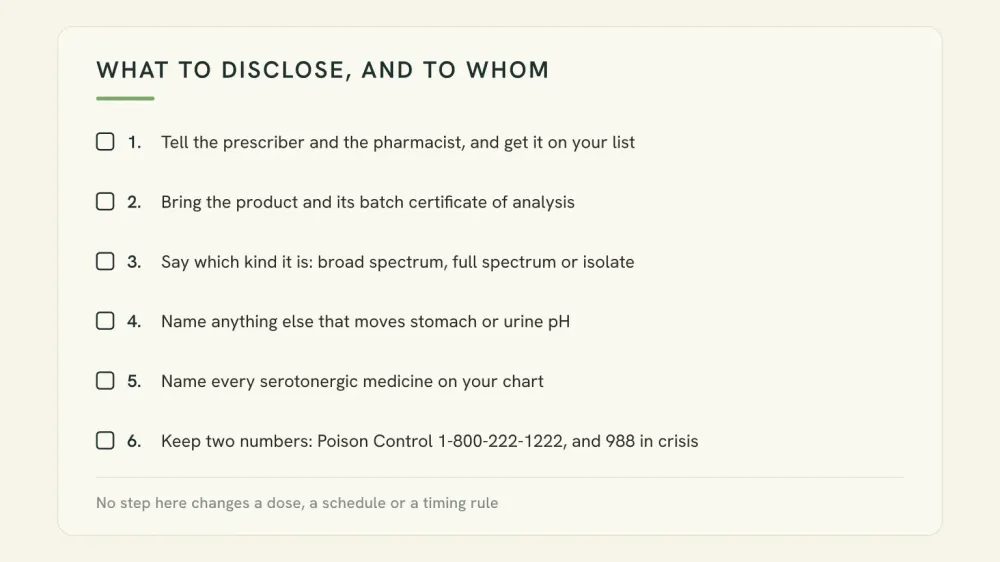
There is exactly one action this evidence supports, and it is not a schedule, a gap or a smaller amount of anything. It is telling the person who wrote the prescription. Here is what makes that conversation useful instead of vague.
- 1Say it out loud to the clinician who prescribes the stimulant and to the pharmacist who fills it, and ask for it to go on your medication list in writing.
- 2Bring the actual product and its batch certificate of analysis, or photographs of both. A concentration and a batch number are things a pharmacist can work with. The words CBD oil are not.
- 3Say which kind it is: broad spectrum, full spectrum or isolate. Full-spectrum products carry trace THC below the federal 0.3% limit, and that is a separate question your prescriber may care about.
- 4List everything else you take that moves stomach or urine pH, including antacids, reflux medicines and vitamin C supplements, and let them decide whether any of it matters.
- 5List every serotonergic medicine on your chart. That is the list this label's warning is genuinely about, and your prescriber can read it faster than you can.
- 6Learn the serotonin-syndrome signs from your own label or Medication Guide, and know that several appearing together is an emergency.
- 7Change nothing on your own. No dose change, no skipped dose, no spacing rule, no timing trick, no trial period. The step this page supports is disclosure.
- 8Keep two numbers where you can find them: Poison Control at 1-800-222-1222, and 988 if you are in crisis. In the United States both are free and confidential.
The certificate of analysis matters more than the brand name, because it is the document that says what is actually in the bottle. For scale, and as a fact rather than a recommendation: a Planntz tincture is 60 mL of coconut MCT oil at 250 mg/mL on the Broad and Full Spectrum products, which is 15,000 mg per bottle and roughly 12.5 mg per drop, with a public per-batch certificate for each one. Put that next to the 640 mg single dose used in the human probe study, or next to milligram-per-kilogram prescription dosing, and you can see why numbers from one context cannot be carried into another. This page publishes no serving suggestion at all; every amount question belongs to our page on amounts. Two more boundaries while we are here: an amphetamine-positive result on a workplace screen is a prescription-disclosure question for the medical review officer who reviews the result, and whether a hemp product can affect a THC screen is a different question answered in how CBD and drug testing actually work; and if you were sent here from the caffeine question, that one runs through a different enzyme entirely, which is why the other stimulant question, which runs through CYP1A2, has its own page.
What this page cannot tell you
The honest list of gaps here is longer than the list of findings, and pretending otherwise would be the same failure the first page of results already commits. Nobody has given a person a CBD product and a prescribed amphetamine and then measured the amphetamine, so there is no exposure ratio, no threshold, no incidence figure and no waiting interval on this page, because none exists to print. Silence in a label cuts both ways too: cannabidiol appears zero times on the stimulant labels and CYP2D6 appears zero times on the cannabidiol label, and those are facts about what has been submitted to and reviewed by a regulator, not findings about what happens inside a body. The genotype question is open in a way that matters, since that human probe study excluded its poor metabolizers and the stimulant's own label says population variations in amphetamine metabolism are a possibility. And the effect question is not open so much as unasked: no human trial of CBD alongside a prescribed stimulant turned up in any of the dated searches printed above. If cannabidiol itself is new to you, start with what cannabidiol is and is not, then come back to the label.
That is a question for the person who wrote the prescription, and it is a reasonable one to raise at the next appointment. What can be said from the documents is this: the Adderall label carries a named CYP2D6 Inhibitors entry with an instruction written for prescribers, it does not name CBD, and a PubMed search on August 14, 2026 for cannabidiol, amphetamine and pharmacokinetics restricted to titles and abstracts returned zero records. So the class warning is real and CBD's place in the class has not been measured in people. Disclose it; do not start, stop or change anything on the strength of a web page, including this one.
Nobody has measured it. In the human study described on this page, which gave a CYP2D6 probe drug and a large CBD dose to the same 18 healthy adults, the CYP2D6 probe did not move, while four other enzyme probes did, and the CYP2D6 analysis was n equals 16 because two poor metabolizers were excluded. Against that sits one in vitro paper, in glassware, calling CBD a potent CYP2D6 inhibitor, and one single case report in a patient with a specific genotype who was taking fluoxetine rather than a stimulant. None of that is a measurement of amphetamine exposure in a person.
There is no human measurement of that either. It is worth knowing that the label prints two entries pointing in opposite directions, one for acidifying agents that lower blood levels of amphetamines and one for alkalinizing agents that raise them, and that urinary recovery of amphetamine has been reported to range from 1% to 75% depending on urine pH. So a day that feels weaker or stronger has many candidate causes already printed on the prescription's own document, and one changed day cannot tell them apart.
No. Adderall is a Schedule II prescription medicine whose label carries a boxed warning stating that it has a high potential for abuse and misuse, which can lead to the development of a substance use disorder, including addiction. Nothing on this page suggests replacing, reducing or delaying it, and no human trial of CBD alongside or instead of a prescribed stimulant turned up in the dated searches printed on this page. Decisions about a prescription belong to the clinician who wrote it.
They are different questions. Vyvanse's own label says lisdexamfetamine is not metabolized by cytochrome P450 enzymes and is converted to dextroamphetamine in blood by the hydrolytic activity of red blood cells, yet it still carries a CYP2D6 Inhibitors entry because that entry is about the active metabolite. Ritalin's label says methylphenidate is metabolized primarily by de-esterification to ritalinic acid, and the string CYP appears zero times in the whole document. None of the three has been measured against CBD in any human study that turned up in the dated PubMed searches printed on this page, run on August 14, 2026.
This page does not analyze drug testing, and it will not guess. What can be said is that an amphetamine-positive result on a workplace screen is a prescription-disclosure question handled by the medical review officer who reviews the result, and that whether a hemp product can affect a THC screen is an entirely separate question with a separate answer, which our page on CBD and drug testing covers in detail.
Because the label says something adjacent to it, and this is descriptive rather than advice. Amphetamine has a pKa of 9.9, and the label states that alkaline urine leads to reduced renal elimination while acidic urine and high flow rates increase it, with urinary recovery reported to range from 1% to 75% depending on urinary pH. The extended-release label names ascorbic acid as an example of an acidifying agent that decreases blood levels, and the interaction table tells prescribers that co-administration with gastrointestinal alkalinizing agents should be avoided. Those are instructions to prescribers about a prescription, not instructions from us about your diet.
Writing about hemp, wellness and the small rituals that keep us balanced.