
CBD and Lithium: Why the Usual Enzyme Explanation Is Wrong
Page one says CBD blocks the liver enzymes that clear lithium. Lithium's FDA label contains the words CYP, cytochrome and P450 exactly zero times, and says in four words that lithium is not metabolized. Here is the mechanism the label does describe instead.

If you search CBD and lithium, the first thing you are likely to read is that CBD blocks or desensitizes the liver enzymes that break down lithium, and can therefore push you toward lithium toxicity. That explanation cannot be true, and it is checkable in one search of a federal document. Read on August 13, 2026, the FDA prescribing information for lithium carbonate contains the words CYP, cytochrome and P450 exactly zero times, and its pharmacokinetics section answers the question in four words: lithium is not metabolized.
There is a real question underneath the wrong answer, and it is a better question. Lithium leaves the body through the kidney, in a process the label describes in the language of fluid and salt, and the label names diarrhea by name as one of the things that can tip a person into toxicity. Diarrhea is also a well-documented adverse effect in the controlled trials behind the FDA-approved cannabidiol medicine, and the rate there rose with the dose. That makes a pathway thinkable. It does not make it measured, and this page will be careful about the difference all the way through. If you want the general framework first, it lives on our guide to CBD and prescription medications, and this article explains why that framework does not reach this drug.
The mechanism the internet gives you does not exist
Here is the check, stated so you can run it yourself. We downloaded the full structured product label for lithium carbonate tablets, capsules and oral solution from DailyMed, the National Library of Medicine's label archive, and searched the concatenated text of the whole document case-insensitively, counting one hit per match. The label is Hikma Pharmaceuticals USA, version 28, and we ran the same search on a second generic from Sun Pharmaceutical and on the brand label, Lithobid, so that nothing here rests on one manufacturer's document. CYP: zero, on all three. Cytochrome: zero. P450: zero. Unchanged: zero. Narrow: zero. Cannabidiol, cannabis, marijuana, hemp and CBD: zero. Renal: 35 hits on each of the two generics. Sodium: 25 on the Hikma label. Diarrhea: 10 on both generics. The full table is below, one column per label, because a count is only worth printing next to the document it came from.
| String searched | Hikma v28 | Sun v9 | Lithobid v12 |
|---|---|---|---|
| CYP | 0 | 0 | 0 |
| cytochrome | 0 | 0 | 0 |
| P450 or P-450 | 0 | 0 | 0 |
| unchanged | 0 | 0 | 0 |
| liver (as a whole word) | 0 | 0 | 0 |
| hepatic | 2 | 2 | 2 |
| enzyme | 1 | 1 | 1 |
| narrow | 0 | 0 | 0 |
| cannabidiol, cannabis, hemp, CBD | 0 | 0 | 0 |
| renal | 35 | 35 | 15 |
| kidney | 13 | 13 | 4 |
| sodium | 25 | 20 | 13 |
| diarrhea | 10 | 10 | 7 |
| caffeine | 0 | 0 | 0 |
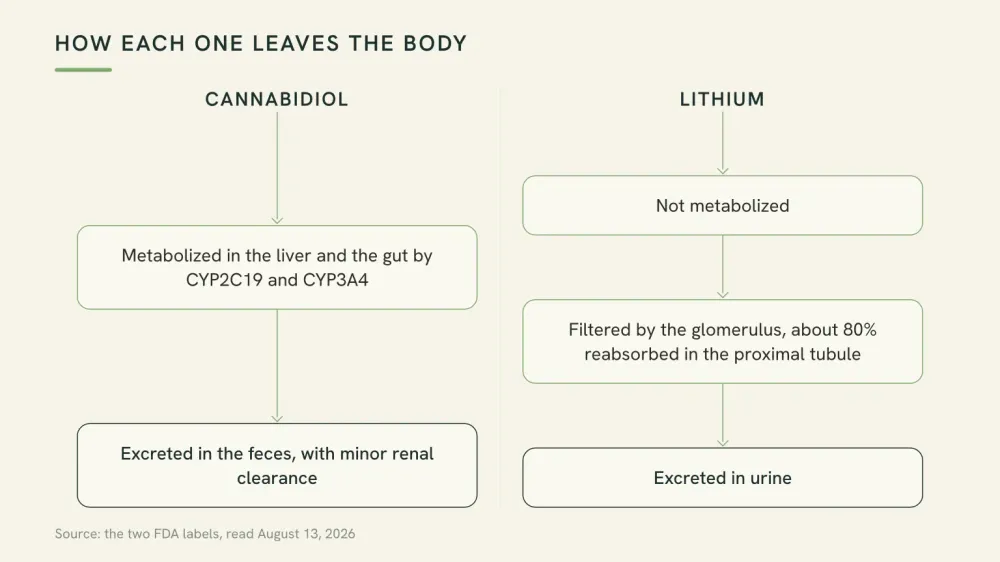
Two traps are hiding in that table, and both are worth your time because they are how a check like this goes wrong. First, a naive search for liver returns five hits on the two generic labels, which looks like it disproves the whole point. All five are inside the word delivery, in the pregnancy sections. Search for liver as a whole word and the count is zero. Second, the single hit for enzyme is not a metabolic pathway at all: it sits in section 5.5, Encephalopathic Syndrome, in a list of laboratory findings that reads elevated serum enzymes, BUN and fasting blood glucose. The two hits for hepatic are in the pregnancy section, about neonates, and in the geriatric section, in standard boilerplate about decreased hepatic, renal, or cardiac function in older patients. Neither is about how lithium itself is cleared. The contrast with the other molecule in this question is total: cannabidiol's own FDA label reports that cannabidiol is metabolized in the liver and the gut by CYP2C19 and CYP3A4, and excreted in the feces, with minor renal clearance. Lithium's label, for its part, is not being coy about any of this. It states the situation directly in section 12.3, under the heading Metabolism, and the entire entry is four words.
“Lithium is not metabolized.”
What lithium's label actually warns about
The label opens with a boxed warning, the strongest warning the FDA uses, and its first sentence is the reason this whole topic deserves care: Lithium toxicity is closely related to serum lithium concentrations, and can occur at doses close to therapeutic concentrations. Section 5.1 puts numbers on that. Toxic concentrations start at 1.5 mEq/L, and the therapeutic range is 0.8 to 1.2 mEq/L. It then adds a sentence that matters more than the numbers: Some patients abnormally sensitive to lithium may exhibit toxic signs at serum concentrations that are considered within the therapeutic range. You will often see this summarized as lithium having a narrow therapeutic index. That phrase is accurate, but it is not the label's; the word narrow appears zero times in it. It comes from the clinical literature, including the StatPearls chapter on lithium toxicity on the NCBI Bookshelf, which also notes that renal excretion is lithium's only clinically meaningful elimination pathway.
Section 12.3 explains what that pathway is, in plain enough language to quote. Lithium is filtered by the glomerulus, and 80% is reabsorbed by passive diffusion in the proximal tubule. Its elimination half-life is approximately 18 to 36 hours. Its distribution space approximates that of total body water, and its plasma protein binding is negligible. Read that against the same StatPearls chapter, which describes tubular sodium-coupled reabsorption and states that even minor changes in volume status, renal perfusion, or sodium balance can produce clinically significant changes in serum lithium concentrations. In other words, the proximal tubule is the stretch of kidney that reclaims sodium, and it reclaims lithium alongside it. Dehydrate a person, or drop their sodium, and the kidney holds onto more lithium. That chapter also makes the blunt point that lithium toxicity most commonly results from reduced renal clearance rather than excessive ingestion. It is usually not about the dose. It is about the exit.
- Recent onset of concurrent febrile illness. These are the label's own risk factors for lithium toxicity, quoted from section 5.1.
- Concomitant administration of drugs which increase lithium serum concentrations by pharmacokinetic interactions or drugs affecting kidney function.
- Acute ingestion, and impaired renal function.
- Volume depletion or dehydration.
- Significant cardiovascular disease.
- Changes in electrolyte concentrations, especially sodium and potassium.
Section 7.1 carries the interaction table, and it has twelve rows: diuretics, NSAIDs, renin-angiotensin system antagonists, serotonergic drugs, nitroimidazole antibiotics, the acetazolamide and urea and xanthine and alkalinizing agents group, methyldopa with phenytoin and carbamazepine, iodide preparations, calcium channel blockers, antipsychotics, an SGLT2 inhibitor row, and neuromuscular blocking agents. Five of those twelve state a renal or urinary mechanism in their own words. None states a metabolic one, which is exactly what you would expect of a drug that is not metabolized. The NSAID row reads: NSAID decrease renal blood flow, resulting in decreased renal clearance and increased serum lithium concentrations. That is a real, labelled lithium interaction, and it is worth knowing about if you also reach for an over-the-counter painkiller, a separate question covered in what we found on CBD and ibuprofen.
Where CBD could plausibly touch that, and how big the claim is
Now the connection nobody on page one has made, and it comes entirely out of the label's own text. Diarrhea appears ten times in the lithium document. Two of those places carry the argument. In the Highlights of Prescribing Information, the Warnings and Precautions bullet that cross-references section 5.3 reads: Dehydration from protracted sweating, diarrhea, or elevated temperatures from infection increases risk of hyponatremia and lithium toxicity. Educate patients on maintaining a normal diet with salt and staying hydrated. The body of section 5.3 says something related and different: Lithium can cause hyponatremia by decreasing sodium reabsorption by the renal tubules, leading to sodium depletion, and then, Decreased tolerance to lithium has also been reported to ensue from protracted sweating or diarrhea. The label is not being hypothetical there. It is telling prescribers that losing fluid and salt through the gut is a route into toxicity.
And diarrhea is a well-documented, dose-related adverse effect of cannabidiol where it has been studied properly. In the placebo-controlled trials behind that same FDA-approved cannabidiol label, diarrhea was reported by 20% of patients on the 20 mg/kg/day arm (238 patients) and 9% on the 10 mg/kg/day arm (75 patients), against 9% on placebo (227 patients). Read the size of that honestly, in four parts. Those are children and young adults with severe epilepsy taking a prescription medicine at milligram-per-kilogram doses alongside other antiseizure drugs, which is not what a consumer hemp product delivers or how it is used. On the lower arm the rate was the same as placebo. Even on the higher arm, four in five patients did not report it. And no incidence figure for consumer CBD is printed here, because we have not re-read one. The effect itself belongs to the page that covers what CBD does to digestion, alongside the side effects CBD actually reports. What the two labels give you is a pathway on paper, not a measurement.
The one case report, and what its full text says
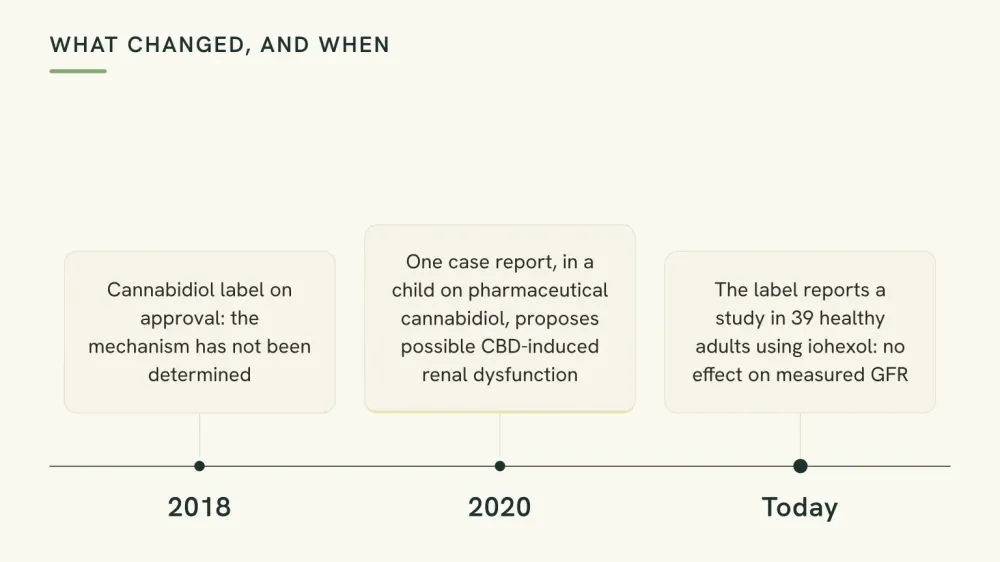
A single 2020 case report in Child Neurology Open, Drug-Drug Interactions Between Cannabidiol and Lithium, describes a 13-year-old boy on pharmaceutical cannabidiol who developed lithium toxicity. That case report is the entire clinical literature on the pair, and its full text says a great deal more than its abstract. The boy had autism, severe intellectual disability and Lennox-Gastaut syndrome, with epilepsy since 18 months of age, a full corpus callosotomy at 4, a frontal lobe resection at 7 and a vagus nerve stimulator at 11. His lithium, 1,500 mg a day, had been unchanged for over a year with stable and therapeutic levels, and it was prescribed for aggression. His cannabidiol was prescribed for seizures. It was started at 5 mg/kg/day, and he was fine for two weeks. Symptoms began soon after it was raised to 10 mg/kg/day: lethargy, weakness, unsteadiness and decreased oral intake. His lithium level came back at 2.4 mmol/L against a historic baseline of 1 to 1.3. Lithium was stopped, he was given twice-maintenance intravenous fluids, and he was discharged three days later at 0.6.
- It is one patient. A case report is a description, not a study: there is no control, no comparison group and no rate.
- His clobazam was being tapered in the same window, by 25% when cannabidiol started and to 50% of the original dose by the time symptoms appeared.
- He was also taking felbamate, perphenazine, quetiapine, trazodone and clonidine at the time.
- The cannabidiol was a pharmaceutical product at milligram-per-kilogram doses in a child, which is a different exposure from a consumer product in an adult.
- Decreased oral intake is itself a classic cause of lithium toxicity, and it was one of his presenting symptoms.
- His blood counts, electrolytes, liver enzyme levels and renal function tests on admission were all, in the authors' word, unremarkable.
The authors are careful in a way the search results are not. In their Discussion they write: While unlikely to spike his lithium so dramatically, in part this progressed because of reduced oral intake especially of fluids. The early stages of lithium toxicity likely provoked the reduced oral intake, though he continued to receive his medications. That is a loop, not an arrow. Reduced intake worsened the toxicity, and early toxicity reduced the intake. Their conclusion is hedged in the paper itself: they highlight an interaction possibly due to CBD-induced renal dysfunction, as reflected by increased creatinine levels. Those creatinine numbers are worth printing, because the abstract omits them. In this one child on pharmaceutical cannabidiol, creatinine was 0.6 mg/dL before it was started, 0.75 mg/dL two weeks after, and 0.64 mg/dL at discharge. The authors describe that as a 25% increase while also stating in the same paper that his creatinine levels were not abnormally elevated. Both sentences are theirs, and both belong in any summary of this case.
The kidney hypothesis has since been tested
This is the part none of the page-one results follows up, and it is fair to the authors rather than at their expense. When they wrote in 2020 that the creatinine rise might reflect kidney dysfunction, they were reading the label as it stood. The cannabidiol label as originally approved in 2018 says exactly this about the creatinine increase: The mechanism has not been determined. Its pharmacodynamics section, in full, reads: There are no relevant data on the pharmacodynamic effects of cannabidiol. The words mGFR and iohexol appear nowhere in it. The current label answers the question. Section 12.2 now reports a dedicated study in 39 healthy subjects given 7.5 mg/kg twice daily for 7 days, in which measured glomerular filtration rate was tracked using the clearance of iohexol, a probe used to measure filtration directly. Serum creatinine rose and estimated GFR fell by about 5%, and 24-hour creatinine clearance by about 10%, and yet measured filtration did not move. The label's conclusion: EPIDIOLEX did not affect mGFR, therefore the increase in serum creatinine is not due to a reduction in glomerular filtration rate. The limits are real. That is 39 healthy adults, for seven days, at one dose level, and it does not prove that nothing happens in a child on eight medicines. But the specific hypothesis in the case report has been tested and did not hold up as a drop in filtration.
What a search for CBD and lithium actually returns
Run the search yourself and print the date, because this is a moving number. On August 13, 2026, the PubMed query cannabidiol AND lithium returned 37 records. Counting rule, so nothing drifts: a record goes in the first category if the phrase lithium chloride or LiCl appears in its title or abstract. Fifteen of the 37 qualify, and in every one of them lithium chloride is the chemical researchers use to make an animal feel sick so that a cannabinoid can be tested against the nausea, in rats and in the house musk shrew. A representative title is Cannabidiolic acid prevents vomiting in Suncus murinus and nausea-induced behaviour in rats. Two more use lithium with pilocarpine to induce status epilepticus in rats. Six use a lithium salt as a laboratory reagent, and three are reviews that list lithium among many drugs. The remaining ten are indexed to the topic without naming lithium in their title or abstract, and most of those belong to the same rodent nausea series. Exactly one of the 37 describes a person taking both, and it is the 2020 case report above, in a 13-year-old on pharmaceutical cannabidiol. That one case also fills several slots on the first page of a web search, because the PubMed record and the publisher's full text are indexed separately and a drug-safety digest republished it in 2020, so the same patient can look like three findings.
That matters for what the search feels like from the reader's chair. Page after page of rat and shrew studies looks like a large literature on CBD and lithium, and it is a large literature on lithium being used as laboratory equipment. Nothing in it transfers to a person. And the absence of human data is not evidence of safety and not evidence of harm: it is evidence that nobody has asked the question.
The symptom overlap that makes this hard to judge at home
| Reported in controlled trials of pharmaceutical cannabidiol | Early signs of lithium toxicity, from lithium's Medication Guide |
|---|---|
| Diarrhea | Diarrhea |
| Somnolence | Drowsiness |
| Decreased appetite | Vomiting |
| Weak muscles | |
| Clumsiness | |
| Blurred vision | |
| Ringing in your ears | |
| Muscle twitching | |
| Abnormal heartbeat |
Look at the top of those two columns. Diarrhea is on both. Drowsiness and somnolence are the same symptom under two names. If you add a CBD product to lithium and then feel loose, foggy and off your food, nothing you can observe at home tells you which document you are reading. This page will not offer you a way to tell them apart, because there is not one: a serum lithium level settles it and nothing else does, and lithium's label already requires that monitoring exist. Section 8.6 is worth knowing for the same reason, since it states that when renal function is abnormal, the risk of lithium intoxication increases considerably. Section 5.1 adds a sentence people should hear once: No specific antidote for lithium poisoning is known. If you are here because you take a psychiatric medication and want the general ground covered, our page on CBD and sertraline and CBD and trazodone work through the same kind of question on drugs whose labels do describe metabolism.
What to do with this before you do anything else
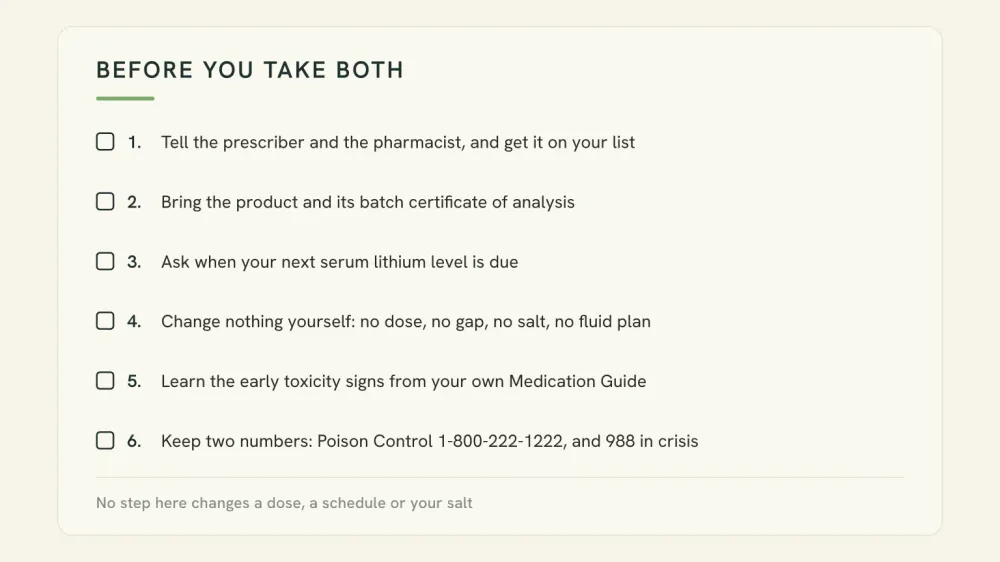
- 1Tell the person who prescribes your lithium, and tell the pharmacist who fills it. Say the words, and ask them to write it on your medication list.
- 2Bring the actual product and its batch certificate of analysis, or a photo of both. A pharmacist can work with a concentration and a batch number, and nobody can work with the words CBD oil.
- 3Ask about the monitoring your label already requires, including when your next serum lithium level and renal function tests are due.
- 4Change nothing yourself. No dose change, no skipped dose, no gap between the two, no extra salt, no less salt, no extra fluids as a workaround.
- 5Learn the early toxicity signs from your own Medication Guide, and know that vomiting, diarrhea, a fever or heavy sweating are the situations its warnings are written about.
- 6Keep two numbers where you can find them: Poison Control at 1-800-222-1222, and 988 if you are in crisis. In the United States, both are free and confidential.
Disclosure is the whole instruction here, and it is not our idea. Lithium's section 17 instructs prescribers to advise patients to inform their doctor and pharmacist if they are taking any over the counter medication, including herbal medication, or are started on a new prescription, and its Medication Guide repeats the request in patient language, naming herbal supplements. From the federal consumer side, NIH's National Center for Complementary and Integrative Health states that CBD use has been associated with liver injury, male reproductive harm, and interactions with other drugs, and adds a line that fits this page exactly: Don't use cannabis or cannabinoids to postpone seeing a health care provider about a medical problem. FDA's consumer update says that CBD can affect how other drugs you are taking work, potentially causing serious side effects. And if you ever need it, Poison Control is free, expert and confidential. The reason nothing here is a spacing rule or a fluid plan is that lithium's own Medication Guide forbids both moves in advance: Do not change the amount of salt in your diet, and, In some cases, drinking too much liquid can be as unsafe as not drinking enough. Fluid and salt on lithium are clinical decisions. If you want this reasoning applied to another drug the kidney clears, we worked it through for CBD alongside gabapentin.
What is still unknown
The list of things this page cannot tell you is longer than the list of things it can. Nobody has given a person a CBD product and lithium and then measured the lithium, so there is no exposure ratio, no threshold, no incidence figure and no waiting interval, which is why we published none. Label silence cuts both ways too: cannabidiol appears zero times in lithium's label and lithium appears zero times in the cannabidiol label, and that is a fact about what has been submitted to a regulator, not a finding about what happens in a body. Nor is the mechanism of the drug itself settled, since section 12.1 of the lithium label states that the mechanism of action of lithium as a mood stabilizing agent is unknown. One more label row deserves a sentence and no more: the acetazolamide, urea, xanthine preparations and alkalinizing agents row says concomitant use can lower serum lithium concentrations by increasing urinary lithium excretion. Caffeine is a methylxanthine, but the word caffeine appears zero times in this label, so that is a category note and not a caffeine warning; what is actually known about CBD and caffeine is a separate page. Finally, the frame this article refuses: nothing here says or implies anything about what CBD does for any condition lithium is prescribed for, and a hemp product is not a substitute for a prescribed medicine. If cannabidiol itself is new to you, start with what cannabidiol is and is not.
That is a question for the person who prescribes your lithium, and it is a reasonable one to raise. What can be said here is what the documents say: lithium's label requires serum monitoring and lists the things that change lithium concentrations, and the FDA-approved cannabidiol label reports diarrhea in its controlled trials. Nobody has measured the combination in people. Do not start, stop or change either one on the strength of a web page, including this one.
No, because there are none to block. Read on August 13, 2026, the FDA prescribing information for lithium carbonate contains the words CYP, cytochrome and P450 exactly zero times, on three manufacturers' versions, and section 12.3 says in four words that lithium is not metabolized. Lithium is an element, atomic number 3, and it leaves the body through the kidney. The cytochrome framework that governs most CBD drug-interaction questions has nothing to act on here.
Lithium's FDA-approved Medication Guide lists them for its own patients: abnormal heartbeat, vomiting, diarrhea, drowsiness, weak muscles, blurred vision, clumsiness, ringing in your ears and muscle twitching, and it tells patients to stop taking the medicine and call their healthcare provider right away if they occur. Gastrointestinal symptoms are often the earliest. Contact your prescriber, or Poison Control at 1-800-222-1222 in the United States. Some of those words also appear on cannabidiol's adverse-effect list, which is exactly why a serum level, not a guess, settles it.
Once, and it was not a study. A single case report published in 2020 describes a 13-year-old boy on pharmaceutical cannabidiol and six other medicines, with a clobazam taper running at the same time, who developed lithium toxicity. A PubMed search on August 13, 2026 for cannabidiol AND lithium returned 37 records, and that case report is the only one describing a person taking both. No trial of the combination was registered on ClinicalTrials.gov the same day.
Because in most of that literature, lithium chloride is the chemical researchers use to make an animal feel sick so a cannabinoid can be tested against the nausea, in rats and in the house musk shrew, and in two more records lithium is paired with pilocarpine to induce seizures in rats. Lithium appears there as laboratory equipment, not as a medicine anybody is taking, and none of it transfers to a person.
No, and lithium's own Medication Guide explains why in two sentences: In some cases, drinking too much liquid can be as unsafe as not drinking enough, and, Do not change the amount of salt in your diet. Fluid and salt management on lithium is a clinical decision, and the label tells patients to follow their provider's instructions about the type and amount of liquids they drink. Extra water is not a substitute for telling your prescriber.
Writing about hemp, wellness and the small rituals that keep us balanced.