CBD and Buspirone: What the Label Measures, and What It Never Measured
CBD and buspirone: the drug's FDA label publishes seven measured interactions with exact multipliers, including a 19-fold rise in exposure with itraconazole and a 9.2-fold rise with grapefruit juice. Cannabidiol is on none of those rows, and nobody has run the study.

If you take buspirone and you are looking at a bottle of CBD, the honest question is not whether CBD and buspirone are safe together. It is what anyone has actually measured. Buspirone is unusual among prescription medicines in that its own FDA-approved label publishes a table of measured interactions with exact numbers attached to named drugs and one named juice. Not one page currently ranking for this question quotes a single figure from it. This page does, and it is just as precise about the row that does not exist.
Here is the shape of the answer to CBD and buspirone, before the detail. Buspirone is cleared by an enzyme called CYP3A4, and its label records what happened when researchers gave healthy volunteers a named CYP3A4 inhibitor alongside it: seven results with both a peak-concentration figure and a total-exposure figure, plus an eighth with a peak figure only. Cannabidiol is not one of them. It has never been characterized as a potent CYP3A4 inhibitor in a person, and searched on August 23, 2026, PubMed returns no study in which anyone took cannabidiol and buspirone together. That is a weaker and more accurate statement than there is no interaction, and the distance between those two sentences is most of this article. If you want the general framework first, it lives in our guide to CBD and prescription medications, which owns the drug list and the enzyme background; if cannabidiol itself is new to you, what cannabidiol is and is not is the place to begin.
What buspirone is, in its own label's words
Buspirone hydrochloride is a prescription medicine indicated for the management of anxiety disorders or the short-term relief of the symptoms of anxiety. It is not a benzodiazepine, it is not a controlled substance, and its label states that it has not demonstrated cross-tolerance with benzodiazepines. Beyond that, the document is unusually candid. The first sentence of its CLINICAL PHARMACOLOGY section reads: The mechanism of action of buspirone is unknown. What it offers instead is a receptor observation that labels its own evidence, verbatim: In vitro preclinical studies have shown that buspirone has a high affinity for serotonin (5-HT1A) receptors. In vitro means in a dish, not in a person, and the label says so itself. You will read elsewhere that buspirone is a 5-HT1A partial agonist. Whatever the wider pharmacology literature says about that, the phrase appears zero times in this label, string-counted across two different manufacturers' versions on August 23, 2026.
One more thing about the document itself, because it partly explains why nobody quotes it. Most modern prescribing information is written in the numbered Physician Labeling Rule format, where a fact can be cited as section 7.1 or section 12.3. Buspirone's label predates that format. Its table of contents runs DESCRIPTION, CLINICAL PHARMACOLOGY, INDICATIONS AND USAGE, CONTRAINDICATIONS, WARNINGS, PRECAUTIONS, ADVERSE REACTIONS, DRUG ABUSE AND DEPENDENCE, OVERDOSAGE, DOSAGE AND ADMINISTRATION, HOW SUPPLIED and REFERENCE, with no section numbers anywhere and no boxed warning. So every quotation on this page is cited by heading path rather than by number, and every one comes from the current buspirone hydrochloride tablets label on DailyMed, Mylan Pharmaceuticals, version 23, effective June 15, 2026, cross-checked against a second manufacturer's version, Strides Pharma, version 5, effective July 8, 2026. Every interaction number below is identical on both.
The interactions buspirone's label actually measures
Buspirone's route out of the body is why its label has these numbers at all. In the label's own words: Buspirone is metabolized primarily by oxidation, which in vitro has been shown to be mediated by cytochrome P450 3A4 (CYP3A4), producing a pharmacologically active metabolite, 1-pyrimidinylpiperazine (1-PP). Note that the enzyme attribution is itself an in vitro finding, stated as such by the label. Under PRECAUTIONS, Drug Interactions, in a subsection headed Inhibitors and Inducers of Cytochrome P450 3A4 (CYP3A4), the label then records what happened when volunteers received a named agent alongside a buspirone dose. Seven agents sit in that subsection; an eighth, cimetidine, is filed a little further down under Other Drugs. Two abbreviations run through it. Cmax is the peak concentration the drug reaches in blood. AUC, area under the curve, is total exposure over time. Here is every row, with the peer-reviewed study behind it and the number of people in that study.
| Agent given with buspirone | Regimen in the study | Cmax change | AUC change | Source study and n | FDA CYP3A class | Measured against CBD? |
|---|---|---|---|---|---|---|
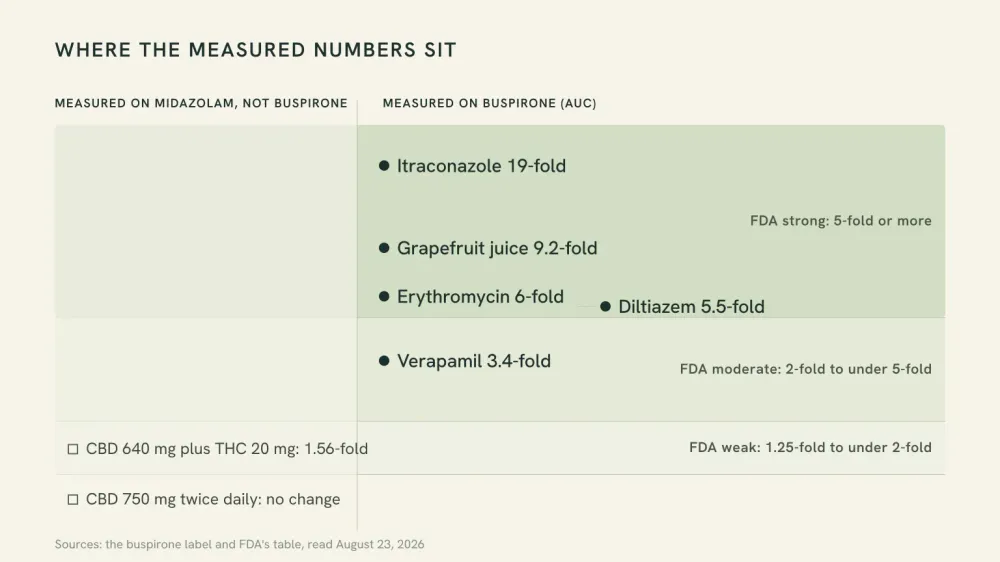
| Itraconazole | 200 mg/day for 4 days; buspirone 10 mg single dose | 13-fold increase | 19-fold increase | Kivisto 1997, PMID 9333111, n = 8 healthy volunteers | Strong inhibitor | No |
| Nefazodone | 250 mg twice daily; buspirone 2.5 or 5 mg twice daily at steady state | up to 20-fold increase | up to 50-fold increase | Label only; no citation and no n given | Not classified on FDA's table | No |
| Grapefruit juice | 200 mL double-strength three times daily for 2 days; buspirone 10 mg | 4.3-fold increase (range 2 to 15.6) | 9.2-fold increase (range 3 to 20.4) | Lilja 1998, PMID 9871430, n = 10 | Moderate inhibitor | No |
| Erythromycin | 1.5 g/day for 4 days; buspirone 10 mg single dose | 5-fold increase | 6-fold increase | Kivisto 1997, PMID 9333111, n = 8 | Moderate inhibitor | No |
| Diltiazem | 60 mg three times daily; buspirone 10 mg single dose | 4-fold increase | 5.5-fold increase | Lamberg 1998, PMID 9663178, n = 9 | Moderate inhibitor | No |
| Verapamil | 80 mg three times daily; buspirone 10 mg single dose | 3.4-fold increase | 3.4-fold increase | Lamberg 1998, PMID 9663178, n = 9 | Moderate inhibitor | No |
| Rifampin (an inducer, the mirror case) | 600 mg/day for 5 days; buspirone 30 mg single dose | 83.7% decrease | 89.6% decrease | Lamberg 1998, PMID 9578186, n = 10 | Strong inducer | No |
| Cimetidine (the one that barely moves it) | not stated on the label | 40% increase, with Tmax doubled | minimal effects on the AUC | Label only; no citation and no n given | Not classified on FDA's table | No |
Read the last column first. Every one of those rows is a measurement of a named drug or one named juice, run in a small group of healthy volunteers, published in the 1990s and still carried on the label today. The itraconazole and erythromycin figures come from a 1997 randomized double-blind crossover trial in eight young healthy volunteers; the grapefruit figures from a 1998 two-phase crossover in ten volunteers; the diltiazem and verapamil figures from a 1998 placebo-controlled three-phase crossover in nine volunteers; and the rifampin figures from a separate 1998 study in ten volunteers whose full text is free to read, in which buspirone exposure fell to 10.4% of placebo. None of those agents is cannabidiol, and none of those numbers is a prediction about cannabidiol. Do not carry any of them across.
The label attaches instructions to some of those rows, and they are worth reading as exactly what they are: sentences written for prescribers about specific, named, potent inhibitors. For itraconazole and for nefazodone, the label recommends a low dose of buspirone, for example 2.5 mg once a day. For erythromycin, the figure it gives is 2.5 mg twice a day. Those are two different figures for two different drugs, they are addressed to the person who writes the prescription, and nothing on this page restates them as advice or attaches them to anything else. Nefazodone deserves a note of its own, because it produced the largest numbers on the whole label, up to a 20-fold rise in Cmax and up to a 50-fold rise in AUC, along with a decrease of about 50% in the 1-PP metabolite. Nefazodone is largely off the United States market because of liver toxicity, so read that row as the label's high-water mark rather than as a live clinical scenario.
Why buspirone's numbers are so big, and why that is about buspirone
A 19-fold rise sounds like a statement about how strong itraconazole is. Mostly it is a statement about buspirone. The label's CLINICAL PHARMACOLOGY section describes a drug that barely survives its first pass through the liver: buspirone undergoes extensive first-pass metabolism, and in a radiolabeled study, unchanged buspirone in the plasma accounted for only about 1% of the radioactivity in the plasma. Peak plasma levels of 1 ng/mL to 6 ng/mL have been observed 40 to 90 minutes after single oral doses of 20 mg. That is nanograms: this drug does its work at concentrations most medicines would call background noise. The average elimination half-life of unchanged buspirone after single doses of 10 mg to 40 mg is about 2 to 3 hours. Food alone, with no other drug involved, raised AUC 84% and Cmax 116% in eight subjects, which is why the label tells patients to take it either always with or always without food. When only about 1% of what reaches your blood is the intact molecule, anything that slows the enzyme has an enormous amount of room to work in. The label makes the same point without any second drug involved: in people with hepatic impairment, steady-state buspirone exposure ran 13-fold higher than in healthy subjects, and in renal impairment 4-fold higher, which is one reason the label says buspirone cannot be recommended in severe impairment of either organ.
That is why the classification of the inhibitor tells you less than you would expect. FDA's reference table of drugs that interact with CYP enzymes lists buspirone as a 3A sensitive substrate, and defines a sensitive substrate as a drug that demonstrates an increase in AUC of 5-fold or more with strong inhibitors of a given metabolic pathway. Now look back at the table. Grapefruit juice is classified by FDA as a moderate CYP3A inhibitor, and it produced a 9.2-fold rise here. Erythromycin is moderate, and produced 6-fold. Diltiazem is moderate, and produced 5.5-fold. A moderate inhibitor meeting a sensitive substrate can out-produce a strong inhibitor meeting an ordinary one. The size of the number is a property of the substrate as much as of the inhibitor, and that cuts both ways: you cannot read buspirone's multipliers off an inhibitor's category, and you cannot read another drug's multipliers off buspirone's label. FDA says both halves out loud in its own footnotes. One notes that diltiazem increased AUC of certain sensitive CYP3A substrates (e.g., buspirone) more than 5-fold. Another notes that grapefruit juice can be classified as a strong CYP3A inhibitor when a certain preparation was used, giving high dose and double strength as the example, which is precisely the preparation the buspirone study used.
There is a second thing that blocking the enzyme does, and it runs the other way. That 1-PP metabolite is pharmacologically active in its own right, so the enzyme does not only remove buspirone, it also creates something. In a 1999 study in two groups of six healthy volunteers, itraconazole raised unchanged buspirone AUC 14.5-fold while cutting the metabolite's AUC by 50%. The authors' own conclusion is the careful one, and it is worth carrying whole: itraconazole and rifampicin caused only relatively minor changes in the plasma concentrations of the active piperazine metabolite of buspirone, although they had drastic effects on the concentrations of parent buspirone. Note also that the parent-drug figures there are close to but not the same as the label's 13-fold and 19-fold, because this was a different and smaller study, and the two sets of numbers should not be fused into one. The usable point is that inhibiting an enzyme does not simply turn a dose up. It changes the proportions of what you are carrying, and the two halves move by very different amounts.
Potent is a defined word, and cannabidiol is not near it
The buspirone label's general instruction reads: when administered with a potent inhibitor of CYP3A4, a low dose of buspirone used cautiously is recommended. Its named examples of such an inhibitor are ketoconazole and ritonavir. Two counting notes matter before anyone applies that sentence to anything. The word potent appears three times in the label. The word strong appears zero times. Those are not synonyms here: strong is FDA's defined regulatory category with a number behind it, while potent is the label's own word and is defined nowhere in the document.
FDA's numbers, by contrast, are public and specific. On that same clinician table, a strong inhibitor is one that increases the AUC of sensitive index substrates of a given metabolic pathway 5-fold or more; a moderate inhibitor is 2-fold or more and under 5-fold; a weak inhibitor is 1.25-fold or more and under 2-fold. The benchmark CYP3A substrates FDA names are midazolam and triazolam, and its named strong CYP3A inhibitors are clarithromycin and itraconazole. So strong is not an impression. It is a ratio measured against a benchmark drug.
Cannabidiol has been put in front of that benchmark twice in humans, and the two answers were not the same. The FDA-approved cannabidiol medicine's own label reports, verbatim, that coadministration of that product at 750 mg twice daily with a single 2.5 mg dose of midazolam, a sensitive CYP3A4 substrate, did not result in changes in plasma concentrations of midazolam compared to midazolam administered alone. The substrates that same label does flag for a possible dose adjustment are those of CYP1A2, CYP2B6, CYP2C8, CYP2C19, UGT1A9 and orally administered P-gp, and buspirone appears in the document zero times. In the other measurement, a 2023 double-blind randomized crossover in 18 healthy adults, participants ate a brownie containing a CBD-dominant cannabis extract, 640 mg of CBD plus 20 mg of delta-9-THC, and 30 minutes later took an oral probe cocktail including 2 mg of midazolam. The authors' own result sentence: the CBD plus delta-9-THC brownie modestly increased midazolam AUC and Cmax by 56% and 28% respectively, and had no effect on midazolam half-life. Their THC-only arm, in their words, did not inhibit any of the CYPs. That cocktail trial is covered at length on our page about CBD and caffeine, which owns it.
Now the arithmetic, presented as our arithmetic against FDA's stated cutoffs and never as an FDA classification of cannabidiol: a 56% rise is a ratio of 1.56, which lands in the weak band, below the 2-fold floor for moderate and nowhere near the 5-fold that defines strong. The other human measurement against the same probe was no change at all. Four limits belong in the same breath. That exposure was 640 mg of CBD together with 20 mg of THC, a mixed-cannabinoid dose; for scale only, at 250 mg/mL a typical 0.05 mL dropper drop carries about 12.5 mg, so 640 mg is on the order of fifty drops swallowed at once, and every question about amounts belongs to our CBD dosage guide rather than here. Both were probe-drug studies, and a probe is a measuring instrument, not a co-medication. Neither has anything to do with buspirone: midazolam and buspirone are both FDA-classified CYP3A sensitive substrates, but a percentage measured on one substrate is still not a prediction about another. And cannabidiol appears zero times in FDA's clinician table, a table that does classify grapefruit juice, St. John's wort, curcumin, diosmin and tobacco. FDA prints its own caveat there, and it belongs in this paragraph: the examples in Table 1 are a guide and not considered a comprehensive list of all possible drugs and other substances that fit these categories. Absence from that table means FDA has classified no data, not that nothing happens.
One arithmetic temptation is worth naming so it can be refused: you cannot divide 19-fold by 1.56-fold to manufacture a headline ratio. Different substrates, different probe drugs, different studies, decades apart, in groups of eight to eighteen people. And CYP3A4 substrate is not one category with one answer, which is the same point our page on CBD and statins had to make about a different drug class: how much of a dose a given enzyme handles differs from drug to drug.
What has actually been measured for CBD and buspirone
Any claim of the form nobody has studied this should arrive with the search that backs it, so here are ours, with the query strings, the date and the counts. All were run against PubMed on August 23, 2026, and you can paste any of them in and get a current number, which may differ from ours as indexing changes.
- cannabidiol AND buspirone: 8 records. All eight were retrieved and read. Every one is a review, guideline or meta-analysis that names the two drugs in different parts of the same paper.
- Those eight include a network meta-analysis of cannabis-use-disorder treatments, a gastroparesis guideline, three anxiety-pharmacotherapy reviews, a geriatric algorithm and a social-anxiety pharmacology review.
- Among them: zero co-administration studies, zero pharmacokinetic studies, zero case reports and zero interaction reports.
- (cannabidiol OR cannabis OR cannabinoid OR hemp) AND (buspirone OR buspar): 39 records. Widening to any cannabinoid adds cannabis-use-disorder trials and neurology reviews, and still no co-administration pharmacokinetics.
- 1-pyrimidinylpiperazine AND cannabidiol: 0 records. The active metabolite has never been measured alongside CBD.
- buspirone AND (cannabidiol OR cannabis OR cannabinoid) AND (pharmacokinetic OR drug interaction), with a trailing wildcard on both of the last two terms: 3 records. None is an interaction study.
Three full-text counts corroborate that. The one peer-reviewed paper that ranks on page one of a web search for this question is a 2019 narrative review of potential cannabinoid drug interactions; its full text contains the words buspirone, buspar and azapirone zero times each, and its own table of CYP3A4 substrates lists drug classes without azapirones among them. That is an observation about how a results page gets assembled, not a criticism of the authors, whose paper is about something else. A 2024 retrospective chart review of 1,586 adverse-event reports, which identified 20 high-probability cannabinoid-plus-psychotropic events, records buspirone zero times; 18 of those 20 events involved medical marijuana at 18% to 22% THC, and the two cases involving a 10% CBD oil both also involved sertraline. And the FDA-approved cannabidiol label records buspirone zero times.
Now the sentence, phrased as carefully as it needs to be. Searched on August 23, 2026, PubMed returns eight records for cannabidiol and buspirone together, and not one of them is a study in which anyone took both. That supports nobody has measured it. It does not support there is no interaction, and this page will not write that. The absence here is a fact about what has been funded, run and published; it is not a finding about a body. It is also why an interaction checker's severity grade is a different kind of object from anything in the table above: a grade is an editorial classification, and the multipliers on the label are measurements.
The serotonin claim, adjudicated
One assertion travels the search results with no source attached: that CBD and buspirone act on the same serotonin receptor and therefore stack. Take it in four steps, because the honest answer has to be careful in both directions. First, what buspirone's label says, verbatim: In vitro preclinical studies have shown that buspirone has a high affinity for serotonin (5-HT1A) receptors, in the same section that opens by stating the mechanism of action of buspirone is unknown. Second, what the CBD half of the claim rests on: a 2005 cell-culture study in which, in vitro on a cloned human 5-HT1A receptor, cannabidiol displaced a radiolabeled agonist in a concentration-dependent way, and whose authors concluded that CBD is a modest affinity agonist at that receptor. Their word for the affinity is modest, and their experiment is in a dish. Both halves of the popular claim are in vitro receptor findings, and neither describes what happens in a person.
Third, what the label's own serotonin-syndrome warning says, because it is real and this page will not soften it. Buspirone's WARNINGS section describes serotonin syndrome reported with SNRIs, SSRIs, and other serotonergic drugs, including buspirone, alone but particularly with concomitant use of other serotonergic drugs including triptans, with drugs that impair metabolism of serotonin, in particular MAOIs including reversible MAOIs such as linezolid and intravenous methylene blue, or with antipsychotics or other dopamine antagonists. MAOIs are a contraindication, with a 14-day gap required in both directions when switching. That list names drug classes that have been studied. No cannabinoid appears on it or anywhere else in the document, and label silence means FDA has reviewed no data on the combination, not that nothing happens. The SSRI side of that list belongs to our page on CBD and sertraline. Fourth, what the literature holds: searched on August 23, 2026, the query cannabidiol AND serotonin syndrome returns exactly one record, a 2020 case report of a man in his thirties taking 4 g of paracetamol and 240 mg of dihydrocodeine daily, of whom the authors write that other than topical cannabidiol oil for eczema he used no other medications. His symptoms resolved within 48 hours of stopping the opioid, and the authors' alternative explanation, which they themselves label hypothetical, is short-term CYP3A4 inhibition from transdermal cannabidiol. One patient, a different drug, a topical product, and a proposed mechanism that is not serotonin at all.
So here is the conclusion that the record actually supports. Two molecules shown to bind the same receptor in a dish are not thereby shown to do the same thing in a person, and the label of the better-studied one declines to say what it does in a person at all. Manufacturing a syndrome out of that would be wrong. Waving away the label's own warning would also be wrong. Those are two separate errors, and this page commits neither.
What a careful label looks like: the trazodone entry
“There is one report suggesting that the concomitant use of Desyrel (trazodone hydrochloride) and buspirone may have caused 3- to 6-fold elevations on SGPT (ALT) in a few patients. In a similar study attempting to replicate this finding, no interactive effect on hepatic transaminases was identified.”
That two-sentence entry is the standard against which a web page should be measured: a federal document records a single report, quantifies it, and then records in the very next sentence that an attempt to replicate it found nothing. Half of it circulates online, which is the half that sounds alarming; the whole entry is the part that is actually useful. It also gives no number of patients, no citation and no year for either study, and the label does not pretend otherwise. Trazodone itself belongs to our page on CBD and trazodone, and every question about liver enzymes, including what an ALT number means, belongs to what is known about CBD and the liver. One further cross-check while we are on labels, read at the source on August 23, 2026. The modern, numbered label for lithium carbonate names its serotonergic drugs in a Serotonin Syndrome section, and buspirone is on that list, alongside SSRIs, SNRIs, triptans, tricyclic antidepressants, fentanyl, tramadol, tryptophan and St. John's wort. No cannabinoid is on it. So two prescribing documents written decades apart in two different formats both place buspirone on a serotonergic-drug list, and neither places a cannabinoid on one. What is known about that other medicine sits on our page about CBD and lithium.

Dizziness, drowsiness, and telling which one is which
| Adverse experience | Buspirone (n = 477) | Placebo (n = 464) | How to read it |
|---|---|---|---|
| Dizziness | 12% | 3% | The clearest drug-attributable effect on the table |
| Drowsiness | 10% | 9% | Essentially identical to placebo |
| Nausea | 8% | 5% | Small separation from placebo |
| Headache | 6% | 3% | Small separation from placebo |
| Nervousness | 5% | 1% | Small separation from placebo |
| Fatigue | 4% | 4% | Identical to placebo |
| Lightheadedness | 3% | under 1% | Small separation from placebo |
Read the top two rows against each other, because that comparison is the whole practical value of the table. Dizziness ran 12% on buspirone against 3% on placebo. Drowsiness ran 10% on the drug against 9% on placebo, which is essentially the same thing. The label carries its own caveat and it belongs here verbatim: these figures cannot be used to predict the incidence of side effects in the course of usual medical practice. The label also says that studies indicate buspirone is less sedating than other anxiolytics and that it does not produce significant functional impairment, and then immediately adds that its CNS effects in any individual patient may not be predictable, and that it is prudent to avoid concomitant use of alcohol and buspirone. The FDA-approved cannabidiol label, for its part, states that concomitant use with other CNS depressants including alcohol may increase the risk of sedation and somnolence, which is a statement about a prescription medicine at prescription doses and not about a consumer tincture. What all of that adds up to is narrow and genuinely useful: new drowsiness that appears after you add something is not well explained by the buspirone, which is a reason to tell your prescriber what changed. The general baseline is on our page about the side effects CBD actually reports, and the additive-sedation question is handled once, on our page about CBD alongside melatonin.
One correction while we are in this part of the document, made without naming anyone. You will find pages saying that combining cannabis products with buspirone raises the risk of respiratory depression. The phrase respiratory depression appears zero times on the buspirone label, string-counted on two manufacturers' versions on August 23, 2026, and the OVERDOSAGE section states that no deaths have been reported following overdosage with buspirone hydrochloride tablets alone. Read the next clause of that same passage just as carefully: fatal intentional overdoses were invariably associated with ingestion of multiple drugs and/or alcohol. That is not reassurance about combinations. It is the opposite, and it is the label's own sentence. A second claim on the same pages, that cannabis or CBD desensitizes liver enzymes, describes nothing that appears in either document; enzyme inhibition and enzyme induction are the two processes these labels actually describe, and they run in opposite directions.
The only thing this page tells you to do
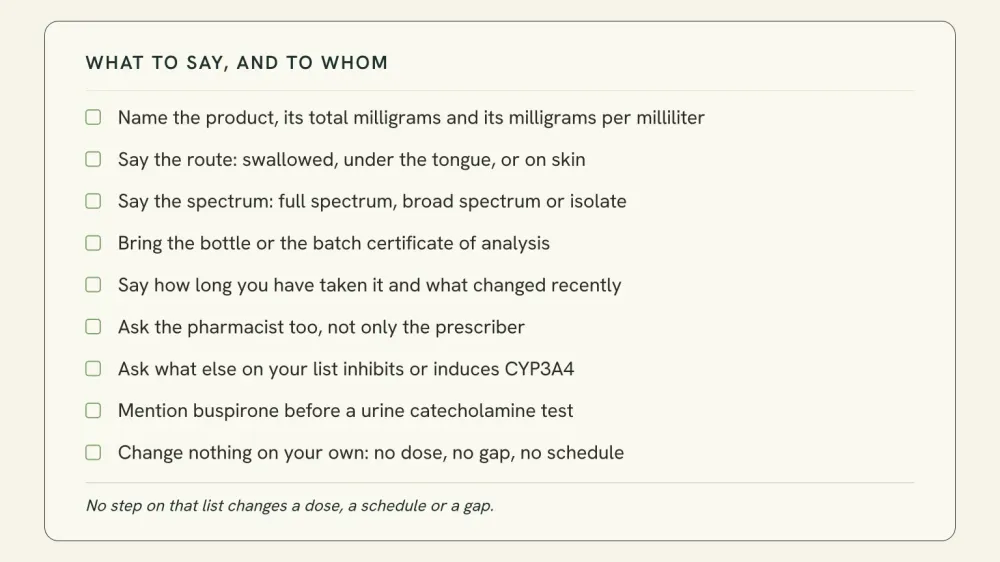
The action here is not a dose change, not a gap between doses and not a waiting period, and this page publishes none of those. It is disclosure, and the instruction is not ours to give: it is item 4 of the buspirone label's own Information for Patients, verbatim. Inform your physician about any medications, prescription or non-prescription, alcohol, or drugs that you are now taking or plan to take during your treatment with buspirone hydrochloride tablets. Item 9 of the same list tells patients to avoid drinking large amounts of grapefruit juice during treatment. A CBD product is a non-prescription product you are taking. That is the entire logic. And unlike some medicines, there is no blood level anyone can check to settle it afterwards: the label's complete Laboratory Tests section is seven words, which read, there are no specific laboratory tests recommended. That is exactly why what you say out loud matters more here than what a lab could find.
- 1Name the product, its total milligrams and its milligrams per milliliter
- 2Say the route: swallowed, under the tongue, or on skin
- 3Say the spectrum: full spectrum, broad spectrum or isolate
- 4Bring the bottle or the batch certificate of analysis
- 5Say how long you have taken it and what changed recently
- 6Ask the pharmacist too, not only the prescriber
- 7Ask what else on your list inhibits or induces CYP3A4
- 8Mention buspirone before a urine catecholamine test
- 9Change nothing on your own: no dose, no gap, no schedule
Four of those deserve a sentence. The milligrams per milliliter figure matters more than the bottle total, because that is the number a clinician can do arithmetic with, and it is printed on the batch certificate of analysis. The route matters because both human measurements of CBD against the CYP3A benchmark drug were oral, and nobody has run the equivalent measurement on an inhaled or a topical product, so route-ranking claims you see online are not measurements. The pharmacist is worth asking separately: pharmacists run interaction software against your whole medication list and see prescriptions written by different offices. And the catecholamine item is there because the label warns that buspirone may interfere with the urinary metanephrine and catecholamine assay and produce a false positive result, an instruction addressed to a clinician about one laboratory test. It is not a wait window and it has nothing to do with CBD. It is here as a concrete example of something the label already knows that you would never guess. No step on that list changes a dose, a schedule or a gap.
What this page cannot tell you
The list of things this page cannot tell you is short and load-bearing. Nobody has given a person cannabidiol and buspirone and then measured the buspirone, so there is no exposure ratio, no threshold, no incidence figure and no interval, which is why none is printed here. A mechanism is a hypothesis, not a result: buspirone being a CYP3A4 substrate tells you what is worth asking about, not what will happen to you. FDA's classifications are regulatory judgements about drugs, not predictions about your liver, your other prescriptions or the bottle on your counter. The label's own multipliers come with the same caveat: those are single doses in young healthy people, and the grapefruit study alone ranged from a 3-fold to a 20.4-fold rise between individuals taking exactly the same thing. Zero counts on a label mean a regulator has reviewed no data on that substance for that drug, and that is the whole of what they mean. And one frame this page refuses outright: nothing here says or implies that CBD does anything for anxiety, panic, stress or mood, and a hemp product is not a substitute for a prescribed medicine. That is not a question this page narrowed. It was never this page's question.
Questions people actually ask
That is a question for the person who prescribed it, and buspirone's label already tells you to ask: its patient instructions say to inform your physician about any medication, prescription or non-prescription, that you are taking or plan to take during treatment. What this page adds is what the evidence contains. Searched on August 23, 2026, PubMed returns eight records for cannabidiol and buspirone together, and not one of them is a study in which anyone took both. Nothing here is a reason to change how you take a prescribed medicine.
Nobody has measured it. Buspirone is cleared by CYP3A4, and its label publishes what happened when named CYP3A4 inhibitors were added: itraconazole raised total exposure 19-fold, grapefruit juice 9.2-fold, erythromycin 6-fold. Cannabidiol is not on that list. The two times CBD has been put in front of the standard CYP3A benchmark drug in humans, the answers were no change at all and a 56% rise, and both of those were measured on midazolam rather than buspirone. A mechanism is a reason to ask a pharmacist. It is not a result.
Because someone measured it. In a 1998 crossover study of ten healthy volunteers, 200 mL of double-strength grapefruit juice three times a day for two days raised the peak concentration of a 10 mg buspirone dose 4.3-fold and total exposure 9.2-fold. The label turned that into a patient instruction to avoid drinking large amounts of grapefruit juice during treatment. The paper's own proposed mechanism includes delayed gastric emptying alongside enzyme inhibition, so even that row is not a pure inhibition result.
One widely used interaction checker grades the pair that way. That grade is an editorial classification made by a database, not a measurement, and as of August 23, 2026 there is no human study of the two together for it to be based on. FDA's vocabulary is different and numeric: strong means a 5-fold or larger rise in a benchmark substrate, moderate 2-fold to under 5-fold, weak 1.25-fold to under 2-fold. Cannabidiol is not classified in any of those categories on FDA's table, which is not the same as being classified as harmless.
Search PubMed for cannabidiol and serotonin syndrome together and on August 23, 2026 you get one record: a 2020 case report of a man in his thirties taking dihydrocodeine and paracetamol, of whom the authors write that other than a topical CBD oil for eczema he used no other medications. His symptoms resolved within 48 hours of stopping the opioid, and the authors' own alternative explanation calls the CBD contribution hypothetical and proposes CYP3A4 inhibition, not serotonin. Separately, buspirone's label does carry a serotonin-syndrome warning, and it names SNRIs, SSRIs, triptans, MAOIs and antipsychotics; no cannabinoid appears anywhere in the document. Both of those things are true at once.
In the label's pooled placebo-controlled trials, drowsiness was reported by 10% on buspirone and 9% on placebo, while dizziness was 12% against 3%. The label cautions that those figures cannot be used to predict the incidence of side effects in usual medical practice. What the comparison does mean is practical: since buspirone's drowsiness rate barely separated from placebo, new drowsiness that appears after you add something else is worth telling your prescriber about rather than working out at home.
No. Read on August 23, 2026 across two different manufacturers' prescribing information, the words cannabidiol, cannabis, cannabinoid, marijuana, hemp and CBD each appear exactly zero times. That means FDA has reviewed no data on the combination for this drug. It does not mean nothing happens, and it is not a safety finding in either direction. It is a statement about what has been submitted to a regulator.
Writing about hemp, wellness and the small rituals that keep us balanced.