HHC vs CBD: What Hexahydrocannabinol Is, and Why It Is Not on a Hemp Certificate
HHC is not extracted from hemp. It is made from hemp CBD in two chemical steps, and the label names two molecules, not one. Here is the chemistry, the counted research record as of August 29, 2026, and why HHC is not on our 13-analyte panel.
People search HHC vs CBD expecting a comparison of two products on the same shelf. They are not the same kind of thing. Cannabidiol is a compound the hemp plant builds. Hexahydrocannabinol, the molecule sold as HHC, is what a manufacturer makes when hemp CBD is put through two chemical steps, the second of which adds hydrogen. That single difference decides almost everything else on this page: what the molecule is, why HHC on a label names two molecules rather than one, why it never appears on a hemp certificate of analysis, how little research exists about it, and what the federal government says about it today.
Here is the short version, up front. HHC is C21H32O2. Delta-9-THC is C21H30O2. The entire chemical difference between them is two hydrogen atoms, added across the one double bond that the delta-8 and delta-9 names point at, in the ring chemists call the terpene ring. CBD sits somewhere else entirely: the same atom count as THC, a different skeleton, and no intoxication, which is a subject we cover on its own page. Commercial HHC is not extracted from a plant. Published reviews describe it as being made from hemp-derived CBD by cyclizing it into a THC mixture and then running hydrogen over it with a catalyst, and that reaction does not produce one product. It produces two, called (9R)-HHC and (9S)-HHC, in a ratio no label states. As of August 29, 2026, PubMed returns zero records indexed as a clinical trial of hexahydrocannabinol and ClinicalTrials.gov returns zero registered studies, which measures how little anyone has looked rather than showing that nothing happens. And DEA lists hexahydrocannabinol in schedule I with its own drug code.
What HHC actually is: two hydrogen atoms
Start with the chemical database rather than the marketing. In NIH's PubChem, cannabidiol is C21H30O2 at 314.5 g/mol and delta-9-THC is also C21H30O2 at 314.5 g/mol: the same atoms in a different arrangement, which is what chemists mean by constitutional isomers. The PubChem record for hexahydrocannabinol reads C21H32O2 at 316.5. Set HHC beside THC and the whole difference is two hydrogen atoms and two mass units. Set it beside the record for cannabidiol and the difference is the entire skeleton. If the isomer idea is new to you, what CBD and delta-9 actually are covers it properly and we will not rebuild it here.
| CBD | Delta-9-THC | HHC | |
|---|---|---|---|
| Molecular formula | C21H30O2 | C21H30O2 | C21H32O2 |
| Molecular weight | 314.5 g/mol | 314.5 g/mol | 316.5 g/mol |
| PubChem CID | 644019 | 16078 | 16050328 |
| Systematic name | 2-[(1R,6R)-3-methyl-6-prop-1-en-2-ylcyclohex-2-en-1-yl]-5-pentylbenzene-1,3-diol | (6aR,10aR)-6,6,9-trimethyl-3-pentyl-6a,7,8,10a-tetrahydrobenzo[c]chromen-1-ol | (6aR,10aR)-6,6,9-trimethyl-3-pentyl-6a,7,8,9,10,10a-hexahydrobenzo[c]chromen-1-ol |
| Saturated positions counted in that name | Different skeleton, no tetrahydro or hexahydro prefix | Four: 6a, 7, 8, 10a (tetrahydro) | Six: 6a, 7, 8, 9, 10, 10a (hexahydro) |
| Where the supply comes from | Built by the hemp plant | Built by the plant | Traces in plant material as THC breaks down; commercial supply is manufactured |
| On the 13-analyte potency panel of Planntz batch 260320 | Yes, reported at 269 mg/mL | Yes, reported non-detected at the printed limit | No, not an analyte on the panel |
The systematic names do the arithmetic for you. Delta-9-THC is the 6a,7,8,10a-tetrahydro compound: four saturated positions. HHC is the 6a,7,8,9,10,10a-hexahydro compound: six. The two extra positions are carbon 9 and carbon 10, and they are exactly where the hydrogen went.
One correction is worth making here, because it is written wrongly on a lot of pages. HHC does not lack double bonds. It keeps its aromatic resorcinol ring, which is nothing but double bonds. What hydrogenation removes is the ring double bond that the delta-8 and delta-9 names point at, in the terpene ring, so after the reaction there is no remaining double bond in the terpene ring. There is a second consequence and it is the one that matters for the rest of this article: carbon 9 was not a stereocenter in THC, and in HHC it is. A new mirror-image choice appears at that carbon, which is why the reaction cannot produce a single substance. Worth noting purely as a matter of naming: by its own systematic name HHC is a hexahydro compound and not a tetrahydrocannabinol. DEA's rule controls it as a tetrahydrocannabinol anyway, because the schedule turns on the agency's definition of the class and not on the prefix.
What is HHC? The step that makes it
Cannabidiol has a biography inside the plant. Hemp builds an acid precursor and enzymes branch it into the acids that become CBD and its relatives; the acid the whole cannabinoid family starts from has a page of its own here, so we will not redraw the pathway. HHC does not have that biography at commercial scale. A 2024 review in Drug Testing and Analysis by Istvan Ujvary describes the industrial route in a single sentence: current large-scale manufacture of HHC is based on hemp-derived CBD extract, which is converted first by cyclization into a delta-8/delta-9-THC mixture, then by catalytic hydrogenation into a mixture of (9R)-HHC and (9S)-HHC epimers (doi:10.1002/dta.3519). That journal blocks automated access, so we are citing it in plain text rather than linking it. The same review states that the human pharmacology of HHC, including its metabolism, is yet to be investigated. We are naming the route at that level and no further: there are no conditions, quantities or procedures on this page, and there will not be.
None of this is new chemistry. HHC was first described by the American chemist Roger Adams in the 1940s, by running hydrogen across THC. A 2023 review of saturated cannabinoids in Molecules tells that story, and it gives 1940 in its abstract and 1944 in its body text, so the decade is the safe figure and the exact year is not. What is new is not the molecule. It is the product. It is also worth separating HHC from its nearest shelf neighbor: delta-8-THC is made from CBD by an acid-catalyzed rearrangement with no hydrogenation step at all, a different reaction with its own separate record, which is why delta-8 gets its own comparison page rather than a paragraph here.
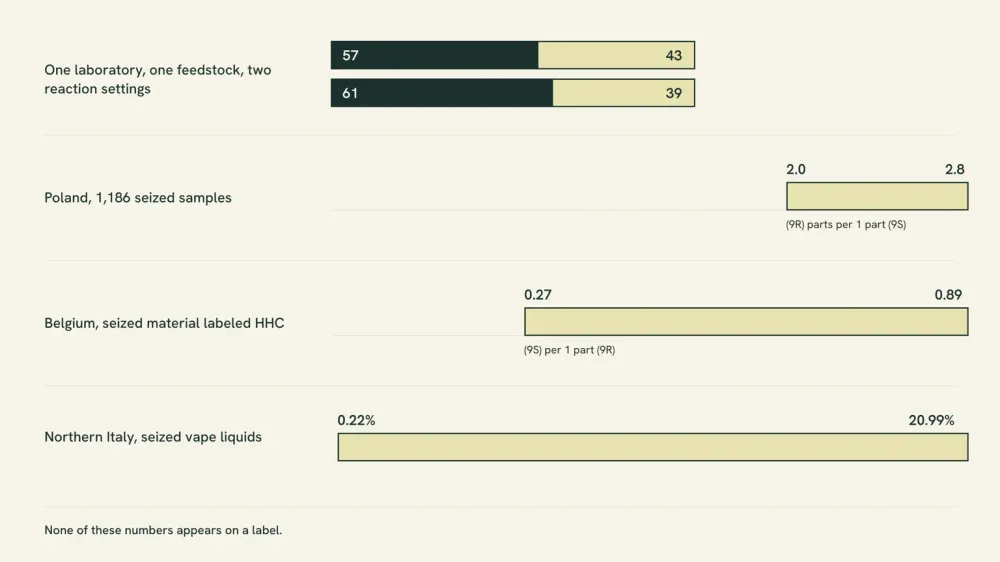
A 2023 paper in Scientific Reports from Cannazza and Citti's group is the cleanest demonstration that the hydrogenation step is a dial rather than a specification. They ran the reaction twice from the same starting material. Hydrochloric acid for two hours gave a 57:43 mixture favoring one epimer. p-Toluenesulfonic acid for eighteen hours gave 61:39 favoring the other. Same feedstock, two settings, opposite products. Summarizing the older literature, the same authors note that hydrogenating delta-9-THC had been reported to give roughly a 2:1 excess of the S epimer while hydrogenating delta-8-THC gave about 3:1 in favor of R. Those two figures are their characterization of Gaoni and Mechoulam's 1966 work, not their own measurement, and we are passing them on with that label attached.
The label says HHC. That is two molecules
This is the part no page on the first results page mentions, and it is the part that makes every other claim about HHC unstable. HHC is a name for two molecules, not one. Which one dominates is decided by the reaction, and the number is not on the label. Forensic laboratories keep finding the same thing. A laboratory in Poland analyzed 1,186 cannabis-type samples seized between 2022 and 2024 and found semi-synthetic cannabinoids in 113 of them, 9.5%. HHC was the most common, and it was consistently detected as a mixture of the two epimers, with (9R) prevailing at a typical (9R):(9S) ratio of 2.0 to 2.8:1 (Wrzesien-Tokarczyk and colleagues, Drug Testing and Analysis, 2026, doi:10.1002/dta.70014; that publisher also blocks automated access, so it is a plain-text citation too). That is seized material in one European country over two years, not a picture of a US shelf.
A Swedish forensic laboratory reports a second spread, from a different country and a different kind of sample: seized material labeled as HHC in Belgium carried (9S) to (9R) epimer ratios ranging from 0.27 to 0.89. We re-read that paper at the source on August 29, 2026 rather than taking the number secondhand, because it carries two published corrections, one dated July 2, 2024 and one dated August 19, 2024, and the first of them rewrote the sentence those ratios sit in. The figures above are the corrected ones. The same paper records that by the beginning of 2024, 24 European countries had identified HHC, and its authors write down plainly what they think follows.
“This poses an inherent risk of poisoning for consumers, as they will be unaware of the differences in strength between products.”
Does the ratio actually matter, or is this bookkeeping? It matters. In August 2026 a Czech group published a receptor study that separated the side-chain homologs of delta-9-THC, delta-8-THC and HHC and reported a consistent split: across matched pairs, the 9R forms showed higher potency than the 9S forms at the CB1 receptor. That is a cell assay in HEK293 cells. It is not a person, it is not a product, and it says nothing about how anything on a shelf behaves. What it does establish is that the two halves of the mixture are not interchangeable, which is a problem when the proportion between them is not printed anywhere.
Two more facts come from a 2026 analytical study of material seized in northern Italy. First, before it could measure anything, that group had to build part of its own instrument calibration. In its own words, at the time the study began the authentic reference standards for the major cannabinoid acetates, including the acetylated HHC epimers, were not commercially available, so those compounds were synthesized in house. A laboratory that has to make its own ruler before it can take a reading is not working with a routine analyte. Second, where HHC did turn up, the amounts inside a single product category spanned an enormous range: the five vape liquids that contained (9R)-HHC ran from 0.22% to 20.99%, a roughly ninety-fold spread. Five is a tiny number and this is seized material, not a US retail sample. It is also five more measurements than most product pages carry.
HHC vs THC: where the 75 percent figure comes from
Almost every page on this query repeats one number: anecdotal evidence suggests HHC is roughly 75% as strong as delta-9-THC. Go looking for the measurement behind it and there is not one. No assay, no dose, no population, no citation. We have taken this exact shape apart before on a bigger number, the claim that THCP binds 33 times more tightly, and the method transfers cleanly: ask what was measured, in what system, and against what comparator.
The published receptor work does not even use delta-9 as its yardstick. The Swedish study above measures against JWH-018, a synthetic cannabinoid from the Spice era, and explains that choice in the paper. It reports (9R)-HHC activating CB1 as a partial agonist with lower potency than that reference, and the (9S) epimer lower still. That is a recombinant cell line assayed against a different comparator, which is a very long way from a percentage of a high. The one place delta-9 does appear as the yardstick makes the problem worse rather than better: the same Swedish paper, characterizing earlier work by other groups, reports that in one functional assay delta-9-THC and (9R)-HHC came out at about the same potency while (9S)-HHC was roughly sixteen times lower, and that a mouse study using a mixture of both epimers found HHC less potent than THC. So the answer to how strong HHC is depends on which HHC you mean, and the label does not say which.
Put the pieces together. The two epimers do not act the same in a cell assay. The ratio between them is set by the reaction, and it moves. It is not printed on the label. A single percentage of delta-9, quoted with no assay, no dose and no citation, is not a measurement of a mixture like that. It is a shape that looks like one. We are not going to hand you a corrected percentage, because there is no measurement to correct it to. That is the honest state of the question, and a page that answers it with a tidier number is telling you something it does not know.
The other names in the same family
HHC arrived with a cluster of relatives, and product pages tend to blur them into one another. They are different molecules with separate records. This page owns HHC itself; the rest get a row and a boundary. Two of them already have their own articles here: the acid-catalyzed route belongs to our page on delta-8, and the side-chain homolog story belongs to our page on THCP.
| Name | What it is | Where it is treated |
|---|---|---|
| HHC (hexahydrocannabinol) | The hydrogenated compound this page is about, sold as a mixture of the (9R) and (9S) epimers | This page |
| HHC-O (HHC acetate) | An acetate ester of HHC. In the 2025 Swedish cell assay the (R)-epimer activated CB1 to an even lesser extent and the (S)-epimer showed no activation, and the authors conclude the acetates likely function as pro-drugs in vivo | One row here |
| HHC-P (hexahydrocannabiphorol) | A side-chain homolog of HHC carrying a longer, seven-carbon chain | One row here |
| HHC-H and HHC-C9 | Further side-chain homologs. They are different molecules, with their own separate case reports in the literature | One row here |
| THC-O-acetate | Named inside our laboratory's own Total THC formula, which is the only reason it appears on this page at all | The certificate section below |
| Delta-8-THC | Made from CBD by an acid-catalyzed rearrangement, with no hydrogenation step | Our delta-8 comparison page |
| THCP | A side-chain homolog of THC, the molecule behind the widely repeated 33x claim | Our THCP comparison page |
Is HHC natural or synthetic?
Both answers are technically available and only one of them describes a product. Trace HHC has been detected in cannabis plants, and the 2026 Italian group states the position carefully: HHC is most commonly encountered as a synthetic product, although trace amounts have been detected in Cannabis plants, where it is thought to arise as a degradation product of delta-9-THC. Note the hedge, which is theirs and which we are keeping. The 2023 Molecules review puts the same fact in blunter language: these trace hexahydrocannabinols are formed as degenerative byproducts as the THC breaks down. In other words it is wreckage from THC, not something the plant sets out to build, and it does not sit anywhere useful on the abundance map of major and minor cannabinoids.
So both things are true at once, and the order matters. The molecule occurs in the plant, in traces, as leftovers. The product occurs in a reactor, from CBD, on purpose, at percent scale. A sentence that says HHC is naturally occurring is describing the first and selling the second. That is not a claim about anyone's honesty; it is a claim about which of two true statements a sentence is doing work with. If you want the taxonomy that sorts natural, semi-synthetic and fully synthetic cannabinoids, the cannabinoid family tree is where it lives.
Why HHC is not on a hemp certificate
Our own certificate is the clearest way to show what a potency panel is and is not. The Planntz Broad Spectrum Mango and Peach batch 260320 was tested by Infinite Chemical Analysis Labs in San Diego, California license C8-0000047-LIC, collected March 27, 2026 and produced April 1, 2026. Its potency panel runs thirteen analytes: CBC, CBD, CBDA, CBDV, CBG, CBGA, CBL, CBN, CBT, delta-8-THC, delta-9-THC, THCA and THCV. HHC is not one of them, because it is not what that panel was built to look for. The full report is published on our lab results page if you would rather read the rows yourself than take our summary of them.
Then read the footnote the laboratory prints underneath its own numbers, which is the single most useful line on the document for this question.
“Total THC = Delta-10-THC + Delta-8-THC + (Delta-8-THCA x 0.877) + Delta-9-THC + THC-O-acetate + (THCA x 0.877)”
Count the terms on the right of that equals sign. There are six: three tetrahydrocannabinols (delta-10-THC, delta-8-THC and delta-9-THC), two acid forms that are multiplied by 0.877 before they are added in (delta-8-THCA and THCA), and one acetate ester (THC-O-acetate). HHC is not among them, and by its own systematic name it is not a tetrahydrocannabinol. Notice something else while you are down there. Three of those six terms, delta-10-THC, delta-8-THCA and THC-O-acetate, are not analytes on this thirteen-item panel at all, so on this certificate half the formula has nothing to draw on. A summed formula is the laboratory's standard template. It tells you what that laboratory is prepared to add up, not what it looked for in your batch, and those are different lists. Eight of the thirteen analytes report ND on this batch, including both delta-8-THC and delta-9-THC. ND means non-detected at the limits of quantification the certificate prints, which for delta-8-THC on this batch are an LOD of 0.0278 mg/mL and an LOQ of 0.172 mg/mL, measured on a UHPLC instrument with diode-array detection. Non-detected is not zero, and this page is not going to pretend otherwise, which matters on this exact document: the potency table's Total THC row reads ND, and the Cannabinoid Overview box higher up the same page reports the same quantity as 0.000 mg/pkg. One certificate, two fields, two ways of writing the same result. Read the row. For completeness, the same panel reports CBD at 269 mg/mL and 16,300 mg per package, with CBG at 145 mg, CBDV at 65.2 mg, CBN at 31.0 mg and THCV at 17.7 mg per package.
Here is the transferable part, and it is not about us. A certificate of analysis is a list of questions somebody chose to ask. If a compound is not on the panel, the certificate is silent about it, and silence is not absence. For HHC that silence is structural rather than sloppy: as noted above, a forensic laboratory working in 2026 had to synthesize its own reference standards for the cannabinoid acetates it wanted to measure, the acetylated HHC epimers among them, because none of them were commercially available, and a 2026 review of semi-synthetic cannabinoids in forensic toxicology and public health reports that conventional toxicology screening methods may fail to detect exposure to these compounds at all, and that telling the epimers apart requires chiral chromatography that routine screening does not run. That is a fact about instruments and reference materials, not a claim that our panel is better than anybody else's. If reading these documents is new to you, our line-by-line walk through a lab report goes through each column.
What has actually been studied
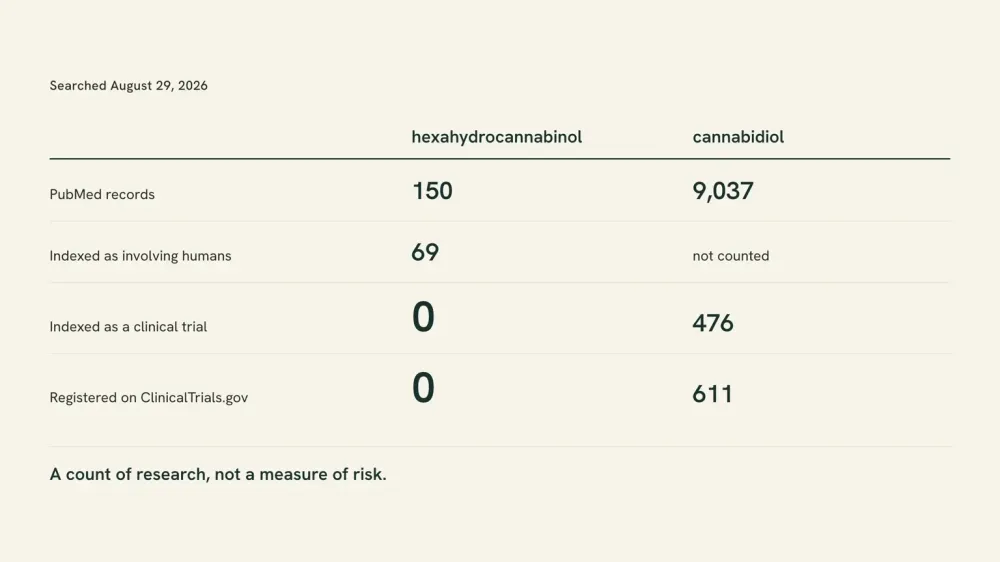
You can check the research claim yourself in about a minute, and it is worth doing, because the numbers are not close. Searched on August 29, 2026, PubMed returns 150 records for hexahydrocannabinol, 69 of them indexed as involving humans, zero indexed as a clinical trial, and zero indexed as a randomized controlled trial. For scale, the same searches on the same day return 9,037 records for cannabidiol, 476 clinical trials and 377 randomized controlled trials. That is a difference of kind, not of degree. It is also not a claim that CBD works for anything: a literature count measures how much has been looked at, on both sides of the comparison, and nothing else.
The caveat belongs in the same sentence as the number, so here it is: nobody has run a controlled trial of HHC, and that is not evidence that HHC is safe. An empty literature measures attention, not risk. Both halves of that sentence are load-bearing, and a page that prints only the first half is doing something dishonest with an absence.
ClinicalTrials.gov, the US federal registry of clinical studies, says it more starkly. Run that search on August 29, 2026 and it returns zero registered studies for hexahydrocannabinol. The same query for cannabidiol returns 611. A registry indexes studies somebody registered, so the honest reading is that nobody has registered one, not that nobody has ever given the compound to anyone.
Now the specific sentence that page one keeps repeating: HHC has been researched for use with pain, sleep, and anxiety. Narrow the search to hexahydrocannabinol AND (pain[tiab] OR sleep[tiab] OR anxiety[tiab]) and on August 29, 2026 it returns seven records. We opened all seven. Three are surveys of what people say they use it for, one is a hospital case report, one is a pharmacokinetics and behavior study in Wistar rats, and two are receptor and drug-discrimination experiments. None of the seven is a trial of HHC for pain, sleep or anxiety. Researched for use with is doing an enormous amount of work in that sentence. Widen it to everything PubMed files under the therapeutic use subheading and you get twelve records, mostly case reports and surveys; the two that look most like laboratory therapeutic research are animal studies of HHC analogs, which are different molecules with different side chains.
The review literature agrees with the count, in its own words. The 2023 Molecules review states that the effects of HHC treatment have not been studied in humans, and thus a biological profile has not been established. The 2026 forensic review, which swept the literature from January 2019 to May 2026, lands in the same place: HHC-related compounds currently dominate the semi-synthetic cannabinoid market and its scientific literature, and much of the current evidence remains limited to case reports and small observational studies. Those are narrative reviews rather than systematic ones, which is worth knowing, and they are describing the same hole this section counted.
What the human record contains
If there are no trials, what is there? Case reports, one poison-center dataset and a handful of surveys. Read each for what it is. One published case report describes a single patient: a 35-year-old man who had a tonic-clonic seizure and then a coma after smoking HHC products, developed severe muscle breakdown that injured his kidneys, and spent fifteen days in hospital, eleven of them in intensive care. He recovered without dialysis. Using high-resolution mass spectrometry the authors identified 35 HHC metabolites in his plasma and urine, in hydroxylated, carboxylated and glucuronoconjugated forms. One case cannot show that HHC causes this, and it cannot show that it does not. It is a named outcome in one person, and it is not a rate. Organ questions in general are not this page's subject and are handled on our page about CBD and the liver.
A second case, reported from Australia, is more useful for what it says about labels than about bodies. A 32-year-old man ate a single gummy that had been sold to him as a THC product, and the only psychoactive substance his serum analysis found was HHC, present as both epimers. His symptoms resolved within eight hours with supportive management. Again, that is one patient. The load-bearing fact is not the symptom list, it is that the label and the contents disagreed.
Beyond the case reports, three datasets. The Czech national toxicology information center logged 236 HHC and HHCP calls between May 2022 and April 2024, and analyzed 196 of them after exclusions. Every figure that follows is out of those 196. The median age was 18, thirty-nine of the patients were children under 15, a physician was involved in 87.8% of cases, 6.1% were classed as severe, and 98% of the cases with a known outcome recovered, with no fatalities reported in that series. Those are calls to one center in one country, not a rate of anything, and most people recovered is not the same statement as this is safe. In the 2024 European Web Survey on Drugs, 2,314 Irish adults who had used drugs in the previous year were asked about HHC: a third reported using it in the past year, the most common source was a high street shop at 62.4%, and 89.9% reported at least one negative consequence, most often anxiety or panic (14.7%), feeling faint or dizzy (13.4%) and dissociation or depersonalization (11.9%). That is a self-selected survey of people who already use drugs, in a country where HHC was sold openly until it was controlled in July 2025. It is not a US figure and it is not a population rate of harm.
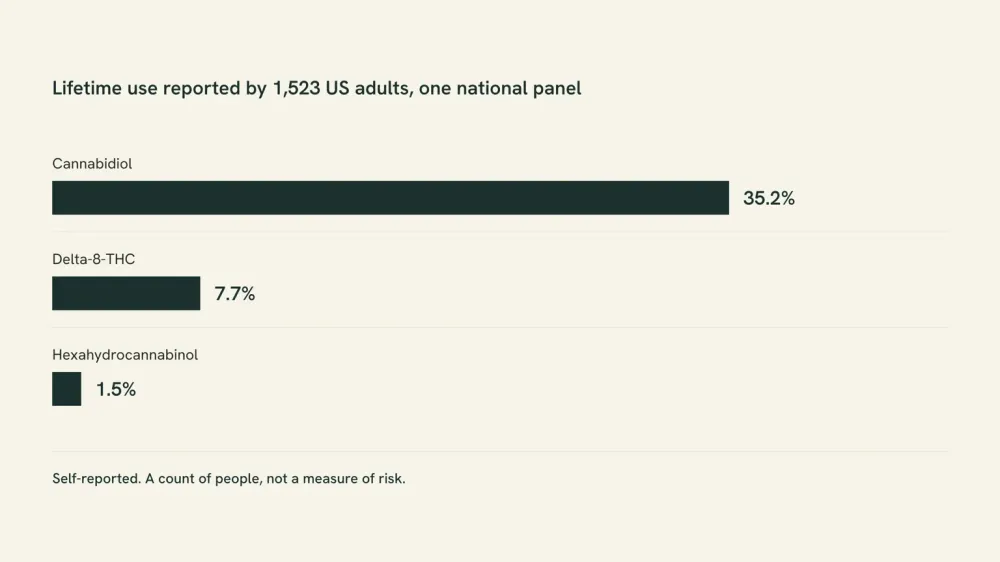
For US scale, a probability-based national panel of 1,523 adults puts lifetime CBD use at 35.2% and lifetime HHC use at 1.5%, with delta-8 at 7.7% in between. HHC is a molecule most Americans have never knowingly met, which is part of why the sentences written about it go unchecked. Two smaller surveys fill in what people say they are doing with it. A hundred and nine people recruited online reported using HHC around ten days in the past month for various reasons including anxiety and pain, with about 17% reporting adverse effects and about a fifth of those who stopped reporting some withdrawal symptoms (Ferretti and colleagues, doi:10.1089/can.2023.0143). A separate survey of 229 past-year cannabis users found 3.5% had used HHC and reported that adverse effects were reported across all the semi-synthetic cannabinoids it asked about (Pabon and colleagues, doi:10.1177/25785125251391987). Both journals block automated access, so those are plain-text citations. And a record of what people say they are doing is not a study of whether it works.
- Zero controlled clinical trials of hexahydrocannabinol indexed on PubMed, and zero registered studies on ClinicalTrials.gov, as of August 29, 2026.
- Published case reports, each a single patient: one seizure with rhabdomyolysis and acute kidney injury, and one analytically confirmed dissociative presentation after a gummy sold as a THC product.
- One national poison-center dataset: 236 calls over two years, 196 analyzed. Among those 196: median age 18, thirty-nine patients under 15, 6.1% classed as severe, 98% of known outcomes recovered, no fatalities reported.
- Self-report surveys: 1.5% lifetime use in a US national panel, 3.5% past-year use in a US convenience sample of cannabis users, 89.9% reporting a negative consequence in an Irish survey.
- Forensic and analytical work on seized products in Poland and Italy, which measures what is inside products rather than what happens to the people who use them.
- Cell-based receptor assays and animal studies, which are mechanism experiments. They cannot tell you what a product does to a person, and this page does not treat them as if they could.
Where the law is, as of August 29, 2026
There is a federal document with a date on it, which is more than most pages on this query offer. On May 4, 2026 DEA published a final rule under Docket DEA-1632 giving hexahydrocannabinol its own entry in schedule I at 21 CFR 1308.11(d)(115), with its own drug code, 7220. The rule took effect the day it was published. It was signed on April 22, 2026 by DEA Administrator Terrance C. Cole and printed at 91 FR 23913.
Read the agency's own reasoning and the correction gets sharper than HHC became illegal in May. DEA's position, stated inside the rule, is that HHC was already a schedule I controlled substance under drug code 7370, because it meets the definition of tetrahydrocannabinols, a schedule I hallucinogen, and that this action does not affect the continuing status of hexahydrocannabinol as a schedule I controlled substance in any way. In the agency's own words the listing makes no substantive difference in the status of the drug. It gave HHC a filing cabinet, not a status. That is DEA's stated position in a rule, not a court holding, and we are reporting it as such. You can read the regulatory text as it now stands in 21 CFR 1308.11 or the full text of the rule at govinfo.
The trigger was international rather than a domestic enforcement campaign. The rule records that the UN Commission on Narcotic Drugs added hexahydrocannabinol to Schedule II of the 1971 Convention at its 68th session in March 2025 under Decision 68/5, that the UN Secretariat notified the United States government by letter dated June 9, 2025, and that HHS responded on December 3, 2025 confirming there are no approved new drug applications and no investigational new drug applications for hexahydrocannabinol at all, and concurring with the scheduling action.
The same rule also states DEA's general position on chemically converted cannabinoids: only tetrahydrocannabinols in or derived from the cannabis plant, not synthetic tetrahydrocannabinols, are excluded from control as tetrahydrocannabinols in hemp, and tetrahydrocannabinols produced through chemical conversion, even when hemp derived, are considered synthetically produced for purposes of the Controlled Substances Act. How that sits against the statutory definition of hemp is a separate subject with its own page, the math that decides what counts as hemp, and the acid-conversion version of the same argument lives on the THCA page. Two limits on this section, both important. This is a federal rule and it says nothing about any individual state's law. And nothing on this page is legal advice; it is a dated read of a public document, made on August 29, 2026.
Five questions to ask about any cannabinoid label
None of this is worth much unless it changes how you read a document. Here are five questions that work on any cannabinoid, not only this one. They are the reason this article exists in the form it does: the certificate is the only object in this whole story that is checkable by the person holding the product.
- 1Is the compound named on the potency panel at all? A certificate reports the analytes it was asked to measure. If the compound you care about is not on the list, the report is silent about it, and silence is not absence.
- 2Does the certificate name a specific batch, a collection date, and the laboratory and license that ran it? A report you cannot tie to the container in your hand is a brochure with a table in it.
- 3If the compound exists as isomers or epimers, does anything state the ratio? For HHC the (9R) to (9S) proportion is set by the reaction, published ranges move a lot, and no label we have seen prints it.
- 4What are the LOD and LOQ, and in what units? Non-detected means the instrument did not see the compound above the limit printed beside it, in the units printed beside it. It does not mean zero, and the limit differs between reports.
- 5Does the compound appear in the laboratory's own summed formulas? Our certificate's Total THC line adds six terms: three tetrahydrocannabinols, two acid forms and an acetate. Anything outside that formula is not inside that total.
HHC vs CBD: frequently asked questions
Both answers exist and only one describes a product. Trace hexahydrocannabinol has been detected in cannabis plants, where researchers describe it as a degradation product of delta-9-THC rather than something the plant biosynthesizes, and a 2023 review calls those traces degenerative byproducts formed as THC breaks down. The commercial supply is a different story: published reviews describe large-scale manufacture as starting from hemp-derived CBD extract, cyclizing it into a delta-8/delta-9-THC mixture, and then hydrogenating that mixture over a catalyst. So the molecule is naturally occurring in traces and the product is manufactured at percent scale. A sentence that uses the first fact to describe the second is selling you the wrong thing.
No. It is usually made from CBD, which is a different sentence. In NIH's PubChem, cannabidiol is C21H30O2 at 314.5 g/mol with a completely different skeleton, and hexahydrocannabinol is C21H32O2 at 316.5 g/mol built on the tricyclic frame that delta-9-THC uses. HHC is far closer to THC than to CBD: the entire chemical difference between HHC and delta-9-THC is two hydrogen atoms, added across the double bond in the terpene ring. Starting material is not identity. Flour is not bread.
The question mixes two things that do not share a scale. CBD is not intoxicating. HHC is an intoxicating, federally scheduled compound, and how much of anything it does has never been measured in a controlled human study. The widely repeated line that HHC is roughly 75% as strong as delta-9-THC has no assay, no dose, no population and no citation behind it, and the published receptor work does not even use delta-9 as its comparator. On top of that, HHC on a label is a mixture of two epimers that a cell assay found differ in potency, in proportions the label does not state. We are not going to give you a corrected percentage, because there is nothing to correct it to.
Counted and dated: on August 29, 2026 PubMed returned 150 records for hexahydrocannabinol, 69 indexed as involving humans, zero indexed as a clinical trial and zero as a randomized controlled trial, and ClinicalTrials.gov returned zero registered studies against 611 for cannabidiol. The human record that does exist is made of case reports, one poison-center dataset and surveys. The 2023 Molecules review states that the effects of HHC treatment have not been studied in humans, and thus a biological profile has not been established. Say the whole sentence: nobody has run a controlled trial, and that is not evidence that HHC is safe. An empty literature measures attention, not risk.
Because it is not on the panel, and a panel is a list of questions someone chose to ask. Our Broad Spectrum Mango and Peach batch 260320 reports thirteen potency analytes, CBC, CBD, CBDA, CBDV, CBG, CBGA, CBL, CBN, CBT, delta-8-THC, delta-9-THC, THCA and THCV, and hexahydrocannabinol is not among them. The same certificate prints its own Total THC formula, and that formula sums six terms: three tetrahydrocannabinols, two of their acid forms multiplied by 0.877, and one acetate ester. HHC is not in it. Three of those six terms are not even analytes on the thirteen-item panel, which tells you that a summed formula is a template rather than a report on your batch. There is also a practical reason the silence around HHC is structural: a forensic laboratory publishing in 2026 had to synthesize its own reference standards for the cannabinoid acetates it measured, the acetylated HHC epimers included, because none of them were commercially available, and a 2026 review says separating the epimers needs chiral chromatography that routine screening does not run.
As of August 29, 2026, DEA lists hexahydrocannabinol in schedule I of the Controlled Substances Act at 21 CFR 1308.11(d)(115) under drug code 7220, through a final rule published and effective on May 4, 2026 under Docket DEA-1632. DEA's stated position in that rule is stronger than the date suggests: the agency says HHC was already a schedule I substance under drug code 7370 because it meets the definition of tetrahydrocannabinols, and that the new listing does not affect that status in any way. State law is a separate question, this is a federal read on a specific date, and nothing here is legal advice.
Two questions are worth carrying away from this page. What did the plant make, and what did somebody make from it? And what does the document in front of you actually report, as opposed to what the product page says about it? If you want the second question answered properly, what each line on a lab report means is the next thing to read, and where each cannabinoid sits in the family is the map that puts HHC in context. This page does not tell you where to buy HHC and it is not going to. It exists because a molecule with 150 papers, zero trials and its own schedule I drug code deserves a page that says so plainly.
Writing about hemp, wellness and the small rituals that keep us balanced.