What Is CBGA? The Acid Every Other Cannabinoid Starts As
The plant builds one cannabinoid first, and it is not the one on your bottle. CBGA is the acid three enzymes turn into THCA, CBDA and CBCA, and on a finished tincture its row on the certificate almost always reads ND.
Every cannabinoid in a hemp plant starts as the same molecule, and it is almost certainly not the one in your bottle. That molecule is cannabigerolic acid, CBGA, and the plant spends nearly all of it before harvest: three competing enzymes take it apart and build the acids that later become THC, CBD and CBC. Which is why, on the certificate of analysis for a finished tincture, the CBGA row usually reads ND.
Here is the short version before the detail. CBGA is the first cannabinoid the plant assembles and the raw material for everything that follows it. Three enzymes compete for that one pool, and which of them dominates decides whether a plant turns out CBD-dominant, THC-dominant or something in between. That decision is largely genetic and it is made in the field, long before anything is extracted, which is the real reason a hemp tincture's lab report looks the way it does. CBGA is also the molecule people mean when they say "the mother of all cannabinoids", although on the pages we read on August 24, 2026 that title was usually given to CBG, which sits one step past the branch rather than at it. If you want the map of the whole family instead of this one junction, we have a plain guide to the cannabinoid family.
What CBGA actually is
CBGA stands for cannabigerolic acid. The A on the end is not a grade, a purity mark or a marketing suffix. It is a carboxyl group: one carbon atom holding two oxygens, attached to the molecule's ring. PubChem's record for cannabigerolic acid gives the formula C22H32O4 and a molecular weight of 360.5, and the systematic name it lists ends in the words "benzoic acid", which tells you what kind of molecule this is. The record for cannabigerol, the molecule CBGA becomes once that group leaves, gives C21H32O2 and 316.5. One carbon and two oxygens apart, which is a molecule of carbon dioxide.
The plant does not make CBGA out of nothing either. It attaches a ten-carbon chain called geranyl pyrophosphate onto olivetolic acid, a reaction known as prenylation, and we have already published that enzymology in how CBG and CBD come off that same precursor, so this page will not re-derive it. What matters here is position rather than mechanism: once CBGA exists, everything else the plant makes is downstream of it. There is one more piece of vocabulary worth fixing before anything else. In a living plant, cannabinoids exist almost entirely as acids. THC, CBD, CBG and CBC, the neutral forms everybody talks about, are largely what heat, time and light produce from those acids after harvest. So CBGA is not an odd variant of a normal cannabinoid. In the plant it is the normal state, and the neutral form is the departure.
The branch point: one acid, three enzymes
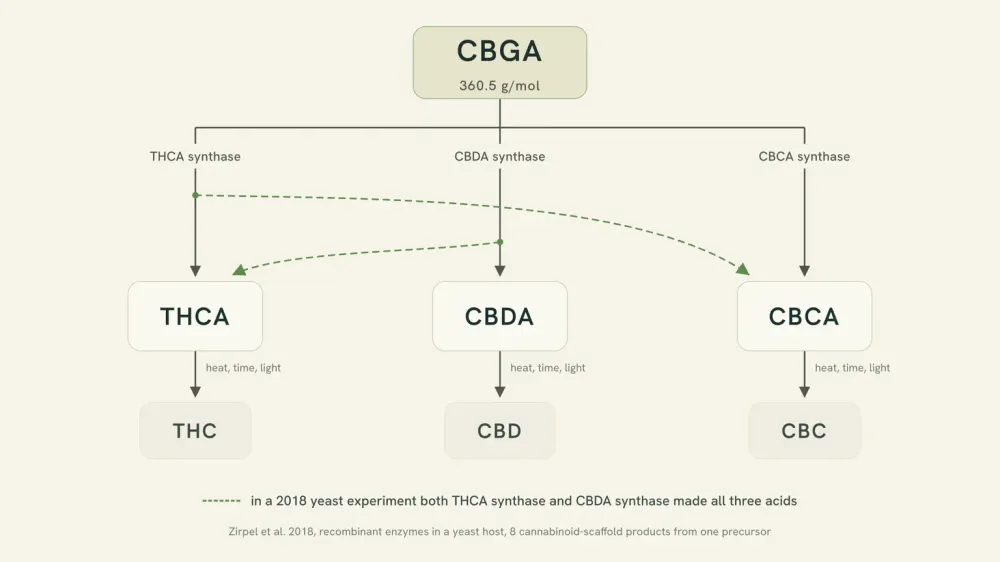
Almost every diagram of cannabinoid biosynthesis draws the same picture. CBGA sits at the top, three arrows leave it, THCA, CBDA and CBCA sit underneath, and the neutral forms hang below those. The shape is right, and the reason is worth stating precisely. A 2023 synthetic-biology paper whose title calls CBG and CBGA the gateways to further cannabinoid production puts it in one line: the plant's native pathway generates CBGA, "the common substrate to multiple cannabinoid synthases". Substrate is the operative word. The three enzymes are not being creative. They are competing for one pool of the same raw material, and whichever of them is most active gets most of it. That paper's own experiments, worth flagging so nobody misreads them, are microbial engineering rather than plant botany: the team built a CBGA-producing system in an E. coli lysate using an engineered prenyltransferase, then made CBG in whole cells. It is a laboratory production route, not a description of any product on a shelf, and nothing Planntz sells is made by fermentation.
Now the part that is missing from every one of those diagrams. In 2018, a group expressed THCA synthase and CBDA synthase as recombinant enzymes in a yeast host and fed them CBGA to see what each enzyme would actually make. They report detecting "eight different products with a cannabinoid scaffold" from that single precursor, five of which they could not identify. And in their own words, "both enzymes were forming three major cannabinoids": THCA, CBDA and CBCA. Not one each. Each of them made all three.
Read that with its conditions attached, because they matter. Those were enzymes produced in Komagataella phaffii, a yeast expression host, working in a laboratory preparation rather than inside a living plant with the plant's own compartments, cofactors and timing. The promiscuity is an observation about the enzymes; it does not tell you what proportions any particular plant will produce. The same paper went on to engineer those enzymes, and one cannabidiolic acid synthase variant ended up with a 19-fold higher catalytic activity for producing THCA, which is protein engineering rather than botany and describes no plant in any field. What the result does do is put a caveat underneath every clean three-arrow graphic, including the one further down this page: the arrows are dominant tendencies, not exclusive assignments.
| Synthase | Acid the standard diagram assigns to it | Neutral form that acid leads to later | What Zirpel 2018 observed when the enzyme was fed CBGA in a yeast system |
|---|---|---|---|
| THCA synthase | THCA | THC | Formed THCA, CBDA and CBCA, among eight cannabinoid-scaffold products in total |
| CBDA synthase | CBDA | CBD | Formed THCA, CBDA and CBCA as well, from the same eight-product set |
| CBCA synthase | CBCA | CBC | Not expressed or tested in that experiment |
Why a plant that makes everything out of CBGA has almost none left
If CBGA is the source of everything, why is it a minor cannabinoid? Because the plant spends it. Every molecule of THCA, CBDA or CBCA in a mature flower is a molecule of CBGA that has already been consumed, and by the time a plant is ready to harvest the synthases have been working on the pool for weeks. What is left over is what a laboratory later measures as CBGA. So the scarcity is not rarity in the geological sense, where there is only so much of something in the world. It is turnover: the molecule is common and short-lived, in the way that flour is scarce in a finished loaf.
One measurement, with its limits attached, gives that a number. In 2024, researchers drew the contents of individual glandular trichomes out of a hemp flower with glass microcapillaries and ran the fluid on HPLC. In that fluid, CBGA was 1.4% of the total cannabinoids present. The acid that dominated the same sample, and the rest of that breakdown, belongs to the same sample read from the CBD acid's side. The limits here are large and they are the point: one cultivar, one laboratory, resin-gland contents rather than a finished product, and no claim at all about hemp in general. We print this figure and not the round numbers circulating elsewhere because it arrives with a named cultivar, a named method and a date. A percentage without those three things is decoration.
Which arrow wins is also largely inherited, and that is where this stops being trivia. A classic 2003 genetics study of controlled crosses traced the difference to a single locus with codominant alleles coding synthase forms of different specificity, which is the genetic reason a plant becomes hemp rather than the other thing, and the chemotype cross and the legal line drawn through it is where we cover that work. There are also plants in which one conversion largely fails and CBGA piles up instead, reported in a 2021 study as a single recessive gene apparently corresponding to a non-functioning THCA synthase allele, and why a CBG-rich plant is CBG-rich carries that paper. The practical consequence is the one no page-one result drew on the day we looked: the cannabinoid profile printed on your certificate was largely settled by the plant's genetics before harvest, not chosen afterwards in a facility.
CBGA and CBG: one carboxyl group, and a conversion the internet oversimplifies
CBGA becomes CBG by losing exactly one molecule of carbon dioxide, a reaction called decarboxylation. That is why the molecular weight falls from 360.5 to 316.5, a ratio of about 0.878, and the CBG side of that arithmetic is already worked through elsewhere on this site, as is the near-identical factor on the CBD side. The thing to hold onto is what that factor is not. It is a mass ratio: the share of the acid's weight that would still be there if every molecule converted. It is not a yield, not an efficiency and not a promise about what actually happens in a pan, an extractor or a bottle. The same reaction on the THC side, where it has a legal deadline attached to it, is covered on the THC acid, where the same reaction has a legal deadline attached.
Now the correction this section exists for. A sentence you will meet repeatedly says that CBGA converts into CBG at 110 degrees C, as though there were a switch at that temperature. There is not. Decarboxylation is a rate, and the rate depends on temperature, on time and on what the molecule is sitting in. A 2016 study that heated cannabis extracts in a vacuum oven at five temperatures for up to 60 minutes measured that rate directly, and it reports an activation energy of 109 kJ/mol for CBGA, sitting between THCA-A at 88 and CBDA at 112 (both of those comparison figures are already published on our page on the CBD acid). The mass balance is more striking than the energy. In that paper's Table 1, CBGA heated at 110 degrees C to completion shows a total molar loss of 52.67%. Roughly half of it did not become CBG at all. The authors describe the reactions for CBGA and CBDA as "more complex with undetermined side reactions", they do not claim to know where the missing material went, and they offer evaporation under vacuum as one possibility.
None of that is a recipe, and this page publishes no method, no target temperature and no time for converting anything. It is an extract dissolved in solvent and heated in sealed vials in a vacuum oven, which is not a kitchen and not a bottle. What CBG itself is, and what the research on it does and does not show, is a separate subject with its own page: what cannabigerol is on its own terms. This one stops at the chemistry of the acid, on purpose.
- "CBGA converts to CBG at 110 degrees C." The 2016 kinetics paper measured a rate at that temperature, not a threshold. The reaction runs slowly at room temperature and faster when heated. There is no switch.
- "Heat turns CBGA into CBG cleanly." At 110 degrees C the same paper recorded a 52.67% total molar loss for CBGA, with side reactions the authors could not identify and did not explain.
- "Sunlight in the field turns CBGA into THC, CBD or CBC." Wrong twice. The conversion inside the plant is enzymatic, and what it produces is the acids THCA, CBDA and CBCA, not the neutral forms.
- "The 0.878 factor tells you how much CBG you get." It tells you what fraction of CBGA's mass survives if all of it converts. That is arithmetic about weight, not a measurement of yield.
The CBGA row on your certificate of analysis
Here is the section no page-one result had on the day we looked. Most cannabinoid potency panels include a CBGA row, and on a finished tincture it usually reads ND. ND means not detected: below the limit that method could see, on that sample, on that day. It does not mean zero, and the report prints the limit for you in the same row, usually as an LOD and an LOQ. That vocabulary, and the question of who ran the test, belongs to what a detection limit actually means, and the guided tour of the whole document is in how to read a certificate of analysis. What this page adds is the CBGA row specifically.
We read all twelve published batch reports for the products we sell on August 24, 2026, from the PDFs on our lab results page. They were run by Infinite Chemical Analysis Labs in San Diego by UHPLC-DAD. The CBGA row reads ND on twelve of twelve, and each report prints its own detection and quantitation limits for that row.
| Product and flavor | Batch | CBGA result | CBGA LOD (mg/mL) | CBGA LOQ (mg/mL) |
|---|---|---|---|---|
| Broad Spectrum, Mango and Peach | 260320 | ND | 0.0613 | 0.184 |
| Broad Spectrum, Lemon and Raspberry | 260321 | ND | 0.0621 | 0.186 |
| Broad Spectrum, Natural | 260319 | ND | 0.0614 | 0.185 |
| Full Spectrum CBD, Mango and Peach | 260310 | ND | 0.0634 | 0.190 |
| Full Spectrum CBD, Lemon and Raspberry | 260309 | ND | 0.0645 | 0.194 |
| Full Spectrum CBD, Natural | 260303 | ND | 0.0630 | 0.189 |
| CBD + CBG, Mango and Peach | 260314 | ND | 0.0391 | 0.117 |
| CBD + CBG, Lemon and Raspberry | 260315 | ND | 0.0625 | 0.188 |
| CBD + CBG, Natural | 260313 | ND | 0.0599 | 0.180 |
| CBD + CBN, Mango and Peach | 260311 | ND | 0.0618 | 0.186 |
| CBD + CBN, Lemon and Raspberry | 260312 | ND | 0.0617 | 0.185 |
| CBD + CBN, Natural | 260304 | ND | 0.0657 | 0.197 |
The interesting row is 260314, the CBD and CBG tincture in mango and peach, because on that single run the same instrument reported CBG at 6,290 mg per package, which the report also prints as 103 mg/mL, and CBGA as ND at a quantitation limit of 0.117 mg/mL. Divide one by the other and the method was quantifying down to about 880 times below the concentration of the neutral form it found, and it still saw no acid. On batch 260320 the same panel picked up CBDV at 65.2 mg per package, CBG at 145, CBN at 31.0 and THCV at 17.7, with CBGA again ND. A run that reports 17.7 mg of THCV is not failing to notice things. So an acid row at ND is not an embarrassment or a gap in the testing. On a finished product it is the ordinary result, and the limit printed beside it is what makes the result meaningful.
The one paper this whole search term is built on
Search this molecule and you will find a benefit list. Follow the citations under it and they converge, over and over, on a single paper, so it is worth reading properly: what it did is genuinely interesting, and what it did not do is the entire story. In January 2022, a team at Oregon State University's Linus Pauling Institute and at Oregon Health and Science University published, in the Journal of Natural Products, a screen of hemp cannabinoids against the SARS-CoV-2 spike protein. We are going to describe the experiments and stop there, because that is all the paper supports.
The screening method was affinity-selection mass spectrometry. An equimolar mixture of cannabinoids at 0.10 micromolar was exposed to recombinant spike S1 protein immobilized on magnetic beads, and whatever stuck to the beads was measured. CBGA ranked first, with a 20.5-fold enrichment in peak area, ahead of THCA-A at 16.7 and CBDA at 12.2. A separate equilibrium-dialysis measurement then put CBGA's binding affinity at a dissociation constant of 19.8 micromolar and CBDA's at 5.6 micromolar. Read those two results together, because they do not agree with each other in the way a headline would want: the molecule that ranked third on the screen bound more tightly in the dialysis experiment.
The cell work is where the labels matter most. In a pseudovirus assay using HEK 293T cells engineered to express the ACE2 receptor, the concentration that halved infection was 8.4 micrograms per milliliter for CBGA. In the live-virus assays the cells were Vero E6, which are African green monkey kidney cells rather than human cells, and the halving concentrations were 37, 26 and 37 micrograms per milliliter against three variants. Cytotoxicity was not significant below 50 micrograms per milliliter. THCA-A could not be tested for affinity or antiviral activity at all, because, as the authors explain, it is a controlled substance and insufficient quantities were available. There were no people in this study and no animals.
The authors are careful about the concentrations in their discussion, and their caution is the part that never survives into a product page. They write that the amount needed is "high but might be clinically achievable", and, plainly, that "no data on the bioavailability of CBGA are yet available". Here is our own arithmetic laid on top of their numbers, so you can check it: 37 micrograms per milliliter divided by CBGA's molecular weight of 360.5 is about 103 micromolar, and 8.4 micrograms per milliliter is about 23 micromolar. The only human blood concentration anywhere in that discussion is 0.21 micromolar, and it is not CBGA. It is a peak plasma level reported for CBDA after an oral amount given to volunteers, which the authors quote from someone else's work as a reason to think micromolar levels of CBGA might be reachable. Set those against each other and the assay concentrations are roughly 490 and 111 times higher. That comparison is ours rather than the paper's, and its only job is to keep the numbers in proportion.
The same senior author published a 2023 review of the antiviral activities of hemp cannabinoids that says out loud what the marketing does not: "appropriately designed clinical trials of safety and efficacy of antiviral cannabinoids are urgently needed". That review's competing-interests statement belongs in the same sentence as the review itself, so here it is: the author "has financial interests in Applied Discoveries and Voyniich Biosciences, companies which commercialize the technology related to antiviral cannabinoids", and "has also filed a patent on antiviral cannabinoid acids". None of that makes the 2022 result wrong, and disclosure is what disclosure is for. It does explain why patent documents turn up on page one of this search, and it is the sort of thing you are entitled to know before you read anybody's benefit list.
What is not there: the number behind "early trials suggest"
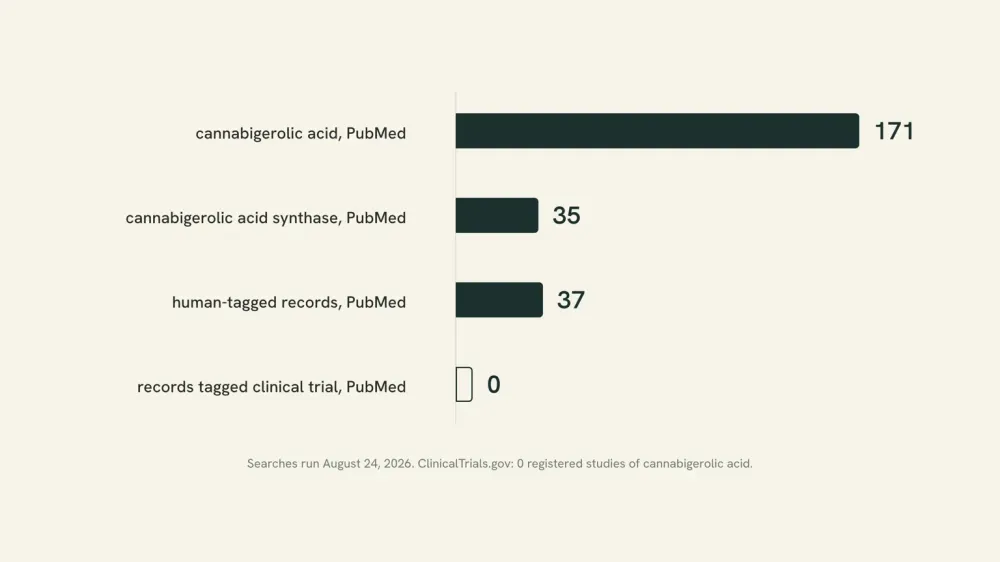
Product pages like the phrase "early animal and human trials suggest". That is a claim about a body of literature, which means it can be counted rather than argued about. We ran the searches below on August 24, 2026 and printed the queries exactly as typed, so you can repeat them and get your own numbers. Counts move over time, which is the point of dating them.
| Query as typed | Database | Records returned |
|---|---|---|
| cannabigerolic acid | PubMed | 171 |
| cannabigerolic acid synthase | PubMed | 35 |
| cannabigerolic acid AND humans[mh] | PubMed | 37 |
| cannabigerolic acid AND clinical trial[pt] | PubMed | 0 |
| cannabigerolic acid AND randomized controlled trial[pt] | PubMed | 0 |
| cannabigerolic acid | ClinicalTrials.gov | 0 |
| CBGA | ClinicalTrials.gov | 1, a homonym: capillary blood gas analysis |
| cannabigerol | ClinicalTrials.gov | 17 |
The 37 is the number that gets misread, so it is worth being exact about it. That query filters PubMed to records carrying the humans tag, and the humans tag marks a study that used human cells, human tissue or human samples. It does not mean anybody was given the compound. All 37 of those records were pulled and read by title on August 24, 2026, and here is what is in the set: work in human keratinocytes and in human recombinant ion channels, cell lines including the ones in the 2022 spike paper, analytical and forensic method papers using human samples, plant genetics and biosynthesis work, rodent studies, a handful of reviews and commentaries, and one survey, which surveys people using CBG-predominant preparations rather than CBGA. Not one of the 37 gave cannabigerolic acid to a person.
The registry side has a twist that is useful to know about. Searching ClinicalTrials.gov for cannabigerolic acid on that date returned nothing at all. Searching for the acronym returned exactly one study, and it is a completed hospital study that has nothing to do with cannabinoids: in that record, CBGA stands for capillary blood gas analysis. For contrast, cannabigerol, the decarboxylated form, returns 17 studies. The acronym is genuinely ambiguous outside cannabis, which is worth remembering the next time a headline appears to promise CBGA trials.
There is one place the molecule does show up in humans, and it is analytical rather than clinical. A 2021 forensic study of serum samples from 117 people who use cannabis ran an 18-analyte panel and reports that, excluding CBDA and CBLA, every cannabinoid investigated was detected in at least one sample, cannabigerolic acid among them. The authors add that findings of minor cannabinoids should always be interpreted with caution, and we would go one step further: detection is not exposure, and exposure is not effect. All that result establishes is that the molecule can reach the bloodstream of someone who has used cannabis and that an instrument can see it there. Laboratories can also measure it deliberately, and precisely: a validated method for human plasma published in 2019 reports a lower limit of quantification of 0.10 ng/mL for cannabigerolic acid in a 200 microliter sample. The tools to study this molecule in people exist. The trials do not.
There is a specific reason to be careful with this molecule rather than generally careful. Turning a cell-entry assay into a marketing sentence about a virus is conduct the FDA has issued warning letters over. We read the agency's table of fraudulent coronavirus disease 2019 products on August 24, 2026 and counted the rows ourselves: 228 firms are listed, of which 24 name a cannabidiol, hemp or cannabinoid product. The earliest of those is dated March 31, 2020 and the latest January 10, 2023, and seven of them were issued on one day, March 28, 2022. None of them concerns CBGA. That count is ours, from that page, on that date, and it is a different page with a different denominator from the warning-letter tally in what the FDA actually enforces, and how, so please do not add the two together.
CBGA is not only a cannabis molecule
One last fact, because it puts the molecule in proportion better than any benefit list could. In 2023, researchers at the Weizmann Institute reported that a plant in the daisy family, unrelated to cannabis, makes Cannabis-type cannabinoids, giving 4.3% cannabigerolic acid as their example figure for Helichrysum umbraculigerum, and accumulating those compounds in the glandular trichomes of its leaves rather than in flowers. Their orthology analysis indicates the pathway evolved in parallel in the two lineages rather than being inherited from a shared ancestor. It is a research plant in a laboratory, not a source of anything on a shelf, and we mention it for one reason: CBGA is a piece of plant chemistry that evolution appears to have arrived at twice, which is a more interesting fact about it than anything a single assay can support.
How to read a CBGA claim in sixty seconds
You do not need a chemistry background to audit a page about this molecule. You need six questions, asked in this order. They work on any cannabinoid, they take about a minute, and every one of them is answerable from the page in front of you or from a free database.
- 1Is a specific study named, with a year and a journal? A benefit list with no citation is a sentence somebody wrote. A benefit list citing one paper is a benefit list citing one paper.
- 2Was it people, animals, or cells in a dish? Every claim on this molecule we could trace ends in a dish or a rodent. Ask which species, and by what route it was given.
- 3At what concentration, and how does that compare with blood? The 2022 assays worked at roughly 23 to 103 micromolar. The only human plasma figure in that discussion is 0.21 micromolar, and it is for a different molecule.
- 4Is there a registered clinical trial? Search ClinicalTrials.gov yourself. On August 24, 2026, cannabigerolic acid returned zero studies and cannabigerol returned 17.
- 5Does the seller's own certificate show a CBGA row, and at what limit? If a product page advertises the molecule and the potency panel has no line for it, the marketing is ahead of the document.
- 6Does the claim name a disease, an organ or a body system? Then it is a drug claim whatever hedge is attached to it, and the hedge is not what decides whether it is allowed.
Questions people actually ask about CBGA
No, although they are one carboxyl group apart. CBGA is cannabigerolic acid, formula C22H32O4, molecular weight 360.5. CBG is cannabigerol, C21H32O2, 316.5. The plant makes the acid, and CBG is what remains after that group leaves as carbon dioxide under heat, time and light. So they are not two grades of one product, they are two stages of one reaction. What cannabigerol itself is, and what the research on it does and does not show, is a separate topic with its own page on this site.
Because the cannabinoid synthases all work on it. A 2023 paper's own title calls CBG and CBGA the gateways to further cannabinoid production, and its text describes CBGA as the common substrate to multiple cannabinoid synthases. The nickname is accurate for the acid. It is usually attached to CBG instead, which sits one step past the branch rather than at it, and that was the slip we saw most often on the pages we read on August 24, 2026.
Nobody has measured that in a person, and that is the honest answer. On August 24, 2026, PubMed listed no records for cannabigerolic acid tagged as a clinical trial and ClinicalTrials.gov listed no registered study of it, so there is no human data on what it does or does not do. Plenty of pages state confidently that CBGA is non-intoxicating, and that may well turn out to be right. The point is that the confidence is not coming from a measurement in people.
Read the row rather than a blog post. Most potency panels include a CBGA line. On all twelve Planntz batch reports we read on August 24, 2026 it reads ND, and each report prints its own limits for that row, running from 0.0391 to 0.0657 mg/mL for detection and 0.117 to 0.197 mg/mL for quantitation. ND means below what that instrument could see on that batch, not zero. Your own product's certificate answers the question in about ten seconds: find the potency table, find the CBGA row, read what is printed beside it and the limit in the same row.
This is the question the internet answers badly, so here is the accurate version. A 2022 laboratory study reported that CBGA bound the SARS-CoV-2 spike protein and reduced infection of cells in culture in cell-based assays, at concentrations of 8 to 37 micrograms per milliliter. The authors did not test it as a treatment, there were no people and no animals in the experiment, and as of our August 24, 2026 search no clinical trial has been registered. The rest of the claims you will meet trace back to receptor and enzyme experiments in dishes. There is no benefit we can state for CBGA, and we are not going to imply one.
Planntz does not sell a CBGA product, and this page is not an argument for buying one anywhere else. On legality we state no status here: it is a cannabinoid found in hemp, the statutory picture for hemp-derived cannabinoids in the United States has been moving, and the two guides linked in the closing paragraph below cover where that stands and what changed in 2026. If a seller tells you the answer is simple, check the date on their page.
If you take one habit away from this page rather than the chemistry, make it the row. Open the potency table on your own product's certificate, find the CBGA line, and read the limit printed beside it, because that pair is a measurement and almost everything else written about this molecule online is somebody's reading of one assay. The rest of the document, section by section is covered separately, and our published batch reports are where the twelve rows above came from. For the legal picture the FAQ deliberately did not settle, see where the law on hemp-derived cannabinoids sits and what the 2026 federal hemp law changed.
Writing about hemp, wellness and the small rituals that keep us balanced.