
CBG vs CBN: Where Each One Comes From, and What It Means
CBG and CBN are not two versions of one idea. CBG accumulates in a living plant because a conversion never happens. CBN accumulates after harvest, when THC meets oxygen. That difference changes what each number on a certificate is telling you.
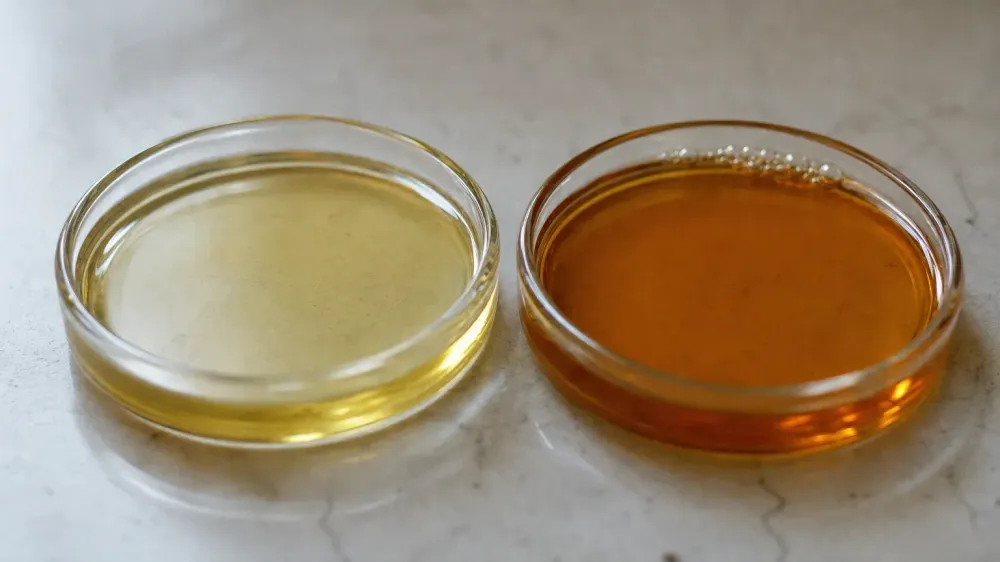
Search CBG vs CBN and the two come back as a matched pair, as if they were settings on one dial. They are not. CBG accumulates in a living plant because a conversion never happens. CBN accumulates in harvested plant material because a conversion happens after the plant is finished, driven by oxygen instead of an enzyme. One molecule sits at the beginning of the plant's cannabinoid chemistry and the other sits at the end of THC's, and that single difference decides how you should read each of them on a label.
Here is the short version before the detail. Cannabigerol, CBG, is what is left of cannabigerolic acid, the acid the plant builds first and then normally spends converting into something else. Cannabinol, CBN, is not built by the plant at all: it is what THC becomes as it sits, with heat, time and acidity doing the work. So a gram-scale CBG figure on a certificate of analysis is a statement about what was grown and how it was formulated, while a CBN figure in THC-bearing material is at least partly a statement about what happened after harvest. Both molecules are also far less common in real life than the marketing implies. In a probability-panel survey of US adults fielded over five days in June 2023, past-year use came out at 5.2% for CBG and 4.4% for CBN against 21.1% for CBD, in a research letter whose AAPOR response rate was 2.9% (1,169 completed out of 6,666 released).
One of these is where the plant starts. The other is where THC ends up.
Start with the arrow the plant actually draws. Hemp does not build CBG, CBD or THC directly. It builds acids. Cannabigerolic acid, CBGA, comes first, and then enzymes convert it onward into THCA, CBDA or CBCA. CBG is what you get when a molecule of CBGA loses its carboxyl group and never became anything else. This is why the phrase you will read everywhere, that CBG is the mother of all cannabinoids, is off by exactly one step: the mother is the acid. That arrow and the enzyme chemistry behind it belong to how CBG and CBD split off from the same precursor, the wider family tree sits in our map of the cannabinoid family, and if you want the molecule's own profile rather than this comparison, start with what CBG is on its own terms.
Now the other end of the same plant's life. No enzyme in cannabis makes CBN. CBN is what THC turns into when it sits: the molecule loses hydrogens and one of its rings aromatizes. That is oxidation, and it is a different reaction from decarboxylation, which is an acid shedding carbon dioxide and is how THCA becomes THC in the first place. Decarboxylation is covered in what happens when THCA turns into THC and in the CBD side of that same reaction, and neither of those arrows produces CBN. The lineage that does, in full, with the citation for the fact that the plant biosynthesizes no acid form of it, is on where CBN comes from and what has been measured about it.
The formulas make the point more cleanly than any adjective. PubChem's record for cannabigerol gives C21H32O2 at a molecular weight of 316.5, and the record for cannabinol gives C21H26O2 at 310.4. Delta-9 THC sits between them at C21H30O2 and 314.5. So CBN is THC minus four hydrogens, and CBG carries two more hydrogens than THC does, because CBG's tail is still an open chain that never closed into a ring. A database record is only a database record: a formula and a mass tell you nothing about what a molecule does in a person, and no absorption or potency statement follows from either. What they do tell you is that these are not two grades of one substance. They are chemically distinct compounds arrived at by opposite routes.
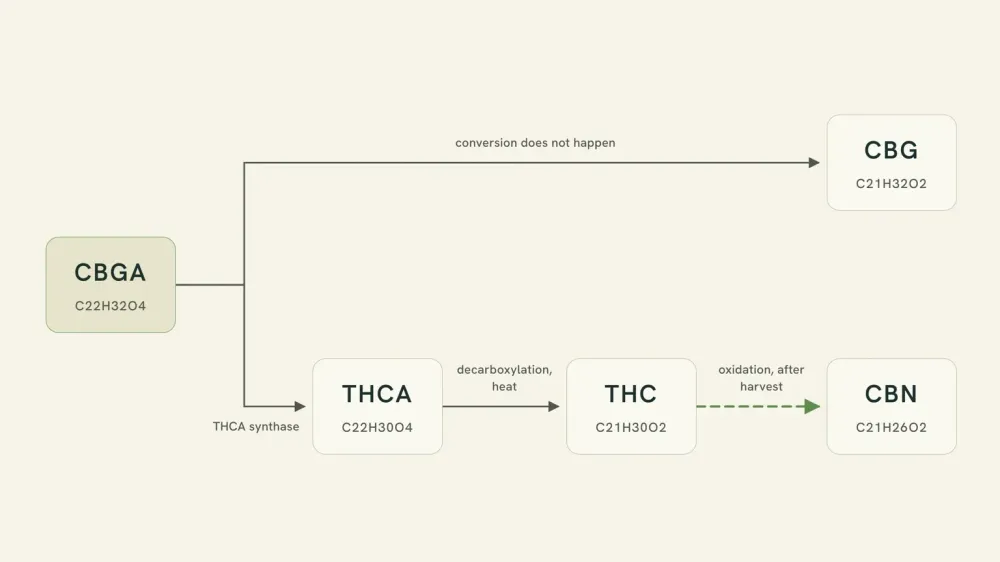
Why a CBG plant is CBG-rich, and why a CBN number is not a plant decision
Breeders can tell you exactly why a CBG-rich plant is CBG-rich, and the answer is that something is switched off. A 2021 genetics paper in the journal Genes crossed a CBGA-dominant cultivar with a THCA-dominant one and with a CBDA-dominant one, genotyped the offspring against their measured chemistry, and reported that CBGA dominance is inherited as a single recessive gene, apparently governed by a non-functioning allelic variant of THCA synthase carrying a single-letter change in its sequence. In the authors' own wording, that variant may leave the synthase unable to convert CBGA to THCA, leading to the accumulation of CBGA. Both hedges are theirs and both are worth keeping. All three authors are employed by a hemp seed company, which is who tends to fund and do this kind of breeding work, and the paper's practical output is a marker that breeders can select on. This is plant genetics and nothing else: it says nothing about effects and nothing about what is in a finished bottle. But it settles the framing. A CBG-rich plant is not a plant that makes extra CBG. It is a plant that never spends it.
The plant type also has a formal name, which matters when a product category is mostly copywriting. In 2024 a group published what they described as the first detailed phytochemical analysis of the CBG-rich chemotype IV of Cannabis sativa, isolating CBGA and CBG alongside CBDA and CBD plus nine previously undescribed phytocannabinoids from it. We are using that paper for its title-level fact only, that a CBG-rich chemotype is described in the literature rather than invented by sellers. Its laboratory work on isolated ion channels is not evidence about anything a person would notice, and it is not quoted here.
CBN sits on the other side of the plant's life, and its appearance has been measured as a rate rather than asserted as a property. A 2022 analytical study tracked CBN forming in cannabis resin held at 50, 60, 70 and 80 degrees Celsius, and in cannabis solutions across pH 2 to 12, reading everything by HPLC. It reported that CBN formation followed first-order kinetics in the resin and zero-order kinetics in solution, and that the transformation rate rose with temperature, fastest at 70 degrees at pH 2. That was resin and aqueous solution in laboratory glassware, not a bottle of MCT oil on a shelf, and no shelf-life number for any product follows from it. What does follow is the shape of the thing. CBN accumulation is a reaction with a rate, and rates respond to heat, acidity and time rather than to a decision made in a field.
The sharpest statement we found of how little CBN a plant will give you comes from the people whose job is weighing it out. Chemists at Inmetro, Brazil's national metrology institute, working with three Brazilian universities and the National Research Council of Canada, published a 2026 method for producing certified CBN reference material in which they convert delta-9 THC into CBN with iodine, directly in cannabis extract, citing CBN's low natural abundance as the reason and reporting more than a ten-fold increase in isolated yield over extracting it from plant material. Read that for exactly what it is. It is a national measurement laboratory making calibration standards, not a manufacturer making a product. It is not a description of how any commercial CBN is made, ours included, and our certificates report a result and never a process.
The evidence on each side is not the same kind of evidence
This is the correction that matters most, because the whole first page of results is built on the thing it hides. Search results for this comparison line CBG and CBN up as two symmetrical product categories with a named effect each. The problem is not that one of those effects is real and the other is not. It is that the two sides are not the same kind of evidence, and putting them in matching columns conceals that. On the CBN side there are randomized, placebo-controlled human trials, and they do not agree with each other: some met the primary endpoint they had registered in advance and some did not; that literature belongs to what CBN is and what its trials actually found and to the CBN and melatonin comparison, and we are naming its design here rather than restating its results. On the CBG side, the source almost everyone is quoting is a survey of people who had already chosen CBG-predominant preparations, alongside one 34-person crossover; both sit on the CBG comparison page that carries that survey in full. A survey and a randomized trial answer different questions and carry different weight. Any page that presents them as two halves of one choice has made a claim it did not earn.
| What you are comparing | CBG side | CBN side |
|---|---|---|
| The most-quoted human source | A survey of people already using CBG-predominant preparations, plus one 34-person crossover | Randomized, placebo-controlled trials, including a crossover using overnight sleep monitoring |
| What that design can answer | What self-selected users report about a product they had already chosen | Whether a measured outcome differed from placebo in that sample, on the endpoint chosen in advance |
| What it cannot answer | Whether the molecule caused what the respondents reported | Whether a result generalizes past that sample, that endpoint and that formulation |
| Where the full account lives on this site | The CBG and CBD comparison | The CBN and CBD comparison, and the CBN and melatonin comparison |
| PubMed records with the name in the title or abstract | 568 for cannabigerol | 929 for cannabinol |
| Registered studies naming it as an intervention on ClinicalTrials.gov | 14 | 11 |
Those last two rows are a measurement of attention, not of quality, which is why they are printed with a date and nothing else. Twenty days earlier the same two searches returned 564 and 923. A count that moves every fortnight is not evidence that either molecule has been shown to do anything, and it should never be quoted as if it were.
There is one more thing worth saying about the search results themselves. When we read page one of this comparison on August 22, 2026, exactly one primary research paper was on it, and none of the pages around it used a word of what it says. Researchers at UCSF applied CBD, CBG, CBN and CBC to primary cultures of mouse dorsal root ganglion neurons, across 0.1 to 100 micromolar. At 50 micromolar the four did four different things in those mouse cells in a dish: calcium response magnitudes, measured as the percent change in fluorescence from baseline, of roughly 71% for CBD, 104% for CBG, 34% for CBN and 86% for CBC. CBD and CBG activated the widest range of neuron sizes, while CBN and CBC activated predominantly larger ones. The dose-response curves were not even the same family, with CBD linear, CBG and CBC sigmoidal, and CBN following an inverted U. The work was funded by the NIH and NCCIH, the California Department of Cannabis Control and UCSF Anesthesia. Two footnotes on citing it. The page-one result that links this study links the 2025 preprint, while the peer-reviewed version appeared in the Journal of Pharmacology and Experimental Therapeutics in 2026, and that is the version linked above. The four figures at 50 micromolar are printed in the openly readable preprint, which is the version we could read in full; the published abstract reports the same ordering without the numbers.
None of that is a finding about you. Those are mouse neurons in culture at concentrations no oral product produces in a person, and the authors' closing line about combinations is explicitly a hypothesis rather than a result: they write that the differences they measured underlie the hypothesis that a combination of these minor cannabinoids could act in complementary ways, which is a question for later work and not something this study tested. What the study is genuinely good for is the one thing the sales pages assert without it: four minor cannabinoids in one assay produced three different dose-response shapes between them, which means they are not interchangeable and they are not points on a single scale. That is also the answer to the most common question about this pair. Stronger has no meaning until somebody says stronger at what, measured how.
What each number means on a certificate of analysis
This is where the chemistry becomes practical. A certificate of analysis lists every cannabinoid the lab measured, with a concentration and its own limits of detection and quantitation; the general method for reading one is in how to read a certificate of analysis. What that page does not tell you, and what nobody on page one of this search tells you either, is that the CBG row and the CBN row mean opposite kinds of things. A gram-scale CBG figure is a statement about what was grown and what was formulated. A CBN figure in THC-bearing material is at least partly a statement about time, heat and air, which is the territory of how long CBD oil actually lasts. Neither reading is automatic and the document will not tell you which applies. It tells you the number, and the number is where you start.
| Batch | Product and flavor | CBG (mg per package) | CBN (mg per package) | Delta-9 THC |
|---|---|---|---|---|
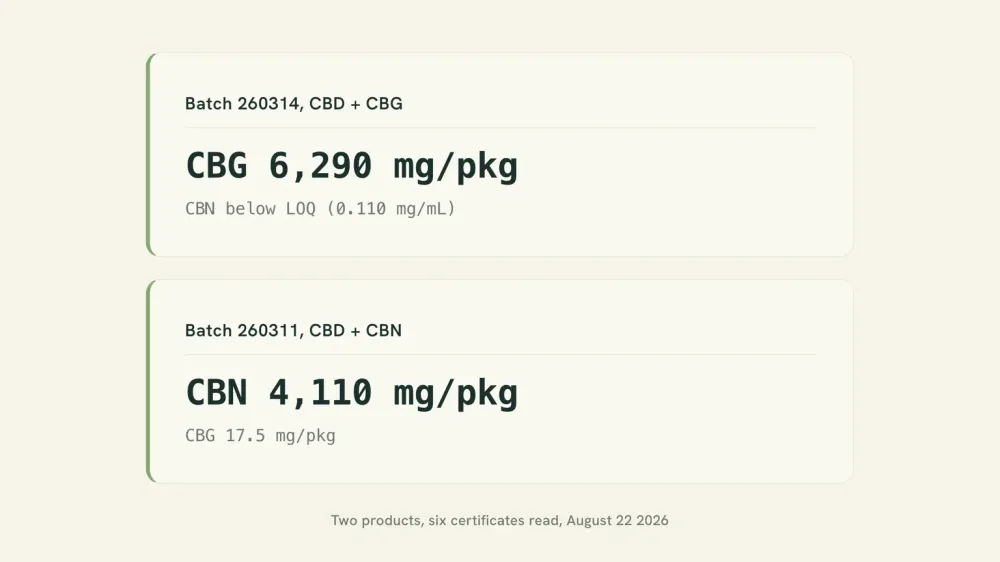
| 260314 | CBD + CBG, Mango & Peach | 6,290 | Below the lab's quantitation limit (LOQ 0.110 mg/mL) | 0.156% |
| 260315 | CBD + CBG, Lemon & Raspberry | 6,520 | ND (LOQ 0.175 mg/mL) | 0.159% |
| 260313 | CBD + CBG, Natural | 6,520 | ND (LOQ 0.168 mg/mL) | 0.142% |
| 260311 | CBD + CBN, Mango & Peach | 17.5 | 4,110 | 0.140% |
| 260312 | CBD + CBN, Lemon & Raspberry | 19.3 | 4,480 | 0.143% |
| 260304 | CBD + CBN, Natural | ND (LOQ 0.185 mg/mL) | 4,150 | 0.129% |
Read the two minor columns against each other and the point lands without any interpretation. Across six certificates from two products, each bottle's non-featured minor is essentially absent. On the three CBG batches the CBN row never reaches the lab's quantitation limit. On the three CBN batches the CBG row is at most 19.3 mg per package, against 6,290 to 6,520 mg on the other product, so even the narrowest gap in this table is a factor of more than 300. These are not two dials on one formula. They are two different raw materials, which is a separate question from the spectrum of a product and gets confused with it constantly.
Two more rows deserve a mention. On all six certificates, CBGA, CBDA and THCA read ND, each with its own printed detection and quantitation limits, and the arithmetic that converts an acid row into its neutral equivalent, including the 0.877 factor that does it, belongs to the page that owns that conversion factor rather than to this one. Second, the magnitude of a minor row is itself information. Our Broad Spectrum Mango batch 260320, a different product from the six in the table above, reads CBG 145 mg and CBN 31.0 mg per package; our Full Spectrum CBD Mango batch 260310 reads ND for both. Gram-scale means somebody added an ingredient. Tens of milligrams means you are looking at the material's own background. The certificate does not explain why those two batches differ, and neither will we.
CBN's parent molecule is the one the law counts
Here is a consequence no page-one result raises. CBN comes from THC, and THC is the molecule the legal threshold is written around. That does not make a CBN product illegal and it does not make it a THC product. Hemp is defined by a delta-9 THC limit measured on a dry-weight basis, which is the subject of what separates hemp from marijuana, and the acid-plus-neutral arithmetic behind a total THC figure lives on the THCA page and stays there. What the lineage does mean is that sourcing a CBN-rich material is a different problem from sourcing a CBG-rich one: the CBG side is a breeding and harvest question, and the CBN side starts from material that carried THC.
The intuition that follows from that, namely that a CBN bottle must sit closer to the legal line than a CBG bottle, is checkable, and on our own reports it is wrong. Look at the last column of the table above. The three CBD + CBG batches print 0.156%, 0.159% and 0.142% delta-9 THC. The three CBD + CBN batches print 0.140%, 0.143% and 0.129%. Same band, and if anything the CBN batches sit slightly lower. Six batches of two products are not a general law about the category, and full spectrum always means trace THC rather than none. But the specific fear does not survive contact with the specific documents, which is the only way that kind of fear ever gets resolved.
There is one measured asymmetry worth knowing before you compare the two, and it is about testing rather than about effects. A 2020 clinical-laboratory study spiked pooled, THC-negative patient urine with four cannabinoids, cannabidiol, cannabinol, cannabichromene and cannabigerol, and ran two commercial immunoassays built to detect THC's metabolite. Both assays cross-reacted with cannabinol. On the EMIT II Plus assay it took about five times more CBN than THC metabolite to produce a signal equivalent to the cutoff, on the Microgenics MultiGent assay about twenty times, and on the first assay CBN added to samples that were only weakly positive pushed them over. That is fortified urine, not a person who took a product, and no dose or exposure can be inferred from it. One honesty note: the abstract reports a cross-reactivity result for cannabinol, and the full text sits behind a publisher login we could not read on August 22, 2026, so we are not telling you what the other three cannabinoids did. The screening question in full, including what the trace-THC row on your own certificate has to do with it, is on CBD and drug tests.
For context, the forensic literature uses these two molecules for something unrelated to buying either. In a controlled cannabis administration study published in 2016, CBG and CBN were frequently identified in whole blood after smoked and vaporized cannabis, with short detection windows, and were not detected after oral dosing. Those participants were given cannabis, not a CBG or a CBN product, and the informative routes were inhaled. It is a marker-of-recent-use finding about cannabis, and nothing about a tincture or a test outcome follows from it.
Can you take both? What the registry actually says
The honest answer to whether you can take both is that nobody has published what happens when you do, and the version of that sentence you can check is more interesting than the superlative version. Searching ClinicalTrials.gov on August 22, 2026 for an intervention naming both cannabigerol and cannabinol returns a single study, NCT07769164: a completed, randomized, double-blind, placebo-controlled trial with an actual enrollment of 332 people, run from December 2023 to August 2024, sponsored by Cannabis Science Innovations with Wana Brands, registered publicly only on August 17, 2026, roughly two years after it finished, with no results posted. Its arms are not CBG plus CBN. They are combinations of three to five ingredients and every active arm also contains THC: 2 mg THC with 2 mg CBN, 2 mg CBG, 10 mg CBD and 1 mg melatonin; 10 mg THC with 5 mg CBN, 5 mg CBG and 20 mg CBD; and 10 mg THC with 20 mg CBN and 5 mg CBG, against two placebos. Those figures are the trial's design and not a suggestion. We publish no amount for either molecule anywhere on this site, and what a dose even means for CBD is a separate page for a reason.
The published literature does not fill the gap either. A PubMed search for records carrying both cannabigerol and cannabinol in the title or abstract, restricted to human studies, returned 76 records on August 22, 2026, and we read all 76 titles: the set is in-vitro pharmacology, analytical-method papers, forensic detection assays and reviews. Not one of them gives CBG and CBN to people as an intervention. So when a page tells you that taking them together triggers the entourage effect, it is quoting a hypothesis and presenting it as a result, and the state of that hypothesis, including what has and has not been shown for combinations generally, is laid out in what the entourage effect actually is. Even when NCT07769164 reports, it will not be able to tell you what the pair did, because no arm isolates the pair.
What the two Planntz bottles actually contain
Since we sell both, here are the figures once, with nothing attached to them. The Full Spectrum CBD + CBG tincture is a 60 mL bottle labeled 9,000 mg CBD and 6,000 mg CBG, which is 150 mg/mL CBD and 100 mg/mL CBG. The Full Spectrum CBD + CBN tincture is 60 mL labeled 8,000 mg CBD and 4,000 mg CBN, which is 133 mg/mL CBD and 67 mg/mL CBN. Both use a coconut MCT carrier, both are whole-plant full spectrum, and both therefore carry trace delta-9 THC below the 0.3% federal limit rather than none. Neither is sold for a condition. Neither is sold for a time of day.
| Product | Label figure | What one certificate measured | Batch |
|---|---|---|---|
| Full Spectrum CBD + CBG | 9,000 mg CBD + 6,000 mg CBG (150 + 100 mg/mL) | 158 mg/mL CBD and 103 mg/mL CBG; 9,640 mg CBD and 6,290 mg CBG per package | 260314, Mango & Peach |
| Full Spectrum CBD + CBN | 8,000 mg CBD + 4,000 mg CBN (133 + 67 mg/mL) | 144 mg/mL CBD and 68.0 mg/mL CBN; 8,680 mg CBD and 4,110 mg CBN per package | 260311, Mango & Peach |
At a nominal 0.05 mL per drop, the label figures work out to roughly 7.5 mg CBD with roughly 5 mg CBG for the first bottle, and roughly 6.7 mg CBD with roughly 3.3 mg CBN for the second, with the standing caveat that real drop size varies with the dropper, the temperature of the oil and how you hold it. Every batch report we have is published at our lab results page, and the useful habit is to open the certificate whose batch number is printed on the bottle in your hand rather than the one linked from a marketing page. If a company cannot produce a certificate for your batch, that absence is itself the finding.
A six-step checklist for reading any CBG or CBN product
This page will not tell you which of the two to buy, because the evidence does not support anybody telling you that. What it can give you is the sequence of checks that separates a real difference between two products from a paragraph of copy. Run these in order, on ours as readily as on anyone else's.
- 1Find the molecule and its concentration on the label, in mg per bottle and mg per mL. A product that names a minor cannabinoid without a mg/mL figure has told you a story, not a specification.
- 2Open the batch certificate and confirm the featured molecule is actually there at roughly the labeled scale. Thousands of milligrams per package means an added ingredient. Tens of milligrams means the raw material's own background.
- 3Read the row for the other minor. On a genuine CBG product the CBN row should sit near or below the lab's limits, and the reverse on a CBN product. If both rows are large, ask what you are actually looking at.
- 4Check what ND means on that specific report. Every certificate prints its own limit of detection and limit of quantitation, and ND means below that limit on that instrument, never zero.
- 5Read the delta-9 THC row, and the total THC row if the report prints one. That is the number relevant to a drug screen, not the CBG or CBN figure beside it.
- 6Ask what evidence is being cited to you and what design it has. A survey, an assay in animal tissue and a randomized placebo-controlled trial are three different objects, and only one of them tests an effect in people.
Honest limits: what a CBG vs CBN comparison cannot settle
Several things on this page are smaller than they look. The genetics paper explains a plant type, not a product, and its authors hedge their own mechanism with the words potentially and may. The kinetics study measured resin and aqueous solution in laboratory glassware, so no shelf-life figure for a tincture follows from it. The reference-material paper is a metrology workflow and not a description of commercial manufacturing. The neuron study is mouse tissue in culture, at a concentration an oral product does not produce in a person. And six of our batch reports are six documents about two products, not a survey of the category.
The bigger limit is structural. As far as we could find on August 22, 2026 there is no head-to-head human comparison of CBG and CBN on any endpoint, and the one registered trial that gave people both gave them three to five ingredients at once and has posted nothing. Research volume is not a substitute either: the record counts in the table above tell you what has been written about, not what has been shown. Anyone who resolves this comparison for you in a single sentence is resolving it from something other than the record. What you can do is read the chemistry correctly, read the certificate correctly, and notice which kind of evidence you are being handed.
Stronger at what, measured how. The closest thing to a head-to-head measurement we found while researching this page is the 2026 study of mouse dorsal root ganglion neurons in culture, and in it the four cannabinoids tested did not all follow the same dose-response curve: CBD's was linear, CBG's and CBC's were sigmoidal, and CBN's followed an inverted U. Calcium response magnitudes at 50 micromolar ran roughly 104% for CBG and 34% for CBN in those mouse cells in culture, which is a difference in behavior rather than a ranking, at a concentration no oral product produces in a person. As far as our August 22, 2026 reading reaches, no human study compares the two directly, so there is no axis on which one is simply stronger.
People have, in a registered trial, but not in a way that answers the question. As of August 22, 2026, ClinicalTrials.gov lists one completed study naming both as interventions, NCT07769164, with 332 people enrolled, no results posted, and arms containing three to five ingredients, every one of which also includes THC and one of which also includes melatonin. A PubMed search on the same date for human-filtered records naming both molecules returned 76 papers, and reading all 76 titles turns up no study giving the pair to people as an intervention. Anyone telling you the combination does something specific is quoting a hypothesis. Our entourage effect page explains where that hypothesis comes from and what has actually been tested.
This page is deliberately the wrong place to answer that. The human record on CBN includes randomized, placebo-controlled trials, and they split: some met the primary endpoint they had registered in advance and some did not. The CBG side rests on a survey of people who had already chosen the product, plus one 34-person crossover. Those are different kinds of evidence, not two candidates in one race, and grading them against each other is what this article does instead of picking. If you want the CBN trial literature in detail, with what each trial measured and where it landed, read our CBN and CBD comparison and our CBN and melatonin comparison. Planntz does not sell either product for a condition and publishes no timing guidance for anything.
Standard workplace screens look for THC's metabolite, not for CBG or CBN. The one measured wrinkle is that a 2020 laboratory study found both of the immunoassays it tested cross-reacted with cannabinol in fortified urine, needing about five times or about twenty times more CBN than THC metabolite to reach the cutoff depending on the assay, and on one of them CBN pushed weakly positive samples over the line. That was spiked urine, not people taking products, and no dose or exposure follows from it. The number to read on your own certificate is the delta-9 THC row, and no product from any company can guarantee a test outcome. Our CBD and drug tests page covers the screening question properly.
Because a certificate reports what the lab measured, and minor cannabinoids show up in whole-plant material at small scale. The magnitude tells you which situation you are in. Our Broad Spectrum Mango batch 260320 reads CBG 145 mg and CBN 31.0 mg per package, while our Full Spectrum CBD Mango batch 260310 reads ND for both, and our CBD + CBN batches read in the thousands of milligrams. Tens of milligrams is a background profile; thousands is an added ingredient. The certificate does not explain why two batches differ and neither will we. Separately, since CBN forms as THC oxidizes, age, heat and air can move a CBN figure in THC-bearing material, which is why storage and shelf life are worth reading about on their own.
Both are minor, and they are scarce for opposite reasons. CBG is scarce because the plant normally converts its precursor onward, so getting CBG at scale means growing a plant in which that conversion fails. CBN is scarce because nothing makes it: it only appears as THC degrades. The sharpest evidence we found of how scarce is that a national metrology institute, needing certified CBN for measurement standards, chose to convert THC into CBN chemically rather than extract it from plants, and reported more than a ten-fold gain in isolated yield for doing so. On research attention rather than abundance, PubMed listed 568 records naming cannabigerol in a title or abstract against 929 naming cannabinol when we ran both searches on August 22, 2026.
If you want to go a level up from this comparison, the cannabinoid family map covers where CBG, CBN, CBD and THC all sit relative to each other, and the single-molecule pages go deeper than any versus page can: CBN on its own terms is the place to take the questions this one deliberately does not answer. Whatever you read next, including on this site, keep our published batch reports open in another tab and check the rows against the copy.
Read the certificate before the claim
Every Planntz batch has a published third-party certificate of analysis with the CBG row, the CBN row, the delta-9 THC row and the lab's own detection limits printed on it. Find the batch number on your bottle and read that one.
See both full spectrum tincturesWriting about hemp, wellness and the small rituals that keep us balanced.