CBC vs CBN: One the Plant Builds, One It Never Made
Page one calls CBC and CBN two cannabinoids from the same plant. One has a purified enzyme behind it; the other has no enzyme at all. Here is the chemistry both ways, the counts on one dated day, and what both rows read on our 13 certificates.

CBC vs CBN is usually written as a choice between two cannabinoids from the same plant, one for the daytime and one for the evening. The chemistry does not support that symmetry. Cannabichromene is made by a plant enzyme that has been purified, named and published. Cannabinol is not made by the plant at all: it is what THC becomes when it sits around with oxygen. One of these molecules is a decision the plant makes. The other is something that happens to a molecule the plant already made, and most of what a shopper needs to know about the pair follows from that one difference.
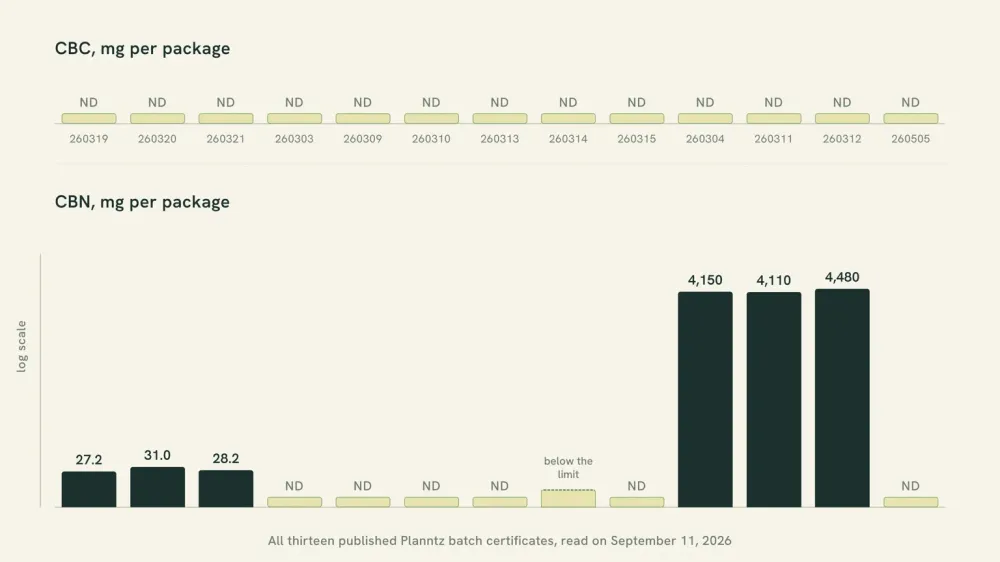
Two things come out of that asymmetry, and both can be checked by somebody who does not trust us. The first is chemical: each molecule sits on a conversion, and the two conversions point in opposite directions. CBC is the one that leaves, because light turns it into cannabicyclol. CBN is the one that arrives, because delta-9-THC oxidizes into it. The second is documentary, and it is the sentence this page was written for: on our own thirteen published batch certificates, the cannabichromene row reads ND every single time while the cannabinol row carries a number six times, which means neither row is telling you anything about the plant. Both are telling you about the product.
One of these has an enzyme, the other has a clock
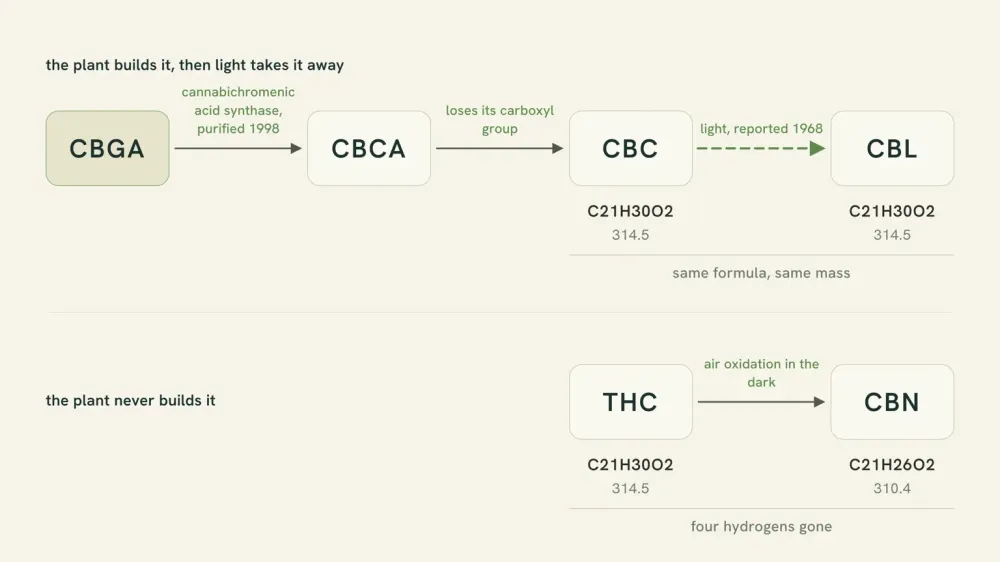
Start where the plant starts. Cannabigerolic acid, usually written CBGA, is the branch point that the cannabinoid synthases pull from, and one of those enzymes is dedicated to CBC. In 1998, a team purified cannabichromenic acid synthase from Cannabis sativa and reported what it does (Morimoto, Komatsu, Taura and Shoyama, Phytochemistry, doi 10.1016/s0031-9422(98)00278-7): the enzyme, purified to apparent homogeneity, converts cannabigerolic acid into cannabichromenic acid, which later loses its carboxyl group and becomes CBC. That is a named catalyst, in a published assay, with a mechanism attached. It is also a 1998 enzyme assay in a tube, which describes a protein and says nothing about a bottle, a chemovar or a person. If you want the whole branch rather than this one arm of it, the map of the cannabinoid family is the page to have open.
Now the other side, and the asymmetry is total. There is no cannabinol synthase. A 2021 review of the cannabinol literature states it in one sentence: "Unlike other phytocannabinoids, CBN is not biosynthesized in an acid form by the plant", and the review describes it instead as a degradative product of delta-9-tetrahydrocannabinol. The same review notes that cannabinol was the first phytocannabinoid identified in the plant by scientists, in the 1930s, which carries a small irony: the first one anybody found is the one the plant does not make. Two caveats travel with that source and belong in any summary of it. It is a single-author narrative review rather than primary data, and its author is the medical director of a for-profit cannabis clinical and consulting entity, so we are taking the structural fact from it and nothing else. What CBN has in place of an enzyme is a clock: oxygen, time and the right conditions acting on a molecule the plant did build. Cannabinol's own profile sits on its own page, separately from this comparison.
Both molecules sit on a conversion, and they point opposite ways
CBC is a destination that is also a departure. In 1968, Crombie, Ponsford, Shani, Yagnitinsky and Mechoulam reported a photochemical route from cannabichromene to cannabicyclol (Tetrahedron Letters, doi 10.1016/s0040-4039(00)76346-5). No abstract is indexed for that record, so it supports its title and nothing more: light can take CBC somewhere else. It supplies no rate, no half-life and no shelf life, and we are not going to invent one. Why CBC is scarce in the first place is a separate argument with two halves, and our comparison of CBC and CBG works through both of them.
Here is the part nobody on this search result prints. PubChem's record for cannabichromene gives the formula C21H30O2 and a molecular weight of 314.5. PubChem's record for cannabicyclol, CID 59444380, gives C21H30O2 and 314.5 as well. Identical formula, identical mass. The CBC to CBL reaction adds nothing and removes nothing: it rearranges the same atoms into a different shape. Now set the other side beside it. Delta-9-THC is also C21H30O2 at 314.5, and cannabinol, CID 2543, is C21H26O2 at 310.4, four hydrogens lighter. So one conversion is a rearrangement and the other is an oxidation that strips mass off the molecule. They are different kinds of event, not two versions of the same one. The THC to CBN arithmetic in full, including why oxidation is not the same thing as metabolism, sits on its own page.
The two reactions also run on opposite conditions, and this is where consumer pages most often get the chemistry backwards. A 1976 stability study of cannabis and its preparations put it in one sentence: "Loss of tetrahydrocannabinol after exposure to light does not lead to an increase in cannabinol, but air oxidation in the dark does" (Fairbairn, Liebmann and Rowan, Journal of Pharmacy and Pharmacology). In the same work, light was the greatest single factor in the loss of cannabinoids overall, and temperature up to 20 degrees Celsius was insignificant. Put that beside the 1968 photochemistry and the inversion is complete: light is what moves CBC out, and air in the dark is what brings CBN in. A 2022 kinetics study adds the temperature half of the picture, and it is careful about where each rate law applies: cannabinol formation followed first-order kinetics in cannabis resin and zero-order kinetics in cannabis solutions, with the fastest transformation among the conditions tested at 70 degrees Celsius and pH 2. Even the rate law depended on what the cannabinoid was sitting in. That study measured resin and solutions in a laboratory, and the 1976 one measured plant material and cannabinoid solutions of its era. Neither measured an MCT tincture in 2026. The storage detail most pages get wrong is corrected in full on our CBN and CBD comparison, and whether a bottle of oil actually expires is a separate question we answer separately.
CBC vs CBN, side by side on what can actually be checked
Every page we read on this comparison converges on the same two rows: what each molecule does, and which one you should pick. We cannot fill either row honestly, because nobody has compared these two molecules in people, so this table does not pretend to. What it has instead is the set of things that genuinely differ, each cell traceable to a named document or a named certificate. Read this way, the difference between CBC and CBN stops being a matter of two personalities and becomes a matter of provenance, direction and paperwork. The last row is deliberately empty, and that emptiness is the most honest thing in the table.
| What is being compared | CBC (cannabichromene) | CBN (cannabinol) |
|---|---|---|
| How the plant makes it | With an enzyme. Cannabichromenic acid synthase was purified from the plant and characterized in 1998. | It does not. A 2021 review states that CBN is not biosynthesized in an acid form by the plant. |
| Where it comes from, or where it goes | It goes. A 1968 paper reports a photochemical route from cannabichromene to cannabicyclol. | It comes. CBN is what delta-9-THC becomes through air oxidation. |
| Formula and molecular weight, per PubChem | C21H30O2, 314.5. Cannabicyclol is also C21H30O2, 314.5. | C21H26O2, 310.4. Delta-9-THC is C21H30O2, 314.5, so four hydrogens are gone. |
| The condition that drives the change | Light. Reported in 1968 as a photochemical conversion. | Air oxidation in the dark. A 1976 stability study reports that light does not increase cannabinol. |
| PubMed title or abstract records | 295 | 932 |
| ClinicalTrials.gov interventional records | 4. The only single-agent record is suspended and never enrolled. | 11, including two completed single-agent studies. |
| Approved drug ingredient in the United States | No match in the Drugs@FDA active-ingredient search. | No match either. The same search for cannabidiol returns NDA 210365, Epidiolex. |
| What the row reads on our 13 batch certificates | ND on 13 of 13. | A number on 6 of 13, from 27.2 mg to 4,480 mg per package. |
| What it does in a person, and which one is better | Empty. No published study has given CBC on its own to people. | Empty. No study has compared the two, so there is nothing to put here. |
Read that last row again, because it is what makes the other eight useful. Everything above it can be checked by somebody else: you can open the enzymology, count the database records, query the registry and read the certificate. The moment a page fills the final row in, it has stopped reporting and started deciding, and the two rows most comparison pages lead with are precisely the two nobody has measured.
Two rows on the same report, and neither one is about the plant
We can only speak for our own bottles, so here is what they say. Every Planntz batch certificate comes from Infinite Chemical Analysis Labs in San Diego, licence C8-0000047-LIC, run by UHPLC with diode-array detection. Cannabichromene and cannabinol are both named analytes on that potency panel, which means both get a printed result on every report, every time, whether or not anything is found. Across the thirteen batch certificates published as of September 11, 2026, cannabichromene reads ND on all thirteen. Cannabinol carries a number on six, reads below the quantitation limit on one, and reads ND on the remaining six.
| Batch and product | CBC row | CBN row |
|---|---|---|
| 260319, Broad Spectrum, Natural | ND | 27.2 mg per package |
| 260320, Broad Spectrum, Mango and Peach | ND | 31.0 mg per package |
| 260321, Broad Spectrum, Lemon and Raspberry | ND | 28.2 mg per package |
| 260303, Full Spectrum CBD, Natural | ND | ND |
| 260309, Full Spectrum CBD, Lemon and Raspberry | ND | ND |
| 260310, Full Spectrum CBD, Mango and Peach | ND | ND |
| 260313, CBD + CBG, Natural | ND | ND |
| 260314, CBD + CBG, Mango and Peach | ND | Below 1 mg/mL, under the quantitation limit |
| 260315, CBD + CBG, Lemon and Raspberry | ND | ND |
| 260304, CBD + CBN, Natural | ND | 4,150 mg per package |
| 260311, CBD + CBN, Mango and Peach | ND | 4,110 mg per package |
| 260312, CBD + CBN, Lemon and Raspberry | ND | 4,480 mg per package |
| 260505, Full Spectrum CBD + Delta-9 Tablets, Mint | ND | ND |
| All 13 published batches | ND on 13 of 13 | A number on 6, under the limit on 1, ND on the other 6 |
Three things in that table are worth reading slowly. First, the three Broad Spectrum batches print a cannabinol number on a certificate whose potency-table Total THC row reads ND. On batch 260320, that row reads ND, the overview box on the same page prints Total THC as 0.000 mg per package, and cannabinol reads 31.0 mg per package. So a CBN number does not require a THC number on the same certificate. An ND row tells you what the instrument could see, and it tells you nothing about how the oil was made; we are not going to speculate about that here. Second, the three CBD + CBN batches print cannabinol at gram scale, 4,110 to 4,480 mg per package, because CBN is a declared ingredient in that product rather than something the plant handed over. What a gram-scale number on a certificate actually means is worked through on our CBG and CBN comparison.
Third, cannabichromene reads ND on the full-spectrum batches too, which are not remediated, and on the mint tablet, which is a different matrix at a different reporting floor. Thirteen production runs, one answer. Put those three observations together and the thesis of this whole page falls out of them. The plant never builds CBN. On thirteen of thirteen of our certificates the plant did not deliver a measurable CBC either. So neither row is a statement about the plant: both are statements about the product, about what was put in, what was taken out and what the instrument could see. That is also why the popular shortcut, that a cannabinol number dates your bottle, does not survive contact with our own paperwork. The age and oxidation story is about stored plant material and resin, not about a formulated bottle. How a report states what it did not find is a document skill of its own, and it is worth learning before you spend money on any minor cannabinoid.
The published record is not the same size on both sides
Both molecules can be counted in public databases in under a minute, so here are the counts with the date and the shape of the query attached to each one. On September 11, 2026, a PubMed search of the title and abstract fields returned 932 records for cannabinol and 295 for cannabichromene. Restricting to records that carry the randomized controlled trial publication type returned 11 and 4. Restricting to records tagged for human subjects returned 428 and 92. Read that publication-type filter carefully, because it is routinely misread: it counts records that mention a molecule, not trials of it. Counts also move as databases are indexed, which is why the date is printed beside every one of them.
The registry says the same thing more sharply, because a count alone does not tell you what is inside it. On the cannabinol side, a phase 1/2 study titled Cannabinol Use in Patients With Insomnia Disorder, with 20 participants, is recorded as completed, and a randomized, double-blind, vehicle-controlled phase 2 study of a topically applied cannabinol cream in patients with epidermolysis bullosa completed on April 19, 2023 with 19 participants actually enrolled. That second one is a single-agent CBN intervention against a vehicle control. We are reporting its existence and its design and stopping there, because the registry record characterizes no result. On the cannabichromene side, the only single-agent record is a phase 1/2 study titled Cannabichromene Safety in Rheumatoid Arthritis, whose record was first posted on July 28, 2025 with no later update posted since, and whose status is suspended. The record's own reason-stopped field reads: "This study was put on clinical hold with the FDA prior to beginning enrollment due to insufficient preclinical evidence." That is a quotation from a sponsor's own filing. It is not a statement by the FDA about cannabichromene, it is not a safety finding, and it is not evidence that the molecule is dangerous.
- Cannabinol, NCT05344170: phase 1/2, insomnia disorder, 20 participants, status completed.
- Cannabinol, NCT04908215: randomized, double-blind, vehicle-controlled phase 2, topical cream, epidermolysis bullosa, 19 participants enrolled, completed April 19, 2023.
- Cannabichromene, NCT07087938: phase 1/2, rheumatoid arthritis, 25 participants estimated, status suspended, enrollment never began.
- A registry record is a sponsor's own filing rather than a peer-reviewed result, and statuses change. All three above were read on September 11, 2026.
One of those cannabinol records has published its result, and the honest way to report it is primary endpoint first. A randomized, placebo-controlled crossover trial of cannabinol for acute insomnia, published in the Journal of Sleep Research in 2026, ran 20 adults through single nights with in-laboratory polysomnography. Its pre-registered primary outcome was wake after sleep onset, and it was not met in either active condition: 6.3 minutes less than placebo with the higher of the two (95% confidence interval 18.2 minutes less to 5.5 minutes more, p = 0.29), and 4.0 minutes less with the lower (15.9 less to 7.9 more, p = 0.50). Twenty people, one night per condition, no formal power calculation. The point here is narrow and it is about the shape of the two columns, not about sleep: the cannabinol side contains a completed, registered, single-agent human trial that reached an endpoint, and the cannabichromene side does not. What the CBN sleep trials as a set actually measured is treated on the page that owns them.
On the cannabichromene side, the four PubMed-indexed human studies that name the molecule share one feature: not one of them gave it on its own. In an oral-oil study in 43 adults, cannabichromene was one component of a multi-ingredient formula alongside CBD and THC, and the authors wrote that CBC "may have preferential absorption over CBD and THC when administered together". Keep their "may" and keep "when administered together", because both are doing work. The trial-by-trial inventory lives on our CBC and CBD page; the count is the part that belongs here. One more symmetry is worth printing, because readers often assume a difference exists where there is none. Queried on the same day, the Drugs@FDA database returns no approved product with cannabichromene as an active ingredient and no approved product with cannabinol as one. The same search for cannabidiol returns NDA 210365, Epidiolex. That is what a database returns on a date. It is not a verdict about either molecule and it says nothing about why.
Where the abundance claim and the psychoactivity claim come from
Almost every page on this search result opens with a version of the line that CBC is one of the most abundant cannabinoids in cannabis. It is worth tracing, because the answer has three layers and they do not agree with one another. A 2026 review of cannabichromene in the Journal of Cannabis Research says in its abstract that CBC "represents the fourth most abundant constituent in many chemovars, yet remains profoundly underexplored", and it names "the absence of clinical trials" among the translational challenges it lists. That is a narrative review with no measurements of its own. Now set it against a measurement: a 2022 chemotaxonomic analysis of 89,923 commercial cannabis flower samples, taken from commercial testing laboratories in six US states, which observed something rather different.
“there are numerous CBC-related genes but we observe very low levels of CBC ... supporting previous claims that CBCA synthase may not be selective for CBC production”
Those are adult-use cannabis flower samples measured by dry weight, not hemp extract in a bottle, and the samples are not independent of one another. The abundance argument in full, including what that dataset does and does not license, belongs to our page on major and minor cannabinoids. Then comes the third layer, which is only about our own bottles: on thirteen batch certificates, the cannabichromene row reads ND thirteen times. A review says fourth in many chemovars, a large commercial dataset observes very low levels and reads the synthase as possibly not selective, and our own reports find nothing above the limit they print. Whatever abundant meant when it entered this literature, it is not a description of what turns up in a finished hemp product.
The other inherited line is that CBN is mildly psychoactive, and it usually traces back to a single human study from 1975. In that crossover study, in five men, the volunteers reported feeling "drugged, drunk, dizzy, and drowsy under the delta9-THC condition, but not under the CBN condition". The same paper also reports that with the two given together the volunteers reported feeling more of those effects than under delta-9-THC alone, and its authors concluded that those increases were small. Five men, in 1975, fifty-one years ago, and the line that survived into product copy is the combination result with the combination taken out of it. The full adjudication of that study sits on our CBN and CBD comparison, linked earlier, and why psychoactive and intoxicating are not the same word is on the page that owns that distinction. The mirror line, that CBC is non-psychoactive, has the same problem in reverse. The one human study that varied cannabichromene concentration did it inside a THC-containing cigarette and reported that varying it did not change subjects' responses on any of the outcome measures. That is an absence of a measured difference in one setting, not a property statement about a molecule, and the record behind it is inventoried on our CBC and CBD comparison. Both lines are the same failure: a sentence about what somebody measured has been rewritten as a sentence about what a molecule is.
Before you buy either one, check these seven things
- 1Find the cannabichromene row and the cannabinol row on the batch certificate before you read a single adjective on the label. The rows are the claim. The label is the marketing.
- 2Read the limits printed beside any ND. ND means below the limit that report prints, not zero, and the limit moves from batch to batch and from analyte to analyte.
- 3Check the unit header before you compare anything. A tincture may report mg/mL or mg/g; an edible may report milligrams per serving, milligrams per package, a percentage and mg/g on one page. Different units do not compare.
- 4Match the batch number on the certificate to the batch number on the bottle in your hand. A certificate for a different run is a document about a different product.
- 5Treat a gram-scale cannabinol number as a formulation decision. At that size, somebody added an ingredient. It is not something the plant delivered and it is not an age reading.
- 6Ask what a CBC claim rests on. If the page does not name a study, a design, a species and a sample size, the claim has been inherited from other pages rather than measured.
- 7If the answer to any of that is a benefit rather than a number, ask which species it was measured in and at what concentration. Cells in a dish are not a person swallowing a tincture.
Where this comparison runs out
No head-to-head human study of CBC against CBN turns up in any of the searches printed above, at any amount, in any population, for any outcome. Any page that ranks the two is ranking them on something other than a measurement. The closest thing that exists is preclinical: a 2026 study in the Journal of Pharmacology and Experimental Therapeutics put four minor cannabinoids, cannabichromene and cannabinol among them, into the same assay on cultured mouse dorsal-root-ganglion neurons and measured how each one activated the cells. Its limitations are stated in the open-access preprint of the same work, which is the version we read them in: the authors write that the compounds' differing dose-response profiles confounded comparing potency values across their experiments, and that their comparisons do not rule out other outcomes at other concentrations. Mouse tissue in culture, at concentrations no oral product produces in a person, is not a ranking of two things a person can buy. That experiment is reported in full on our CBG and CBN page, and nothing about pain, nerves, sensation or relief is built on it here.
Three more limits are worth naming out loud. The 2026 review that supplies the fourth-most-abundant line also asserts receptor pharmacology in its abstract that a 2011 primary screening paper does not support, which is why we took exactly two clauses from it and nothing else; the receptor story is adjudicated on the page that owns it, and a narrative review is not a measurement. A registry filing is a sponsor's plan rather than a result, so a suspended record is a status, not a finding about a molecule. And our thirteen certificates are thirteen batches from one laboratory and one product line: they are evidence about our bottles and about nothing else in the category. No Planntz product is sold as a CBC product, and none of them delivers a measurable amount of it.
CBC vs CBN: frequently asked questions
CBC is built by the plant. An enzyme called cannabichromenic acid synthase was purified from Cannabis sativa and characterized in 1998, and it converts cannabigerolic acid into cannabichromenic acid, which later loses its carboxyl group and becomes CBC. CBN is not built by the plant at all. A 2021 review of the cannabinol literature states that, unlike other phytocannabinoids, CBN is not biosynthesized in an acid form by the plant, and describes it instead as a degradative product of delta-9-THC. So one of the two is a product of the plant's own chemistry and the other is a product of oxygen and time acting on a molecule the plant already made. Every other difference on this page, including what each row means on a lab report, follows from that one.
CBN, by every count we could run on one day. On September 11, 2026, a PubMed search of titles and abstracts returned 932 records for cannabinol and 295 for cannabichromene; restricted to the randomized controlled trial publication type, 11 and 4; restricted to human subjects, 428 and 92. That publication type counts records that mention a molecule rather than trials of it, so read it as a rough shape and not as a trial count. The registry is sharper: querying ClinicalTrials.gov interventions the same day returned 11 records for cannabinol and 4 for cannabichromene, and among them are two completed single-agent cannabinol studies against a single-agent cannabichromene record that is suspended and never enrolled. More records is not the same thing as better evidence. The most rigorous completed cannabinol sleep trial did not meet its pre-registered primary outcome.
No trial has compared them for sleep, so that question has no measured answer, and what follows is a description of the evidence rather than a recommendation. On the cannabinol side there are registered human sleep studies, and the most rigorous of them, a randomized placebo-controlled crossover trial in 20 adults using in-laboratory polysomnography, did not meet its pre-registered primary outcome of wake after sleep onset. On the cannabichromene side there is no trial that gave the molecule on its own, for sleep or for anything else. Our comparison of CBN and CBD goes through the sleep trials one by one and is the better page for that question. Nothing here says either molecule will or will not help you sleep, because nobody has shown it.
No study has tested that pair on its own. The human records that contain both put them inside multi-ingredient products alongside CBD, which means any result belongs to the whole formula rather than to either minor cannabinoid. There is also a practical problem before you reach the pharmacology: finding a product that delivers a measurable amount of cannabichromene is hard, which is exactly what the ND rows on our own thirteen certificates show. We publish no dosing guidance and no stacking protocol here, and if you already take prescription medicines you should talk to a clinician before adding any cannabinoid product. Our CBC and CBD comparison inventories the human records that name cannabichromene, trial by trial.
ND means below the limit that report prints, not zero. On our thirteen published certificates the cannabichromene row reads ND every time, while the cannabinol row carries a number on six. The quantitation limits beside those ND rows are not one number: on the three certificates that report that column in mg/g they run from 0.0845 mg/g on the mint tablet to 0.359 and 0.365 mg/g on two tincture batches, and the other ten report the same column in mg/mL, where batch 260314 prints 0.217 and batch 260320 prints 0.341. The instrument is not blind to minor cannabinoids: on the twelve tincture certificates, cannabidivarin is quantified on all twelve and cannabitriol on nine. Our guide to reading a certificate of analysis explains what ND, LOD and LOQ each mean and why the pair beside the row matters.
Not on its own, and our own certificates are the proof. Three of our batches carry cannabinol at gram scale, 4,110 to 4,480 mg per package, because CBN is a declared ingredient in that product. Three broad-spectrum batches carry a small cannabinol number, 27.2 to 31.0 mg per package, on a certificate whose potency-table Total THC row reads ND. And the three full-spectrum batches, which are the ones that do carry delta-9 THC, read ND for cannabinol. A CBN row tells you the molecule is present above the limit that report prints. It does not tell you when, where or how it got there. The oxidation story is about stored plant material and resin, which is a different object from a formulated bottle, and for shelf life and storage our page on whether CBD oil expires is the right one.
If one habit is worth taking away from this page, it is reading the row and the date before the adjective. Every certificate we publish is posted batch by batch at our lab results page, with the ND rows printed beside the quantified ones and the limits printed beside both. Find the cannabichromene line, find the cannabinol line, and read what is actually there. That works on our documents, and it works just as well on everybody else's.
The CBN row, on a real batch report
Our Full Spectrum CBD + CBN tincture is 60 mL in coconut MCT oil, with 8,000 mg CBD and 4,000 mg CBN on the label, and every batch certificate is published in full, including the rows that read ND. It is full spectrum, so it carries trace THC below the 0.3 percent federal threshold.
Browse the Planntz tincturesWriting about hemp, wellness and the small rituals that keep us balanced.