CBN vs CBD: The Real Difference and What Trials Found
Almost every comparison says CBD is for falling asleep and CBN for staying asleep. In 2026 a sleep laboratory measured both in twenty adults, and the staying-asleep number did not move. Here is what can actually be compared about CBN and CBD.
Almost every page comparing these two cannabinoids prints the same division of labor: CBD to fall asleep, CBN to stay asleep. No trial has ever tested that split head to head. In 2026 a sleep laboratory in Sydney did wire twenty adults with diagnosed insomnia to overnight electrodes and measure both of those numbers under cannabinol. The staying-asleep number did not move, and the study missed the primary outcome it had registered years earlier. This page runs CBN vs CBD on the four things that can actually be checked: where each molecule comes from, what the receptor data says, how much human evidence exists, and what is in the bottle.
The short version. Cannabidiol and cannabinol are not siblings. CBD and THC are isomers: identical molecular formula C21H30O2, identical molecular weight of 314.5, the same atoms arranged differently. CBN is neither. It is what THC becomes after losing four hydrogen atoms to oxidation, formula C21H26O2, weight 310.4, and the hemp plant has no enzyme that builds it. The evidence gap is just as wide as the chemical one. On August 2, 2026, PubMed held 8,390 records with cannabidiol in the title or abstract and 923 with cannabinol, and the FDA has approved only one CBD medication for specific seizure conditions while no CBN medicine has been approved for anything. If you want the map of the whole family first, start with the wider cannabinoid family. What cannabidiol actually is covers the CBD half on its own terms, and our profile of cannabinol covers the other.
One of them is built by the plant, the other is what THC turns into
Hemp makes CBD on purpose. A dedicated enzyme does it, and the 1996 paper that purified that enzyme from a CBD-type cannabis plant describes its job as the oxidocyclization of cannabigerolic acid to cannabidiolic acid. In plain terms: the plant takes a precursor molecule and folds it into CBD's acid form, deliberately, with a tool evolved for the purpose. That is biosynthesis, and it happens in a living plant.
Nothing like that happens for CBN. A 2021 review in Cannabis and Cannabinoid Research puts it flatly: unlike other phytocannabinoids, CBN is not biosynthesized in an acid form by the plant, and is instead a degradative product of delta-9-THC. Compare the PubChem record for cannabinol with the records for THC and CBD and you can see the transaction. THC and CBD both carry C21H30O2 at 314.5 g/mol. Cannabinol carries C21H26O2 at 310.4. Four hydrogen atoms are gone, and what they leave behind is a ring that has gone aromatic: a full benzene ring where THC still had a partly saturated one. That is an oxidation, and it does not run backwards. CBN was also, as that same review notes, the first phytocannabinoid anyone identified, back in the 1930s, decades before THC or CBD were characterized. It was easy to find precisely because it accumulates in aged material.
The storage detail almost every page gets wrong
Search for how CBN forms and you will read the same triplet everywhere: oxygen, light and time. Two of those three are right. A 1976 stability study in the Journal of Pharmacy and Pharmacology stored solutions of pure cannabinoids and eleven cannabis samples for up to two years under controlled conditions, and its conclusion is specific enough to be checkable: "Loss of tetrahydrocannabinol after exposure to light does not lead to an increase in cannabinol, but air oxidation in the dark does." Light was the single greatest factor in destroying cannabinoids, and temperature up to 20 degrees Celsius made almost no difference. But light destroys THC without turning it into CBN. Air, in the dark, is what turns it into CBN.
That distinction is worth holding onto, because it tells you what a CBN number on a lab report actually represents. It is partly a clock and partly an oxygen exposure history, not a light exposure history. The same 1976 authors concluded that carefully prepared herbal or resin cannabis or extracts are reasonably stable for 1 to 2 years if stored in the dark at room temperature, which is a finding about 1970s plant material and solutions rather than a rule for a modern MCT tincture. If what you actually want is guidance on your own bottle, how storage changes what is in a bottle is the page for that, and this one is only explaining why CBN exists at all.
CBN vs CBD, side by side on what can be checked
Most comparison tables on this topic have a row called something like primary effects, with one mood word on each side and no citation underneath. Here is a table built only from things that carry a source: a database record, a published binding assay, a dated search, a federal document. Every number in it appears again further down the page with the study it came from and the limits that travel with it. There is deliberately no best for row, because nothing has been measured that could fill one.
| What you can check | CBD | CBN |
|---|---|---|
| Molecular formula and weight | C21H30O2, 314.5 g/mol (PubChem CID 644019) | C21H26O2, 310.4 g/mol (PubChem CID 2543) |
| How it arises in the plant | Built by an enzyme, CBDA synthase, from cannabigerolic acid | Not built by the plant at all; forms as THC oxidizes and loses four hydrogen atoms |
| Relationship to THC | Isomer: same formula, same weight, different arrangement | Product: what THC becomes after oxidation, irreversibly |
| Listed relationship to the human CB1 receptor | Allosteric modulator, action negative; no affinity value listed | Agonist, action partial agonist, pKi 6.0 to 6.5 |
| PubMed records with the name in title or abstract, August 2, 2026 | 8,390 | 923 |
| Studies registered on ClinicalTrials.gov, August 2, 2026 | 531 | 10 |
| Registered studies with results posted on the registry | Not counted here | 0 of 10 |
| FDA-approved medicine | One, for specific seizure conditions | None |
| Named on FDA's cannabis page, read August 2, 2026 | Yes | No standalone mention |
Where the story that CBN is the sedating one came from
The belief has a traceable history and it is not a trial. Jamie Corroon's 2021 narrative review of the CBN sleep literature opens by suggesting the claims may be "rooted in cannabis lore. Namely, that 'old' cannabis makes users sleepy," and then quotes the marketing genre directly: CBN's sedative properties are up to 10 times stronger than those of prescription and over-the-counter sleeping drugs. That sentence is quoted in order to be examined, not offered as a finding, and note what it is comparing CBN to. It is about sleeping pills, not about CBD. The version circulating today, that CBN is roughly ten times more sedating than CBD, is a refuted marketing line that has been laundered into a potency ratio between two cannabinoids nobody has compared. Worth knowing about the review's author: he is the medical director at the Center for Medical Cannabis Education, which the paper discloses as a for-profit clinical and consulting entity.
Under the lore sits an animal record, and it is old and split. As that review summarizes it, Loewe in 1945 gave 12 mg/kg of CBN intravenously and reported clear signs of ataxia in dogs, concluding that cannabinol must be included among compounds having marihuana activity. Mechoulam in 1970 in monkeys and Frankenheim in 1971 in pigeons reported no effect. Karniol in 1974 found CBN prolonged barbiturate-induced sleeping time in mice, and a 1987 paper in Chemical and Pharmaceutical Bulletin on cannabinol and its major metabolite, also in mice, reported catalepsy and hypothermia alongside it. Dogs, monkeys, pigeons and mice, between 1945 and 1987. That is the provenance of a belief. It is not evidence about people, and no page that repeats the belief tells you which species it is standing on.
Then there is the human study from that era, which is the part almost nobody quotes. In 1975, five male volunteers took, one week apart, placebo, 50 mg of oral CBN, 25 mg of delta-9-THC, and two THC-plus-CBN combinations, in a double-blind design. The paper reporting it in Pharmacology records what the volunteers said about how they felt, and it is the opposite of the story it now gets used to support.
“The volunteers reported feeling drugged, drunk, dizzy, and drowsy under the delta9-THC condition, but not under the CBN condition.”
What the four CBN sleep trials measured, and what they found
In 2021 that same review screened 99 human studies, read eight in full, and reached three conclusions worth keeping: that published clinical trials investigating associations between CBN and validated sleep questionnaires or formal polysomnography were not identified in the review; that there is insufficient published evidence to support sleep-related claims; and that individuals seeking cannabis-derived sleep aids should be skeptical of manufacturers' claims of sleep-promoting effects. That was 2021, and the interesting part is what happened next, because researchers went and ran the trials it asked for. As of a PubMed and registry search run on August 2, 2026, four randomized trials have given CBN to people and measured sleep. Three had a placebo arm. Two of the four missed the primary endpoint they had registered in advance.
| Trial | Design and participants | CBN dose | Pre-registered primary outcome | Was it met | Who ran it |
|---|---|---|---|---|---|
| Lavender and colleagues, Journal of Sleep Research, 2026 | Randomized, double-blind, placebo-controlled, three-arm single-night crossover with overnight polysomnography; n = 20 adults aged 25-65 with physician-diagnosed insomnia | Single oral dose of 30 mg or 300 mg | Wake after sleep onset, the minutes spent awake during the night | No. At 300 mg, minus 6.3 minutes, 95% CI minus 18.2 to plus 5.5, p = 0.29. At 30 mg, minus 4.0 minutes, p = 0.50 | Woolcock Institute, funded by the Lambert Initiative for Cannabinoid Therapeutics, a philanthropically funded university center rather than a product company; several authors hold cannabinoid patents and consult for industry bodies |
| Bonn-Miller and colleagues, Experimental and Clinical Psychopharmacology, 2024 | Randomized, double-blind, placebo-controlled, five arms, seven consecutive nights; N = 293 analyzed, self-rated poor sleepers, self-report only | 20 mg nightly, alone or with 10, 20 or 100 mg CBD | Sleep quality | No. Odds ratio 2.26, 95% CI 0.93 to 5.52, p = 0.082 | Every author affiliated with Canopy Growth Corporation or Wana Brands |
| Kolobaric and colleagues, Pharmaceuticals, 2024 | Randomized, double-blind, placebo-controlled, decentralized, four weeks; 818 adults across three CBN arms and placebo, self-report only, no objective sleep measure | 25 mg (n = 206), 50 mg (n = 205), 100 mg (n = 203) against placebo (n = 204) | PROMIS Sleep Disturbance 8A questionnaire | Yes. All three CBN groups improved relative to placebo on the questionnaire | Six of eight authors employed by Radicle Science, the company that conducted the study; the tested ingredient is a branded one. A separate 4 mg melatonin arm of 202 people is not covered on this page |
| Saleska and colleagues, Journal of the American Nutrition Association, 2024 | Randomized comparative-effectiveness trial, four weeks, six capsule formulations, no placebo arm; N = 1,793 | 15 mg CBN inside combination capsules, including one with 5 mg melatonin and 15 mg CBD | Not a placebo-controlled sleep primary; the design compares formulations against each other | Not applicable, because there was no placebo arm | Industry funded |
Start with the 2026 trial, because it is the one the 2021 review called for and the one no comparison page has read. Published in the Journal of Sleep Research in February 2026, it put twenty adults with physician-diagnosed insomnia through three separate nights in a sleep laboratory, two weeks apart, on overnight polysomnography, each night with a single 2 mL oral dose of 30 mg of cannabinol, 300 mg, or a matched placebo. The pre-registered primary outcome was wake after sleep onset: the minutes you spend awake once you have fallen asleep. It did not move. At 300 mg the difference was minus 6.3 minutes with a confidence interval running from minus 18.2 to plus 5.5, p = 0.29. The authors put it in one sentence: the improvement "was neither statistically nor clinically significant." They are equally direct about the size of the study: "We arbitrarily selected a sample size of 20 participants for this proof-of-concept study," with no formal power calculation applied.
The primary outcome did not move, but several secondary measures did at the 300 mg dose: NREM-2 sleep increased (p = 0.03), the EEG arousal index fell (p = 0.02), self-rated sleep quality improved (p = 0.005), and sleep-onset latency fell by 7.0 minutes (p = 0.004). Notice which number that last one is. The comparison table you keep meeting online assigns falling asleep to CBD and staying asleep to CBN. In the only trial that has measured both with electrodes, the staying-asleep number did not change and the falling-asleep number did. That is not a reason to flip the table around; it is a reason to distrust a table that was never measured in the first place. Secondary outcomes in a single-night study of twenty people are grounds for running a bigger trial, not grounds for a claim, and the authors say plainly that "the potential influence of placebo effects cannot be ruled out." Their own closing line is: "Larger, longer trials are warranted."
One more number from that trial is worth carrying to every supplement label you ever read. It logged 246 mild adverse events plus one moderate one, and the split is the useful part: 91 on 300 mg, 73 on 30 mg, and 82 on placebo. All twenty participants reported something. The blinding check tells a similar story: 40% of participants correctly guessed they had received CBN, and 35% guessed correctly in the placebo arm. When you read a side-effect count for any supplement, the number that carries information is the difference between the arms, not the total.
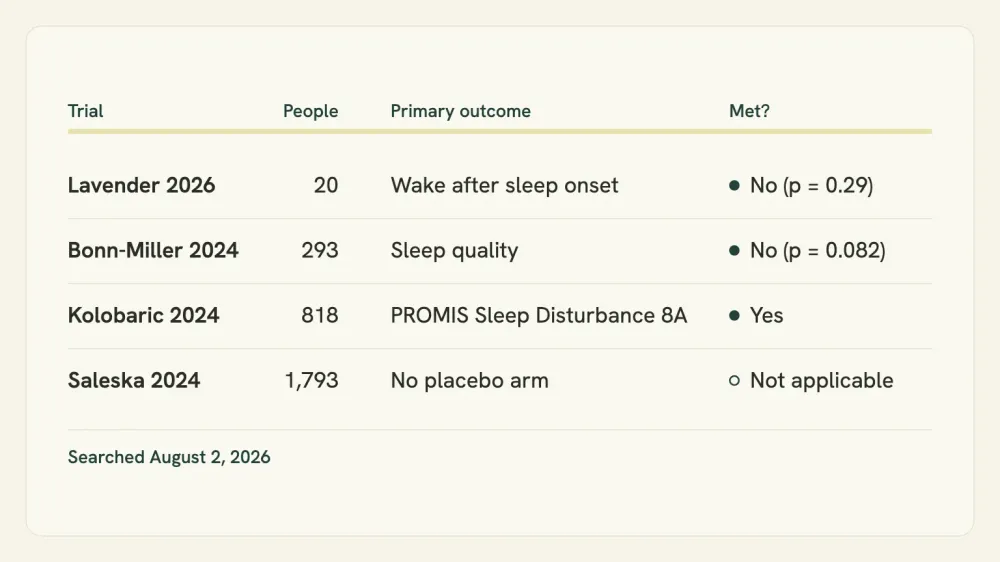
The two larger trials came from inside the industry, and both should be read with that on the table. The 2024 seven-night trial randomized 293 self-rated poor sleepers across five arms and missed its own primary endpoint of sleep quality, with an odds ratio of 2.26, a confidence interval of 0.93 to 5.52 and p = 0.082, while two secondary measures, number of awakenings (p = .025) and overall sleep disturbance (p = .023), did reach significance and sleep-onset latency, wake after sleep onset and daytime fatigue did not. Every author on that paper is affiliated with Canopy Growth Corporation or Wana Brands. The 2024 four-week trial tested a branded CBN ingredient at 25, 50 and 100 mg against placebo in 818 adults and did meet its primary endpoint, a self-report questionnaire, with no objective sleep measurement anywhere in the design; six of its eight authors are employed by Radicle Science, the contract research organization that conducted it. The fourth trial gave 1,793 adults one of six capsule formulations for four weeks with no placebo arm at all. It also contained melatonin arms, which we do not adjudicate here: what happens when people combine cannabinoids with melatonin is a separate question with a separate page.
None of that is a verdict on CBD, which has its own thin and mixed sleep literature that we go through separately in what the CBD sleep evidence does and does not show. What it is is an answer to the comparison question people actually arrive with. As of the searches described below, run on August 2, 2026, nobody has run CBN against CBD for sleep in anyone. The trials above compare CBN to placebo, or formulations to each other. Until someone runs the head-to-head, which is better has nothing to measure.
What the receptor data settles, and what it does not
CBN and CBD do not even relate to the same receptor in the same way. The IUPHAR/BPS Guide to PHARMACOLOGY, an expert-curated pharmacology database, lists cannabinol at the human CB1 receptor as an agonist with the action partial agonist and a pKi of 6.0 to 6.5, which corresponds to roughly 100 to 1,000 nanomolar. It lists cannabidiol at that same human CB1 receptor as an allosteric modulator with the action negative, and no affinity value at all. Those are close to opposite jobs. One nudges the receptor on, weakly. The other changes how the receptor responds to whatever else arrives. If the vocabulary is unfamiliar, how CB1 and CB2 actually work unpacks it properly.
In numbers, the 2021 review cited earlier puts cannabinol's CB1 affinity at 211.2 nM against THC's 21 nM, roughly ten times weaker. At the CB2 receptor the picture is different: the 1996 binding study that measured it reported that "the affinity of cannabinol for CB2 receptors (Ki = 96.3 +/- 14 nM) was confirmed to be in approximately the same range as that of delta 9-THC (Ki = 36.4 +/- 10 nM)." On CBD's side, the 2015 pharmacology paper that established the negative allosteric behavior worked in HEK 293A cells and a striatal-neuron model, and found that CBD reduced the efficacy and potency of both 2-arachidonoylglycerol and THC at CB1. All of that is cloned receptors and cell lines. None of it tells you what either compound does in a person, which is the same argument the same comparison run for CBG makes at greater length.
The strongest mechanistic support for the sedation story is a 2025 study in rats. With implanted biotelemetry, researchers reported that cannabinol increased total sleep time in the rats, with "biphasic effects with initial sleep suppression before a dramatic increase in sleep," raising both NREM and REM sleep. They also report that the magnitude of the CBN effect on NREM was comparable to zolpidem in those same rats, although unlike CBN, zolpidem did not influence REM. That is a rat-versus-rat comparison inside one experiment and it can never be restated as a statement about a person and a sleeping pill. The most interesting finding in the paper is about something else: the metabolite 11-hydroxy-CBN reached brain concentrations equivalent to CBN itself and was active at CB1 "with comparable potency and efficacy to delta-9-THC, however, CBN had much lower activity." There is a procedural reason this rat work matters here. The 2026 human trial says in its own methods that its 300 mg dose equates to this preclinical study: 10 mg/kg in rats, adjusted for species using interspecies scaling and for route of administration. That is a clean illustration of how preclinical work becomes a human dose, and of how far apart the two things are.
Will CBN get you high?
People have been given a great deal of oral cannabinol without much happening. As the 2021 review summarizes the human record, a 1973 study by Hollister gave healthy volunteers oral CBN across a range of 20 to 400 mg and reported: "At no oral dose level were any of the characteristic mental or physical effects of THC observed." A 1980 double-blind placebo-controlled study of 161 people found "no suggestion of systematic effects involving CBD or CBN, either alone or in combination." A 1984 trial in Clinical Pharmacology and Therapeutics went much further, giving experienced marijuana smokers oral CBN at maximal doses of 1,200 mg, and reported that it "did not induce significant dose-related physiologic effects"; a 20-day arm of 600 mg of CBN daily did not indicate tolerance either.
There is one counterexample, and it is instructive. A 1973 intravenous study, quoted in the same review, found that cannabinol is capable of producing a marijuana-like high, but that the doses needed for it are "several orders of magnitude larger" than those of delta-9-THC, and it was delivered into a vein rather than swallowed. The honest asterisk is more recent: the 2026 insomnia trial did detect modest subjective drug effects at 300 mg, which the authors estimate at roughly ten times milder than THC and describe as contradicting most, but not all, historic studies describing CBN as non-intoxicating. So the accurate statement is a statement about doses. At the milligram amounts present in consumer tinctures, the human record shows no intoxication from CBN. That is not the same thing as a guarantee, and it says nothing about the trace THC that a full-spectrum product also contains.
What is actually in a CBD+CBN bottle
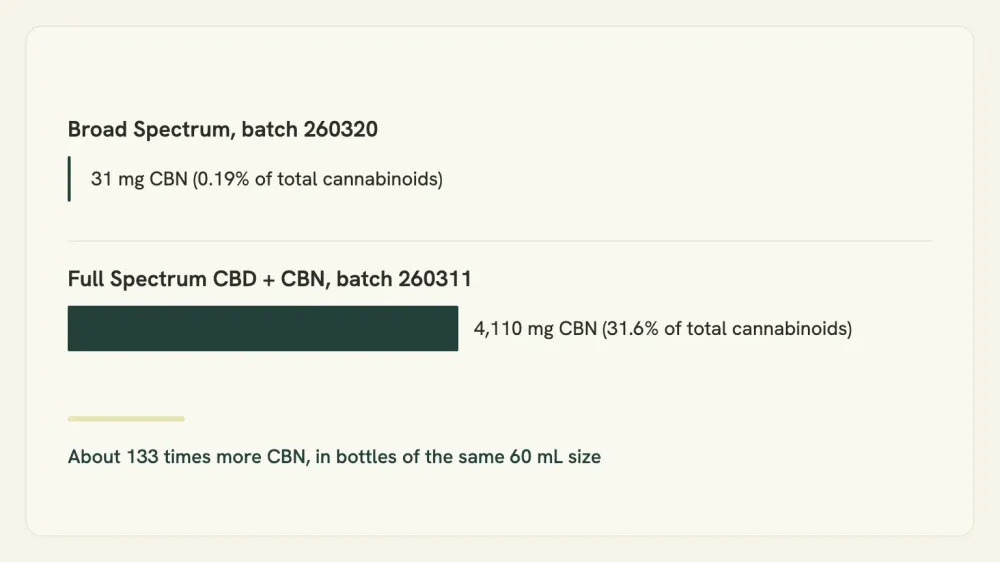
Here is the part you can verify yourself, on our numbers. CBN turns up in almost every whole-plant hemp extract, because THC oxidizes and the extract carries whatever the plant material had. On our Broad Spectrum Mango batch 260320 the lab measured 31 mg of CBN out of 16,600 mg of total cannabinoids, which is 0.19% of the cannabinoids in it. On the Full Spectrum CBD+CBN Mango batch 260311 it measured 4,110 mg of CBN out of 13,000 mg of total cannabinoids, which is 31.6%. Divide 4,110 by 31 and you get about 133 times more CBN, in bottles of the same 60 mL size. Different products and different batches, both stated. That gap is the whole difference between a cannabinoid that is present and a cannabinoid that is an ingredient, and it is the same distinction where minor cannabinoids show up in a product works through for the rest of the family. Worth noting separately: removing THC does not remove CBN. Our broad-spectrum batches report non-detected THC on the mango and natural flavors and 10.7 mg (0.019%) on lemon, and they still carry 27.2 to 31 mg of CBN. CBN is not THC.
The CBD+CBN tincture is also not the CBD tincture with something added, which is how these products are usually described. It is a different bottle with a different split of actives, and the arithmetic is unflattering in a way worth seeing before you choose.
| Full Spectrum CBD | Full Spectrum CBD + CBN | |
|---|---|---|
| Label | 15,000 mg CBD | 8,000 mg CBD + 4,000 mg CBN |
| Total actives on the label | 15,000 mg | 12,000 mg |
| Price | $80 | $88 |
| Price per mg of total actives | $0.0053 | $0.0073 |
| Price per mg of CBD | $0.0053 | $0.011 |
| Per drop, about 0.05 mL | about 12.5 mg CBD | about 6.7 mg CBD and 3.3 mg CBN |
Read that as a trade rather than an upgrade. You pay $8 more, which is 10%, and you get 3,000 mg fewer actives, which is 20% fewer, because 7,000 mg of CBD has been swapped for 4,000 mg of CBN. Per milligram of CBD that is about 2.1 times the price of the CBD-only bottle. To match one drop of the CBD-only tincture at about 12.5 mg of CBD you would take about 1.9 drops of the CBD+CBN, which also delivers about 6.2 mg of CBN. The lab reports land close to the labels: Mango batch 260311 measured 8,680 mg of CBD against an 8,000 mg label (8.5% above) and 4,110 mg of CBN against 4,000 mg (2.8% above); Lemon batch 260312 came in 4.9% and 12.0% above; Natural batch 260304, 2.0% and 3.8% above. Choosing this bottle means choosing less CBD and a great deal more CBN, at a higher price per milligram of either. What it does not mean is that anything has been shown to work better. For scale, and only for scale: one drop of it is about 3.3 mg of CBN, while the trials above used 15, 20, 25, 30, 50, 100 and 300 mg as single or nightly doses. That is arithmetic, not a recommendation, and no dose of CBN has been established for anyone. If you want the full walkthrough of a lab report, reading a lab report line by line covers it; below is just the CBN line.
- Find the batch number on the bottle and confirm the same batch number appears on the lab report. A report for a different batch is not a report for your bottle.
- Find the CBN row in the potency panel, not in the summary at the top. Read the milligrams per container, not just the percentage.
- Compare that number to the label. Our CBD+CBN batches run 2.8% to 12.0% above their 4,000 mg CBN label figure, which is the ordinary variation of a plant product.
- Check the total cannabinoids line and work out what fraction the CBN is. Below 1% it is a trace component of the extract, not an ingredient someone put there on purpose.
- Check the THC row too. A full-spectrum bottle carries trace THC regardless of its CBN content; ours run 0.129% to 0.163% on the CBD+CBN batches, below the 0.3% federal limit.
- Check what the panel actually covers. Ours reports potency, heavy metals and microbials. There is no pesticide panel and no residual-solvent panel on it, and a report cannot tell you about a test it did not run.
- Accept what no lab report can tell you: how much of a cannabinoid is in a bottle, yes; where it came from, no. Aged extract or isolated cannabinoid, a potency panel looks identical. True of every brand's report, including ours.
A 60-second check before you believe a CBN page
The most useful thing on this page is not a fact, it is a habit. Almost every strong claim about CBN online has a citation sitting under it, and most of those citations do not say what the sentence above them says. Checking takes under a minute and works on any page, including this one.
- 1Find the citation behind the specific claim, not just the references list at the bottom. If there is no citation for the sentence that made you want to buy something, you are done already.
- 2Open it and read the title, not the link text. Link text is written by the person making the claim; the title is written by the researchers.
- 3Work out what kind of document it is. A trial reports results. A protocol reports a plan. A review summarizes other people's work. A survey reports what people said. Only one of those four measured anything.
- 4Check the species. If the abstract says rats, mice, dogs or cells, the finding is about rats, mice, dogs or cells, and the page you are reading is about you.
- 5Check whether the primary endpoint was met, not just whether something was significant. Trials register one main outcome in advance precisely so nobody can go shopping through the secondary ones afterwards.
- 6Check who employed the authors. It is usually in the affiliation line at the top or the disclosure at the bottom, and it does not invalidate a study, but it belongs in your reading of it.
Here is that check run for real. On August 2, 2026, one page ranking on the first page of Google for this exact comparison offered a single reference for its CBN sleep claim. Opening it shows a 2023 BMJ Open article whose title names the two doses, 30 and 300 mg, and ends with the words "protocol for a randomised, double-blind, placebo-controlled, cross-over, three-arm, proof-of-concept trial." It is the study's design document, published years before any results existed, and it contains no results at all. It does contain one sentence that settles the argument by itself: "The primary outcome is wake after sleep onset minutes." When the results finally arrived in 2026, that primary outcome was not met. We are not naming the site, because the point is not that one page got it wrong. The point is that the check took forty seconds.
What is still unknown, and what the regulators say
The size of the gap is measurable. On August 2, 2026, a PubMed search for cannabidiol in the title or abstract returned 8,390 records against 923 for cannabinol. Filter both to the randomized controlled trial publication type and you get 342 for cannabidiol and 11 for cannabinol; open all 11 and only three actually gave CBN to people. The filter is imperfect in both directions, which is itself the lesson: the four-week trial in the table above is a randomized placebo-controlled trial that the publication-type filter does not return at all. A count of papers is not a count of good papers, and no search string is a substitute for opening them.
On the same date, ClinicalTrials.gov listed 10 studies with cannabinol as an intervention against 531 for cannabidiol, and none of the 10 had results posted on the registry. That last number needs care in both directions. Registration is a plan, not evidence, so a long registry list proves nothing on its own. And no results posted does not mean a study failed: the insomnia trial's own registry record is marked completed with nothing posted, while its results have been published in a journal since February. The rest of the CBN list is not about sleep at all: a cream for epidermolysis bullosa, knee replacement and osteoarthritis pain studies, orofacial pain.
Regulators have said less about CBN than about CBD, and the silence is not permission. FDA's page on cannabis-derived products names THC and CBD and states: "Based on available evidence, FDA has concluded that THC and CBD products are excluded from the dietary supplement definition under section 201(ff)(3)(B) of the FD&C Act." When we read that page on August 2, 2026, the standalone word cannabinol did not appear on it once. That is a gap in guidance, not a green light, and it is not a reason to treat CBN as the freer or safer of the two. The agency does act on these products, and what it acts on is the claim rather than the cannabinoid: in a warning letter dated August 30, 2024, FDA told a hemp company that five of its products, one of them a "Rest CBD+CBN Oil", were "unapproved new drugs introduced or delivered for introduction into interstate commerce." The claims that letter quotes are disease claims. A cannabinoid does not make a product a drug; a sentence on the website does.
The federal government's own evidence summary is not enthusiastic about any of this. NCCIH's overview of cannabis and cannabinoids states that "the effects of cannabis/cannabinoids on sleep problems in people who don't have other illnesses are uncertain." Add up what that leaves. Oral CBN has low bioavailability, quoted in the 2026 trial as a range of 4% to 19% from earlier work rather than measured in it. No head-to-head trial of CBN against CBD exists for anything. No consumer dose has been established. And the largest trials so far were run by people who sell cannabinoids. None of that makes CBN uninteresting. It makes the confident comparison table a work of fiction.
CBN and CBD: common questions
CBD and THC are isomers: identical molecular formula C21H30O2, identical molecular weight of 314.5, the same atoms in a different arrangement. CBN is neither. It is what THC becomes when it loses four hydrogen atoms to oxidation, giving the formula C21H26O2 at 310.4, with one ring gone fully aromatic. The plant builds CBD deliberately, using an enzyme that folds a precursor into CBD's acid form. It does not build CBN at all. CBN accumulates as THC ages in the presence of air, which is why the oldest material tends to carry the most of it, and why CBN was the first cannabinoid anyone managed to identify, back in the 1930s.
There is no head-to-head human trial of CBN against CBD for anything, so stronger has nothing to measure. At the CB1 receptor the two do not even do the same kind of thing: a curated pharmacology database lists cannabinol as a partial agonist with a pKi of 6.0 to 6.5, and cannabidiol as a negative allosteric modulator, which is close to the opposite job. On research volume the asymmetry is stark. On August 2, 2026, PubMed held 8,390 records mentioning cannabidiol against 923 mentioning cannabinol, and ClinicalTrials.gov listed 531 registered studies against 10. The ten-times-more-sedating figure that circulates about CBN comes from a marketing line about prescription sleeping pills, quoted inside a 2021 review in order to be examined. It was never a comparison with CBD.
Nobody has tested that comparison. What exists is four randomized trials that gave CBN to people and measured sleep, identified by a search on August 2, 2026. Two of them missed the primary endpoint they had registered in advance, including the only one that used overnight polysomnography, which found no significant change in wake after sleep onset in twenty adults with diagnosed insomnia. Two of the four were run by employees of companies selling cannabinoids. CBD's own sleep literature is thin and mixed in its own way, and we cover it separately rather than here. Anyone telling you which of the two is better for sleep is telling you something that has not been measured.
In the older human record, oral CBN produced no THC-like effects at doses far above anything in a consumer product. A 1973 study went to 400 mg with no characteristic mental or physical effects of THC observed, and a 1984 trial gave experienced cannabis smokers maximal oral doses of 1,200 mg without significant dose-related physiologic effects. The 2026 insomnia trial did find modest subjective drug effects at 300 mg, which the authors put at roughly ten times milder than THC and describe as contradicting most but not all of those older studies. At the milligram amounts in a consumer tincture the human record shows no intoxication from CBN, which is a statement about doses rather than a guarantee. Note separately that a full-spectrum product also contains trace THC.
They occur together in whole-plant extracts and are sold together. Our CBD+CBN Mango batch 260311 reports 8,680 mg of CBD and 4,110 mg of CBN in one 60 mL bottle. Whether the combination does more than either alone has not been shown. The 2024 seven-night trial was designed to test exactly that: it added 10, 20 or 100 mg of CBD on top of 20 mg of CBN and reported, in its own words, that the addition of CBD did not positively augment CBN treatment effects. That trial also missed its primary endpoint. If you take prescription medication, that is a conversation to have with a clinician before adding any cannabinoid, not a question to settle from a product page.
Standard workplace screens look for a THC metabolite, not for CBN. For any full-spectrum product the relevant question is the trace THC it contains rather than the CBN, and our CBD+CBN batches report 73.1 to 92.4 mg of THC per bottle, which is 0.129% to 0.163% and below the 0.3% federal limit. No product and no brand can guarantee a test result, because sensitivity, cutoffs and individual metabolism all vary. We treat the whole question properly on a separate page.
Because CBN is what THC turns into. A 1976 stability study that stored pure cannabinoid solutions and eleven cannabis samples for up to two years found that air oxidation in the dark converts THC into CBN, while THC lost to light exposure does not produce CBN at all. That distinction matters, because almost every page online lists light as a cause of CBN formation and the paper most often cited for it says the opposite. The same study found temperature up to 20 degrees Celsius made little difference, and concluded that carefully prepared cannabis or extracts are reasonably stable for 1 to 2 years stored in the dark at room temperature. That is a finding about 1970s plant material, not a shelf-life rule for a modern tincture.
If you arrived here with a sleep question, the honest destination is not a product page. Start with our review of the human CBD sleep research, which is equally unromantic about its own literature. If you would rather check our numbers than take them from us, every batch report we publish is public, and the guide to what each panel on it means explains what a lab report does and does not cover. Two adjacent questions have their own pages rather than a paragraph here: the honest answer on drug tests, and where hemp cannabinoids stand under federal law, which is its own moving target.
Writing about hemp, wellness and the small rituals that keep us balanced.