CBN vs THC: An Oxidation Product, Not a Metabolite
Cannabinol is not a metabolite of THC. It is what a THC molecule turns into outside the body, given time, air and heat. Where the one quarter as strong figure comes from, what the 1975 human comparison measured, and why a cannabinol row can run backwards from the folklore.
Cannabinol, CBN, is what a THC molecule turns into when it is left alone with time, air and heat. That happens in the living plant, in dried plant material, in a storage jar and in a bottle on a shelf, which is to say outside anybody's body. Almost every page you will read comparing the two gets this wrong in the same two ways: it calls CBN a metabolite of THC, which it is not, and it tells you CBN is about one quarter as strong as THC, a figure that traces to a single sentence which does not say what the pages repeating it think it says.
Here is the short version, up front. CBN and THC are two different molecules with a one-way relationship: THC oxidizes into CBN, slowly at room temperature and faster with heat, and nothing puts it back. A metabolite is something a body makes out of a compound it has taken in, and THC's are 11-hydroxy-THC and THC-COOH, not cannabinol. The famous potency ratio turns out to be a receptor binding constant that got promoted into a strength claim. The only ratios measured in a living animal in the records gathered here are roughly 1 to 8 and 1 to 10, both in rats, and the 1975 human crossover this comparison rests on gave people twice as many milligrams of CBN as of THC and found none of THC's effects at the larger dose. And on our own certificates of analysis the folklore runs backwards: the batch carrying 136 mg of delta-9-THC reports no detectable cannabinol at all.
A metabolite is something a body makes. Cannabinol is not one.
Start with the word, because the word is doing all the damage. A metabolite is a compound an organism produces by chemically altering something it has taken in. THC has a great many of them. The review the field still treats as the reference on human cannabinoid pharmacokinetics, published in 2007 by the chief of chemistry and drug metabolism at the National Institute on Drug Abuse, notes that more than 100 THC metabolites have been identified. Two of them do the work in that review's own vocabulary: 11-hydroxy-THC and 11-nor-9-carboxy-THC, usually written THC-COOH. Of the first, the review says: "Hydroxylation of THC at C(9) by the hepatic CYP 450 enzyme system leads to production of the equipotent metabolite 11-OH-THC." The second is the compound a urine test is built around. We have written the whole route out, enzyme by enzyme, on our page about 11-hydroxy-THC.
Cannabinol appears in that same review, but not in that paragraph and not under that word. It appears in the chemistry section, in a sentence about what happens to THC when nothing biological is involved at all: "THC decomposes when exposed to air, heat, or light; exposure to acid can oxidize the compound to cannabinol (CBN), a much less-potent cannabinoid." A second source says the same thing from the plant's side. A 2021 review in Cannabis and Cannabinoid Research states that "Unlike other phytocannabinoids, CBN is not biosynthesized in an acid form by the plant", and describes it instead as a degradative product of delta-9-THC whose concentrations "in plant material and extracts are low, but increase over time as THC is exposed to light, oxygen, and heat". That review is a single-author narrative review and its author discloses a role as medical director of a for-profit cannabis clinical entity, which is worth knowing and does not change what the sentence says. The change itself is small and permanent: cannabinol is four hydrogen atoms lighter than THC, C21H26O2 at 310.4 against C21H30O2 at 314.5, with the ring that gives tetrahydrocannabinol its tetrahydro gone aromatic. Our CBN and CBD comparison walks that change through atom by atom.
Where one quarter as strong as THC actually comes from
Read the consumer pages ranking for this comparison and you will meet the same sentence over and over: cannabinol is about one quarter as strong as THC, or its effects are about 25% as powerful. We read the top result in full on September 9, 2026. It prints the claim twice, once as a fraction and once as a percentage, and attaches no citation to either. Elsewhere on the same page of results the same molecule is described as having psychoactive properties about 10% those of THC, also uncited, so the first page of results contradicts itself on the number it repeats most. We are not naming those pages, because the problem is the number rather than the publisher, and because you can run the trace yourself.
Follow the figure back through the secondary literature and it stops at one sentence in a peer-reviewed book chapter: Cannabis Pharmacology: The Usual Suspects and a Few Promising Leads, in volume 80 of Advances in Pharmacology, pages 67 to 134, published in 2017. That is the earliest peer-reviewed statement of the figure we could find, which is not the same thing as the first time anyone said it, and we will not claim more than we checked. Section 2.5 of the chapter, headed Cannabinol, opens by getting the chemistry exactly right: "Cannabinol (CBN) is the nonenzymatic oxidation byproduct of THC and is most commonly an artifact found after prolonged storage, especially at higher temperatures." A few lines later comes the sentence the consumer pages are quoting without knowing where it is from.
“Relative to THC, CBN maintains about ¼ the potency (Ki at CB1 = 211.2 nM, CB2 = 126.4 nM) (Rhee et al., 1997).”
Read it slowly, because the sentence carries its own correction inside the parentheses. The word is potency. The numbers are Ki values, which are binding constants: they describe how tightly a molecule sticks to a receptor in a laboratory preparation. And the citation points at a 1997 paper in the Journal of Medicinal Chemistry called Cannabinol derivatives: binding to cannabinoid receptors and inhibition of adenylylcyclase. That paper prepares and assays cannabinol derivatives, and the affinities its published abstract reports are for those derivatives: 11-hydroxycannabinol at Ki 38.0 nM at CB1 and 26.6 nM at CB2, plus a dimethylheptyl homolog. Its abstract states no CBN-versus-THC potency ratio. We should be exact about our own reading here, because this is where these traces usually overreach: the 211.2 nM value sits in that paper's tables, the tables are paywalled, and we read the abstract only. We are not telling you what is or is not in the tables.

Do the division the sentence invites
Here is the part worth putting side by side. The same chapter prints THC's own binding numbers two sections earlier, in section 2.1, where it says that "THC interacts efficiently with CB1" and CB2 receptors, giving the ranges as 5.05 to 80.3 nM at CB1 and 1.73 to 75.3 nM at CB2. Now do the division the ¼ sentence invites. Against a CB1 range of 5.05 to 80.3 nM, cannabinol's 211.2 nM is anywhere from one part in 2.6 to one part in 42. Against the CB2 range of 1.73 to 75.3 nM, cannabinol's 126.4 nM is anywhere from one part in 1.7 to one part in 73. A quarter does sit inside the first of those spans, and that is exactly the problem: so does a third, so does a tenth, so does a fortieth, and the only fractions that span rules out are the ones stronger than about one part in 2.6. The chapter's THC figure is a range about 16-fold wide, a range that wide cannot produce a single fraction, and nothing in the chapter says which end of it the quarter was taken from. That is arithmetic you can redo in ten seconds with the two figures in front of you, and it is not an accusation: a narrative review is a summary of a field rather than a measurement, and summaries compress. What it does mean is that the most-quoted number in this comparison has never been a number you could check, and it has been repeated for nine years as though it were.
There is a second reading of the same primary paper, and it disagrees. The 2021 review quoted earlier cites Rhee 1997 for the identical 211.2 nM figure and sets it against a THC value of 21 nM at CB1, citing a 1996 binding study alongside it. 211.2 divided by 21 is about ten. So two peer-reviewed reviews cite the same primary paper for the same number and characterize it as roughly a quarter and roughly a tenth. Neither of them is wrong in any interesting sense, because neither number is a potency in a person. That is what happens when an affinity is asked to do a potency's job. The ladder from a binding constant to a potency to a dose to something a person notices has four rungs and a measurement is needed at every one; we set that ladder out on the 11-hydroxy-THC page linked above rather than rebuild it here.
| What was measured | The number as printed | What kind of measure that is | Where it is printed |
|---|---|---|---|
| Cannabinol binding at CB1 | Ki 211.2 nM | An affinity: how tightly it sticks in a dish | Cited to Rhee 1997 by both reviews below |
| Cannabinol binding at CB2 | Ki 126.4 nM | Same kind of measure, second receptor | Russo and Marcu 2017, section 2.5 |
| THC binding at CB1, same chapter | Ki 5.05 to 80.3 nM | Same kind of measure, printed as a range about 16-fold wide | Russo and Marcu 2017, section 2.1 |
| THC binding at CB1, other review | Ki 21 nM | Same kind of measure, one value | Corroon 2021 |
| The ratio the chapter states | About one quarter | A potency word attached to affinity numbers | Russo and Marcu 2017, section 2.5 |
| 211.2 divided by 21 | About one tenth | Still an affinity ratio, still not a potency | Our arithmetic on two printed numbers |
| Dose ratio in rats, operant responding | About 1 to 10 | A dose ratio in an animal, on response rate | Hiltunen 1989 |
| Dose ratio in rats, withdrawal model | About 1 to 8 | A dose ratio in an animal, in one model | Chesher and Jackson 1985 |
| A potency ratio measured in people | None in the records here | Not a ratio at all: the 1975 crossover used two fixed doses, 50 mg against 25 mg, and found none of THC's effects at the larger one | Karniol 1975 |
What was measured, and in what species
Strip out the reviews and go to the experiments. The human study this comparison is built on is from 1975. Five male volunteers took, one week apart, placebo, 50 mg of oral cannabinol, 25 mg of oral delta-9-THC, and two combinations of the two. Note the doses before the results: the cannabinol arm carried twice as many milligrams as the THC arm. The paper reports that delta-9-THC produced an increase in heart rate while cannabinol did not, and that under the THC condition the volunteers reported feeling drugged, drunk, dizzy and drowsy, which they did not report under the cannabinol condition. The combination arms deserve their own sentence, because they cut the other way: with both drugs together the volunteers reported feeling more drugged, drunk, dizzy and drowsy than on THC alone, and the authors write that cannabinol increases the effect of THC on some measures but that these effects "are small and cannot account for the greater potency which has been reported when plant material is used". Then the limits, which are large: five men, all male, half a century ago, on 1975 instrumentation, and the 2021 review quoted earlier adds that four of the five were residents at a psychiatric facility and were likely taking other psychotropic medication. It is also not the only occasion on which people were given both molecules: other human studies from the 1970s and early 1980s did that too, mostly titled as interaction work rather than as any ratio between the two.
Everything else quantified in the records gathered here was measured in animals or in tissue, and the species has to travel with the number. There are three such records, and none of them lands on a quarter either: a 1989 operant study in rats published in Neuropharmacology, a 1985 rat study in Pharmacology Biochemistry and Behavior, and a 1998 functional assay in rat cerebellar tissue in Life Sciences. Here is what each of those three did, with the 1975 human study set beside them for scale.
- Rats, 1989. An operant study put the difference in potency between delta-1-THC and cannabinol on response rate at approximately 1 to 10, dosing THC at 0.3 to 5.6 mg/kg and cannabinol at 1 to 56 mg/kg.
- Rats, 1985. In a quasi-morphine withdrawal model, cannabinol showed the same activity as THC but required a dosage of approximately eight times that of THC to produce an equivalent effect.
- Rat brain tissue, 1998. A functional assay in cerebellar homogenate called cannabinol a weak agonist at cannabinoid receptors, and found that delta-9-THC itself did not produce the maximal effect classical agonists do.
- People, 1975. Five men, 50 mg of cannabinol against 25 mg of THC in the same crossover. No ratio came out of it, because the larger cannabinol dose produced none of the effects the smaller THC dose did.
Two things follow. First, the only measured ratios in that set are roughly 1 to 8 and 1 to 10, both in rats, on endpoints (a lever schedule, a withdrawal model) with no consumer meaning attached to them, and the third animal record gives no number at all, calling cannabinol weak instead. Second, none of the primary records assembled here states a quarter: the quarter lives in a review. Separately from potency, how much cannabinol has been given to people in other studies without much happening is its own story, with a modern asterisk on it, and we tell that story on the CBN and CBD page rather than half-tell it here.
Psychoactive and intoxicating are not the same word
These two words get used as synonyms and they are not. Psychoactive means a compound acts on the central nervous system, which is true of caffeine and nicotine as well as THC. Intoxicating means it impairs you: judgment, coordination, perception of time. A compound can be the first without being the second, and the honest sentence about cannabinol is a sentence about doses rather than about the molecule. At the milligram amounts in a consumer tincture the human record shows no intoxication, and that is a statement about doses rather than a guarantee. In the controlled comparison above, 50 mg produced no rise in heart rate and none of the subjective effects that 25 mg of THC produced in the same five men a week apart. Beyond that the evidence thins out fast, and where it does we say so instead of rounding it to a reassurance. If your question is the identity one rather than the relational one, our page on what CBN is is the place to start, and the parallel question for the cannabinoid in most of our bottles is answered in does CBD get you high.
What a cannabinol row on a certificate is telling you
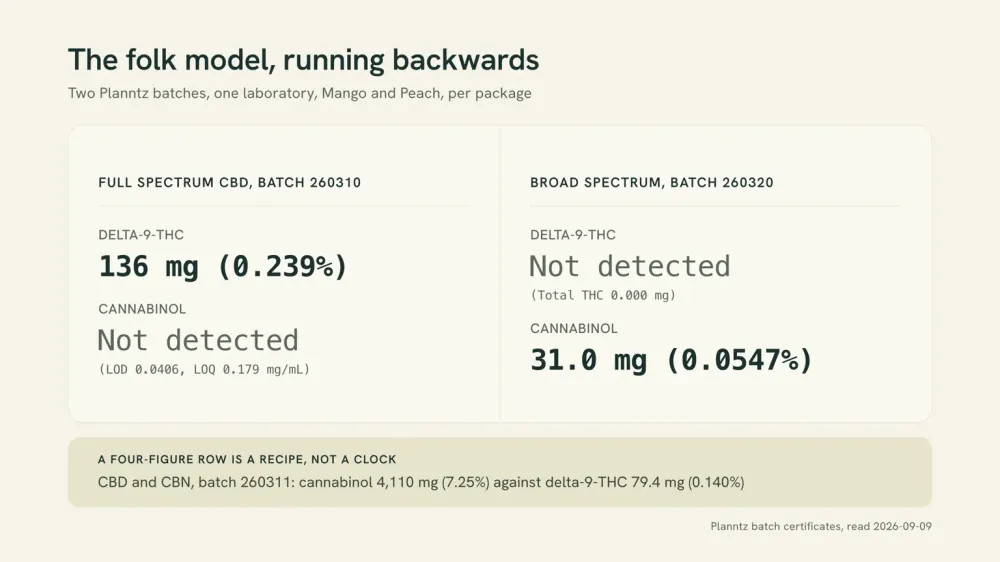
Now the practical half, and this is where the folk model breaks in public. If cannabinol were simply THC's shadow, then more THC would mean more cannabinol. Take two of our own batches, same flavor, same laboratory, two different product lines. The Full Spectrum CBD in Mango and Peach, batch 260310, reports delta-9-THC at 136 mg per package, 0.239%, and its cannabinol row reads not detected, with that panel's limit of detection and limit of quantitation printed beside it as 0.0406 and 0.179 mg/mL. The Broad Spectrum in Mango and Peach, batch 260320, reports delta-9-THC not detected, a Total THC line of 0.000 mg per package, and cannabinol at 31.0 mg, 0.0547%. The batch with the larger delta-9-THC figure has no measurable cannabinol. The batch with no measurable delta-9-THC has 31 milligrams of it. Two caveats belong in the same breath: not detected means below that panel's limit on that batch rather than zero, and two batches from one laboratory are an illustration rather than a survey.
Two more batches say the same thing. Broad Spectrum Lemon and Raspberry, batch 260321, reports 10.7 mg of delta-9-THC, 0.0189%, alongside 28.2 mg of cannabinol, and Broad Spectrum Natural, batch 260319, reports delta-9-THC not detected alongside 27.2 mg. So a two-figure cannabinol row in the twenties or low thirties is one kind of fact, and a four-figure row is another kind entirely. On the Full Spectrum CBD and CBN in Mango and Peach, batch 260311, the cannabinol line reads 4,110 mg, 7.25%, against 79.4 mg of delta-9-THC, inside a total cannabinoid figure of 13,000 mg. That is about 52 times more cannabinol than delta-9-THC inside one bottle, and it is not a story about age. It is a recipe, and the product name says so. The Lemon batch 260312 reads 4,480 mg of cannabinol against 81.1 mg of delta-9-THC, and the Natural batch 260304 reads 4,150 against 73.1. Read the right row on that Lemon report: its Total THC line says 92.4 mg rather than 81.1, because that summation also counts the 11.5 mg of delta-8-THC printed on the same panel. A certificate can carry two different numbers for what a reader thinks of as one thing, so the row you quote matters. Reading the rest of a panel, contaminant sections included, is a skill of its own and we wrote the walkthrough for it: how to read a certificate of analysis.
Time does this slowly. A reactor does it on purpose.
The conversion is not a metaphor. It has a rate, and the rate has been measured. A 2022 kinetics study in Cannabis and Cannabinoid Research tracked the degradation of CBD and delta-9-THC and the formation of cannabinol in dried cannabis resin held at 50, 60, 70 and 80 degrees Celsius, and in solutions across pH 2 to 12 at 40 to 70 degrees. Cannabinol formation followed first-order kinetics in the resin and zero-order kinetics in solution, and the authors report that "The transformation rate of the CBD, CBN, and Δ9-THC increased with increasing temperature, especially as temperature increased to 70°C at pH 2.0". Their minimum-transformation conditions were low temperature, slightly to moderately acidic pH, and short processing times. Read the materials before you read that across to your bathroom cabinet: this is cannabis resin and aqueous solutions in a laboratory, not hemp extract in coconut oil, and it gives nobody a shelf-life number for any product, ours included. Storage as a practical matter is covered in our piece on whether CBD oil expires, and which environmental factor actually drives the reaction is a correction of its own, which we made on the CBN and CBD page linked above.
The same reaction is also patentable, which is a useful thing to know, because it means somebody had to make it happen reliably and then describe how. A US patent granted on October 18, 2022 describes converting a THC-rich cannabinoid mixture containing "at least about 20% THC" into a CBN-rich mixture containing "at least about 2.0% CBN" by contacting it with "a benzoquinone reagent". A second, granted May 14, 2024 describes "aromatizing an alicyclic region of a cannabinoid", specifically "the cyclohexene group in Δ9-THC-C5", using "sulfur" as the oxidizing agent: the very ring whose saturation puts the tetrahydro in tetrahydrocannabinol. And a third, granted May 21, 2024 runs the trick in the other direction, describing "A method of oxidizing Δ9-tetrahydrocannabinol (Δ9-THC) in hemp oil to cannabinol (CBN)" using "a heated spray system assisted with ultraviolet (UV) lights", forming droplets in the presence of oxygen. Google is already ranking several USPTO documents on the first page of results for this comparison, and no consumer page there cites one, which is a shame, because they explain the inverted certificate above better than any blog does. Two limits, both important. A patent is a claim of invention, not evidence of what any manufacturer does. And a potency panel records what is in a bottle; it never records how it got there, for our bottles or anyone's.

What the label counts, and the clause that decides the rest
On a certificate of analysis, Total THC is not an observation. It is an arithmetic line with a printed definition, and ours prints that definition as a footnote on the report: "Total THC = Delta-10-THC + Delta-8-THC + (Delta-8-THCA x 0.877) + Delta-9-THC + THC-O-acetate + (THCA x 0.877)". Six terms. Cannabinol is not one of them, and it would be odd if it were, because cannabinol is not a tetrahydrocannabinol at all. The federal crop rule works the same way and is shorter: 7 CFR 990.1 defines "Total THC = (0.877 x THCA) + THC", and that one governs the pre-harvest test on a crop rather than what is in a finished bottle. Where the 0.877 comes from, and what the 0.3% is a percentage of, are worked through on our CBD and THC comparison.
The law is a different arithmetic and it is currently in motion. Public Law 119-37, at section 781 of division B, rewrites the definition of hemp around "a total tetrahydrocannabinols concentration (including tetrahydrocannabinolic acid) of not more than 0.3 percent on a dry weight basis", and excludes from hemp any final product containing "greater than 0.4 milligrams combined total per container" of "(aa) total tetrahydrocannabinols (including tetrahydrocannabinolic acid); and (bb) any other cannabinoids that have similar effects (or are marketed to have similar effects) on humans or animals as a tetrahydrocannabinol (as determined by the Secretary of Health and Human Services)". Read (aa) and (bb) as two separate questions for cannabinol. It is not a tetrahydrocannabinol, so it is not in (aa). Whether it lands inside (bb) turns on a determination by the Secretary of Health and Human Services, and look at what that clause's own test includes: "or are marketed to have similar effects". Part of the test is a marketing test, not a chemistry test.
Two dates matter, not one. H.R. 6500, the Continuing Appropriations and Extensions Act, 2027, signed on September 2, 2026 and since numbered Public Law 119-103, provides at section 2019 that until December 11, 2026 the section 781 amendments apply only with respect to products described in two paragraphs of the new definition. The practical result is that the total-THC standard and the 0.4 milligram combined total per container ceiling arrive on December 11, 2026, while November 12, 2026 carries only the exclusion for cannabinoids "not capable of being naturally produced by a Cannabis sativa L. plant". The full sequence, including the vote record and the section quoted end to end, is in our report on the delay, and what the statute does to hemp-derived THC products in general is in our hemp-derived THC explainer. The determination that would answer the cannabinol question is one of four lists section 781 required the FDA to publish by February 10, 2026. As of September 9, 2026, when the Federal Register and the FDA's own cannabis page were last checked for this article, none had been published, which is 211 days past the deadline, and the nonpartisan Congressional Research Service brief on the provision, updated August 17, 2026, records the same absence. That is a dated absence and nothing more. We are not going to tell you why, or what happens next.
Drug tests, in three sentences
Standard workplace panels are built around a THC metabolite, not around cannabinol. For any full-spectrum product the question that matters is the trace delta-9-THC it carries rather than the cannabinol row beside it. No product and no article can guarantee a drug-test result, and the whole subject, including which analyte a federal panel names and where the cross-reactivity figures come from, has a page of its own: does CBN show up on a drug test.
How to read the cannabinol row on your own certificate
Five steps, and they work on anybody's certificate, not only ours. This is the cannabinol row specifically; the general walkthrough of a lab report, contaminant panels included, is the page linked in the section above.
- 1Find the cannabinol row in the potency table and read it in milligrams per package, not in percent. A percentage is a share of the container's weight, and it makes very different amounts look similarly small.
- 2Read the delta-9-THC row in the same column and compare the two numbers. Which one is larger, and by how much, is the most informative thing on that panel about how the bottle came to contain cannabinol.
- 3Count the digits in the cannabinol figure. Tens of milligrams in a 60 mL bottle can arrive without anyone formulating for it, from storage or from processing. Thousands of milligrams is a formulation decision, and the product name should say so.
- 4Read the Total THC footnote and count its terms. Ours has six and cannabinol is not among them, so the Total THC figure on that report tells you nothing about the cannabinol row, and the cannabinol row tells you nothing about it.
- 5Find the limit of detection and limit of quantitation printed beside any not-detected result. Not detected means below that number on that batch. It does not mean zero, and no certificate can promise a drug-test outcome.
CBN vs THC: the questions people actually ask
No, and it is not a form of THC either. Cannabinol is what a THC molecule becomes after it loses four hydrogen atoms to oxidation and one of its rings goes aromatic: C21H26O2 with a molecular weight of 310.4, against THC's C21H30O2 at 314.5. The tetrahydro in tetrahydrocannabinol names the saturated part of the molecule that the reaction removes, which is why the result has a different name rather than a modified one. They are two compounds with one shared history.
This is the error we found repeated on every consumer page we read for this comparison, and the distinction is practical rather than pedantic. A metabolite is a compound an organism makes out of something it has taken in. THC's are 11-hydroxy-THC and 11-nor-9-carboxy-THC, and the second is the compound a urine test is built around. Cannabinol forms outside a body: in the living plant, in dried plant material, in an extract and in a finished oil, driven by time, air, heat and light. So a cannabinol figure on a lab report tells you something about a product's chemistry and history. It does not mean anyone metabolized anything.
As far as we could trace it, that figure comes from a single sentence in a 2017 chapter of Advances in Pharmacology, which states it as a receptor binding constant, Ki 211.2 nM at CB1, and cites a 1997 paper about cannabinol derivatives. Three problems travel with it. The same chapter prints THC's own CB1 affinity two sections earlier as a range, 5.05 to 80.3 nM, which is about 16-fold wide and cannot produce any single fraction, and the chapter never says which end of it the quarter came from. A second peer-reviewed review cites the same primary paper for the same 211.2 nM and sets it against a THC value of 21 nM, which is about a tenth. And a binding constant is not a potency in the first place. No human study we found produces a potency ratio at all.
Psychoactive and intoxicating are not synonyms, and the honest answer is about doses rather than about the molecule. In the 1975 crossover this comparison is built on, five men given 50 mg of oral cannabinol reported none of the effects they reported on 25 mg of delta-9-THC a week apart, and cannabinol produced no rise in heart rate. Given both together, they reported feeling more drugged than on THC alone, and the authors call that increase small. At the milligram amounts in a consumer tincture the human record shows no intoxication, and that is a statement about doses rather than a guarantee. What has and has not happened at higher amounts is covered on our CBN and CBD page.
No. The reaction runs one way. Oxidation takes hydrogen atoms off THC and leaves an aromatic ring behind, and nothing sitting in a jar or a bottle puts them back. That one-way arrow has a practical consequence worth holding onto: a product held badly can gain cannabinol and lose delta-9-THC, and it cannot do the reverse on its own.
Not in the summation our certificates print, which has six terms and no cannabinol among them, and not in the federal crop formula at 7 CFR 990.1 either, which reads (0.877 x THCA) + THC. What the 2025 statute will count from December 11, 2026 is a different and unfinished question, because its per-container ceiling covers total tetrahydrocannabinols and also any other cannabinoids that have similar effects, or are marketed to have similar effects, as determined by the Secretary of Health and Human Services. That determination has not been published, so the scope of the clause is not settled and nobody can tell you that it is.
If you arrived here from a page that told you cannabinol is a metabolite of THC that is a quarter as strong, the useful correction is not a different multiplier. It is that the two claims come from different kinds of document and neither survives being opened: one is a word borrowed from biology for a reaction that happens in a jar, and the other is a binding constant wearing a potency's clothes, which two peer-reviewed reviews read two different ways. What is left when you take those away is more interesting anyway, and it is checkable: a one-way reaction with a measured rate, a row on a lab report that can run in either direction depending on how the bottle was made, and a statutory clause that has not been settled yet. For the wider map of which cannabinoids exist and what each one is, start with our guide to the cannabinoids. For the other two minors people compare in the same breath, CBG and CBN side by side does the same job. And every Planntz batch report, cannabinol row included, is published on our lab results page.
Read the cannabinol row yourself
Every Planntz batch publishes a third-party certificate of analysis with the full potency panel, cannabinol and delta-9-THC printed in milligrams per package. The figures in the section above are the ones on the paperwork, not the ones on the marketing.
See the Planntz tincturesWriting about hemp, wellness and the small rituals that keep us balanced.